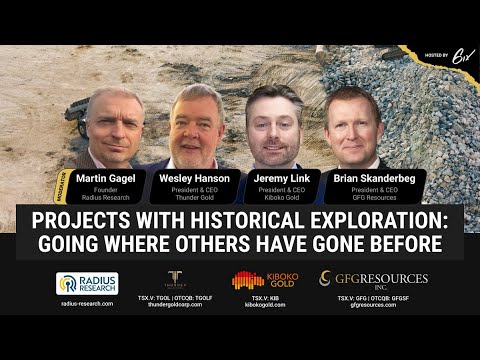
Automated transcript · Written by software from the replay's audio. It can mishear names and figures; the replay is the record.
30:28 your due diligence could be very diverse where you're trying to find the old timers and interview them in someone's cousin. Maybe they've got old documents and so forth. Could you tell us some of the, like that, that's real Sherlock Holmes stuff you've got to be doing on some of this. I know, can you tell us some good stories or just some of the, all the things or different angles, old government archives or someone's shoe box or anything that you kind of have to do that's not in the typical geologist textbook in terms of your due diligence. And Wes, I don't know, you've been doing this a few years, Any good stories on that?
31:18 Sitting around talking to the old prospectors that have worked the area extensively is always a worthwhile venture. And provided you just don't end up drinking too much. You usually get a pretty good overview of the camp and a lot of insights that the old-time prospectors, they were good at finding Gold. I don't think there's anywhere in Ontario that hasn't been extensively prospected. There's all kinds of Gold showings out there that have been identified on surface. They're in the right rocks. You know, Company X came in here in 1950 and drilled 5 holes and was discouraged. And then, you know, I laugh when Brian was describing his experience because it's exactly the same wherever you go. 1930, 1960, 1980, 2000.
32:12 Now we're at 2020. It's like every 20 years, people come back and start looking at these things. I think the gold price, if you're bullish on the gold price, which I assume everybody who's joined the call is bullish on the gold price and they should be, gold's going up. That's gold. This is one of the better investment vehicles out there. It has been for the last 25 years. It will be for the next 25 years. The supply-demand fundamentals are solid. Don't use the North American market as a basis for your investment decisions. Look what's happening where the middle class is actually in ascension as opposed to being in decline. That middle class is gonna buy cold buying and that's gonna drive gold price, which is gonna drive our profits and your shareholder benefits.
33:00 All right, Brian, any sort of good story? And I guess a lot of it would be the soft skills when you're doing that extra bit of due diligence on a historic project is trying to talk to as many people. Maybe there's a geo who had a story of why this happened or that or am I off line there? No, you're right. And I mean, the obvious one was the historical kind of prospectors and that's 1 that's just invaluable to me, spending time with these guys. They have a different vintage of time and trying to understand, you know, the pieces of data that may not have been included. And I'll go back to working in Saskatchewan on SCV there and we found a great ore body in Santoy Gap And the reason we found that one was because there was an old prospector that somehow sampled 300g in this area, 20 years before we were there. And this thing sat in our database and nobody could understand what he sampled, how he got this thing.
34:00 But it led us to keep coming back to this target. And in the end, we found Santoy Gap, to me what will be coming in is Saskatchewan's best Gold deposit. And we found it because it reflected leakage off a blind deposit. And he found this little, probably fracture controlled Gold, 150m up dip of the mine. And had we not had that data point in his context, we wouldn't have gone back to continue giving a target a third chance after dusting it twice on it. So this historic knowledge context angle is really valid to spend time at. The other one I would flag is even things like history context of Northern Minor in newspapers is fascinating.
34:53 If you go read a Timmins newspaper from the 30s, you come out of there with a fascinating number of stories in context of the camp at the time. You know, it's like there were 6 divorces in this weekend in Timmins. But, you know, here's the gold that was found at Montclair and here's the setting of it on this farm and the description of it. And simple articles that you can't find anywhere else. I've always find going back to look at newspapers and Northern Miners, ironically, to be an interesting source of a piece of information you don't get out of an assessment record. Interesting. And Jeremy? Our experience for due diligence, and not just on historic projects, but particularly historic projects, is that it's a black hole.
35:42 You didn't collect the data yourself. For example, with our Harrah-Cantor project, we got a hand-me-down Excel spreadsheet with a bunch of historical data in it, which was great for the early stages of evaluating the project and deciding that's what we want to go ahead with. And then we turned to the actual historical records. I think Jack Stock at Globex had over 200 banker boxes full of data with our project, which probably hadn't been open in decades. We had Jack's team scan every document twice to make certain that we didn't miss any. We then roll the logs and the assay certificates, get double blind data entry. That's where someone enters it, someone else enters it, and then you compare to make sure that there's no errors. And it just goes on and on.
36:29 Then you turn to like the government deposits of data, and then you find a whole bunch of stuff. And then you go, you know, start looking at academic papers. You go to the Northern Miner, and their website's incredible. You can pull back things, you know, decades and decades. And so this due diligence exercise becomes a black hole. And then you talk to people who were there, maybe there was a bulk sample taken. Our project, one of the geologists we know said he was there for the bulk sample and he'd never seen native Gold outside of a quartz vein. That was the first time he'd ever seen that. And so that's interesting to find out that that's, you know, a perception people didn't didn't understand. Yeah, like, ultimately, due diligence is a black hole on these projects.
37:15 For us, it took us like 2 years to work through the boxes of data. And even then, we eventually just said, that's enough. We'll stop here. All right. And Wes, when you're structuring a deal, purchasing it off of the old owners or that, those have different characteristics. There may be royalties on them already or NSRs and that. Can you tell us things to look out for on how these old deals are structured when acquired or what's the, obviously you want to get it for the cheapest amount, but if someone says given it to you for, sure, we'll give it to you for nothing. Does it sort of signal like, oops, Maybe we're just buying some moose pasture here?
38:05 Well, no, I mean, some of the best deals are the deals that are undervalued, right? I mean, it's really difficult to do a deal now in this day and age where you don't have a royalty chain attached to it. And sometimes those royalty chains are complicated and messy. And personally, they drive me nuts. It's a drag. It's another financial drag on your opportunity. Those royalty payments, those residual royalty payments that are carried, you know, 20, 30, 40 years back from operator to operator to operator. And, you know, it's a cost of doing business. I think you just got to try to isolate the best projects you can in the best districts that you can in areas with demonstrated Gold or Copper or Zinc or whatever mineral you happen to be looking for. You focus on those areas where there's historical work that demonstrates that there's some Gold there and now it's your job to go in and quantify how much Gold it is. And then you go in and look for deals and acquisition targets where the vendors are reasonable. And we were quite lucky with Tower Mountain. Some of the vendors that we've worked with have been very reasonable and they're participants in the upside in terms of becoming shareholders of the company.
39:29 And we value that investment that they've made into the company and we want to return that investment to them by being successful of our exploration program. It's an expensive business, but you want to try to structure a deal that's got a cash component and a share component and a residual NSR component and still end up coming out with an asset that if there is 10Moz there, that you haven't given away the farm, so to speak. Brian, any experiences on you in negotiating these deals or structures to look out for? Excessive royalty burden is the obvious one. You know, complexity of land tenure is another 1 If you have underlying agreements, partial interest, backing rates, unreasonable payments down the line tied to per ounce. And if you look at a lot of the assets that are really struggled, and let's just take Holt Holloway for an example, in Timmins, this thing carries 10% Royalty burden and that's a vestige back to previous exploration cycle deal done in the 80s. And inherently, you know, that Royalty is siphoned off.
40:43 Probably 90% of the free cash will be asset to the point where it's sterilized. So excessive royalty burden would be 1 that I really flag and certainly stay clear of. To me, sub 2% buy-downs, things that are palpable are reasonable ones that we, I think, in the industry can accept. Although I'll agree with Wes, I don't particularly like them either. In terms of the red flags in social and community relations, it's always a big one. We recently did a pretty deep dive on an asset that was available. The data looks fabulous. It looks like you could walk up there and drill a nice Gold system. But when you dig into the social side, this thing hasn't moved in 4-years. And it hasn't moved in 4-years for a particular social reason. And it's unlikely to move on a go forward basis. So this social license to operate piece, really got to understand potential red flags in that. If you're going into a jurisdiction that does not have infrastructure, that does not have demonstrated mining history, these pieces can become very relevant. So those would be 2 of the big red flags that I focus on off the start.
42:00 All right. And Jeremy? Yeah. In our experience, royalties are often, you know, negotiating those are often deal breakers. You know, you like the project, you like where it's located, like the potential of it. And then someone wants to, you know, either slap on a new royalty on top of existing ones. Like no 1 here is the first one. Well, it's very rare that you're the first company to drill a project. All projects have a history. And usually it's not 0.333 or 4th person that drills it that there's actually a real discovery made. But like projects are crazy. And I don't know, Canon or Kyle, if you're on the line, if you could pull up slide number 6 for me, you could show this as an example. So here's the Hurricane of Project map. This is 100 square kilometers on the left hand side of the screen here. Each one of these different colours is a different Royalty that we've got. And so we'll be working with 4 different groups on Royalties.
42:54 And but before we consolidated these 6 projects, they're all side by side into one. We went back to Jack Stock at Globex and got him to negotiate a new royalty on the project. So he had a whole bunch of little ones that we had to replace it with a single 2% NSR, gave us a buyback option, which is important to have a right of first refusal on it as well. But what's also overlooked sometimes when looking at royalties, though, is the area of interest clauses. Vovex had a 25km area of interest clause on this project. How do you move that forward? Because how do you ever sell the company? How do you ever move it forward with that? And so we got rid of that in our transaction.
43:40 So royalties are really important. That took a long time to get that renegotiated. And we try to avoid Royalties unless you're making a production decision. It's really valuable the Royalty that you have, and you really want to sell it for when it's part of a construction decision, not as part of an exploration decision. So whatever you can do, like anybody out there who's looking to build their own exploration company is take Royalty seriously, try to get them knocked down or restructured, make sure that there is no AOI or it's very limited. You have buyback provisions, a right or first refusal, and so on. These are all really important parts. But if not, down the road, these royalties can end up being huge hurdles that your budget may not be able to clear.
44:32 Yeah. And what are kind of a rule of thumb for maximum royalty be around 2%? And if you're going above that, you're, you, and I guess if you've gotten more than so much, it takes away possible financing opportunities for you in the future as well. If there's already 3% or 4%, you won't be able to get another Royalty on top of that to help fund development or anything. You mentioned 10% is definitely sounds like a deal killer, but where does things start? The red flag start going up on Royalty rates? I think it's so critical that this, the nature of the carrying capacity of the deposit. So Malartic is a good one. So Malartic has an exceptional deposit and it carries an exceptional Royalty and still makes good money.
45:22 That's probably unusual. And your filter for a deposit that can carry that threshold is a high bar. If you're looking at big bulk tonnage systems, royalties kill them very quickly. So if you're looking at a big bulk underground, a block cave, a big open pit, 2%, 3%, 4% can have a very, very material impact to the economics of a project. Certain underground high-grade projects probably have higher ability to carry burden, inherent by the nature of how they move their throughput of tons and how it drives the economics. Things in Nevada, Some of these things in Nevada carry tens and actually still make good money. It's unusual. So I think you need to understand a jurisdiction and a belt and a given style of deposits and look around. If there's an operating mine that's carrying this burden and doing pretty well, it probably gives you a benchmark and you can find the technical parameters that are allowing the deposit to do that. But if you're working in a camp where people are working at twos and threes and it's a given style of mineralization, there's probably a pretty good benchmark for where you want to head.
46:34 If you're not in that game, you're probably putting an unreasonable burden on it and inherently just adding risk to a project. Anyone else to add to that? No, not really. I mean he Brian pretty much nailed it on the head. It's Look at look at the neighbors if they're surviving at a certain royalty rate and a certain rate of mineralization Then that's your benchmark to work towards. Yeah. Yeah. I'm curious, what is- Right? And I think the golden, like the royalty companies and the streamers will tell you what your project can likely bear because the royalty holder wants your project to go ahead. Right? They want to see a market developed so that royalty actually becomes worth something. You know, there are thousands and thousands of royalties out there, but how many of them actually like pay the holder? Yeah, but you know, the royalty companies are a different beast than the vendors of the original claims.
47:31 And that's where the issue comes in. I think the royalty streamers understand that the goal is to make money for everybody involved, whereas often cases some of these legacy royalties just kill you, right? Yeah, absolutely. That's why buyout provisions are so important. A cap on them are important. And that right up for refusal as well. Those are really key parts when you look at these transactions. All right. When you're presenting to investors historic projects, do you find that, do you find investors more interested in historic ones? Are they like greenfield projects or It just really depends on the setup of it. Or what's your general perception on how investors react to old news stories?
48:28 You know, I think there's nothing more exciting than a new discovery in a new district where there's no historical mining that's been carried out. I mean, that's like the unicorn deposit, so to speak. That's an exciting time, but my own preferences, I tend to look where it's pretty hard to argue with success. I mean, Timmins, Abitibi, the Greenstone belts of Ontario, Quebec, that's pretty happy hunting ground. Nevada, the Basin and Range deposits down there. There's all kinds of historical data that you can pull. And I think you have, you're beholden to pull together a story that describes the opportunity to investors that gets them excited. That's our job as CEOs and technical people is simplify the presentation so that the average investor can understand the opportunity.
49:30 And that's what we have to try to do. And that's a challenge across the board. Any other thoughts on that? Go ahead, Brian. I think Wes is sorry, but I'll leave it at that. Yeah. Yeah, I say that investors, that if the project's been around for a while, you know, people go like, oh, it's a new goal, but it's another gold cycle. This project's come back to life. And you know, what you need to do to offset that view is highlight your team, their qualifications, their history, what makes them different from the past operators, and also having a dramatically different view and approach to how you're going to assess the project.
50:18 Otherwise, a lot of projects just get called retreads, which I don't think any of our projects offer this. Everyone's got a new plan of attack and a view of looking at their projects. So if the new operators or the new owners of a project are just saying, hey, we're doing the same plan essentially that the old guys did. We just have better metal pricing here. That's probably a bit of a red flag that it's maybe just a retread and not a real creation of value. It depends, right? On our project, there was a bulk sample, like 16,000 tonnes taken out and a grade of 1.2g per tonne at surface. In 1988, no 1 cared about 1.2g per tonne. You were saying 2.5g per tonne, what is the cut-off? It's 0.3g per tonne. In Nevada, you get down to 0.15g per tonne.
51:21 That material is 2 or 3 times cut-up. So that makes a big difference. Metal price is not just one thing that's a red flag. I think you need to have several flags out there to make you want to be very sceptical of the project. But when alone, the fact that metal prices change and now this is economic, that will get my attention. I'm an investor too. We'll get my attention every single time. I think what you can always say is that the best deposits that we all seek to find will be competitive agnostic to metal price, and they'll be even more competitive at a lower price. So what I look for is, you know, if we're trying to find this unicorn, I call them company building assets.
52:09 You know, you want assets that are competitive through a cycle and you know, you're putting on a different landscape from a producer point of view. But having something that is dependent on $1800 gold, it's going to make you not a lot of money. If it is making you money, it's probably going to cost you a whole bunch of capital. And you are very risk sensitive on the metal price side. So trying to think about it, I don't just think about it, I would not rely on metal price. I definitely would need to see how this asset and what the end resulting resource is, how it's going to compete in the landscape for capital. So we kind of think about it that way, as opposed to trying to say, oh, metal prices up, gold's up to over $2,000. We really need to, you know, this deposit needs to be revisited solely because of that.
52:58 I think the fundamentals of that deposit are probably still going to be pretty similar. OK. Some audience questions quickly here. Do these historic mines shorten the time of exploration? Did the old data include other minerals that have now considered critical minerals and maybe minerals that weren't considered valuable are valuable now. That's an omnibus kind of question right there. It is. Yeah. Yeah. I mean, you got to look through the data for clues to everything. I mean, sometimes people have the, you know, I'm only looking for gold. I don't care about copper. And there may be economic copper grades associated with the deposit.
53:49 You're not going to find Lithium usually. I don't think there's a geological model that puts Gold and Lithium together, not to my knowledge. I think you've just got to go in. At the end of the day, and we've talked about it repeatedly, you have to have a good team and you have to have a good plan and you have to do good science. And then you have to go beg and go to beg for the money to go out and prove your theories. And that's the secret sauce right there. One thing we look at is, you know, the project in Timmins, it would have been a relatively fine area, 3 patents, so maybe a couple of miles. But our vision is to say, if we understand this whole corridor and the history of exploration across it, so this timeframe question, I think when you think about timeframe to make discovery, timeframe to get to an economic deposit, You have to pair it with the land configuration side.
54:50 And so for us, the quickest point to discovery is finding and building this coherent regional land position, understanding the deposit and then taking that model and applying it across a bigger land position with new technology. It's pairing something that is thinking of the bigger picture and the bigger value in lock. Time to make discovery If you're starting from something that is a relevant deposit, you might have, maybe it's small, but maybe it's approaching critical mass and you need to grow it or you need to find another one. There's a very valid point to that. And we think about it from exploration and prospectivity, how we're going to put this land position together. Because ultimately, if we're looking undercover, which we are, we will use different technology and we will look in areas where the old timers, they would look in prospect, but difficult to see through 30m of till when you're an old-timer.
55:52 And that's the preserved opportunity we still look for. One final question here that I'm going to add to as well. How much should we consider if there are existing but out of operation mills that can be upgraded, utilized versus having to build a new mill? And I guess conversely to that, if there was an old operating mine there, How much do you assess maybe environmental liabilities that are now on the property that fall onto your purvey of having to, you're responsible for to clean up or to ameliorate? I feel like I want to take this one. Cam, can you put up slide 7 of our deck? The GFT deck. 1 forward.
56:41 So this is a map that's 30km across and in that map there's 4 mills. And so When you think about this piece of Timmins, that map has about, let's just say, 90Moz of Gold in it. When you think about the underutilized piece of infrastructure to meet the economic threshold, We can truck on a highway to any of 4 mills around us. You've got Black Fox, you've got Holt Holloway, you've got the Bell Creek mill and you've got Dome. So this piece of underutilized infrastructure in the camp is very, very critical to assessing what reaches critical economic mass and what your chances of making a discovery, and that discovery being economic. It's one of the key reasons we went to Timmins, was because of the underutilized infrastructure, the evolution of the infrastructure in the camp and the preserved endowment being, it's pretty thickly covered in till.
57:38 That's just a bit around this piece of underutilized infrastructure. Montclair sits in the center of this map within a 25 kilometer radius. There's mills sitting idle, there's mills underutilized, or there's mills using milling low grade. And all of those are opportunities where somebody is or may be willing to acquire a deposit and it makes more financial sense for them. That's just how it applies to GFC. Thanks, Ken. All right. And any comments on looking at environmental liabilities that may be lurking? Go ahead, Wes. There's none of our- Well, it'd be- I have 1. 0, go ahead, Wes. Go ahead, Jeremy.
58:27 Although we've worked not, there's none associated with our current project, but we've worked on other ones that have. And usually it comes down to what was part of the mine closure plan? Who took liability for it? We had 1 project where the government assumed all the liability for it. And so that wasn't really a concern. Well, not a concern, but that does kind of mitigate the risk for the company. Another company we had, we had to take on the environmental risk associated with the historic tailings for the project, which was fine because the tailings were grading 2g per tonne. We were quite happy to take that and reprocess that material. So it's really like each project's environmental issues are unique to that project. I was fortunate at one point in my career to restart the Mesquite mine in California.
59:20 And that's about as tough a permitting regime as you could possibly imagine working in. Newmont, the previous owner and operator of the mine, did an absolutely fabulous job in shutting it down, doing all of the permits and establishing the path to reestablish operation of that particular asset. And man, that worked like a charm. They recognized all of the environmental liabilities, historical that they generated and future that would be created by the resumption of mining activity in a higher Gold price regime. And because of that, you just jumped over the hurdles in the permitting process and it all worked tickety-boo. And I think when you're evaluating, and that was a money-making decision to get involved in that particular project.
1:00:19 And I think when you're doing your due diligence and looking at some of these historical assets, look at who shut it down. If it was shut down with foresight and planning and shut down in such a way that would allow a quick and efficient restart of mining operations, that's a huge benefit. And I think the Timmins camp and other camps around Canada in particular, where there's underutilized infrastructure, tailings ponds and so on and so forth. Those are opportunities because re-establishing all that stuff is very costly. Yeah, like Wes said, what's really important too is what you mentioned is the shutdown. Like if a major, proper care and maintenance, great. We worked on other project where they come in and ran out of money and they just pulled the plug. And the mill was like a disaster to like refill the pay, to clean the mouth and stuff like that. And that was not an expense that was kind of like foreseen. Well, there's a mill there. And then it's been sitting there for quite some time and not on proper care. I think it's well shut down properly, you know, has an adverse impact on the economics of the project.
1:01:28 Yeah. Yeah. All right. Well, There's good old and there's bad old. Yes. Right? Yeah, exactly. I think that's a very good thing to remember just because there's an old mill there could be good or bad. Yeah. All right, gentlemen, we're into this an hour. We should wrap it up. Why don't we just have some final comments from each of you? Any thoughts on the general topic? And I don't know if you want to plug your company, any new catalysts coming up here in the new term, toot your horn a bit, go for it. Brian, why don't we start with you? Yeah, TFT, we've just wrapped up the drill program in Timmins. You know, our vision has always been to take Montclair forward to resource and continue to grow it. We consolidated land positions where we hold 800 square kilometers in Timmins and we're next only to Newmont in our land holdings. So we focused on this belt. We've got an advanced deposit that we're drilling off of economic hits and we're making discoveries and step outs and across the land position there. So we just completed a financing, $4.5M in the bank led by Alamos and the Lundin family.
1:02:31 So we've got very strong backers, a good balance sheet and good news flow. So using this piece of historic data has allowed DFG to recognize an asset that maybe was under-recognized, under-appreciated and found a good way to enter a belt like Timmins in a cost-effective manner. And this is really what we're all about, is creating value for shareholders. And if we can find entry points that are palpable and reasonable, no heavy royalty burden, maybe the cost of it is shares or future payments, but they're manageable. This is what we're focused on. So very focused in Timmins, certainly pay results to our, pay attention to our draw results coming forth here in the next quarter. Thank you very much. All right, thanks, Brian. And Jeremy. Yeah, Almost all exploration projects have historical data.
1:03:21 Most companies who work these projects weren't the first ones to make the discovery. It's the 3rd or 4th group that comes along. For Kiboko, our team's best bet is in course gold. Our gold, where we're all executives or consultants of, you know, was acquired by Endeavor Mining for about $116 million. And we went back and reevaluated a historical project that many others had worked on before. And then a couple of years ago, we formed Kiboko to go out and do that in the game, look for a data-rich project, found 1 55km north of Galdor. I think the best mining jurisdiction in the world. There was about 140,000m of historical drilling that our team located and tabulated and used that to generate a model showing the principle of a multi-million ounce open pit project. And we've completed drilling about 11,000m over about 17 holes. We have had some delays with the lab, which means we haven't had some drill results out in a few months. We expect that to clear very shortly.
1:04:27 We'll have a flurry of drill results to come out and we expect to report a made in resource for an open pit in the middle of the day. And Wes, last but not least. I was happily riding along the road to retirement before I had this opportunity of Thundergold to fall into my lap. And there's one reason why I'm here. And one reason only is I took a look at the data set for Tower Mountain, and I see an opportunity for a large tonnage discovery, large tonnage low-grade discovery. Our business, look, there's really nothing less useful in society than a pessimistic exploration geologist. So I think my project is the greatest thing since sliced bread. We plan on doing exploration and doing it in a fundamentally incorrect way, demonstrating the potential to the marketplace over time and advancing that project so that our stakeholders all benefit from it.
1:05:26 It's an exciting time and I urge people, if you haven't heard of Thundergold or the Tower Mountain project, to investigate it a little bit. I think you'll see that there's lots of opportunities to grow the size of this deposit. The belt itself has tremendous potential. There's similar mineralization to what we see in the 175 holes that we've completed being demonstrated 10 kilometres away by another company in the district. And that to me just sort of nails down the fact that this is an immense cold system. It's low grade, which is why the historical guys didn't really recognize that opportunity. And we have the tools and we have the knowledge and we have the ability to drive this thing forward. So that's that's what we're going to try to do.
1:06:14 Sounds good. Gentlemen, thank you. I'm Martin Gagel and thank you, the SICKS team, for setting this up. I'm with Radius Research and check out my videos if you can. And thank you very much, guys. Great getting to know you and have a good day. Thanks, Martin. Thanks, everyone. Great, great panel discussion and some very excellent points made by all.