
Polycaprolactone
Polycaprolactone Market is segmented by Form (Pellets/Resins, Polyols, and Blends/Compounds), Application (3D Printing/Medical, TPU & Coatings, and Adhesives)
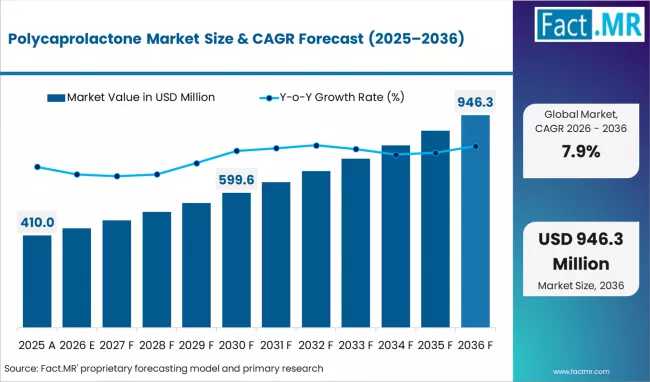
ROCKVILLE, MD, UNITED STATES, April 9, 2026 /EINPresswire.com/ -- According to Fact.MR’s latest analysis, the global polycaprolactone market is gaining traction as biodegradable polymers move from niche biomedical applications to commercial-scale deployment. The market was valued at USD 410.0 million in 2025, is projected to reach USD 442.39 million in 2026, and is forecast to expand to USD 946.28 million by 2036, registering a CAGR of 7.9%.The market is expected to generate an incremental opportunity of USD 503.89 million during the forecast period. Growth is being driven by expanding use in 3D-printed medical implants, tissue engineering scaffolds, drug delivery matrices, and biodegradable consumer products. The industry is transitioning toward pharmaceutical-grade polymer production and additive manufacturing applications.
Get detailed market forecasts, competitive benchmarking, and pricing trends:
https://www.factmr.com/connectus/sample?flag=S&rep_id=4754
Quick Stats
Market Size (2026): USD 442.39 Million
Market Size (2027): USD 477.30 Million (est.)
Forecast Value (2036): USD 946.28 Million
CAGR (2026–2036): 7.9%
Incremental Opportunity: USD 503.89 Million
Leading Segment: Pellets/Resins (56% share)
Leading Region: North America
Key Players: BASF, Perstorp, Corbion, Daicel, Merck KGaA
Executive Insight for Decision Makers
The polycaprolactone market is transitioning from industrial-grade polymer demand to pharmaceutical-grade, regulatory-compliant material sourcing.
Strategic Shift
Medical-grade polymer qualification becoming critical
Additive manufacturing driving customized polymer demand
Biodegradable polymer innovation accelerating
What OEMs / Manufacturers Must Do
Invest in pharmaceutical-grade PCL production lines
Ensure molecular weight consistency and batch traceability
Develop dedicated grades for 3D printing and healthcare
Risks of Not Adapting
Manufacturers supplying industrial-grade PCL without regulatory documentation risk losing opportunities in medical device applications and high-margin healthcare segments.
Market Dynamics
Key Growth Drivers
Rising adoption in medical implants and tissue engineering
Expansion of 3D printing and additive manufacturing
Increasing demand for biodegradable polymers
Growth in TPU formulation and adhesives applications
Key Restraints
High production costs and limited scale
Technical processing challenges in manufacturing
Regulatory approval complexities for medical use
Emerging Trends
Personalized medicine and custom implants
Smart biodegradable materials development
Medical-grade polymer supply agreements
Expansion of PCL filament in additive manufacturing
Segment Analysis
Leading Segment
Pellets/Resins hold 56% market share due to processing flexibility
Fastest-Growing Segment
3D printing and medical applications (41% share)
Breakdown
By Form: Pellets/Resins | Polyols | Blends/Compounds
By Application: 3D Printing & Medical | TPU & Coatings | Adhesives
By End Use: Healthcare | Industrial | Consumer
Strategic Importance
Healthcare applications deliver premium margins, while industrial TPU applications provide baseline demand stability.
Supply Chain Analysis
Raw Material Suppliers
Caprolactone monomer producers
Petrochemical feedstock suppliers
Specialty chemical intermediates manufacturers
Manufacturers / Producers
Polycaprolactone polymer manufacturers
Pharmaceutical-grade resin producers
Specialty polymer compounders
Distributors
Medical polymer distributors
Chemical raw material suppliers
3D printing filament distributors
End Users
Medical device manufacturers
Pharmaceutical companies
3D printing service providers
Adhesive and coatings producers
Who Supplies Whom
Caprolactone suppliers provide feedstock to polymer manufacturers. Producers convert monomers into PCL resins and supply healthcare and industrial customers. Distributors enable small-volume supply for additive manufacturing firms. End users integrate PCL into implants, adhesives, and specialty products.
Pricing Trends
Commodity pricing for industrial-grade polyols
Premium pricing for pharmaceutical-grade resins
Pricing influenced by:
Molecular weight consistency
Medical regulatory certification
Production scale
Additive manufacturing demand
Margin Insight
Highest margins seen in medical-grade PCL and specialty 3D printing filaments.
Regional Analysis
Top Countries by CAGR
United States – 8.9%
Mexico – 8.4%
Germany – 7.8%
France – 7.5%
United Kingdom – 7.1%
Regional Growth Drivers
USA: Medical device innovation and regulatory pathways
Mexico: Manufacturing cluster expansion
Germany: Medical technology ecosystem
France: Healthcare polymer adoption
UK: Biodegradable material demand
Developed vs Emerging Markets
Developed markets lead in medical applications
Emerging markets focus on cost-effective biodegradable materials
Competitive Landscape
The polycaprolactone market is moderately consolidated, with top players controlling a significant share.
Key Players
Perstorp
BASF
Corbion
Daicel
Merck KGaA
Shenzhen Esun
Haihang Industry
Durect
Shenzhen Polymaker
Sigma-Aldrich
Competitive Strategies
Pharmaceutical-grade production capabilities
Additive manufacturing partnerships
Biodegradable polymer innovation
Strategic supply agreements with medical OEMs
Strategic Takeaways
For Manufacturers
Expand pharmaceutical-grade production
Develop medical-specific polymer grades
For Investors
Focus on additive manufacturing growth
Target healthcare biodegradable polymers
For Marketers / Distributors
Highlight regulatory compliance and traceability
Expand presence in medical device supply chains
Future Outlook
The polycaprolactone market is moving toward biodegradable, customizable, and healthcare-focused polymer solutions. Additive manufacturing, personalized medicine, and tissue engineering will create strong long-term demand.
Key opportunities include:
3D printed implants
Drug delivery systems
Biodegradable consumer products
Medical-grade polymer development
Conclusion
The global polycaprolactone market is evolving from a specialty polymer niche into a high-value healthcare material ecosystem. Companies investing in pharmaceutical-grade production, additive manufacturing compatibility, and biodegradable innovation are positioned to capture growth as the market approaches USD 946.28 million by 2036.
Why This Market Matters
Enables biodegradable medical implants
Supports sustainable polymer innovation
Drives growth in additive manufacturing
Unlocks personalized healthcare applications
Full Report: Unlock 360° insights for strategic decision making and investment planning-
https://www.factmr.com/checkout/4754
To View Related Report:
Polycaprolactone Industry Analysis in the UK https://www.factmr.com/report/united-kingdom-polycaprolactone-industry-analysis
Biochar Market https://www.factmr.com/report/3781/biochar-market
Conductive Silicone Rubber Market https://www.factmr.com/report/conductive-silicone-rubber-market
Green Chemicals Market https://www.factmr.com/report/green-chemicals-market
S. N. Jha
Fact.MR
+1 628-251-1583