
Automotive strength, green regulations, and high-performance coatings accelerate Germany’s pigment demand outlook through 2036
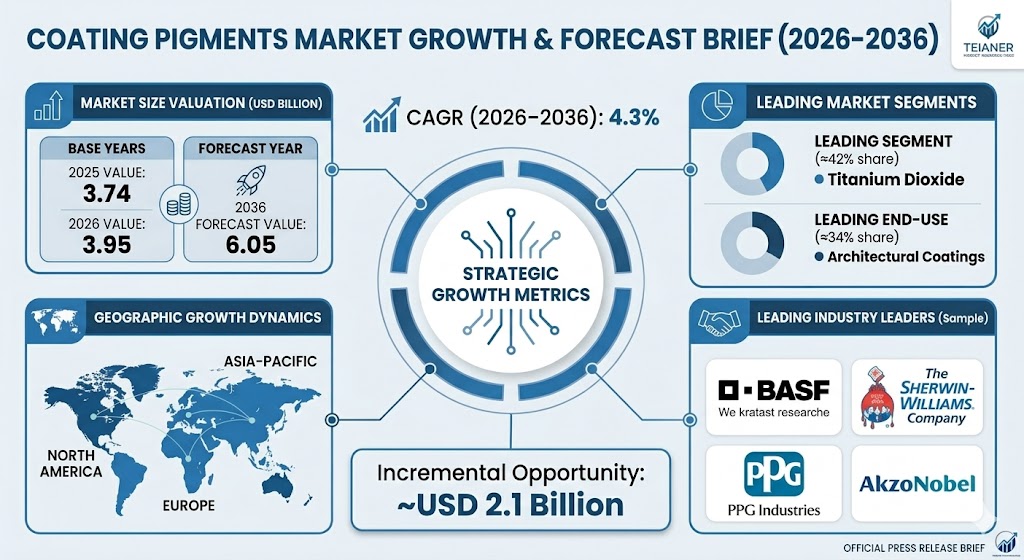
ROCKVILLE, MD, UNITED STATES, April 10, 2026 /EINPresswire.com/ -- According to Fact.MR’s latest analysis, the Germany coating pigments market is projected to reach USD 3.95 billion in 2026, up from USD 3.74 billion in 2025, and is forecast to surpass USD 6.05 billion by 2036, expanding at a CAGR of 4.3%. The market is expected to create an incremental opportunity of over USD 2.1 billion during the forecast period.Market transformation is being driven by Germany’s strong automotive manufacturing base, rising adoption of eco-friendly coatings, and stringent EU environmental regulations. Increasing demand for high-opacity titanium dioxide and sustainable organic pigments is reshaping procurement strategies across OEMs and coating formulators.
Get detailed market forecasts, competitive benchmarking, and pricing trends: https://www.factmr.com/connectus/sample?flag=S&rep_id=2402
Quick Stats
Market Size (2025): USD 3.74 Billion
Market Size (2026): USD 3.95 Billion
Forecast Value (2036): USD 6.05 Billion
CAGR (2026–2036): 4.3%
Incremental Opportunity: ~USD 2.1 Billion
Leading Segment: Titanium Dioxide (≈42% share)
Leading End-use: Architectural Coatings (≈34%)
Key Players: BASF SE, The Sherwin-Williams Company, PPG Industries, AkzoNobel
Executive Insight for Decision Makers
Germany’s coating pigments market is shifting toward high-performance, regulation-compliant, and sustainable pigment systems.
Strategic Shift: From commodity inorganic pigments toward specialty organic and eco-compliant formulations
For Manufacturers: Invest in chloride-process TiO₂ and low-VOC pigment innovation
For Investors: Target firms with strong R&D pipelines and backward integration
Risk of Inaction: Supply chain disruptions, regulatory non-compliance, and margin erosion
Market Dynamics
Key Growth Drivers
Strong demand from automotive and EV manufacturing hubs
Rising green building construction and infrastructure upgrades
Stringent EU regulations driving low-VOC and non-toxic pigments
Growth in industrial coatings for corrosion resistance
Key Restraints
Volatility in ilmenite and rutile raw material prices
High energy costs in pigment production
Dependence on global supply chains for feedstock
Emerging Trends
Shift toward organic and bio-based pigments
Adoption of smart coatings (self-healing, UV-resistant)
Increased supplier diversification strategies
Digitalization in coating formulation and supply chain management
Segment Analysis
Leading Segment: Titanium dioxide dominates with ~42% share due to superior opacity and UV resistance
Fastest-Growing Segment: Organic pigments, driven by sustainability and color performance
By Product Type:
Inorganic: ~63% share
Organic: fastest growth (5.3% CAGR globally)
By End-use:
Architectural coatings lead (~34%)
Automotive and aerospace segments gaining traction
Strategic Importance:
High-performance pigments are critical in Germany’s automotive exports, where durability, aesthetics, and compliance are non-negotiable.
Supply Chain Analysis (Critical Insight)
Value Chain Structure
Raw Material Suppliers
Ilmenite, rutile, iron oxide, organic intermediates
Pigment Manufacturers
Produce TiO₂, carbon black, specialty pigments
Coating Manufacturers
Formulate paints and coatings for industries
Distributors & Logistics Providers
Ensure timely delivery across Europe
End-Users
Automotive OEMs, construction firms, industrial manufacturers
Who Supplies Whom
Mining companies → supply titanium feedstock to pigment producers
Pigment producers → supply coatings manufacturers
Coating manufacturers → supply OEMs and construction companies
Key Insight:
Lack of backward integration in pigment production exposes manufacturers to cost volatility and supply disruptions, making supplier diversification essential.
Pricing Trends
Commodity Pigments: Price-sensitive, driven by raw material costs
Specialty Pigments: Premium pricing due to performance and compliance
Key Influencers
Raw material costs (ilmenite, rutile)
Energy-intensive production processes
Regulatory compliance costs
Demand from automotive and construction sectors
Margin Insight:
Margins are tightening for commodity producers, while specialty pigment players maintain higher profitability.
Regional Analysis
Top Countries by CAGR (2026–2036)
China – 5.1%
USA – 4.8%
Germany – 4.3%
South Korea – 4.2%
Japan – 3.9%
Germany Growth Drivers
Strong automotive manufacturing ecosystem
Leadership in engineering and industrial coatings
Strict EU environmental policies
Developed vs Emerging Markets
Developed (Germany, USA): Focus on sustainability and innovation
Emerging (China, India): Volume-driven growth and infrastructure expansion
Competitive Landscape
Market Structure: Moderately consolidated
Key Players:
BASF SE
PPG Industries
AkzoNobel
The Sherwin-Williams Company
DowDuPont
Competitive Strategies
R&D in sustainable pigments
Strategic acquisitions and partnerships
Geographic expansion in Europe
Strengthening distribution networks
Strategic Takeaways
For Manufacturers
Invest in eco-friendly and high-performance pigments
Secure long-term raw material contracts
For Investors
Focus on ESG-compliant companies with innovation pipelines
For Marketers/Distributors
Highlight sustainability and durability benefits
Expand presence in automotive and construction sectors
Future Outlook
Germany’s coating pigments market will evolve toward sustainable, high-performance, and technologically advanced solutions.
Growth in EVs and aerospace coatings
Rising adoption of low-emission pigments
Increased investment in green chemistry and circular economy models
Conclusion
Germany remains a cornerstone of the European coating pigments market, driven by industrial strength and regulatory leadership. Companies that align with sustainability, secure supply chains, and invest in innovation will capture the next wave of growth.
Why This Market Matters
The Germany coating pigments market is critical to automotive excellence, infrastructure durability, and environmental compliance. As industries transition toward greener and more efficient systems, pigments will play a central role in enabling performance, protection, and sustainability at scale.
Unlock 360° insights for strategic decision making and investment planning: https://www.factmr.com/checkout/2402
To View Related Report:
Methane Sulfonyl Chloride Market https://www.factmr.com/report/967/methane-sulfonyl-chloride-market
Corrugated Fish Box Market https://www.factmr.com/report/976/corrugated-fish-box-market
Packaging Nets Market https://www.factmr.com/report/977/packaging-nets-market
Shielding Bags Market https://www.factmr.com/report/979/shielding-bags-market
About Fact.MR
Fact.MR is a global market research and consulting firm, trusted by Fortune 500 companies and emerging businesses for reliable insights and strategic intelligence. With a presence across the U.S., UK, India, and Dubai, we deliver data-driven research and tailored consulting solutions across 30+ industries and 1,000+ markets. Backed by deep expertise and advanced analytics, Fact.MR helps organizations uncover opportunities, reduce risks, and make informed decisions for sustainable growth.
S. N. Jha
Fact.MR
+ +1 628-251-1583
sales@factmr.com