
Green Chemicals Market
The Green Chemicals Market is segmented by Product Type (Bio-alcohols (Ethanol, Methanol, Butanol/Propanol, Other Bio-alcohols)
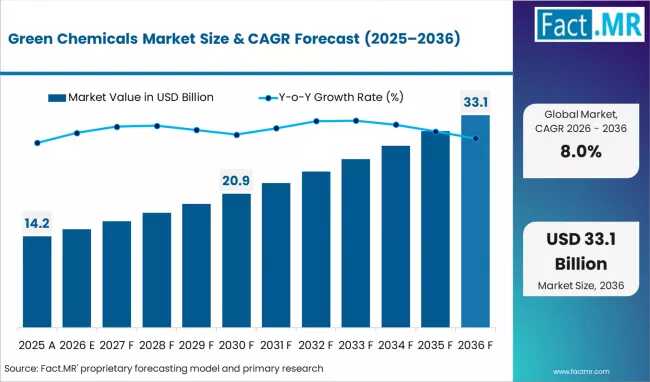
ROCKVILLE, MD, UNITED STATES, April 9, 2026 /EINPresswire.com/ --According to Fact.MR’s latest analysis, the global green chemicals market is valued at USD 15.34 billion in 2026, up from USD 14.20 billion in 2025, and is projected to reach USD 33.11 billion by 2036, expanding at a CAGR of 8.0%.Within this global transition, Germany emerges as a strategically critical European market, projected to grow at a CAGR of approximately 6.8% through 2036, driven by strong regulatory enforcement, industrial sustainability mandates, and advanced chemical manufacturing capabilities.
Germany’s green chemicals market is undergoing a structural shift from petrochemical dependency toward bio-based and circular chemical production systems, supported by EU Green Deal policies, carbon neutrality targets, and increasing adoption of sustainable materials across automotive, construction, and packaging sectors.
Get detailed market forecasts, competitive benchmarking, and pricing trends: https://www.factmr.com/connectus/sample?flag=S&rep_id=12198
Quick Stats – Germany Focus
Global Market Size (2026): USD 15.34 Billion
Global Forecast Value (2036): USD 33.11 Billion
Germany CAGR (2026–2036): ~6.8%
Incremental Opportunity (Global): USD 17.77 Billion
Leading Segment: Bio-alcohols
Leading Application in Germany: Construction & Automotive
Key Players in Germany: BASF SE, Evonik Industries AG, Covestro AG, Wacker Chemie AG, Lanxess AG
Executive Insight for Decision Makers
Germany’s market is shifting toward compliance-driven, high-value green chemical adoption, where sustainability is embedded into industrial operations.
Strategic Imperatives:
Chemical manufacturers must invest in integrated biorefinery and recycling technologies
OEMs must prioritize low-carbon and certified sustainable inputs
Investors should focus on companies aligned with EU taxonomy and ESG frameworks
Risk of Inaction:
Failure to align with EU regulatory standards and carbon reduction targets may result in restricted market access, increased compliance costs, and loss of competitive positioning.
Market Dynamics
Key Growth Drivers
Strict EU environmental regulations and carbon reduction targets
Expansion of circular economy initiatives across industries
High demand for low-VOC and sustainable materials in construction and automotive sectors
Strong R&D ecosystem in green chemistry innovation
Key Restraints
High production costs compared to conventional chemicals
Limited availability of large-scale biomass feedstock in Europe
Complex regulatory compliance processes
Emerging Trends
Growth of chemical recycling and closed-loop systems
Increasing adoption of bio-based polymers and specialty chemicals
Integration of carbon capture and utilization (CCU) technologies
Digitalization and carbon tracking systems in supply chains
Segment Analysis
Leading Segment: Bio-alcohols (dominant due to industrial and fuel applications)
Fastest-Growing Segment: Biopolymers and specialty green chemicals
Application Breakdown in Germany
Construction materials (green coatings, adhesives)
Automotive (lightweight, low-emission materials)
Packaging (biodegradable and recyclable solutions)
Industrial chemicals and specialty applications
Strategic Importance:
Germany’s market emphasizes high-performance, certified, and sustainable chemical solutions, favoring premium product categories over commodity volumes.
Supply Chain Analysis (Critical Insight)
Value Chain Structure
Raw Material Suppliers:
Agricultural biomass imports
Industrial and municipal waste streams
Manufacturers / Producers:
Chemical companies operating biorefineries and recycling plants
Distributors:
Specialty chemical distributors and industrial partners
End-Users:
Automotive OEMs
Construction companies
Packaging manufacturers
Industrial processors
Who Supplies Whom
Biomass suppliers → provide feedstock → chemical producers
Producers → convert into bio-based chemicals → supply to formulators
Formulators → deliver sustainable materials → OEMs and industrial buyers
Key Insight:
In Germany, circular feedstock integration and recycling capabilities are critical for maintaining cost efficiency and regulatory compliance.
Pricing Trends
Commodity Green Chemicals:
Price-sensitive and influenced by feedstock costs
Specialty & Certified Chemicals:
Premium pricing due to sustainability certifications and performance
Key Pricing Influencers
Biomass availability and import dependency
EU compliance and certification costs
Energy prices and carbon taxation
Margin Insight:
Companies with integrated recycling systems and energy-efficient processes achieve better margin stability in Germany’s regulated environment.
Regional Analysis – Germany Focus
Germany is one of Europe’s most advanced green chemicals markets, driven by policy and industrial innovation.
Growth Drivers
Strong automotive and industrial base
Government-backed energy transition initiatives
Leadership in chemical engineering and R&D
Developed Market Characteristics
High adoption of certified sustainable materials
Focus on innovation and efficiency over cost
Strong regulatory compliance environment
Comparison with Emerging Markets
Lower volume growth but higher value per unit
Greater emphasis on technology and sustainability standards
Competitive Landscape
Market structure: Moderately consolidated with strong domestic and global players
Key Players
BASF SE
Evonik Industries AG
Covestro AG
Wacker Chemie AG
Lanxess AG
Dow Inc.
DuPont
Cargill
Competitive Strategies
Expansion of biorefinery and recycling infrastructure
Strategic collaborations for feedstock sourcing
Development of high-performance sustainable chemicals
Investment in advanced R&D and process innovation
Strategic Takeaways
For Manufacturers
Invest in circular production technologies
Focus on high-value specialty chemicals
For Investors
Target companies aligned with EU sustainability frameworks
Prioritize firms with strong R&D and innovation pipelines
For Distributors
Build compliance-driven product portfolios
Offer technical and regulatory support services
Future Outlook
Germany’s green chemicals market is expected to evolve toward:
Closed-loop chemical production systems
Greater adoption of carbon-neutral manufacturing technologies
Expansion of bio-based specialty chemicals
Long-Term Opportunity:
Integration of sustainability with advanced manufacturing will position Germany as a global leader in high-performance green chemical innovation.
Why This Market Matters
Central to Europe’s decarbonization strategy
Drives innovation in sustainable materials and chemicals
Supports high-value industrial transformation
Unlock 360° insights for strategic decision making and investment planning: https://www.factmr.com/checkout/12198
To View Our Related Report:
Fracking Fluids and Chemicals Market https://www.factmr.com/report/493/fracking-fluid-market
Oleochemicals Market https://www.factmr.com/report/587/oleochemicals-market
Internal Boiler Treatment Chemicals Market https://www.factmr.com/report/636/internal-boiler-treatment-chemicals-market
Electroplating Chemicals Market https://www.factmr.com/report/1561/electroplating-chemicals-market
S. N. Jha
Fact.MR
+ +1 628-251-1583