
BPS/BPA-free Polyphenylsulfone (PPSU)
Germany BPS/BPA-Free Polyphenylsulfone (PPSU) Market expands with medical and automotive demand
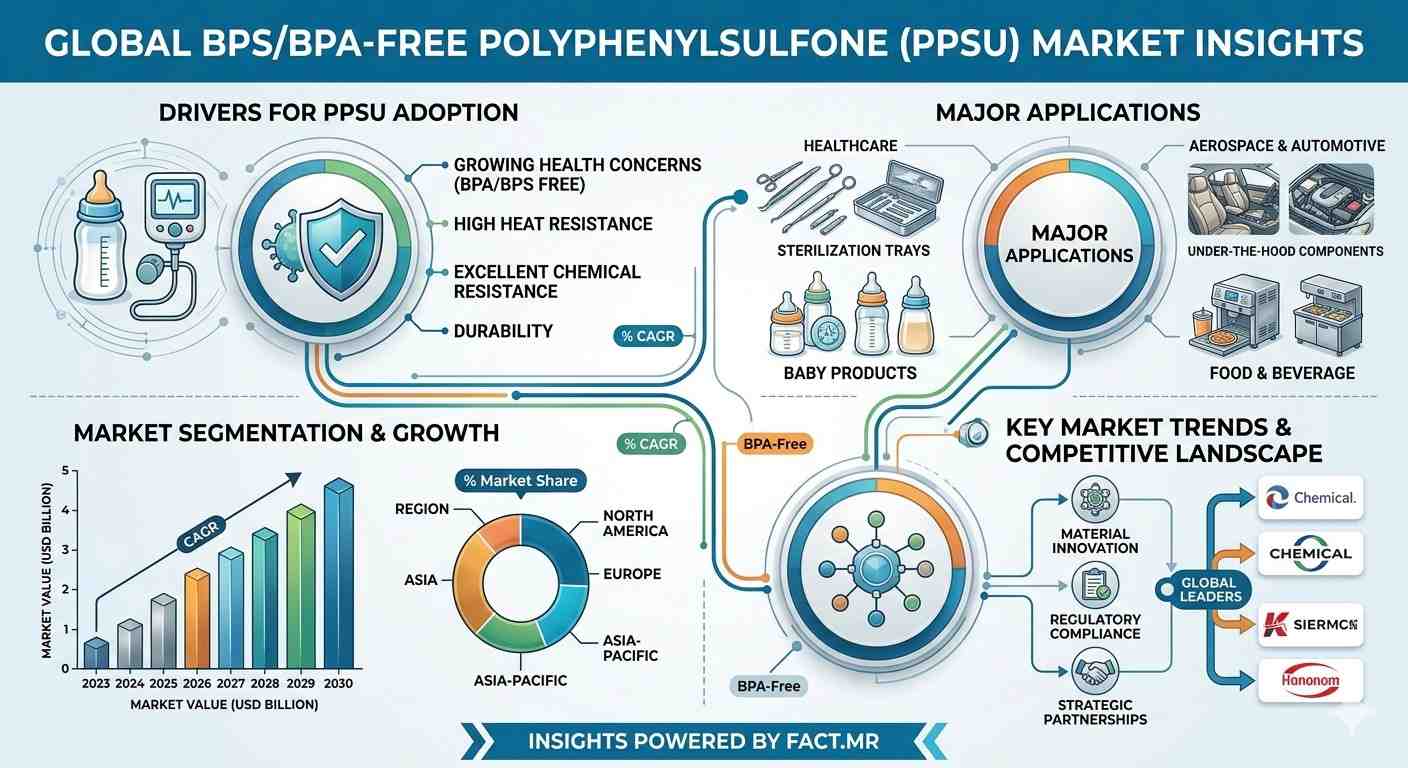
ROCKVILLE, MD, UNITED STATES, April 15, 2026 /EINPresswire.com/ -- According to Fact.MR’s latest analysis, the Germany BPS/BPA-free Polyphenylsulfone (PPSU) market is undergoing a structural transformation driven by stringent regulatory frameworks, evolving healthcare needs, and advanced automotive engineering requirements.Market size reached USD 410.0 million in 2025
Estimated to grow to USD 446.9 million in 2026
Forecast to reach USD 970.0 million by 2036
Expanding at a CAGR of 8.8% (Germany-specific growth)
Generating an absolute opportunity of over USD 500 million
The market is shifting from cost-based polymer selection to compliance-driven material adoption, particularly in medical devices, infant safety products, and automotive components requiring high thermal and chemical resistance.
Get detailed market forecasts, competitive benchmarking, and pricing trends:
https://www.factmr.com/connectus/sample?flag=S&rep_id=14718
Quick Stats
Market Size (2025): USD 410.0 million
Market Size (2026): USD 446.9 million
Forecast Value (2036): USD 970.0 million
CAGR (2026–2036): 8.8%
Incremental Opportunity: ~USD 523.1 million
Leading Segment: Injection molding grade (53% share)
Leading Application: Medical devices (45% share)
Leading End Use: Healthcare
Key Players: BASF SE, Solvay SA, SABIC, Evonik Industries, Sumitomo Chemical
Executive Insight for Decision Makers
Germany’s PPSU market is entering a specification-driven phase, where material approval and regulatory compliance outweigh pricing considerations.
Strategic Shift: OEMs are locking in long-term PPSU supply contracts due to high switching costs linked to EU MDR validation.
Action Required:
Invest in medical-grade certification and documentation capabilities
Strengthen OEM partnerships in automotive and healthcare sectors
Expand localized production and technical support
Risk of Inaction: Companies failing to meet compliance standards risk exclusion from high-value medical and automotive supply chains.
Market Dynamics
Key Growth Drivers
EU MDR compliance mandating BPA/BPS-free materials in medical devices
Automotive lightweighting initiatives replacing metal with PPSU components
Rising hospital procurement of sterilization-compatible polymers
Increasing demand for BPA-free infant and food-contact products
Key Restraints
High raw material and processing costs compared to standard polymers
Limited adoption in cost-sensitive industrial applications
Energy cost pressures impacting polymer manufacturing in Germany
Emerging Trends
Shift toward premium, high-performance polymer grades
Expansion of PPSU in fluid handling and under-hood automotive systems
Increasing OEM-material supplier partnerships
Growing demand for extrusion-grade PPSU in consumer safety products
Segment Analysis
Leading Segment: Injection molding grade holds 53% market share (2026)
Critical for precision manufacturing in medical and automotive components
Fastest-Growing Segment: Medical device applications
Account for 45% share, driven by sterilization and compliance requirements
Breakdown
Product Types: Injection molding, extrusion grades, specialty compounds
Applications: Medical devices, automotive components, infant products, industrial systems
End Users: Healthcare OEMs, automotive manufacturers, consumer goods producers
Strategic Importance:
Medical and automotive segments represent high-margin, long-term contract opportunities, making them central to supplier strategies.
Supply Chain Analysis (Critical Insight)
Value Chain Structure
Raw Material Suppliers
Bisphenol-free monomers and specialty chemicals
Manufacturers / Resin Producers
Companies such as BASF SE, Solvay SA, SABIC produce PPSU resins
Compounders & Processors
Customize PPSU grades for specific applications
Distributors & Technical Service Providers
Facilitate OEM integration and regulatory documentation
End Users
Medical device manufacturers (surgical tools, housings)
Automotive OEMs (fluid systems, lightweight components)
Infant product manufacturers (bottles, feeding systems)
Who Supplies Whom
Resin producers supply certified PPSU grades to Tier-1 OEMs
Compounders adapt materials for application-specific requirements
OEMs integrate PPSU into regulated, high-performance end products
Key Insight:
Once approved, PPSU materials become deeply embedded in OEM supply chains, creating strong vendor lock-in.
Pricing Trends
Premium Pricing Model: PPSU is positioned as a high-performance polymer
Price Influencers:
Raw material costs
Regulatory compliance and certification expenses
Demand from medical and automotive sectors
Margin Insights:
Higher margins in medical-grade PPSU
Competitive pressure in automotive and consumer segments
Regional Analysis (Germany Focus with Global Context)
Top Countries by Growth
United States – 9.4% CAGR
Germany – 8.8% CAGR
China – 9.0% CAGR
Japan – 8.2% CAGR
South Korea – 7.5% CAGR
Germany Growth Drivers
Strong automotive base focusing on lightweight engineering
Advanced healthcare infrastructure and EU MDR compliance adoption
High demand for precision-engineered, high-performance polymers
Developed vs Emerging Markets
Developed (Germany, US): Compliance-driven, high-value demand
Emerging (China, India): Volume-driven growth with increasing regulations
Competitive Landscape
Market Structure: Moderately consolidated, driven by technical capability
Key Players:
BASF SE
Solvay SA
SABIC
Evonik Industries
Sumitomo Chemical
RTP Company
Competitive Strategies
Regulatory compliance and certification leadership
Product innovation in medical and automotive grades
Strategic OEM partnerships and long-term contracts
Expansion in high-growth regions
Strategic Takeaways
For Manufacturers
Focus on certification-driven differentiation
Develop application-specific PPSU grades
For Investors
Target companies with strong OEM relationships and regulatory expertise
High returns in medical-grade polymer segments
For Marketers & Distributors
Emphasize compliance, durability, and lifecycle benefits
Build technical support capabilities
Future Outlook
Germany’s PPSU market is set to evolve into a high-value, compliance-centric ecosystem.
Growth driven by medical sterilization standards and automotive innovation
Sustainability and safety regulations will further accelerate adoption
Long-term opportunities lie in advanced healthcare applications and next-gen automotive systems
Conclusion
The Germany BPS/BPA-free PPSU market is transitioning from a niche specialty segment to a core material platform across regulated industries.
With regulatory mandates tightening and OEM requirements evolving, PPSU is becoming indispensable in high-performance, safety-critical applications. Companies that invest in compliance, innovation, and partnerships will be best positioned to capture the expanding opportunity.
Why This Market Matters
Germany stands at the intersection of regulatory leadership, industrial innovation, and healthcare excellence. The PPSU market reflects a broader shift toward safe, sustainable, and high-performance materials, making it a critical focus area for decision-makers across industries.
Full Report: Unlock 360° insights for strategic decision making and investment planning-
https://www.factmr.com/checkout/14718
To View Related Report:
Hexamethylene Diisocyanate (HDI) Trimer Market https://www.factmr.com/report/hexamethylene-diisocyanate-hdi-trimer-market
Gravity Battery Market https://www.factmr.com/report/gravity-battery-market
High-Brix Fruit Quality Enhancement Fertilizer Market https://www.factmr.com/report/high-brix-fruit-quality-enhancement-fertilizer-market
MDI Variants for Rigid Foam Insulation Market https://www.factmr.com/report/mdi-variants-for-rigid-foam-insulation-market
S. N. Jha
Fact.MR
+1 628-251-1583