Transcript
Automated transcript · Written by software from the replay's audio. It can mishear names and figures; the replay is the record.
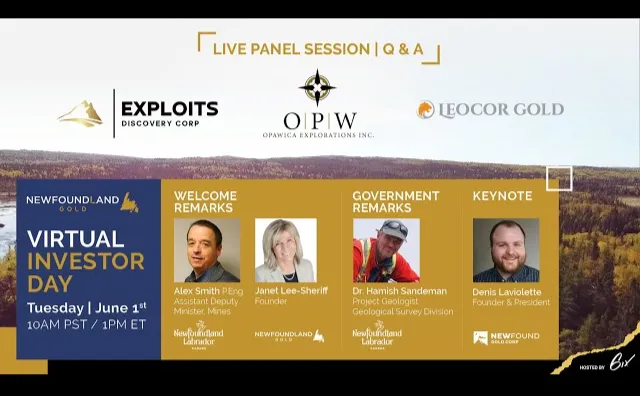
0:04 Hello, my name is Janet Leigh-Sheriff. I'm the founder of Newfoundland.gold and I want to welcome everybody to our 1st Virtual Investor Day focused on the emerging gold camp in Newfoundland. We have a great panel lined up today and great panels for the next few days. And I don't wanna take up too much of your time. I wanna get right into everything and introduce our first speaker, which is Alex Smith, an Assistant Deputy Minister from the government of Newfoundland and Labrador. But first I want to thank everybody who's helped make this possible. In 30 days we've put together a great lineup of 9 companies and an amazing team that's pulled this all together. So I thank them and special thanks to Sean Ryan and Mike Collins of Exploits and Colin Cattell of Newfound Gold who really helped pull this group together and we couldn't have done it without them.
1:01 Enjoy the conference and remember, if you've registered for day 1, please also register for day 2 and day 3. You'll find some amazing keynote speakers starting with Sean and today, Denny Laboulaye, who really started it all with Newfound and then wrapping it up with Rich Gold Farm. Again, welcome. And Alex, I'm handing it to you now and I wish everybody great success and a great season. Thank you, Janet and Newfoundland.gov for the invitation to virtually welcome everybody to the province and provide a brief overview and introduction to the jurisdiction. For those of you who are unfamiliar, Newfoundland and Labrador is, funnily enough, comprised of the island of Newfoundland and Labrador on the mainland. We have a population of about 500,000 people.
1:52 The province's capital is St. John's, the most easterly city in North America. It has an international airport, typically serving 1.5 million passengers per year with direct flights to Canada, the U.S., Europe and beyond. We also have ice-free ports from which exports to and from the imports and exports to the province can be made. We have been successfully minimizing the impacts of COVID-19 in the province. Our vaccination rollout is going quite well. Additionally, in recognition of the importance of the mineral industry to the province, exemptions to the province's COVID-related special measure orders were provided to the mining industry, which includes the mineral exploration workers.
2:38 Newfoundland and Labrador is a top-tier jurisdiction for mineral exploration and development. We're rich with world-class deposits of iron ore, nickel, and base metals, and as you all know, currently a red-hot jurisdiction for gold exploration. The province has a rich mineral endowment and a long history of mining dating back to the 16th century. Newfoundland and Labrador's geology is diverse, spanning almost 4 billion years. As a result, we have a wide variety of mineralizing styles and environments, with a wide variety of commodities present. Our geological survey is responsible for public geoscience, acquired through geophysical and geochemical surveys, mineral deposit studies, and systematic bedrock and surficial mapping.
3:23 Resulting data from our geological survey and reports and mapping are all publicly available on our website. We have recently created an independent Geoscience Technical Advisory Committee, with appointments of members pending, to provide recommendations to ensure our public geoscience meets industry's needs and requirements. Because the focus of this event is on gold, I'm showing only the island portion of the province here to demonstrate the level of the gold related activities. Claims staked in 2020 are shown in orange here, representing 47,000 claims staked in 2020, which is the most in the province since 2007. So far this year, the claims staked in 2021, which are shown in red, is over 51,000 claims. So we've exceeded last year already. And in fact, in May alone, we had 32,000 claims state.
4:20 Things are really hopping as you all know. We undertook airborne geophysical survey programs over the last few years in the southern portion of central Newfoundland in the St. Albans-Twilligbrook area. Yesterday's budget that was presented by the province includes additional funding for similar programs this year. Labrador is vastly underexplored and has potential for gold as well. One of the field programs for this year's geological survey includes work in western Labrador on iron oxide, copper gold potential in the area.
4:53 Dr. Hamish Sandeman with our geological survey has a field program for central Newfoundland planned for this year and Hamish is presenting later during this session. Newfoundland and Labrador is a mining-friendly jurisdiction. We were highly ranked in the most recent Fraser Institute survey with great improvement over last year, likely driven by the interest in gold in the province. We offer exploration incentives through our mineral incentive program, the Junior Exploration Assistance Program, and have a modern, transparent legislative framework. But we are looking to improve. As part of that, government, in partnership with industry, continues to advance our mineral strategy, Mining the Future 2030, and is implementing related actions as outlined in the strategy.
5:43 So our mining and mineral development team here is a small team of dedicated professionals passionate about the industry. And we are approachable, so feel free to reach out should we be able to be of assistance to any of you. Again, welcome to you all and we look forward with work with you to advance the industry in the province. Next up is Michael McCray, who will introduce the panel for today. Thanks again. Cheers.
6:09 Alex, thank you very much. Yes, again, my name is Michael McCray, Mining Audience Manager at Kitco Mining. Kitco is your leading source for precious metal news. Welcome again to Newfoundland Gold's Virtual Investor Day. It's 10 a.m. Pacific Standard Time, 1 p.m. Eastern Time. Stay when and up next is our first panel. Under the next hour, we'll be running an interactive session with help from Michael Collins with Exploits Discovery, Blake Morgan with Opowica Explorations, Sean Ryan with Leocor Gold. The 4 of us will start off with some Q&A, but again, this is interactive. Please ask questions using virtual conference software and I will pass on to our panel. Now, first up, I would like to invite our panelists onto the screen right now. Sean, I was going to get Michael to set us up, but maybe we could start with you first and maybe you could talk about what is really exciting about Newfoundland and maybe just a bit about the geology, Sean.
7:06 Thank you. Yeah, Newfoundland is actually very unique. And once I started doing my research, like I'm coming from the Yukon, like the actual geological setting and the setup for this gold system is extremely unique. And same is that the age of the timing. And that's what I talk about in my talk. So yeah, Newfoundland is like it's got all the key ingredients for a big district play here. And I think this is gonna just keep going. The geology is set up perfect here. Could you talk about that further, Sean?
7:41 What is the geology? What are the trends?
7:43 And just basically in the island, what are kind of the major regions? Well, the gist of it is it was a big regional structural setup. And it was actually at a specific time,
7:55 the Selenic and the Silurian time. And it was so the uniqueness of the continents collided with each other. And then this gold pulse that actually happened at the same time, basically at the same event, created a unique setting that you don't really see too many spots in the world. But Australia is very, very close in that analogy to the Foster Bill. I agree with that.
8:24 Blake, I'd like to bring you in. What was your interest that was peaked in what was happening in Newfoundland? Well, our flagship assets are on the Abitibi, Greenstone, Cadillac, Lada fault. So, we modelled our move into the Newfoundland based on that structure. So, that's sort of where we looked at where we wanted to get in and how we wanted to go about sort of thing. So we moved on to the Marathon Gold side. Obviously Marathon Gold is creating some good
8:55 numbers and some fantastic deposits. So that's sort of what brought us into the region and we're following up on that model system. I know Raymond James just put out something in regards to the Abitibi and Newfoundland, and there's a few more reports coming out over the next few weeks. So you're gonna see a bit more in that correlation between those 2 regions. I'd like to describe, because I mean, Newfoundland really kind of arose. I would say I've just kind of heard more and more of it. And then obviously with also the success of Denny Labiolette. And he'll be talking later of the success and the run up that Newfoundland Gold has. But Can we talk about how it suddenly came on to everybody's radar? I'll start with you, Sean. Well, say again.
9:43 I'll start with you, Blake. Talk about that first and then Sean, you can grab it. You can grab it there as well too. Blake,
9:51 how did the region come onto your radar? So we heard about what Newfoundland Gold was doing back when they were private, and that sort of got us into that region. And I think a lot of people were down that same route. Now, we started looking quite early. So it was last year, we started to make some moves. We worked closely with Michael Collins from Exploits as well. And obviously, they picked up a really large land package. So that was the sort of fundamentals that brought us into that region. I know Opal Weaker itself started gaining ground next to where Sean was picking up ground with C2C Gold. And that's sort of how we went into the region. Sean, the question was again, how it became everybody's interest? Well, I came to the island back in 2014 and started researching it before anybody showed up.
10:43 And then in 2015, we actually launched an exploration program across the island, just taking regional soils to see if we could get a response. We could do it off of claims because there was nobody really jumping around in there too much. We did our science and had a look at the data and realised, yes, we could actually locate these anomalous structures. Then we jumped in in 2016,
11:12 led to a big staking rush. Well, staking overnight. We crashed the server and the government server was down for 2-weeks and then as soon as it popped back up again, that's when Newfound Gold tied onto us to the south. And that's kind of what launched this whole kind of start of looking at these gold systems in Newfoundland. You talked about crashing the server, Sean. I'm just going to take this to Blake first. I mean, it's an area that is suddenly seeing a lot of interest. What is the type of support that you see in Newfoundland for the types of exploration work that you're doing, Blake? Well, you've definitely got government support. It's a very mining-friendly jurisdiction.
11:53 Tax breaks is fantastic. Cruise is easy to find. So the more the area picks up and the more discoveries that are made, the more simple it's going to be for companies like ourselves. You know, you've got your standouts of Newfound Gold, obviously doing some fantastic stuff. You know, they got 8 drill rigs going, 100,000 meters. You got Marathon Gold, obviously just raised $50 million. They're doing some amazing stuff. So structure and infrastructure will pick up as deposits are made, discoveries are produced, and that's just going to basically help everyone in the region. And now you've got tax breaks with the government funding and stuff like that, which is going to be phenomenal. So when you're spending money on your exploration, you're getting a lot of it back, which is for small junior mining companies, that's fantastic. Just gives us more money to put into the ground, which creates more discoveries.
12:42 Sean, a question about support from the government and just the infrastructure for the work that you do? In my mind, I'm always from the exploration side, like the geological survey of Newfoundland is probably one of the best ones I've ever seen. And that's really, you know, that led me to basically be able to research from remote through this COVID time. And yes, I can't say enough kudos for the geological survey. They have geophysicists on staff, they have geochemists on staff, they have structural geologists.
13:17 The stuff they did over the last 30-years, it's actually what's launched and is helping us as an industry jump into this next Gold rush. It all starts with a good Gold map or a good map, and that's what the survey is providing. They've been providing this for the last over 100-years now, they've been as a survey. We can't say enough good enough about these guys. Sean, stakeholder relations in terms of the local communities and the support of what the exploration people are doing?
13:48 The first time I got there, my little story is, when we were in Millartown, we actually got a call within hours from the mayor looking for a job to get out in the bush. People just do want to get out to work. They want us to find deposits and they're the friendliest people on the planet. It was the perfect storm and the perfect, Newfoundland as a whole, they export a bunch of miners out across the country. They're miner types. They would love for us to find a mine on the island so they don't have to leave the island to go to work. The whole setup from roads everywhere, we're used to using helicopters in Yukon, there's roads to 70% to 75% of the ground here.
14:36 It's a different part of the world, but from an exploration, we have all this rest of the stuff from the money side. The key was the geological survey that set the whole setup up, set the shots up, and now we're able to take that data from surficial maps to till maps to geology maps to these air like you know to the whole package and take that and run with
14:58 this now. So like that's to me it was the setup was the survey that set started this. I'd like to remind the people watching, this is an interactive session. If you do have any questions for the panelists, please ask. Blake, could you talk about, just following up from Sean, just what it's like finding workers in the area and what the support is for doing exploration work? Well, like Sean touched on, it's fantastic. The people in the region are fantastic. We've got a lot of mining companies moving in now, So there's a lot of jobs available, but it doesn't seem too difficult finding the workers because these people really want to get out on the ground. They're excited about the Gold rush that's happening in the region. They're excited about what's going to produce in the future. And we're jumping on board with that. So, you know, and like Sean mentioned with the road infrastructure, you've got power.
15:50 I'm used to doing a lot of programs up in the Golden Triangle where it absolutely costs you a fortune to fly around and your drill programs are ridiculously priced. Whereas in Newfoundland, it's very, very cheap. You know, you can drive to a lot of these spots. The small helicopter support you may need is very easy to get. Drill rigs don't seem like too much of an issue, even though there's a lot of getting around at the moment. So it's set up quite nicely.
16:15 What is the, what are the, what's the seasons like? What's the weather up there? It's quite good, actually. You can work all year round, but it just depends on where you are. So you've got some swampy area. So, you know, we like to try and stay out of the sludge, but working through winter is not too much of an issue. But obviously, you know, your summer, spring is fantastic to get out on the ground. Sean could tell you a bit more about that. Definitely. Sean, I know, you know, if anybody knows about seasonality and weather, I think it would be you, Sean, but maybe you could compare what type of work you can do in the Newfoundland and when you can get some exploration out. Yes, and that's actually originally why I started researching there was to actually get a shoulder season for the Yukon explorers up in the Yukon because we really only get June to September to drill with the diamond drill.
17:10 We're caught with the 30, 40 below. Newfoundland, the irony here is we could soil right until December, like right until just before Christmas with a skip of snow because we're not getting 30, 40 below, but you could drill all year round. And that's what's the difference here, the big difference from kind of working, like I still love to work in the Yukon, But here we could actually work 12-months of the year and the juniors could still get their news flow kind of continuously through the winter. I like it because now we could soil for 6-months out of the year, that's what we're planning to do. And then we could still continue to rab drill through the winter, set it up for some nice diamond drill targets for the spring. You're not rushed and that's what I like.
17:55 What I could accomplish in 1-year in Newfoundland takes me about 2-3-years in the Yukon. That's what we really like. It's the season, a nice big window to work with. We talked about the infrastructure, but one piece on that, Sean, just what's the electricity grid and what is it like getting power in there? Well, there's power almost, there's communities everywhere, so there's power everywhere. And they have these big, big trends, big grids cutting across the island. So that's why like there's almost roads everywhere. The power is probably like, I don't know exactly the price, but I bet you they've got to be competitive with Quebec ports. Anywhere you are within basically 125 clicks of anywhere on the island, you're within a port range. The infrastructure is set up and the people are taking on. That's what I was getting at, that from a miner's point of view, that's where our population of miners are. So you could find a mine, but who's going to mine it? So you need these people.
18:53 And Sean, First Nation support is in Newfoundland. Actually, it's interesting. There is some, I guess there is some First Nations, but it's not as prevalent as up in the Yukon, let's say, or other parts of Canada. I see that Michael Collins is joining us. He was going to be our fourth panelist right now. I think he was having some internet issues. Michael, thank you for joining us. I'll let you get settled. It's glad to see you. I would like to remind the people watching us that this is an interactive session, so please submit your questions and then I will be happy to take them to the panelists. There was this interest, Sean and Blake, in what was happening in Newfoundland.
19:39 You've both come into, you've come on, you know, you've come onto the province now. Could you talk about the major players in the area right now, who they are and what type of work they're doing? Yeah, yeah, yeah, certainly. So, the standouts, obviously, for me are Newfound Gold and Marathon Gold. So, we'll touch on marathon slightly. You know, they're not talking, but they're not spoken about much in compared to the new place, you know, but they have a monster deposit. They've just raised $50 million and they'll be producing a mine over the next few years. So you've got them, obviously, Newfound Gold is doing some fantastic stuff. They're pulling numbers basically not seen before. I think they've got 8 drill rigs going, 100,000 a meter drill program. So they're doing some fantastic stuff. Then you've got companies like Sockerman, Labrador and Exploits.
20:30 Obviously Exploits just had Newfound Gold invest in them. They've got Eric Sprott's coming twice. So they're doing some fantastic stuff and they've got a major land package. Sockerman, obviously, they've got some fantastic drill holes. They're currently drilling at the moment. I think they're doing about 50,000 metres. So I expect to see some good stuff coming out of them. Then you've got Labrador, for example, they just put out some drill results and they're doing about a 50,000 metre programme as well. They're fully funded and they'll be doing some fantastic stuff. You've got Eric Sprock putting money into a lot of these companies in the region. Our company itself, you know, we're going to be oversubscribing our financing at $5 million. We put some news out today. So, you know, that's sort of where we're sitting. Sean's got some fantastic stuff. I'll let him go into a little bit more of it. Thank you very much for the overview, Blake. Just I was trying to set the map there.
21:22 And Blake, of course, did mention Marathon and Danny LaViolette and Colin Cattell's Newfoundland Gold. Is there anybody else in that mix that should be mentioned, Sean? Well, to me, the gist of the island is it's still brand new. And that's from an exploration point of view. So to me, it's kind of interesting. There's the juniors that are ahead of the pack right now because they've been there for a few years. But it's kind of, to me, almost everybody's equal. We're coming out, that's what's kind of cool about Newfoundland is, you know, all structure has a good probability. From Cape Ray all the way to Bay Bird, that's what's so unique about the island.
22:11 We needed someone like Eric Sprott to basically grease the wheels from an exploration point of view. It reminds me of when Murray Peasant was financing the Hemlow discovery. You needed someone at the back of that, the exploration side. Eric has jumped in and that is fantastic for us. Now we just have to crack a couple of good codes on the exploration side, which is potentially deeper soils and this kind of attack with geochemistry. And then we just hit it with, that's why we're trying to bring rab drills. Blake probably knows them from Australia, but we don't use it that much in Canada. So all of a sudden now we could get some cheaper exploration going in. And it's the cool part is like the whole island's just starting to come. It hasn't had a good exploration like this since 1988 to 89 when Naranda did the last big push. And so I think we're just picking up the torch where they left off.
23:06 And basically with all this new data from the survey, like this is just the beginning. That was an interesting point, Sean. Sorry, I'll bring you in in just a minute, Blake. Just a note to people that Michael Collins, unfortunately, he's having issues with his internet. He will not be able to join this panel. So we will be bringing him in on day 3 is what I've been told from the presenters. But just that was an interesting point that it was able to do a cheaper drilling and then you did make a reference to Blake, Sean, just with that wrap drilling. Yeah, well, I wasn't actually gonna touch on the wrap drilling, I was gonna touch on the Alliance itself. So, it's not a competition in this region. The more discoveries that are made by all the players is better for the whole region.
23:55 You know, the Gold Spot, you know, for example, are doing some fantastic stuff with their AI technology, and they're looking at stuff. So they've got some fantastic data. Obviously, Newfound Gold's got some fantastic data. So the more that comes out, the better it is for everyone. And I suspect this year is gonna be a really big year over in Newfoundland. I will say that that's been, oh, sorry. Sorry, sorry for interrupting, Sean. I'll let you grab the point that Blake made, but I will just notice that I worked for a long time with the Yukon jurisdiction.