Transcript
Automated transcript · Written by software from the replay's audio. It can mishear names and figures; the replay is the record.
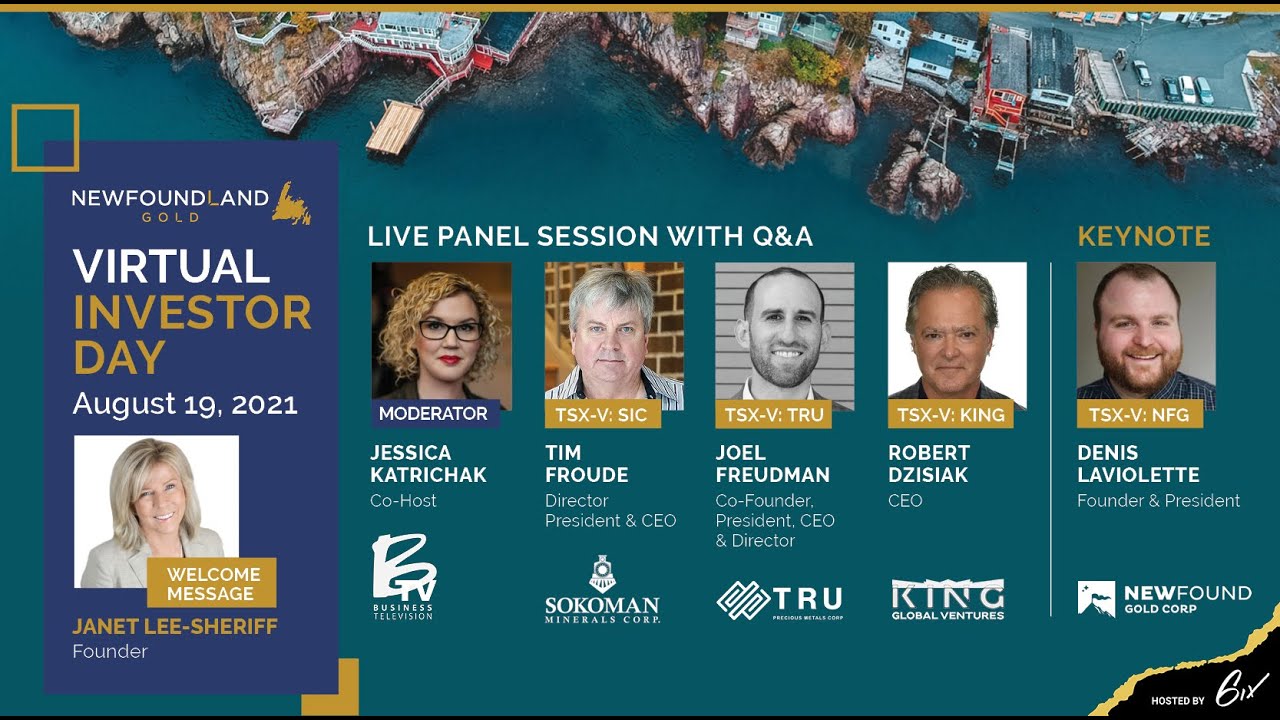
0:07 Thank you very much. And I just unmuted myself and I should pay credit to Tim for putting Newfoundland in the spotlight because in many ways it helped us. So with Tim's discovery, it really catalyzed our ability, even as a private company, to garner interest in what we were doing. And so everyone on the line today is playing a role or has played a role in the past of Newfoundland and most definitely will play a role in the future of this wonderful jurisdiction unfolding before us. So I'll kick start the presentation with a forward-looking statement here. Bear with me as I drive this presentation. So please take the time to read through that as forward-looking statements will undoubtedly be made.
0:56 Okay, so just to jump through a couple of quick things. This is a quick picture of the overall island of Newfoundland and our very compelling and large land position on that island. What brought us here was macrogeology as well as some incredible specimens of visible gold and some very high-grade and I undoubtedly that's what brought a lot of the the other participants in today's presentation and conference into this jurisdiction and surely there's going to be many many discoveries made throughout the the island as we're finally hitting an inflection point where investment money for modern exploration is at long last entering into this landscape.
1:44 So I'll just fast forward through some of this stuff here and our team, I think, and just dive right into to the project itself. So again, zooming into our overall project here, there's 2 key faults that we're interested in. One is the Appleton fault and the JBP fault, and these lie adjacent to the Dog Bay line. Our land is confined to what we call the Davidsville land package or the Davidsville sedimentary suite. It's a turbidite, sandstone, siltstone, and shales of Devonian age, essentially. And yeah, we're basically exploring both of these faults to find what appears to be at very least at the north so far something world-class.
2:29 We had a lot of great work done before we ever got here. So that was one of the great pleasures that we had was we got to come in and eat the lunch of some of Rubicon's work, some of Niranda's work in the early years. But I think this is because
2:50 these groups took to this problem in a very unique way. At the time, Newfoundland and still, Newfoundland is covered, unlike many other jurisdictions around the world and other orogenic plays, by gravel, glacial till. And this hides everything. This is what makes this very challenging. We've heard a lot about the rationale as to why everything is still here And why hasn't anything been found so far if this is such a great place to look? And the reality is, is because it's hard. Everything's covered. There's very little outcrop. And so finally, we have the technology and we have the capabilities to look a little bit deeper. Some of the work that got kickstarted in the 1990s was large till sampling programs and these were done in pursuit of base metal deposits like Duck Pond and things like that. So what was being looked for was really VMS style deposits, base metal deposits, and the area was being scoured, the till was being scoured for that purpose.
3:52 The result of course in this area was gold. There was a pretty pronounced set of gold anomalies that Naranda ended up following on, but with very little capital. When we look at what some of that work led to, it led to the discovery of some veins, some trenching work where a soil anomaly was ultimately then trenched with an excavator and some veins were exposed and drilled, maybe with 1 short drill, maybe 2. And that was about it. Expiration budgets then weren't really what they were today. And, you know, ultimately the market environment, the commodity price, the gold price at that time, $250 an ounce, give or take. Not exactly a great place to or a great sphere to be in the gold space.
4:38 Base metals were the talk of the time. And so this thing didn't really get a whole lot of attention. Moving on to some of Rubicon's work, they did quite a bit of drilling on the H-Pond and Pocket Pond trend on this JVP fault just in here. And again, very shallow work. And it's when we look at this a decade later, so Colin and I came in 2015, And we started looking at what some of these historic numbers were like, and really they were jaw dropping. And so it was about recognizing that this was not only an area with tremendous grade potential, but one that was under explored. There was a tremendous amount of empty space between showings in and around showings. There was 1 off or 2 off drill holes into veins that were exposed at surface, very short things.
5:23 And, and then, you know, those companies ultimately walked so we could really look at this with a under a different lens. It was a district scale play, but more importantly, an orogenic play. And I think that was one of the bits that many missed. We talk about orogenic gold. Dr. Richard Goldfarb, who's an advisor to C2C, is just a tremendous thinker in the sphere of orogenic gold. He's very well published. This is basically the god of orogenic gold belts around the world, understanding these systems better than likely anyone. If you have the pleasure to listen to what Dr. Richard Goldfarb has to say, you'll learn very quickly that this is a world-class orogenic belt but even in 2015 when we came in there was debates, there was thoughts when this vintage of expiration was occurring very early days in Queensway North, there was discussions that it was epithermal or maybe even Carlin type deposits and stuff were a potential. And so the model, the geological model, everything that we're looking for was really, we're looking for the wrong things.
6:38 You know, VMS was again, the primary goal or base metal type deposits. These orogenic gold things, not only did they not name a lot of the features and faults and things appropriately, the recognition wasn't made really that this is the type of system that we have here. And now when we look at it in 2021, thanks to Dr. Goldfarb, ourselves and many other people that have came from different parts of this gold environment, whether it be the Abitibi or in West Africa or other places where we know and smell what an orogenic system looks like and we look at this and it's irrefutable, you know, that's really allowed for us to pursue the right breadcrumb trails, if you will, to make tremendous discoveries. And so that's really what's enabled Newfoundland to be a jurisdiction worth exploring, worth investing in today, because really the formula wasn't there before and it was mislabeled in many ways.
7:37 So just zooming in here, we're looking at the northern portion of our land package, the Queensway North. We have the Appleton Fault here and the JBP fault and a tremendous number of showings, as I've mentioned before, some of these are historic in nature and some of these are thanks to us. Our maiden discovery was made here at Keats and it is a bonafide discovery because what was found at Keats was largely the football mineralization, the low-grade smoke stuff. And, you know, they were very close to the good stuff. Had they stepped back 10 or 15 meters, maybe we wouldn't be here today having this opportunity. But undoubtedly Keats was a very, very tremendous discovery. We drilled behind and underneath all of that stuff and came up with a pretty miraculous intercept that's now matured into a multitude of intercepts that follow that up and some new discoveries further along the Appleton fault zone.
8:31 A major driving force here, so we've heard some discussion about this by past talkers here today, is the Iapetus sutureson. So this is really what underpins this orogenic story and what really needs to be keyed in on. And we'll look at this, even If you look here, Pollock et al, 2007, this image comes from. There was publications in 2013 specifically relating to the Dog Bay Line. We had Hansberger 2018, 2017 comparing this jurisdiction to the Abitibi. So this is really modern, this is new stuff. And if you look at the money flows in the space and some of the discoveries that have been made along this feature in the UK, specifically Dalaradian, through Newfoundland with Marathon, Atlantic Gold being another major deposit here that was sold and is currently producing. We have also, if you go down through the United States, this entire trend extends down there and you have the Hale deposit, which was purchased by Oceana Gold from Armarco.
9:40 All of these happened in sort of the last cycle, which is pretty remarkable. And so you have a tremendous amount of thought leadership paying very close attention. And the market was really well rewarded for gambling on this particular feature as it extends from the UK all the way down to Alabama. And so this is really the manifestation of 2 continents colliding. We have the African plate crashing with the North American plate. And particularly here in Newfoundland, we have a tremendous amount of structural complexity. This crash front is a really thick, juicy package of faults and fractures, and many of them are Gold-bearing. This is the piping system that really formulated a lot of the orogenic Gold systems that we're talking about. The sheer presence of such distinct and tangible macro-scale structures, deep-seated faults and fractures, crustal-scale breaks, These things allow for world-class deposit potential to occur on this island. It was matched by the gravel, as I mentioned before.
10:47 And so we've taken to charge to basically unearth a portion of it. Our focus is the Dog Bay Line, so in this zone, essentially the easternmost feature. This is what it would look like, hypothetical cross-section through such a thing. So when you have 2 continents colliding, if you can imagine, it's not this simple, but I'll make it simple. 2 cars crashing together in the hood of the cars, crinkling up like accordions. And eventually, these, we're talking about rocks here, and they will break. So you'll get these big accommodation faults, these big low displacement faults that occur, and they propagate very deeply. These deep structures basically provide the conduits to allow gold bearing fluids to migrate through all of that material.
11:36 And guess what? They do pick up gold from other features. So some of that VMS stuff that we're talking about, the sheer presence of that, this can further feed into the system and allow more metal content to be injected into these fault systems. And so here we have 2 that we care most about, the Appleton and the JVP as a hypothetical cross-section through either of those. So again, here, this is a zoomed out view back to that of the entire property package in the Stavidsville group. And this is really the sedimentary group that we're key, where the JBP and the Appleton Fault sit within. We have this Mount Payton batholith. This is older than the gold event or the orogenic event here, not sure exactly how much. I mean, that question is being answered as we speak. There's quite a bit of academia surrounding the age dating and the relationships between all of this stuff. But essentially, we believe that it would play some role in a very least rheologically in allowing for fluid pathways in these structures to occur where they do.
12:45 You know, some parts are going to be a bit tighter and Some parts are going to be a bit tighter, and some parts are going to be open and dilated and allow for more fluid flow. We took to this with a very systematic approach as Tim was mentioning on one of his other projects that he's developing. The first step was to use till sampling, geochemically sample the entire belt. So we did that. We came back and we've employed many modern geophysical tools, notwithstanding this airborne EM survey that was conducted, we followed up and achieved tighter line spacing on follow-up surveys. We've also done airborne gradient gravity and many other things to really try to take the lid off of this. Again, the big problem here is till, you can't map the rocks. And so remote sensing plays a really big role in finding gold in this jurisdiction.
13:39 We compare this jurisdiction to other orogenic belts around the world. And one that we like to compare to, and it's not even us, that's gonna be the academic bodies in Newfoundland have compared it to this for quite some time, is the Bendigo Gold Belt in Australia. This is the Victoria Goldfields. It's been exploited since about the 1850s and has produced over 22Moz of Gold. This is a very prolific gold belt in Australia. It's exactly the same age, it's exactly the same rocks. We have Caneborough Division to Devonian, Turbidite, Sandstone, Silsil and Shales. The metamorphic grade is sub-green schist to green schist in both jurisdictions. The structural conditions are almost exactly the same. We have a lot of the same accessory minerals. So not only are we in the similar system, we're also in, in many cases, at least in the case of Fosterville, in the same part of the system. And so when we look at an orogenic system, You can be very high up where these faults came through the crust and gold was carried all the way through the crust and brought very close to surface and precipitating in the form of veins and visible gold. Or you can be very deep down in more ductile rocks.
14:46 This would be more mesozonal. We're in the epizonal part, the upper part of that. And there's some really characteristic things that we look for to fingerprint the fact that we're there, antimony being one of them with our belangerite and stibnite. We have also a lot of textures, brittle structures, things like that, that suggest that we are in this epizonal horizon. And surely one of the shining stars of the Bendigo Gold Belt in Australia is of course, the Fosterville Mine and the Swan Zone exhibits all the same aforementioned characteristics. I'll just dive in strictly into the Appleton Fault and the stretch of it we're exploring today. So our journey began with Keats and We got extraordinarily lucky.
15:31 We knew that the structure was right. We had a bit of low grade to work with on surface, some good smoke. There was some high grade flares for sure. Some of the other showings historically on the project were far better in terms of numbers that were yielded from that historic work. We'd even found some of our own, but nonetheless, Keats was the first place we decided to stick a hole. And sure enough, Eureka, we hit a 19 meters of 93 grams. And that today has evolved. We've been continuously exploring this zone. We found mineralization in the footwall towards the Appleton fault itself. And when I talk about the Appleton fault, I like to depict it as this nice black line on a map, but in reality, it's like it looks here. It's this braided network, complex network of a deformation zone, really. It's not a discrete fault or a crack. It's just a braided diffuse deformation zone that extends basically for many, many kilometers, at least on our land package, almost 100 kilometers.
16:33 And then our neighbors to the north also have exposure to this basically all the way to the coast.
16:44 We started as I mentioned with the Keats zone and that's been developing. We've been continuously following that up and chasing it to greater depths. We've been trying to fill in the gaps because basically what's manifesting here at Keats is that we have this beautiful second order structure that comes out of the Appleton fault zone. We've been systematically exploring that second-order structure and it balloons out into this big dilation zone that formulates the highest, thickest grade portion. You'll see a lot of our drilling focused along that trend because it gives us the largest widths and the best grades quite simply put and but above and below that are also to, you know, of material interest. The structure is still there, but the widths taper up to a smaller width. But in some cases, we still get incredible grade. So if you have a look at the table here, you can see some examples of both, some really nice, big, wide intervals with great grade. And you can also see some pretty small intervals with high grade as well.
17:50 So the overarching message here, I guess, is that we're going to intersect these great high-grade chutes within a larger, prolific mineralized system, And that system is really, really big. So we stepped out 2km to the north to a zone called Lotto. And Lotto was again, some trenching, etc. That gave us good indices that there was Gold there. So we followed up on Lotto and sure enough, our very first hole came back with 2 tremendous intervals, 4.8 meters of 41 grams and 5.2 meters of 25 grams in the same hole. And so since then we followed up and we've found quite a bit more mineralization at Lotto and that story is really coming together for us. We followed up on the dome. The dome was, you know, this is actually quite a famous showing for the project because it's one of the only places where you see outcrop and it's this massive outcropping vein.
18:46 It looks like a big knob of quartz sticking out of the ground. And over the years, people have picked off really tremendous specimen type samples off of the dome. And so we've been following up on that. And then we went, we sort of split the difference, if you will, between the dome and Keats, and started working our way back towards Keats, and we drilled into the golden joint. And so we've been having a lot of fun pursuing that, and that's delivering some really good numbers. The key here is that there's a lot of white space on this image above, this long section. You can see tons of areas between all of these zones that need to be explored, and these white bocuses represent 50 meters. And so if we're looking down at depth here, on average, we're well within the top 200 meters, and that's going to continue to grow. These systems do not stop at 200 meters deep.
19:42 If we look at orogenic systems around the world, they're kilometers deep in many cases. And so we could be experiencing and finding new high-grade chutes and new additional zones at any given depth. And this is just a 2 kilometer stretch of what we already know is basically a 7.8 kilometer manifestation of high-graded surface. So this is a zoom in of Keats. And as I mentioned before, just to show you, we've been following down this trend, this plunge of high grade. And there's minimalization above and below that. Below, we haven't had as much joy, but again, things can sort of pinch out and then bang, you get another balloon. So there could be a repetition as we go deeper along this plane.
20:28 But right now we're just Continuously chasing this down and we're having good success above so we're continuously filling in this above wedge. We call it And and we're getting back some some pretty nice numbers from that. So that's the the story of Keats the Gold circles represent drill holes that we've we've drilled and we have assays back for. And like everybody else, assay labs have been slow and the turnaround has been slow. So the gray circles represent holes that we've drilled. We just don't have assays back for. So pay attention to those. And hopefully in the future, we'll be pressure leasing some of those as they come in. One of the key things with Keats, and I think is going to hold true for many places along this feature, both on our property, off our property, other places, is that there's a couple of things happening. We have this tremendous zone along a second order structure, the Keats main zone. This is a plan view looking in. We're grading towards the Appleton map here. We're drilling essentially west.
21:25 And as we're doing that, we're intersecting a tremendous amount of footwall mineralization. So there's other veins back here. There's other potential zones. And at some depth, they could blow up and become, you know, more important than even the Keats. We don't know yet. But ultimately, there's a ton of mineralization back here. And we're really, right now, mission number 1 was to understand what's happening with the main zone. And we're discreetly modeling out the footwall zones as we speak to get a better understanding of their architecture. And this is just all illuminating what really there is to pay attention to as we move our exploration forward above, below. If we look over here on the West side of the fault, I got the question the other day about how come we're always drilling on the East side of the fault? Does that mean the West side's no good?
22:15 And the West side's really good. We've got some really good examples of that. Some of our neighbours to the North have been exclusively finding things on the West side of the fault. The West side, by all means, has just as much potential. It's just that we've had greater success on the East side and we started there. So eventually we are going to move over and if you look at some of the sparse drilling at Coke Zone, even drilling the other way, not only are we hitting some high-grade close to surface, but we're hitting some pretty good low-grade intercepts. This is a very, very big envelope and this entire thing spans almost 500m end to end. So it's a very, very compelling thing. And so, you know, it's not to rule out the fact that this could maybe even 1 day materialize into a bulk tonnage situation, even though we have a very key focus on developing high-grade tons as we speak.
23:11 Jumping up to Lotto in the same fashion, we're looking down on these zones, Lotto Dome, a Golden Joint. As you can see, we call it the Golden Joint. We've got the Lotto Baseline Fault somewhat intersecting in theory with the Appleton Fault zone. We've been drilling that intersection, hence the term golden joint, and we're finding mineralization sitting inside of the Appleton Fault. It's not the first time we found it. As we went up to Lotto, we drilled through Lotto and we kept the drill hole running and we found the Sunday Zone sitting inside the fault. And so the fault is open for business and it's actually a target in and of itself. And so we're trying to make heads or tails of that too. So there's tons of expiration potential, not only in these second order systems and all of the space in between them, connecting them, but moreover in the Appleton Fault itself. And some of these numbers are just absolutely incredible. As you can see from some of our most recent results from Golden Joint, and I'll point out the 5.3 meters of 430 grams.
24:15 And if you go further to the east, you have this little zone over here, road. We haven't ignored it, we haven't forgotten it. It's not any less important, but road has some pretty cool numbers. I mean, we've just released as a batch of other holes, a couple of intercepts here, 2.9 meters of 9 grams and 35 grams over 2.7 meters. So these are great intercepts. Anywhere else in the world, these would be headlines. And for us, somehow we got, they got lost in the couch cushions to some degree. But road is a very important zone for us. And if you look again, the width of this section, so forget about the strike, the strike extent is huge, it's beyond this map, but the width is really big too. The amount of prospective ground just along the 7.8 kilometre stretch in strike, Both on the hanging wall side of the Appleton fault zone or to the east of it and the foot wall side to the west Of it. There's a tremendous amount of exploration potential the possibility for new economic zones to be folded into this thing.
25:21 This is just some zoom-ins here of a couple of the other zones we've talked about in the cross-section of Lotto. I'll skip through some of that and get into some of what the Gold looks like. One of the cool characteristics we talked about is the comparison to Vostrovil. One of the cool things you see about this thing is that when you look at some of these veins, they're somewhat unremarkable, I'll say, being a geologist that's worked in orogenic camps around the world, mostly in mesozonal systems or mesothermal systems, in the Archean greenstone belts that we're very familiar with in Canada, like in the Abitibi, or even in West Africa in the Ashanti Belt. And you don't really see these milky white veins being all that attractive.
26:08 And here, what's very unique about this is not only are these veins gold bearing, but if you look closely, you can see all of this fine grain disseminated gold, it seems, inside of the matrix of this quartz. That's a telltale sign that this happened very explosively. This is an epizonal deposit. We have buggy texture in our veins. There's also this strange kind of almost crustiform, coliform banding that we get. That's almost an epithermal flavor and maybe why this was mischaracterized as an epithermal deposit once upon a time. You know, there's a lot of really cool things that we have, not just in terms of grades in common with Fosterville, but also all of these textures and the way that this gold occurs is very, very unique.
26:59 So again, just some more images of what this looks like when you drill it. I'm just going to jump over briefly 5km east. This is the parallel trend to Pocket Pond, H Pond. This is the JBP system. It's very big. It's very impressive. We're really excited to be drilling this. So it's one that for us, we're drilling actually as we speak, and we're going to continue to do that. But we just have very little drilling anywhere outside of Pocket Pond or H Pond. But we have this system with surface mineralization for 12.4 kilometers. And this is the map that I like probably best, which shows both of those things I just talked about. So you've got the 7.8 kilometers on the Appleton, all of these samples are greater than 5 grams that are red. And you can see that both on JVP and on Appleton. And we've really just tested a few little spots. And as we're adding rigs, we're getting a chance to revisit and fill in gaps and find new things. So if You can imagine this system extending down hundreds and hundreds of meters in 3D, the number of new zones that we could find, how many kitses might be here, how many lottos and roads and golden joints might exist along the Appleton Fault itself or some of these second order features.
28:18 It's just really a bottomless pit of potential on the northern side of our project. And I'll make this last comment as I guess we're wrapping up on time, but both of these structures extend for 70 kilometers to the south, and we've got great soil targets plotting along those structures. And so we're working this up as we speak. We've got a team of about 15 people, and a little camp down here, and we've been working up scouring this ground, opening it up. A couple of excavators are in there now trenching on things. And so we're really excited to find new things down here and try to unlock some potential on the southern extension of both the Appleton and the JVP on the southern portion of the project. So that's basically it, I think we can probably put it in park there.
29:06 Some things to look out for with Newfound Gold in the future. We're really key on being a data-driven company and trying to employ the most modern mining, you know, Exploration 2.0 techniques. We've got a close relationship with my other company, Gold Spot Discoveries, and we're currently looking into new tools that we think will give us an edge. And one of them is We haven't made a decision on it yet, but we've certainly put in many hours of research and it's about possibly being using seismic in this land package to help sharpen our exploration efforts. And so with that, I'll hand it off and really exciting times for Newfoundland, exciting for all the other companies. There's a tremendous amount of potential here and wish everybody the best.
29:53 Hello again everyone, Janet Leigh Sheriff. On behalf of everybody with Newfoundland.gold I want to thank you for your time today. I also want to thank CSR Management and their fabulous team for helping to pull this together, along with 6 and Dasha, a big thank you. Our panelists, 3 fabulous companies, Thank you so much for your time. And Jessica and Denny Lavallee, thank you again. I welcome everybody to follow newfoundland.gold. Our website is that. You can also watch the conference again on that website as well as six.com, S-I-X.com. Thank you on behalf of all the member companies of Newfoundland.gold.
30:39 We have a fabulous, very busy exploration season underway, and there's a lot of results that we're expecting for this fall. It's been an exciting season in Newfoundland, Labrador. I also look forward to seeing everybody at the Precious Metals Summit. Newfoundland Gold will be there and will be representing the jurisdiction along with all of our member companies. Please look us up. We're proud to announce that we'll be having a great presence at the Vancouver Resource Investment Conference and look forward to seeing everybody there. Again, follow us on Newfoundland.gold and follow us on social media. Thank you again for your time and your interest and have a wonderful day.