Transcript
Automated transcript · Written by software from the replay's audio. It can mishear names and figures; the replay is the record.
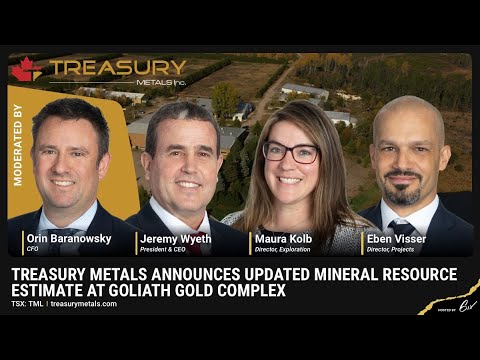
0:08 Good afternoon, good evening, good morning, depending on where you're located across the globe. Welcome, everyone. Thank you for joining us today at our 6 Investor Summit. I'm Warren Baranowski, Chief Financial Officer of Treasure Metals, and I'm joined by my colleagues, Jeremy Witt, President and CEO, Mark Holt, Director of Exploration, and Ibn Vissar, director of projects. So on Thursday, Treasure Metal released an updated mineral resource estimate for the Goliath Gold Complex that showed growth across all categories and improved
0:40 our confidence levels in the geological models as the basis of the resource estimate. We've got a few slides here for you that we'll walk through. There was a press release that we put out and a more detailed presentation. Both of those are on our website. Also attach that presentation as a handout here today. So Jeremy's going to give us a quick high level overview of what the company's done over the last year, and then he's going to turn it over to Maura, who's going to get into a bit more detail on the geology of the deposit. And then Evan and I will be available with both Maura and Jeremy to answer any questions that you might have. So before handing it over to Jeremy, I just want to point out this event is being recorded. And I'd also like to point you to the forward-looking statement language in the presentation, as well as on our website, which urge you to read at your leisure. And so with that, Jeremy, can you kick things off?
1:34 Excellent. Thank you, Oren. It's been almost 6 months, 8 months since we did our last session on 6, so really exciting for us. I think it's probably worth just taking us through the last 18 months as to how we got to where we are today. So August of 2020, we had the acquisition of Goldland, which for the first time for Treasury Metals provided that critical mass to take the project forward. A lot of new people have come on board. In 2021, we set ourselves quite a few objectives and I'd like to go through them. February, we released the PEA, which showed a really solid base economics with good leverage to gold price.
2:22 We committed to drill, we raised funding in March, we committed to drill 60,000 meters. And that was mainly to increase geological confidence and grow the resource. That we did, as you can see from the latest resource estimate. We committed to assemble a team of mine builders, and we're actually at the point now where we have the full team in place, a team that can take us right through to operations. We integrated the data sets and models for Goliath and Goldland. In the PEA, we had 3 QPs for the 3 resources. We've now pulled that into one. And Moira and the team have done a huge amount of work to actually integrate these data sets so that we we can now start using it from a regional perspective.
3:15 And we've now, based on that, embarked on a generative exploration program to identify new targets on the property. And Moira will talk to that as well with the new discoveries that we've had in our recent press releases. So I think it's fair to say that the TML team has achieved the objectives we set out for, to achieve in 2021. For 2022, we released the updated mineral resource estimate. So that's done. We closed a royalty financing with Sprott, which funds us through to a construction decision. And then the activities that are underway at the moment, Pre-feasibility study, now that the resource is published, we will now kick off with the pre-feasibility study.
4:10 Our plan is to show growth from the PEA as we committed to. We have a 25,000 meter generative exploration program, which is underway. And then we'll continue IBA discussions and permitting activities, especially now as we get closer to the PFS coming out and we actually know exactly what the project looks like. I won't go through all the numbers in this. I think what's important for me is that we are now sitting with measured and indicated resource of 2.1 million ounces and almost 800,000 ounces of inferred. So, we're getting close to a 3Moz combined measured, indicated and inferred.
5:00 And I think importantly here, we've only really looked at 3 odd kilometres of the 65 kilometres of strike. We incorporated about 41,000 metres of drilling in this resource update of the 60,000. So there is still more that is coming back from the laboratories as we speak. It won't be included in the PFS, but will definitely be available for upside as we move into the feasibility. Overall high level numbers, we increased the overall measured and indicated ounces in the pits and the underground by 173,000 ounces, which was 9%. And we increased the overall inferred ounces by 255,000 ounces, which was 48%.
5:51 And we'll let Moira talk to the improved confidence. And I think really importantly for us here in the PEA, our conversion from measured and indicated at that stage, including inferred, was less than 50%. And what we're doing here with this increased confidence in the block models, we see that as one of the tools to allow us to improve on that conversion as we move through the mine plans to a reserve. Moira, if I can ask you to take us through the changes in the block models and the geology please. Yeah, thank you Jeremy. So I thought I'd start from the rocks themselves. So, you know, Jeremy mentioned that we went back and we amalgamated the 2 databases and we worked to integrate the rock codes and understand the 2 deposits together.
6:45 So when we sat down with SRK to begin this resource update, we looked at the geology for Goliath. You know, we have a nice halo mineralization here, alteration, which you can see in that top photo, that's very easy to see and define. And then we know just that. We did discrete wireframes for the high-grade mineralization and then low-grade wireframes for the halo mineralization at Goliath.
7:11 Now at gold London Miller we have a totally different style of mineralization. It's a typical Archean but it's related to granitoid intrusions and the contact with those specifically. So we have veins and sulfide mineralization making up that gold mineralizing system. And The veins are at many different orientations. You can see from the photos there that there are multiple orientations, and so very difficult to capture in a wireframe. There are a few instances where it's really tight. The mineralization is really tightly related to a contact between the granitoid and mafic rocks and there we are able to capture a high-grade wire frame. But outside of that mineralization we used a probabilistic approach the same as the previous resource to identify what would be high, medium, and lower grade and then did the estimation from that. So we worked with the team to figure out the best approach for these 2 different geological settings and we feel really happy with the way they've come out as being very representative of the geology. So on the next slide we'll look at Goliath specifically And here we see on the top, the PEA resource pit and underground designs.
8:24 And the bottom image is the updated mineral resource pit and underground designs. So we spoke before about capturing the high-grade mineralization with specific wireframes. So the reason for this was to show the continuity of that high-grade mineralization. And as you look at the difference between the underground stopes in the PEA to today's updated mineral resource, you can see there's more continuity on the strike and dip, which is what we see in the geology. So we are happy to see that kind of continuity come through in the underground stope shapes. And you can see the increase as well. The table there shows just the ounces for the underground stope shapes. And the cross sections as well show you that the pit, very similar shape, but now we're getting that continuity in the underground.
9:14 Next, we'll look at a video. Switch to it. And this is looking at Goldlund. So right now we're looking at the PEA mineral resource and we'll spin it around and then we'll show you what the new updated mineral resource looks like. Now remember a lot of the drilling was
9:32 at Goldlund, 120 of the holes and a lot of that was focused around the main pit. So you can see now that we're looking at the updated mineral resource, it's quite a bit deeper and that main pit has really grown. So that's where a lot of our drilling effort went into understanding the accessory zones around zone 1 and zone 2. And we've really seen growth there and in the resource. And just again, from the plan view, looking at that into looking back at the PEA and the change we see there. So nice growth at Goldland, sorry. Now I'll turn it back over to Jeremy. Thanks, Moira. I think if we look at the diagrams we have here, we try to break down the resource into different intervals. So we had an idea of where the, in those different intervals, how many ounces and how many tons were available to us. And this is only in the open pits.
10:32 So if we look at Goliath, the top we're looking at above 2.2 grams per ton, 1 to 2.2 in the diagram below it, and then 0.25 to 1. And I think for me, The numbers that I'm looking at here are, if we look above 2.2, we're looking at 254,000 ounces and if we look at above 1 to 2.2, we're looking at just over 204,000 ounces. So if we go and we look at Goldland in a similar way, above 2.2, we have 221,000oz and between 1 and 2.2, we have 238,000oz. So it shows you looking down mineralization and looking in section as to where we see a lot of these intervals and where these ounces are. And this is important for us looking forward, especially with the startup of the mine with the open pits.
11:35 If we look at both of those combined now, we're sitting with 476,000 ounces above 2.2 grams per tonne, which is about 40% of the measured and indicated ounces. And if we look above 1, we're looking at over 900,000 ounces, which is 62% of the measured and indicated. Now, what's important for us here is that conversion from the resource into the mine, through the mine plans into the reserve. So what we were looking at here is this is only open pit and if we remember the PEA was looking at about 100,000oz
12:19 per year. So this just gives us an idea of how we can actually now get that flexibility that we wanted as far as the scheduling, whether we bring the underground in earlier, whether we start with open pits, it gives us a lot more flexibility. And we were encouraged by what we saw here, which was quite similar to the PEA, that we have a decent amount of those answers in the open pits at good grades. Arun, back to you. Thanks Jeremy, thanks Maura. So I think we'll now open the floor up to questions for people. Maybe the first question we'll kick off is, I guess maybe Jeremy, you can talk to some of the catalysts going forward over the next 6 to 12 months for the company.
13:12 Okay, Arun, just talking catalysts for us moving forward. Now It's been an interesting or a very busy couple of weeks with us closing out the Royalty transaction, getting the mineral resource estimate update out.
13:27 We now take a lot of that information from the mineral resource. Jürgen and the team will put that straight into the PFS, we're starting with the mine plans as we speak. We're looking at the second half of this year for the PFS to come out. We know that we're not going to be able to bring in, for example, the silver. We've sent a lot of assays away for silver. It won't be back in time for the PFS, but what we like with that is it leaves upside for us for the FS. So PFS second half of this year, moving straight then into an FS. And while we're doing both the PFS and the FS, obviously continuing with our permitting and with all the community work and looking at getting our agreements in place for that.
14:19 Still looking at having an FSA start in the second quarter next year. And with that, going forward to Q4 of next year, 2023 for a construction decision to go ahead with the project. And then looking at, you know, timeframe for discussion for construction and then looking at another question was the probability of going into commercialization. So, I mean, what is the timeline for starting construction? And then when do we look at
14:55 when commercial production would be?
14:59 The plan at this stage, Q4 of 2023, we would take a construction decision. These projects typically take 18 to 24 months to build so let's say it's 24 that would be Q4 of 24, 25, 23 to 25 and then straight after that it's probably about a 6 month process into commercial production.
15:24 Contract mining, Irwin, can you maybe talk to open pit mining, whether we're looking at in-house and then also whether we've looked at flotation instead of CIL. Yeah, so thanks Jeremy. Now that we've gone through the resource estimate,
15:45 we'll, As far as the mining schedule and the method of contracting, whether that's the same for both Goliath and Gold, and we'll form part of the straddle study that's set to complete next month and 0.5 or so as part of the BFS but it is definitely one of the things that we're looking at. And we also, like I said, we're not putting everything under the same umbrella. We're definitely looking at treating or potentially treating Goliath differently to Gold and then differently to Muller. In terms of the Met test work, we've gone through quite an extensive programme in the last 6 to 8 months, specifically geared around understanding
16:27 the metallurgy and the mineralogy at Goldland and at Muller. And we've seen quite a lot of benefit out of that program. So, that's getting incorporated into the BFS. It's a big driver along with the transport and haulage options between Goldland and Goliath. The met test work and eventual flow sheet the selection is quite important for us in terms of the Under specifics around the circuit and which sort of flow sheet we all will be selecting I mean that's going to be the subject of the BFS. It's coming up We are running part an extensive program on solar which will only be included for the feasibility study. It's about 3,600 samples that's going for assays.
17:15 So that won't be incorporated in the PFS, but definitely in the feasibility study. And that's to include silver, gold and net molybdenum. I see that there's another question about what could be the total ounces for gold, london and Goliath. It's really early to say there, but I think with our exploration outlook this year, we're really trying to find additional satellite deposits. So, I've spoken about Far East already, we're looking at Foldnose, which is also quite close to the Goliath deposit itself. There's huge opportunity on Goldlund property, strike, but then we're also looking at other targets like Interlakes, which is in a folded area where we see really tight folding in the geophysics.
18:06 We're going in this year, as soon as the snow melts, to do field mapping there and then follow up that with drilling. So, you know, could we grow? Could we double? Yeah, you know, it's kind of pie in the sky right now. There's a lot of exploration targets to pursue. So I'm pretty excited about the opportunity. One of the questions that we've been asked is CapEx creep and OpEx. A lot of mines are being built at the moment and there have been some changes in both CAPEX and OPEX. Ibn, I think you can talk to some of the benchmarking we're doing, the fact that we've you know been challenging the financial model both from a cost perspective and a revenue perspective, and maybe I'll ask you just to talk as to how we're approaching that moving forward.
18:54 Yeah, so I think like everybody is aware of the inflationary pressures that we're living in, Jeremy. I think That's undeniable. The PEA was published in March of last year, so we know exactly what's happened in the last year. Our approach for the PFS will be to understand how those inflationary supply chain pressures drive both our schedule and as well as OPEX and CapEx. A lot of these trade-offs are obviously geared to reducing costs both in capital and in fixed as a form of mitigation around increase in supply of material and goods and also especially on the op-ex side the increase in in the cost of diesel and Consumables But then also on the revenue side, and that's where this, things like the haulage selection, the flow sheet selection is so important so that we understand how we can maximize the revenues, whether that ends up being, you know, Now that translates into NPV and free cash flow.
20:04 On the supply chain side, maybe just to add, I mean, the recent royalty agreement with Sprott gives us that flexibility, three-tier construction decision to start that part of procurement and detail engineering with vendors and suppliers, which mitigates a lot of the schedule risk that we're seeing. I think it's also important that, and I think some of The other projects that have had some changes in costs also did their studies during COVID, but ours was done in the middle of COVID, so we already have some of that built into it. We'll be looking at three-year rolling averages for different things. We also need to bear in mind that we're not building right now. We're only taking a construction decision in 18-months' time and then it's going to be another 2 years to build it. So from an operations perspective and a construction perspective, we need to be careful that we don't build in everything that's just happening right now because we do still have some runway on that.
21:15 I think we'll take maybe a couple more questions here. Probably this one for you, Evan. A question coming in. Is there sufficient power supply in the area for a mine project of this size, or will generated power be required? That's an excellent question. Infrastructure in general around the project probably sets the Goliath Gold Complex aside from a lot of projects in northwest Ontario and in Canada as a whole. We have overage supply that runs within 500 meters of where the process facility and Goliath pit will be, sufficient electrical power available, sufficient road and rail transport infrastructure, natural gas. So when it comes to the mode at which we will power the mine and mill, that is again part of the PFS.
22:19 There's 2 sides to that equation. One being is that we want to obviously get access to infrastructure that's readily available at the lowest cost possible, but we also cognizant of how we future-proof the mine, in which electrification is obviously a big part of what we'll be looking at. Great. Thank you, Evan. And I think with that, we'll wrap up the discussion today. Thank you, 6, for hosting this event for us, and thank you, everyone, for joining us and supporting us on our journey. Feel free to reach out to us if you have any further questions at info at treasuremedal.com. And then I'd also encourage you