Transcript
Automated transcript · Written by software from the replay's audio. It can mishear names and figures; the replay is the record.
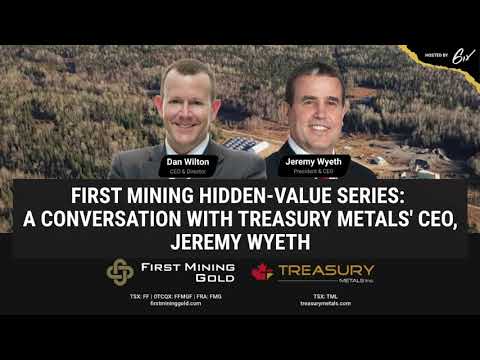
0:08 Hello, everyone, welcome to the second installment of 1st Mining Gold's Hidden Value series hosted by 6. I'm pleased to introduce today the CEO and Director of 1st Mining Gold, Dan Wilton. And with us today is our guest, President and CEO of Treasury Metals, Jeremy Wythe. Remember, during today's conversation, you can submit your questions using the Q&A panel found on the right hand side of your screen at any point during today's presentation. And as always, this event is being recorded and will be available to come. We'll be available to watch on six.com in the coming days. Without further ado, Dan, I'd like to hand things over to you and get us
0:39 started. Cam, thank you very much for the introduction. Jeremy, welcome. And to everyone who's joined us here, thanks very much for joining us. Apologize for a slightly delayed start here. The focus today really, as we've been talking about the hidden value series amongst the 1st mining shareholders, we do continue to get a lot of questions about Treasury Metals. And I just thought it'd be very important or just a great opportunity to get an update from Jeremy on the progress. You know, there's some very exciting things coming toward Coming toward Treasury metals here in terms of milestones over the course the next Course the next few weeks and months you know, I think one of the things that people haven't really appreciated is the extent to the exploration success that Treasuries has been having up and down Goliath and Goldmine. We'll get Jeremy to talk a little bit about that.
1:45 But first and foremost, Jeremy, welcome.
1:50 And yeah, maybe helpful just to, you know, we'll start at the beginning just with a bit of an update in terms of where things are and level set everyone around the progress you've made over the last 6, 9 months at Treasurer. Excellent, thanks Dan. Now, the last time we were together was on site, so it's actually quite exciting to go through another update. I think maybe If we step back just a little bit, the important thing for us was at the acquisition, which was now, my gosh, 18 months. Almost 2 years ago. Yeah, almost 2 years ago. And that gave us, now the term we've used is critical mass. That gave us the opportunity, I think, both properties by themselves were just not quite big enough to be taken forward.
2:42 With that acquisition, we got that critical mass. We've done a lot since then. We did 60,000m of drilling last year. We've put out a resource update recently. I think the really important thing, and you've alluded to it, is just that exploration upside. It's probably the first time in a while that we've seen the resource grow as we've done more work on it, which is always important in these processes. You know, it was a commitment we made. We want to grow it from PEA to PFS to FS. And we've taken that first step. We saw a nice growth in measured and indicated of almost 9% and a bigger growth in inferred of 48%.
3:28 So we've seen that, which I think is important. We've kicked off all of the trade-off studies. They are in full swing. We're in the process right now with a lot of the mine planning, getting all of that done, looking at how we transport material from Goldland through to Goliath, make test work. We've done quite a lot of that recently. So, you know, it's exciting. We'll see all those results in the PFS, which should be out in the next, we said second half of the year, we flat out in it. So as soon as we have that ready, it will go out.
4:07 If we look at other things that have really happened over the last while, end of last year, we raised some money for this year's drilling, some flow through, 25,000m that the team have for this year and all of it exploration. So I think to your point, this is to me where, you know, the untapped value is here and being able to take this and just look, We've had a few discoveries in the last 4 or 5 months.
4:34 We've got 3 really exciting areas. We've just put out a press release on Far East. We've spoken about Foldnos. And then the one that I'm excited about is getting into interlakes. It's never been drilled and for those who know northwestern Ontario, it's pretty clear why it's never been drilled. It's not easy to get into. And then also recently raising 20 million US in a royalty with Sprott, which now puts us in a really nice position that while the market sought themselves out, we're not looking to raise money. We funded now through until we take a construction decision towards the end of next year. So I think if you look at all of those things, that's probably a wrap up of the last 18 months, 2 years, but really exciting moving forward.
5:29 Yeah. So let's, Jeremy, let's knock it on the head because it's a question I'm sure that you get asked all the time. We're making all this good progress. You've demonstrated a robust economic project.
5:43 You've built a team. You have a federal environmental assessment in place. You're moving through provincial permitting. You're making progress with the indigenous communities around you But yet the share price is where it is. What what do you? What do you think is causing that? Dan, I think a couple of things. I think legacy. I think the project has been around just as Treasury has been around for 15 years. And I think there have been a couple of false starts. And I think people are looking at it and saying, and I've been asked, so why is it different now to what we've heard in the past? You know, I think you've
6:29 raised a whole lot of points there on the critical mass, the federal EA, the team in place, the PEA, which had good results in it. And, you know, we're looking at how do we take that and improve on it. So that's where we see it moving. Markets have been tough, the team's in place. And I think if you, I think so the legacy is the one issue. I think the other issue that's hitting us is the fact that there are quite a few projects on the go at the moment in Ontario that have seen tough times and they've seen increased capex and they've seen all sorts of things happen to them and I think the market is actually looking at it now and saying, you know, we're going to apply factors to what you're saying based on what's happening around you. And
7:22 I think that's unfortunate. I'm pretty comfortable we're not going into a PFS that's gonna see the blowouts we've seen elsewhere. And let's put it in perspective, Dan, it's not a $2 billion job. It's a 230 million Canadian job, 5,000 tons per day.
7:45 It's not of the same magnitude that we see elsewhere. And also bear in mind, we started it in the middle of COVID. So we're not going from a pre-COVID to a now. And I think my concern probably is more on logistics and supply chain than it is right now. We're going to see pressure on CapEx and OpEx but we must also be careful not to apply today's numbers to everything we're doing. We're taking a decision in 15-18 months time and we're going to be in operations in 3 and A04 years time. So let's be careful we don't apply everything as of today and shoot ourselves in the foot.
8:31 Yeah, no, for sure. Because the market, you know, 6 weeks ago was saying we're going to have rampant inflationary pressures forever through your commodity prices. And today they're saying, you know, this is a disaster and we're falling off a cliff. So what We always think about this in the context of Springpole as well as we're moving through that Feasibility Study. Picking that point in time is tricky. In some senses, you can't pick the point in time. You do a study, you have to come out with robust costing at the time that you complete that study. But I think the timeframes that we're talking about, to your point, are the timeframes through which supply chains adjust.
9:17 They're the timeframes through which capacities in industries adjust. I don't think it's fair or logical to be looking at peak Steel prices, for example. They're going to revert to a mean. We face the same thing with Springpole. I know exactly what you're talking about. And the other point that you make, where there have been some of the projects that have had some real challenges in construction right now. I think part of it is you're building during COVID and the most expensive thing you could do is have a crew there ready to build and not working. I think that's a lot of what's happened during COVID times where you've had that trouble with having people in place.
10:02 Some of the other real challenges have been in infrastructure, right? And that's one of the things that only highlighted when we were at site a couple of weeks ago. You know, this is, You kind of hate to say it, but it's about as easy as it gets from a logistics and infrastructure perspective, right? You are so blessed with the location of this project. We didn't mention that in the puzzle pieces at the start, but Dan, let's put this in perspective. I thoroughly enjoyed taking a bus from Sioux Lookout with 25 people and showing them our mine site where we can actually drive to a drill site. Yeah. We can drive to each one of Goldland, Goliath, and you know, let's put it in perspective.
10:49 The last project I built was at the end of a 400 kilometer winter road, so probably a little bit more complicated than what you have at Springpole but 60% of that project was logistics.
11:02 When you're talking a truck every 20 minutes out of Moosonee up a 400 kilometer winter road, we don't have that and I think the markets probably aren't really appreciating that. Pretty much any bit of mining kit that goes up the Trans-Canada to any one of the mines in Northwestern Ontario goes past our turn off. Yeah. And it could literally turn in there when we talk about, you know, we have Dryden and Sioux Lookout right on our doorstep and we have, you know, supportive towns that are really seeing some pain with the downturn in the paper industry, then things like that, where they're supportive. How do we help you?
11:48 It's not a fly in, fly out camp. It's those sort of things that are, now you asked what's happening in the markets, and I think there are a whole lot of them, that just being an additional one that I think at some stage the penny will drop and people will say, you know, this really does have way more pieces in this puzzle that are complete than anything else I know in the area. Yeah, no, For sure. So maybe just talk a little bit about what some of the trade-off studies that were done kind of post-PEA in terms of kind of the fine-tuning of the final scope of the project and To the extent you've landed on some of those, what are some of those that you can talk about as well?
12:34 Well, none of them have actually been published yet, but I can talk about the areas that we're in. 1 that was very important for us was transportation from Goldland to Goliath. So we did look previously at things like railway where, you know, we write on, we have a power line running through our property. So the previous base case was looking at at trucking from from Goldland to Goliath. We now looking at very seriously bringing rail there in as an option for that, using electricity. We go from, you know, 6 bucks 50 a ton to 50 cents a ton. So we really are talking a huge opportunity here.
13:21 Yes, additional CAPEX, but if that's not right in the beginning, then it's not part of that initial build. It allows us to get everything permitted and put in place. We did a lot of work on the MET test work.
13:37 So we looked at, we had a lot more samples and work done on Goliath than was done on Goldland, understandably so. So we did a whole lot more work on that. And we're coming to now what we believe would be the optimal flow sheets. And we're also looking at this in a sense of if we did in the future want to increase the throughputs, how would we,
14:02 what flow sheets make most sense for that? So that's been a big part of how we've looked at it. You're aware of the silver, we've shown a couple of our silver results. So no work was ever done at Goldland for silver, but Goliath had silver and quite significant amounts of silver for us. So we started the test work with new holes. And now we've actually sent, I think, 25, 30,000 samples off for testing, and we're starting to get the results back. And no real surprise, we're finding
14:35 solver in pretty much everything. So there's a good upside for the FS. We won't have it back. You can imagine with the backlogs in the labs at the moment, when you send them 30,000 samples, they just look at you and smile. And that will be back in time for FS, but definitely not for PFS.
14:56 We've had a good re-look at the tailings. You know, we've looked at the whole setup of... We were sub-aqueous before, we're looking at sub-aerial. You know, the initial work that was done around the EA time was before the big disasters we saw in the world, especially in Brazil. So we believe we've actually got a stronger, better technical solution with a smaller footprint, easier to build, easier to maintain, easier to close, easier to monitor and at a reduced price. So we think that's also beneficial to us. We did look in the PEA at using the open pits because we have this hub and spoke model. We have the opportunity to use the open pits for waste and for tails. So we are looking now at what are the opportunities to actually build on that. And that way, reduce footprint, reduce cost.
15:58 I think the important thing for us is we didn't take the PEA and say that's the starting point. We,
16:04 you know, now everything goes up from there. We actually looked at it and said, how do we reduce both from, you know, the revenue side and the cost side? So on the revenue side, we've seen changes to the flow sheets. We've done the net test work. We've seen the silver come in. Then on the cost side, we've said, how do we go into what we had as a base case? And you can see from an OPEX perspective, $6.50 to 50 cents a ton on, on tracking. That's, That's significant.
16:32 We're looking at the tailings, we're looking at the deposition. So we're saying, yes, we're gonna see the pressures, but it hasn't been a, that's the minimum and we build from there. It's how do we reduce the minimum and balance the 2? Because we all having pressures. You're gonna have the same pressures in your studies as we having, and it's how you manage that process. And I think we were really proactive on that, which has helped a lot. Yeah, no, that's great. And we've kind of been going through the same process at Springpole over the course of the last year from the PFS, really kind of locking in a few, just before you get into that final feasibility. And for us, as much as anything, it was around completion of the draft environmental assessment.
17:19 That's a scope you really want to have locked down.
17:23 As you're starting to really work with regulators and communities around exactly what this project is going to be, that scope that you're carrying through your EA is pretty critical.
17:37 You made the comment that made me think about this, about how we drove from Suluk out to Dryden and stopped at a few of the drill holes on the project. What struck me when we were doing that drive, strikes me every time we used to look at Goldland, is most of that 45-minute drive is along or through Treasury's mineral tenure. The fact that it's highly perspective down about 40 or 50 kilometers. And you've sort of found a few of the things in between Miller and Goldman. Now, maybe you can just, I don't know, you might have some visuals you can throw up to talk a little bit about the exploration and the exploration success, but I think that is one of these things that investors just don't really seem to be getting here. So, yeah, I think if we look at this slide that we just put up there, you can see the whole property.
18:39 So look out up to the top, Dryden at the bottom. And I think the really important thing, Dan, is the one thing that when Moira Kolb joined us, she said she's worked on very few sites where the core has been and the storage of core and the preservation has been as good as she's seen on both sides here. So her first job and it took almost 6 months to do it, was to build
19:05 this geophysics map of the whole region. So we had to get similar logging techniques, similar definitions, similar everything, because when it wasn't like that, it was really tough to try and understand what was going on. But we now have a really good idea as to why Goliath is where it is, why Goldland is where it is, why Miller is where it is. And I think really importantly, just the faulting that runs between those areas. And we're
19:34 seeing that we're getting accumulations in good areas on either sides of these faltered areas, which is pretty normal. We've got pretty much train track geophysics running up the property with a couple of areas where we've got kinks and bumps, Goldland being 1, Miller being 1, Goliath being 1. And okay, let's start at the top on the northern side as you come down. I mean, we found Ocelot and Caracal, which you can see there just below Miller, between Goldland and Miller. And both of those are carbon copies of Goldland and Miller. We're seeing those same conditions that are coming out. You know, we've drilled there and we haven't hit bonanza holes, but what we've definitely hit is the area, there's definitely gold there.
20:20 And the future of this property is not in, and I'll be honest, when I joined, I thought the future was in expanding all the pits into massive pits. And it isn't. It's with the amount of faulting we've seen, it's finding those high grade cores. So what we starting to find here is, and we're seeing some nice areas there in those 2 where you've got a decent core with a halo. And The balance here is you can't include too much of the halo because you're adding ounces, but you drop in grade all the time. So it's this balance, millers over a gram, we've got some good results in ocelot and caracal. And then, if we look Goldland South, there's another area we want to get into. More recently, we've done Foldnose and Far East.
21:09 And if we look at those last drilled 2011-2012, Foldnose has some of the highest intersections, great intersections we've seen on the property, but because, and I think it's fair to say, both projects were underfunded. So what they did is they concentrated just on the core asset, being Goliath and being Goldlin. We've gone back into both of those. And on Foldnose, we're seeing a nice complex folded area and we're using Myra Geosciences to help us with that at the moment. Because we don't wanna waste holes. We wanna drill once we understand the plunges and the chutes, but some really good stuff there and it's really close to Goliath.
21:55 Far East, you know, if you look at, put it in perspective, Goliath is about 1500 meters of strike. At Far East, we've now identified
22:05 600 meters of strike that's all with almost identical conditions. And you guys were at site with us when we had that group what 3 or 4 weeks ago, where Moira actually put out the core and you can't tell the difference between Far East and Delife. And that to me is so significant, similar with Foldnose.
22:27 So, you know, 600 meters already defined. We starting to understand that's also close to where the facilities will be. And then interlakes, where probably the most complex folding on our property. And we've got 2 big plutons. The train tracks run up the one side and then nicely bend in and around on that area. We've had Mira Geosciences doing work on that as well and we're starting to see the first models on that. We've had a lot of ground truthing, we've sent the teams out, exactly what we're expecting to find on surface we're finding. So, you know, that to me is going to be, I'm probably most excited about that. I think shorter term, if we had to look at how do we grow the resource quicker, it's far east, nose fold probably next and then interlaced.
23:23 But as you said,
23:25 this is not a property with a shortage of targets, we just scrapping the surface at the moment. And I think the important thing here is, and I think the market hasn't quite got this, is with critical mass we can build this and we can keep growing this as we go along. So as long as we're careful on how we put the flow sheets together, how we structure everything.
23:50 I've worked on mines that have had a 10 year life of mine for 10 years, and you just keep adding each year. And to be honest, we looked at the last 18 months and we looked at good press releases on drill results and the market has not reacted. There is 0 recognition at the moment for it. So, you know, thinking about the shareholders, we're not in a rush to go out and dilute, especially at the prices we're at right now. We've grown this sufficiently to build it, and we will keep growing it as we move along. So it's that delicate balance around too much drilling at too much dilution and getting out and doing what you need to and growing the rest out of cash flow.
24:36 And I think there's a huge, huge argument to do the latter. Yeah, for sure. What's the timing for getting drill holes into the interlake? It will be later this year. We were hoping to get in. You had the same problems we had up at Springpole. This winter was probably one of the coldest and snowiest we've had in a while, 6 foot of snow, but all the snow came early. And what it did is it insulated the ground and we had a lot of those areas we needed to get into that never froze. So it's going to be later in the year. We need to find the best way of getting in. We need to get some trails in. We're trying to dovetail in with a lot of the logging roads that are in the area. It'll be later, probably around the fall, that we get into it. Okay.
25:34 And remind us what the drill budget is for this year, dollars and meters?
25:41 We raised $6.5M at the end of last year for a 25,000-meter drill program, all exploration. And we've drilled about a third of that. Strangely, and I never thought we'd see ourselves doing this, we actually parked the drills in May. It was just so wet and so swampy, it was not safe and it wasn't worth, we had drills moving while they were drilling. So we stopped everything. We will pick up to a second drill later in the year to catch up that meters, but we will complete the 25,000 meters within that budget. Okay. So changing tack a little bit here, recently had some changes on the board where
26:29 I stepped off and we brought a couple of new board members on. Do you want to just tell the group here a little bit about the new board members and the backgrounds of each and how it's been received? Absolutely. I think spoken about the process we've gone through, and when I joined 18 months ago, the decision was made to go ahead and actually become a developer rather than an explorer, and we needed to start moving towards that. So
27:04 if we look at the process we're going through, the next major things for us are PFS, FS, raising the capital to build this and building it and getting into operation. So we looked at it, Dan, I mean, you stepped off. We appreciate all the hard work you've done.
27:28 We looked at what skill sets do we need to bring in to assist us in the next steps of our journey? And 2 came up, 1 was technical and 1 was capital markets with the big raise coming and then with the technical side of all the studies, the construction and getting into operation. So we brought 2 people in, Paul McRae, over 40 years in the industry, done projects, Australia, US, Canada, Spain, Chile, Portugal. I worked with him previously at Victor. He also built the Eagle Mine for Lundin in Michigan. And he chaired the Lundin Technical Committee for 7 years. So to me, here we're bringing in a guy that's got that technical background, understands the process, done the studies, done the construction, commissioning and the whole 2.
28:27 Then we brought in Margot Naudy as well. Now Margot comes from, you've worked very closely with her, you know her background, 25 years in the industry, all capital markets based, TD, Merit Asset Management, and then CPP Investment Board. So again, when we look at it, I think for a company our size, at our stage to be able to attract 2 people with these skill sets is really indicative. And I think what, When I've spoken to Margot, what got her really excited is she was involved in Red Lake in the early days before it was a camp. And she is looking at what we're seeing, and I know her and Moira have had long discussions on the different types of deposits we're finding, the fact that we're now into similarities to a Timmins camp or to a Red Lake camp.
29:29 And those sort of indications for us, the fact that it's bringing really top class board members in because they see those similarities and that's what's exciting because, you know, we really believe we are only just scratching the surface yet. So I think, you know, if you look at a need for certain skill sets, gone out on a very exhaustive process, found the right skill sets, found these people willing to join us. And they only really joined a few weeks ago, so it's early days, but really looking forward to having that input into helping shape this project and move it forward. Yeah, no, I mean, it's a great upgrade from me. So, you know, we were happy to see that.
30:14 I mean, a big part of it is a couple of the other board members who are big contributors, Fraser Boucher and David Whittle, you know, were people we helped bring to the board at Treasury and, you know, know that we have it in good hands with representation there. So, no, it's great. Before we pivot to questions here, I was conscious of the time, talk a little bit about status of discussions and relationship with the indigenous communities around the project. Dan, I think you've had a similar challenge that we had during the initial stages of COVID. And unfortunately, with this new wave coming, we're seeing even more challenges in some of the communities. We've maintained those discussions with the impacted communities.
31:02 There are discussions ongoing. We have, the team are up at the moment, they're actually in Dryden in meetings with a couple of the communities. So I would say, you know, It's always a part that is absolutely critical to these projects is maintaining those relationships, building those relationships. We have, what is symbolic for us is we have a very new team. So if I look at, you know, when I joined 18 months ago, we had 6 or 7 people. We probably up close to 30 now. Very new team. And this just gives us an opportunity to, and I've seen in the communities too, quite a lot of the teams within the chief and councils have changed. So we have that opportunity just to build completely from a new base, get those relationships, build on the ones that are good and repair some of the ones that haven't been that good, but I'm really optimistic and comfortable with what I'm seeing in those meetings and those relationships.
32:10 And, you know, we need to build on that. That is an absolutely crucial part. We've just grown our team a little bit further on that. We've brought in some really good people. And yeah, I think just like you, some of the chiefs that we're working with are very, very used to mining. It's very different to what I had when we were at Victor, where no one had ever permitted or worked with communities about a mining project, whereas some of the communities we're dealing with have got 5 or 6 IBAs under their belt. And it's really, it's encouraging and positive to see that. And we've seen quite a lot of discussion around shared territory protocols and things like that, which again, very positive coming from some great leadership amongst the communities and the chiefs.
33:05 Right, and what's, just remind me the total number of communities that you are working with on it? We've got 4 primarily impacted communities in the region and then another 3 or 4 that are further afield. So probably I'd say 4 or 5, maybe 6, and then some that are quite a lot further away from the project. Yeah, a bit like what we have at Springfield as well. All right. Well, before we dive into a few of the questions, let's just finish this part with summary of the key milestones upcoming and timing for those. All right, so resource update went out a few months ago.
33:53 PFS will be out in the next 3 or 4 months. Straight away from there, we'll go into an FS. We're looking at an FS probably round about mid-year, next year. We're looking at construction decisions round about Q4 of next year, and 18 to 24 months to build this. So if we look at, you know, if we look at it being 24 months, we'd be commissioning it in a winter, which I'd prefer not to do. So we're pushing to try and reduce that to closer to the 18 months so we can commission in the summer rather than the winter.
34:39 But that's probably key. PFS, FS, obviously working very hard with the permitting. We should have permits in place by Q4 when we take a construction decision, and working very hard on those agreements with the communities to have those in place around about that time as well. And then exploration all the way through, so that you continue to define what the future of this operation is going to be. Correct. And I think Dan, you know, as we see results coming back, that's going to probably be the pivot for us on what the main focus is there. This year, we're not doing any infill drilling. It's all exploration, but I think once we get, none of what we're seeing at the moment is even in inferred. So we need to get that into inferred. It won't be part of the PFS, might not even be part of the FS.
35:35 But to me, that's not the crucial thing here. It's we have that critical mass. Let's go ahead and let's be systematic and be and be careful how we spend money because that's why we've actually stopped for a while. We're doing all this additional modeling so we don't put holes in. When you're waiting 3 months to get a result back and it comes back as a 0, that's not good drilling. Yeah, Particularly if you've drilled 10 holes around it before you have that result. Correct. There we go. We've got a lot of questions piling up here. Let's dive into a few of them. Stephen has asked the question, are you looking at ore sorting and then a flotation, tannination, I guess, what's the overall flow sheet?
36:25 And I'd be curious on a bit of your thoughts on ore sorting and then What throughput are you now envisioning? All right, so let's go, if I miss them, bring me back to them. It's a gravity CIL goal plan. So it's a very basic, it's a very basic flow sheet on that. Ore sorting is interesting. And I spent 25 years in the beers where ore sorting was one of the biggest topics. We actually had Tom Ray involved. And the interesting thing for us is we have very little difficulty differentiating between ore and waste. It's pretty clear what is ore and waste. What we are finding, though, is it's a lot more difficult to differentiate between high grade and low grade.
37:14 So Tomra have actually said to us at this stage they don't recommend we go to that. That doesn't mean it's out of the question. The next steps are actually bulk samples and a lot of test work, but indications right from Tomra have been we actually don't know what technology we would use. But so they've said, let's, let's park that one for a while and we can look at a later stage as to whether that makes sense again. Fair enough. What was the other one? 0, no, that was just the, the overall flow sheet, which I think you've talked about. Okay, the next question from Timothy is what percentage of the permits needed are provincial and or federal?
38:02 And given the continuity of the provincial government in Ontario, does that help move things forward? Well, the federal process, the federal EA has been completed. So we're now moving into the provincial class EAs as we move forward. And then a lot of pretty much everything after that is on the provincial permitting side. So there are some, You know, now that we've combined the 2 projects, there are some requirements for some changes to be made, but we will still be fitting in within the throughputs and the footprints that were envisaged in the EAs. In the EAs. Right now we're looking at a, I think this was one of the earlier questions, was a 5,000 ton a day gravity CIL gold plant. We are looking though at potential increases to that as long as we stay within the footprint. So there's certain footprint requirements.
39:05 We can't increase by more than 50%. So we're pretty comfortable that we're looking within the boundaries of what's already approved in the federal EAs. No, that's, and the overall timing again on that you're thinking permits, well, the, is there much, is there much lag between the receipt of the provincial class EA's and receipt of permits? Some of them can run concurrent, some of them run separately. You know the process, Dan. The other question was around the changes in the government, and we've seen now that some of the ministries have been split up again. So we're back to 3 ministers for the 3 different areas that were combined previously.
39:55 I'm looking at it from a perspective of the new Minister of Mines has got a strong history in mining, understands mining, so I think that's positive for us. He's well known to a lot of us, so I think that also is positive. I don't see anything in the changes, other than everything was under 1 umbrella before, now it's under 3, but I'm not sure that that's necessarily gonna be a bad thing. I think we've looked at how now, I think that ministry was really large before and probably very tough to put under one person. So I think we might see some efficiencies in being able to, you know, have different people concentrating on the different areas. Yeah, no, I think, you know, we're, we're optimistic moving forward with some of these changes as well. I think sometimes you just need a bit more focus on each of those constituent parts.
40:57 I do see it as a very positive thing. Obviously, for the Goliath Gold Complex, having the support of Minister Rickford, who I think you're in his district or close to it anyway. Yeah, No, I would think that's just important with his new role of Indigenous Affairs as well, that you continue to get that kind of support there. But yeah, we've always had great support in this area of the Northwest from the province. And so, yeah, long may it continue. Timothy's asked another question here, which is, with the supply chain issues needed for things to operate, do you think the mining community could mitigate some of these risks by working together beyond company lines, sort of joint warehousing and, you know, sort of what are the areas for collaboration between companies in an area, do you think?
42:06 I think that's a great question and we've looked at it, you know, I've been around almost 40 years in the industry and when you're getting into areas where, you know, Warehousing and carrying costs on inventory are high. Just as a slightly separate part of this, we're actually looking at using Dryden potentially as being where a lot of our warehousing is done. And the reason for that is it's so close to our site. It's right on railway lines. It has all the facilities and warehousing and everything we would need. It saves us building additional facilities on site. So again, we speak about potential savings, but it also has that amazing ability that we can then, and we've started discussions with people in the area as to how do we work together on this?
42:54 Yes, some of us are competing in similar areas, But at the end of the day, you know, you don't need to have insurance or strategic spares on for every single one of them. You're not all going to have failures in the same couple of months. So definitely great idea. And it is something that our team are already starting. And I think by moving it into, potentially into Dryden, that also gives us that great opportunity that it's right on the TransCanada, it's right on the railway lines. So anyone else that wants to participate in that, it's just, it's really a no-brainer, Dan. It makes perfect sense. Yeah, for sure. Although driving that collaboration forward and having it come to reality has all of its itinerant challenges as well, right? So history is, there are isolated examples of mining companies collaborating effectively, but I think there should be more of them for sure.
43:57 But Dan, just on that, Dan, I think the circumstances we're in now require a different approach. We are going to have supply chain challenges and we're all going to have them. So it's not like someone can say, well, I'm good for the next 5 years, I don't care anymore. So I think the circumstances we're in and the fact that we don't know how long it's going to continue, I think that potentially puts us in a slightly different position to previous or the history. Yeah, I think that's right. I think that's right. And that sort of dovetails into a question that Warren has asked, which is, with the recent market volatility and specifically exploration stocks being pulled lower, in brief, any comment on what counter-cyclical approaches Treasury Metals is embracing that would make Treasury different from the overall junior sector?
44:55 What are some of those things we can do differently, or you are doing differently? I think if you looked at us last year, where we did 60% of our drilling in full, 40% exploration, looking at growing the resource, converting from inferred to indicated, we're in the fortunate position now that we've done the bulk of that conversion. So it's not a run that your infill drilling typically is an expensive process to get that additional inferred material. We're not in that position right now. You know, if I look at the markets and I just look at, I think being in the position where, and I can go back to those puzzle pieces, having that critical mass, not needing to drill to actually get to that next decision, having the team in place, and you know as well as I do in that area how tough it is to find people at the moment, but having that team in place and I don't need to bring additional people in at a management level to build this.
46:03 And then Dan, probably most, you know, what really separates us is there are not many people in the room right now that are funded for the next 12 to 18, probably 18 months. That, you know, give us that flexibility and numbleness that we don't need to be worried about the next 3 or 4 months, the market knowing we're running out of money, we need to raise, driving the price even further down. You and I are not gonna be happy with the way things are going. But, you know, I think at the end of the day, there's certain things we can control and it's nice being in charge of our destiny in those areas. Whereas the ones you can't control, we've got to work with what comes our way. But I do think being funded, having the team and not being pushed to actually do that additional drilling to give you that construction decision, I think is very good. And it does separate us from the peers.
47:05 Yeah, no for sure. And I think, I guess one thing that this just brings up for me too, in that next stage of evolution, you know what, We didn't talk about this before, but I just want to make sure we have a chance to talk about this. You've got what is more or less, I won't get the 43-101 numbers right, but call it 3Moz of a total resource at Goliath Gold Complex. The PFS is only going to be a smaller portion of that, a smaller high-grading portion of that. I think that's where there was probably some disconnect when the resource came out. And so you need to see the grade tonnage curves to know there's a lot more Gold there at lower grade, even at the end of what you're talking about in the PFS.
48:00 And with all of the infrastructure built, I think there's a lot that you can do to demonstrate value longer term with the rest of the resource that's there, even if it is lower grade. It's not just optionality. I mean, at some point that stuff's going to go through a mill somewhere. So what do you see as that next stage? I mean, I know it's probably, it's, well, while, while we're in, in the middle of defining scopes around permits and environmental assessments, there is walk before you can run, but just thinking big, how does this become a 200,000 ounce a year producer? And Dan, this is always a concern, especially for a mining guy when you're leaving stuff in the ground. So there's always this push of how do you find a way to get that through?
48:56 One area we haven't spoken about is we're going to be a fully functioning mill in the area. And there are a lot of neighbors that have similar properties that really maybe not big enough to warrant the building of a whole facility for it, but toll treating definitely becomes an option. So there's a lot of option to extend life that way. I also think as we get to a point, you know, the hub and spoke, what I've always loved about that is it gives you a lot of opportunity for progressive reclamation. So you in the situation where you use a pit, you mine a pit, you can use it for waste, you can use it for tails, and you're not increasing that footprint. So you're retaining that original footprint that you set up by careful scheduling of your mine planning.
49:51 So I see lots of opportunity for that and we're starting to look at it as to when do you bring underground in, when do you bring Goldland in. One thing we didn't speak about here was Goldland was an operating mine in the 80s. And it was never closed. There's still an old mill building there. There's an old shaft. There's an old access point to underground. So we have these opportunities now as to use that and be flexible in our scheduling. When do we bring each of the different components in that make most sense, not only from a answers perspective, but also from a rehabilitation perspective, a footprint perspective, a cost perspective. If I don't need to move waste material a kilometer away to put on a dump, but I can put it into a pit that's right next door, those sort of things start making a lot of sense.
50:52 It is challenging in that you're still defining some of these that are close by and I know our plans the minute you put them out they're already outdated but that's part of this business. And you've got to get started. At some point, you just got to get started. And I think, you know, assuming you get that part right and get into cashflow, then a lot of those other things get a lot easier over time. Absolutely. Absolutely. And I think, you know, I don't see this. I said this when we put the PEA out, I don't see this as a 12, 13, 14 year mine life. And I don't see it as 1.1 million ounces, this thing is way bigger than that. And it's just a matter of how we careful and how do we build this in a way that we create the most value, because you can rush in, and you can destroy value, or you can be careful about it. And you can actually create value all the way along the process.
51:50 Yeah, no, fair enough. And on that, on the topic of being careful, we'll just have one last question from Sajed here, who was asked, what are the risks going forward? And how are you trying to mitigate them? So what are the 2 or 3 things that keep you up at night? The gold price, the market, and if anyone can help us with those, please. I think on these projects, my experience on them is that the technical side is typically stuff that you can deal with. The risks are typically in the permitting and in the community agreements and how you work through those processes. So a lot of effort going into, we have a very strong permitting team. We have a strong team on the community engagement.
52:39 So those are the areas that we need to put a lot of effort into and build those relationships. And, you know, I think, you know, for all of us looking at putting studies out, the last time we did this in the PEA, we used $1600 Gold. I was really excited when we were up around $1900 gold. I'm not quite sure what's going on right now. It's 1740, but it's these sort of things about, you know, the risks for us are that you, you know, you're in a stage of putting out studies where you've seen changes in exchange rates, you've seen changes in gold price. And I think, again, the point I made earlier, we need to be careful not to go knee jerk on this and go to cost of the day and look at rolling averages, because we're in a pretty extreme world at the moment and things are going to change and we just need to be mindful of that and not penalize ourselves necessarily in this process.
53:42 Right, yeah, no fair enough. Okay, Jeremy, we're kind of at the wrap on the hour. Really appreciate you coming in and being able to update all of the 1st mining shareholders who are Treasury shareholders. Lest we forget, we did send well more than half of the shares that we own directly out to our shareholders last year. So yeah, I think we're obviously all very invested in your success, watching closely and want to be as helpful as we can be. So we'll be watching with interest and yeah, we'll have you back in a forum like this sometime in the not too distant future where maybe just after the PFS comes out and we can kind of bring everyone up to date on that as well. So yeah, we'll look forward to the value of our 20 million Treasury metal shares increasing significantly here.
54:42 Excellent, Dan. It's always a pleasure doing this. We'd love to come back again and it's absolutely great having all those additional shareholders that you brought to us and we'll do what we can to make sure they see the value in this project and they become long-term shareholders with us. Fantastic. Okay, well thanks everyone for joining us today and we'll be back soon with the next of the Hidden Value series. But thanks again for joining us.