Transcript
Automated transcript · Written by software from the replay's audio. It can mishear names and figures; the replay is the record.
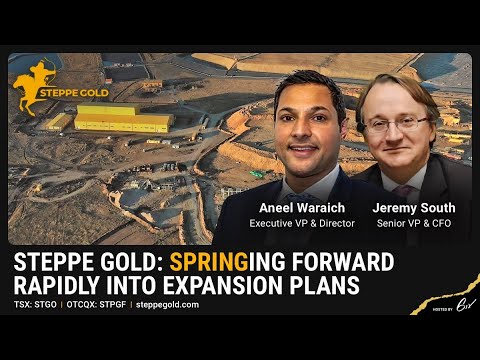
0:08 All right, well, hello, everyone, and welcome to Stuff Gold's live summit today, hosted by 6. I'm pleased to introduce our speakers today. We have Anil Waraj, Executive Vice President, and Jeremy South, Senior Vice President and Chief Financial Officer. We're going to kick off with a quick video and then Anil and Jeremy are going to walk us through a company presentation and after we will be accepting questions live. So as a reminder, feel free to submit your questions at any time on the right hand side of the screen and we'll get to them after the presentation. And as always, this is being recorded and will be available to watch afterwards on six.com. But without any further ado, I am going to kick it off with this video. Thank you. Dear StepGolf shareholders and partners, we are happy to announce that StepGolf has received the key reagent supplies via multiple routes and is now back in full production.
1:08 Last year despite the unexpected reagent supply issues, we haven't stopped the full-scale mining, crushing and stacking operations and built a significant stockpile of unleached, fresh ore equal to 81,800 ounces of recoverable gold at a 70% recovery rate. Since most of the operational costs were covered last year, we expect to generate free cash flow from the high margin, low cost operations this year. The company commenced the leaching process and is planning to produce over 100,000 ounces of gold in 2022 and 2023. As for the Phase 2 expansion plan, the company has received a $60 million financing package from Mongolia and is currently assessing UPC and full financing options to build the new partition plant and its facilities.
1:54 The company is targeting to complete the Phase 2 development by 2024 and increase our production rate to over 100,000 ounces gold equivalent per year for the next 10 years. We believe this year would be the year of rapid growth and full production for step gold and for the development on phase 2 expansion plans. Thank you for being with us and investing with Step Gold. Thank you. And investing with StepCorp. Thank you. Thank you, everyone, for joining and watching that video as an introduction. So it's great to be here with my colleague Jeremy South, our SVP and CFO, and obviously talking about being back into production. So thank you for taking the time for this brief update.
2:45 For those of you who may be new to the Step story, I'll just give you a quick overview of where we started and where we're going. We started this company as a private company at the end of 2016 with the aspirations of building Mongolia's premier precious metals company. In 2017, we acquired our first 2 assets privately, both our UK project and our ATO project that we bought from Sinterra Gold for $20 million. Sinterra previously spent $30 million on the project and drilled 67,000 meters, 28,000 meters of trenching. And most importantly, got a fully licensed and permitted for the heat bleach that we just built and brought online in April, 2020 and restarted production last month, but also our phase 2 expansion,
3:36 which is full tasting plants in CIL circuit, tailings facility, power upgrades. So we have a fully permitted phase 2 expansion project, but we just took a phased approach to build this company. And today we are now a full-time employer of 225 plus people. We're a taxpayer, a royalty payer, and most important, can generate our own cash flow to grow our business. In 2018, we listed the company in May 2018, fighting off at $2 a share price. That's a higher price than our current price. Gold was $1,250. We hadn't built the mine, So we had project risk, CapEx risk, build risk, and we brought production successfully online at a gold price 50% higher. So that's certainly something we haven't had to pay for and certainly an opportunity for new investors.
4:28 We were the only main board mining IPO in 2018 as well. 2 years later, we brought production online in April, 2020. So again, we were their only IPO in 2018 and in 2020 in a very tough environment with the first waves of COVID globally in a restrictive world, we still brought production online successfully. And that first quarter doing startup and ramp up the 100% local staff, we produced about 15,000 ounces at about $740 all in cost. In February of 2021, we managed to increase our resource. We bought this project at about 1.2 million ounces from Sinterra Gold, and we're roughly just under 2.5 million ounces on a resource basis, or 1.6 million ounces on a reserve basis, on a gold equivalent basis. So 1.6 million ounces of reserves today when we started with 210,000 ounces when we bought this project.
5:26 So pretty good lift in terms of reserves with, I would say, minimal focus and effort, given we were building our first mine and wanted to bring that online successfully. In October of last year, we released a feasibility study on that phase 2 expansion. That's added another 10.5 years of mine life, about CAPEX, about $130 million US, and doubles our production profile, rough give or take. So in about 2 years' time, we plan to double our production profile, and we've added 10.5 years of mine life, with a lot of room for growth and optimization, which we'll get into shortly. 2 weeks after announcing that feasibility study, we received a 60 million US debt package sponsored by the Bank of Mongolia as part of the Goal 2 program. So this was a landmark debt package received from within Mongolia 2 weeks after releasing the feasibility study and allowed us to essentially
6:21 move out to the winter without any production and continue the phase 2 expansion. So very important to receive that endorsement from within the country, almost half our CAPEX requirement and just 2 weeks later. We will look to expand that debt facility to about $110 million US later this summer, which will be our full debt requirement for phase 2 expansion. And we'll happily take questions on that later. Our share structure is pretty tight. Today we have 70 million shares outstanding. On a fully diluted basis is about 91 million shares with about 44 million cash coming in should the options and warrants be exercised at the $2 and $3. So all options and warrants are higher levels than we're trading it today. We have strong support from within Mongolia.
7:07 Board and management are fully aligned. Today we own close to 20% of the company and have never sold a share since being public for almost 4 years now. We really are aligned with our investors, and we feel the pain as our stock drifted, and we'll ride the game, and that's very important in any business, not just mining. We have strong support from long-term family offices who've been in the stock since we were pre-public and have a longer-term view of building a business like we do. Eric Sprott came in as well just under 2 years ago at a price of 2.15, and Fidelity International owns about 6% of our company today and they've been accumulating on market over the last 12-14 months. We do have some sophisticated investors that back us and we're very proud.
7:58 Our goal this year is to increase both our retail and institutional roster.
8:04 Currently 3 banks cover our stock today. Hanuman Partners under the UK, Stifle GMP, and Haywood Securities. And all those banks have coverage target prices well above where we're trading today. In fact, you know, 2 to 3 X or 2 and A0X. Jeremy, if you want to jump in quickly about Mongolia today. Yeah, sure. Thanks, Neil. So Mongolia is certainly evolved. I've been working in Mongolia since 2010 and I've seen the ups and downs as it's built its mining industry and its economy. And I'd say that as of today, I feel the most confident about Mongolia in terms of their direction, in terms of the government.
8:57 Mongolia essentially has 2 levers of power. You have the parliament led by the prime minister and you have the president who wields quite a bit of power. And now in the past, those 2 positions have typically been from different political parties. And that's Not the case right now. The former prime minister is now the president and the current prime minister is from the same party, the People's Party. And we're starting to see the benefits of that, of some really, you know, some stable policy and things are getting done. And I think, you know, the Mongolian government, you know, has finally recognized, I think, that the mining industry is, you know, is the most important engine for growth and that's good for Stepgold. So, you know, stable government. And I think, you know, one of the most visible examples of that was the recent, you know, 2 recent developments at Oy Tolgoi, which is, you know, which is the biggest employer in Mongolia and really is, and plays an outsized role in the economy in Mongolia.
10:06 Rio Tinto has essentially committed over $5 billion, probably closer to $6 billion by the time they've completed the acquisition of Turquoise Hill to essentially take 100% ownership of that project, which will be the third largest copper producer in the world once it's into the underground phase. And also the forgiveness of debt to the Mongolian government. Mongolian government is a 34% shareholder in that project. So that project has been a bit of a millstone around the neck of the Mongolian, above Mongolia as an investment destination. And that's now gone. And in fact, it's being replaced by some really positive news, which is that Rio Tinto, one of the super majors in mining has committed to Mongolia in a very major way. And we're already starting to see the benefits of that with other international investors now approaching us as they look for other investments in country. Other majors will follow. We're already seeing the likes of Freeport, Anglo American and BHP back in Mongolia where they hadn't been before. And where the majors go, the rest tends to follow. So I think that's extremely positive for us.
11:29 Geopolitics,
11:30 Mongolia is bordered by China and Russia. And while the current conflict in Ukraine is a long, long way away, clearly people look at Mongolia and want to understand how geopolitics plays a role. I think my view is it's going to, there's obviously going to be some bumps with Russia, but I think, you know, China is still the largest foreign direct investor in Mongolia and that won't change. Russia doesn't have major investments in Mongolia, China does, And we expect to see China start to invest more in Mongolia. I think they put the pause button for the last few years. And that's certainly one of the reasons why we've had issues at the border with our reagents. But The Belt and Road Initiative is still very much in front of the center for China.
12:22 And we see the sourcing of commodities from Mongolia is only going to increase. And in fact, I think China will start reinvesting in mining projects in Mongolia. So we now have this policy, I think it is very much investor friendly. I think, you know, the banks are supporting us. We're getting a lot of interest from not just our current lender, TDB, but also Bank of Mongolia through the Goal 2 program. And infrastructure, if you've been to Mongolia, if you haven't been to Mongolia in the last 3 years, you'll notice significant changes, a brand new airport, some major roads have been input, and now we're starting to see more infrastructure happening in the south of the country near the OT project.
13:10 So I think all that's to say Mongolia is back and I think better than ever right now. Thanks Jeremy. Obviously we highlighted in the video our operation, but here you can see what our operation looks like today with the phase 2 crusher in the middle here. So This is being installed as we speak. And even with the issues we had on procurement last year for the reagents from China, we actually managed to get this crusher across the border in the fall of last year. And we are installing it over the summer. It should be operational. So, you know, things are still moving forward on the phase 2, as I mentioned, while the phase 1 operation is back online with that significant inventory that we built up last year while waiting. So we're very, we're in a much stronger position starting this year than last with the phase 2 moving forward and the phase 1 operation having a lot of inventory built up that allows us to generate a lot of cash flow over the next 12 to 18 months.
14:10 Quick reminder for anyone new to the story, when we started this company we acquired the ATO project from Sentara Gold. Sentara, essentially the 1.2 million ounces I referred to when we listed in 2018 were based on ATO 1, 2 and 4 here on the left. Sentara's model assumed these were closed off and constrained, finished off, I guess, in terms of deposits and no room to grow. Well, the ATO4 deposit looked more like the ATO1, a carrot-like pressure pipe, with no, and closed off, well, we proved that model wrong. So our exploration team and our executive chairman who's a geologist worked together and quickly saw that there was an opportunity for growth here. And that's why we bought the project. So ATO4, we doubled the size of ATO4, still open at depth.
15:00 It's only been drilled down to about 350 meters. So a lot of room to grow on all 4 deposits. The other growth on our resource came from the Mung deposit. Mung, which means silver and mongolian, is a new discovery, just over 400,000 ounces today. Only one of the 9 million tons that exist there is included in our Phase 2 mine plan, which we'll get to shortly. So again, there's a lot of room for growth here to add more ounces to our mine plan for Phase 2, and potentially additional oxides for Phase 1 mine. All 4 deposits still can go below 400 meters here. We still have opportunity to chase a trend. We're ATO 4 in Mungaran, north of it, and hopefully some step-out drilling also yields some new discoveries and satellite deposits that we can bring into this infrastructure.
15:47 So this is just located, this deposit, mine license ATO is located just below Russia, about a couple hundred kilometers north of us. There are large 5 million plus, 10 million plus ounce deposits and in production. So the scale potential certainly exists and we do have the logistical advantage of having China about 180 kilometers to the east for procurement and also for shipping of our concentration phase 2. So our logistical advantage and cost advantage of being where we're located.
16:21 So the second property we also acquired in 2017 is a large exploration license and the highly prospective new gold district and province and buying hunger province. So, we also acquired this in 2017. It's a 14,400 hectare exploration license that has never been drilled we've been dying to drill it for the last few years and this year finally we're looking to get to it over the next couple months so there will be a release an update on exploration in the coming weeks we hope confirming a program here and when we expect to start drilling here, drilling for the first time ever. However, this license has been drilled all around. So the white licenses to the north, immediately adjoining to the north and adjoining to the south Our license is held by our peer or Dean resources also trade in the TSX and they've had some fantastic results on expiration and have over 1 million ounces between the 2 properties, I think over about A0A million ounces of reserves, and they put out a feasibility study on their mining license to the south of us.
17:24 So we're certainly in the right jurisdiction. It's a fantastic exploration license that has a lot of prospectivity that we just haven't had time or resources to get to. So this is something that's quite exciting for STEP and hopefully our shareholders as we get to restart exploration. Now we've restarted cash flow and production and we'll be able to fund our own exploration on this second property. And we do think down the road, this could be another production center for the company. You can see right from surface that Milky Way, you know, from trenching results, yielded, you know, 1.5 grams gold, 450 grams silver, 3% copper, 4% lead. So highly encouraging from surface results that we finally get to follow on. So we have drill ready targets and just a matter of getting there and we'll look forward to updating the market on that.
18:12 We'll also, as we put out the news this morning, be able to release the pending results from ATO from last year's smaller program at the end of the year. So I mentioned this earlier on, but in terms of phase 2, we now have phase 1 and phase 2, we have about 1.6 million ounces on a gold equivalent basis. So it's a big jump in terms of reserves, enough reserves to back up our phase 2 expansion program. And that's only based on drilling ATO4 and some of that infill drilling on Moong. So a lot of opportunity again to grow this and convert more ounces into reserves from the deposits we have today and hopefully keep adding as we continue to explore. Our goal here is to start after we start UK we can start an exploration program also at ATO in probably early summer And so we'll have drills turning on both of our properties at the same time. So a lot of news flow coming from, I guess over the next few months of production and cashflow, expansion updates on phase 2, and then expiration updates from both properties. So quite exciting mix that we offer.
19:22 And these are all funded programs. So we don't have to raise equity to do this. So I'm gonna highlight here the feasibility study that we put out in October, 2019, 2021. And it's showing you 130 million capex, 12 1 1 1 1 1 1 1 years of mine life starting now, so it's oxide plus the phase 2, fresh ores, all in costs coming in at $853. So there's a lot of room for growth here in terms of optimization on this phase 2 project. First, I think the low hanging fruit is the power solution. So this is currently based on diesel power for phase 2. Our plan is to connect to the grid in the next few years. And when we have a solution and defend their agreement, we'll be able to update the market, what that cost is, that's not included in our CapEx today, but also what the savings, and we're looking at, We think roughly 10 million US a year in savings, which should equate to about $100 an ounce. So our oil and gas costs have the ability to obviously come down significantly into the $700. So we're looking forward to update the market on that. And as I mentioned before, The feasibility in the mine plan does not include 8 million tons of the 9 million tons at Munk, the new Munk deposit. So hopefully we can convert more ounces on that deposit.
20:40 There's more drilling required and met work required, but as we convert that, there's a good chance and likelihood by the time we bring phase 2 online in about 2 years from now,
20:51 it'll look a lot more robust, either from a life of mine extension or increasing the production profile or both. This is really just the high level schedule of what we think for phase 2. Bringing online today realistically is closer to 2024. The end of Q1 2024 is more realistic. The beauty we have in having an oxide mine that's in production today, is it should be running well into the commissioning of the phase 2. So, you know, if things take longer, as they do in this world, and it takes longer to bring phase 2 online, the chances are we're still going to have a cash flowing asset from the oxide mine at surface. That's obviously healthy cash flow at pretty much any gold price above $900.
21:37 There's a strong margin. I guess above $750 it's still profitable. So it's nice to have that cash cushion coming from an operating mine while bringing the second one online. So that's going to be an exciting year in 2024 to have hopefully both operations online. This is just showing you what the phase 2 looks like in terms of additions here. So you know the biggest thing here is we're adding a process plant with the flotation plants here in the green, you know, so something that's 4 times the size of our current ADR building that's in the purple here. Obviously a conveyor and we have the fixed crushing circuits that I showed you in this earlier on. So Not too complex of an expansion. We already have the water roads are there, camps is being expanded, adding a tailing facility, eventually a power upgrade in what you see here.
22:27 Again, just highlighting what the process plan looks like, what the major buildings are there. And then I'll let Jeremy summarise really, you know, in a year that was quite difficult last year, not being a producer, just highlight the finances from last year and kind of get into the highlights again of this coming year. Yeah, thanks, Anil. So not a lot of highlights from last year. We're able to grind out 13,000 ounces of gold and around 24 million in revenue. The operating profit already obviously reflects allocation of inventory, et cetera. So we made a loss after tax, after corporate overhead, but The 24 million of revenue was really able us to really stay alive and keep things moving along and to continue that we mined and stacked and so on.
23:27 To really get that inventory built up, which is still, I don't think, being reflected in the market. And that's the thing that we're most proud of. We were able to continue to do that and at much higher grades than expected. We were able to get 65 million of debt through a combination of the Bank of Mongolia and our main local Mongolian lender with a $5 million working capital facility, which enabled us to essentially avoid having to go back to the equity market. So we ended the year with net debt of around $6 million and available liquidity. Essentially, the whole of the $60 million was available to us. And we're now into that for about
24:09 $3 or $4 million. And we're into, obviously, cash flow again. And so We're looking forward to a very strong Q2 on the production front and at current gold prices, it certainly makes for a profitable endeavour. We didn't report cash costs in AISC last year. They're not really meaningful, highly sensitive to the denominator and with low gold production, it really wasn't meaningful to present that 2022 AISC is around 700 an ounce at 50,000 ounce gold production. And really, when you look at the marginal cash to generate, the marginal cost to generate our cash flow this year will be significantly lower.
25:00 Much of that gold is already paid for, it's stacked or it's on the wrong pad or it's on the floor of the pit. So the cost to get that into gold bars, you know, is really primarily chemicals. And that's gonna be reflected in the overall cash generation in 2022. In our view, we are continuing to look at additional liquidity from Mongolian institutions. Dollar assets are heavily in demand. The and, you know, gold production, particularly in a U.S. Dollar
25:39 environment that we have right now where particularly our neighbours are struggling to get US dollars. We are certainly in demand and the currency has started to weaken and that has actually had a positive effect on our
25:58 results as much of our expenses are in Mongolian Togruk. So our interest costs on our loans with the Bank of Mongolia are higher than international rates. We are able to benefit from some of the upside on the currency. You will have seen a restatement of our streamlinability in the results. It has 0 impact on cash flow. I could bore everyone for many hours on the merits of IFRS 9 versus IFRS 15 and how you value stream liabilities. Suffice to say that, you know, we certainly have felt that we
26:43 recorded our stream liability in compliance with the standards. The OSC had disagreed with that. There's 2 ways to value streams. You value them as deferred revenue, which is essentially a prepaid sale. We actually feel that that's what our stream is. We deliver physical gold to Triple Flag.
27:07 The regulator, I think, is looking for more consistency across the industry and felt that we should be fair valuing what the liability is, which really makes it a financial liability. So, I mean, this is a highly technical area. It's a lot, there's lots of judgment. And, but the bottom line is it has 0 impact on cash flow. It's going to mean our income statement is going to be a lot more difficult to understand because you're going to have fair value adjustments every year, every quarter, and they're going to jump around depending on what the gold price is. So anyway, I won't go further, but if anyone has any more questions on that, happy to discuss. And yeah, next slide, please.
28:01 Okay, that's the, Why don't I finish up here, Neil, and hand off to you. You know, so, you know, as we announced this morning, we had our 1st gold pour recently. We have now received 3 shipments of reagents. We are getting reagents
28:20 every week or 2. So building up our inventory, so we will have received around about 100 tonnes. Boiler house is working well. That was one of the benefits of having a quiet winter is we're able to really sort of, I know a lot of the kinks at site, the boiler house is working well and that's going to really enable us to, to lease throughout, throughout the year.
28:47 As mentioned in our recent press release in March, over 80,000 ounces of recoverable gold at a 70% recovery rate. That's 100%. So, you know, 75% of the gold belongs to us. You can do the math. It's still well over $100 million in inventory to us. And
29:08 with the market cap of whatever it is today, we certainly have some strong cash flow coming. Feasibility study has been released. We've got that first phase of the financing and working with other Mongolian lenders.
29:23 Into phase 2, we have a heavily concentrate. It's a constant, we're essentially making 3 concentrates. As Anil mentioned, we're very close to the Chinese border. There's already a mine about 100 kilometres from us that ships an almost identical concentrate. So there's already logistics lines, there's already established procedures and processes and indeed traders and smelters on the other side of the border. So we're getting lots of interest from the trading community for our phase 2. And that will probably come with sort of some ability to finance. I think Anil touched on exploration and we are still actively considering enlisting in Asia in 2022.
30:12 Great. Thanks, Jeremy. And With that, we'd like to open up to questions. Great, thank you. There's a bunch of questions here already, but if you haven't submitted a question, feel free to do so. Our first one is, why was the OSC concerned about the way the streaming agreement was being reported? Can you please explain the restating move and what actual impact it's had on cash flow? Yeah, I just answered that question. So, yeah, if anyone needs more clarification, please reach out on that. But we just did a good job of answering that. It's a non-material event. Something we had to restate. It's not material with cash flow. It has 0 impact on our cash flow, which I think is how people value our company. Essentially, it's going to inflate our liabilities. It's going to make our income statement a lot more difficult to follow.
31:06 All right, thank you. So it's great to hear that your team's already tried to mitigate future reagent supply risk. Are there any other risks that you've had to adjust your planning for in light of what our industry has been through in the past 2 years?
31:20 Yeah, obviously I think we've tackled now and learned from the mistakes of the past or not fully in our control on the reagent side. And I think that's where multiple sourcing for equipment obviously comes in play. Certainly we learned a lot and adapted a lot already with the COVID procedures and how to do roster changes
31:44 and similar. So certainly we're adapting, we've learned a lot and we can't control, obviously it seems like there's one thing after another, whether it's COVID and now geopolitical issues that's right next door and close enough, but we adapt pretty quickly, I'd say, as a team. And I think we're in a good position for at least in the near future to just keep plugging away at bringing production, continue to bring production online, generate cash flow and in a way domestically
32:15 finance this company for the debt side for the phase 2. So that's something else. You know, we've been also mindful of that for an international syndicate to be involved. It's gonna take a lot longer and delay our expansion. So we're focusing where we think that we can get near term success. And then it goes look at the international syndicate down the road.
32:35 Thank you. Bernie's asking, he said that you mentioned to produce 100,000 ounces of gold in 2022 and 2023. He's asking, does that mean 100,000 each year or in both years?
32:48 It's cumulative, so it's just called 50,000 a year, total 100,000 ounces. OK, great, thank you. Our next question is from Bruno, he's asking, what is the benefit for Mongolia to hand out such a generous loan to a gold miner except for the jobs that will be obtained? Will Mongolia apply a higher taxation? No, it wasn't a generous loan. It was it was lower than, you know, it was a 9 percent interest rate loan, which is which is higher than we would get on a project finance internationally.
33:24 But, you know, in COVID, we don't really have the option to go and get a lot of money offshore. You will have seen other companies, other juniors in Mongolia struggle to get international debt. So we were really reliant on local lenders. It was a 9% loan and we get interest income at 7%. So it's a 2% spread. So it wasn't super generous to us. It was certainly lower than the average rate. The average Mongolian company can raise capital probably closer to 15 or 16 percent. So it was beneficial to us. I think What it was, was it was it was a really a strong sign of support from the Bank of Mongolia in Stepgold was the was the main benefit.
34:11 And it has it will allow us to and it has allowed us to continue to to source phase 2 capital in advance of when we otherwise would have. Yeah, that was a key. Yeah. So to jump in there or finish off, A couple of things that allowed us to continue phase 2 without waiting for a full package of debt on expansion because this year is not a CapEx heavy year for phase 2 expansion anyways. So we have more time to expand that number. 2, they didn't tie our hands. Yes, it wasn't generous, but 9% interest rate on a pretty significant cashflow generating asset, not that bad. So you can pay it back pretty quickly, but we also have the prepayment, no prepayment penalties. So we have the option of growing it, or I guess getting rid of it and refinancing it out without any penalties. So it was attractive from that as well.
35:05 Okay, thank you. Nigel has a 3 part question. I was asking how much capital is tied up in the 4 to 6 month reagent inventory?
35:14 What is the current lead time for reagent replacement and how many suppliers do we have now? Do you want me to take that? Yeah, go ahead, Jeff. So, you know, the actual cost of the reagent isn't that significant. So it's in the, if we're buying it at sort of, yeah, 2.5 to 5,000 a ton, you know, 100 tons, you can kind of get a sense. It's not huge dollars, but obviously, we're still tight for a little bit tight for cash and
35:53 we're being careful with all of our expenditures. We are looking at What was the second part of the question? The current lead time. So how much capital is tied up in the 4 to 6 months of region inventory? That's you kind of answer that. It's not meaningful. It's meaningful today, but in a couple of weeks, it won't be as we continue to generate. It'll be 500,000 to 1 million type dollars. Yeah. 500,000 to 1 million of tied up inventory there in the reagents. And then what is the current beat time for reagent replacement? Well, we'll be getting it weekly, as I mentioned, weekly or every 10 days. It's mostly been it's being sourced from 90% of the world's cyanide comes from China. So most of it's coming from China. It's not always coming from a Chinese supplier. It's sometimes coming through distributors.
36:43 And so we are getting it through multiple countries. We have now 4 sources of supply and we're trying to tap them all. We have 220 tons of free storage. But every shipment we're getting right now is going straight on the leach bed. So the goal, Nigel, is over the next month or 2, continue to obviously leach and put as much as we can into the circuit. So that generates a lot of cash flow very quickly with our sales cycle and our production cycle. And every week, you know, whatever we can't use, then we build up our inventory so that we can mitigate this issue in the future. If the word delays for whatever reason in the future, not 10 days, and it becomes 2 weeks or 3 weeks, we have a couple of months or 4 or 6 months ahead of us.
37:34 And that's that's really something we want to mitigate. Thank you. There's a few questions about the Mongolian Stock Exchange. 1, how is that coming along? And then also, what are the advantages Do you expect to accrue from another stock exchange listing? Nigel is saying it seems like it would create a lot of compliance work. Well, I think the Mongolian stock exchange listing was always more about, you know, allowing our investors to trade in the country. And as the largest gold producer in Mongolia, it was important that we played a role. So there was a bit of visibility element to that. The compliance, the additional compliance for Mongolian Stock Exchange listing is negligible. The main cost would be translation of documents into Mongolian, but we already, you know, translate most of our documents. So I'd say I'd say minimal.
38:24 We are still looking at it, but, you know, given the sort of the 2021 we had, obviously we had focused on other things and we are still looking at it. We might well consider it this year. But nothing nothing to confirm yet. Yeah. Howard just wants to clarify are the Mung's ounces gold or silver. Both. It's it's It's higher grade gold and silver. There was silver at surface, I think, and that's why they named it Mung when it was discovered. But Mung has high grade gold and silver. So it's precious metals. Great, Thank you. Can shareholders buy ounces directly from Stump? No, unfortunately not.
39:11 Okay, so Alan. And sorry, just to add to that, is we don't export our gold. We sell all our gold domestically to the central bank or the approved banks at spot pricing and potentially even a premium we're hearing about. So we're not incentivized to export it. And for us, it's a quick sales cycle to not export, sell it within a day or 2 of our gold pour, then money's in our bank. So it makes a lot more sense. We had a follow up question from the previous question. He's asking, how is it that Stepgold is the largest gold producer in Mongolia? There aren't a lot of gold producers in Mongolia. There isn't a lot of gold producers. And OT is a copper producer that has gold concentrates as well that are shipped out of the country. So we are the largest gold producer for primary sources And that's only growing as we move to phase 2.
40:06 There are smaller miners, alluvial and whatnot, but no 1 of our size. How much money do you need for phase 2 expansion? Well, I think we've announced $130M. Obviously, if we go the route of grid power, we'll need another $15M in CapEx, so it'd be closer to $150M. Obviously, with the significantly lower operating costs. We have a $60M facility that's available in 3 tranches. We can't use all the tranches at once, but we're looking for 100 plus million in the next 6 to 12 months. And it'll come in tranches.
40:55 Thank you. Frank is asking, should you get to 100,000 ounces in 2025? What would the balance sheet look like, the cash flow and the share structure look like? The cash flow, obviously, on 100,000 ounces in 2025, assuming let's just assume an $1,800 gold price, you're at about a $1,000 margin, right? So cash flow gross is 100 million, Jeremy, and EBITDA would be just below that. Very healthy. So that's why how quickly our company re-rates when we get to that level. So there's strong cash flow generation. And I see Alan and Honda's questions all just kind of tied into here as well, is that by 2025, after a full year of production and we're in our second year, what will our balance sheet look like? We'll probably be close to 100 million U.S. On the balance sheet. And our share structure will probably be very close to where it is today on a fully diluted basis. So, you know, circa 100 million shares. So you can do the math of what that is per share in terms of cashflow and valuation, pretty significant.
42:01 And for Alan's question is, yes, maybe that's when we become a dividend payer. You know, there's a lot of ways to create a liquidity event for investors. We are obviously large investors ourselves. And at that point, if there's not a best use for all that cash, or maybe we don't need all of it. And maybe you can create a dividend policy or special dividend policy, but we wouldn't create a dividend policy until phase 2 is in stable state. We're reinvesting all that cashflow today into expiration and expansion. So it doesn't make sense to do a dividend policy until phase 2 is online and stable. Okay, thank you. A question about that just came in. Will there be an equity raise in connection with phase 2? Well, at this point, we're gonna have the time to wait with the capex drag being more heavy in 2023 and our cash flow generation just starting to accumulate.
42:57 It's really going to see when we need to expand and have a definitive agreement on that expansion debt. So if we get to the 100 million that Jeremy mentioned, there may be a requirement to have 30 or 40 percent of that in equity, the additional equity. We may have that or close to that on our balance sheet without relying on future cash flow. So our goal, again, as owners of the company, is to minimize dilution. And we have the luxury of waiting to reweight on our stock or just let cash flow continue to generate to be the equity plug. As you can see, the inventory alone on the circa 80,000 ounces that are sitting there. That is the equity plug right there without mining any additional material that we still have on the oxide mine. Thank you. So about the geopolitical conflicts, if those continue to worsen or if they continue, what would the potential impacts be on Stepgold's 2022 and 2023 plans?
43:54 Well, we have exposure to Russian oil like everybody else in Mongolia. That's just a fact. There's no getting away from that. We haven't seen any disruption to that. We generate US dollars. So we have the ability to continue to source that. We get explosives from Russia. We don't need explosives for the rest of the year. So, we have exposures. In China, as I said, I think there are more positives being next to China than negatives. And we just sort of, we saw the negatives through COVID. We need China to get through their COVID right now. That is a problem. But I think they're on the, coming down the backside of it now, I think. So, you know, It's an interesting place to be, Mongolia, but I think because of what Mongolia does, which generates significant revenues from commodities, I think, on balance, we feel that we have risks, but we're doing our best to manage them.
45:02 And Mongolia has become even more strategic, given its location between Russia and China and how resource rich it is with the discoveries and mines like Rio Tinto and the commodities it produces. And so I think you can see some elements of some other partners coming in and countries coming in to help support as well if needed. But China certainly is the biggest partner there, and I think we'll just rely more on that in the future. But yeah. And how is the current environment for foreign investment in Mongolia? Well, so we sort of talked about it in the presentation, I think it's, you know, very positive, best I've seen. And I think Mongolia has done a very good job of managing its geopolitics, actually, I think it's generally considered to be pretty neutral because it has to be, to be honest.
45:51 But I think a strong, stable government and all aspects of the government are pulling in the same direction. Mining is very much front and center as the main driver of economic activity in the country. And I know we're not as big as many other companies out there in the mining space, but yet, but by design, when we listed on the main board of the TSX in 2018. We wanted to show foreign investors that you can invest capital, you can build mines, you can get the government support, and we've done all that. So we've shown 1 element of de-risking and that we thought that would also attract more investors. But The Rio Tinto news really this year is what I think is the biggest stamp of approval there. You know, doubling, almost tripling down and, you know, $7 billion in addition to their own investment they're on the line for. So a supermajor like them, you know, could have walked away from the country and they chose to invest further.
46:48 So I think the climate's fantastic. Great, thank you. Frank has a question. He's asking how long do the 220 tons of cyanide last? About 6 months, give or take, Jeremy, I think, right? Yeah, 6 to 8, yeah. 6 to 8 months. 6 to 8 months. About 30 tons of, sort of around about 30 tons a month. Yeah, consumption 30 tons a month, and so the storage is pretty significant. And that was one of the other things that we did over the last 9 months while waiting is building up an inventory of the ore to process and generate a lot of cash flow, but also mitigate this in the future by adding storage so we can have this further on site and manage it in the future.
47:36 Bernie is asking, does so, but the Mongolian politician have learned their lesson from Rio Tinto 10 years ago. Maybe you can explain some context. Yes, I think that could be the answer. I mean, but I think it's, they've had to learn. I mean, it's still a young democracy. And I think they made a decision back to take that stake. And I think that by and large, you're not not taking that route with with the other, you know, major assets. They're mostly sourcing overseas capital and to see the government's role as a facilitator and, you know, they can earn royalties and taxes. And, but yeah, that, they'll continue to have a major, a major role in that, in policy, Sean.
48:25 Yeah, absolutely. And to add to that, over the last few years at PDAC, this government that's been in power now 2 terms since 2016 have been saying they've learned from their mistakes, they want to attract foreign investment, they don't need to be owners of assets, and they'd rather be passive royalty partners and collect the taxes and the royalty revenue. And we're another prime example of that, where they're not asking to own more or any of the asset and we're happy with the taxes and the royalty that we're generating and obviously the gold too. Bernie's asking what will the tax rate be? 25% flat and that hasn't changed for a while. Right, Jeremy? Yeah, thank you. And last question here from Nigel. Are we now at a 365 365 production capability?
49:16 I wouldn't say it's 365, but there's maintenance built in. We run night shifts and we are certainly comfortable with capacity and workforce and so on to support both current production and into phase 2. Yeah, certainly our plan is to leach this winter. We have the boiler house installed. We'll have the supplies this year to actually run all year round with obviously some downtime for maintenance as we did you know we took advantage of that during the downturn anyways the forced downturn for maintenance but it allowed us to be stronger so there's always the maintenance but this year we look to over the next 12 months run all year round through the winter with the boiler house installed.
50:03 And obviously we have the staff and all that. So we're getting there. Thank you. Actually, one more question came in. Bernie's asking, what did the boiler house cost? Probably about 300,000 only. All right. Well, thank you so much, obviously, for taking us through the presentation and answering all of these questions. I also want to thank everyone who attended and asked all the great questions. If you do have any follow up questions after the summit, Not only will you be able to re-watch this on SIX.com, but you can also go to Stepgold's website, stepgold.com, to find more information there. Before we close out, I'll just pass it back to you, Anil, if you have anything you want to mention. Thanks, Dasha. And thank you, everyone, again, for attending, I guess, this first positive webinar of the year here. Things are back on a roll here with production. We obviously have expansion news, production news, cash flow news, and expiration news flow. So quite an exciting year for us.
51:00 As always, if we didn't answer any questions or you want a one-on-one call with myself, Jeremy, or anyone else from the team, please reach out directly. You have our email address and we're happy to facilitate.