Transcript
Automated transcript · Written by software from the replay's audio. It can mishear names and figures; the replay is the record.
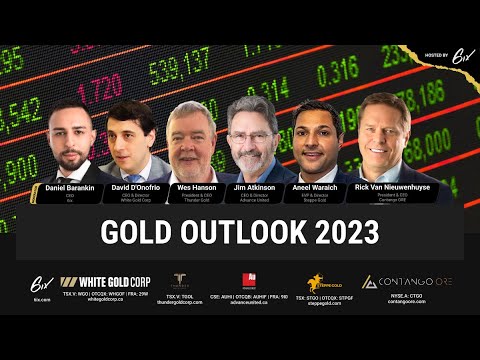
0:08 Hi, and welcome to the Gold Outlook 2023 panel. I'm your moderator, Dan O'Barren, founder and CEO of Ed6. Our mission is to unlock social mobility on a global scale by empowering anyone from anywhere to invest in anything. And so in pursuit of that aim, I invite you to submit any questions that you have related to our theme and I'll do my best to work your ideas into our panel discussion.
0:31 To kick things off, let's begin by introducing our guests, starting with the largest to smallest by market cap. So Rick, who is on the microphone presently, the floor is yours for a brief introduction. Thanks, Daniel. Good morning, everybody. Contango is developing a nice high-grade Gold deposit in Alaska in joint venture with Kinross. And the unique thing about our company is we're not building a mill in a tailings facility. We're simply transporting the high-grade ore up to the Fort Knox mill
1:04 by truck. And so we basically are able to get our deposit quickly into production and with a simple execution plan and obviously fairly low capital since we're not building the mill and tailings facility. So we'll be in production in 2024 and producing about 67,000oz of Gold a year. Should be cash flowing, free cash flowing at $1,800 Gold, about $40M a year. So we're a pretty advanced story and quickly becoming a producer.
1:38 Wonderful. Thank you for that introduction. Anil, the floor is yours. Sure. Thank you everyone for joining today's panel. Stepgold is a Gold and Silver producer today, currently producing from our phase 1 operation. It's an oxide mine, straightforward heat bleach that we brought production online in April 2020. So during COVID with 100% local team, we commenced commercial production, profitable production and we are now expanding over the next 2 years into our Sulphide.
2:08 We're going to grow from a 40,000oz to 50,000oz producer today at about US$850 all-in costs to over 100,000oz at current mine life of 12-years that We just announced an update last week. We're doubling our production profile over the next 2 years while continuing to expand through drilling, not only on this mining license that's only been drilled down to about 350m, 400m, but also on a very large exploration license we hold in the southwest of the country. So a pretty action-packed story with production, proven track record of building a mine very quickly and cheaply and profitably, obviously today, and expanding that into a larger scale project that has some legs, I guess. Thank you. Wonderful. Thank you, Neil. David, over to you.
2:54 Thanks, Rick, to be here. White Gold Corp, it's a pretty unique exploration company. We're based in Canada's Yukon. We have an extremely large portfolio of early stage grassroots properties, which has successfully grown into a significant Gold deposit. The properties are all located in what's known as the White Gold District or the Klondike District. This was the epicenter of the infamous gold rush of the late 1800s.
3:23 And remarkably, there's been over 20 million ounces of gold found in placer mining right from the surface, but there really hasn't been any modern day exploration until about 15 years ago. This is when our partner Sean Ryan entered the district and started to use some very novel approaches to try and find the source of this mineralization. What's unique is it's not glaciated there, so there's really very limited outcrops. You have to kind of bring a different approach than your traditional Canadian prospecting. And he was able to sort of dial in soil geochemistry as an indicator. And remarkably, within a couple of years of applying this technique,
4:00 His work led to 2 major multi-million ounce discoveries, 1 being the Golden Saddle deposit, which we now own. It was actually acquired by Kinross for $140M. They've combined that with our company and our partner bars. The other is the coffee deposit, which was acquired by Goldthorpe for $500 plus million, which is now owned by Newmont and being advanced into production. So this is an area of the world, it's a great jurisdiction with a huge land package, such prolific history, hardly no work's been done, but a little bit of work that has been done, it's brought incredible success. And I think it's now finally really come onto the global radar in terms of an emerging district. As I mentioned, Newmont is in there. Kinross is our partner. Agnico Eagle is also our 20% partner. We partnered with them right at the very beginning.
4:49 We see Rio as a partner of Casino Deposit, which is owned by Western Copper Gold. That's a huge multi-multimillion copper gold corporate. And it's at the very early stages of emerging district. We really think we've sort of crafted code as to how to find these deposits. Our own resources are either bumping on 2Moz over 2Gz, which is pretty unique for a junior at this stage. And we think we're just scratching the surface and hopefully be able to make many, many more of these. We've had some great discoveries by Nuance Property on our Betty super high grade gold from surface. So it's an exciting place to work and exciting time to be working with. Very cool. Wes, over to you. Thanks Daniel and thanks everybody for joining us today. So Thunder Gold is, we own and operate the Tower Mountain Project in northwestern Ontario, just a few kilometers outside of the city of Thunder Bay. We have a number of strategic benefits, including existing infrastructure that's in place. We're immediately beside the Trans-Canada Highway. Our work to date
5:52 on the project indicates that this is a potential magmatic hydrothermal gold deposit, and that's a somewhat different target than what Arkeen Greenstone belts are famous for, which are more of the original
6:08 load Gold type deposits with super high grades. This is a very large tonnage low grade opportunity. Gold grades are probably going to average somewhere between 0.8 and 1.2g per tonne. But the good news is there's going to be a lot of tonnes, which equates to a lot of ounces. So I'm looking at this as an opportunity to get in early on an undervalued junior company. That's one of the attractions that brought me to the story and I'm looking forward to advancing the project at a rapid pace and developing some value for our shareholders.
6:41 Very cool. And Jim, over to you for an introduction. Well I guess we're last, that means we're the smallest, but I would say that gives us the largest amount of potential. So I'll just quickly talk about the company. We're mainly focused on Gold, of course. That's why we're here. We have 2 major Gold projects that we're working on, 1 in the Kirkland Lake area where we're drilling off high-grade quartz veins, which
7:06 had a past producer on a small mine in the past, has a small resource. Our other major project, which we're a little more excited about, is what we call our Hemlo project in the Batchewana Greenstone Belt. And that is a Hemlo look-alike. It's been called a Hemlo look-alike by one of the guys that discovered Hemlo, so I kind of rely on his opinion as to the thing, as to the project.
7:32 On that project we have at least 4 high-grade intersections from the past that have not been followed up. That project was explored from the late 80s to the early 90s, and sort of very appropriate for what we're talking about is that the reason it was abandoned in the early 90s was because the price of gold went to $350. And I think that's one of the things that we now have the opportunity to take advantage of some of these dips in gold price, which caused some projects to be abandoned, including both of the projects that we're working on in the Kirkland Lake area and in the Batchewana area. That's it. Incredible. Well, thank you for the introduction and the introductions. What's really interesting about the panels we have here today is the unique perspective and views and connection to gold itself.
8:23 And it's been said before that there are weeks where decades happen and decades where weeks happen. And what's really interesting to me is that over the last 3 years we've seen significant volatility
8:34 in pretty much all aspects of the macroeconomic environment and all aspects of the gold environment. We've seen gold's volatility move from a low of 1400s to highs of 2050. We've seen interest rates reach new levels. And so the question that I have to the panelists is in this environment, has gold done what it was supposed to do? Well, I'll take a first crack at it just to get the ball rolling maybe. I actually believe it has. So back in 2020, you know, obviously February, March was the beginning of this three-year run of COVID, I guess. Gold came down with every other asset class.
9:19 It's liquid, very liquid, it's the most liquid currency in the world, I think, right? So it sold down, but it was the first to recover and hit all-time highs. So everything had to get sold, stocks,
9:33 hard assets and what not, and it hit all-time highs in a very tough time. Fundamentals for Gold were already strong going into the beginning of COVID with nothing's changed in terms of debt and what's going on in the world. It's only gotten worse. We've had now wars. So I think Gold actually, compared to other asset classes, has performed as it should. I mean, a lot of people want it to be higher. That's great. It will come, I believe. But certainly where it is today versus other asset classes, I think it's still the best performing asset class. And it did hold its value, majority of its value versus others.
10:10 Yeah, I agree with that. And maybe just add, you know, people are looking at gold generally in US dollar terms because that's what it's quoted, right? So maybe people, you know, we're in decades high inflation, there's geopolitical uncertainty. But if you look at the price of gold and pretty much every currency other than the US dollar, it's at its all time highs. And it's like, then it's really reflecting, it's acting as it should have as a hedge against inflation and
10:38 a safe haven type asset. So I think that's something, you know, perspective people should remember. And I think the other thing that you should remember is very important, and we'll talk about this later, gold is a financial instrument being priced in US dollars with interest rates as high as they are in US dollars as strong as it is. And the price of gold being where it is in that environment is actually very bullish, right? Because at some point in time, you know, these interest rates are cyclical. You know, they're going to pause, they're going to go down. I don't know when that's going to be. People have different views. But when that's going to happen, the dollar comes down, price of gold is going to now increase in U.S. Dollar terms. So if that starts happening from a base of $1,800, I think the rerating potential here is going to be through its all-time high, it's going to be higher than that on that element alone.
11:25 I'd just say that I've been looking for gold since Nixon took the Gold Standard off, so as Wes probably has as well. So we've seen a few things. So when somebody says to me, is gold behaving as it should, it's been going up for 50 years. So it's pretty hard to say it's not going to keep going up. But I would say one thing, since 2000 to 2020, gold basically traded in a, let's call it a channel, between 1700, 19, that kind of channel. Now, that has 2 different aspects. First of all, if you're doing a feasibility study, that's great, because one of the challenges you have when you do a feasibility study for Gold is trying to figure out what the Gold price is going to be in 10-years when your mine is operating. Now, the second thing that's bad about that is if you're trying to raise money, of course you want the price to go up. So as far as behaving as it should, I think it really depends on what you want to do. If you want to raise money, you want it to go up. If you want to put a mine in production, you probably want it to stay fairly high but fairly consistent.
12:30 I think it really has to do with what I call, let's call it, I don't know what people think. For instance, I tell everybody when gold goes from, let's say, $1,700 to $1,800, everybody gets excited. When it goes from $1,900 down to $1,800, everybody gets sad. It's the same bloody price, but it has to do with momentum. And I think that's really what we're seeing right now. We're starting to see a little momentum and that will certainly help, hopefully, get us out of this channel we've been in for quite a while and help help juniors raise money because as we know when the price of Gold is going up it just makes it easier for juniors to raise money so that's where I'd like to see it go.
13:13 Now I'll just jump in to say maybe a bit broader view I mean this last 3 years it's about money printing related to COVID, but the money printing in a big way started back in 2008 with the world financial crisis. And if you look back at the gold price, We went from a $600 gold price
13:35 pre-2008 to about a $1,200 gold price post. We went up all the way up to $2,000, but it settled back down around $1,200. So because of the money printing and the inflation that caused, Gold doubled. And then from 2012 to today again, we're about 1800. We've been pretty stable at about 1800 for about 3 years now. And that is related, in my opinion, to the money printing that came as a result of COVID. So you kind of just look at the big, broad strokes. Gold's done exactly what it's supposed to do. It's reacted to the inflationary pressures of money printing.
14:18 And the question is, are we done printing money or are we gonna be stable for a while? Well, I think when you're looking at driver, and I don't want to disagree, but during the, again, the period from 2000 to 2020, the inflation was pretty constant. It came down after 2020, but stayed pretty consistent and in fact went down a bit, but the price of Gold still went up. So I'm having a little trouble relating
14:48 gold to inflation on that basis, just on a long-term basis. And I understand that the past is no predictor of the future, but I just tend to look at those kind of trends to see what I think might happen going forward. Well, I would say that if you just look at the charts when the money printing started in 2008, it's pretty clear
15:13 when you print trillions of dollars, And it's not just the United States printing dollars. Remember, it's other countries printing other currencies. That's, in my opinion, that's where the inflation's coming from. And that's what gold is reacting to in a very predictable way.
15:30 As a safe haven asset and as a risk off asset, we're seeing record inflows into groups purchasing gold itself. We're seeing central banks purchasing gold at the most aggressive rates to the most aggressive pace. We're seeing institutions, you know, it's for capital to gold. What is your view about ultimately how gold will discover its price, how that price discovery mechanism will ultimately unfold and what the price of gold ultimately will be 2345 years out?
16:02 I'll jump in here again, just saying that I think right now there's 2 big events going on that are having an effect on gold. We're talking about piping in US dollars here. The Fed and what it's done in the last year. We've gone from near 0 interest cost of capital to 5% risk-free cost of capital in 1 year. The market, the general market hasn't adopted or adapted to that huge change in the cost of capital. People who loan money at near 0 are basically losing, losing out on getting very low returns on that money in an environment where we now have a 5% risk-free cost of capital. So that reset, in my opinion, is going to take place at some point in time.
16:58 I think the Fed's going to run out of bullets. It can't just keep increasing
17:03 the risk-free rate. And when, I don't think there'll be a Fed pivot to lowering interest rates, because they've been signaling stronger for longer. So higher interest rates for longer. They don't want to create a huge worldwide recession. So I think the pause, the Fed pause will be the pivot and gold will move on that pause. I know it's difficult to predict where it's gonna go, but I would, and I hate to recommend somebody, but I would recommend that people take a look at a group called CMP Commodity Analysts. So they've been analyzing commodities, including gold and silver, for like 50 years. And each year at the beginning of the year, they put out a gold and silver, all metal actually, but especially a gold and silver idea about where they think it's going based on their ideas and they've been pretty good and so I tend to read them, maybe
18:06 I believe them or not, but it's a group that I read and have some pretty good ideas about where gold is going to go. Yeah, I think Daniel touched on the fact that the central banks have increased their purchases of gold and that's an interesting development that we'd like to see. But one of the things that always catches my eye is the fact that gold has been
18:29 a steady state performer for certainly the last 10 years, if not longer. And what you're seeing is you're not seeing a significant increase in more people purchasing jewelry or more people purchasing gold for investment purposes. These are sort of steady-state with a slight, just a slight increase year on year. So we currently see production of about 120 million ounces of gold a year globally and demand of about 150 million ounces of gold a year annually. And that to me signals that there's a lot of people out there that perhaps maybe not Western focused society is still bullish on gold, but I think a lot of the emerging economies around the world are very interested in
19:18 putting some money towards gold for the future and building some wealth that way. Yeah, I agree with that. Definitely Eastern culture hasn't changed in thousands of years. It's in our culture and you're seeing that. So Indians, Chinese have never stopped buying gold and always believed in it, even through all this volatility in the world. So that hasn't changed and will continue. And those populations are continuing to grow and they're less indebted, I would say, than many other Western jurisdictions in the world. So they have an opportunity to really
19:53 increase their wealth this way. That's an excellent point, actually. The indebtedness is just not there. And their middle class is growing at a faster rate than the middle class in Western society.
20:07 For savvy investors building out their portfolio strategy, how should they think about gold as a hard asset that's generally viewed as risk-off relative to junior mining equities, which are a speculative asset. Well, I guess you should probably have a bit of both. Whatever weighting you choose your own. But, you know, if you want this slow and steadier approach, obviously buy the physical. And that should be depending on your risk profile and your wealth
20:35 and your portfolio, then you should have a certain percentage there. Clearly, gold can go up 50% and 100%. We've already seen it over a decade or 2, right? So you still have a pretty good upside there by those owning the physical. But obviously we know in the junior space, you're not going to get a 10, 20 bag out of Gold just as quickly as you can from owning a junior that has that leverage in a strong market, leverage to the gold price and to M&A and all that jazz. So I would just look for a good weighting of both.
21:09 Those who move to production obviously have excitement, those who explore and it can be sold at 10, 20 times their valuation in short order. You probably want that exposure too because then you can then convert that into more physical, conservative portfolio, I guess. Yeah, that's exactly the way I would sort of view it as well. Equity, especially junior equities, is leveraged to the gold price. The reality is junior equities, all of them, not only junior mining, they're viewed as speculative assets. So notwithstanding the fact that the commodity prices continue to hold in or perform very well, I think everyone on this call is well aware that the equities have done the exact opposite. But that's because they're more viewed as a risk asset, like a tech asset. They kind of follow that path. And actually, I think it's
21:56 currently it's the largest disconnect ever between the equity values and the values of the underlying commodity, which, from my perspective, is setting up a very nice entry point for a major re-rating. Once the risk sentiment comes a little bit back on, that'll dovetail with gold prices going up because interest rates will be flat or coming down. And then I think you're really going to see a catch up play. And this is kind of the time as an investor where you want to be looking for these quality type assets that are trading at these historic discounts where you can start building a little bit of a position. Right, you know, I think one thing that we're all sort of seeing is there's not a lot of FOMO in the market in the junior mining side right now. Everything's sort of basing or kind of coming down. But historically, when it turns, it turns quickly, right? So when you get in, it's hard to say, but I think with most investment strategies, as you start to build these positions slowly over time, you want to be prepared ahead of the crowd to take advantage of the opportunity. I think we're in that exact position now. Like I said, interest rates can't go up forever here, I think we're closer
23:03 to the end than we are at the beginning. So this could be a very timely opportunity to start doing it. Yes, I'd just comment that the Gold commodity price and the Gold equity price is really disconnected, starting back in 2008, again, with this inflationary pressure that came as a result of printing money. And we haven't stopped printing money. We've had various reasons for printing money. And the disconnect in my opinion
23:33 is related again to inflation. The fact that Gold mining companies haven't actually made any more profits at the higher Gold prices because the cost of producing Gold goes up. If you look at the overall trends and the overall stats, that's basically what they're showing. And that's something that I think the Gold industry has to wrestle with. And that's why I think free cash flow is an important metric in being in the Gold mining business. And as far as the explorers go, the fact that, I think investors are disappointed in general because
24:09 gold producing companies aren't more profitable at the higher prices. And that's an unfortunate fact. And unfortunately for junior explorers,
24:19 they are discounted to their potential nav of the projects that they're exploring for, and in some cases, finding and defining resources. But they traded a discount to that. And then lately, that discount has been a very high discount. I would totally agree with what David said that I think there is a pivot going to happen here. Meanwhile, you've got the major companies producing less gold
24:46 And the demand for gold has not waned. In fact, it's increasing. Central banks are buying gold. You've got this nexus of Russia, China, India, and Iran against the US dollar, the US dollar hegemony. So that's a big trend. And that's not gonna happen overnight. That change to an alternative world currency. It's not going to happen overnight, but it is a trend.
25:09 So I think those are the big dynamics that are going on with respect to gold, the commodity and the gold equities, in particular, the junior explorers that are always traded at a huge discount to their potential net. On the discounts that many companies in the gold equity space are experiencing, P.P. Whedon has submitted a comment, which I think probably expresses the sentiment that a lot of gold investors are feeling, which is that many gold companies that you follow that they follow are hitting their 52 week lows now. When the sector should be turning around. Is this finally the actual bottom or is there more pain to fall? I wish I had the answer to that.
25:58 You can't really predict the bottom, I guess. I mean, yes, we're somewhere near it, but listen, there has been the financing windows opened up again in the last little while. How long will that last? If it doesn't last long, there's still some carnage in the world that's happening. You've seen all these layoffs, North America included and whatnot. So I don't know if we're seeing the exact bottom, but we're certainly getting close. Maybe still 1 or 0.5 away. A lot of these companies never got funded last year or the year before. They're going to remain at 52-week lows until they get funded, And then it can create news flow and all that. So I think there's a lot, there's a large overhang for a lot of unfunded companies that had a delay because they couldn't get access to the capital. It wasn't there or very small windows. And so I've seen that, right? And that's where you've seen M&A happen at some of these small guys at 52B Glows too.
26:54 You're forced to see that, you're forced to believe that you don't need a massive premium to create a win through a merge, right?
27:00 And that you'll catch it up later together as a re-rate. So I think it's a combination of that kind of stuff. I think when we start to see, we know when we're close to the bottom, when we start to see more of the generalist funds and the generalist investors come in, because they'll take a look at the valuations and that's what they invest on. And I think that's when we'll be able to sort of say, well, we must be very close to a bottom if those guys are starting to see value in the generalist investors. I'm not talking about the
27:31 people that invest in junior mining or mining companies all the time, but right now there's a lot of money around that can't be deployed. Cannabis is no good. Bitcoin is no good. There's a lot of stuff that's really been very painful for investors. And so I think when they start to come back into the mining space, that's when we know we're close to a bottom because they can pick them.
27:57 That's a good point. I think that's starting, right? It doesn't happen overnight. They do their homework, they kick some tires. And I have perfect examples over at the Vancouver Resource Conference a few weeks ago and you know, bumping into guys there that haven't bought a mining stock in 5 years. So I'm talking to a bunch of other investors, companies that are out there and they're getting meetings, whereas a couple years ago they couldn't get the meeting. Right now they're getting the meeting, people are doing their homework and like you said, from just a pure financial perspective, looking at historic valuations, it's starting
28:29 to look very attractive to them. So I think That's certainly starting. I think the M&A should also start to bring a little bit of excitement back in. These are opportunities to make 30%, 50% type increases over a very short period of time. We're starting to see those sort of premiums coming back into the market. From the majors perspective, these assets have never been cheaper ever. So they're depressed too, but not at the same multiple that some of these juniors are depressed. A lot of great assets out there. So we're going to see that starting to pick up.
29:00 At the end of the day, I think what drives it the most, notwithstanding the disconnect we were talking about earlier, is the price of gold. We can start to see a little bit of traction with the price of gold like we saw in January. That just builds excitement. That brings the generalist investor into it. I think that $2,000 is a mental milestone and that's when you start getting back into the media and CNBC and all that kind of stuff. And it's flows of capital, right? It's a very small pool of capital in the venture space. To the extent any capital starts to come in, it has a big rerating potential. Then it will all start to happen very quickly, as it does. I would agree with David that I think $2,000 Gold is a magic number for investors, whether it's just psychological or whatever.
29:47 I think that'll be a defining moment. I don't know when that'll happen. Obviously, I wish we had the crystal ball, but we've been pretty stable here at $1,800. And I think that's going to provide a great opportunity for M&A because when it moves, it's gonna probably move quickly. And we've mentioned that before. And for companies like ourselves who are trading at a good valuation, and we've done very well, We're not trading at a discount to our nav, we're trading at a premium to our nav. So we'll be looking in the M&A space for those kinds of opportunities. I think that'll be an exciting time in the business because that's what the junior exploration business is all about finding good quality assets and then and then having put in the other ideas putting the other companies that then 1 plus 1 is 3 that's the that's the real that's the real big story I think for the next phase of the junior exploration business.
30:51 I think that sort of supercharges everything that's related to the overall movement in the Gold prices, the M&A activity. And we're starting to see it with the majors now. And typically that filters down to the intermediate producers and they start to do acquisitions and mergers with other companies to build a better value creation opportunity and vehicle.
31:12 And it just keeps trickling down to the junior sector and you see a number of good projects that are assembled with good teams and those are the opportunities in the space. Jim, you mentioned that you've been in the sector in this space since the Nixon era. And the question I have for you is, why am I still doing it? You've seen a few cycles where the euphoria takes off and it can happen quickly. What are some of the memories that you have of those cycles? And the question I have for you is, at what point in that cycle do you realize this is real, this is happening? Most of the, well, oftentimes the cycles start because of some kind of discovery. Like one of the things that happens in this business is that it doesn't matter where somebody discovers something, as long as there's some discovery happening, that seems to affect the whole thing. I mean, I remember when Gold price went from $35 to $100, we thought we were going to be fabulously rich, But that was because of the fact that there was an overhanging amount of potential there. And I think every time we've seen a major spike, it's been because of potential.
32:29 Like people see momentum in the price. OK, there's some momentum. Doesn't matter where it's from, too. Let's say even if it goes from 500 to 800, like it did back in 2008 or whatever, it's because people see the potential. They say, okay, all of a sudden, those projects that were not potentially not viable or not economical at that price now become more attractive at the new price. And I think that's what I've seen as mostly what happens with the various cycles when it moves. And as a junior exploration company, I mean, that's what we look for. I'm sure that's what most junior exploration companies look for, something that's got, perhaps it's got historic resources that were not profitable at, in our case, in 1992 at $400 or $500 Gold, but become a lot more attractive when Gold is $1,500 or $1,700.
33:29 And that gives a boost to the exploration business because there's a number of those projects that are out there that can be financed and can be explored and out of that will come discoveries. That's what always happens. You get new discoveries And through my years, I've seen some things where people have said, listen, there's nothing there. And somebody has gone and said, well, we found something here. And that, I think, is the thing. So I think what it does, It allows people to think about different areas, different places, and that's when I've always seen the cycles happen. I think a lot of people don't understand the actual work that's involved in making a discovery, especially of a large gold deposit. We'll call them a tier 1 gold deposit that's over 10 million ounces. And we've got to find the industry right now, today, has to find 12 to 15 of those tier 1 discoveries every year just to replace production.
34:35 Reserves are declining, the average grade of deposits is declining, but the cost of gold is going up. So all those fundamentals sort of play into it And it just becomes this flywheel of momentum, like you've got a rising gold price. You start to get more investment into the junior sector to allow juniors to go out and do their jobs, which is to drill holes in the ground and find gold, develop gold reserves for a few day feeding, I guess is a good way to put it. You know, it just builds that momentum and it keeps going and it's like, man, the good times are the great times. I've been through 3 or 4 of them myself, similar to Jim, And we've seen work for a number of companies that have done quite well and made some major discoveries. And that's the upside in this business.
35:26 And you're seeing opportunities out there that are coming to the forefront because of changes in technological methods of exploration. You're starting to see, everybody's talking now about the chat GPT and artificial intelligence. You're starting to see that being deployed across the industry to look at established gold camps that have been deemed to be past their prime, and you're starting to see new discoveries and new exploration concepts and new opportunities in camps that have previously been ignored or forgotten or replaced by someplace else in the world that's slightly better. And one of those areas is Canada. And I think investment in Canada, you're going to see a great deal of new investment in Canadian gold properties going forward, because let's face it, the best place to look for gold is where there's gold.
36:17 So discovery drives the value creation in this business and that's largely how these as you mentioned earlier some of these investments can return pretty spectacular results whether it's 10x or 20x. Here on the panel we have folks that have in some cases made discoveries, whether it's in the Yukon or Mongolia or Ontario or Alaska, or otherwise are searching and preparing to make a discovery, hopefully fingers crossed, hopefully they succeed. The question that I have for each of our panelists is what are you most excited for this year in your particular pipeline of discovery or production or a value creation or growth? Well Duncan, so I mean for us we'll be in production this time next year, or close to it next year.
37:09 So that generates cash flow that allows us to finance our advancing our projects without dilution for the shareholders. So our next project that we own 100% of is Lucky Shot, high-grade underground mine, historic production of 40 grams per ton. I'm sure that was selectively mined and selectively processed, But it's a high-grade underground vein. Last year, we put in the infrastructure to be able to get underground and explore it. This year, we'll continue our exploration effort to define more high-grade underground resources. We know we've got a big underutilized mill at Fort Knox, so we see the opportunity to do the same thing that we've done with our Montreux project in joint venture with Kinross in sending ore from Mucky Shot up to the Fort Knox Mill.
38:04 And again, sort of jumping, leapfrogging that valley of death that the Lausanne curve talks about when you make your discovery and then you try to get into production, you go through feasibility and permitting, which can take 2345 years, depending on jurisdiction. If we can, again, leapfrog that valley and get into production quickly by just sending our way up to the Fort Knox mill, the mill that's been operating for 25 years, that's how we think we can very rapidly increase value for our shareholders. And so that's the kind of model that we're working with. You know that millet for Knox is there and we're just going to keep looking for opportunities where we can help them feed it. I'll go next. I guess what we're most excited about this year is continue to advance our phase 2 expansion. We've already started construction last year and built the fixed crushing circuit, so that's already installed, and continue to chip away at an expansion while having stable, profitable production, which we have.
39:09 We've built a great inventory of unprocessed ore on the pads today, or on the ROM pad. We have reagent inventory for 6 months sitting on site today, so we have no supply chain issues that we dealt with in 2021. And really, you know, continue to get that scale, I guess, growing our production profile over time. Our goal is to be a 200,000-plus ounce producer in a few years. So showing the path through exploration, continued delineation of our current deposits and maybe some other opportunities to roll in and go build another heap leach in another region that has sulphides below it as well and continue to grow that way. That's cool. I'll jump in next. So what's really exciting about White Gold is it's basically like 4 or 5 different junior companies in 1 with the size of the land package that we have.
40:01 And based on the work that we've sort of done to date, you know, we got to the top of our list, a couple of very highly prospective targets. And one of them we had a major discovery on last year, which is called our Betty property. I think as Wes says, you know, the best place to find a mine or gold is where you know there's other occurrences of gold. And so this property sits right along the same fault structure that hosts Newmont's multi-million ounce deposit. It was our team that made that original discovery. So based on what we're seeing, ultra-high grade gold from surface, you know, Our very first diamond drill hole in there was 50 meters of 3.5 grams. It's in the shadows of the Western Copper's casino, which is 20 million ounces of gold and several billion pounds of copper. So This is like true elephant country. And so for us to be putting the first drill holes in there ever, it's just exciting, exciting stuff.
40:53 And what we've seen so far is just pretty incredible. And that's just like a small part of our overall package. Right, So you have all these lottery tickets, up by our existing deposit, we made a brand new discovery there called the Ryan Surprise. We think that's gonna continue to increase the size of our flagship deposit. So we have this great balance of ore in the ground, new discoveries, a couple other targets on deck this year that have never been drilled. And there's just so much happening in this district, which is also what really excited me. You need to have that macro momentum behind you. Newmont's got their approval to move forward with their permitting. Obviously, you have the largest gold company in the world in your backyard. Rio is invested in Western Copper. We have Agnico and Kinross.
41:39 Hakla just bought out a company in our district. So, you know, the majors, you know, these guys do their homework right before they move in. So to see that all coming together, and it really just feels like we're at the precipice of this district really sort of going from being prospective to in production. And there's a webinar out there, I think Michael Gray did it at the BRIC, that he views this district being like the old Ohio was 10 years ago. So that's, you know, an exciting time to be doing the kind of work we're doing and, you know, time is everything in a lot of businesses, especially this one. So we really feel like everything's kind of coming together at the perfect time right now. From my perspective, the best thing about this business in the last 40 years has been looking at what comes out of the drill bit.
42:30 That's always the most exciting time when you initiate a drilling program. At Tower Mountain, I think we have a real opportunity here to identify a new style of mineralization in the Archean Greenstone belt. As I noted earlier, it's a magmatic hypothermal system, so it's a large tonnage, low-grade opportunity. I mean, there's a few successful examples in Canada. They're specifically Detour Lake, and not that they're magmatic hypothermal, but just large tonnage, low-grade opportunities that, you know, they lack some of the drama and some of the challenges that higher grade districts often bring into the equation. So that's our focal point is to use our drill bit and try to deploy our capital as efficiently as possible. We are extremely fortunate that we're located immediately beside a highway. We have year round access. We're a half hour from Thunder Bay. By the time I get to the work site in the morning, my coffee isn't even cold.
43:25 And I just walk in the core shack and start looking at core. And that's a significant advantage to have. We're also lacking any significant water courses that we're impacting with our development. We're not really relying on any government largess to allow us to proceed with developing the project. So I see Tower Mountain. I mean, the bitter reality is since I have been around since the Nixon years, I was kind of sliding towards retirement and a nice quiet kind of lifestyle. And this opportunity came along and I thought it was just too good an opportunity to pass up. So I dusted off my geological tools and dove in with both feet and we're going to see where it takes us. And I think it's going to be a really exciting ride at exactly the right time. Yeah, I'll just continue what Wes is talking about.
44:20 The most exciting thing about exploration is drilling, of course. And I'm really excited about both of our gold projects. The project we have in Kirtland Lake is Malba, as I said. It's a high-grade, Abitibi-type gold mineralization, veins with visible gold. But pretty exciting is we also discovered a brand new style of gold mineralization there with our drilling. It's never been followed up. And we're very excited about that, because Malba is kind of a unique situation. It's a small area of exposed rock where the 4 veins are. It's totally surrounded by swamp and it's really never been explored away from the outcropping areas where the gold veins are. And the new exciting discovery that we found is actually in the swamp.
45:09 So no prospector has ever looked at it. No one's ever sampled it. This is the first time it's ever actually been drilled. And the second one we're excited about is, as I said, the Hemlo model in the Batchewana Greenstone Belt. You have to understand about the Batchewana Greenstone Belt, it really hasn't been explored at all. And we have this beautiful discovery there, which was discovered by, as I said, one of the guys that discovered Hemlo and he sort of got shut down by the bad price of Gold. But we have 4 high-grade Gold intersections on that property, including an intersection of 15g in a section that's 9m wide of say 1 or 2 grams. So it has the potential to have some tremendous intersections and we're looking forward to and very excited about starting to drill on that project this summer and follow up some of the high-grade zones that are known there and continue to explore these high-grade intersections.
46:14 So like Wes said, what you get most excited about is what's coming out of the drill. And that's what I'm pretty excited about right now. Very cool. On the theme of what's coming out of the drill, James Radner has submitted a question where he has described that he's seen some gold stories that took off when they started exploring additionally for battery metals, lithium, nickel, etc. Will any of you consider that move this year? No. We're precious metals focused. We do have base metals component to our Sulphide expansion. So there is some exposure to base metals, Lead and Zinc. But in this vehicle, our primary focus is precious metals.
47:01 I would say it's the same for us, even though we do have a Copper project where we did some drilling last year and got some high-grade Copper intersections. I would say because we're focusing on Gold, that's a project we'll be looking for a partner more than expanding our own work there. We spent about 1 million dollars there last year, discovered a very nice massive sulphide deposit with, as I said, high-grade Copper, sometimes a little bit of Gold and some Zinc. So as far as critical metals, I would say, yeah, we have a little bit of that, but I agree with Anil, we're going to be a Gold company. That's what we're going to focus on. Yeah, same for us. We've spent north of US$100M defining our assets and getting these targets drill ready. So that's our focus. Now, with that said, it's such a big land package, Yukon is so minerally diverse and rich.
47:57 There's certainly a probability we come across something. You know, We have a couple of properties with copper porphyry signatures, kind of similar to the casino of our neighbour. If something comes out of that, we're going to do the work, we've done the soils, etc. Then that's worth a conversation. Would it be a focus? Maybe that's a sidecar or there's some other opportunity. But our team, we're Gold experts. We have 2 of the best Gold companies in the world as our shareholders. So we're continuing to focus there. I hate to be a broken record, but It would be the same for Contango. We do have some interesting Copper assets in the portfolio, but I think like David, we'll probably end up doing something in a sidecar arrangement with those.
48:46 Yes, and the same for Thundergold. We're extremely fortunate in the fact that Tower Mountain, it's Gold. There's really no other economic metals of interest associated with that particular deposit, which again is indicative of its unique nature and the way that the deposit forms. So, you know, it's it would be I won't lie. It would have been nice to have some low-grade copper associated with the deposit. This makes things a little easier in some respects, But this is a gold play and we're going to we're going to continue to explore it as such. Absolutely. Building on the theme of gold and the gold outlook for 2023 Dr. Ivar asks in recent weeks a few countries especially the emerging markets have started adopting the gold standard to back their currencies.
49:39 What is the view of the panel in terms of its effect on the gold market? And can the new demand push prices even higher? Yeah, I guess, I mean, buying will, that creates more buying, right? So obviously it's going to have an impact. I mean, I think the biggest push was going to be the generalists, as they come into the market, increasing to 1% or 2% of their portfolio would have a massive, massive demand for gold. But now you have central banks buying, all of them, obviously, in that region, are buying more. So that's the increase in demand. So you're going to have a double whammy, I think, between generalists and investors and central banks that will increase demand significantly in these coming years.
50:28 That's my belief. So whether they all adopt the actual gold standard or just backing their currencies with as much as gold as they can. I mean, that's what Mongolia was doing before COVID, but they were forced to have to sell down some reserves because their exports were down significantly because of 0 COVID policy with China. But certainly I think as things get better and improved, you'll see smaller countries like that continue to build up their gold reserves. And what's unique now, it's a lot easier to buy physical gold than it has been ever before. Before you just have to go, you know, walk to an outlet, buy physical gold, you got to store it at home and save it, whatever it is. But now there's a number of, you know, online outlets you can do. I think every, at least in Canada, every bank has, you know, just log in through your online banking, you can buy physical gold, right? They store it for you and everything else.
51:16 So that accessibility is going to be very interesting, you know, once this new generalist investor starts to take interest in the sector as well. So that's something that's been difficult for it. And then the one other thing, we're talking about demand, demand, demand. I think someone brought up before, the supply. There's been a huge underinvestment in expiration in the last decade at least. So, you know, it's economics 101, supply and demand. Looks like there's gonna be an increase in demand, there's gonna be less supply, so what's that gonna do with the price, right? So there's a lot of sort of factors that are really sort of coming into play here that I think are setting up the market quite nicely for a major re-rating in Gold. And we discussed I think the equities along with that. Yes, I couldn't agree more. The average rate of what's being mined today is a lot lower than it was 10, 20 years ago. And that trend isn't going to change. And you're seeing the big Gold miners basically having to start becoming Copper miners so that they can also mine Gold in these big Copper-Gold porphyries.
52:20 They're very low-grade Copper and they're very low-grade Gold deposits, but they're big and so they require huge amounts of capital. That's on the supply side. On the other side, the central bank's buying, and key among those is Russia. We've sanctioned Russia as a result of the Ukraine war. That's not going away anytime soon. Hopefully it doesn't go nuclear, but that central bank, that's forced Russia to buy gold, along with China and India and Turkey and Saudi Arabia. Those countries are all collaborating to do something different than rely on the US dollar and that's that's also a long-term trend that's not going away anytime soon either. So I think both those are that supply imbalance and the demand that's sort of a backdrop it's not necessarily always front page news but it's it's going It's ongoing and it will continue to go for a long time.
53:38 And I'll just, I mean, Rick said it very well, it's a different world that we're living in right now for sure, and there are certainly geopolitical factors that come into play, but I think that buying pressure with the central banks from the countries that he noted is gonna continue in the future, and that's a backlash against the, I think somebody said it earlier, the hegemony of the US dollar. It's just people trying to get away from the current status of the world financial markets. Essential banks and institutional investors are significant allocators of capital. And so they seem to be voting with their dollars that a global market is coming.
54:30 And so the question that I have for you is, how does each of your companies fit into the portfolio of either a retail investor or an institutional investor? And how should they think about the job that owning your particular equity does for that portfolio? I guess I'll start there. I guess I'll start there. Listen, we're a producer, so I guess we've shown execution from building a mine and bringing it online successfully. We're very local, we do our business, so I think from a risk mitigation perspective we're lower risk because we're established now. We're employing 300 local employees. We pay taxes. We pay royalties.
55:17 Yet we still offer all, what I would say is the upside that Explorer or our peers here on this panel offered, and can still be a potential 510X as a producer. There's not many producers that can be a 510X in the next few years. That's our belief of what our valuation should be. A 100,000oz producer with a $1,000 margin is back in the envelope getting there. And then we still have exploration, sizzle and opportunity ahead of that. And last but not least is our alignment with our shareholders. We own 20% of the company. We've been public for over 4.5 years, have never sold a share. And we are always mindful of dilution. So we feel the pain in this undervalued market, but we always do what we can to mitigate dilution. So there's a very strong alignment with our investors. And I think that's very important too.
56:09 Yeah, I'll just follow on with Neil. And I think much the same that an investor in Contango is investing in a company that is on a, you know, within a year we'll be in production and we'll be generating cash flow and we'll be able to continue our exploration efforts which we've been successful at and but we'll be doing that without dilution to shareholders and I think that's a key thing for a shareholder looking at looking at any opportunity is is you know what's what's the what's the prospect of dilution. And it's not that you can't invest in companies that are going to need more capital. That's certainly is the name of the game in the exploration business. And that's where the 10X and 20X is gonna come from. But there's also this slow and steady, you're producing, you've got time to be able to do your analysis and decide what your next step is. And for us, it's lucky shot.
57:06 But we have a very low share count. We've been very stingy with our shares. So it's not to say we wouldn't look at an acquisition opportunity. As we talked about earlier, most of the juniors are trading at big discounts to their NAVs, and so there may be opportunity in the M&A space for us. I can jump in here. Like I mentioned earlier, White Gold is quite unique from a junior exploration perspective in that we do have a very significant deposit. We're at about 1.8Moz now across sort of all categories. We've done a bit of work, we're putting out an upgrade sometime later, an update sometime later this year.
57:52 You know, to have an asset that size at a tier 1 jurisdiction at the grades we do, those are sort of few and far between. So we're really happy to have that. Unfortunately, as a market cap, we traded a significant discount to our peers, maybe an opportunity for new people. But at the same time, we have this very exciting new discovery potential like we see with our Betty property and a number of other properties like that. So you sort of get the best of both worlds. And we're fortunate for a junior company to have institutional analyst coverage. I think the last target that I saw was about 245. We trade at about 35 cents these days. So There's clearly a disconnect. We've talked about a lot of reasons why, but to have somebody out there saying that other than myself, I think that should give people a lot of comfort in at least the approach that we've been taking.
58:44 And hopefully when the market does start to come back a little bit, we'll see that re-rating quite quickly. As a quick follow on, David, just a question from Greg Charlton. What is the plan for White Gold? Do you plan to develop a mine or is the intent for one of your major shareholders to roll White Gold into their portfolio? We're an expedition company, that's our skill set. So you know, corporately, it's on our agenda, right? This asset is now ready to go to the next level. What's it going to look like? Like I mentioned before, to the best mining companies in the world, the shareholders, They got a seat at the table. So there's other parties that have been showing interest. So depending on whatever is the best fit and most importantly, whatever makes the most sense for shareholders of which we're the largest shareholder group being managed by Insiders. That's what we're going to look to pursue.
59:31 It's great to be in an environment where there is so much interest. And I think that all just speaks to the quality of the deposit, where it is. We talked about geopolitical risk a little bit. That's always an issue. I think when you're investing in mining, It's clearly never been more so an issue than it is today. People have the opportunity to step into positions where our company, I don't think it's ever been more valuable, I don't think that prospectivity's ever been greater, yet we're trading at a 52 week low, like 90% of the other junior companies out there. So it's a very interesting time to be involved in the industry. But for new people coming into the market, I think the setup is great. And it's nice to see, like we discussed before, that there is interest building and success is being rewarded in the market.
1:00:24 There are times where companies have phenomenal drill holes and they do go unrecognized. But we've seen in the last year or so, companies have tremendous recognition of their work, like say, Ophelia Mining, that's done tremendous work in South America. Collective Mining is another company I'm very close with. They've had some exceptional drill results and the market's rewarded very significant equity pricing. I appreciate you. So, I think the momentum is there. We're right at the early days, but, you know, it's very comforting to sort of see that everything everyone sort of thought would be happening is starting to happen. And, you know, whatever that next major catalyst is going to be, it's going to happen and things likely will start to compound quickly from there. Very cool. And last, Jim, over to you in terms of how investors should be thinking about owning shares potentially and what role that plays in their portfolio.
1:01:14 Well, I mean, Thunder Gold is kind of a great value opportunity because of the fact that you're acquiring a position in our company at essentially founders' prices and we have an asset with potentially significant size potential that we can explore quickly and efficiently at a very low cost. So, I mean, where we sit on the Lassonde curve of things is totally different than where some of the other guys have noted that they sit and they're moving towards development and production and high capital. There's a lot of capital involved in that. We're actually at the lower end of the curve. There's exploration companies, I'll be honest, still have no problem spending money, but the amount of money that they have to raise is significantly reduced than a company that's trying to develop a mine and bring it forward to commercial production. So we've got lots of upside on the share price and lots of opportunity and speaking through the drill bit. My plan is basically to tell people what I plan to do on a regular basis and then go out and do it. It's really that simple.
1:02:19 And Jim, over to you. You're on mute by the way, just as a heads up. Oh, sorry, Jim, you're still on mute. You go ahead, you wanna talk? No, you're good. Well, I'm just gonna say, that's the way it is with exploration. You get in at a low point where most junior mining exploration companies are and you just wait for them to do the good work that they can. And as David was saying, good results are getting rewarded and we're expecting good results because we have 2 projects with high-grade Gold, one of which has a historical resource. So we're expecting good results from our exploration program once it starts.
1:03:08 And that's really where I think is the opportunity. Get in at founders prices, exactly what Wes said, and then ride the success from there. Very cool. So folks, we're at the end of time. And so I'm gonna invite each of our panelists to make a prediction 10 years from now about where they think the price of gold will be. Higher. That would be a consensus opinion, I think. At the price, though, I'm not on the forecast. If you give me 5,000, give me 10,000, it'll be higher. I can all go on record to say that much. I'll agree with Anil. I think it's really going to depend on how much more money printing is going to be. And if we're heading into a recession, and if it's a global recession that lasts a year, that'll be a reset. I think gold will do well in that environment in that it at least will hold its value.
1:04:08 And if the solution to a recession is to print more money, which has been what they've been doing, then Gold will perform extremely well. I'm bullish for Gold and that's why we're going to stay focused on Gold. I'll just go with slow and steady growth in the price of gold. I mean, over the last 20-25 years, it's what, annual appreciation in the gold price of somewhere in the range of 10% annually, and I think that march is just going to continue. If I was a gambling man and I was putting my chips on the table, I'd go for around somewhere around $3,000 gold in 10 years' time.
1:04:56 And that's what we're putting all our chips towards with Thunder Gold. How about these guys? I think we're going to be higher, a lot higher. And I'm not an economist, but even some of the most bearish economists that I follow feel like there's going to be a significant uptick in the price of Gold here as soon as the rates are signal that they're going to either pause or start to come down, which I think it's all cyclical and it's going to happen. So I could be excited. I don't know when that's going to be, 369 months, a year, but that could be a real catalyst to get things moving here. Well, I'm not going to be shy. I'm going to say $17.42. I don't know. Who knows? I don't know. Incredible. Well, thank you, folks. I appreciate all of the perspectives and ideas, and I'll give it to each of you if you want to make 1 closing remark before we close things off.
1:05:53 That's good, thank you. Well with that then unless anyone else wants to jump in. I just want to thank everybody for participating. I thought it was a very informative session and it was nice to hear everybody speak and learn about their projects. I wish you all nothing but the greatest of success going forward and let's stay in touch. Thank you.