Transcript
Automated transcript · Written by software from the replay's audio. It can mishear names and figures; the replay is the record.
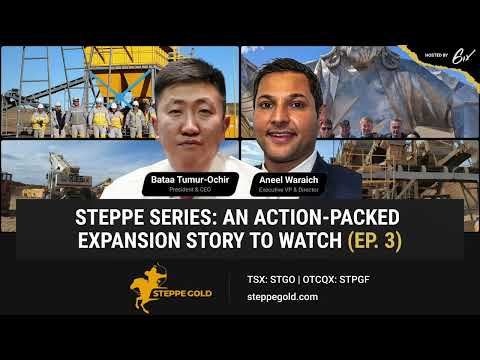
0:08 Well, hello everyone and welcome to Step Gold's live summit today hosted by 6. I'm very pleased to introduce our speakers today. We have Bhattacharya Timur-Oshir, the President and CEO of Step Gold, and Anil Wara, Executive Vice President and Director. Our speakers are going to go through a company presentation, and then we will be accepting questions live. So as a reminder, you can submit your questions at any time, and we'll leave time at the end to get through them. So please use the Q&A panel on the right-hand side to submit those questions throughout the discussion. And as always, the summit is being recorded
0:39 and available to watch afterwards on six.com. But without further ado, I'm gonna hand it over to you and you have to kick it off. Great. Thank you, Dasha. And thank you everyone for joining for our year end update and webinar. And as everyone knows, we've been trying to be as communicative as possible throughout the year as we restarted production and in March of this year, very successfully building up our reagent supply. But for anyone who may be new to the story, we'll just give you a quick update as well of who Step Gold is. We are a gold and silver producer focused on Mongolia, where we started this company at the end of 2016 as a private company with the hopes and aspirations of building a premier precious metals company. Today we are a producer. We're producing from our phase 1 oxide mine at about a 45 to 50,000 ounce run rate at about $800 all in costs.
1:38 In fact our last 0.5 have been around $800 all in. So very successful phase 1 mine that generates cash flow to grow our business. And we're now focusing on our expansion, which is the phase 2 operation right underneath the oxide mine. So the oxide mine is really from surface down to about 40 meters, shallow open pit across 3 deposits, which I'll show you in another slide. And with our phase 2 operation will be the larger open pit from 40 meters down to about 300,350 meters. That phase 2 operation has a meaningful mileage today of 10 and a half years at about 100,000 ounces per annum. So it's a doubling of our production profile over the next 2 years using cash flow plus debt and debt-like structures to expand into this phase 2 operation while continuing to explore and grow.
2:33 And we have had some success in our exploration and growth strategy there as well, which I'll get into. So, as a reminder, we're listed on TSX main board, ticker STGO. Today, our cap structure remains fairly consistent and hasn't changed actually in the last almost 2.5 years now. We haven't raised any equity since August 2020. Our last equity raise was completed at $2.15, which is 1 investor, strategic investor Eric Sprott. So, you know, we are very mindful of dilution as a company and a board of management team. Why? Because we also own the company. We own close to 20% of the company. So we are highly aligned with our investors. We feel the pain and we're here to ride the game together.
3:21 And so I think that's very important in showing the alignment. Our share structure's fairly high here today. We've got just under 70 million shares outstanding. On a fully diluted basis, we'd be about 85 million shares with about 22 million of cash coming in. Our market cap is about 75 million Canadian today, or circa 55, 60 million U.S. So as a producer, generating circa 25 million U.S. Viva to this year, 35 to 40 next year and the year after, we're certainly cheap. We're doubling our production profile, and yet we have a lot of expiration and sizzle. On our roster here for investors, we also have Fidelity Investments, which is showing about 6% of our company today.
4:08 Eric Spod actually is showing 10% here today, but he's been buying on market as of last week and today he's at over 11% of the company. So it's a strong endorsement to have investors who've come in at much higher levels, as we listed $2 actually in 2018, and who are still supportive. I think that's a testament to our team and the asset and the upside that exists in our company. Today we have 3 banks that cover our stock, Handman Partners out of UK, Stifel GMP here of North America, and Haywood Securities. We do expect our resource coverage to grow in the coming quarter. We had a site visit for the first time in 3 years in April this year. And so additional banks and analysts did join and got to see the operation in full steam. So we do expect more eyeballs on the story as gold becomes interesting again to investors.
5:04 We're one of the companies that offer that torque and leverage to the gold price. In fact, our stock price was about 90 cents 2.5 years ago when we started production for the first time ever, and 3 months later, we hit $3. So our market cap has been triple what it was today when we were actually a smaller company. We didn't have that 10 and a half years of mine life ahead of us that's now been solidified. So quick reminder, we started the company in 2016 as a private company. In 2017, we actually acquired the 2 assets that we own today. The ATO project is a project we bought from Sintergold for 20 million US. They had previously spent 30 million US on the project, drilled about 67,000 meters, 28,000 meters of trenching, but more importantly, got a fully licensed and permanent for the heap leach, which is our phase 1 operation in commercial production and profitable production today, but also for our phase 2 expansion. And so what we did is take a phased approach by building the heap leach, which is smaller CapEx, generates cash flow to actually grow our business.
6:11 And that's exactly what we did, bringing production online in April 2020 in a very tough time. COVID, you couldn't get in the country if you tried, and that's the importance of being local. Our team in-country is almost 300 people, and 99% of them are local Mongolians. So when you have a local team, you can operate during pandemics and times where you can't travel as we've seen in the past few years. We brought production online in April 2020. Last year in 2021, we actually updated the resource and reserves. And so that's a big jump from where we started. When we bought this project, it was about 1.2 million ounces on a resource, inclusive of 210,000 ounces of reserves, oxide only. Today we're over 2 million ounces in the resources, inclusive of 1.6 million ounces of reserves on a gold equivalent basis. So, a big jump shows you the validity of expansion. We have enough ounces today to expand and have a circa 100,000-ounce production profile that's 10-plus years. We do expect to update the market again in the coming weeks, if not a month or 2, which will be an update from last year's feasibility study and mine plan and resources and reserves. So that doesn't include a lot of drilling that we actually completed in the last 12 months. So there's a lot of upside, which I'll get into.
7:39 Last year, just over
7:42 a year ago, we actually released a feasibility study on that 10 and 1⁄2 years of additional production. And we also received a landmark debt package from within Mongolia for that phase 2 expansion and we actually have built our phase 2 crusher which is now fully installed and will be operational in the spring. So we have accomplished quite a lot over the last 18 months in a very difficult time.
8:10 I'm going to highlight obviously Mongolia, why Mongolia. Firstly, Our team, Bhatt, our partner here, and Matt Wood, our Executive Chairman, have actually worked together in Mongolia since 2009, and previously built another company called Hunu Coal, and that was a $500 million cash sale at the end of 2011. So there's a track record of success in country. More importantly, what we replicated in that success previously is being local. And so, today our CEO is local, our half of board are local, and more importantly, 90% of our workforce in country. So, that allows you to obviously get the buy-in locally, provincially, federally in country. No one stops you from growing if you're doing things properly, employing, educating, providing the social benefits to the region. And so that's certainly a big win. But Mongolia is one of the most underexplored countries that's resource rich, home to world-class assets and discoveries with the Rio Tinto OT mine in commercial production and expanding.
9:14 It's one of the biggest copper mines in the world. So you can build world-class assets. There hasn't been a lot of focus on precious metals where we believe there's opportunity to build a 5 and 10 million ounce resource profile and a production profile that could grow to a mid-tier status. And that's what Step Gold is focusing on. Bata, if you have any comments on Mongolia, please. Yeah, so, yeah, the country itself is a mining country. It's 90% of all our exports in Mongolia is our mining commodities. And the border last year, we had some border issues with China because of COVID. And now it's improving and we expect it to be fully open next year. And The main issues last year we had were challenges. We had some challenges importing reagents into the country.
10:05 This year it's all being fixed and with the new routes and new suppliers. Right now as of today we have specked enough reagents until April next year, but we still continue to purchase more reagents, starting January next year again. So last year, so the issues and challenges being fixed and the country itself is improving to much better conditions. Yes, absolutely. Rio Tinto, obviously one of the biggest super majors in the world, diversified miners has doubled down in country this year. So that's a big endorsement of Mongolia. I think you're going to see other majors coming into the country. And that's where we have it as distinct first mover advantage of setting up the infrastructure, being a producer, a taxpayer, a royalty player, an employer in country.
10:56 It allows us to grow, and the goal for STEP is to become that precious metals platform. So any investors that want exposure to precious metals in Mongolia come through STEP. Any corporate company that wants a toehold in Mongolia, instead of recreating the wheel, use our infrastructure and our relationships and our pipeline of assets to grow in country. And that's really what we're trying to accomplish. In fact, just a couple weeks ago, the CEO of Rio Tinto was at a gala dinner, and his final comment was he was most excited out of his portfolio assets. He was most excited about Mongolia and the opportunity there and the employment of 15,000 locals. Very excited. So that was another strong endorsement for the country.
11:44 So As I mentioned earlier, we're currently in phase 1 of our operation. So you can see the shallow open pits here. That's the oxide mine from surface down to about 40 meters. We're now focusing on expanding into our phase 2. So over the next 2 years, while continuing to produce and generating cashflow, we'll expand into our phase 2 operation and bring the much larger production profile online, which we see is continuing to grow. Today it's at 1.6 million ounces on a gold equivalent basis. We believe that's going to grow to 15, 20 years by the time we bring it online. So there's a lot of growth optimization and even the production profile could also increase.
12:29 And that's our goal. Again while constructing the phase 2 operation over the next 2 years, is continuing to optimize and grow it, grow the production profile so that we can bring more ounces up front, which is more valuable from a cash flow and evaluation perspective, and also extend the mine life. And we've already shown a path to that. So as a refresher, last year, when we put out our feasibility study for the phase 2 expansion, it came in at about 130 million US in CapEx, $850 all in costs. Now, Since we put out that study, we've already signed a power agreement, a landmark power agreement, with the state grid. So this feasibility study that we put out a year ago was based on diesel power for phase 2. We are now going to connect to the grid.
13:15 That savings is over $10 million U.S. In OPEX, or over $100 an ounce. Now there is additional associated CapEx, so it's gonna be another 10 to 15 million US for that power, but the payback is basically a year. So Certainly very valuable optimization and update there from the feasibility study a year ago. Now also what I want to highlight is the lead and zinc grades that are in the feasibility study. So the phase 2 operation in current state is a flotation circuit. So we're going to produce lead in zinc concentrates with high precious metals content. If you look at the lead in zinc grades here, 0.46 and 0.78% on the zinc, these are in the feasibility study, very profitable, very economical.
14:00 Since this feasibility study came out, we've actually had 2 drilling programs at the ATO1 and 2 deposits. So previous to the feasibility study, we had never drilled underneath the ATO1 or 2. When we took over the project, We immediately drilled ATO4 and doubled the size and we drilled on our fourth deposit called Mung Which is actually in the top right corner here, and that's About 440,000 ounces today in resources also not converted into the mine plan So You're looking at about 400,000 ounces of precious metals that's not included in this phase 2 expansion. We have additional drilling, new drilling, discoveries and extensions underneath the ATL 1 and 2 deposits that's not incorporated. Last year's drilling program, we have the results here, have demonstrated grades on the base metals that are 10 to 20 times higher than in the feasibility study. So you have 21 meters at 10.5% zinc and 3% lead, 55 meters at 4% plus zinc, almost 2% lead. These are very meaningful intercepts that will add mine life value
15:09 revenue to our phase 2 expansion, and we don't see any additional capex required for that. So that's where we see this mine life continue to grow. At depth, all 4 deposits still remain open below 350 meters. So the maximum depth so far drilled on this property is about 400 meters. That's included in the resources and reserves. So still room to grow all 4 deposits. So this can become an underground mine maybe after a decade or so. And there's still an opportunity to step out of this mining,
15:43 not on the mining license, but from these deposits and potentially uncover more deposits similar to Mung or ATO, where maybe we have additional extensions for the oxide mine if we make new discoveries and certainly have maybe more satellite deposits for the sulfide mine. That's all Optionality, something that we're not banking on, but certainly an opportunity to continue to grow. We believe this circa 2.5 million ounces of resources could grow to 3 to 5 million on this deposit, and our reserves obviously similar growth profile, and our production profile could grow to circa 125,000 plus ounces and have 15 to 20 year of my life. So a lot of room to grow and optimize this expansion project. This expansion project is already underway, as I mentioned.
16:31 We've already signed the landmark power agreement. We've already built and constructed this phase 2 crusher. So this is 1000 ton per hour fixed crushing circuit that we'll be using for phase 2. This is now fully installed. So last year, when we received debt from the government, the Bank of Mongolia sponsored debt for our phase 2 expansion, we drew down on it. We actually procured this crusher
16:56 and installed it. And we've since used our operating cash flow this year to pay down that debt again. So there is the ability to use our cashflow to fund this expansion alongside debt. And so what we've done now and close to is essentially brought our balance sheet back to net debt 0 with the goal of refinancing or bringing in a larger financing package over the winter to plug the remaining CapEx spend. So debt plus ideally future cash flows over the next 2 years and maybe some other non-dilutive
17:31 plug like a prepayment on offtake is how we believe we can fund the remaining CapEx over the next 18 to 24 months for phase 2 and bring it online. Now, as Bhatia mentioned earlier, last year we had supply chain issues. So 2020 was a very successful year for bringing production online. We produced over 30, almost 35,000 ounces on a gold equivalent basis, gold and silver at circa $800 all in cost for that year. So Very profitable production right out of the gate with the local team. You couldn't get out of the country if you tried in 2020. So we had a very strong start to production. In 2021, we ran into supply chain issues on the reagents. And this had to do with the land border being closed
18:17 with China during COVID. They closed it. And as it reopened, hazardous materials still were not allowed to pass. And that still remains today. We believe that will be solved shortly, but that certainly impacted our ability to procure reagents. And so we had had to take production offline last year or defer production. So we only end up producing just over 12,000 ounces, still profitable production last year in 2021, while solving for the supply chain issues. We've since managed to open up new supply channels
18:49 and build up an inventory, as we promised. We built up an inventory on site. So we now have, as of a couple of weeks ago, almost 6 months ahead of us of reagents on site today. And as Bata mentioned, in early New Year, we'll procure additional supplies. So we'll continue to have that 5, 6 month of inventory of reagents, key reagents on site. Last year, while solving for that issue, which we did, we continued to crush and stack and mine material. So we hit the ground running in the new year when we solved for the reagent issue. So by the time we started production in March of this year, we already had 85,000 ounces on a recovered basis, sitting there unprocessed on the leach pads, on the ROM pad, and blasted in the pits. Allowed us to continue to hit the ground running when we restarted production. And as you can see here, production came online in March 1,500 ounces,
19:41 3,300 ounces in April. And we were just under 4,000 ounces until September. September, we hit over 5,300 ounces. And we were above 4,200 ounces in October. So you can see the ramp-up worked very well. In a normal ideal world, if we had 5, 6 months of reagents on site before the summer, you would have seen the ramp up of 5,000 plus ounces in a June-July scenario and even going higher. So next year, 2023, we do expect that this will go, we'll be hitting these higher numbers in the summer months, which we couldn't this year. But the last 0.5, we produced over 23,000 ounces at $800 all in costs. Very profitable production. We used that cash flow, again, to pay down some of the debt for phase 2, allow us to clean up a balance sheet and refinance. We're now going into winter.
20:35 This is – there is seasonality in Mongolia given this minus – up to minus 40 plus wind chill during these next couple months. Our production will be lower as expected and as confirmed to the market and everyone who knows cold weather heat bleaches, we'll probably end up producing about 1,000 to 2,000 ounces per month for the next few months, but then we'll hit the ground running again. We have over 70,000 ounces, again, unprocessed ahead of us, so it allows us to hit the ground running. In fact if we didn't mine again or blast again we probably have about 18 months of production ahead of us. So a lot of this production has now been a lot of this
21:17 future production has been paid for. So from a allocation of costs, they'll still come in about the $800 all in costs. So we do expect to produce about 45 to 50,000 ounces in 2023 and similar in 2024 at similar costs, about $800 all in. So quite robust production. And then we'll use that cash flow to continue to explore and contribute to the expansion in phase 2. Now last but not least is our second project, very exciting expiration license. So as I mentioned, today we're a producer expanding and doubling our production profile and yet we're still drilling on both properties, our ATO project and down here in the Udum Khundi project, which we also acquired in 2017.
22:02 We, This is a 14,400 hectare exploration license that previous to us owning has never been drilled. But what's very exciting about this region is a new gold district and province where our peers, Erdene Resources, have had a lot of success over the last few years. So our license is the gold outline here with the 4 discoveries, and Erdene's is the blue license is adjoining ours to the north and the South. So they have over 1 million ounces today, I think about A0A million ounces in reserves.
22:36 The license to the South is the actual mining license. They put out a feasibility study also about 2.5 years ago. And they've had some new discoveries in drilling in the last couple of years. And I believe they're saying they're going to be close to 2 million ounces, maybe by year end or early in the year. So we're certainly in the right area. This is a fantastic new region, gold district. We believe this region also has the ability to be a 3 to 5 million ounce plus district and in a way it's what we call our phase 3. So our early work from surface was very encouraging. We did all the IP magnetic soil sampling trenching from surface, you know yielded 1.5 grams gold, 450 grams silver, 3% plus copper.
23:22 So this is a very, very exciting prospect that we just started our maiden drilling program in the summer, a 3,000-meter program, just to get going, because we've had this project since 2017 with very minimal work. We started a very early stage drilling program on this property with the intention of follow up in the new year, I believe with 10,000 plus meters in this region. Batra, anything else to add on the UK project? Yeah, so besides Irtin and us, there is a state-owned company called Irtin Soft Resources, which has a license at the bottom. And it's owned by a state-owned company called the Irtnas Mongol, the parent company of the Irtnasat Resources. So they just announced that they're going through the corporate restructuring and the government is considering to
24:11 list its assets on international and local stock exchange. So StepGold has offered to help with the listing and capital raising process and provide technical expertise to the resources, state-owned company. So we are cooperating with them and we believe this whole region will be the next new gold district in Mongolia. So the cooperation is still going on and we have offered some joint exploration programs with them and also joint social responsibility programs in that area. So the process is going on. Excellent. Yeah, I mean, this is what we think is our next production centre. Certainly the ounces are there, the opportunity is there. It's obviously more greenfield than where ATO is today.
25:01 But certainly I think the locals have seen what we've accomplished in Dornald Province where we've created 300 jobs plus a lot more indirect opportunities in the region and educated and scholarships and meat and dairy co-op. We're doing all the right things. So I think we have the strong support to do the same thing down here. And this could be another 100,000,150,000-ounce production center for the team down the road in what I call phase 3. So certainly an opportunity to continue to grow our production profile within country. There are a lot more opportunities still to assess
25:38 through exploration projects, advanced exploration and development projects. And as I mentioned earlier, the goal for a STEP is to build a mid-tier precious metals company focused on Mongolia, where we've now demonstrated success and have the execution, have the infrastructure, and yet there's still a lot of opportunities for new discoveries and additional mines
26:01 to be built. So as mentioned, in the new year, we'll continue to be drilling at ATO again underneath all the deposits, continuing to incorporate the drilling completed over the last 12 months, roll that into obviously the extension of the phase 2 operation, continue to convert the Mung deposit and additional drilling and bringing the Mung deposit of about 400,000 ounces also into the mine plan. We'll continue to optimize and grow that phase 2 both from a production profile, life of mine and optimize the cost structure. So that's obviously quite exciting. And you can see that the clear path that we have, we've already accomplished in just the last year in terms of development, bringing the phase 2 Crusher already online in country, continue to optimize and we'll finance. So quite a lot ahead of us.
26:57 So in summary, Bata if you just wanna highlight again what we've accomplished and what to expect in 2023, then we'll open it up to Q&A. Okay, thank you. So the company is working towards becoming one of the largest precious metals producers in Mongolia. So as for this year, first, we are back in production. This year we have fixed all the issues related to the reagents and increased our production by over 200% compared to last year. Secondly, we have received initial funding for the Phase II of the ETL gold mine and currently working on the full financing package to fully finance the phase 2 of the gold mine. As for inventory, we have about 90,000 ounces of recoverable gold on the leach and raw and underground to further increase our production next year.
27:48 And this year we have also completed the construction of a new crushing unit, which will be operational next year and receive all the approvals to connect to the state power grid system. So Lastly, we will continue drilling programs at the ATO. And currently we're actually updating our resources and the research estimates. And also this year we have finally commenced the initial drilling programs on the Oudmuhundi UK project located in Western Mongolia. So for the next year, our main focus and main goal is to fully finance phase 2, commence the construction of the exploitation plant, completed by 2024, and increase our production to over 100,000 ounces of quality pure land.
28:35 So we will continue, keep continuing our exploration programs and also keep continuing to assess new development projects for further acquisitions. So we're happy to now say we're back on track and keep continuing increasing our portfolio and increasing our productions. Yeah, thank you. Great. Great, thank you so much, Anil and Bata. We're going to jump right into live Q&A. So if you do have a question, feel free to submit it now. Anil, you mentioned that Mongolia is a mining jurisdiction, and I understand that the government is opening up more licenses for mining. Will ZEPP Gold continue to acquire more licenses as part of its growth strategy? Yeah, that's exactly what Vata just mentioned right there at the end is our goal is continue to assess new opportunities in country. We actually wanna be the consolidator of all the prospective assets, development assets, and exploration, get to that resource profile that's of substance, the 5 million plus, and a production profile pipeline that can get to 250,000 plus ounces. So then we really become meaningful, have this scale. So again, if anyone wants to come into the country, they should be coming through us and that's really what we want to accomplish. And there is a lot more exploration opportunities we think in the future. And the beauty is as we continue to generate cash flow and bring phase 2 online, we'll have all the funds without having to dilute to continue to explore and fund new discoveries.
30:07 Okay. And how has Mongolia... Oh, sorry, go for it. Yeah. Also, there are lots of Mongolian companies with a highly prospective and very interesting project. So we keep receiving their presentations and technical information and keep assessing. And we had quite a few selections and hopefully we'll have some good news next year. Great, thank you. And how is Mongolia and Stepgold impacted by the current geopolitical situation, and will it impact any catalyst timelines? And also, Will the reagent supply continue to be a pressure for subgold? Yeah, so on the geopolitical side, certainly there was an impact.
30:56 We saw, given we're sandwiched between Russia and China. And so where we saw that initially was as we were opening up the new channels for supply for reagents, you know, it slowed that process down because we were shipping product out of China but out to different countries, and certainly that was slower because of the geopolitical issues. We also saw the supply-demand issues on USD, which certainly had an impact this year for the availability of USD in country. Luckily, our majority of our costs are actually local, 60 to 70 percent of our costs. But certainly, I think what we saw is it was a lot harder to convert into USD on a regular basis than previous.
31:45 And so that's where you saw the government supporting, you know, because of COVID and because of the geopolitical issues, the government paying us a 5% premium to spot price since May of this year. That's since over, I believe, but, you know, it was a benefit that we saw as a producer to be able to get a premium to our gold sales in country, because the government needed the reserves and the effects. But I would say in terms of reagents, it delayed our ability to get that 5 to 6 months worth of inventory on site. Our goal was to have it by summer. We have it today, which is fine. And now we're seeing the regular shipments, as Bhatia mentioned. So we don't see reagents being a major issue anymore. We've now built that 5, 6 month inventory on site. So if we haven't received a shipment for the next few months, we're still in production. So we think that's all solved. And as Bhatta mentioned, in early new year, we'll continue to procure regular shipments. So we should always have 5, 6 months of inventory of key reagents on site for us today. So that's going to allow us to continue to remain in production and generate cash flow.
32:55 Thank you. Paul is asking here, what are the newest infrastructure changes coming in Mongolia now? Mata, do you know? Infrastructure changes, you mean, infrastructure challenges or? Changes. Yeah. Or challenges. Yeah. Changes. No changes. Yeah. The newest infrastructure changes coming in Mongolia now. Well, this year the government has, I mean The private entities have completed a new railway to China, and the government is highly focusing on increasing our exports to China.
33:41 So they just completed 1 new railway and also completed the previously started railways, mostly for the coal and copper and iron concentrates. So right now we have 2 new railways into China. And yes, so the main thing, the new government is actually really working hard towards and accomplishing is opening up new export channels. Those are the infrastructure. Great, thank you so much. Another question from Paul is, Are provincial GVs such as Udam Kundi going to become more frequent or a one-off for the country and industry as a whole? Well, I believe the way how we perceived it is it was under tender, open tender, and it was only for the joint venture between the local companies and private entities.
34:41 So that has been, that regulation has been off right now. So as of today, it's been, it's on the ass right now. There are a few other previous companies, but this regulation has stopped and there are no more of those regulations. It's been removed from the law. Yeah. Thank you. Can you tell us more about the growing youth demographic in Mongolia and the demographics of your team? As Stepan has stated many times, it's focused on developing Mongolia's young talent. Well, yeah, so the country has a lot of young people.
35:26 They over 70% of population is about 30, 35 years old and even younger. And StepCult, with our previous companies, and we have our fund, which is focused on education. And as of today, StepCult has provided scholarships to about 1,000 students, financial aid, since we established in 2027. So we are the largest, one of the largest scholarship and educational financial aid providers in the country. And we are very proud of it. Yeah. And if you look at the average age for our company would be an average 30, 35 years old. Young people and we're very happy and supportive. Yeah, that's amazing.
36:12 I believe our workforce is probably 25, 30% of women, but I think from the women demographic, we have a very strong content as well, right, across the company. That's key. This new young regime is certainly educated. They're now getting more educated on mining and understand how important it is. And I think that's also very important to have a receptive new generation. Yeah, absolutely. That's great. I think you answered this, Anil, but maybe you can clarify, is Mongolia paying a gold premium in order to draw USD dollars, or is it some other reason? Is the question. I think it's a combination, Bhatta, safe to say, I guess They're paying a premium because of the lack of USD availability.
37:06 Exports were also down during this time. So exports to China because of the 0 COVID policy means mining revenue is down, sales were down, And because of the lack of FX in the region, gold is obviously the easiest and most liquid asset to convert into USD. So for them, it helps them build up gold reserves, which they can monetize into USD at any time. Bata, anything to add to that? BATA ASSISTANT Yeah, it's a part of this Gold II program. It's a government program. It's also government and central bank's program called Gold II. And because of this COVID situations last year, the coal and copper exports were at very top and difficult to export out of country.
37:57 And government and central bank decided Gold and silver will be the easiest exports to bring in foreign currency into the country. So that's why they pay 5% premium on top of the spot gold price. Thank you, Will. Gold continues to be at the forefront of a lot of discussions about the current economic and inflationary issues, but what about silver? I know you just mentioned silver. Is that still a focus for Sep Gold's team? Yeah, listen, silver is less meaningful and material in our phase 1 operation because the recoveries are lower, about 40% on silver, so it's less than 5% of our current production, so it's less material. But we do have 20 million plus ounces, I think almost 22 million ounces for phase 2 currently. I think that will grow because that Mung deposit is high-grade gold and silver.
38:55 It's about 400,000 ounces today, again, not included in the mine plan. We have the ability to convert 20 to 25 million ounces of silver in the coming years without any additional expiration. So it becomes more meaningful for our phase 2. So certainly, we'll have that exposure to silver. On a revenue breakdown, I think it's about 10% of our phase 2, but 10% is meaningful in phase 2, given that our ounces, our profile is double. And so silver, we have some torque and I guess leverage for that silver price should actually move by the time we bring it online. Thank you. Chris is asking here, how much more money do you need to complete phase 2?
39:45 Yeah, I think the safe estimate is still $130 million US, which would be debt or debt-like instruments. Obviously, inflation is here, but We did price a lot of things at the high of the market in terms of steel. The crusher is already locked in and paid for it and installed. So I think the plug today is about 130 million US because we had that power upgrade that we announced in the summer. So that's a realistic, I think we can beat that, but that's kind of the target. So the new capital coming in would be in that quantum between debt and debt-like structures. David has a question. He's asking, is the company aware of a big seller?
40:42 I'm unaware of any big seller. Our biggest shareholder is Eric Sprott today, and he's the biggest buyer. On the sell side, we're unaware of any seller, but it's really tough. You're finishing off tax season right now, still about 2 weeks left. Why someone would want to sell at these levels, I have no idea, given that we've actually executed and performed better than expected this year. So, but I'm unaware of any big seller, but if there is 1, that's obviously an opportunity for a lot of investors to get in at these lower prices. Absolutely. Simon's asking, how many ounces did you produce in November, 2022?
41:31 I don't think we've published it yet, but as expected, November, December, January, and February will be in the range of 1,000 to 2,000 ounces per month. That's an indicative range. So when you model our next 12 months of production, it's still going to be in the 45,000 to 50,000 ounces, including these lower winter months. This is really just a deferral of production. You catch them up in the summer. But I guess for November, December, January, and February, it's best to assume about 1,000 to 2,000 ounces of production per month. Just another question about Mongolia. We've been hearing about ongoing youth protests in the country. Does any of that impact step in general or create any uncertainty with the government or conducting any business in the country?
42:23 Yes, so it's been almost a week. There's a small and small to medium-sized protest, especially from the students, that's regarding the coal, state-owned coal, regarding the state-owned coal company and its relationship with the politicians and so on. So one of the main whispers or the main people, actually the current government actually brought that issue to the public. And I believe they are the current government is actually receiving that public support in order to clear up the certain politicians and changing the management of the state-owned enterprises. So that's a daily progress and daily improvement coming from the government side and hopefully it's been should be hopefully to resolve very soon.
43:19 It's not impacting our operations to be clear. Yeah, yeah, yeah. All right, great. Well, that's all the questions we have submitted at this time. I just wanted to thank you both so much for taking us through the presentation and then thank you everyone who joined today and asked questions. If you do have any follow up questions, Stepgold's contact information is on the screen here. You can reach out to them directly with any follow up questions that you may have. And as I said, this has been recorded and will be available to watch later today on six.com. So if you have, do you want to go back and rewatch anything, it'll be up to view. And feel free to reach out and follow up with Stepgold and on the website stepgold.com. But for that, before I close out, I'll pass it back to either Neil or Bhatia for any final remarks.
44:07 Yeah, sure. Listen, thank you. Thank you, everyone, for your support and engagement this year in what was obviously for us a great restart of production, and I think we've had a very exciting year, and next year's gonna be even more exciting. I think the gold price and love is gonna be there, which means the equities will get the love. We don't have to raise equity to get to a higher share price or market cap or value. And so we've been there before and we'll get there again. But again, we offer production, we offer expansion of that production, and yet a lot of expiration sizzle and opportunity. And I think that's very exciting. A lot of room to grow as a company. And we look forward to updating you guys on a regular basis in the new year.
44:53 So I think there's quite a lot of updates to come out in the new year. And we'll see you then. Yeah. Thank you very much for being with us and supporting the company and hopefully starting the Q1 we'll bring in more good news and even more productive new year next year. Thanks. Thank you very much and I hope everyone has a great new year. Great, thank you.