Transcript
Automated transcript · Written by software from the replay's audio. It can mishear names and figures; the replay is the record.
0:08 I'll say good morning, good afternoon, good evening, depending on where in the world you're signing in from today. I'm joined today by Ewan Mason, Chair and CEO of Stardiamond Corp and George Reed, the company's SVP Corporate Development. Good morning, both of you. Good morning. Good morning. And today we'll be discussing the company's pretty exciting recent press release announcing a revised mineral resources estimate for the Orion South Diamond Project. A bit of housekeeping before we get to the protein. Today's event is being recorded and the replay will be available probably about mid afternoon actually because we're nice and early today. This is
0:38 also an interactive event. So if you'd like to ask questions to you and George, please do. There's a chat button in the bottom right of your screen. Ask at any time during today's chat. We'll try to get to as many questions as we can. If we don't get to them, don't worry. I'll pass your questions directly on to the Star Diamond team, and they'll get back to you as soon as possible. Here's how today's event is going to go. I'm gonna throw it first to Ewan to give some context for this press release, then to George for some of the details. Then I got a couple of questions for both of them and I'll shoot it to you guys for the audience questions. So that's broadly how it's gonna go today. Without further ado, I'll pass to you and to kind of sum up and give us some context. Well, great, Thanks, Romeo, and good day, everybody. You know, quite simply, back when Rio gave their walking notice 2 years ago, we realized we had to do something epic to be able to move this project forward and to get into a position to be breaking ground in a reasonable period of time. So George and his technical team embarked upon a study to see if we could mine Orion South first due to its lower
1:41 level of till coverage and overburden coverage and the fact that higher grade diamonds were closer to the surface in the deposit rock. And so lo and behold, this press release yesterday is a result of all that work. Quite an extensive amount of work was done combining Rio Tinto's results, and we used consultants all over the world to come up now with the concept. Basically, we're ready to go, subject to a pre-feasibility feasibility study completion on Orion South. And so what does this mean? This means breaking ground within 3 to 5 years, as long as we can get the financing in place. And it means we've saved, we've saved possibly as much as half a billion dollars. Rio Tinto laid it out for us and they said if they were to do a bulk sample, which we weren't going to do, it would cost anywhere from a couple hundred million to $1.2 billion and take 5 to 7 years. All that's off the table now. Really, we don't have to drill any more holes, do any more of that kind of stuff, because we're at the point now where we're ready to commence with the feasibility studies. And so, I think what that means is 3 to 5 years to breaking ground, good news for the project, good news for our shareholders.
2:49 Thank you, Ewan. As we step into a few of the details of this revised resource estimate, I should say at the outset that we were very fortunate to have a much larger data set. We took a very in-depth look at the numbers. We wanted to mitigate the risk on the diamond price on Orion South because there was this advantage in mining Orion South first. We get very good cash flow from mining Orion south first because of its shallower overburden and the fact that it has the higher grade kimberlite units in proximity, direct proximity to the overlying till at about 100 meters below surface. So we dived in, we took a very careful look at the data, we had the advantage that Rio Tinto had done some very
3:39 diligent work using the trench cutter drill to take a significant bulk sample on the star kimberlite. That was then processed through a very modern on-site bulk sampling plant, which had a very, very good recovery of diamonds throughout the size frequency distribution. Both the coarse diamonds, it was used an XRT sorter to avoid breakage, it used a dense media recovery circuit to recover the small diamonds. And so the diamond size frequency curve that was developed by Rio Tinto was very advantageous And we were able to integrate the Rio data with large diameter drilling data of hours from the past, as well as underground bulk samples collected on both the star and Orion South Kimberlite. And thereby, we had a much larger data set.
4:35 We took a very hard look at it. We had a statistician working in Australia. We had a team of mining engineers and resource geologists working in the UK. And between us, we were able to come up with this very positive improvement
4:53 in the mineral resource estimate with significant increases in both the carats and the grade on both Star and the Orion South Kimberlite. And this bodes very well for the future. As Ewan says, we are at the cusp of commencement of a pre-feasibility study, which will have a short period of operation. We don't need to do any fieldwork, we can get going with that and get it done by the middle of next year and then directly into feasibility study. There may be some minor fieldwork that needs to be done in terms of geotechnical work for the feasibility study, but it can be all systems go and we can build on an extensive archive of information that we have already acquired on this world-class diamond project.
5:49 Romeo, I think we're back to you. I appreciate the summon. I do have a couple more questions. I know some of these we've alluded to, but I want to just make it as clear as possible for our audience today. So I've got a couple of questions for you guys, if you don't mind. And then there's some from the audience that we'll get to. Appreciate the questions that have already come in. Please do ask more. We'll get to them as soon as I'm through mine.
6:09 So I guess this one's for George, but obviously both of you are welcome to speak on it. The previous resource estimate was compiled, as I understand it, in 2015 by Star Diamond. Curious, was a more conservative approach taken? I'm just curious if you could touch on why there was such a large improvement, a really significant improvement compared to the updated MRE.
6:29 The very big improvement comes from the integration of the trench cutter data that were recovered through a very modern plant that used a low-range 1-6 millimeter dense media separation surface to recover the small diamonds. It had a HPGR, high pressure grinding rolls, to ensure very good liberation
6:53 of those small diamonds. And most notably, the small diamonds, unlike most other deposits where the small diamonds have very low value, between $5 and $10 a carat. In the case of Star and Orion South, these small diamonds have appreciable value and they have very good bright white colors and fantastic octahedral shapes. So they are an important part of the economics of the project, and it's important to recover them. And in so doing, the plant that was designed by Rio Tinto for the bulk sampling program on the trench cutter drill recovered those diamonds very efficiently.
7:33 So we were able to integrate the trench cutter diamonds, large diameter drilling diamonds, and underground bulk sampling, which were large samples with lots of diamonds, integrate those and make very good grade curves. The grade curve improved appreciably, very good size frequency distribution curves, and we could get a far more in-depth look at the actual numbers of this project. And we, Peter Ravenscroft, the qualified person on the statistics of the resource model, he took a very very careful look at this and he does not do this without a very rigorous approach. So we are very satisfied in his work. He has very extensive experience over some 4 decades of working on mostly diamond projects and so we're very confident in the numbers that he has produced and we are happy to hang our hat on them and move forward into the pre-feasibility study. So
8:36 integration of very good data and a very hard look at the entire data set to make sure we have the largest number of diamonds representative across the body both horizontally and in the vertical section to get a very good understanding of exactly what's there. Right, yeah, I mean from my perspective looking at it, there's a substantial increase, as you said, in number of carrots, but as you've said pretty explicitly in the last piece, in grade as well, at Star as I understand it, there's a 20% increase in grade, and Orion South, a 32% increase.
9:12 What factors contribute specifically to this impressive increase in grade, just so investors understand. The addition of the trench cutter data to the data set with that very well recovered small diamonds gives us a very positive look at the grade. We have a much stronger data set, there's less variability in it, and then we can then apply that grade to our former diamond
9:43 parcels and strengthen them because we know these diamonds can be recovered easily in a modern diamond processing plant. Great. Now I know this is for me and I know other investors as well, especially the ones in the audience who are new to the Stardiamond story. The diamond deposits are unique, you know, Especially for people like me who are more familiar with gold or base metal deposits, they're quite different. It seems the majority
10:10 of the deposits are in higher confidence indicated category. I was wondering if you could elaborate on why bulk sampling isn't required, just so people can understand. So it should be understood we've taken a very large bulk sample on the star Kimberlite, 75,000 tons were taken out and almost 11,000 carats were recovered. On the underground on Orion South, we took a smaller sample because it was impacted by the world financial crisis in 2008. It's a 2,500 carat sample. But in both projects, we have extensive large diameter drilling that looks at the grade variation on a grid of about 150 meter spacing across both kimberlites.
11:00 And then we can look at the relationships between the drilling results and the underground bulk sampling results. And then on top of that, we add the trench cutter results, which gives us a much better understanding of the true grade, particularly related to the small diamonds. And so that work then gets integrated and gives us these stronger numbers.
11:25 Certainly Orion South, because of its smaller data set initially from the underground, We had to be more cautious with the numbers in the past. Now we have very much greater confidence. We have mitigated the risk on Orion South and it gives us an opportunity to move forward, as Ewan has said, very much quicker without the necessity of going back to the field and taking a long, expensive bulk sample from Orion South. We understand now that from the dataset we have, we are good to go on Orion South. Great. And speaking of moving quickly, I had a question that was also echoed by Dominic in the chat. Dominic, thanks for your question. Note that the news release provides a timeline for the feasibility study, which I believe is a second half or end of 2026.
12:15 But what is the, if you can, the precise timeline for the PFS? We would like to finish the PFS in the middle of next year. Obviously, we would get that done as quickly as we can. I've stated already that We have an archive of data on which we will build. We have already been in contact with the people who will do the work and given them a scope of what we want them to do. They already, many of them have worked for us before. They have a good understanding of what they need to do. And I believe we can put the work together very quickly. So the middle of next year for the PFS and the FS to follow thereafter in 2026.
12:59 Great. I got 2 more questions for you, George. Apologies for the gauntlet and then some for you, Euan, from the chat. So this is what we're going through. So both the Star and Orion South deposits have multiple zones. Can you discuss generally what the high priority zones are and provide insights into what kind of systematic approach you have for extraction. In both Kip Star and Orion South, the principal economic driver is a kimberlite unit we call the EJF, or early Jolifu. And the name Jolifu comes from the sedimentary stratigraphy. And the kimberlite was erupted synchronous to the deposition of those sediments, hence the name. And the early Jolifu in both projects, if you look at the table 1 on the news release, you can see that the lion's share of the diamonds lie in that unit.
13:54 However, in star, that unit is deeper down and you have to remove more overburden, plus some low-grade kimberlite on the top and then you get into the early Jollifu whereas on Orion South you go from overlying Glacier till directly into early Jollifu kimberlite and hence your cash flow for repayment of your capital cost of your mine come
14:23 very much quicker on Orion South than they do if you commence mining on Star. And so you can then run a seamless program mining Orion South first and then preparing the open pit on Star and moving over with a seamless production of carrots all the way through a 34-year mine life on the project of mining these 2 properties sequentially. Perfect. Thanks, George.
14:53 This is my last question. This is just something I didn't understand. I'm not familiar with the expression. You can tell me, what is a Whittle optimized pitch shell? It's interesting that you ask that. So in 1965 there were 2 IBM computer engineers who came up with what they called a Lurks-Grossman optimization for the optimum design of open pit mines. So that's a long time ago. And then a fellow by the name of Jeff Whittle, who died in February of 1994, a very outstanding geologist and will be remembered for a long time, he created a software in 1983
15:34 already that utilized that algorithm. And we must remember that in 1983, computers weren't very fast and powerful. So he had to work inside 1 megabyte. Nowadays, geological models and resource models are infinitely larger. Computers are very much faster. And so the Wittel optimization, it takes a geological block model that's created by a geologist that has grade and
16:04 diamond distribution organized into it, and then it puts that model into an open pit that minimizes the cost and construction of that open pit. So you apply economic parameters to a geological model and lo and behold, Whittle spits out an optimized pit design. And when I first started doing this in the sort of 15 years ago with Star, those optimizations would take 45 minutes to an hour to run on a fast computer. Nowadays, they run in a matter of minutes. Geologists can do their work much quicker. Appreciate the info there. Crazy what we used to be able to do with the megabyte.
16:50 I feel like a singing birthday card is more than a megabyte now, but at one point a megabyte was pretty useful. Appreciate that very much, George. Euan, I'm going to bring you in for a couple of the audience questions here. Mike from the audience asks or says, one of the biggest hurdles going forward, and Star Diamond's no exception here, is the challenge of obtaining capital sufficient to develop a mine. I'm curious if you could speak generally to that, what developments are being made, what the plan is, etc.
17:17 Well, that is a fundamental point. The industry right now is in the doldrums, not just the diamond mining industry, but the whole money industry is out of favor. There's a lot of money going towards crypto and A.I. That'll change. But, you know, ideally, we need over the next 2 years, we need 10 to $15 million to complete the pre feasibility study and the feasibility study. So our goal right now is to get that funding, we do not want to do it with equity because our share price is too low. So we're having discussion with a number
17:48 of the larger players and there are 3 categories that I would call pre-mine finance and that's really royalty and streaming players. There's bridge debt providers And then there's the buy side equity funds. So we're talking to all 3 of these groups, but I would say that in general, the bigger companies are the smarter ones on this one. And they're going like, we really like projects where someone already spent a billion dollars on it, so we don't have to do it. So yeah, we're interested. And so we've had a couple of proposals,
18:21 which have been, to be fair, kind of outlandish and robber baron proposals. So we're still working on it, but I am optimistic we'll get some over the top financing to fund the pre-feasibility and the feasibility because without that sort of money on the balance sheet, the engineering firms are gonna look at us and go, okay, just wait until you have some money in your account before we start our work. But I think we're gonna get there. There's a lot of smart people looking at this right now. And certainly this is an epic,
18:51 I would say, sea change in the way we're gonna go forward here because there is nothing like this deposit on the planet or not. I appreciate that. Rod's got a question that's interesting. I think it's an opportunity to explain why this time's different. He notes that it's exciting news. He's a longtime shareholder. And he said there's been several times over the years where it seemed like we were close to moving forward. But he wants to know why this time's different? Why this really is news that will push you to move quickly? Well I think it's different now because we've shown the route to
19:28 rapid commencement of mining. We've shown that with any at all there can be breaking ground going on in 3 to 5 years and that's because of all the work that's been done over the previous 25-30 years. It's because of the billion dollars that's been spent. We are already there and
19:47 Times are changing a little bit in the diamond sector today. There will be no diamond mining without diamond marketing. It's a whole new business. What is diamond marketing? You better have an ESG compliant project. We have that in spades. Our project is likely going to be carbon neutral, if not carbon negative, and we're just starting a Phase II study on that. And of course, conflict-free. Where do the diamonds come from? Saskatchewan. You've got that. And at the end of the day here, you need to have Indigenous involvement. And we're having discussions with a number of parties on this right now. So I'm thinking we're looping it all together in what's required today to move a project like this forward for diamonds. Appreciate that. Paul,
20:32 going back to George for this next one, it's a question from Paul in the audience. He says, hello, George, congratulations on the result. But then notes that from the 11,000 carats used for your pricing assumptions, have there been sufficient recovery of larger stones since incorporating the RT data set to accurately state your average diamond price. So what's the breakdown of actual versus modeled pricing?
20:55 There is a there is a difference obviously between parcel price and model price but there are, Rio were successful in recovering the highest value... The largest stone was 17 carats, a type 2a diamond, very good stones. There were definitely additional stones, but you must remember that in the underground, Both on Star, we recovered a 49-carat stone. Orion South, we recovered a 45.6-carat
21:22 stone. So there are a whole string of large diamonds greater than the specials, which come in at 10.8 carats. There are a whole string of those stones that have been recovered, that build up, and it's not just 11,000 carats, that's just star. There's over 15,000 carats from the entire diamond parcel that we're looking at at the moment. So we can get a good look at the opportunity
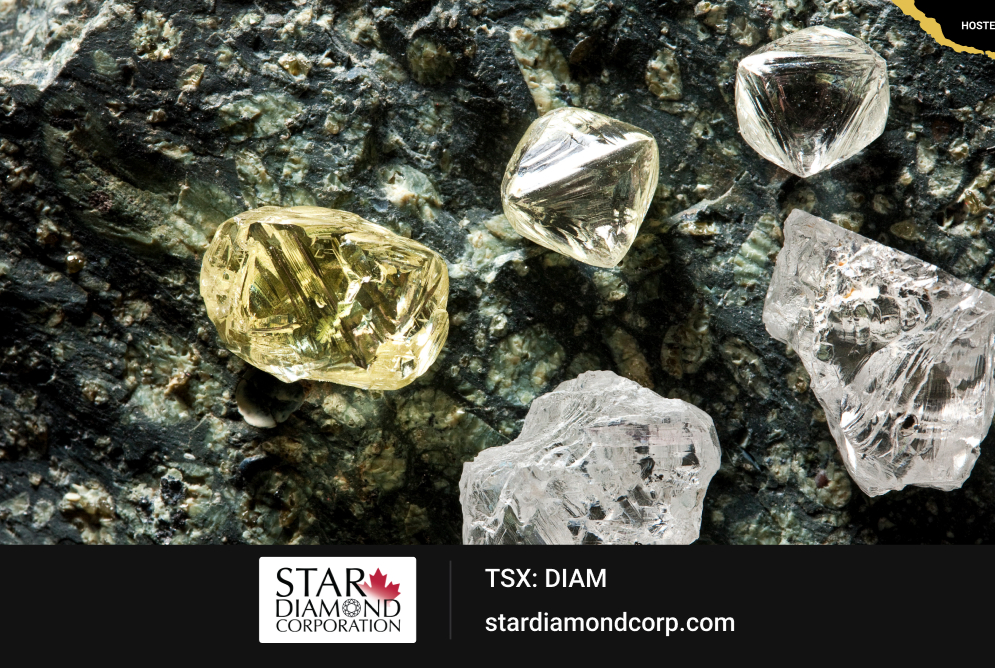
21:52 for large stones. There are large stones that are both very big and not of high quality, but there are exceptional quality stones, as in a 12-carat stone from Star at some $14,000 per carat, and the light fancy yellow stone from Orion South at 10.5 carats, $8,000 a carat. So there's some very attractive stones. The yellow stones also appear to be coming more important. Since our recent employment earlier this year of
22:26 Nelson Caroon, an expert diamond sorter now in-house, he has been very cognizant of the occurrence of yellow within the project, within the diamond parcel, and he has specifically noted that as an opportunity for the future. Great, thanks. One question, it's an interesting question from from Rock in the chat, I think it helped give some perspective to the audience, is he says you have 11,000 carats on hand, and he's curious strategically if there's a chance of selling those to raise capital. Whoever would like to respond. I think that's you, Ewan.
23:05 Well, coincidentally there are discussions taking place today with Saskatchewan government about that. I don't know the answer. We've been looking into it sort of peripherally for the last year and a half. But it would make quite a difference if we could do that. We could sell the diamonds, we could use that to, some diamonds, and I say sell the diamonds, George will cut my head off. But sell some diamonds to help fund the Prefeasibility study and pay the government their royalty. I don't know how the machinations of that would work out. But yes, we've been thinking about it. Great, thanks. And Eve asks one of these questions, it's hard to answer in full, but it is for for you and and it's can we get Any info as to contacts that have been made with potential investors?
23:51 Well, I can tell you that we have contacted, by this point in time, more than 50 of these type of financers I mentioned earlier. So royalty companies, bridge financing, buy side. Out of those 50, I would say 35 were an outright diamonds are not part of our mandate, sorry, good luck. And then out of all those, probably 5 to 7 were like, interesting.
24:16 Let's set up a check. You know, this is an iterative process, you really have to work on it. And that's what I've been mainly doing now, since, you know, in the last 6, 7 weeks. And I can say we've had quite a bit of positive interest. But you know, what we're going to have to recognize is that this type of financing is not going to be cheap. Debt-ridged financing for something like this will have a double-digit coupon on minimum and likely take our first and second born just to get there. So, however, there's lots to go around with this project and so we're not gonna be shy and cut in the field that works for our shareholders. Appreciate it. Now I'm gonna give last call to the audience for questions, but while we give them that last call, I'm curious for both of your perspectives, what are you excited about in the lead up to the pre-feasibility study? So what, just a view to investors and the audience in the room what goes on for the next year and the anticipation of that PFS. And what are you most excited about? George, I'll throw it to you first.
25:20 I'm very pleased with the numbers that we were able to produce. We had this vision of being able to do this in mind and it came out better than we expected. We're very confident in the numbers. It was done very carefully. The fact that we didn't put it out in the beginning of July was because of a lot of checking that we had to do, And we're very happy with the numbers. And I think these are very good numbers now on which to build the pre-feasibility study and really get moving. I have some optimism in the diamond business. If we're lucky, the diamond business might have reached the bottom, and the only way it can go from here is up. But let's see, we need to go into August, which we're on the cusp of now, and usually as the summer comes to the end in Europe we will just have to see how things develop but as geologist I'm an eternal optimist.
26:26 Even before I shoot it to you there's one more question for George just came in from the audience so I'll ask that and then let you wrap us up. Rock asks, what are the main differences in milling process between diamond and other minerals? He gives copper as an example. I think the principal idea is that In copper milling, you grind it up fine, and you recover the copper fine, and then you melt it back together. Unfortunately, with diamonds, you can't do that. And particularly in a project like Star and Orion South, where you have the opportunity for very large stones, you want to recover those stones without breaking them. And so fortunately, in the modern world, we have X-ray transmission sorting, which can be used at various stages of the crushing process to ensure we recover the big diamonds that have been liberated early without breaking them. So it's an iterative crushing process.
27:29 We recover the diamonds before we break them. That's most important. And they are exponentially more valuable as their carat weight goes up. Appreciate that. I know there are some non-diamond people in the audience. That's always helpful, that kind of info. Yuan, sorry, I'm going to put you off one more. This is a question from Greg from the audience. Are there any plans for the Bower and Orion North, or is Orion North off the table for right now? Orion North is a huge opportunity, and certainly Should funds become available, the application of the Bowerig to a bulk sample on that would be a wonderful thing to do. That's not in our sights at the moment, but it is certainly an incredible opportunity.
28:16 We have shown that very recently that there is this unusually high proportion of type 2a diamonds in Orion North and certainly that carries a huge opportunity for the future. But a lot of work has been done on the evaluation of star on Orion South. So let's get this going and Orion North can follow. Awesome. Ewan, finally, after putting you off, I apologize, I'll leave it to you for what you're most excited about the rest of this year and beginning of next year. Well, look, you know, science aspects aside, which is my specialty, I think we're coming into a perfect storm here. I mean, number 1, we're coming out of a recessionary environment, it looks like, okay? Recessionary environments have never been good for diamond purchases. We all know that.
29:05 Number 2, we're coming close to the implementation of sanctions on Russian diamonds, and Russia produces 30% of the diamonds for the jewelry market worldwide. The Western world consumes 75% of it. So this is actually quite incredible. And I think it will create a bit of a price squeeze here. And that's what we're looking for, right? The turnaround. And of course, Thirdly, the ESG component cannot be understated. We are pushing forward with that. We have already had some evidence that 1 ton of kimberlite ore can absorb up to half a ton of CO2. Truly phenomenal. People say, where are you going to get the CO2 from? That's somebody else's problem. Somebody else can collect the CO2 and put a corporation together through a carbon reactor.
29:53 These are all things that are good for us. And really, at the end of the day, I see a resurgence in the diamond market. You take a look at lab-grown diamonds falling off the shelf. De Beers has shut their lightbox division, no longer going to sell lab-grown diamonds for jewelry. Yesterday I read on the JNC site that their lab-grown diamond producer went bankrupt. The day of lab-grown diamonds for jewelry are over. These are all great factors that can push us forward. Awesome. Well, you and George, this is very exciting news and thanks so much for joining me today. Honestly, I look forward to the next time we chat. And everybody in the audience, thanks so much for joining us today. If you have any additional questions, you think of the perfect question right after the event ends, like I usually do, please do reach out. We'll be sure to get back to you