Transcript
Automated transcript · Written by software from the replay's audio. It can mishear names and figures; the replay is the record.
0:07 Good morning, good afternoon, or good evening, depending on where in the world you're standing in from today. Looks like we have a relatively international audience. So thanks everyone for joining us. Today, we'll be going through a deep dive on the diamond market, or at least as deep a dive as we're able to do in part of an hour. But I'm joined today by Star Diamond's Senior Vice President of Corporate Development, and with 39 or 40 years experience, a bona fide diamond expert, George Reid. It's great to be with you today, George.
0:32 Thank you. Nice to be here. I hope I can share some knowledge with you that I've accumulated over 4 decades in this business. It's been a wild ride. No, I'm sure you can. That's what I'm excited about. I'll do a couple of brief housekeeping notes before we get into the protein of today's discussion. Today's event will be recorded and the replay will be made available later this afternoon. So feel free to share it once it pops into your email inbox. But also I'll let you know, this is an interactive event. Only the first half is gonna be my questions to George. Following that, we'll take audience questions regarding the diamond market, how it applies to Star Diamonds project. So if you'd like to ask George a question, there's a chat button on the bottom right-hand side of your screen, looks like a little chat bubble. Press it and you'll be able to ask questions at any time during the presentation.
1:18 If there's a question that George or we're just unable to get to today for whatever reason, still pose it, and I'll make sure that it gets to the Stardiamond team soon as possible so that they can get back to you as soon as possible. Thanks for bearing with me during this housekeeping, but let's get right into the meat of this discussion. So I'll start off, George, with dollars and cents. I'm curious if you could share with the audience here what the typical industry size and capex is on a diamond project, and what's considered economical?
1:51 It's a good question because in the diamond business it's quite complicated. You have 3 variables. You have tons of kimberlite that have diamonds in it. You have the grade of that kimberlite in that how many carats are there per ton. Or because the grade is sometimes quite low, it would be carats per 100 tons. But then the wild card in this mix, which we don't have in metal projects, where you have a price that's quoted almost by the second throughout the day, is you have to determine the run-of-mine diamond price. And that price can be extremely variable, and as can the grade, and still the project can be economic. And so if we look at the end members of kimberlites that fall into those classes, we have at the one end with high grade but low price and huge tonnage, we have Ogile, which was a mine operated by Rio Tinto in Australia. It's now reached the end of its life. It was a highly successful and economic mine. It had a grade of some 700 carats per 100 tons. Some areas were even higher than that, but it had a dollar per carat value for the run of mine of about $20 per carat, which is considered low.
3:20 But in that mix, there were rare pink diamonds, some of which were sold for more than a million dollars a carat. So that's the one end of the scale. At the other end of the scale, we have a kimberlite in the mountain kingdom of Lesotho in Southern Africa called Letseng. It has a grade of 2 carats per 100 tons, so a very low grade. But it has a run of mine dollar per carat price that usually exceeds $2,000 per carat. So both of those mines are economic money-making concerns, very different grade and very different diamond price. So when you do your evaluation, you have to take out a large bulk sample to try and get a reasonably good control on that price. You can measure the number of tons. You can determine the grade with smaller samples, but in order to get the price of the diamonds, you need to recover between 2 and 10,000 carats, and in so
4:28 doing, you might have to take a very big sample. I think that might lead us almost into the next question, but I won't preempt anything. No, I appreciate that. And yeah, you have got into a bit, but it's really, I know, there's perhaps one thing that I should say is that if we want to develop a world-class diamond mine, we should anticipate that our capital costs will be in the order of 1 to $2 billion. So it costs a lot of money to put it into production, But once it is in production, it can generate cash quickly and you can repay your debt within 3 or 4 years. Yeah, I mean, that's significant for people to know, so I do for sure appreciate that.
5:15 One thing I know there's a lot of precious metals investors in the room, just looking at the list before we jumped in. I know that gold deposit, for example, is typically measured in the size of the resource and grade. But I'm curious, for an investor, how ought they evaluate a diamond deposit? What markers should they be looking at to show that it's optimally economical? So as I said, I started to say in the previous question was we need to take out some sort of bulk sample And obviously you need to take that sample in 3 dimensions. So you need to know, you need to define the number of different kimberlite eruptive events, remembering that kimberlites are volcanoes that bring diamonds from deep within the Earth at high temperatures and pressures below about 150 kilometers from surface, and they
6:11 bring them to the surface, and the diamond is merely a passenger on the Kimberlite train. So it has been carried to the surface. It is not a crystal that has precipitated from the Kimberlite. So in order to sample this complex volcanic body, you have to do core drilling to decide the size, the shape, the internal structure. And then you can develop ultimately a geological model. And then you have to define the grades for the individual units that make up that model. So quite a complex geological model can exist in many cases, and there can be great variation between different kimberlite types. And then you have to determine for the principal economic units that will be the drivers, the economic drivers of a future mine, you have to determine the diamond price.
7:08 In order to do that, you need at least 2000 carats and or approaching that. And so you need to take out a very big sample. If that is at depth, obviously, you can do it with large diameter drilling. If the kimberlite is at surface, you could do it with trenching and pitting and some drilling. Large diameter drilling, Obviously, we always have to be cautious that if we have a very aggressive drilling technique, we don't end up breaking diamonds, particularly if there are big diamonds which have exponentially high value. We don't want to break the brick diamonds in the recovery process that obviously will drastically affect the economics.
7:57 So we can do pitting, trenching, large diameter drilling, and then ultimately, if we really need to take out a big sample, as we did on the Star and around South Kimberlites, for Star in the past, we did underground bulk samples, because we had to sample beneath a hundred meters of overburden, We had to sink a shaft, get down into the kimberlite. We ended up taking out 75,000 tons from underground. We sampled all the principal units that contribute to the economic model of star. And so we took out a very, very rigorous sample on the star kimberlake.
8:35 I appreciate that, that's our 40 years of expertise comes useful, got good speedy answers to these. I don't want to zoom out and look at the global market for a second because I think for a lot of laypeople, myself included, it's not actually clear where most diamonds are currently sourced in the world and as a sort of corollary to that, where do you see the need for North American diamonds to be in that context? So principally there are diamonds mined in Canada and Canadian diamonds have an exceptionally good cache, because they're from an ethical, stable political jurisdiction. They are mined in an environmentally friendly manner with rehabilitation plans that are in place before the mine goes into production.
9:26 So that's very important. But a very large portion of diamonds
9:32 comes from Botswana and Russia. Canada is a significant producer. In 2022, I think there were some 16 million carats that were produced from Canada, with 42 million carats being produced from Russia. So Russia is a very big producer. Obviously, there have been very strict sanctions put in place by the G7 and EU countries that restrict the sale of Russian rough within those countries and goods manufactured from Russian rough. There have been very recently traceability methods put in that can identify where the rough comes from and so those methods are keeping a strict control of that.
10:19 So there is obviously, there are other markets, potentially India and China, that will accept Russian goods for cutting and polishing, but certainly There is very strict control now in place as of the beginning of 2024 that restricts the movement of Russian rough, particularly with the European Union. And as a consequence of that, there will be a desirability for diamonds from other ethical and conflict-free sources, particularly in light of Canada. There is also a long-term trend seeing that there will be a fall in the production of natural rough with time.
11:05 There have not been significant big discoveries in a number of years. There are some mines that are trying to be developed in Angola. There are companies that are looking significantly at Angola. The politics of Angola has dramatically improved over the last number of years, and people are trying to do business there, but it is still complicated because not unlike the four-teller corn, those kimberlites also have a complicated morphology and are relatively difficult, or are very difficult, to sample. So, you know, there's opportunity in Angola, but it doesn't come without complications. Even if those political complications have improved and disappeared.
11:56 Yeah, even an improvement, there's still a complication. So fair enough. I'm curious just on the same topic. So there's tracing methods now where you can actually determine any diamond, its original location, just through the digital platform? Yes, there are companies that have developed techniques where they can characterize diamonds. And Star Diamond is aiming to become a participant in these programs so that our goods will be very easily identified and prove to be immediately responsibly sourced and ethical. And I think it is a very good method, it's very high x-ray techniques, I think is the simplest way to say it, and analytical techniques that enable them to recognize these diamonds.
12:50 Sorry, I must just get rid of this.
12:54 Anyway, traceability is is now a function of the diamond business. That's really it's just really interesting that they have tech that can do that. So it's a rough on the people trying to smuggle in Russian diamonds.
13:11 Tough call for them. So my next question, it's a totally different topic, But this is something that comes up a lot when discussing diamonds and the diamond market of the future. Obviously, in the last number of years, we've seen the creation, really, of the synthetic diamond market. And I'm curious with your almost lifetime of experience, Do you see synthetic diamonds as a threat to natural rough diamonds? And how do you see them impacting the market going forward? I certainly don't see the synthetics as a threat to natural gem quality rough. We must remind ourselves that synthetic diamonds have been used in industrial applications for decades, for many decades, and there have probably been many more synthetics manufactured for that application than have ever been mined.
14:03 So synthetics is not anything new, but gem quality synthetics have always been spoken of as a
14:12 threat to natural rough. I do not believe that that is the case. Certainly synthetics do look nice. They are attractive. They are diamonds. But they are a very different animal. And you must elect what you want. And I think There will be, I am quite confident that there will be parallel markets as there are with pearls, where you buy cultured pearls and natural or Tahitian pearls that have very, very different price points. And the same will be for synthetics, which we see already. De Beers has a big synthetic company called Element 6, namely Carbon, the fundamental building block of diamonds, is the sixth element.
15:00 And so Element 6 is a very big synthetic business, which also has a retail arm called Lightbox. And anybody can go and buy a diamond, almost anywhere in the world from Lightbox, either as
15:15 a loose gem or as something in jewelry. And so the price points on either white, blue, or pink diamonds from lightbox is very much less than of natural rough. I should emphasize, though, that natural rough is, in spite of very big mines and millions of carats being produced by certain companies, natural rough is still very rare. And they're not something that is easily sourced. And we must remind ourselves also that most diamonds that ladies might end up having as their engagement ring, most of those stones are over a billion and maybe even 1 or 2 or 3 billion years old. So they are early formed minerals from as building blocks of the Earth. So really a very unique thing with a long history. And obviously, De Beers' slogan of the diamond is forever suggests a lot that it encapsulates.
16:24 And so I think certainly I see a synthetic market and a natural rough market with very different price points running in parallel. There is a suggestion that synthetics might be a greener source. I think that's false advertising. Synthetics use a lot of electricity to manufacture and that electricity may not necessarily come from an ethical hydroelectric or solar or wind-generated source. So think carefully before you buy a synthetic, but the choice is yours. You decide what you want. But if you want something really special, the choice is natural rough.
17:13 No, that's interesting. And yeah, I think it's funny people think about electricity as, well it's probably clean but a lot of that comes from burning coal. Not all electricity is created equally, right? But I like the idea of 2 markets sort of running in parallel in the same way that you can get a $15 bottle of wine or you can get a $200 bottle of wine. It depends on what market you're in and what level of prestige or history that you're looking to access with the product. So I think that makes total sense. One question, just going back to what we had talked about earlier, but I really want to kind of focus in on a bit. And I'm not really sure how the market sets the price of any individual given diamond. So I'm curious for
17:54 myself, but also the investors in the room, can you run us through what that process is for pricing kind of an individual diamond? So long ago, De Beers had a program where they talked of the 4 C's and I think the idea of the 4 C's is still very much it should be in everybody's mind when they're buying a diamond and the 4 C's are cut, color, clarity and carat weight and those are the and then underneath that there are many many price points dependent on the size, the cut, the color, and the quality of the diamond, the clarity of the diamond. And there are thousands of different price books. So the one commercially available price book to which you can subscribe is done by a fellow, Martin Rappaport, who works out of New York City.
18:46 And Rappaport's price book can be publicly accessed at a fee, I believe. And certainly, that gives you an idea of the pricing of goods. You can also go to
19:01 one of the large online retailers of both single polished stones and jewelry is a company called Blue Nile. You can see the incredible variation in the various statistics that underlie the pricing of diamonds. And you can see a variation in price. You can put the limits of the price you want to into Blue Nile's online app, and they will help you select a stone. So it's an opportunity to see this variation. My advice to people that are looking at diamonds, if you don't necessarily, obviously, the top end is D color. So it goes from D down to about K, and then you get into browns and yellows down below that.
19:54 But certainly, if you decided you wanted a D internally flawless stone that was over a carat, you would immediately push the price up quite exponentially. However, if you go to color E or F and you choose a diamond with some internal inclusion, even S1, which would be very difficult to see on a finger, on an inner ring on a finger with the naked eye. You could have a diamond that has beautiful adamantine luster, but it has a slightly cheaper price point. And so you have to mix and match the cut color, quality, and carat weight in order to determine the price of the stone and what you want to purchase.
20:46 But there are a lot of other sub-variables. People worry about fluorescence. Some people like the idea that their diamond glows in ultraviolet light. That maybe depends on the type of places you like dancing.
21:06 But there is a suggestion that very high fluorescence in diamonds will turn a stone milky or appear milky in very bright sunlight. So perhaps you want to avoid very high fluorescence, but a little bit of fluorescence doesn't do anybody any harm. And I really appreciate all the context, because especially for precious metal investors, a brick of gold, or a brick of pure gold is a brick of pure gold, and it's bought by a Chinese central bank. So this is a lot more complicated for, for, you know, how to price it, what that market looks like. So I do appreciate that. I wanted to look for a quick second before we really zoom in on star diamond, which is the next set of questions. But I want to talk about the market fundamentals for diamonds. What I'm curious is, is do you, what is the current supply of diamonds and where do you see, is there a gap emerging for demand?
21:58 Where do you see that the state of that current market? So I've already spoken of the sanctions against Russian goods. So Russian producers, Alrosa, is the state diamond company. It is a partially listed company that is responsible for more than 90% of Russian rough production, and those diamonds are then sold on the world market, and, but there are restrictions among G7 countries, and, or serious
22:32 sanctions among G7 countries and the European Union. So that type of restriction will create opportunities for other companies, particularly the likes of Canadian goods, which are seen as ethically and responsibly produced under safe environmental conditions. And so I see that there will be effects of the restriction on Russian rough duty sanctions. I appreciate that. So let's zoom in on Star Diamond for a second, because I'm curious, what drew you to the company? Given what we've gone over today, what's interesting to you about the diamonds at the Fort LaCorne in Saskatchewan?
23:22 So I'll start off with some background in that you must remember by the time I joined Star Diamonds I had been in the game for a while, for essentially 20 years, and I was a diamond exploration geologist. So the first thing a diamond exploration geologist has to find is a kimberlite, and then you want that kimberlite to contain diamonds. And a lot of kimberlites don't contain diamonds, and it depends how and where they erupted as to whether they carry diamonds in their volcanic rocks. And so I had been involved with De Beers in South Africa, that's where I started my career, and I'd seen a lot, I'd seen a lot of variability, I'd been involved in various exploration programs around the world, And certainly when I came to Star, they had a kimberlite, a big kimberlite,
24:23 and that kimberlite had diamonds in it. So the first 2 boxes on the check sheet had been checked off already, which made it very attractive. So we had to then evaluate this kimberlite and prove that the diamonds could be mined economically and make a profit. And so certainly, I came to visit Star Diamond Corporation, what was then called Shore Gold Inc. In Saskatoon, on the August long weekend. And I spent the day with the then president of the company. We talked up and down through the company's
25:09 activities. And then we went out to a core warehouse where we looked at some core. And one of the things that's associated with diamond populations in kimberlites is very large olivine macrocrysts, which are from the mantle. And they form in the area where diamonds form. They are the dominant mineral. And they are dragged up with the kimberlite, along with this subpopulation of diamonds. And certainly this kimberlite that I walked on the core boxes and could look at the core, and the core was littered with olivine macroporous. And I thought, well, if this doesn't have the right stuff then I'm a useless geologist well we've turned that corner we've shown that the diamonds from the star kimberlite or are certainly valuable with a dollar per carat price and probably in excess of $200 a carat for run of mine and maybe very much more in the future.
26:10 And so certainly that was a drawing point
26:14 at the beginning. And then we had at the time that I joined the company they were sinking a shaft they were still burrowing down through the overburden and in my second week at star we entered the Kimberlite and Certainly, we've had an interesting time since then. We did a very large underdown development, took out 75,000 tons from the underground, produced some 11,000 carats, some 80,000 stones from star alone. And so it's been a very interesting ride. More laterally, we have seen that star is among a very unique subset of timberlights, of which there are only a couple of others.
27:05 The most well-known is Le Tzing in Lesotho that I mentioned early on, that produces very large diamonds, up to 910
27:15 carats is the largest stone from Lietzing, but there are many others that are 100 carats or more. And most of these diamonds are type 2a stones, and they have a unique gin and tonic white color, and they are extremely valuable, worth millions of dollars. The other kimberlite that falls into this category is Lucara's Karowi mine in Botswana. Karowi is in the unique position that 5 of the 10 largest gems ever recovered in the rough have been from Karowi, with the largest being 1178 carats, I think. And then there's an 1111, and so on. There are a number of carats that are there. There are 3 diamonds that are over 1,000 carats that come out of Karowi.
28:10 And the size frequency distribution of diamond parcels is abnormally skewed towards the small end, but in the case of Letsing and Karowi, they have an unusually
28:24 coarse diamond-sized frequency distribution pointing to the fact that, yes, in a mine you will from time to time see these absolutely outstanding stones. And in the case of Star, lo and behold, our size frequency distribution for the principal economic unit on star lies between that of Lexang and Karowi. So we certainly expect to see very big diamonds in our future. That's great. And PT in the chat coincidentally just asked if you could compare Stardiamond's deposit to other deposit sizes in the world. So hopefully, PT, you've got your answer there. But, George, if you have any other comments on that, just bring it to the contest.
29:09 From a rock volume point of view, our kimberlite is very big.
29:17 Between Star and Orion South, we have some 470 million tons of mineable kimberlite that can go through the plant and produce diamonds. There is another very big kimberlite in the vicinity of star and Orion South, namely Orion North. And it has a geological model defined. That geological model includes some 500 million tons of kimberlite that it's been shown by large diamond drilling to contain diamonds. But we can't call it all at this stage yet. But certainly with further evaluation in the future, I would like to think Orion North will be a huge opportunity for future development.
30:05 That's great, thank you. And PT, let us know if that answered your question, but I hope it did. Now I know we've got a number of audience questions, and I do want to get to them. But before we do, I would just really like to know, just on a personal history,
30:21 and as short form as you're able, curious what the road to becoming a Diamond expert was for you. I mean, is this something, were you 8 years old, always imagining you'd be a Diamond expert, or how did that come to pass? No, no, I had various aspirations as to what I wanted to do when I was a young person and in high school. And it was only probably in my last year of high school that I figured that I would consider studying geology at university. I went to speak to a professor in my school uniform 1 afternoon, and he certainly gave me a very encouraging look at becoming a geologist. He was a sedimentary geologist, so not a diamond person. But when I then attended the University of Cape Town in Cape Town in South Africa in the 70s, I was exposed to 2 professors, namely Tony Erlunk, A.J. Erlunk, and John Gurney, both of whom did very significant pioneering work on mantle rocks, which are the source areas where diamonds are formed in the early history of the Earth.
31:33 And the processes, certainly Tony Erlang was a proponent of mantle metasomatism, which encourages the formation of diamonds in the mantle. So I was exposed to that early on, then fast forward to being at the end of university, I went to ask Tony for a reference to get involved in another job and he said, oh you can send my name off as a reference for that, but he says, don't worry about that. He says, I've just been called by a guy from De Beers and I said, you're the man, so just phone him up, I'm sure he'll give you a job. So that led to starting with De Beers in Johannesburg in 1984.
32:20 Certainly, I was in De Beers at a very exciting time. There were some very adventurous and creative geologists, principally led by the late Barry Hawthorne. And those were exciting times, I had incredible exposure to projects all over the world, and visited some of the really landmark mines in Kimberley, in South Africa, Droning and Arapa in Botswana, and picked through the dumps, went into the process plants, it was a fantastic time.
32:56 And then, eventually came to Canada in 1997 as a landed immigrant, and I've worked as a consultant and became involved with Star Diamond Corporation in October 2003. Well we're glad you made your way to Canada for sure. Got a good number of questions from the audience so I do want to run through as many of them as possible. Keep them coming, we'll get to as many as we can and like I said earlier, if we don't get to your question or if you think of the perfect question right after we sign off today as I usually do, feel free to pose it, We'll make sure that the team gets back to you as soon as possible. Let's jump right into these. So Greg asked fairly early in the presentation, he said his assessment of the new NPV for Stardiamond's project will be about $7 billion at 7%.
33:45 He's curious if his calculation is close to your anticipated figure. That's difficult for me to comment on. His number has gone up, I think probably as a function of diamond price. Certainly, the feasibility studies are very sensitive to diamond price, diamond grade, and exchange rate. And certainly, diamond grade we can maybe affect by very good recovery of the smalls. And the small diamonds on Star and around South, in particular, have substantially high value. So by very good liberation and recovery in a high-tech plant of recovering of the smalls, we can make the grade come up.
34:37 So certainly, the grade can be affected. The diamond price, which is presently at, I think, the PEA was done on $190 a carat for both Starr and Orion South overall diamond price. That number in the course of time could double, but that might only be after the first or the second quarter of a production of a future mine when a decision is already made. But I think we are in the process of taking a very careful look, and we will take a hard look at the Orion South price. And we're looking particularly at the similarity between the diamond populations and the geology of Orion South and star, and whether we can augment the Orion South price by relying on its similarity to star. But that work is underway. We're not at the end of that yet, but certainly we aim to have that all done when we aim to publish our revised mineral resource before the end of June this year.
35:51 So his number is high. It's probably not out of the ballpark, but interesting. Good to know. Good to know. Jared's got a technical question for production in the chat. He asks, how many diamonds would you be bringing up per day if you're mining 45,000 tons of ore per day? Well, I'm not good at mental arithmetic, but you would be mining perhaps 15 carats per 100 tonnes, and you would be mining 45,000 tonnes per day. So for every 100 tonnes, you can do the arithmetic, There's the number. So certainly our bulk sampling that we've done to date, while it represents a large number, it probably only represents 2 days of production. So we have about, say we have about 15,000 carats.
36:49 That probably represents a couple of days of production. OK, great. I appreciate that. Somebody asked in the chat, they note that they were looking at a 3 carat finished diamond and that it retailed for 100 grand Canadian. And they're curious how many three-carat finished stones. I imagine they're asking how many are at your project. I don't fully understand the direction of that question, because we're not a diamond producer yet. We are in evaluation. We have a parcel of diamonds that is the evaluation parcel. And we have done a trial cutting and polishing exercise on some 200 carats of those diamonds.
37:38 And certainly, the cutting and polishing as a due diligence exercise was highly successful. There were no surprises. But certainly, there aren't diamonds presently for sale from the project. But there would be many three-carat diamonds for sale from a future mine, Yes. Perfect. Let us know if we've just answered your question. If not, try and reframe it in the chat and we'll see if we can get to it. But I think that should cover it. Brett asked from the chat, he's curious what Star, like what he can anticipate as far as news flow over the next few months to attract investor interest. He says it's clear the value is far above the current price, but he's just looking how Stardiaming can create awareness in the coming months.
38:25 We have a number of avenues that we will, we have work that Rio Tinto completed that we will put into the public domain that has shown that that work augments and supports original conclusions we did in the past. That's very encouraging. There are pieces of work that have not been published in the past leading up to the closure of the deal with Rio Tinto and Star Diamond Corporation becoming the 100% owner of the Forta Lecord mineral dispositions. And so there is. And then we also, you are fully aware that we employed Nelson Caroon as our diamond expert.
39:14 He is working on the diamond parcel, And I would like to think, and I don't want to preempt anything, that we can have news from the diamond parcel that I believe will be encouraging. That's great. Thank you. So we do have a clarification for the last question. He really wants to know, this is how much you anticipate, so some crystal ball gazing here, but how many three-carat diamonds will be mined per day is his question. I can't do the arithmetic in my head, but there would be very many that come up per day. Yes. Perfect. And if you look at our presentation and you see that there are 2 high-value, on the high-value stone slide. There are 5 stones.
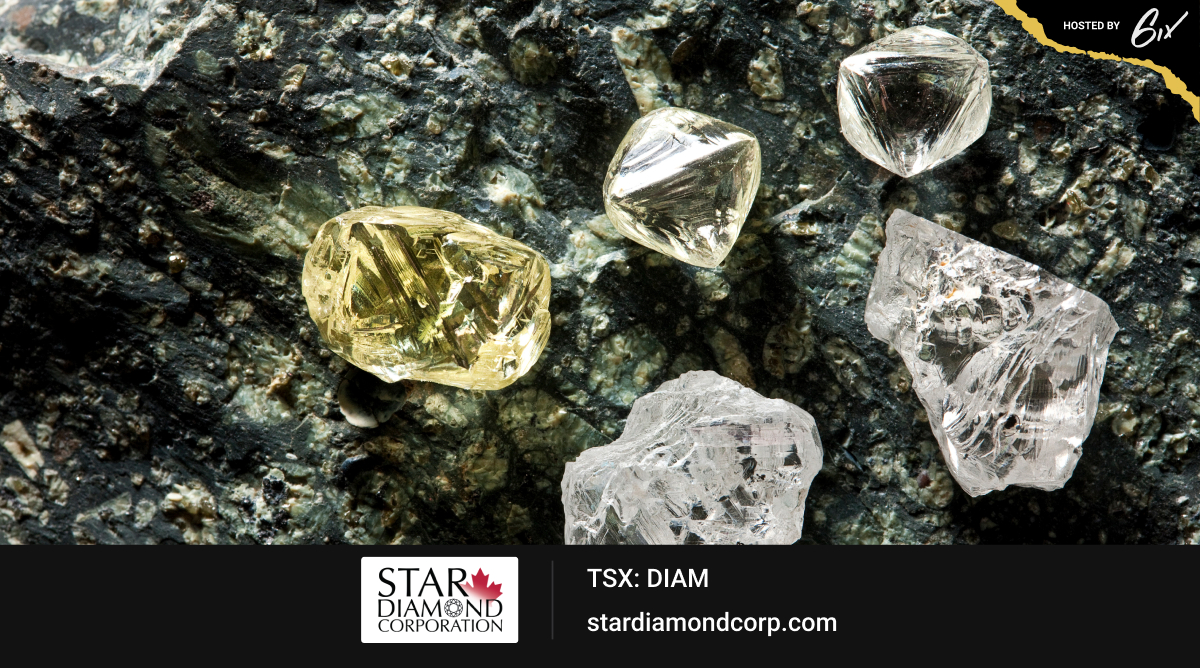
40:06 There is a yellow one. There are 2 octahedral stones, and there are 2 type 2a stones down at the bottom. Those 2 octahedral stones would produce 3 carat, at least, round brilliant stones from them. And so certainly we have seen a number of these internally flawless, beautiful octahedral diamonds in our evaluation parcel, and we would like to see, we think we will see many more in future production. Great, I think that's great. In the future, I'll make sure we bring calculators to the storage so we can do some quick maths on the call. So Eric from the chat asks if Star Diamond has any partnerships or negotiated impact benefit agreements in place already with any of the Indigenous First Nations in the area of the project?
41:04 Impact benefit agreements can be discussed with community groups in proximity to the project, particularly indigenous groups, prior to a mining decision. But the actual impact benefit agreement would only be, to my knowledge, signed once a decision has been made to proceed towards production. Proceed towards production. So certainly we have had Star Diamond, Andrea Tinto had many discussions with groups in the past, but those discussions will need to be re-engaged specifically with Star Diamond Corporation and any associated companies that may in the future become involved with Star Diamond Corporation to build a mine.
41:58 Makes sense. Next question is one of those that my guess is you probably can't answer it, but we can use it as an opportunity to talk about interest in the company generally But tan invest asked if Newmont still has an interest in star So if we're able to answer that I think we get opportunities to talk generally about what a potential path could look like with majors? So we have, we have 2 major companies that hold equity positions in Star. And the first and foremost being Rio Tinto, who converted their interest in the project, their project interest, 75% of the project, into an 11, sorry, a 19.9% interest in the equity of Star Diamond Corporation. So Rio Tinto is the largest single investor in Star Diamond Corporation at 19.9%.
42:51 So they have a provision for the future should something, a great opportunity occur, they're invested. And Then with respect to Newmont, Newmont has an 11.8% equity position in Star in the same way as Rio has 19.9%. And again, in the past, under the leadership of the former president and chairman of Newmont, Pierre Lassonde. They did a joint venture with Shore Gold Inc, formerly the company prior to Star Diamond Corporation. And certainly, Pierre Lassonde saw the four-tollar Kymkorn kimberlites as the Carlin trend of diamonds.
43:41 And he was very optimistic. There were changes in Newmont. There was a world financial crisis. And they converted their share in the project to an equity interest, which has gone down from some 17%, I think, to 11.8% presently. Great, thanks. Any more on that? I think I've pretty much answered that. Yeah I think that pretty much covers it. So Death from the Chat asks who will commercialize and distribute the actual stones once produced. Star Diamond alone or a partner? He references De Beers. Certainly it would be in Star Diamond's corporation's interest to sell its own rough.
44:33 Certainly there is every reason to sell your own goods rather than make a deal with another big company. Certainly, if De Beers wanted to participate in acquiring specific types of diamonds from Starr, that would be fine. But they would need to tender for those goods like everybody else. So they would be an open market. Certainly when we did our 2011 feasibility study, we in honor of the PEA in 2018, we envisaged selling diamonds both in Saskatchewan and in a diamond center such as Antwerp, Antwerp being the principal diamond center.
45:23 And so there would be opportunities if there were unusual world events that prevented movement and travel. We could sell our diamonds on our doorstep in Saskatoon as it were. That's great. There doesn't necessarily have to be a relationship with a major such as De Beers. There can be an opportunity and if De Beers wanted to purchase the goods or any other major diamond merchant, they have the equal opportunity to do that, but it is a competitive market and they have to agree to the price. Makes total sense. Brett from the chat asks, could you clarify the name of the document that you're planning to release in June 2024 that will update the mineral resource? I think he's just looking for what that document's going to be called. It would just be a revised mineral resource.
46:21 And it's a revised mineral resource estimate. A resource estimate is an estimate. It's a very good estimate based on the information available at the time and all the conclusions that can be drawn from that information, some of which are done with very rigorous statistics. Yeah, it's a guess, but it's a very educated guess. Exactly. Not shooting in the dark. This is pretty accurate. Paul from the chat asks, and this is 1, you know, answer to the best of your abilities. We're not getting in trouble on this chat. But he says, he knows you're working on an updated resource estimate that includes Rio's findings and data He's asking if you're able to dangle any carrots and he spelled carrots very cleverly while we wait for that update Certainly the the opportunity lies in the the trench cutter sample that Rio did, that material was processed through a very modern processing plant.
47:26 That processing plant included a X-ray transmission sorter, which recovered the diamonds greater than 6 millimeters, and below 6 millimeters, those diamonds went through a dense media, or the concentrate was generated, containing those small diamonds, through a dense media separator, that had a very narrow range, in other words, 1 to 6 In our plant, formally, that range had been 1 to 22 which led to inefficiencies in the DMS, particularly at the bottom end of the size frequency distribution. So there was an under-recovery in the 1, 3, and 5 diamond trading company screen sizes in that size frequency distribution originally from STAR, but in the real data, that was very well constrained because not only did they have this narrow range dense media separator, they also had a what's called a high pressure grinding rolls crusher that treated all the plus 6 millimeter goods or all the plus 6 millimeter kimberlite fragments.
48:42 And it ensured very good liberation from the kimberlite of these small diamonds, so that most, a very high proportion of them would have been recovered and very small contribution would have gone to waste. So it's a... And then there's still a third aspect to the smalls in that usually in the small diamonds the 1, 3s and 5s, they have low value, $5 to $10 per carat for a group of these diamonds. Whereas in the case of star, in particular, and around south, the price is very much higher, between $30 and $50 a carat, so substantially higher. There are lots of these stones, so that's a good driver on the economics.
49:38 And the reason for that is a very high proportion of extremely good colored stone, color being high quality white, and sharp edged octahedral diamonds. Very desirable, very sellable, and certainly the market wants those at a price. So That's a good opportunity. There is also an opportunity to mix the size frequency distribution generated by the trench cutter and the work generated by our original underground bulk sampling and hopefully we can get a slightly better control on the large goods that we can anticipate in future production.
50:24 So also a good constraint on the geological model. The geological model has been refined a bit recently and I'm optimistic about the result from this. And then we have Nelson Karun to do our underlying diamond price on the, for the resource estimate. Awesome, Paul, I hope that's enough morsels dangled for while we wait for that update. I would also say George is really great obviously to learn from an expert. I think that's all the time we have for today's presentation, But I'll remind everybody in the audience, if there is a question we didn't get to, or you didn't get an opportunity to ask, please do still reach out. We'll make sure that George of the Star Diamond team gets back to you as soon as possible. And I do want to thank everybody for joining us today. And George, obviously, thank you so much for all of your time. I think this was really interesting chat.
51:17 Thank you for the opportunity.