Replay available
In-Depth Interview With Nelson Karun, Star Diamond’s Diamond Specialist
Buckle in for an in-depth interview with Star Diamond's newest employee, Nelson Karun. Discover Nelson's colourful work history, the significance of his expertise in diamond sorting and valuation and how his addition to the Star Diamond team will help the company shine bright. A live Q&A follows the event.
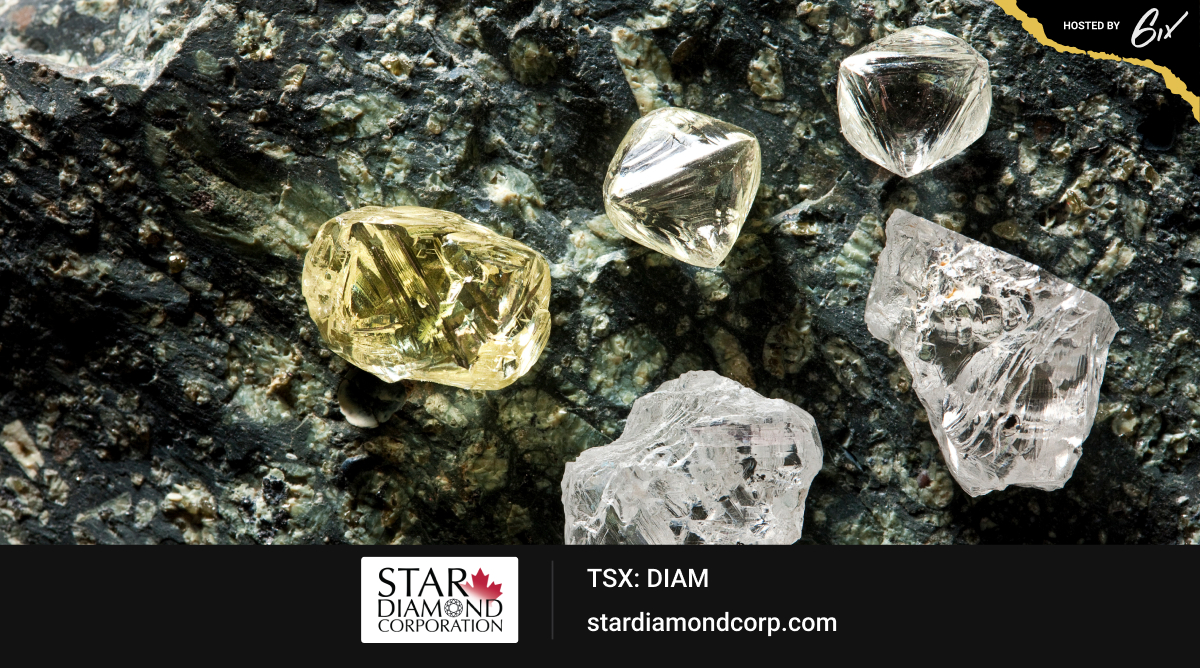
- Company
- Star Diamond Corporation (TSX:DIAM)
- Date
- Tue, Feb 27, 2024, 3:00 PM ET
- Replay
- Watch the replay on this page · 32 min
On 6ix: 6ix.com/event/in-depth-interview-with-nelson-karun-star-diamond-s-diamond-specialist
Replay
Transcript
Automated transcript · Written by software from the replay's audio. It can mishear names and figures; the replay is the record.
0:08 I'm so pleased today to be joined by Nelson Karun, Star Diamonds recently minted full-time diamond specialist. How are you today, Nelson? Very good. Thank you. Nice to meet you. Yeah, nice to meet you. I've got a few questions today for Nelson, but then we'd love if the audience had any questions as well. So in that bottom right hand part of your screen, there's a little chat box. Please do feel free to ask any questions of Nelson that you'd like. And we'll try and cover it once we're done the formal Q&A part of this event. I'm really hoping today to cover Nelson's role in the company, his history, and what he's excited about working at Star Diamond. Any other questions, I'm happy to get you in touch with the Star Diamond exec team, and they'll get in touch with you as soon as possible. But let's get started. So, Nelson, I got a good number of questions for you today.
0:53 Oh, good. I'm curious first, you know, because I work with people all across the mining sector. I'm curious what initially drew you to the world of diamonds and how has your kind of passion for the industry evolved over the course of years? Yeah, good. Let's say, you know, I was in the right place at the right time, and I found myself within the industry. The diamond industry is glamorous and fascinating. And I quickly became fascinated about it. Similar to any snowflakes, every single diamond is different
1:32 and has a uniqueness. Every single diamond is very unique. And when I start with the Arbor Diamond, which is initially 20 years back, it was a small company. But over the time, it grew into Harry Winston, Dominion Diamond, which enabled my career to advance very quickly. I was exposed to every level within the industry and had an opportunity to learn and gain knowledge about entire pipeline, which is mind to marketing. That's, you know, I'm proud to, I'm proud to say I became a diamond expert.
2:23 Yeah. Sure. Yeah. I mean, it's certainly a lot sexier than copper tin, no offense to people who work in those industries. It's got a bit more of an exciting vibe to it. Now I know we did our homework on you and my understanding is you've got a really extensive experience in diamond sorting and valuation. So in the past, you've been entrusted with overseeing the appraisal of parcels for feasibility assessments and for controlling the annual production of diamonds worth, I believe, billions of dollars, sorry, with a B. So I'm curious with all that experience, can you share a particularly challenging project or moment that tested your skills and knowledge as you've been going through it? Right, that's a very good question.
3:12 So diamond valuation and sorting is very challenging. Every day is challenging. Every day with different challenges with its own uniqueness, because every diamond is different. The diamond needs to be carefully analysed for the precise valuation, the right value for it, the right price for it. It needs years of experience and market exposure to know and market exposure to know the everyday market, how is changing, evolving, and what's happening out there.
4:04 So that this skill, the whole diamond valuations sorting and all the skills, you cannot learn in the schools or anywhere else. You have to be in the market day to day and export to the market and gain the experience. And throughout my tenure with Dominion, I was involved in addressing various exploration samples and for feasibility studies and so on. So one of the examples I can highlight is Point Lake project, now owned by Burgundy Diamond, which is a few, you know, when I was with Dominion, I am the one value with the project and it was very challenging, but it's successful and now is, you know, ready to produce soon in the production stage with Burgundy Diamond.
5:10 Then other challenges I can tell you is when I was with, again, Dominion Diamond as a director for valuation and sorting. I was spearheading the transition of diamonds from Toronto to Mumbai, India. During that time I was managing, as you were saying, billions of dollars annually. And it's about say 10 million carats, the volume, annual volume was. And so I was
5:52 doing the full transition from diamonds to technology and training people in Mumbai with various backgrounds, various skills, people who were very new to diamond industry. So I trained them, same time managing the production and sales. And it was very challenging. And the toughness was, you know, same time I'm, you know, doing the transition and working with sales VP and making sure we, I'm preserving the value of the diamond, which is the sales people always wanted to be opposite direction.
6:50 So it was, you know, very challenging. That's a that's a tension for sure. Right. I have one question. I mean, given your experience, obviously, like you said, you're a Diamond expert and with that range of experience in a fairly niche industry, presumably afford you a number of career opportunities. So I'm curious what made you want to join the Star Diamond team specifically.
7:19 Right. There are a few reasons. The foremost reason is the 4-Dollar-Coin project. And it is the biggest, you know, everybody knows, it's the biggest undeveloped project in the world currently. And the samples I analyze excite me and they are very incredible sample. Mostly they are, you know, Most of the port, they are white goods, majority more than 50%. And if I can say collection color is
7:59 D to F with the GIA standards. And type II stones are more than 30%, or up to 30%. So also I've seen some fancy yellows, rare purple in the sample. These are the smaller bulk sample or the drill sample. If you are seeing these kind of fancy and the color, white goods and stuff is very rare. And that's really good, the production is going to be.
8:46 Another reason is, the last 2 years I'm working with Star Diamond with different projects. So meantime, I build the relation with the staff. It's a fascinating,
9:04 fantastic team here. I build the relationship. And the other reason is the city. It's Saskatoon, it's a small, growing, beautiful city. And I foresee a lot of potential and a lot of talented people are here. So these are the reasons I'm here. That's a good answer. The rocks, the team and the town. Sounds good. Exactly. I didn't know you had purple ones. I'm going to avoid telling my wife she'll want 1 Yeah, yeah, it's but and also is There are some browns I see which lead to purple, I'm sorry, not the purple, pink.
9:59 Right? And the type 2 stones is incredible. It's the production will be
10:09 the production, but we need it in the future. That's in here. Yeah, so the diamonds of the future, I like that. Now, your role at Star Diamond, as I understand it, it's going to involve completing a pretty in-depth valuation exercise on the Star and Orion South diamond parcels. Could you walk us through, in as much detail as you're able, the process of conducting such evaluation? What factors do you consider? How do you ensure accuracy? How can you make sure it's reliable? All that stuff. Yes. That's a very good question. Obviously, it is a long and detailed process. Rough diamond valuation methodology uses reverse engineering metrics based on the polished prices.
11:04 Its starting point is the market price of the polished diamonds, which informs the estimated price that the rough is expected to fetch once it's polished, based on the characteristics and the yield from the rough stone.
11:28 And then we do the deductions and make the polish price, reflecting the direct cause to polish the stone. For example,
11:45 labour and other shipping and other courses related to the manufacturing or the policing of the cost of the rough. This reverse engineering metric produced the price is that we come up with the initial one is called rough baseline price. Then in addition to the system taking into account rough market sentiments that may reflect the direct relation between rough and polished transaction prices, which we call the rough trading price. Price.
12:32 But to ensure the accuracy and reliability, the price book is built, adopting the GIS standard classification system, which is 4C, the color, carrot and cut and clarity. And also the price book I'm building it for Star Diamond is roughly going to have 18,000 price point, which will be the most detailed price book in the world. It is going to be a very detailed price book.
13:20 And the prices for the price book will be based on, majority of the prices will be based on Rappaport price, which Rappaport, you know, they release it every week, end of the week, every Friday for the police prices. So, you know, as I said, it's as a reverse engineering will be calculated back into the rough.
13:45 And some degree of the market prices will be built into it. Yeah, no, I appreciate that. Just for people in the chat, I know the questions are coming in. I'm just going to ask Nelson a couple more questions that we've got planned. We'll get to yours in a few seconds. Yeah. This is a question, and you tell me if this is kind of a silly question, but it's 1 I've just always been curious about. And I know some of our investors are too. It's a 2 part question. How important is it for someone to be able to sort and grade a diamond? And here's where, call me silly, I don't know, do you literally look at every single diamond to be able to evaluate it? Yes, for this kind of like a feasibility studies or sample analysis or this kind of study, we look at every single diamond. It's important to get the detail and again to get accurate price because it's the importance of it.
14:50 It's take a few years of experience, the person who doesn't like it, become a new, becoming new diamond person, right? So for example, if the new person comes in to prepare him or her to become a production shorter, we call it, it takes at least 3 years. Wow. Yeah. It's a long time and depend on the person. Skill and how much interest. It can be even more than 3 years sometimes. As I said, like 18,000 price points will be built in the price book, right?
15:36 And, you know, for the sample valuation of the feasibility study purpose, literally a single stone, Yeah, as I said, like, you know, I greatly value, we looked at, oh, I will look at every single stone for, you know, this project. Yes. That's a labor of love for sure. Yeah. I got one question. This is, I assume for all lay people in the audience, but what makes 1 diamond more valuable than another? And could I, for example, get an eye for what is a good uncut diamond? Or is it only with years of training that you're gonna get the eye to see what's good and what isn't?
16:21 Yeah, the diamond value is based on, as I said, like before, like a similar to 4 seeds, it's based on size, shape, color, and clarity.
16:35 So 1 diamond will be valued more than other, not just based on the size, but also based on all other details and its uniqueness. So that's why, as I said, like for this study purposes, I will look at every single stones to be accurately assessed and value.
17:11 If it's like an uncut rough diamond, If it's laying there, someone can say, is it a good diamond or not? Yes, they can by looking at the color and the model of the rough diamond. You can probably just say, is it good or not? But in order to really see it, you need a hand loop to, you know, look at the internal structure, right? To really get value and yeah, really get the value. That makes sense. I got one question left, but there's 1 from the chat that I think now's a good time to jump into
17:54 just because it's a fun question. So if you got the number off the top of your head, I think it's fun. Doug asks, what's the highest value Canadian diamond that you've ever personally valued? I did, I looked at if they know, Dyvik, it was a light fancy stone. It's called Dancing and Sun. That was, I think 2.5 million. Oh, yes. And yeah, there are a few big ones we produced from the dive week and 1 from Akati during Yeah.
18:47 I think from a Kati, we had $12 million stone one time. Wow. Yes. How many carats is, let's say, the 2.5 million, the Dancing Sun? That's 254 million. It was like fancy. Sorry, 254 carats. Right, wow. You don't hear that number very often. Right, It came from some 500 carat diamond. Wow. OK. So there's still a number of questions in the chat, but there's just one more that I wanted to ask. And it's really specific to Star Diamond. So Looking ahead towards the year we got coming up, what excites you the most about the future of Star Diamond Corp and the potential of the star in Orion South Kimberlites?
19:41 As a corollary, how do you see your role evolving as the company progresses towards its goals? Yeah. I'm going to say it a little bit detail on this. Probably everybody has to listen to it. I foresee busy years to come with lots of excitements at Star Diamond. For now, my top priority is asserting accurate pricing. That's the foremost important one. I'm thrilled to be here to complete the update resource estimate that will come soon and then continue with the pre-feasibility study within the next few study within the next few months after the resource estimate.
20:42 Then I'm anticipating this project to be very similar. Even the goods, everything is very similar to Karovi project in Botswana. You guys know Karovi, right? Considering high percentage of types to stones in the sample and the characteristics of the stones and size frequency is very similar to Karovi. And I'm excited to see this mine will produce exceptional, very large stones, like more than 100,000 carat stones going to come based on the characteristics and the type to the percentage in the sample. The percentage in the sample.
21:49 And for me is by just looking at the sample now, I would say probably the average value during the production per carat can be between 500,600 range. And it can, you know, like the exceptional stones, larger stones, more than 100 carat stones alone can bring 50% of the production revenue. Of the production revenue. But the issue, even though I can distinguish these larger stones out there, we are unable to include these larger stones into the valuation of pre feasibility study due to the fact that we can only use the samples for these estimates and the feasibility study.
23:10 An interesting observation is that the free feasibility study only calculates up to 10 carats. We don't use more than 10 carats. So all these, the exceptional stones, larger stones are not included in the NPV or IR calculations. This doesn't even consider it. So when I compare the average prices again, $4 corn to carob, this can be, you know, I would say again, like between $500, $600 per carat range.
24:07 I noticed there are a significant number of fancy yellows there, purple, some purple diamonds in there. So, as I said, these diamonds are going to bring millions and millions you know, these diamonds going to, you know, bring millions and millions of dollars to the project.
24:55 Right. And I'm very motivated and very, you know, excited to see these, you know, exceptional stones going to come and I'm going to work with them. That's the other reason I am here. Then my dream and that my role will evolve into further deep involving the polished diamond and the marketing. But for now, There are a lot of jobs to be done in the coming years.
25:58 So it's going to be busy, hard work. Seems like they're keeping you busy, Nelson. Busy, exactly. Yeah. There's lots coming up. I appreciate that answer very much. I'm also looking forward to seeing what Star Diamonds got on this year. But there are some questions from the chat, so I'm just going to throw a couple to you. Obviously only to the best of your ability. If you don't have an answer, I'll make sure that the exec team gets back to these question askers. The first one is from Doug. You wanted to know that over the 4 years that Rio Tinto was on the project, you want to know what the largest stone they reported finding and analyzing over that 4 years was.
26:46 Rio Tinto, I think 16, there are a few 40, 50 carats, but I don't know which one's real reported. They had to ask the management. Joe, Joe. No, fair enough. Fair enough. He's also curious from the chat of what, and this is to the best of your knowledge right now, what the revised value of all the star slash shore diamonds it is? The revised value, I just started, you know, doing the, or looking at the stones and building the price book, as I said. So it will come soon with a pre-feasibility study, I think, or even before that.
27:41 Yeah. Makes sense. I actually had a similar question. I didn't know these other stats used. But I was curious why there's an 18,000 price points for the diamond value. Because he notes in the chat that De Beers used fewer, government valuators use fewer. So Why that 18,000 price points number? The reason is to get, again, the accurate value and more detailed value. The reason is this is a sample value. We are working with a smaller sample volume, right? To be more confident and get a very precise value, I would say.
28:37 Because when you become, when you start producing and doing it for production, you can minimize it. You can roll back into the groups and you can get the value that way because during that time you may not need very detailed pricing. I appreciate that. Once you are in the production, you know your goods then. It's more producing than doing feasibility study. That's the reason. Yeah. That makes sense. Yeah.
29:25 Rock in the chat wants to know, are there any AI automated evaluation tools for sorting and pricing diamonds? Do they exist? Are they accurate? Is it technology somebody's working on? I was just curious. Probably there are people working on, but currently there's no AI pricing, but there are a few online price books, you can use them. But I'm not sure those are good for a feasibility study or this kind of purposes, because again, those Again, those are based on the market pricing and, you know, yeah, that's the reason.
30:14 You know, our price book, I'm building it here more with more reliable source, wrapper port pricing. I think for now you're still a lot better than the AI. They haven't quite come for your job yet, the machines. Yeah. Unfortunately, I only have time for one more question. So I'll throw the last one in the chat. Anybody's question I didn't get to, or if you have additional questions, please do send them in and I'll make sure that the Star Diamond team gets back to you as soon as possible. Last question I'll poke around in just before we jump for the day. How many actual diamonds are you evaluating? If you have a precise number, great, but if you have an estimate, that'd be good too. For this purpose, it will be thousands, but there are projects that you even looked at millions of diamonds.
31:14 But for the 4 dollar coin, probably I will look at all the samples, every single stone. Those are in thousands. Well, they're certainly keeping you busy, Nelson. Which is good to see. Well, honestly, this is a great chat. Thank you so much for joining us today. For everybody in the room, this event has been recorded. We'll be able to send you the replay soon. You can share it with anybody who missed it. But Nelson, thanks so much for sitting down with me today. This was fun.
Follow Star Diamond Corporation into a list and get an email when it puts out news.
Latest news releases
- TSX:DIAM — Star Diamond Announces Appointment of Jean Raymond Boulle II as Chief Executive Officer · Mon, Sep 14, 2026
- TSX:DIAM — Star Diamond Corporation announces second quarter 2026 results · Fri, Aug 14, 2026
Companies on this call
More from Star Diamond Corporation
- Jul 25, 2024 Star Diamond Corp. Provides Commentary on Updated MRE
- May 28, 2024 Diamond Market: Featuring Primer on Sanctions With Paul Zimnisky
- May 16, 2024 Star Diamond Corp.'s AGM
- Apr 11, 2024 Deep Dive on the Diamond Market With George Read
- Mar 27, 2024 Star Diamond Corp. Provides Market Update
- Feb 27, 2024 In-Depth Interview With Nelson Karun, Star Diamond’s Diamond Specialist