Transcript
Automated transcript · Written by software from the replay's audio. It can mishear names and figures; the replay is the record.
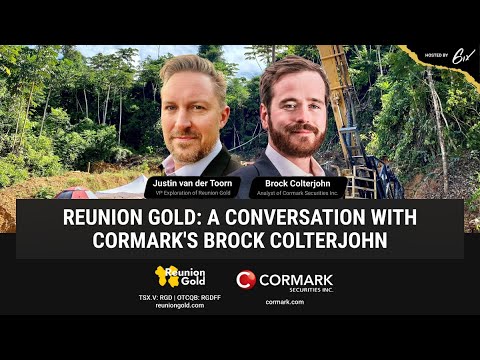
0:08 Good morning everyone and welcome to today's 6th discussion with Reunion Gold. I am pleased and excited to host this discussion today as we believe it will help shed further light on the company's game-changing gold discovery on its Okaw West property in Guyana, South America. Before introducing Justin, I would like to first introduce myself. My name is Brock Goldjohn and I'm a Mining Analyst at Cormark Securities, covering exploration and development companies for the past 2.5 years. Before being a mine analyst, I was a mine sales specialist on the institutional sales desk at Canada Virginian, and before that, an exploration production geologist working at several projects and mines in Mexico and Canada. In terms of housekeeping items, I would like to take a moment and to encourage viewers to submit questions at any time during this panel discussion by selecting the Q&A panel on the right-hand side of your screen.
0:53 With that, I would like to introduce Justin Van Der Toor, Vice President of Exploration at Reunion Gold. Justin, since This is your first time on 6 as Reunion's VP of Exploration. Can you introduce yourself and provide an overview of your previous experiences in the resource sector?
1:08 Sure. Morning, Brock. Thanks for taking the time today as well. So yeah, as Brock said, my name's Justin Van der Toorn. I recently joined or rejoined Reunion as their VP Exploration. My background, I'm an Exploration Geologist. Spent a lot of my career working in Eastern Europe and then North America, a bit of South America, really working on a diverse range of commodities and mineralization styles throughout the industry. And yeah, so I've been back with Riyuny now for about probably 2 months now. And before that, I've been working for them a couple of years back on the same project. So it's exciting to get back into this space and into the projects that we have in Guyana. As you mentioned, you rejoined Re-In Gold in August.
1:55 Why did you decide to rejoin and maybe discuss some of the key qualities that drew you back to the company?
2:01 Sure. So, I mean, first of all, it's an exciting project. It's an exciting space to be in. The Guyana Shield is prolific in the amount of gold that's sitting there. And you see those examples when you go there and see the amount of alluvial working, the artisanal workings that are going on there and what these guys are producing. And then obviously you look beyond that at the hard rock sector and see the existing deposits that are there, as well as the potential in the shield in terms of making new discoveries. You know, it is a challenging place to work. It's logistically quite complicated due to the jungle cover, but that's really where the opportunity comes from. So for me, it's about the opportunity of making discoveries.
2:47 You know, I worked with this group a couple of years back and we'd actually just started on this project. So it's really exciting to come back and see how far this project's progressed from the initial work that we were doing, what was it, 2 years back.
3:01 Obviously COVID got in between, made life a little bit complicated 2020, 2021, but the group and the team in the field has done a fantastic job in moving this project forward and delivering the results that are there to date. Absolutely. And so, speaking of that, Rune's management team is known for their long track record of success within the Guyana Shield and is certainly not new to Guyana. Can you briefly talk about managers' experience within the Guyana Shield and discuss how this wealth of in-region experience gives the company a competitive edge over other exploration companies? Yeah, of course. So, we've got a few key people in the company who, our chairman David Fennell is obviously very well known in the Shield. He was involved with Golden Star and the discovery of the Omae mine and then Roosevelt and Suriname as well.
3:48 We have another couple of our management and directors, Rajan Gord was the SVP of Cambior back in the day and also worked on both Omae Roosevelt and helped develop those projects to where they
4:02 are today. Our interim CEO, Carlos Bertoni, he was actually also working for Golden Star and also involved in running the exploration. Not only Omae, Roosevelt, and a number of other projects that spanned all the way across into French Guiana. But this wealth of experience, what it does, it provides us with the knowledge of how to get work done. As I said, it is a challenging place to work, mostly logistically, but the potential is there. And having that kind of experience and knowing how to operate in all these countries, knowing how to operate with the local workforce that's there and knowing how to get the exploration results is crucial. And I'll add as well, I mean, also for me, I mean, I've been working so with David and this also plays a
4:51 part in why I rejoined Reunionist. I've been working with David and the management team of Reunion for really the last decade in various places. So it's also been good. You know, this is a group of people that are passionate about making discoveries and taking opportunities and really building them and building them into something meaningful. Absolutely. And speaking of Guyana, the country may be unfamiliar for some viewers. Could you provide an overview of the country and maybe expand upon some of those challenges and opportunities you see for research and development in your country?
5:26 Sure, so again, as part of, one of the countries in the Guyana Shield, The Guyana Shield kind of stretches across from Venezuela, Guyana, Suriname, French Guyana, and then down into the northern part of Brazil. The potential here for orogenic gold systems is immense. I mean, historically, this region was joined to West Africa and shares the same geological background and potential. Obviously, West Africa has seen a lot more development. It's seen a lot more exploration activity and it's therefore been able to move projects forward and develop them a lot faster. But the gain of shield, there's been a lot of work done, especially in the artisanal space. So there's a very big local mining community that are mostly processing alluvial deposits that are formed from these hard rock systems that lie underneath.
6:18 And gold exploration and mining has really been a huge backbone to this part of the world and provided a lot of income. I'd say that at the moment, it's actually quite an interesting time in both, especially Guyana and Suriname. Guyana obviously has Exxon involved now, producing oil offshore. And this is actually providing a huge revenue boost to the country. Suriname has recently announced some discoveries as well in conjunction with Total. And together, these countries are going to see a massive kind of advancement in the coming years as this oil revenue starts to come in, which will probably reduce the dependence on gold mining as a driver for the economy. But at the same time, it brings in a lot of advancements in technology and professionalism, which will then expand, you know, obviously across not just
7:08 the infrastructure space, but then also into the gold mining sector as well. Okay, great. Okay, with that introductory, let's get into OcoWest and maybe talk a little bit more detail about the project. So can you briefly talk about the history of the project and discuss what compelled Reunion to pick up this land in the first place? You were there with the team originally, So maybe just provide that color to investors. Sure. So Reunion, originally, pre, let's say, 2019, we had a package of ground in Guyana. We had some other properties, and we still do, in French Guyana. We picked up a package of ground in order to have a portfolio to explore. I mean, our focus at the time wasn't really on OCO West itself.
7:55 It was more further into the interior over at some other projects that we had, including some that were part of our alliance with Beric as well.
8:05 Oco really came out of a local miner who brought us this project and said, look, there's some interesting material here. Guyana is a country where, as I said, the importance of knowing people, of knowing, of having those relationships where people trust you as a potential partner to develop and explore these projects is vitally important. So we optioned this property. We thought it was an interesting potential. We did some very basic geochem stream sampling work right in the early days. We flew a large magnetic survey at the time. And then in 2020, we decided to expand basically a soil survey, Geochem survey over the eastern part of the project, which is where we're currently drilling. That was then followed up with trenching and really the results that came out of that drove the financing that then allowed us to put this very large and comprehensive drill program together.
9:01 So, you know, in the time since, it's really been not even a resource definition drilling program. It's more just trying to understand the footprint, what kind of potential this system has. And it's been extremely successful. So the holes we've been drilling, we've just basically been expanding that footprint as we go north to south. And now we're finally getting to the point where we're saying, okay, we understand this system. It's obviously still open at depth. And we're continuing to now try and explore in other parts of the project, both to the south and also in the west of the permit, which has seen a very limited amount of work to date. Yeah, okay. Let's expand on that. So you completed over 50,000 meters so far in the last 14 months or so. You've successfully delineated a large, high-grade, open-pitable resource so far, and also while returning some of the best gold intercepts in the industry this year. So
9:54 can you maybe expand upon what you're seeing in the drilling in terms of your potential grade scale, that style of mineralization, the opportunities? Well, I think our press releases probably speak for themselves in terms of the intersects that we're seeing. But the mineralization, one of the, let's say, positives about this system is the volume. So a lot of orogenic gold systems, they're very strongly structurally controlled. You often see gold mineralization in veins, but the veins themselves tend to be quite limited in width. So although you might have very good grades, This is why these projects often lend themselves to underground mining rather than open pitable resources.
10:36 In our case, we've made this discovery, which has a sizable width. The main zone of mineralization is probably about 50 meters thick. And it extends all the way to surface. And most importantly, also, we have preserved the sacralite material on the project. So as I mentioned before, the alluvial mining in this part of the world is very important for the local economy. And there's been a lot of alluvial mining that's gone on following up the drainages that lead up to some of these gold discoveries. And you can see that example as you go through the belt and look at the other mines that exist as well. But what will happen often is that those alluvial miners basically hit the saprolyte where the source of the gold is, and they will start extracting that material as well, which is great for them and provides a good revenue.
11:27 But because it's a small operation, they require very high grades. It doesn't necessarily take advantage of the entire mineralization that's sitting there. So at this system, we have this thick zone of gold mineralization coming to surface, and we have about 80 to 100 meters of thickness of Sacralite sitting up there, which is very easy to process and very easy to mine. And that provides a great starter opportunity for the project as we move it forward through development and hopefully down the road into the mining phase. No, for sure. And that's one thing that always surprised me while seeing the site is how it's completely unminded. This is a true version discovery, which I think is so exciting and the SapperLite is clearly going to drive some really robust economics, especially at the beginning of my life.
12:18 So beyond the Karuni zone, which is what we've kind of been discussing about, you recently
12:23 reported some positive results from the Takuto zone to the cell for the first time. Can you kind of explain to viewers what the Takuto zone is and how impactful you think these results are for the overall potential, scale potential of the project? Sure. So the main area we've been focusing our work on over the last, let's say, 18 months has been the northern, let's say, 2 kilometers of strike length of this system. So as I mentioned, the success has been extraordinary in terms of drill hole after drill hole. We're simply defining the size of the system. And there's been very little impetus to step outside of that until we understand, do we have something large enough that we can move forward from?
13:05 But as that's become more apparent, we've started to now explore further to the south. We are seeing some geological complexities. There are some slight offsets. And you'll see on our map, there's a bit of an offset as we go from what we've named as block 4 to block 5. These are things we're still understanding. And obviously, as we move down to block 6, we've started to hit more gold mineralization. And the next job there is to simply continue exploring at depth and understand what do these zones actually entail, and do they bulk out to the same kind of volumes that we see further to the north. But the summary is we've been drilling the top 2 kilometers of what is effectively a 6 kilometer long contact zone,
13:47 sitting at the contact of these granites and greenstone volcanic belt. And that's really where the exploration potential now sits, is how can we grow out from what we have and keep growing the potential resource that we have, and then move this into additional discoveries within the permit as well. Yeah. Well, speaking of the additional discoveries, you know, outside of this main mineralized trend that we've been discussing, you've also identified some promising greenfield drill targets. Can you maybe, what can you tell us about these potential of these discoveries and kind of your near-term plans to advance them?
14:23 So the area where we're focusing most of our resource definition drilling is obviously an area that has been a great greenfields discovery. What really led to that was the outcropping high-grade mineralization. And part of that is due to the fact that this mineralized saprolyte is very easily outcropping on this topographic break on the eastern part of the property. Now, as we move to the west of the property, as well as to the south, there's a lot of well-developed DuraCrust, which is providing a bit more of an exploration challenge in terms of being able to see through it. But if you look at the larger picture as to where, again, these alluvial systems, the alluvial mining has taken place historically,
15:08 there's actually a very large area in the west of the permit that remains unexplored. And there's well-developed alluvial mining leading right up to the foothills of these topographic highs, which, again, we haven't had time to explore yet, and we're going to be getting there. And that's really where a lot of the potential is, out in the West, down in the South. I mean, we've explored a very small percentage of the permit. And how is the access for those targets easy to get to?
15:38 It's very easy. And actually, it's a good point to mention for the entire project is, you know, this project is effectively road accessible from Georgetown. It's a little bit of a long drive, but for projects in the interior, this is a very rare find. A lot of projects, and we've worked on projects before in both Guyana and Suriname and French Guyana, where we've had to deal with helicopter-supported projects. We've had to deal with The entire transportation is on boats to the nearest landing and then from there by road or quad bike to the site. For this project, you can drive from Georgetown. It's about an 8 hour drive. The alternative is you take a short flight to Bardica, and then from Bardica, it's a 2.5 hour drive to site. So the roads are there, the infrastructure is there, and it makes it very accessible.
16:26 And obviously that means our expiration dollar can go a lot further. So rather than spending money on helicopter flights where we're spending money on putting drill rigs on the ground. Absolutely.
16:36 So given the exploration success to date, the company recently decided to delay the maiden resource estimate to Q1 of next year, in addition to accelerating the drilling by adding 2 more diamond rigs for, I think, I believe a total of 5 diamond rigs and 1 RC rig. So can you talk about the details of this fully funded, accelerated drill program and take us through what the company is targeting for its native resource estimate? So the thinking at the moment, I mean, there's always this balance between how quickly do we put out a resource and publish that to the market. Now, let me be quite honest, the moment you put a resource number out, everyone thinks that's the resource and that's it. What we found is that as we continue drilling we continue to expand the footprint of this system
17:23 and it's going to take some time for us to drill that out to a spacing that's required to actually put it even an inferred classification around it. So at the moment, we drilled a lot of the top part of the system, the saprolyte or the resource that would sit within the saprolyte to an effective indicated drill spacing requirement. And then we've started drilling beneath that to an inferred drill spacing. But so long as we keep seeing the potential to grow the system, we don't really see the rush to put out a resource number. I'm hoping that our press releases and what we're putting out to the public is explaining the potential of what we have. But it's our job to basically deliver the largest potential that we can for our shareholders who are obviously investing in this business.
18:10 And we feel the best way to do that is to continue to grow the system before we start to try and put a number around it and put a bow around it. So right now the exploration program is to continue stepping out and stepping down with that inferred drill space in your mind
18:26 so that when we do get to the point that we say, okay, now we're ready to put a resource around this, that we'll be able to do so. But obviously that takes a lot of time. The fact that we're bringing more rigs into the property obviously speaks to the confidence that we have in the results at the moment and seeing and how, and obviously us being able to deliver that resource as soon as we can. When do you expect the additional rigs to arrive on site? Is this week?
18:55 So the 2 rigs, they've just arrived in Georgetown. These are 2 rigs that we've contracted from Major Drilling. Major Drilling has their main base over in Suriname, in Paramaribo. So the rigs have just arrived, and we're literally getting them on trucks this week to bring to site. Okay. And jumping back to the resource, you have $50 million in the Treasury. How long and how much do you think it will cost to drill off that kind of 2.5 kilometer area for your compliant resource?
19:28 It's a bit of a how long is a piece of string kind of question. Let's put it another way, We're able to continue drilling at the rate that we want with these 5 core rigs and the additional RC rig through the entirety of 2023. That's our plan at the moment. In terms of how long would it actually take to drill out everything we need for that resource, that simply depends on how big it gets and how deep we need to keep going. So the point is that we're well funded to keep delivering results and keep exploring this project through the entirety of the coming year. Right, okay. And I know this is always a moving goal for us, as you mentioned, the resource keeps on growing, but do you have a target or an approximation for the length, width and depth target that you're looking for an initial resource? And I know it's
20:23 a tough question. Well, those kind of questions, I think I'll just refer you to our press releases. I mean, I feel we've done a reasonable job of trying to get as much information out there. We have all of our significant interval results and coordinates even listed on our website. So it's pretty easy to do the maths on that and probably easier than me trying to explain it here as well. Fair enough. Okay, let's pivot to maybe some project de-risking aspects. So outside the drilling, you've also been actively de-risking the project. You've completed some preliminary work that demonstrated high-goal recoveries across multiple rock types. You're also now undertaking a larger, more comprehensive metallurgical test program.
21:09 Can you maybe talk about this larger program in greater detail and kind of explain to viewers why this is such an important de-risking step? Oh, of course. So, you know, obviously, you know, the main driver in exploration is obviously finding the resource, but, you know, it's extremely important to do all the other work that goes around the resource and to actually, you know, putting the project forward into a development phase. That includes the metallurgy, it includes the environmental baseline work, which we've also started this year. We're doing some geotechnical work as well, so we can actually understand how the geotechnical aspects of the rock will affect pit slopes and pit designs. And then, yeah, the metallurgy. So the original, you know, the initial metallurgy we did was very encouraging. I mean, it's not particularly surprising given, you know, the systems in the country and how they all behave.
22:04 We have just submitted to the lab a very large, very big test work program. So this is effectively doing a bottle roll analysis on, we've submitted about 400 samples for this to really try and identify if there's anything in the system that will flag up as being potentially problematic. And that's the point of these programs is to identify things that might be problematic so that then you can actually focus on those and develop a process around how to deal with that. So right now, as we stand, we've submitted these samples. That should be about a month or so to get returned. And after that, we'll design a much larger composite network program, which we'll be doing overseas and actually doing a full analysis, everything from bond work index through to the gold recoveries as well.
22:55 You're also in the process of converting your small and mid-scale claims into formalized expiration licenses. Can you talk about the benefits of converting your claims to expiration licenses and kind of what this overall means in terms of overall permitting and de-risking as well? Yep, well, we've actually now done that. So, you know, originally when we came into this project and similar for other projects in the region, we basically do an option agreement with the local permit holders who are quite often carrying out their own small-scale artisanal mining operations on the permits. Now, the first step in de-risking that 10-year situation is to convert the options and to convert the medium-scale permits into what is called a prospecting license.
23:43 So it sounds a little bit like a backward move, because you're obviously going from medium-scale mining permits into a prospecting license. But the prospecting licenses are the initial step that can be held by a foreign entity. So we have now been granted this prospecting license, which also means that we are now responsible, obviously, for all the activities on the permit. And that's something that we are taking very seriously. And it's part of the reason why we're now setting out all our baseline environmental work and securing that permit ourselves. So, 1 advantage we have is we don't have any local miners on the property, unlike a lot of other areas where there are existing underlying agreements with local miners and small scale alluvial miners, we don't have anyone on the permit at all.
24:33 So it's actually a very clean situation to be in. And as I said, now as the permit holders for this project, it obviously gives us that slightly more advanced level of tenure and starts that process of officially going from exploration through to development and into mining down the road. What would be the next step from here, from an exploration license then you convert it to a mining license? Yeah, effectively it goes into a mining concession. And so part of that is also setting out an agreement with the government on the terms and everything else that's associated with it. And that's something that I will add that Guyana, as a country, regardless of the change of governments, the change of administrations, they've never gone back and changed or modified any existing agreements. So they've really stuck to their word. And you can see this example on other permits, on other mine sites, sorry, in the country as well.
25:30 Yeah, absolutely. Okay. So you're also not the only company to have made a major gold discovery along this trend. G2 Goldfields has also made a material gold discovery within 1 or more of the same mineralized structures located less than 2 kilometers to the north. So given the kind of the obvious synergies the 2 projects could have in a joint development scenario, you know, what are your views on the dynamic and the camp from a consolidation and M&A perspective? Well, So on the ground, we're very good neighbours. I mean, we talk regularly. They're obviously quite close by to where our camp is situated. But in terms of longer term, you know, what happens? I'm not really positioned to be able to talk too much about that.
26:17 Our focus right now is really on expanding the potential that we have on the permit and the sizable system that we see developing through the drill results. Yeah, no, for sure. And looking more macro type of M&A, like given the lack of new major gold discoveries over the past decade, more and more major companies, gold producers are beginning to look to more frontier jurisdictions in pursuit of the next generation of Tier 1 assets. Guyana is already viewed favorably by the majors with Xinjiang mining acquiring Guyana Gold fields for $323 million in 2020 and Barrick Gold having JV agreements in place with both yourself, Union Gold and Troy Resources as it looks to expand its country presence. And also, we just saw the Iron Gold Roosevelt transaction with Xinjian as well.
27:05 And so, general interest of the guy in a shield. So, can you maybe reiterate to viewers why you believe Opal West is such a standout potential M&A target? Yeah, so, Well, first of all, I'll say that we have a number of options on the table as we move this project forward. I mean, M&A is obviously one of them. The other options are doing some kind of development joint venture. And then there's also a full possibility of us actually moving the project forward ourselves as well. We have plenty of in-house experience and expertise that we can do this with. But yeah, you're right. I mean, the interest in the Ghana shield has definitely been growing. You've got Newmont happily operating over in Suriname at Merian and quite an advanced exploration program in French Guiana as well.
27:52 As you mentioned, Barrick, we have a joint venture, well, strategic alliance with Barrick and we still have 1 active project with them in Suriname. And then, yeah, IAMGOLD, recently just sold, as you mentioned yesterday, I think it was, to Zing Mining. And Zing's obviously busy trying to wrap their heads around Aurora. And then you've got other developments happening in Guyana, DTK, and the Toro Piro mine. So it's an exciting place to be. OCO is obviously another, you know, potentially tier 1 development project that we hope to put some numbers around down the road. But it's a good place to work.
28:37 It's got a demonstrated history of both discovery and mining. And yeah, We're excited about this project and we're happy to also see plenty of other people are excited about it as well. No, for sure. For sure. I would be remiss maybe not to ask about the other projects in the portfolios. Maybe you just want to touch, any updates worth highlighting? Not really at the moment. I mean, we are looking at additional projects. Our focus really has been on OcoWest. I mean, that's really been the best use of our shareholder funding at the moment to bring that project forward and to keep delivering results. But obviously, as the year goes on, we are looking at other potential projects in the region. Again, that competitive advantage of knowing the region, knowing how to operate, and having the experience of operating in the shield is vitally important, and it's something we can make use of.
29:34 Any thoughts maybe of continuing that dual program at the Northwest Extension Project with the Strategic Alliance or is that optional? We're in discussions. I mean, that's something that we're in discussions with Barrick on. It's not really something I can comment on, I'm afraid. Okay, cool. So before heading to questions, which I encourage people to ask some questions, maybe can you remind viewers what they can expect in terms of new flow into year end as well as 2023? Yep, of course. So, you know, as I mentioned, we've now got 5 core rigs on the property and 1 RC rig. The 5 rigs are obviously turning 24 7 and we're looking forward to releasing more results, probably on a, let's say, 2 month basis, we'll be putting results out into our news flow. We think it's important to keep everyone up to date on what we have. And we see that continuing, really through the rest of this year and into the start of next year, which point we'll be looking at the potential of putting a maiden resource out.
30:36 Awesome. Okay. Thanks, Justin. So, we've got a few questions here. We kind of touched on this, but maybe can you comment on yesterday's sale of Roosevelt and talk about the comparison to Oklahoma West in terms of size, maybe just contrast between the 2? Well, look, Roosevelt is, I would say, was a very good discovery back in the day. And obviously, since then, it's seen an immense amount of funding and exploration, both at Roosevelt and the surrounding pits around some of those initial workings that were there. And then obviously, IM gold's been expanding into the rest of Suriname and exploring down further to the west, Saramacca as well.
31:28 I think it's difficult to compare the 2. They are geologically a little bit different. But the sale of Roosevelt, I mean, we'll see how housing mining deals with some of the more non-geological issues that have been going on there. But other than that, I can't really comment much on what the plans are going to be, obviously. Okay. And then there's a question about just general infrastructure. In an actual development scenario, What do you think is really required? I know the Peruni road is being upgraded, as we speak, by another mining company, which increases your access. But in a development area, what do you think is really missing in terms of critical infrastructure?
32:18 I mean, as I mentioned before, I mean, the fact that you can drive to this project today is a huge positive. Obviously, you know, the road conditions do change during the wet and dry seasons. But as you mentioned, The road that's being overhauled, that's the road that effectively leads all the way to the Toroparu development further west, is being upgraded at the moment, as we speak. And that's being converted into an all-weather road. So once you have roads in place, it becomes very easy to move infrastructure, to move equipment in. So really, there's not a huge issue. Power is something that is always going to be an issue in this part of the world in terms of how do you get power lines to the project. This is something we've been trying to explore a couple of options on. One is there is a hydro development project that the government is doing in conjunction with the Chinese in building a new hydro dam, but that is an option for us, but it would require putting a 100-kilometer power line in from L'Etem up to the project.
33:22 The alternative, and something we've been in discussions with a British group – sorry, a Canadian group – is doing run-of-river hydro. So there's ways to put modular systems in that will effectively generate anywhere from 1 megawatt to 200 megawatts. We'd obviously need something like 30 or 40 for the mine. And this part of the world is full of river systems with reasonable flow in water. So hydropower would be a huge benefit to the project. Not only, obviously, you're getting power that's close by. We basically generate this power about 20, 30 kilometers from the site. But also from an ESG potential, it's huge to have a mine site that would be effectively run on renewable power. Okay.
34:09 And just to confirm this question about just the rig count, so with those 2 additional rigs you're going to 5 diamonds plus 1 RC? That's right, yeah. So we've got 5 core rigs on the project once these 2 new ones arrive and then 1 RC rig which will be continuing the exploration work. It's obviously a lot more mobile and a lot easier to move around to new targets. What do you think in the near term would be the max amount of rigs you could have in terms of your current infrastructure set up? We could probably accommodate another couple of rigs and that is something that we'll look at later in the year. We've grown at the moment from a camp, and people working in the shield would know this term, but from a fly camp where we had maybe 20 people to now we have a camp which is set up for about 18, 90 people and we're growing that to probably about 100,115 capacity. So it is remote. It requires a full setup, everything that you would expect elsewhere in the exploration industry, but in the middle of the rainforest.
35:13 But we could accommodate additional rigs, and that's something we'll look at once we get the infrastructure in place and get and keep growing the camp. There's a question about assay turnarounds in Guyana. It's actually very encouraging I mean at the moment our turnaround is somewhere between 2 and 3 weeks, which is really not that long when you look at some of the turnarounds that are happening in North America at the moment where I've had experience in the last year or so with two-month, three-month turnarounds, which obviously makes exploration planning very difficult. So all of our assays are being done at the moment with Acclabs, which is obviously, they run a certified lab in Georgetown and they're providing services not just for us, but also many of the other larger companies in the region.
36:04 So the turnaround is good. We'd always like to see it even faster, but compared to elsewhere that you can be working, it's very useful. Yeah, absolutely. OK, looks like there's no other questions. Maybe you just want to leave us with some final remarks. Yeah, so look, as somebody who's obviously, you know, I came into this project a few years ago, and, you know, we had really nothing there. And to see the amount of work that's been done and the amount of results that have come out of this is extremely encouraging. It's not something you'll see very often in the industry to go from literally a soil sampling campaign through to enough drilling to put a sizable resource around in the space of 18 months.
36:53 So it's an exciting project. It's well located. It's easy to get to. We have a very enthusiastic and knowledgeable team on the ground and within our management as well. So, I mean, I hope everyone's looking forward to the results that we're releasing and to see how the future of this project turns out. Well, thank you very much, Justin. And I completely agree with that. And clearly, the market's definitely noticing, taking notice with your, I think you're one of the few stories that's trading near 52-week highs. And you're one of the best names out of our coverage and it's definitely exciting and look forward to the discovery continuing. So thanks a lot Justin and over to you Cam.
37:40 Yeah, thanks a lot for the time and doing this today.