Replay available
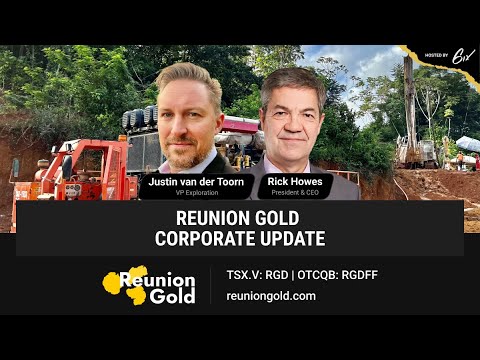
Reunion Gold Corporate Update
Join us for a great event!
- Company
- Reunion Gold
- Date
- Wed, Jun 14, 2023, 10:00 AM ET
- Replay
- Watch the replay on this page · 53 min
Replay
Transcript
Automated transcript · Written by software from the replay's audio. It can mishear names and figures; the replay is the record.
0:08 Hello everyone and welcome to today's live summit featuring Reunion Gold's live event hosted by 6. I'm pleased to introduce our speakers for today, their president and CEO, Rick Howes, as well as their VP of Exploration, Justin Van Der Toorn. Rick and Justin are going to be reviewing a presentation and after we're going to be taking questions live. So just as a reminder, if you'd like to submit any questions, please feel free to do so using the Q&A chat found on the right hand side of your screen at any time today. If you'd like to get in touch with the Uranium Gold team as well, please feel free to fill out the survey that's linked at the top of the chat. As always, this event is being recorded and it's going to be available on demand in the coming days. So take a look for that if you want to refresh. Without further ado, Rick, I'm going to pass things over to you so we can get started. Thank you. Good morning, everyone, and welcome to our Uranium Gold webinar this morning.
0:53 We're very excited to provide you with some background on our recently announced Maiden resource estimate. So both Justin and I will cover a number of topics, including the background behind the generation of the latest resource estimate that we've put out, as well as a little bit of discussion around how we're moving forward with the project from here. I will remind you that our forward-looking statements will be in the presentation today, so I'm just cautioning you about that. So yes, at Renew Gold, we're a Guyana Shield-focused Gold exploration company. I've been an activist since 2003 in the Guyana Shield and clearly excited about our most recent discovery at Oko West, which is in the western, northwestern part of Guyana.
1:49 It's 100% owned asset by Reunion Gold and we've now identified what I think is a very significant pick and strain resource, which we'll talk about more today. Just to give you a quick summary of where we are, we've now announced a 1.4 million ounce indicated resource and a 1.7 million ounce, sorry, 1.7 million ounce indicated resource and 1.4 million ounce inferred resource. And both grading 1.84 ounces on the indicated and 2.02 grams on the inferred.
2:36 So very significant maiden resource estimate. We think this is just the beginning of the story. We're happy to share the background behind that. The background behind that. Just to talk briefly about the team, Reunion Gold is made up of a fairly experienced team. The team has been operating for a long period of time in Guyana and in the Guyana Shield. We have quite a bit of experience both in exploring and developing and even operating mines in the Guyana Shield. Some of the projects that the reunion has been involved in include the Roosevelt Mine in Suriname, Omai Mine in Guyana, the Matthews Ridge Mine, which is a manganese mine in Guyana, as well as several other exploration projects that we've been working on over the years.
3:39 The experience of working with the government, the experience of working with the local businesses, the experience in successfully operating, developing these mines, All is still within the DNA of the company. We've joined forces now with G-Mining to do the work on the Okaw West project. They also have a significant background in the Guyana Shield and other places in South America. Just to give you a quick overview of Guyana, Guyana's population is about 800,000 people. It's a small country, but it has a long history to its mining and fairly good fiscal regime in terms of taxation and royalties. The tax levels are 25% for corporate tax and 8% gold royalties.
4:32 The thing about Guyana I think most important to take away is that it's an economy going through a major transition. It's growing to be one of the fastest growing economies in the world today. It grew last year at about 62% growth rate and it's tripled its growth in the last 3 years. That's all primarily due to the major offshore oil and gas discovery that Exxon and its partners made back in 2015. And they, since then have brought into production the first oil in 2019, oil production in 2019, and they're now growing that production to about 1.2 billion barrels a day, 1.2 million barrels a day. And the discovery itself is a growing discovery of about 11 billion barrels to date. So It's one of the largest offshore oil discoveries in the last decade and it's certainly going to have a transformational effect on the economy.
5:23 The GDP per capita of the country, which was one of the poorest in South America prior to the discovery, is now the richest country in South America already, and projected to be in the top 30 countries in the world in GDP per capita by 2025. So very exciting story. What that means, I think, to us is the transition to The infrastructure or the major investments that are required to upgrade infrastructure are starting to be made in the country. Bridges, roads, new power plants, major communications upgrades. All of These things bode well for future potential in terms of supporting mining projects and other developments in the country.
6:13 Just to give you a sense of the transformation and how quickly it's happening, the Fraser Institute survey, which was completed for 2022, has Guyana as one of the top countries in terms of transition from it was 60, I think 67th in the world at the beginning, and now it's 22nd in the world. That's just since the previous year, 2021 to 2022. It's now climbing up the ranks as being one of the best jurisdictions from an investment attractiveness point of view. Here's a shot of the property location. I'll hand over to Justin to talk about the resource and the exploration activities on the site.
7:01 I'll just quickly talk a little bit about the background of the project and then we can go through the resource details. So for those of you who haven't heard about the project before, the Okawesk project is located about 100 kilometers west-southwest from Georgetown. We have a number of access options to get there. Most of our team actually travels by road to Parika and then down by boat to Bartica and into Bali, and then from there by road to site. It does, despite what that sounds like, it's about a four-hour trip, it does make it one of the more accessible projects in the interior and quite a unique situation for projects that are in this region of the world. Geologically, we're located at the edge of a major granitic batholith to the east.
7:50 So our Oco-West project straddles that contact zone and then extends further to the west over other greenstone sediments, volcanoclastics, which are really the host to the mineralisation. This image here on the right shows you some of the alluvial workings in yellow, the pale yellow, and these are excellent vectors to use in the region for locating Gold sources. This is an area that's been worked historically. We don't have any alluvial activities, artisanal activities on the property these days, which is good, but obviously these alluvial workings form great vectors for us as an exploration tool. A little bit about the history of the project. We optioned these claims in 2018.
8:37 After that, we did some regional work, including an airborne magnetic survey. That was then followed up by soil geochemistry in 2020, and subsequent trenching of the high-grade anomalies that we discovered. Following that, there was an initial drill program early 2021. And really following from that in the middle of 2021 to today has been the very aggressive activity of drilling out this resource and bringing the numbers to market that we have today. So on the right here, you can see the image of the block model and the associated pit constraints that have been put around it. And probably more importantly, are some of the upside that we see both below block 4, the central part of that ore body, and then also below block 6, where we're starting to see some good indications of high-grade as well. These are obviously areas that we're going to continue following up as we continue both down the development path as well as the exploration upside on the property.
9:35 So the resource itself, as Rick mentioned, we've got almost 2.5Moz of Gold and indicated, so more than 50% of the resources are indicated and that's sitting right up near surface where we've had the greater density of our drilling. And then 1.7Moz of Gold and inferred sitting below that, kind of sitting in the lower part of that pit constraint you saw on the previous screen. So the top 300m is all indicated and that obviously includes the saprolite transition zones, which are oxidised near surface. We have also found that the model, and I'll show you a section in a minute, has a number of stacked lenses within it, and that main lens, the main zone of mineralization, which is sitting kind of a little bit towards the base of the sediment package, also contains quite a high-grade domain that we've managed to model out through the use of about 75 different drill holes, which average a true thickness of about 5.5m running over 7g. So quite a significant high-grade core that we see extending outside of the pit constraints as well and giving us the opportunity of looking at further high-grade at depth.
10:45 Interestingly, we also see a bit of an increase. So we plotted on the right here a couple of graphs that showed in the indicated and inferred resources what is the contained gold in 50 meter slices and also showing the associated gold grade with that. And although we can't combine these in these presentations, if you mentally combine them, you can see the average grade is increasing with depth as well, which is an interesting aspect of Ocoa West at the moment. So in total, we've got about 460,000oz sitting in that oxide and transition material at surface. And that's obviously the most amenable to both mining and good recoveries in the early stages of the future development project. Just going through a little bit on the model, on the left here, you've got the weathering model. So this shows that oxide and transition zone near surface and the fresh rock, which comprises obviously the bulk of the model sitting beneath. There's a very thin layer of colluvium, alluvium sitting at surface, mostly colluvium. And you'll see very little of that actually sits right on top of the deposit. There's a bit more sitting higher up as you go to the the west in the area of higher topography.
11:58 On the right here, a very simplified geology model. You've got the 2 granitoids in pink, the hanging wall granitoid on the east and then the foot wall granitoid on the west that sits beneath the sediment package. The sediment package itself is then divided up into volcanic clastic sediments. There are some carbonaceous sediments in there as well, not necessarily associated with where we find Gold, but some lenses sitting within the overall package of sediments in there. And then right down the West, as we go further west at the moment in this model. It's a kind of undifferentiated package of mafic volcanics. And obviously some of the exploration work we're now doing is finding additional lenses of sediments, clastic sediments within that as we move further west and away from the resource.
12:48 The mineral zones shown here on the left and then a section cut through them on the right. So as I was mentioning we've got those kind of stacked lenses of mineralization. On the right here we actually have some in the center you'll see that kind of yellow zone, which is the high-grade domain that we've managed to model out within the resource. We've obviously modeled this resource, and the image here on the left shows that outside of any pit constraints, but gives an idea of what we've actually drilled so far to a drill density sufficient for resource classification. The classification itself, as I mentioned, there are some details listed here on the resource classification. I won't go through them in detail, but just for everyone's reference.
13:35 Normally we're working at about a 40, 45 metre spacing for our indicated drilling and our inferred drilling is about 80 metre spacing throughout the resource. The image here at the bottom shows you the division between the indicated near surface and then the inferred that's drilled beneath. So that was something we decided last year, we drilled a lot of this resource to indicate it already near surface. And the potential was then to expand that down at depth using that larger drill spacing. And that's going to be part of our focus moving forward is moving that inferred resource up into indicated as well. One thing we've noticed, so the table here on the left shows the cut-off grades. And what we've noticed is actually quite a low sensitivity to cut-off changes.
14:24 The central COG value there is the combined cut-off between the different cut-offs used for the oxide transition and fresh rock. But if you just look at the overall changes in cutoff grade, you'll see there's very little difference in the contained gold within those until you get to about a 1g cutoff right at the bottom there. So very robust ore body and very positive as we keep moving this forward. I just wanted to show some sections through the block model as reference. These are just in the presentation, But probably more important is if we zoom out from those block slices, is actually looking at the upside now beneath the pit. So the pit at the moment has a maximum depth of about 600m.
15:12 Beneath that, we've already drilled, and these are previously announced, a couple of holes, Diamond Hole 200 and 203, which are drilled to about a kilometre depth. These basically extend the known extensive mineralisation about 300m beneath the current pit. And what you'll see here on the left is that high-grade domain that I mentioned, which has been modelled within the resource, but then obviously extends outside, and it's quite easy to project with the deeper holes that we know at depth as well. So this is obviously a target for us now, as we understand the kind of limits of the current pit constraints and we look at the upside of where the options for the company as we keep growing near surface, but then also start looking at the underground potential at depth.
16:03 The similar kind of image on this slide, just to show that same high-grade domain shown there in pink, extending out beneath the pit, and then the potential zone that we still need to drill further down at depth. And then just to highlight over on the south there, block 6, we've got strawhole 237A, which again hit a nice healthy intersection of 9 metres at over 5 grams and gives us the potential to again look for more of these high-grade chutes elsewhere in the current resource, but also within the rest of the permit. So, zooming out again at what we're going to now be doing from the exploration side. Obviously, our priority is to keep moving the resource forward. We're going to be infilling those inferred blocks down the depth, looking to expand that high-grade potential under the current pit that we have, as well as expanding those blocks 5 and 6 to the south, which really haven't seen as much deeper drilling as we've done on block 4. If we then look outside of the resource itself, we have a couple of zones. Our Carroll zone, which is a mag destructive zone, which we're still exploring directly to the west of the resource. The Takatu zone, which is the southern 3km of the shear zone, the sheared contact with that granitoid to the east. And then we have the larger brown zone on the west of our project, where we've already defined a couple
17:33 of targets on the basis of our Scout RC drilling. So that was drilling that was done deliberately to puncture through the DuraCrust, the very leached cover that we have at surface, and to give us kind of a proxy for a soil anomaly grid, a ridge and spur sampling grid over the property. And that's already developing some interesting targets as well. We released a couple of releases ago, about a month ago, we put out a release, including an RC hole 1006 that was actually drilled as part of that program, testing an area that was a little bit more undercover, and so we didn't think the smaller Scout RC rig could drill necessarily through all that. So we put an RC hole there, a line of RC holes, and we ended up with 17 metres at 1.7 grams, which has definitely demonstrated the potential of converting some of those anomalies into significant drill widths.
18:27 So that part of the project is probably going to see about 15,000 metres of drilling, combined our sea and diamond. We've actually already got a diamond rig on site, which is going to be starting at the end of the month. So Just looking at comparing to some of our peers in terms of advanced stage exploration projects, we rank pretty well. We think we have one of the better projects out there today, just from a size and grade point of view. This is just to remind you, it's just a maiden resource estimate. Many of these other projects have advanced down towards feasibility level. On a grade basis, when you combine the inferred and indicated, you get 1.9g.
19:14 We're just comparing the combined here with all the others, and to put an apples and apples comparison or close to apples and apples comparison together. And you can see it's ranked fourth in this pool of projects, Eskay Creek, Rupert Ikari, and then Ovidore projects are the only projects that are higher in grades. In size, Oco, Adam Aden Resources 4.2, when you combine them with the indicated inferred and then looking at some of the projects that are perhaps closer to feasibility and so on. Rupert Resources is a larger project and several others, DuParquet and Moss Lake and Toro Paru. But I think it's important to note that, as Justin talked about, the upside that we still have yet to evaluate both on the Kairuni zone and on the remaining part of our property. It's likely to certainly grow the size of this as we continue to advance the work.
20:19 It's exciting to be where we are at this stage in the game. To talk a little bit about the value enhancement potentials we see on the project to date. And now I'm starting to talk more about advancing it from a design point of view. Obviously, there's more to add to that. In terms of the topic we talked about earlier, Saperlite feed for high early throughput and higher early Gold production. We have a high-grade core to that Saperlite as well. The average grade was running around 1.6g, but there are sections of the Saperlite that are running as high as 4 or 5 grams as well, and that can form the basis of early feed to the mill.
21:08 Early sequencing of the high-grade core in block 4 will be part of the starter pit design to get down to the fresh rock and to take out some of that higher-grade material. With the competent hanging wall and footwall rocks, which are really granite on both on the hanging wall and the footwall, should allow us to do steeper pit slopes and optimize the strip ratios. The assumptions that we have going into this study or going into the MRE is that the 50 degree slopes on the rock, 40 degrees on the transition and 30 degrees on the Sapper lights, but we do see upside as we do more geotechnical work on that. Optimization of the open pit and underground mining and transition of sequence. Justin talked about the potential we have below the pit.
22:00 Current pit shell that we're using for the resource. And obviously that point at which we transition this from open pit to underground needs to be determined where the optimum is for that. That'll get done during the PEA. It's not likely to be as deep as 600m as an ultimate pit. Somewhere above that will likely be the transition point. Then we'll be looking at where do we sequence that as well. Does the underground mining come in early? Does the open-pit mining carry on for a while and then later the underground mining? There's a number of options we'll be evaluating. All of them are designed to find what we think is the optimum or the maximum NPV we can generate from the project.
22:48 Other opportunities that we are looking at, and we've talked a little bit about before, is looking at the way we source power. We're in a remote location. There is no grid power available, so the natural path would be probably diesel or heavy fuel oil generated power, but we have an opportunity to look at what's called Run-of-River hydroelectric power. We're in the feasibility stage on that project. That obviously has a benefit from a power elimination of greenhouse gas emissions and green energy source, but also lowering the cost of power to the site. That's an important project. The sale of waste rock for aggregates – the market seems to be pretty good for aggregates in Guyana.
23:40 Obviously, we're going to generate somewhere in the order of 400-500 million tonnes of waste rock. That's a good source of potential for aggregates. We're exploring that with a partner who's in the aggregates business to see if that makes any sense. Hollows and electrification automation. If we can be green on the source power, also being green on the use of electrification instead of diesel power for how we move the material. I'm not talking about just trucks, but other options that we'll be looking at in terms of moving the material. Those are all areas that we think we can explore for opportunities. Ultimately, this project, if we can be successful at some of these ideas, could really be a source of one of the few green gold supplies of gold and potentially might see a premium for that green gold if we can be 100% 0 emissions, 100% green supply of power energy.
24:46 In terms of strategic opportunities, G2, our nearest neighbor to the north, also has made discoveries in the same camp and within a striking distance of each other. Logic being, we would look at the possibilities around how that might impact the project from a scaling point of view. Obviously, it doesn't make much sense to build 2 projects with 2 separate processing facilities when they're within a stone's throw of each other. So I think both companies realize that's logically the path forward. It's just a matter of sort of coming to some understanding of how that's best done in terms of combining things together. Rapidly advancing to production.
25:32 You can see that we're moving at a very fast pace. 22-months to go from the initial drilling to the 1st Maiden Resource Estimate. But when you look at the complete timelines, and we'll show you a slide in a 2nd, We think this is one that could go right from first discovery to production in less than the order of 6 years, which is about a third of what the industry averages today. Exploring new discoveries for increased scale, That's a key part. And then maximizing our shareholder value by exploring all the strategic pathways to value. And of course, there's many of those going at a loan, obviously being 1 merging joint ventures, takeovers, all of those possibilities will be part of the evaluation work we do going forward.
26:22 Potential to shorten the discovery cycle, this is looking at the trends and data sourced for that was from SWOT resources. It's on average now around 15.7 years. I think they're showing for open pits 15.8 years. It's the average cycle from discovery through to production. And We're showing here what we roughly think our timelines could be, which is around 6 years here. It's quite exciting to be able to see that. I think what makes that happen or what makes that possible? One is a very supportive government in Guyana and a straightforward process for permitting, which has been experienced by the company before in the Omae project and other projects they've built in Guyana.
27:14 And that trend seems to be the same. It's all under 1 ministry. Both the environmental permitting and the mining licensing are essentially the Ministry of Natural Resources. There are not a lot of problems going back and forth between different government groups. Strong project parameters, I think, allowing us to go and make it a financeable project. Making it 1 that I think would get support fairly quickly to go into construction. We are busy now on the metallurgy. We're doing what we call the pre-PA level metallurgy at Basement Labs in Kamloops, BC. There's a fair bit of work to do there in terms of both the comminution testing, gravity testing, leach testing, mineralogy, etc. All of it to really come up with a preliminary flow sheet design that makes sense.
28:08 Early indications are that we're going to see fairly good recoveries out of this project. The Sapperlite is somewhere north of 95% and then the transition in fresh rock minimum we see now is at least 90% and more likely higher than that. In terms of ESG and our commitment to ethical and responsible mining, we are looking at a number of innovative solutions to reducing or eliminating carbon emissions and sourcing our green energy supply. Another area that we're very focused on and given that we're in the Amazon rainforest is protection of nature and the biodiversity that occurs in there. And there's a huge amount of both plant and animal flora and fauna that is in the area. So minimizing our footprint as much as possible and working at ways to rehabilitate and to support the biodiversity that exists in the region.
29:13 Minimum waste through reducing, minimizing the impact and finding other uses for our waste products. That includes both tailings and waste rock as the 2 primary waste products. Of course, we talked about the sale of aggregates as a possible way of reducing the footprint on waste rocks storage. We don't see our waste rock as acid generating at this stage. And so it isn't going to cause so much of a problem from a environmental impact point of view. Best practice water stewardship, making sure that we recycle as much of the water we can. There is of course a lot of water in the region, so that water is not a problem, but keeping it clean and protecting the water basins in the area as much as possible so that we have a minimal impact on that. Training and developing our workforce locally.
30:03 We've had experience operating in the country and building our own workforces for those projects and mostly locals. So that's the same plan we have this year. We'll be starting, or this project, we will be starting with an apprenticeship training program, working with the government and developing some of our different skills we require for the project through that program with one of the technical universities and technical colleges in the area. Expecting the indigenous rights and peoples and human rights. There are indigenous Amerindians in the area. None of them have, there's no claims, Amerindian land claims or land claims on the area that we're mining, but there are Amerindians in the area. So we certainly look to work with them and we are already employing a fair number of Amerindians on our project currently.
30:59 Closure to reduce risks and create new opportunities, obviously looking beyond the life of the operation itself and what could be the possibilities that create new opportunities for sustainable development for the communities nearby, primarily Bardica and Itta Valley, which are the 2 largest communities near our site. And then maintaining good governance and transparency throughout the process as we go. And I think we've done a good job of being very frank and transparent with the government and the communities that we operate in today, as the long history we've had already in the country, and quite successful at being able to maintain good working relationships with all the different stakeholders in the area.
31:48 In terms of valuations, we're still trading somewhat below the developer medium. We think obviously with such a high-quality asset and the upside potential we have, We do expect that to improve over time. And as we advance and de-risk the project and get more clarity on what the value that the project itself would create, we think that would move our share price accordingly to a more up in the upper range with some of the sort of top of that peer group like Rupert and others. So just to summarize the key points here.
32:34 I think we have one of the best advanced exploration stage projects globally. The assets scale and quantity and the above average grades. I think they're well above average grades for open pits today. I think the open pits are running on average about a gram. This one's closer to 2g. The dimensions that we're talking about, the contained ounces and the geometry of the discovery itself is ideal for maximizing recoveries and minimizing dilution from the mining and also being able to predict fairly accurately where we need to mine and take the ore from. A very high-grade core as part of the discovery, which will certainly help on the early high-grade feeds and quick paybacks to the investments.
33:21 Grade continuity, which is fairly predictable using the modelling as shown by Justin in the modelling work that was done. The upside potential that we talked about down at depth below block 4 and below the current pit, as well as blocks 5 and 6, and then the upside potential regionally as well. Open up depth for underground potential. You can see from the graph that Justin showed earlier, we're seeing in the order of 300,000oz per 50m at depth at the bottom of the pit. And then if you were to say that trend continues, that's about 6,000 ounces per vertical meter material and grades on average. And you can see that in that graph, the grades averaging close to 3g.
34:17 That's for the entire package, the entire thickness, not just the high-grade core. That looks to be quite amenable to an underground mining project with a mining method that more of a bulk type mining methods or a low-cost mining method where we can take that 70m package and even be selective about it with the drilling and blasting and leave behind some of the waste so we can bring the grades of that package up even higher and get a very low cost mining method. So it's very attractive from that point of view. So that's work we will really have to do as part of the PEA work to evaluate that. And a relatively straightforward metallurgy, which I talked about earlier.
35:03 The exploration targets also being favorable upside to the project. The region is relatively underexplored yet, so we have a number of targets that we're looking to test. The Carroll, the Carroll, Bryan and the Takato zones. And of course, the Bryan already have several Geochem anomalies, which we'll follow up this year on to see what's below the Geochem targets. And then 3.5km sheer extension on the Takatu. And then these geophysical anomalies that are on the Carroll Zone and partially on the Kairuni as well. We've got lots of work to do yet on that favorable exploration targets. And I think the other thing to mention is the favorable conditions.
35:50 Guyana is certainly a proven mining friendly jurisdiction. I think people aren't quite knowledgeable about Guyana because it's such a small country. It probably falls off the radar screen. And it was historically a very poor country. As I mentioned, it's transisting from one of the poorest countries in the world to one of the richest. So that certainly abodes well for the country and for the, I'll say the infrastructure that we'll get invested in and the development of the people as well. Those are all things that are favorable for making this a great country to operate in. Rignion Gold, I think our own background and experience and our strong government relationships with Guyana are going to bode well for getting things done and keeping these strong relationships going that we have developed over the years.
36:38 I think a very strong management team now that we put together, along with the help from G-Mining Services as our partner in advancing the project and doing the studies as well as ultimately going into construction and commissioning of the project. So I think the key for us will be integrating all these various components and pieces together, both the technical, social and commercial to certainly turn this into a very value enhancing opportunity for shareholders and which is our focus. So leave it that. That's I think the last slide in the deck. And I will open the floor to any questions. Absolutely. Well, thanks team for that great presentation. And just as a reminder to everyone in the audience, if you have any questions, please feel free to ask them in the Q&A chat panel on the right hand side of your screen. To start with, Cameron has this question guys. What's the strip ratio of the resource pit shell? And what do you believe will be the optimised strip ratio in the PEA going forward?
37:38 Yes, I mean, the resource on this pit shell is 7, sorry, the strip ratio is 7.15 currently. And obviously, as you pull that pit deeper, the strip increases. So the key will be how ultimately, where is the optimum transition between the open pit underground that will definitely change the strip ratio. I would suspect it's certainly going to be above the current resource constrained pit shell that we're using in this resource, somewhere above the 600m mark, which will then lower that strip ratio just by the fact that we're not going quite as deep. And then the other will be obviously the pit walls themselves. What can we ultimately achieve given they're very competent rocks on the hanging wall and the foot wall? What can we ultimately achieve? And I think that can only be determined using our geotechnical specialists in terms of the work that we need to do to support that, that will really be understanding the joint, mapping all the details in the pit walls and understanding the joint frequencies and joint orientations, and then modeling those to determine sort of what angles those, any of the blocks become unstable in the pit walls. But based on what we've seen in other similar types of open pits with very competent rocks, certainly well above our 50 degree inter-ramp angle that we're using currently in this open pit constrained resource number.
39:10 Fair enough. Okay. Konstantin has this question. Tor Paru was acquired by GCM Mining, now Aris Mining, in 2021 for CAD$315M. Your current market value is for about CAD$494M. Where do you see the explanation for why OCO is valued higher and will continue to be so in the future? I'm not intimately familiar with that project. I have a general understanding of it. I think they were advancing the project and they put it on hold, so I think there's some doubt whether the project, until they can come up with a revised study that shows the economics are attractive, I think there's sort of a question mark on whether the project itself will be advanced.
39:58 Could be that AERIS has full intent to advance that project forward, but they have indicated that they are revisiting the project now, since they've acquired it from Grand Columbia. So I think a question mark would be the best way to describe it, And we're not a question mark in terms of what we have at this stage. We clearly know what we have in terms of a resource. The question mark for us, of course, is what's that translated into in terms of value as a project. And we are obviously going to have the answer to that in a PEA level by the end of this year with our PEA study. Right. OK, awesome. Dave wants to know this. Where does the Barrick filing stand regarding that they're possibly contesting the termination of the joint venture? Did they know of the Greenfield work being done on Oko West and definitively elect to still terminate the JV and relinquish all exploration interests upon their exit by legal documents prepared by reunion?
40:55 Well, yeah, so the alliance agreement, as anyone's been catching up on our press releases and probably Barrick's, We had an alliance agreement where they were partners or they had the opportunity to participate in a 50-50 contribution to explore these projects. Oco was one of those projects early on. Barrick decided that they would not continue to invest in it, so they dropped it as one of the projects in the alliance. It's very well-papered in terms of the way that that agreement requires in terms of the decision that they made. So essentially they have no rights or back-end rights and it's outside of the Alliance Agreement now. And so it's 100% owned by Reunion Gold. I don't think they're, and they're certainly not claiming that they have rights into Oklahoma West.
41:52 Ed Barrick has filed a claim, but the claim is basically the claim being that the agreement itself, the Alliance Agreement, can't be terminated unilaterally because there's no clause in the agreement that covers that. But of course, our position would be different in that we believe that general law still applies and that as long as we give sufficient notice and pay any damages that might be caused by us unilaterally withdrawing from the agreement, then there shouldn't really be a much of an issue for that to occur, so. Right. David also wants to know, with over 1 billion shares outstanding, are there any plans for consolidation? You may have seen in our notice from the annual general meeting that we have sought shareholder approval to do that consolidation and we received that.
42:44 So yes, certainly we would consider a share consolidation at some point, I think it would have to be tied to some significant milestone around the value, firming up the value that we really have in the asset before we did it. So, But it's certainly a possibility in the future. Constantine would like to know, how high do you rate the risk of not getting permission for an open pit? Well, here I think it's low. There are, I mean, the history of Guyana, there's been many open pits already. Omai was 1, Aurora had an open pit, now moved underground.
43:30 So open pit from a social acceptance point of view isn't really a big issue in the country today. So we don't see that being a barrier to moving forward on an open pit. Okay, fair enough. Alex wants to know what's your monthly cash burn and how much has been spent on the property to date since conception? Well, the first question I'm not sure I could answer. I don't know, Justin, can you answer that one about the, or so the total spent to date on the property? Okay, so I don't know that number. I'm unfortunately a newer individual to join the company. I just joined in January, so I don't have that history in the background. But your first question, I guess, the burn rate, I wouldn't talk so much about the burn rate. I was, I would talk about, you know, we were sufficiently funded currently. We have 33 million at the end of March in cash and they've been a bank and our plans to move forward.
44:29 We ultimately of course would run out of money if we were trying to take it all the way to complete construction or through the feasibility and permitting stages. So at some point we will need additional money to carry forward, but we're certainly funded now to carry out the plans we talked about today. Right. Okay. Matt has a question about, is this Gold only mineralization as associated with Gold coffers? We got your answer to your first question. Sorry, your second was $35M. Sorry to interrupt. $35M was invested to date. Great. Perfect. And we're all caught up. OK. So Matt's question here is, is the footwall and hanging wall granite similar lithologically and or in age? There appears to be a moderate to steep plunge to the high-grade domain in the central portion of the deposit.
45:20 What's controlling this plunge? So what we're seeing is we've obviously got our main North-South shear zone, which is that contact with that granite. I'd say pretty much all the rocks in the region, the granites included are pre-mineral. So you've got the 2 primary controls on mineralisation is one that high-grade, let's say permeable zone controlled by that shearing. And then secondly, we do see some cross-cutting secondary fabric and possibly what we think is that the high-grade zones in the centre of block 4 is kind of controlled by the intersection between those 2. So that's one of the reasons you see that kind of steep northerly dip, although we do expect that plunge to be maybe varied from steeply north, steeply south. And that's part of the challenge now is as we chase those particularly higher grade and higher grade domains below the pit is seeing exactly where those go.
46:18 Okay, great. And then there's actually just another part of that question and it's basically, is this Gold only mineralization or and is there any associated Silver or Copper or anything else? There's very basically, the answer is yes, it's Gold only. We see, you know, limited amounts of associated other base metals, but it's really as a, let's say, a low-grade association, but nothing that would really be deleterious to the final product. And interestingly, this is quite typical in the Gaina Shield, very low or 0 arsenic as well. So it's very much a Gold only system. Okay, great. Matt also has another question, another follow up. Maybe just he's asking for a brief update on exploration upside of the several other targets that you've mentioned, and are there plans for 2023?
47:06 And are those exploration activities budgeted? Yes. We've got quite a substantial exploration program. I think I might have mentioned, we've got about 15,000m of combined RC and diamond budgeted for exploration that's really in that Brian zone. So we've completed now that initial phase of Scout RC drilling, which has generated those gold, broad gold anomalies that you see on the map. And then we are basically going to be following those up with deeper RC holes. So rather than the kind of proxy to the Saprolite sampling that we've been doing so far along all those holes that you see on the map, we're going to be doing follow-up drilling and then obviously diamond drilling as well. We are also concurrently running a ground mag survey over the property and we're looking at getting some other geophysical tools involved as well to help rapidly kind of bring down the search space that we're exploring in.
48:06 Okay, great, absolutely. Just looking at any other questions, that appears to be it at this 0.0, no, we have another question coming in from Cameron. With about $35 million spent, this implies a discovery cost of $8 per ounce at Ocoa West. To what factors do you attribute this industry-leading discovery cost to? I think, and I might have mentioned this during some earlier presentations, I think the key is knowing how to operate in this region. I mean, you know, OCO is, as I mentioned earlier on with the kind of layout and access to the property, it is somewhere that's relatively easy to get to compared to a lot of other projects that are discovered out in the interior of the guy in a shield. So access helps, having a team that knows how to operate, knows how to sample, knows what geological components matter in vectoring into these kind of systems. I think that's really key. So yeah, it's about I think an 8.5 dollar an ounce discovery cost in total.
49:10 So yeah, it's also a very good result. And that includes obviously, you know, high grade indicated resources as well. Absolutely. Okay. JR wants to know, is the 3 to 1 to 7 to 1 ratio of consolidation based on a possible future acquisitions such as G2 before consolidating the shares out, is that just 1 factor? 3 to 1 if you don't acquire G2 and 7 to 1 if you do acquire them? No, that wasn't really a consideration in that. That's just a range that we thought was reasonable as a consolidation of the current, as you say, north of 1Bn shares that are out there. And the long history that obviously the company has investing and raising capital to invest in exploration activities and development activities over the years, just accumulated a large number of shares outstanding.
50:05 And we think, people think that we're being, might perceive that we're not being judicious around the use of capital. But the reality is that the success of this project, clearly we don't want to tag it with the reputation that it's a use of capital that's sort of very dilutive. We're trying to be as very frugal as we can with the capital and ultimately want that message with the shares as well, that we will be very frugal in terms of how we spend the capital to achieve what we want to achieve. We think this project has such great value potential that the money we're spending is clearly going to translate into value for shareholders. Right. Absolutely.
50:51 Marco wants to know, would it make sense to do a joint P.A. With G2 to see the increase in economics and value of a combined entity? Sorry, I missed that last part. So it would make sense to do a joint PA with G2 to see the increase in economics and value of a combined entity. Certainly, it's a good idea. Obviously, the both parties would have to agree to do that in order to make that work. We currently are trying to stay on top of what they're releasing in public information and trying to incorporate our understanding of it into our thinking at this stage, but it's not information that's detailed at this stage or anything like that.
51:37 But yes, I mean, the simple answer is it might make sense for both parties to look at the combined picture. Right. Okay. Well, listen, gentlemen, this looks like all the questions that we've received for today at this point. So I wanna thank you for such great presentation and such a great Q&A session. Of course, I also wanna thank everyone who's joined us today, especially those who've asked questions. But before we wrap up for the day, I wanna pass things over to you guys for any closing remarks that you might have. Well, I just thank everybody for joining us today and thank you for showing your interest in the recent announcement. I look forward to further contact following this and we're out on the road as much as we can to kind of share this story and make sure people understand what value we can bring and answer any questions you have. If you have any follow-up questions, contact Doug Flagg or myself.
52:29 We're happy to answer. Thank you.
Follow Reunion Gold into a list and get an email when it puts out news.
Companies on this call
More from Reunion Gold
- Mar 27, 2024 Investing in the Permitting Process
- Feb 27, 2024 Reunion Gold: Updated Mineral Resource Estimate
- Jan 11, 2024 Reunion Gold: 2023 Recap and Looking Forward to 2024
- Jun 14, 2023 Reunion Gold Corporate Update
- May 08, 2023 Marketing & Managing Major Deposits
- Apr 25, 2023 The 6ix Report - Reunion Gold Releases Additional Drill Results From Its Oko West Project In Guyana Including Hole D-243 Which Intersected 109.7 Metres Of 5.59 G/t Au And Works Toward MRE