Transcript
Automated transcript · Written by software from the replay's audio. It can mishear names and figures; the replay is the record.
0:08 Hello, everyone, welcome to Reunion Gold's Live Investment Summit today, hosted by SIXX. Good morning or good afternoon, depending on where you're signing in in the world. I'm Romeo and I'm joined today by the company's COO, Keith Boyle, and the company's Vice President of Exploration, Justin Van Der Toorn. Today, Justin and Keith will be running through a presentation that will cover, among other things, the company's recently updated mineral resource estimate. A bit of housekeeping, as always, the summit is being recorded and will be available to watch afterwards on both Six.com
0:36 and YouTube. You can submit your questions at any time during the event on the Q&A panel, little chat box on the right-hand bottom side of your screen. We'll get to the questions towards the end, but you can submit them at any time during the presentation. Without further ado, I'm going to go ahead and hand it over to Justin to get things kicked off. Thanks, Romeo. Appreciate it. As Romeo mentioned, we're very excited to be here and talk a little bit about our updated mineral resource. And for those who are a little bit less familiar with the project, give you a bit of an overview of Elko West and where we sit, a little bit about Guyana and what our development plans are going forward. So I'll kick off with the first part of the presentation, then I'll be handing over to Keith, who'll talk through more of the development side of what our plans are going forward.
1:27 So our obligatory forward-looking cautionary statement, we are gonna make some, obviously some comments about the plans here. So I'm sure the slide that everybody reads in detail. Moving on to the project, we're located in Guyana, part of the Guyana Shield. I'll run through a bit of the overview because I know there's a few people maybe part of the crowd who are not familiar with the story. We see this as obviously a very high quality gold development project located about an hour outside of Georgetown. We've got plenty of opportunity to still keep growing the resource and our latest update to our mineral resource estimate is a clear demonstration of that, what we've managed to achieve over the last about 8, 9 months.
2:15 Guyana, we find is a very mining friendly jurisdiction, a long history of mining activity and a lot of support from the government. Guyana itself is obviously going through a lot of development at the moment with the very rapidly growing oil industry offshore. We ourselves, very strong management team, significant partners who know how to explore and develop in this part of the world. Obviously, we sit on a good amount of capital. We're able to carry out both our exploration and development plans that we have online for this year. So just to talk a little bit about Ocoa West. We just announced our mineral resource estimates. This totals 4.3Moz of indicated resources at just over 2g per tonne Gold.
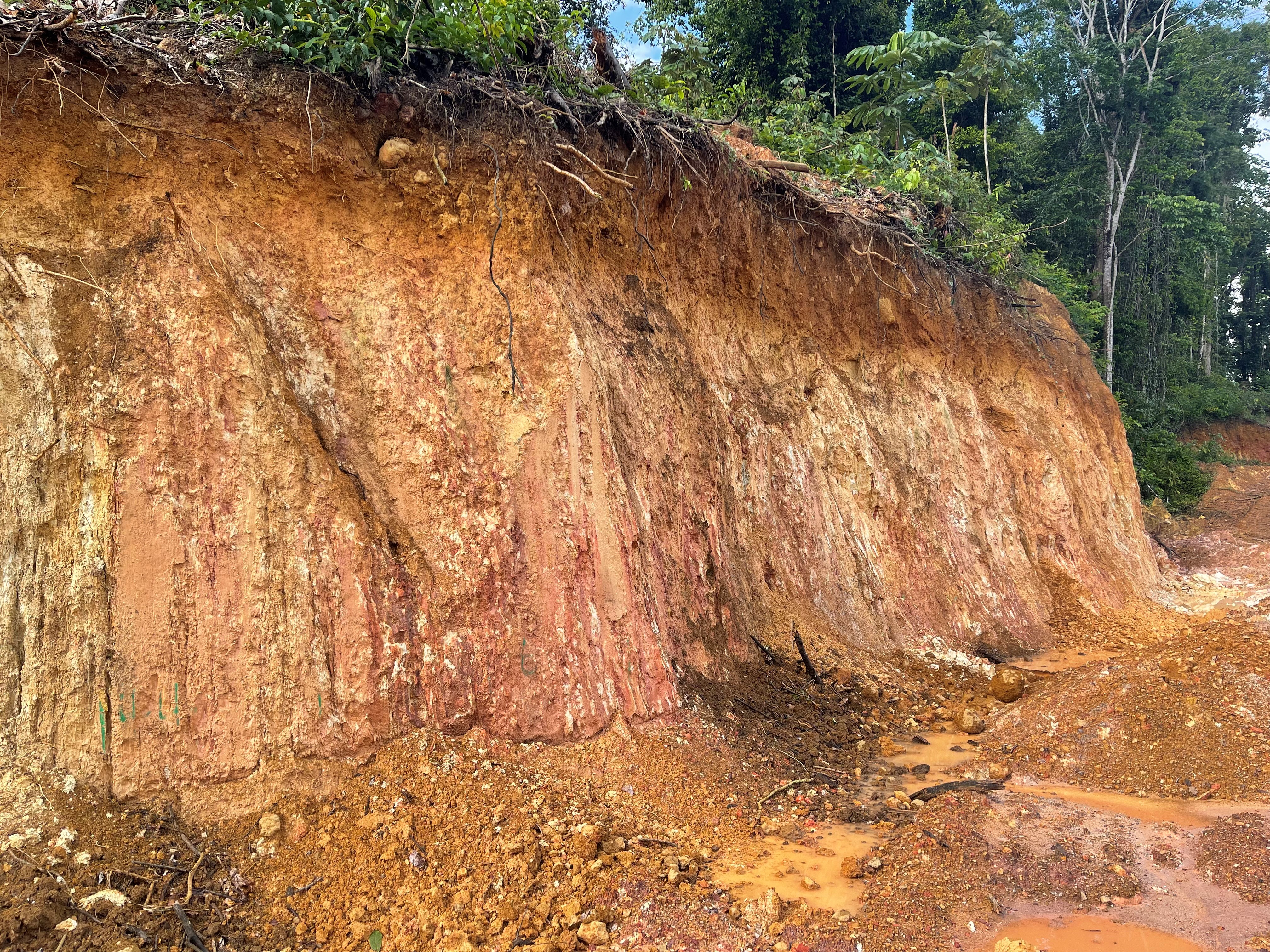
3:09 In addition, another 1.6Mt of inferred. Most of that inferred sits in an underground resource totalling 1.1Moz at just over 3g. We see this as one of the best projects on the market at the moment. We are very excited to bring this story to everyone. We have a very rapid, accelerated timeline to production. We are quickly going through various study stages at the moment in order to achieve that. The top of the deposit still maintains its entire Saprolite profile, which means it's high, It's oxidized, easy mining, free digging ore that we're able to put through a mill very quickly and provide quite a rapid production at the early end of the project.
3:55 And then we obviously have a lot of exploration potential still around the project. This project really only been going for the last about 4 years or even less. So we're still exploring the remainder of the project. And we're also looking at additional assets around the country as well. So where we're located, if you come to Guyana, you fly into Georgetown, the capital. And then from there, we have a number of options to get to site. Most of our personnel come from Georgetown now by a quick charter flight to Barlica, and then a two-hour drive from Barlica through to Bali and then to the project. All of our supplies come from Georgetown by truck. And there is obviously also an option to fly directly helicopter to site. And we are looking hopefully towards the end of the year at putting in an airstrip and having a direct China flight ability to the project.
4:48 The key point about this for obviously for everyone who knows about operating in this part of the world and in the Amazon rainforest is access is key. If you can get into the project you can do the work and it keeps your costs down. The fact that we have an eight-hour trip to bring supplies from Georgetown that are required to site is a huge advantage. The project is a prospecting license. This is the first level of tenure that a foreign company holds and covers about 44 square kilometers, which is being actively explored by the company. In terms of the geology, we're located obviously in the Gainish field, a very prolific area for large Gold deposits.
5:35 The resource itself sits at a contact zone, a shear zone between a large granitoid batholith to the east. And it's mostly hosted within sediments and volcanic clastics that are sitting along that shear zone. And there's a package of those sediments that extends out through the western part of the project as well. So the map here on the right, you can see the contact zone. The pink here is the Granitoid to the east. You can see the outline of the mineral resource estimate pit constraint. Our camp is located right at the north of the project. And we're actually just south of our neighbours to the north, which I'm sure those of you familiar with Guyana will have looked into as well, G2 Goldfields and their exploration activities on the Ghani zone and their resource up at Ogo main.
6:28 The resource that we've Just announced, just to run through some of the numbers. So, as I mentioned, we've got 4.3 million ounces in total. That breaks down at 4.2 million ounces have been indicated within the new pit constraint with an additional just under half a million ounces in inferred within those pits. Most of that inferred material sits in our blocks 5 and 6, which are really to the south of our main high-grade zone in block 4. And then as we extend down beneath block 4, and also a little bit beneath the blocks 5 and 6 as well, we've done limited amount of work so far. We have underground resources totaling 1.1 million ounces in inferred sitting right down underneath. So what we've been doing there is really looking at this high grade chute and exploring that at an inferred spacing down to about a thousand meters depth.
7:25 In section, the resource itself, especially within the open pit, is made up of a number of domains, discrete domains, the largest of which sit along the upper contact of our footwall granitoid. So if I just walk through the geology here, on the eastern side, you've got our hanging wall granitoid That then sits against a package of clastic and volcanoclastic sediments. And then that sits against a footwall Granitoid, the top of which has a very well-developed intense shear zone that has been obviously exploited for alteration. That alteration has then later been fractured and hosts the Gold mineralization. The larger domain, the lower 2 domains, our lower defamation zone and our Gold 2 domain extend down beneath the pit. And that's what we've been targeting for high-grade underground material down to our deepest drilling at the moment, which is just about 1,000m depth or about 1,100m down dip from surface.
8:32 So, about 90% of our resources within the pit are indicated. And then we've obviously done wider space drilling beneath that, which is where the inferred resources are sitting. So, on the right here, you've got a graph showing the ounces per vertical metre, anywhere from 6,000 to 10,000 ounces per vertical metre within the pit. And then obviously,
8:57 less material being captured in the underground stoke optimisation models, but still looking at about anywhere from 2,000oz to 4,000oz per vertical metre in the underground. So far, we see the mineralisation obviously continuing down at depth. This deposit has been extremely well behaved, both in terms of the geology, the geological controls and mineralization profile throughout the system. So, part of our objective now is upgrading those underground resources to an indicated classification. So, we're then ready to move the project forward into further studies. But right now we'll be putting the current in open pit indicated material and the underground inferred material together for a combined open and underground PEA.
9:47 That'll be coming out by mid-year. So in long section, we have the, right now we have 6 diamond rigs operating on the project. 5, 4 or 5 of those rigs are basically dedicated to deep drilling, upgrading our underground resource from inferred to indicated as well as helping to define those higher grade zones within that. And then we have 1 or up to 2 rigs at times, working on exploration activities, basically outside of the resource area to the south in our, what we call our Block 7 and 8 in our Kansaka 2 zone, as well as out in the western part of the project. I've got a slide that'll show the other activity a little bit in a second. In terms of where we sit now, we are obviously a little bit cautious of combining resource numbers, but a lot of the analysts that cover us are a lot better at doing this.
10:46 We have managed to move the needle quite a bit since last year, where we were sitting at 4.2Moz in total to just under 6Moz today. This is obviously making this an extremely attractive project and good grade with a strong support for development. So looking at the exploration activities outside of the resource, you can see the resource and the pit shell shown here, the pit shell projected to surface shown in green. Within that you can see the black resources projected to surface at a 0 metre RL, so about 100 metres below surface.
11:33 This is part of really what is now quite well defined as a 4km long zone of mineralisation extending from where we've defined our resources now through G2's properties, through the Ghani zone and Elko main. The contact zone with that granitoid and the associated shearing that's been developed along it continued for another 4 kilometres to the south as well, and that's part of our exploration activities right now. We completed quite a lot of, I would say, early stage activities last year. Over the last 3 to 4 years, the focus on this project has really been on the resources themselves and the rest of the project didn't really get a lot of attention as a result due to the good grades we were getting out of those initial drill holes.
12:24 So since then, we've been developing quite an extensive geochemical survey across the project. We've also been following up now with ground IP, ground magnetics and combining that to develop additional targets throughout the PL. So some of those you can see here on a circle on the map we've got a couple of targets even within the granite to the east. We've got our Block 7 and 8, our Southern Tanker 2 zone, which is actually in areas we haven't drilled so far. We have drilled some initial holes along that contact zone, more for geology early on. And we're now going back to follow that up, obviously first with the geophysics and then following it up with the diamond drilling after that.
13:12 Over in the West, we've got a number of targets, sitting on our North Drive target, which is probably our furthest West target right now, and some new targets developing just to the east of that. These are really looking for the source material of the extensive alluvial workings that are sitting on the western part of the project. So A lot of the exploration vectoring that you do in Guyana and the Guyana Shield is really looking at where a lot of the historic alluvial workings have been active and trying to chase up the source rocks for that mining activity. So We have very extensive alluvial work sitting in the west of the project and really no source as yet where those have been derived from. So that's the exploration target. So there's still a lot of exploration upside on the project, outside of obviously the expansion work that we're doing on the MRE itself.
14:04 With that, I'll hand over to Keith, who will talk a little bit about our development and study work. Okay. Thanks, Justin. We went through a preliminary metallurgical study last summer. We got some very good results. Typical of the Guyana Shield, our fresh rock, the Gold was recovered at 94.4, transition 96.5 and Sapper Lite 97.5. You'll see in the footnotes of the press release that we've used a slightly more conservative number to reflect what's in the plant. Fresh at 92.5%, transition at 95% and sap at 96%.
14:55 We're now embarking on our second phase of metallurgical test work that will help us with our design phase, feasibility phase, but we're getting very good metallurgical response.
15:21 When we step back and look at what we can do with the project, first we've got about a half a million ounces of
15:34 Gold in free-dig Saprolite transition material, which will be the early material through the mill at a higher throughput because it doesn't have to go through the grinding. We're expecting a little bit higher bump in production early on. Looking at a concurrent open pit and underground mine, which will bring forward the value on the underground in the NPV. Next, we're looking at sequencing the high-grade core of block 4 to bring forward our highest grade early on and we've got competent footwall and hanging wall.
16:21 So we'll get steep walls, which will reduce our overall strip ratio. Other opportunities that we're investigating and looking at, We're currently doing or working with a company that's performing a Feasibility on run-of-river hydro-kinetic, hydroelectric power in order to replace the assumed heavy fuel oil generated power. And so, you know, that would reduce our scope to emissions to 0 and potentially give us a carbon credit for that. Next, we've got waste rock that's good for aggregates.
17:08 And as Justin mentioned, Guyana is in a state of rapid development and the need for aggregates for that construction is high. We would look at shipping our trucking, our waste rock offsite in aggregate form and selling it into the market. The last one that we're looking at is haulage, both electrification and automation in order to reduce our carbon footprint and perhaps look at a premium for the Green Gold we produce.
17:53 Well, our accelerated timeline to production, our PEA will get completed as Justin mentioned by the mid-year end of Q2. In parallel, we're currently assembling our impact assessment, which we are targeting to submit that impact assessment the beginning of Q4.
18:19 With after that, we'll get our completed feasibility study which will start right after the PEA, our permits and our financing. All discussions will start later on this year,
18:36 leading up to a construction decision in Q2 of 2025, which will allow us to then start construction in 2023, production 2 years later. Now, How does that compare to the average in the industry? Well, the average time to production in the industry is 15.7-years, but we're looking at doing it in 6 from discovery to production.
19:09 Why can we do this? The government is extremely supportive. The permitting is very straightforward and we've got very strong project parameters, firstly with our resource and having a good open pit, high-grade underground mine, good recoveries, we've got great project parameters for us to be able to advance the project. So as we mentioned, Guyana is a mining-friendly jurisdiction, straightforward permitting process. It's one of the most attractive jurisdictions in South America.
19:59 The fiscal regime is very attractive through some tax exemptions and supportive government policies. It's got a great history of mining and quarrying, but the oil and gas sector represents about 62% of the GDP in 2022. And even there's a strong growth trajectory in mining, given the number of juniors that are advancing projects. So as we mentioned, the permitting timeline is very straightforward. We applied for our environmental permit back in September.
20:44 We did the appropriate community consultations and drafted our terms of reference in Q4. We're expecting approval of that terms of reference in order to complete our ESIA by Q4 where we'll submit it. And then in Q2 of 2025, we get approval. We get approval of our mining license and we're ready to go.
21:14 So it's a mining jurisdiction. Guyana is very high. You look at in South America, the best mineral potential index, it's second to Brazil. Policy perception index, second to Ecuador. So again, it's emerged as one of the most attractive jurisdictions in Latin America.
21:39 It's one of the fastest growing economies.
21:57 When you look at a GDP per sector, mining, quarrying and oil and gas represent over 60% of the GDP of the country. So again, there's something that Guyana is really, really supporting in terms of growth.
22:21 So our Reading Gold team, we've got a long history of finding, financing and developing operating projects in the Guyana field, the shield rather. We've got, when you look at the team, we've proven ability to
22:41 acquire projects. You look at Cambior and Golden Star back in the day with Oh My Gold and Rose Bell and Surinam. We've got a trusted partner and strong relationships with prospectors, government and local businesses. When you think about some of the leads that we get, we get a phone call from one of the port knockers there and they'll lead us to show us some Gold. We've got proven technical abilities that in particular, we've got G-Mining on our team that has proven itself time and time again to build and develop projects.
23:33 And we've got a management team that possess the extensive experience and leadership for successful mining operations. Just going through our management team, Dave Fennell is our executive chair. Rick Howes, our CEO, ex-DPM. We've got myself and Doug, who's our corporate development, Justin and Carol and Valet, our council and CFO. A very experienced management team. When you look back at our track record, we've got Golden Star with Discoveries, Omai and Rosebell both built and operated.
24:26 Reunion developed the Matthews Rich Manganese project And now we've got Ocoa West. Manji Mining Services, when you look at their track record, they deliver projects on time, safe and for big companies. With respect to our ESG on the environmental side, we look to minimise our impact, preserve the environmental quality and biodiversity.
25:13 We are securing a sustainable energy supply, or at least we've identified 1 and are working to get one, minimizing our carbon footprint to achieve a net 0 offset. And we're also working at some reforestation in order to offset the carbon footprint that we somewhat wish we had, and prioritizing water management. On the social side, prioritizing our local workforce hiring and training. 95% of our current workforce is Guyanese with 23% Amerindian. Uphold human rights, indigenous rights, and respect for local culture and heritage, conduct business in accordance with high ethical standards and fair dealing. We're very transparent in what we do through many interactions we have with the community and developing our business opportunities that will outlast life of the operation.
26:28 As far as governance, We're always building strong relationships with government and local communities and stakeholders. We focus on our ethics and transparency and we provide a safe place to work and safe space to our people. So we're well positioned for share price growth. We have good, strong, supportive shareholder base. Dundee Resources, Condier, La Mancha, Jupiter. And we were awarded the Mines and Money Award for Discovery of the Year back in 2022.
27:18 And We're well covered by the analysts. We have great re-rate potential. We're below the median of when we look at comparables, some of the catalysts we're going to release our PEA, we'll have further expiration news on the resource expansion and outside of the resource area, potential acquisitions of new projects within Guyana and Suriname, and we're de-risking the project as we advance it through permitting and study. So in summary, it's Guyana's next great Gold mine. We've got near-term catalysts, including the PEA.
28:12 We've got a world-class management team with a proven track record of building and operating mines, leveraging to unlock the full potential. We've got significant exploration potential on the property and we're looking outside and we're well capitalized through to the end of the feasibility study and construction decision and we've got a strong supportive shareholder base so all that we're undervalued and a great attractive entry point. Thanks. Justin Keith, thanks so much. I know there's some questions that have already come in. Just a reminder, especially to the cohort, looks like they came in after the hour. There's a chat box in the bottom right of the screen. You can answer your questions any time.
29:06 If we have time during this, we'll get to them. But I'll jump to some of the ones that have already come in. Julio from the chat asks, is a potential conflict with Venezuela a potential risk for that accelerated timeline? We both took a break. I think the answer is no to that, to the Qanonists. We've had questions before about the whole, the Venezuela political situation and there's no denying that there is, there are overtures being made by Venezuela. That said, I would say that everybody in the region around Guyana, whether that's talking to officials from Guyana, obviously, but also Brazil and other countries around that the likelihood of a conflict is extremely low.
30:03 We don't see this as a big risk and it really doesn't have an impact on what we're doing. The photo you see on the screen, by the way, is our camp, which is actually in the Essequibo region, which is part of the region that Venezuela is talking about. But the answer I've given to Bill before when asking about Venezuela is, we have not changed anything that we're doing at site. We actually currently have the Canadian ambassador or high commissioner visiting the project today. We are all operating in country. We have everyone from myself, Keith, our executive chairman David in country all the time. So we don't see that as playing an impact at all.
30:51 Cheers. Thanks. Tony from the chat asks if Reunion Gold needs to raise any more money this year, or if you're clean through to 2025? I think the best way to put it is we're looking at that decision point for construction. And so we can complete all the study work, including the feasibility study in order to make a construction decision. And the next step would be project financing. That's great. Also, Tony from the chat, I think is a follow-up question. He asks if reunions is going to slash is prepared to build the mine and he asks otherwise at what stages reunion for sale to a major? I think the best way to say that is, we have the ability to build the mine, and we're on track to build the mine.
31:45 Great. SMCV asks from the chat, is gold going to be forgotten as Guyana increasingly becomes a petro state? I don't think so. I think what's been interesting actually with the development of the oil industry in Guyana is oil's obviously bringing in a lot of revenue to the GDP. People are seeing the construction activities going on, especially around Georgetown. But the one downside of the oil industry is it doesn't provide a lot of jobs. It tends to be highly specialized. There's only so many people you can put on a rig out in the ocean. So it's helping develop the country. It's helping bring in revenue for infrastructure development. It's also helping, obviously, bring in a need for, let's say, more technical roles and skills that the universities are catering towards.
32:43 But I would say as an employer of the general population, the Gold industry has a much larger potential to satisfy that than the Old industry would. So in our discussions with the government, it's been interesting to see how they really want to see Gold industry develop and to see mines such as what we hope to see at Ocoa West, develop because of that employment's capabilities. Great. Jake asked from the chat, this is for either of you, he wonders why you guys believe the share prices remained relatively stagnant. And he wonders if the shares outstanding could perhaps play a role, but really just looking for your insight.
33:32 Good question. You know, I mean, it's, I think it's partially market-driven. The number of shares is outstanding. There are some larger institutions that won't look at you because of the share price itself. So maybe some of that, but at the end of the day, we've got a very good asset that we should be trading higher and we're trying to get the story out that it is as good as we're seeing. Cheers, thanks. G. Godberson asks, this is a technical question. He notes that Sapperlite feed was very important at Omae when it first started production. So I wonder what the potential is of expanding this, in his words, easy milling feed.
34:26 So from from I mean, that's obviously one of our main objectives on the exploration side, So the benefit of having a project that is economically sound and we can put through the various study stages and permitting stages is that it lets us now go look for potentially smaller targets that we could then feed into that early stage production. So there is plenty of potential. I mean, that's exactly what we're looking for, both to the south of the current resource, especially over in the west of the project as well. Great, thanks. Ahmed asks if there's any expectation for the construction cost and he's also, I think you covered it, but just as a reiteration, when you expect to release the feasibility study?
35:13 So in terms of the construction, we're in the middle of getting that done now. Some of the analysts have taken their ballpark estimates or their estimates from some benchmarking. I'll point them to go and see the analysts. We're looking at completing the PEA by mid-year, so in Q2 of this year. In parallel to that, we're doing our trade-off studies in order to be ready for the feasibility study, which will start right after the PEA. Justin will be completing his drilling, the drilling that's required to convert the inferred to indicated for the underground resource, and that will feed into the feasibility study.
36:06 And so the feasibility will start Q3 of this year, and as we showed above there, will be completed end of Q1, beginning of Q2 of next year. Great. Tony, a different Tony in the chat, asks, this is for Justin specifically, outside of Karunizone, what area has the most potential for further discoveries? I would, it depends when you ask me this. Earlier I would have said I think the western part of our permit is highly underexplored. You know, one of the reasons we came into, both us and other people came into this part of the district is really for looking for that source of where the alluvial workings were coming from and understanding some of the satellite mining that was going on all the time.
37:02 So the entire eastern flank of our project has these alluvial workings that are very well developed over the granite to the east and they lead up to these foothills. The volcanics and sediments tend to form topographic highs, so they're quite an easy source to go look for. And that said, at the moment, we've had some very interesting results, GECAM results, which you can see on that map previously in the south, so basically a long strike from the current results. Obviously, if you look at the development of where mineralization has been found along that contact zone, it's obviously both to the north and south of our Block 4. So I would say right now we've got some very interesting targets in the South. We've got a little bit more time on our hands, I would say, than we had last year when we were very rapidly advancing the resource, trying to make sure that everything was on track for the resource and the PEA that's coming up.
38:02 So right now we're working up those other targets and we're getting all the kind of fundamental work done, be that the geophysics, the geochem, and then really developing the drill targets out of that and making sure we're spending the money wisely at the end of the drill bit. Great, thank you. Pierce Promotions in the chat is asking, how economic is the 600-meter open pit? Just wanted to clarify for investors who think that only the first 300 meters is economic. So as a resource, you put in, I'll call them parameters that will identify an inventory of Gold that's a little bit more generous than you would end up engineering as part of your mine.
38:49 We're probably looking at a pit that's about, call it 450m to 500m deep. And so when we apply all the costs and a lower Gold price to be more conservative when we announce our PEA. That's probably what you'll see as well. What we will be looking at is the transition between underground and open pit. Having that high-grade core at the bottom of the pit and only seeing it in year 10, 11 or 12, as opposed to mining it out in the first year from underground, We're looking at a much higher NPV if we're going to mine it from underground.
39:37 And so that will push the bottom of the pit up a bit higher as well. So we're going to be looking at that transition and maximizing our NPV of the combined operation. Great, thanks. Arl Sands from the chat asks, what royalty is going to be paid to the government? Well, the royalty right now is 8%, as we know, and we are negotiating a minerals agreement that will specify all the details of what our relationship is to the government and our regime under which we'll confirm what we'll be doing.
40:25 Great, thanks. One question in the chat that's already been covered, but we'll make sure that we send you the recording and also get the reunion team in touch with you. One more just came in. G. Gopperson asks, has there been any studies on competence of rock with respect to UG mining? The short answer is no. However, we do know the type of rock, the waste rock is granitoid and so it's very competent. We do have measurements of RQD that give us the general competency of the rock. So the next phase of our study, so we generally know what kind of openings that should be capable of designing.
41:23 But our next phase of study, which we're just starting now, is to do that rock mechanic work and identify the strengths of specific strengths for underground design. Great. Greg asked is the lower grade of the underground resource feasible to mine? Lower grade... The underground resource was his question. Yeah, yeah. So I mean At the end of the day, we'll be analyzing or the mine design will get completed. And then from there, we'll identify what the total cost of operations will be, and that'll define our cut-off grade in order to generate a profit.
42:13 So once you've identified the cut-off grade, you sometimes look at incremental, which is a slightly lower grade than your overall cutoff, but it usually doesn't make up a significant portion of the mill feed. Got it. Thanks. It looks like one last question here from SMCV, asking what is average head grade of the underground operation? Well, the average grade of the resource, ooh, I just had a brain wave. 3.12. 3.12, yeah. Just all of a sudden it was like, boing. 3.12.
42:59 We've got to do the work now to see what will be mining and dilute. First, we've got to do dilution, mining recovery, apply those factors to the stoping blocks that we design and we'll get something. I mean, rule of thumb, it's usually about that plus a bit more because we're using a higher Gold price. So, is it in the 3.2 to 3.5 range-ish? Probably is a good number to work with. Great. I got one question that's always a tough one to answer, so obviously only to the best of your abilities. But Pierce Motion asks, has there been an increase in talks with potential suitors since the MRE?
43:47 And if we told them, we'd have to kill them. As usual. The GeekOpperson asks, is this a long-haul stopping scenario? It is a long-haul stopping. That's what will be our base case for the Feasibility Study. We'll be long-haul open-stope with cemented rock fill and cemented rock fill for the primary stopes. But we will be doing trade-offs to see if there's a different mining method that makes more sense. We'll be looking at sub-level cave, we'll be looking at a Volca, we'll be looking at other mining methods to see if it makes sense to do that.
44:33 Great. Thank you. Well, it looks like that's all the questions that we've had today. So, Justin, Keith, I'd really like to thank you for taking us through the presentation and the Q&A and obviously to everyone who attended and particularly those who asked questions and engaged in the event. If you think of the perfect question to ask right after the event ends like I usually do, please feel free to reach out and we'll be sure to get back to you as soon as we can. You can always reach out to the Reunion Gold team directly and look for more information at their website at reuniongold.com. With that I'm gonna hand it back to you guys, Justin and Keith for the last word before we jet. Okay, well, thanks for, I mean, thank you to everyone for attending. I think it's always great for us to see the amount of people that come and attend these things and listen to the stories.
45:21 So if you have any more questions, please get in touch. Keith. Well, and it's not unusual, Romeo, to want the answer before we actually go to work and do the answer. Watch this space, the PEA is coming, everybody's working very hard to come up with that answer.