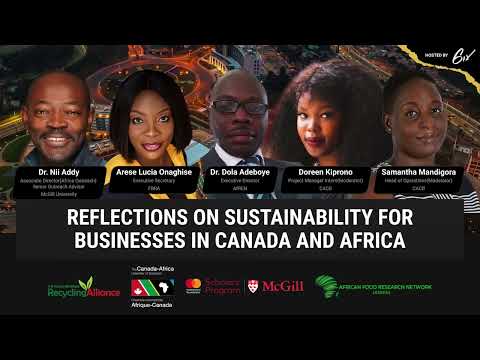
Automated transcript · Written by software from the replay's audio. It can mishear names and figures; the replay is the record.
28:45 Just to give an insight of how our collection strategy. So for collection strategy, and I use an example for the PET, which is the bottles, and we have different means of the collection system. We have the upstream activities and we have the downstream activities. One of the critical thing that is changing in this sector is that initially most of the material or packaging material that is collected is mostly used for let's say low-grade applications or mostly for fibers for clothes they are exported to other countries But what we're trying to do as an alliance is how do we develop in-country capability. And then in 2019, we're able to work with the Standard Organization of Nigeria to develop and approve a standard for recycled PETs for food grade application. Because if you want to effectively close the loop in the brewery sector, you have to be able to use it in the same application.
29:38 Meaning that when the waste is collected, it is recycled. A certain percentage of it can be put back into the production process. And that's what we call recycled PETs. And with that, in the bottom part of this diagram, you can see that different facilities are coming up in their plans towards developing and producing recycled PETs that manufacturers and producers can put back into the application. Now, just a bit of some of our performance, okay based on I'll talk first about the challenges and what we have achieved so far in terms of the recovered recyclables. So if you look at the waste management value chain in Nigeria these are the major steps I'll call it. But in the major steps there are some challenges that we are facing and that is what one of the role of the alliance is how do we bridge the gap in the challenges. So if you look at collection There's a gap in awareness, incentive provision, segregation, limited access to service providers. So that's how we work. And if you look at our 3 pillars, so you can see that our 3 pillars are addressing these collection issues.
30:45 We also have sorting, aggregation. In aggregation, we see that there's a challenge in storage space, in cleanliness of stock. And so we're trying to set up collection centers and we also intend to set up the infrastructure for recycling hubs around the country that can help to foster this aggregation. And then processing, how do we get infrastructure, power, and local technology to be able to process this material so that it can be converted for use, and we can also create market opportunities in the different packaging material so that we can ensure that we also close the loop. In terms of collection activities, I've talked about the total recyclables recovered, which is over 20,000 metric tons. But you can see that we are having different types of packaging material that are being collected, the rigid plastics, the flexibles, the glass and the used brivet cartons.
31:36 So the final book I'll talk about is what is my role, what is your role as an environmental sustainability expert or a climate leader. For a sustainable sustainability professional role, there are different issues that can come up in terms of environmental social governance. We have climate change issues, we have waste management, we have circular economy, resource and energy management, sustainability, decarbonization, which is of course a lot of discussions on 0 carbon emissions and net 0, and then value creation. What value can we create as sustainability professionals? And in my role, or in your role, I mean, all of us need to come collectively to work together, how can we do this? We can do that at an advisory level.
32:25 Advice on ESG issues, what are the possible solutions, how can we leverage on other solutions that have been applied in other clients, in other countries, in other sectors that can work in your local environment. And then the administration. Administration of the different entities. So we have a waste value chain. How do we get all the value chain together, to work together? And also how do you aggregate all the solutions to ensure that the challenges I've highlighted earlier can be resolved and sustainable solutions can be provided. Awareness is very key. How do we create our awareness? We're doing that through this platform today, but also how do we do that on a global level, on a national level, at the grassroots level within the communities.
33:11 And finally, as sustainability professionals, we all need to continue to be an advocate of the environment, an advocate of the Earth. The last event we had on World Environment Day, which is what we're also celebrating today, is saying that we don't have a plan B. We have just 1 planet. As advocates of the environment, what are we doing to promote the preservation and conservation of the planet? So it is our responsibility, it is our role as businesses, as individuals, anywhere you find yourself in the value chain, to come together to work collectively. I'll end my slide with opportunities for collaboration. So there are several ways in which we can collaborate and I'll just highlight it based on 3 focus areas. So first is the knowledge transfer.
34:02 There are lots of opportunities for knowledge transfer. In the waste sector, especially in Nigeria, it is a very informal sector, highly informal, and we're trying to formalize that. But how do we provide knowledge transfer? We can do that through capacity building and training. We can also do that through youth empowerment, creativity and innovation. We can also provide those information and transfer through, for example, McGill University, we can provide our knowledge transfer. And for other entities or businesses that have worked very well, that have seen initiatives that can work, how do we transfer those initiatives to think global and act local, so adopt it to our local environment. The second is the technology transfer. We have a lot of technologies that other countries have used that can help us to transit from a linear economy to a circular economy, how can we transfer that technology, how can we adopt it and see how it will work in Africa.
35:08 So in the partnership with when we say Canada and Africa, how can we transfer the technology from Canada and translate it into Africa and see how we can transform to a second economy. And then the best practices, the lessons learned, of course, in implementing this technology and implementing these initiatives, there are lessons that have been learned so that we don't make the same mistake or start from scratch. How do we implement that? And then finally, for infrastructure development, which is very critical, we need to develop the infrastructure. And that's one of the things that the Alliance is doing. How do we establish infrastructure? Because if we create the awareness, we tell people about the benefits of recycling, and we don't have the infrastructure for collection, for processing, or for recycling ultimately, then we're failed. So we have to make sure all the boxes are together. So we're open for opportunities for collaboration, and I'm available to discuss further on any of this. Thank you very much.
36:05 Thank you so much, Arise. A great presentation and great to understand a little bit about creating circular economy and in particular, the different roles that we can play as individuals and businesses. I'd like to move forward to our next presenter, Dr. Dola Adedboye. Dr. Dola is the executive director and board chairman of the African Food Research Network. Dr. Dola, you can go ahead. All right, good morning. Good morning, everyone. Yeah, it's my pleasure to welcome all of us to this collaborative session. I bring my goodwill message from African Food Research Network. Many thanks to the Canada Africa Chamber of Business and McGill University Massacre Foundation for this opportunity.
37:01 I would like to start by just giving a short background about AFRIN, the African Food Research Network. Our website is hereby displayed for details, but basically we're a growing community of practice, you know, with the research, policy, regulation, academic and industry segment of our profession. Anything that concerns food and its impact in society concerns us. We base our mantra on advancing the science of food and nutrition through lab industry trade measures. So this kind of partnership is very deep for us and we appreciate the opportunity because it's one of the ways by which we can achieve our mandate and objective.
37:53 Okay. I can see that I'm having issues with my slide, but so never mind, I might speak faster than the slide, but it's fine. All right, so our friend have working groups like about 10, and the one that connects with the subject matter of today is food waste reduction and polarization. And so we'll be bringing thoughts from our own idea of how we can ensure sustainability in terms of food waste reduction and polarization. Remember, we are food researchers. The only difference about us is that we align with the idea of Mastercard Foundation in terms of transitioning academic engagement into businesses that make an impact in the society. And we'll get to that in about now.
38:45 All right. The subject matter, I'm sure it's not new to every one of us. This picture says it all. And there is no continent that is safe when it comes to waste and packaging materials constituting pollution and litter in our aquatic spaces. So in Canada, there's a recent statistics that says that the percentage of single use food packaging litter nearly doubled during COVID-19 lockdown. And that's of course, 1 can relate to that because everyone is at home just taking single use and using single user material and dumping them. All right, so we also have these statistics to also bring to fore what we are trying to address today.
39:41 And if there is anything to go by, we'll see that this shows that plastic material is one of our major issues in the subject matter. So my story, I will try to narrow it down and put the bulk in the door of the plastic packaging waste so that we'll get a drift of what I'm trying to say. And not that all the other food packaging materials are not corporate, but, you know, for for intent and purposes, I would like to do it that way so that we will concentrate our energy on trying to solve the packaging plastic material. All right, so I don't know if it's from my side or my device, I'm trying to move my slide, but it's a bit slow. Please pardon me. All right, so our objective as researchers is to use effective design research to create innovative packaging system that addresses 2 sides of the story. One side is to create a packaging material that offers the traditional function of a food packaging, which is essential to us we want because there are some barriers, barrier properties that it needs to have in order to deliver the food in some states. We don't want to compromise on that. But then we also have a responsibility as researchers to design,
41:12 just like Arisa said, material that will be eco-friendly and contribute to planetary health. These responsibilities create opportunities for technological innovations. And it also requires social, cultural and behavioral change management solution. This is why leadership and governance is very important. And we are hoping that the discussion today will teach action in this regard. All right, so then how does responsible research come into the picture? Responsible research will come into the picture by deepening understanding of packaging consideration for planetary earth. We can achieve this as researchers if we continue to link population growth statistics to the need to future-proof packaging system to preserve or protect the ecological system upon which all of us, we derive existence.
42:06 So how do we achieve this? We achieve this in our own view by evolving tech solution to compostability. I just mentioned the responsibility placed on the doorstep of food manufacturers and also across the value chain and also the distribution chain. And we can see clearly that it's everyone's responsibility. But the management solution that's been offered even in developed countries still leave one thing out. And they are still struggling with one thing. That is making sure that the packaging materials are compostable. In our own view, that will really be a very significant step in ensuring that this will reduce the maintenance of food packaging waste.
42:59 And how do I mean? The next slide we put in perspective what I'm trying to say. Yeah, let's have a view about management pathways that one of the developed countries of the world have been using. I got this statistics, 2018 statistics, and it's still quite relevant. I was unable to get the 2020 or more recent statistics. But the point I want to make here is that you can see that paper and paper boards, really a lot of what is generated can be recycled. Good. And we know that. But then when we look at the energy that is obtained from that in the process of recycling, that at what expense? Because the search industry also generates a lot of heat and this heat is blasted into the same atmosphere that we are trying to salvage. So a lot of issues also come in as part of climate issue. Climate issue.
44:03 And so we look at other type of food packaging material like glass and aluminum and steel, we notice that, okay, they do not really constitute so much a problem. But if we look at plastic, plastic constitutes a lot of problems. Only just 14% of what is generated, the solid waste that is generated by plastic packaging, food packaging material, is recycled. Where would the rest go? OK, let's say 2,460 is combusted in the process. We still have about 10,000 tonnage in landfill. And this landfill that we're talking about, it comprises landfill all around the surface of the environment.
44:57 So we see that plastic is our real issue here. And so that's why I will want to concentrate on the plastic food, plastic waste, you know. And the research for sustainable solution, I've tried in the last, we must give a researcher's kudos as to what they have been able to come up with in terms of disposable tablewares, bio-waste bags and the rest of them. But at the end of the day, if this innovation does not lead to a situation where they will go back to hurt and be compostable and disappear, They will still constitute a kind of a nuisance and menace. And so that's why our consideration for sustainable environment when it comes to food waste management will be that we look at an opportunity that all innovation that can ensure that this food packaging materials at the end of their lifespan, that is when the user has finished using them, are compostable.
46:08 And I was trying to put this in perspective by just sharing these notables with the chemistry of the conversion, but basically just to show that our food materials, you know, can be used or has been used, you know, in the time past, you know, to produce packaging materials. And what they just use is the starch and polysaccharide inside some of these foods. And with a little addition of food grade chemicals, they are strengthened and formed into materials that can be used to carry and package our food. And at the end of the day, the microorganism also will benefit from it because when in the presence of sunlight, heat and oxygen, microalgae act on this and decompose them, the microalgae also benefits our ecosystem by producing what life, what human life also need, you know, for a cleaner environment.
47:02 And so we believe that composting is a better opportunity to invest in. Yeah, so what we are asking for in a nutshell as food researchers that is concerned about the subject matter is that we should rather be echoing biodegradable plastic to come back. They've been around for some time, but the reason for the low production is very obvious. And I've tried to list like 3. Yeah, the confounding variables of carbon water, land and crop diversion footprint of bioplastic is inundating because you want to say, okay, how much of land that is supposed to be used for crop for human being will be used for the purpose of generating food material that will be used to now form biodegradable containers for food.
47:57 Then there is this other issue of consumer apathy, which deals with awareness. And I'm happy that Recycling Alliance recognized that fact as part of the strategy that can lead to sustainability in that regard. And This apathy of a consumer can also be addressed by research, and I will get to that later, because consumers are so used to their hard plastic, which is made from fossil material, and they look at biodegradable material for food packaging as being either being fake or too weak to offer the traditional function of food packaging. Then there is this issue of how much waste are we going to need to collect to be able to use that to now convert to biodegradable packaging material. You know, I get that. And the statistics now is not encouraging at all.
48:53 That the demand is extremely greater than the ability of the entire scientific industry to meet up with the demand, with the challenge, you know. And they put out that we are only about 1% in the pie. And so that's quite discouraging. But thank God for the effort of Recycling Alliance, but at least efforts in that direction can bridge the gap. But that is not to say that researchers have sat down doing nothing. We must give credit to the effort so far, which has produced nano packaging materials, you know, that's produced so many nano materials. These nano materials, in terms of size, they have been able to reduce. Thank you, Liz. I see that.
49:39 So they have been able to reduce the sizes of these packaging materials that are out there after use. So because of time, I want to quickly go to the solution. Okay, cost is one of the issue that has been delaying research in producing biodegradable packaging materials. But can we try that food that are related to beverage that take away packs, contact any packaging material that has contact with food packaging, can we try and make them to be biodegradable? You know, that at least will be meeting just a little part of the demand or what is required. That will go a long way in ensuring that these wastes are removed from or circumvented from entering our society. Then Governance, innovation and funding need to look at land use in favor of bioplastic production.
50:37 If we look at the amount of hectares that are still desert in Africa, for instance, we can convert those ones into smart agriculture that has to do with vertical farming. We don't need the soil in such a situation. And such can actually be used for the purpose of producing or farming crops for bioplastic production. I talk about a single-use policy. Thank God that Canada has just recently announced a ban on single use plastic. And they have given the business environment some time to adjust, which is good. And I can see some businesses already are aligning to this by not using plastic at all. They will just ask you to go and take, even water, they will ask you to go and take it from the dispenser. And with that, we reduce the amount that we end up out there on the street. All right, I want to end up by saying that if we can incentivize solution, you know, it will go a long way.
51:34 By this, I'm talking from the theory of a Boston friend of mine, which postulated the beneficial advantage theory, you know, a system of thought and decision that drives motivation for action that we do. So my belief is that if we incentivize the solutions that we are offering, maybe this will go a long way in solving the problem, at least solving a chunk of the problem. I'll now put this in perspective as I close up. Governance innovation needs to recognize for instance the disruptive time that we are in. We should fund courses in the university that has to do with with valorization and let the youth come up with ideas that can help. And by this, I want them to suggest a business solution that drive bioplastic farming. Youth have the tech sense, but they don't want to do the farming that is traditional. Don't want to do the farming that is stressful. But so if we can invest in science about plastic farming, that is innovative and that is smart, we can begin to generate enough crop to be used in that direction. Then let us incentivize collection of single use plastic, by turning it into an online business.
52:53 By that we can build business model around collection. I had a recent mentioning that the collection, the feedback on collection has not been that 100% and so that's why we still find you know liters of plastic food packaging still around our streets. But if we can incentivize that and make it an online business that youth can participate in without getting their hands dirty. It's going a long way. Then we should incentivize attitude as well. Attitude of say, okay, if you go for bioplastic packaging for the same food product, you will buy it at a lesser amount. Nobody wants to waste money. That will encourage also people to start choosing about plastic packaging or package food and material rather than the regular traditional fossil fuel plastic packaging. All right, so that's what I have for now. Those things I couldn't cover because of time. I think I'm hoping that time will permit during the question and answer session to shed light on those. Thank you very much for the opportunity.
54:05 Thank you so much, Dr Dola. Again, great presentation to help us understand about, you know, the role that each person and businesses can make in terms of recycling. Some key themes that keep coming up are youth involvement in this, the role of government from a policy perspective, and the role of technology and science in terms of innovation. So thank you so much for that. We'll move to our next speaker, Mr. Ken Jones. Mr. Ken Jones is the Director of Sustainability at B2GoldCorp. Mr. Ken, you can go ahead. Thank you. Thank you very much. Good morning or afternoon or evening to everyone wherever you may be.
54:53 Thank you very much to the Canada Africa Chamber of Business and to McGill University for this opportunity. As introduced there, I'm Ken Jones, the Director of Sustainability at B2Gold Corp. It's my pleasure to join today and to discuss B2Gold and share our approach to sustainability and managing our environmental, social and governance issues for our company. B2Gold is a low-cost international senior gold producer. We're based in Vancouver, Canada, and we have operations in 3 countries, in the Philippines and 2 countries in Africa, in Namibia and Mali. And then a number of exploration and development projects in various countries throughout the world.
55:43 In 2021, we achieved our 13th consecutive year of record Gold production of just over 1Moz. And as you can see, we have an impressive history of growth. This growth through strategic acquisition, construction of new mines and then exploration success to grow and expand our operations. In 2022, our projected guidance is also right at about 1 million ounces, broken down as you can see here. Our Focola mine in Mali is our flagship operation, which produces almost 600,000 ounces of Gold each year. As I said, we are a growth company and much of this growth comes from exploration of both Greenfields and Brownfields projects.
56:31 In 2022, our global exploration budget is approximately $72 million, nearly half of which is spent in Mali, also in Namibia, but also 40% or $28 million of this budget in 2022 dedicated to grassroots greenfields exploration projects in countries around the world, such as Finland, Uzbekistan, and also in Egypt. So with that brief context of what B2Gold is, as a senior gold producer, but here I'd like to share then our approach to sustainability and ESG. B2Gold, ESG is deeply embedded in everything that we do, and we're very proud of the strong relationships that we have with our stakeholders and with our communities in all of the countries where we operate.
57:27 This is what gives us our social license to operate, And for us, this social licensing comes from these 3 pillars I'm showing here. First, it's our open, honest, and our transparent engagement with our stakeholders, including engagement as early as possible in the life of a mining project, including during our exploration activities. Second, then, is to understand what impacts we may have on the communities that we work with, so that we can ensure that we are not negatively impacting them, either to their social structure, to their cultural traditions, or that the surrounding environment, be it the air quality or water quality or the biodiversity, is protected, and that in fact our communities then have access to benefits from our presence, including through direct employment and investment in our communities.
58:20 And then through this engagement investment, it's our aim to ensure then that we can leave a positive legacy. This is what sustainability is for us, to ensure that our communities are better off following the cessation of our activities and long after our presence is gone. And again, this is the definition of success in sustainability for the mining industry and for B2Gold and it's how we do business and engage with all of our stakeholders. We generate a significant direct economic benefit for our host communities and our host country governments. As you see here in 2021, we invested over $9 million directly in our surrounding communities. We paid over $150 million in wages and benefits worldwide and paid over $400 million in direct payments to governments. That's in the form of taxes, dividends, royalties.
59:15 In addition, in 2021, we also spent over $450 million in our host countries on goods and services providing direct support to local businesses. In 2022, as I mentioned, we also again to project over 1 million ounces of gold production from our 3 operating mines. B2Gold's most critical asset is our workforce. We employ over 5,000 people around the world. One key issue in all of the countries that we operate in is to ensure that we employ people from within our host communities and host countries. And over 97% of our employees are locally employed. And then we have training and professional development programs to upskill the local workforce into more skilled positions and into senior management roles where we're able.
1:00:09 Also critical to B2Gold is diversity and including gender equality. In 2021, just over 14% of our workforce was female. Improving and actually still a low number overall as we work towards total equality, but quite excellent actually in the mining industry. And we are working to make our workforce more diverse. The safety of our workforce is our highest priority. Our aim is to ensure that every worker goes home safe at the end of every day. And in 2021 was our 6th consecutive year that we did not have a fatality at any of our operations. We also have one of the lowest lost time injury frequency rates in the industry with our operations exceeding 1 to 2 and even 3 years currently at our Mozbate operation in the Philippines without a lost time injury.
1:01:12 B2Gold implements Industry best environmental practices at our operations, focusing on mitigating first our impacts on the environment, and then progressively rehabilitating our mine facilities to minimize our environmental liabilities and costs. At our operations, we've rehabilitated over 200 hectares of land while we continue to operate and expand our mines, planting over 2 million trees in the process. We've also rehabilitated and planted over 300 hectares of mangroves at our Masbate operation in the Philippines, planting well over 1 million mangrove propagules as well. We recognize that climate change is one of the biggest challenges facing the globe, and we are actively working to mitigate our climate impacts.
1:02:08 We have been an innovator and implementing renewable energy at our operations and both in Namibia and Mali have solar facilities. And in 2021 10% of our total electricity consumption was generated from renewable sources. We are currently looking at how to expand our portion of renewables and other technologies to reduce our emissions and our impact on the climate. And these practices and our climate strategy has BT Gold well positioned to be resilient as society transitions to a low carbon future. And Lastly, our communities are the lifeline of our mining operations and our projects. We've invested over $36 million in our local communities since 2017, and we focus this investment in key areas such as clean water and sanitation, access to health services, access to quality education, often remote and marginalized communities, in environmental conservation, and then also in development of small and medium enterprises through skills, business development, and access to markets, and also access to our mining operations.
1:03:24 We also work to form strategic partnerships to leverage our ability to positively impact our communities. Among numerous partnerships, we've implemented successful programs with UNICEF in both Mali to protect and empower young children and girls in an artisanal mining context, and in Namibia to upskill and promote entrepreneurial opportunities among the local youth. And Molly, we've also partnered with Global Affairs Canada on the APEC project. This is a vocational training center to develop qualified and certified technical professionals for employment both within B2Gold and within the region. This project's actually successfully been handed over to the local municipality and continues past B2Gold's partnership and investment.
1:04:15 And while we don't approach environmental and social issues for recognition, it is simply part of our values and how we do business. We are honored to have been recognized by several leading organizations for our initiatives, some of which are highlighted here, including prospectors and developers Association of Canada's 2021 Sustainability Award and the Mining and Journal's 2020 Most Sustainable Miner Award. So this concludes my brief presentation of our approach to management of environmental, social and governance issues. Again, I want to thank the Chamber of Business and McGill University for this opportunity. It has been my pleasure. Thank you very much. Thank you so much, Ken. Again, great presentation and hopefully a learning opportunity for everybody.
1:05:05 It was interesting to hear more about your social impact strategies and your climate strategies to reduce carbon emissions. We'll now move forward to the question and answer segment. And my colleague, Doreen Kiprono, will take us through that. Doreen, you can go ahead. Hi, everyone. Thank you so much to our speakers today. Ken, Dr. Nyi, RSC, and Dr. Dona, the presentations are very insightful. And so we're going to proceed to the Q&A section. So there have been quite a few questions that are very interesting. And I'm going to start with 1 directed to Dr. Nii.
1:05:53 And this is asked by Toya. So what can the MasterCard Foundation do to support Africans to reach out to businesses to transfer skills, to meet some of the environmental challenges in the secular economy. So I'd love to hear your thoughts on that. Yeah, so thanks for that question. Yeah, so part of what's happening, I mean, currently, as I mentioned, there's been the scholarship program, but there are multiple other programs that are ongoing at various institutions, both in Africa, the largest part of course, the Mascara Foundation support is with African institutions, right? And then you have you have Canadian institutions like McGill being one of a few institutions also in North America that is engaging with some of what's ongoing.
1:06:43 I was listening to the speakers, I think some of what's already happening and I think again some of what can happen moving forward and scaling some of these efforts include partnerships, you know, I was hearing for example what Ken said about B2Go, what they're doing with communities where in some cases you know you come up with a project and then you have others that take up some of the project. You know, so I see that moving forward, you know, what are the ways, the kinds of programs that businesses are engaging in with communities become projects where if there's collaboration with say educational institutions, you know, like McGill, you know, or with with the Food and Beverage Recycling Alliance, you know, can actually sustain what's ongoing, you know, at the community level. Obviously, there's a lot going on at various communities.
1:07:31 One of the things that we've been doing, I think, which the MasterCard Foundation has been supporting is the engagement of the scholars who are from the communities and engaging in various innovative projects in their communities. A lot of these projects are small, they are scattered, So where there's opportunity and where a foundation like MasterCard, I think, has been supportive, at least from the McGill point of view, I think moving forward, there can be more collaboration with others as well around this, becomes mapping something as having an ecosystem approach, where essentially, if you look at what are the businesses doing, what are the youth themselves doing, what are the various institutions, Afrians of the world, the Food and Recycling Alliance of the world, And having, I see this as having youth, particularly the students and the youth, driving most of this, right? Because very often they understand the communities that they come from more than most. But they also have an outlook, which I think I speak to in my presentation, understanding where things are going, you know, more than most people. I think that's where things like mentors also come in. I think, again, where Masaka Foundation has been supporting mentorship, the key thing becomes, as I said, there's nothing new under the sun, right? What are the lessons that have been learned? What are the mistakes that I have made?
1:08:52 That I can engage with people and say, you know what? We tried this. It didn't work for this and that reason. The mistakes that my mentors have made that they share with me so that these things get shared. And I think that's where moving forward, you know, some of the support and the connections that the Canada Africa Chamber of Business is engaging with and bringing us together becomes vital for being able to move things like that forward with the youth. Thanks so much, Dr. For that answer. I think I totally resonate with everything that you're saying. As a former MasterCard scholar, I really understand what the challenges are coming from an African country and I know how best to help the community that is around me so I support that message.
1:09:42 So moving on to other questions We are going to focus now on questions directed to Arase and I find one that was specifically interesting is centred on packaging and the circular economy. So there's a lot that you've mentioned about the circular economy, but we even need to start by understanding how can sustainability be implemented when we are packaging in terms of designing. So and Kem asked the question, could you throw more light on how packaging can be designed for sustainability? And could you provide some ideas and examples? And following that, what are some of your views on the packaging circular economy?
1:10:33 Okay, thank you, Doreen. I've tried to answer most of the questions. Maybe I'll just read from what I've written down. And so packaging can be designed for sustainability. And she was asking what do I think about it. So first, we're thinking the design. So most times we already design a particular packaging in the past. But with the new trend, we're talking about sustainability, we're talking about the impact on the environment. We need to start thinking of the kind of packaging that is reusable, that can be compostable, that can be recyclable, biodegradable, or degradable so that it doesn't stay long in the environment. We talked about plastics. Plastics can stay for over 100 years in the environment. So if it's disposed inappropriately, it's going to stay there and going to outlive us. So how can we start redesigning for sustainability?
1:11:30 How can we ensure that we use packaging that is like maybe the ones that are made from plants, from starch, that can easily decompose after it is being used? Because most times the packaging, we don't really need the packaging. We just need the content of the product. And then the second one is what's my thoughts on circular economy. When we are looking at circular economy let's not look at it from a limited point of view. Most times as professionals in the field we tend to look at okay the environmental aspect but what about the economic aspect? What about the social aspect? So it has to be looked from a holistic point of view. We also need to look at resource and energy management. How can we leverage on all those other things that can affect it? Because if you look at just this environmental point of view, you might miss out on the energy consumption, which can also contribute to emissions that can also affect the environment.
1:12:29 So we need to also be more holistic in our view when we are looking at sustainability. And then the third one is what are the challenges? Where are we on this, on the continent, African continent, and what are the key challenges? The interesting thing is in the continent in the last decade it is really growing, it is emerging, there's a lot of creativity and innovations that are coming up and just like Dr. Adji said, thanks to the youth, a lot of the youth are engaging in entrepreneurship. So they are bringing in their creativity, they are bringing in their innovations and they are also helping the green economy to grow. So in the continent, generally, I mean, it's something that is growing and is emerging. So it's a space to look out for.
1:13:15 However, there are some challenges in the space which include the logistics, the technology, I also talked about capacity building and training. There's also the collection system and infrastructure that is not really structured and is not really adequate enough to address the issues. And then, of course, we can't do any of this without funding. Funding is very key. So how do we also ensure that we have enough funding? How do we also ensure that we can package sustainability projects in a way that they are bankable, that financial institutions can come and support, that can give loans, they can give funding to support it. Because the challenge we have also had in the past is, everybody thinks, I mean, financial institutions is now that they're becoming more aware that waste, I mean, the waste sector can be a lucrative and viable business that is bankable.
1:14:06 So if you don't present it in the proper way and look at the holistic point of view, seeing the economy, the social benefit, and then the environmental benefit, a bank might not want to fund your project. So we also need to think, look inward and see how we can package those activities, the projects, the initiatives in a way that banks or financial institutions will want to support and fund it. Thank you. Those are great insights, Yaseh, and just acknowledging you've been able to answer most of the questions on the chat, and I thank you for taking that initiative. I currently can't see Dr. Dollar, so I'm going to move on to Ken.
1:14:54 And just the first question that I'm gonna maybe address is Toya asking, is there an opportunity for partnership opportunities to provide graduates and scholars from the McGill MasterCard Foundation Transitions Project to come into internships and employment at B2GOLD? We've talked a lot about the youth and their responsibility and role in terms of sustainability, so this would be a great opportunity for you to let us know what opportunities are there at B2Gold. Sure. We actually do – I mentioned in our investment in our communities, we do, you know, access to quality education is a key pillar of our investment, and a lot of that is bursary and scholarship to universities, And then we actually have programs, yes, that we do return some of these then college educated or otherwise trained individuals that do have the opportunities to work for B2Gold.
1:16:05 And so that's a key portion of our investment in our community members. As far as specifics of what opportunities there are, I don't know if I have details of that right here, but a key focus of our investment in programs is on our local and regional communities. We really pride ourselves on being able to work in remote parts of Mali, for example, or Namibia, and to have high school students go off to college and be able to come back and work in good quality high paying jobs in their homes really, you know.
1:16:53 So that is the focus of our scholarship programs. Thanks so much for that response and just giving leeway into the type of opportunities that are centered on the locals within those countries. I know for sure there are so many students or scholars that come from some of those countries and I think there would be a very great opportunity to connect with them. So I'm opening up that to you in terms of a conversation if there's a possibility to follow up with you on some of this bursaries or scholarships that are currently available at B2Gold.
1:17:43 So I'm going to move on to Dr. Dola. So we have a question from Ann Kem and he or she says that sometimes there are some elements that are important to the industry that are not prioritized in sustainable packaging research efforts. For example, commercial liability and total carbon footprint. So the question comes in, how does your organization ensure that research efforts are not great theoretically, but commercially unviable? Okay, so that's a very good question because it is part of the reason why our mandate is so structured that we believe that advancing the impact of food science and technology to our society demands that we form an exodus of the lab, industry and the trade. And so answering the question is the way by which we hold our summit. When we hold summits, we ensure that the objective of the summit is bottom up. That is, is driven by the desire in the society. For instance, this is a desire that the 3 major players have a role to play. For instance, okay, the academia, you know, what we are used to, what we are used to, everybody can relate to that, that the scientists come up with a hypothesis based on based on the chemistry of their science. In this case, chemistry has a role to play as a major role to play
1:19:13 in when you are coming up with a reside that addresses sustainability of food packaging materials and trying to make it biodegradable is pure chemistry. But how do you now generate the objective in such a way that it will be driven by the need and the business. When I say the need, it's not only the need of the users, but also the need of the traders and the need of business, because if you don't make profits from your business, you are going to be discouraged at the end of the day, no matter how fantastic the science is. So what we are advocating for researchers in our midst, and we are reorientating researchers all over the continent to begin to drive objective and hypothesis from the need and business point of view. That way we can circumvent that concern that Nkem is having. That is if all of us, you know, decide to buy into such a ideation, you know, when we come up with research objective.
1:20:15 I hope that addresses his concern. Yeah. Thank you so much, Dr. Dalla, for that response. I think I'm just going to follow up with one more question that was asked specifically on the process of how this aquatic environment can be prioritized. And I'm going to also combine it with the question that was directed to Arase as well. So Ibrahim had asked, how can FBRA better protect the aquatic environment in particular from the detrimental effects of poor solid waste management as we move towards a circular economy. But at the same time, we're thinking about some of the things that come in when we think about chemicals.
1:21:24 So Ibrahim also asked, there's a time that's needed for chemicals to migrate from plastic-based packages into food and then later on to bioaccumulate into the aquatic ecological system. So all these things involve the environment and it would be wonderful even just to understand a bit of the chemistry that goes into that. Okay, You want Arisa to go first? Yes. Okay. Maybe I'll quickly just go first before the photographer will give the chemistry part of it. So, 80% of the pollution we see in the waterways in the ocean is based on the leakages from the land. And that's why our focus mainly is on the land because we know if we address that it also reduce what goes to the ocean. But specifically for the ways in which we are preventing a co-activist.
1:22:25 I think we have lost her. So maybe Dr. Adola, you can proceed with the section of the question and then she can come back. All right. The aspects of, I will address it from the aspect of circular economy. You see, when there is a motive created around a system, You see everybody willing, I mean, coming up willingly to volunteer, especially if there's a benefit attached to it. So we can build a business model around the economy of waste management, especially the one that we are addressing, that is the plastic food packaging materials. And in terms of the time, that is because I'm also seeing the Brian question here, that the time needed for the chemical does to migrate from plastic-based packages into food, and then later on bioaccumulate into aquatic ecological system. He really wants to know that.
1:23:27 There's no 1 answer to this because there's a lot that goes, a lot of factors that goes into this. One is the manufacturer of the biobased plastic materials, you know, and what they put, the strength of what is put together, because the strength of what is put together will determine how easy it is for the microbiome in the soil to be able to act on it in the presence of oxygen, UV and sunlight. So it depends on, and then again, it depends on when it gets out, because collection is an issue. And that's why I really commend the food and beverage recycling alliance for their effort in terms of collecting it because sometimes this waste stays inside the house, inside the building, and if they are not collected and ensure that they fall back into the soil. They won't be biodegradable because they need to have access to that heat, that sunlight, you know, to degrade them. And the earlier we get that sorted out, the earlier we are going to handle that way so that it doesn't get into an environment that you won't have access to the appropriate atmospheric condition that will make, that will ensure that it's degradable because it's not just giving that it's degradable.
1:24:47 It needs to be in the environment and the condition by which it can degrade. And recycling alliance are well positioned to ensure that that happens. But where I want to address very well in terms of how this happens, is that the stronger nation should see this as a collective responsibility. When they come up with models that work, they should try and sell the model also to the nations that need it. I'm talking about developed nations versus the developing nations. And I'll put this in perspective. In developed countries, waste are disaggregated into biodegradable waste and non-biodegradable waste. So, collection is easy for the consortium that comes to your house to collect.
1:25:43 Even the collecting truck is designed in such a way that each one can be collected separately. That way it is easy to collect and transit that into the environment that will ensure that it is degradable. So in such a system we'll find it easy to utilize the suggestion of food and beverage, recycling alliance compared to a a system where there's no structure that is no process at all, you know, but if you can assist them in building such a business model and such process, you will at the end of the day be contributing to planetary health. Because if you don't assist them and they are poorly managed waste gets into the aquatic ocean, they are going to find their way into your own ocean as well anyway, because this thing you can't control them. So that would be my suggestion, that we see all of this circular economy that they are suggesting as a global responsibility.
1:26:40 A platform like the Canada Africa Chamber of Business need to start seeing this now as a social responsibility that we need them for, because there is a platform that can bring all of this together, especially on the platform of United Nations and OAU, for instance. Thank you. If I may just jump in, I think, given some of what's been talked about here, one of the things I see is there's an opportunity, needs to think, how do we motivate some of these things? I'm thinking, for example, if you think about B2GOLD and what's happening, what they might be working on, but other businesses. In academia, we often have calls for proposals that are driven by research ideas, And I think Africa Chamber of Business, the idea of having a call for proposals that is driven by business around some of these things where students can work on, faculty can work on, I think would be an interesting approach to take where it's driven by the needs of business and the company motivation. This is what business needs.
1:27:32 This is what can drive some of the research and innovation. So I just wanted to jump in. And that's something that we could work on moving forward. A quick 1. So maybe to jump in there again from my own interview, so maybe I'll take this back even to the Food and Beverage Recycling Alliance, to the partners that make it up, because so that we don't, let's desegregate the alliance. So we have Coca-Cola, Nestle, those other guys. So I would say part of what, following up on what Dr. Oni has given us now is can we have a means of reaching these individual partners of your alliance so that we start looking at how to make these things even more practical in application? It's that aspect that we will talk to B2GoldCorp, right? But B2GoldCorp doesn't do the food and beverage part of it, although they're consumers of what is produced. But I think more directly now to say the Coca-Cola that you talk about, the Unilever, the Guinness, those individual institutions, are you able to give us some headway, maybe beyond this conversation to say, let's take that conversation with the McGill University and Massacai, right? And there might be ways we can then come back to people like Ken and say okay what are the sustainability issues from this perspective so that we don't just leave it broad if you understand what I'm saying, to say how do we narrow that down So even if we're going to work with Nestle, we
1:29:02 have some relationship with Nestle and we say, how do we take this forward? So maybe we can take that afterwards, you know, because of time. Yes, well, we can do that. Okay. So we've got some commitment. So we'll take that from there. Thanks. At this point, I'd like to thank all the speakers for their lovely responses and just being able to engage with our audience today. I'm hoping that you would be open to follow up from the audience, as there has been numerous interest and questions on that end. So I'm asking if there's a possibility to follow on LinkedIn, or even just reach out through email if that's a possibility from your end.
1:29:53 Given that confirmation, I'm going to hand it over to my colleague, Toye, to give closing remarks. And yeah, thank you for joining the session today. Okay. All right. Thank you very much, Doreen, for that. And just to thank everyone on behalf of the Canada-Africa Chamber of Business, the partnerships we have with McGill University and the Nwasaka Foundation Transitions Project to say thank you for making this happen. And to RSA also for just making sure that the World Environmental Day doesn't get beyond June when it was celebrated. It was celebrated on June 5th, and Arisa just kept on pushing that we can't allow this to go past June. But thanks for pushing us and making this happen. Thanks to B2Gold Corp for being that sustainable partner of this initiative and the work we do, and we're looking forward to building on this conversations.
1:30:51 Just like we've talked, 90 minutes will not be enough to solve the world's problem or the Earth's problem. But remember what Arisa said, there is no plan B, we only have 1 Earth. And so we've got to keep engaging so even when we come back to you and we pull you and we ask you please we're doing this for ourselves for the earth we only have 1 earth. I'd like to thank the Africa Food and Research Network for taking that nexus between the lab the industry and trade this is something novel which I know that McGill University did something before, so that we're not just talking about the academic theories that we find in the universities, but how do we link it to industry perspective and trade and the businesses associated with it. So the wonderful team at the Canada Africa Chamber of Business, particularly our interns, our project managers, Doreen Kiprono, Liz Thomas, Ferdinand Ocho. I want to say thank you for all the background work. And of course, we couldn't have achieved any of these things.
1:31:51 We could design all of these things if we didn't have the wonderful support of 6, great partners at six.com for providing us this platform to be able to reach the world, to be able to share this information. And of course, the recording is available and every one of us can also share this even with our communities, even those who are not able to participate in this. And we'll build on this. So I see Liz already hounding me with 3 minutes over the time. So I just want to say thank you very much. And we will be in touch with everybody on what the next steps are. ♪♪