Peter Kenyon
CEO at RAMSDENS HOLDINGS PLC
Replay available
Interim Results hosted by Ramsdens Holdings (LSE:RFX) on Investor Meet Company, held 2024-06-06.
On 6ix: 6ix.com/event/ramsdens-holdings-plc-rfx-interim-results
Automated transcript · Written by software from the replay's audio. It can mishear names and figures; the replay is the record.
0:01 Good afternoon, and welcome to the RAMSDENS HOLDINGS PLC interim results investor presentation. Throughout this recorded presentation, investors will be in listen only mode. Questions are encouraged and can be submitted at any time by the q and a tab situated on the right hand corner of your screen. Just simply type in your questions and press send. The company may not be in a position to answer every question received in the meeting itself. However, the company can review all the questions submitted today and publish responses where it is appropriate to do so. Before we begin, I'd like to submit the following poll.
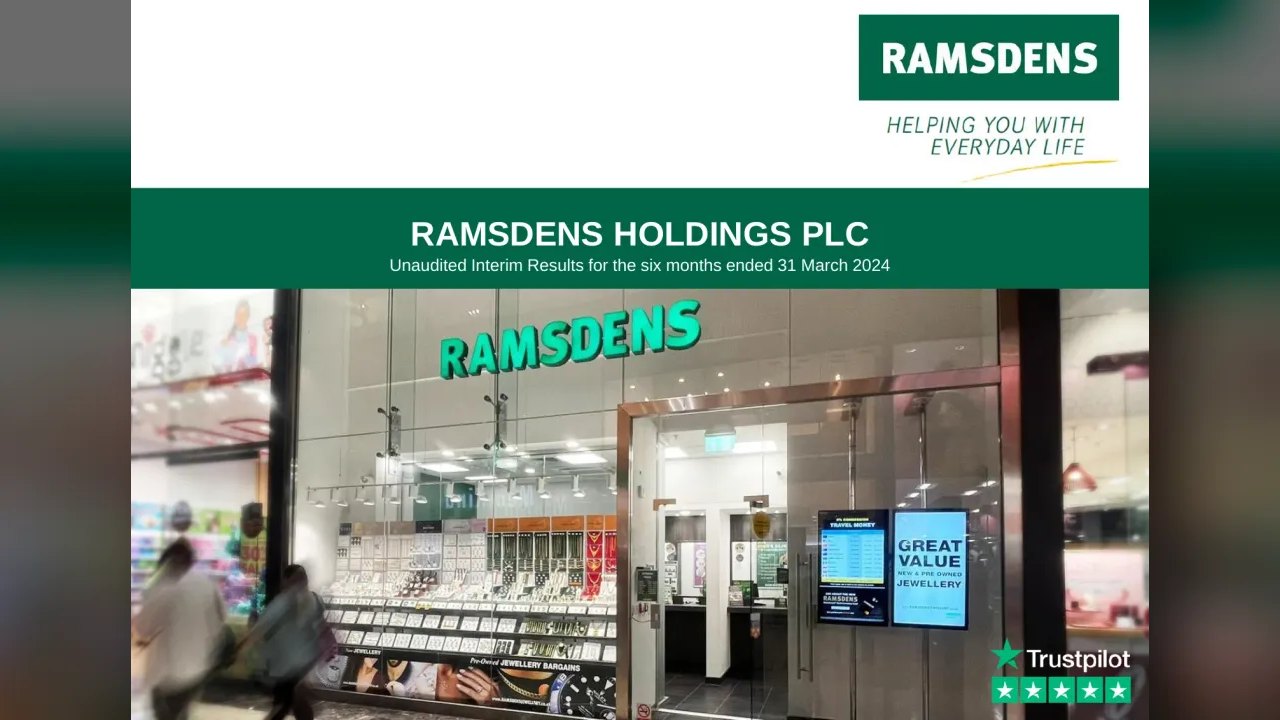
0:31 I'd now like to hand you over to CEO, Peter Kenyon. Good afternoon to you, sir. Thank you. Afternoon, everybody. We're gonna obviously go through the interim presentation. There's a minor slide change to what's on our our website, and that's in case people don't know too much about ourselves. So introductory slide, disclaimer. That's inside of our New York Stormgate store. So that's New York as in Yorkshire store Stormgate Road. I'm gonna go through who we are, a summary of of of what we're doing, and I'm not gonna cover off the appendices. But if you've looked at those and you've got any questions, just please fire away. So who we are? We're we're we're headquartered in Middlesbrough, 168 stores strong, 169 once the store in Blackpool finishes its shop fit. We're mainly located in the North Scotland and Wales, as you can see by the pins on that UK graph.
1:34 And our key services are foreign currency, pawnbroking, retail jewelry, and precious metals, and I'll explain those in more detail. And you can see on the right hand side, because we keep talking about our diversified income streams, that we have a pretty balanced set of income streams there at a gross profit level. We've had some very kind comments on Trustpilot and strong ratings. So that gives you a bit of background. But if you if you know a bit more about us, then we'll go through some of the some of the details. So some of the summaries, eight, yeah, 8% up in pretax profit. All the income streams or retail, jewelry, pawnbroken loan book, palm broken gross profit, foreign currency are all up. Purchase metals are all up. We've got a stronger balance sheet.
2:28 We've increased the dividend, and we have said that, if you like, April and May have traded well, and we've got positive momentum now as we approach our key summer period with FX. Our strategy for growth has not changed. It's still really got these four key things. So driving growth from the core estate, we've got continued maturing of the stores open in recent years to come through. We're we always see continuous improvement in what we do and how we develop our people, and we're encouraged by the early start of our multicurrency card. That's got off to a good start. Over 5,000 people have used that card in in the period. Five new stores opened, plus we've acquired our Burry franchisee store in March.
3:18 We've got a pipeline of where we can go to, well researched towns, local more to come through in the second half of the year. Online, we think we're making good progress in retail. Jewelry, good progress in currency. We've got palm broking and gold buying to come in dedicated websites, later this year. That's our Broadway Bradford store. So taking our key income streams in order, starting with foreign currency. So the gross profit is up 3% year on year. So we are making progress, but there's a few moving parts in that. The sales of our foreign currency are up 9%.
4:03 So this is if you're off to Benedict you want your euros, we've got more sales happening in terms of total currency exchanged. On the flip side, the purchase of foreign currency back from customers, that's actually fallen by 9%. Now what we think, obviously, we're encouraged by the fact that more people are traveling and we're we're selling currency to them with a, if you like, a pretty consistent average transaction value that's higher than it was pre COVID. But I think people are spending more on holiday, coming back with less, maybe keeping what's in their pockets to to spend again next time they go. So it's the mix of everything. In terms of our customer offer, our sales margin is slightly stronger than it was last year. We think that will hold true.
4:52 And our margin for purchases, that holds true as well that that is staying pretty consistent. We've eked up the margin that we charge when we sell currency, and that is offsetting, you know, some of the inflationary pressure that we have within the business, and I'll cover off that through the income streams too. Bottom left graph, you can see that if, like, the growth in that gross profit income stream over the years, and, hopefully, it will continue to grow as we move forward in the next few years. Right hand side, you can see the the RAMSDENS multicurrency card. And as I've said, 5,000 customers topped up with that. We're very happy with where we are after now seven, eight months of the launch of product.
5:39 Mastercard are quite happy. They obviously they get a read across against their other programs, but we have very positive conversations with them in terms of direction of travel. So we think we've got opportunity to continue market share and grow our foreign currency. Into pawnbroking. So the loan book is up 12% over the twelve months, and gross profit is up 15% year on year. Our interest rates have stayed exactly the same as they were. We haven't, if you like, passed on costs in this area. We think the right thing to do here is just support our customers a little bit more. We understand times are tough, and that is actually bringing more customers to us, especially when they have fewer opportunities to to go elsewhere if you only wanna borrow £200.
6:28 The yield on the book, quite strong and quite consistent at 53%. And you can see if you like the low in the the loan book growth that's there. And you can see bottom left hand corner, the growth in the pound broken interest. It fell down slightly in COVID, but it's rebuild it back quite strong. One thing to note is we have a new website that will launch this summer that's dedicated to pawn brokers. That is gonna be very much focused on customer acquisition. It's not like a new route to market. It's about acquiring customers who can then trade through our stores because you've still got that passage of an item that needs to be valued,
7:09 and and that'll happen face to face in store. We have experts across all of our products, across the whole good geographic representation. So that's what we're gonna push when that goes live. The strong sterling gold price means that our loan book is very conservatively led. Our loan to value now is about 55% of the gold price. And then, obviously, you think that some of the stuff that we sell is retailable and, obviously, even lower loan to value. That gives an opportunity to to lend more to customers, and that's something that's currently under review. Obviously, these are loans that need to be repaid, so we don't want to, like, you know, push customers. It's gotta be about their ability to repay.
7:54 We want customers to keep their goods so they can borrow again. But palm broking's in a good space. Not expecting any any changes per se. You know, the Bank of England has that independence on interest rates, and and they're gonna remain high for probably at least, well, two months, I think, before we see a cut and then maybe slowly over the remainder of the year. I think, you know, unfortunately, for some mortgage rates are gonna stay high, but that means there'll be gaps in people's cash flow and therefore have a borrowing need, which can provide a very good solution. Onto our retail jewelry, lots of moving parts in this one. So our revenue is up 1%, but our gross profit is up 6%.
8:41 Now the factors in this is we have seen continued momentum in our new jewelry sales and especially in our pre owned jewelry sales. They have gone particularly well, and the growth in those two has offset the falling premium watch sales that we have encountered in the period. Now we said in January that it'd been slower pre Christmas. It had been, if you like, a tough quarter '1 to to 2024 in our watch sales. However, post March when we changed the website, external finance provider that we had, approval rates have improved and watches since then online have started to improve. But they've also improved in store where we don't have, if you like, finance facilities.
9:28 We think that the improvement in the watch sales is is more to do with the leveling out or the normalization of premium price watch or premium watch prices. So we've seen, you know, a good up increase in prices and a lot of froth post COVID. Then we've seen a slight downturn, but we think that we've had normalization. And we share the the watch in Switzerland comments that we're cautiously optimistic on watches moving forward from here. But overall, given the economic backdrop, given the fact that this is discretionary spending, you know, growing revenue and growing gross profit, we think is a good result. And we think we still have momentum here to take us forward as as we move, you know, move into the months ahead.
10:20 Our last key income stream is the purchase of precious metals. So this is buying unwanted jewelry from customers. The weight that we bought in H one this year is very similar to the h two of last year. So the weight is all holding up, and you can see the increase in revenue, which is driven by the gold price, and that's up by 35%, and gross profit is up by 25%. The differential or the lag really is the customer getting a better price for their gold. When the gold price goes up, we pay the customer more. However, you can see in the bottom left hand graph there how our purchase of precious metals gross profit has has increased. One thing to note, obviously, when we buy gold from the customer, we have two options.
11:08 One, we can melt it straight away for its intrinsic value, or we can put it into our retail stock and then sell it through our windows. You'll have seen in the balance sheet that the and Martin will come back onto it, that the stock level is pretty flat or fallen slightly. And that's because we're taking choices. We've been a bit smarter, bit more effective with our stock management and what stock we have for sales. And therefore, some of the gold that we have bought, we have actually just melted it, taken the cash profit, and moved on. And, obviously, that's reflected in this segment here.
11:45 Moving on to the financials and the p and l, I'll hand over to Martin. Thanks, Peter. You know, as an overall period, the six months has been really positive. Revenue's up 12%, 43,800,000 in the half. It is a real mix, but all four key services are up. There's a slight reduction in other services. If you remember a year ago in April 23, we actually stopped doing check cashing as a service. And, actually, that like for like in the six months is the is the last comparative where you'll see that reduction come through. So foreign currency, as Peter said, it's up 4% at revenue level, 3% at gross profit. There is a logistics cost in getting the currency to the stores. That's the only cost of sale here, and that's just gone up disproportionately slightly to to revenue. So that's why it hasn't all fallen through. However, as Peter said as well, sales are up 7% actually, and and purchases are down 9%.
12:43 We do sell more to a to current currency to customers than we buy back. But
12:48 when we buy it back, it is it's at a higher margin. So that's shaking out as being three percent up in gross profit. However, we saw that fall in purchases if you remember backwards. We we mentioned that last year. So, actually, we think from a like for like position that fell from about May last year, so we should be through the worst of the the reduction in purchases. And as Peter said, the key driver of those people spend in all of their holiday money holiday money abroad and bringing less back with them. Pawnbroken, the loan book growth, obviously, the interest lags the growth. So you can see here, we've got stronger income growth than you've got in the loan book, and that's because of the the growth we saw previously as well. So pawnbroken interest up 15% on a gross profit level.
13:35 Jewelry retail has has been a mixed position. Watches have been a bit slower, as Peter mentioned. But, actually, the growth in the other retail, particularly pre owned jewelry, which is at a higher margin, has replaced the revenue and actually, therefore, has has actually grown gross profits. The overall margin on jewelry has improved. If you look at the margins individually of our three types of jewelry retail, they're actually very consistent. So when we sell pre owned jewelry, we, you know, we make around 60% depending on the type of product. And that's because we buy it well from the consumer, and, obviously, we refurbish it and sell it on. The new jewelry that we buy, obviously, the input cost of that has gone up with the gold price, but actually, we've been able to pass that on to the to the customer by increased pricing. So the margin on new jewelry might be between 3040% depending on the product type, whereas watches generally around 20 to 25%.
14:31 And, actually, they're the ones that have have reduced in the periods. That's why the mix, if you like, has resulted in a higher gross margin falling through. As Peter mentioned, repurchase of precious metals. We have that choice over what we we put into stock versus what we melt. Actually, over the last two or three years, we've heavily invested in retail stock. We've grown the estate, and we've grown the amount of stock in some of the stores because we've not done that as dramatically in the in this period. And, actually, we already carried in the stock we needed for the new stores. Inventory in the period is actually relatively flat. It's down slightly. And that's why partly we've been able to merge more of the gold we buy as well as a at a higher price, which is why purchase of precious metals is probably slightly stronger growth than you would see, certainly, just in volume pure volume terms. That that's a 35% of revenue and 25% at a gross profit level.
15:28 If you look at our admin expenses and you compare to a year ago, we've obviously got more stores now than we had twelve months ago. And and we estimate it's around 500 to 600,000 of the increase in admin expenses is from having a larger estate. The other big growth, if you like, in our admin expenses is the cost of people. At the lower end, we pay the real living wage, and that's increased by around 10% for the last two years, actually. And that's added about 700,000 to our admin expenses in the six months. And the other larger ticket item in there is we've we've got around £200,000 of increased in noncash to liquidation provision. So we've actually taken a more prudent view in the cost provision that we put in in case we relocate or close stores in the future.
16:20 So that so that's probably the key the key movements in the admin expenses, but overall, that's up 9% in the six months. Profit before tax, circa 4,000,000, that's up around 8% on on the same period last time. You know, that's good growth. That doesn't all fall through to EPS partly because of the the increased tax charge. So we've been moving from a corporation tax rate of 19% through to 25. Last year was a hybrid rate for us given our year end. So this year, it's gone gone higher than that. This is actually a a slightly higher than usual deferred tax charge in the period as well. So the average rate, if you work it out there, is is about 28 and a half percent. Over a more normalized position for us would be 26%, the slightly higher tax rate than the the the nominal rate because of, you know, some small add backs in the normal tax compensation. But, certainly, there is a slightly higher charge there, but you would expect that to normalize going forward back towards the the the normal level.
17:25 Just moving on to the cash flow. We mentioned stock a a few times. We've been in a a real growth mode for retail over the last, you know, probably four or five years, really. And, actually, we've been putting significant investment behind that income stream because of that and because of the slowdown in watches, particularly in in h one. We've been able to rationalize a bit of the stock. And, therefore, you can see actually that the working capital movement in total is very, very small, and the bear is about 9,100,000. And because of that, you see the cash generation is very, very strong in the half year. So 5,000,000 of net cash flow from operating activity, and that's from, you know, the the normalization of stock and actually the growth in the loan book being a a more normal level as well. We've had a recovery in in the loan book post COVID, and that's now in a more, you know, standardized position where we've seen 400,000 of growth in in the half year.
18:23 We've opened five stores in the in the half year, and the CapEx is predominantly relating to those stores. And we've purchased a store, our Burry franchise store, actually in March, and that's that's shown as an acquisition there, 600,000. And, obviously, that's a RAMSDENS branded store, which, you know, carries on and and and slots in very easily. It will be profitable from from day one. We actually have a, I guess, a very seasonal cash flow in that we pay both dividends in this half year. So we pay the interim and the final dividends, and actually also our profitability is seasonal as well. So we make more profit in the other half of the year and pay no dividends. So the the interim dividend and the final dividend, when we when we get to September, the big key months for us in in terms of currency are tuned through September, and we carry more cash in the till throughout that period. And when we come out of that period in October, we we release that cash from the the from the till, if you like, and and that funds the dividend. So, actually, that's the reason why the dividend historically was moved from September to October.
19:36 We have increased our lending facility. We had a 10,000,000 RCF with the Yorkshire Bank or Virgin Money. We've now got a 15,000,000 facility with Bank of Scotland. We actually have a 5,000,000 accordion as well if we want to increase that value in the future. So we've got a, you know, a strong facility.
19:54 We've got headroom there if we need to invest in any opportunity in the future. We've increased the dividend, so we've got 9% growth in the interim dividend. We typically pay one third, two thirds with the interim and final. And our philosophy has always been around 50% of our profit as dividend. The other 50, we reinvest for growth. We've never quite got to 50%. I think 43 is the highest payout we've had. But we continue to have significant opportunity to grow the business, and therefore, we've we've allocated cash towards growth historically, which is why we probably not got the full 50% payout.
20:35 Moving on to the balance sheet. Very similar to where we've been in recent times. You know, we've got a very, very strong balance sheet. We have a very strong covenant. But in terms of being able to get a bank facility, we have better terms than we had given the growth in the business. And when we're looking for units, for instance, for rent, you know, landlords are very happy with the strength of the business in order to secure those units. So you look at the inventories, 27,000,000. That's about 8,000,000 of premium watches, the balance being jewelry heavily backed by its intrinsic value. Trade and receivables is the pawnbroken lending. And, again, as Peter said, the loan to value is actually reduced given the strength in the gold price. So, again, very, very strongly backed by intrinsic value of the collateral.
21:26 And the cash in the balance sheet does include the currency that we hold, and that's 6,800,000 of the period end. The way the the month end the period end finished actually with was right on Easter Sunday. So we had to carry in slightly more cash into that weekend because of the bank holidays. And therefore, we've drawn probably slightly more than we would usually have done in our RCF. There's 10,000,000 drawn. There's probably a million pound of that cash in RCF, which was because of the extra bank holiday across Easter. But all in all, net assets of 48,000,000, very, very strong position, adequately resourced to to continue to grow moving forward. Thanks, Martin.
22:12 So going to our overview, that is Kit and Tony outside our store. This slide, if you've ever had a presentation from ourselves before, is exceptionally similar probably apart from the images. So we underpin it, if you like. The ESG actually doesn't underpin what we do. You know, our culture, the customer service, the focus that we've got. We've got a strong brand. We've done a lot of sports sponsorship over the years, and we have our own bespoke computer system with very three exceptionally talented IT developers working on that every day for us. So our option is to grow the business, drive growth from the store estate, have more stores online, and then if you like, buy somebody. So I shall quickly run through these for you.
23:03 So the platform, strong store estate, that is Dundee. That's been relocated, which gives us opportunity to grow our business in Dundee. The investment in the staff, and those three ladies in our branch had just completed one of the jury costs that we have. There's just opportunity. You know, we're still a very small value retailer in terms of transactional count. You know, we're still averaging only just over two transactions per day per store through the branch network. So we've got growth opportunities to come from retail. The high gold price will stay there in the short term. Homebroking, we're getting more customers. They recommend us to their family and friends. Currency, more people traveling. We can sell more things to them in terms of the the card, and we get more of their spend while our customers are abroad. So we've got more that we can do through our existing business.
24:00 The store estate, you you can see where the pins are there. We've missed out a great big chunk of Birmingham and part of the country. There are 350 towns with 30,000 people, and London is just one with 8,000,000. So we have a lot of opportunity of where we can go to. It lists the five stores that we've opened. We have a lot of towns that we have researched that we would look to go to. I'll just talk about a relocation that we are currently doing in Scotland in Cumbernauld. There are two shopping centers in Cumbernauld, and I wanted wants to be in the new one, but I only wanted one of four units in the new one because they're on a site across path. We finally got one. We've been patient. It's taken us about eighteen months to get there, but we've now got that unit, and that'll open later this year.
24:51 Location does matter for new stores. We can still get some really good attractive rent deals, but there has to be a nucleus within that town of returning customers on which for us to build a business. On that slide, it's got a an example of an average model for a new store, so it loses money in year one. This is to do with having the the the store and having to pay rent before we've occupied it because we've a shop fit here. We've got the staff trained and embedded before we open. So we've got some some costs coming through before we can generate and start growing our income. And, obviously, income grows over time. And, obviously, you've got the the the working capital. So if you like the jewelry put in and then you've got future years, the loan book growth.
25:36 I mean, you've the capital expenditures, so the actual, you know, the the leasehold improvements, the pictures and fittings, and and doing the shop out. So it looks like the new store there, Burnley, which is currently featuring, you know, a TV advert for foreign currency.
25:55 Moving on to online. If you look at the top graph on the right hand side, you know, the last six months doesn't look very good there when you've got that falling revenue. But if you actually look closely at the gold bar and the gross profit at the bottom, it is very flat. So despite a falling revenue, we've managed to keep gross profit at the same level, and that's the mix of product sales that both Martin and I alluded to earlier. So less watches, more secondhand jewelry. So we think that they were still making progress. We've still got opportunities online in the retail website. And as a separate division, that separate division makes over a million pound contribution to the wider head office costs within the business.
26:45 We've got a foreign currency website launched last July. We've seen some really encouraging click and collect numbers that's not cannibalizing our branch sales. So we've got some growth there that we hope will come through this summer. I mentioned the pawnbroken website been about customer acquisition, and we want a separate gold buying website as well to target customers who just want to sell their gold.
27:09 Something will always crop up. This is called capitalization on on consolidation opportunities. Often, can't force it. We've gotta be patient. We've gotta be there. We've gotta have our network, and we've got a strong network within our pawnbroking industry. And here, we've got our brewery franchisee who wanted to step back a little from the if, like, the regulation and all that burden that he would have. He actually still wanted to stay in the business. So the franchisee is now the manager of the brewery store, and it's been obviously seamless to the customer, and you would do this acquisition every day of the week. There are more that we come with quite discerning. If customer want oh, sorry. If a vendor wants too much money for their store and we can get a better return by opening our own store in that town, that's what we will do. We don't need, despite having the cash, just to spend it and and grow and pay too much for businesses.
28:09 So we have those growth opportunities.
28:11 I talked about underpinning it through, if that environment on doing it the right way. We've recently signed up for green energy when our energy contract finished. We've actually had very strong staff service service, great engagement with our customers. 91% saying that their place is a happy place to work in, you know, they enjoy what they do. So, you know, that's a great testament, and that helps us serve our customers better.
28:39 Strong governance as well has been listed. It's q four, the QCA code. We do board effectiveness reviews. And as part of our board review, you'll have seen recently in the r and s that Andy, who's the chair, he will retire at the AGM next year, and Simon Herrick, who's the senior independent director, he will take the chair role, and we're currently recruiting for a new nonexec. So that's really us. We have a a slide that shows the journey of profit before tax since coming to market and the same with the growth in the dividend over the years. And, hey, we're we're we're in a we're in a good confident position. We've got a strong business. We've got opportunity to grow. We've been cash generative. We've got a great team that's set behind Martin and I.
29:26 And, you know, we look forward with optimism. So, you know, on that note, I'll pass you back to Alessandro. Perfect. Peter and Martin, thank you very much for your presentation. Ladies and gentlemen, please do continue to submit your questions just by using the Q and A tab which is situated on the top right hand corner of your screen. Just while the company take a few moments for you those questions that have been submitted today, I'd like to remind you the recording of this presentation along with a copy of the slides and the published Q and A can be accessed via your investor dashboard. Peter Martin, as you can see, you've been very popular. We have received a number of questions throughout today's presentation. If I could just hand back to you just to read out those questions and give responses to what's appropriate to do so, I'll pick up from you at the end. Okay. Thank you. So question one then, what factors are considered important for you to decide whether a store should be opened in a new location?
30:17 You're looking for a return on your capital invested at at the top level in terms of the location, a nucleus of returning customers. We look at the competition levels. Is there a pawnbroker? Is there a change? What is the jewelry offering? Are people walking around wearing jewelry? Where are people walking from and to? Are there good, solid bellwethers of the of the high street still less or next in Primark? Lots of lots of things. How big is the coffee shop? How many tills the card factory have? Lots of details going to look in at a new store. And I've got two or three people who are are trained in doing this, and I say we have a lot of research locations, but it has to be the right unit.
31:04 Question two. I believe it's your aim for the company to distribute around 50% of its profits in dividends to shareholders. Is that something that's likely to happen in the next year or two, or is it more of a long term aspiration for shareholders to receive 50% of the company's profits? In one respect, it's aspirational. It's a very crude half out for the shareholders, half in to invest. As Martin said, we got to 43% of our profit paid out in the past. I suspect that that will increase. It depends on the growth of the profitability and the options that we have for for growth. You know, whether an acquisition comes up, you know, our balance sheet is lowly geared. We have options, but we are intent on increasing our dividend every year in terms of the pound value.
32:02 Okay. I've gone too far. Right. Many years ago, it was usual to take travelers checks for use on your holiday. That is no longer the case. We are more and more a cashless society, so it seems likely to me that most people in future will only take a limited amount of euros, dollars, etcetera with them on holiday. Even though we have a card for them to use for holiday expenditure, surely, it's likely that profits from customers exchanging pounds for the currency of the location they are visiting, sorry, are likely to fall. Do you agree with my thoughts about this matter? Well, if you look at the Scandinavian countries, it's about 8% of transactions are undertaken in cash.
32:50 If you take The UK, in the last two years, the use of cash in transactions has increased. If you go to the Eurozone, it's about 60% of Europe uses cash for all transactions. So I don't think cash is going anywhere soon. I think if you're holidaying in Portugal, Italy, Greece, Spain, it's absolutely take cash with you. And it's about the mix. It's been about the mix for years. The card has replaced the travel's check. About 10% people take a card, a specialist card with them. Some use their bank account, and I would say if you're gonna use your main bank account in a bar in Spain that you don't know, is take a currency card and have that layer in between.
33:39 So I can see why the question is asked, but, no, I don't wholesalely agree with it. If we were last man standing as well because we've got our other services, we'll be able to widen our margin through that fall. So I don't think we're in a bad position. Question five. Can you explain what the share based payments oh, this is one for Martin. Can you explain what the share based payments in your consolidated changed in equity statements are? Yeah. It's a good one. So when when you issue LTIP options or or share options, you actually you you come up with a bit of an arbitrary charge through the p and l. So you work out a an accounting charge. And, the the deferred tax on that. You can only put through the tax that matches the penal charge. Any of the tax actually has to go through the the statement of changes in equity. So it has to do with the tax allowability of the of the options versus the the actual charge, the accounting charge, which are not necessarily the same.
34:46 Okay. If you can comment, what is the difference in margins on FX purchase and sales? Also, are the exchange rate markups the same for the physical cash service and for your multicurrency card? Okay. So very crudely, the average euro is sold at about 2.7%, and that is very attractive on the high street because we know because we have a very strong price proposition. Our purchases are about a 10% margin. And, again, because we, you know, mystery shop our competitors on the high street, that is a competitive position. On the card, if you top up through the store, you will get the store rate. If you top up on the app, you get a slightly better rate. And if you top up online, you get a slightly different lane rate depending on what our online rate of the day is.
35:46 We have a very competitive reload rate. If you've got a currency card from a competitor, I would always check your load rate when you first get the card and your reload rate because some of them are not that competitive. You can obviously change on the currency card, you can change it back to sterling a similar rate to a sales rate as well. I say it's a much better purchases rate on a on a currency card than it is physically. But typically on a physical card a physical cash, they are low value, which is low value transaction, which is why the margin's wider. Okay. So I'm just trying to work out some of these comments. It goes out of order. Right.
36:31 The purchase of gold coins and bars has become very popular recently. I think RAMSDENS well placed for such an offering. Will you consider making this offering more prominent on your website? It is relatively prominent on our website, and sales of of coins and bars has gone quite well. So I'll have a look on our website to see what its prominence is. But, obviously, we're selling a lot of different products, and they've got different profit margins within them. But it is popular, and coins are a good seller for us. People are doing it for investment purposes. Is the increase in your store relocation provision indicative of the likelihood of store relocations over the near medium term, or is it more about factoring inflationary cost pressures?
37:24 This the increase is a provision should we close stores. It's more to do with the accounting side of it and being prudent that, if you like, that if we were to wholesale close a lot of stores, there's a provision there to to cover the cost of it. When we enter into a lease, we take a lease. We do a shop fit. We have, if you like, a responsibility to return that property to how we found it, and that comes at a cost. And that's what that increase in that provision is for that reason. We've got more stores, costs are higher, and it might have been a little bit lower in the past. So it's a it's a combination of those. How does profitability compare between your newer stores in the South to your historically core Northern ones.
38:17 Not sure what I'm comparing here. The stores in the South that have recently been opened have got higher costs than the stores opened in the North. Lower cost stores usually get to profitability a bit quicker. We're very happy with where our store estate is new in the South and new in the North. I haven't really got an aged store estate in the South to, like, compare it against the aged historically, you know, the the Northern core stores. Are you aware of any plans from the likely upcoming labor administration about increased regulation, margin ceilings, etcetera in your market. No plans, no discussion with regulators that that I have had as my role in NPA president.
39:13 We think pawnbroking is well understood by the regulator. If if you think of an interest rate cap, that's currently about 24% per month. Our rates are less than 10% per month at the lowest levels or, hopefully, the highest level for the lowest amount borrowed. So I don't think that we're gonna be affected by any any limits to the rates that we can charge customers. What is your minimal threshold for return on invested capital for opening new store buying an existing one? 20% is our hurdle rate for that. We might do less if it's one that has maybe more of a premium or logistically good sighted for us or whatever it is, but generally 20% is our hurdle.
40:05 Are the new stores open in f y twenty three performing according to expectations? Well, there's a few of them. They're a mixed bag. Some of them are well ahead of our expect our initial expectations. But, obviously, as time has lapsed, we've raised our expectations of their of their possible performance. So very happy as a cohort where with our new store estate, which gives us the confidence to open more state more stores. As of September 23, you estimated 870 pound broking outlets. Are there any updates on this number? It's about the same. Some independents have left the market. H and T and ourselves have opened a few stores, so it's about static at about eight seventy, eight eighty.
40:58 How much is the gross profit from the multicurrency card in one h twenty four? We haven't disclosed that, Andrew, so, we haven't disclosed that. It's not massive, but it is growing. It's over 99% that we make from the sale of currency notes. So it's less than 1% together with, if, like, the international payments that we do. Can you go into more detail on the multicurrency card in terms of expectations and the unit economics? Well, it's about the, you know, the card use. So the card gets loaded. We make a a small percentage on that load. And then as customers load it and spend abroad, we make money on that card getting loaded without doing any transaction, you know, without doing any activity.
41:43 So we want customer we want the cards issued. It has a a cost, but it has a five year life. It's still, you know, it's still early days of how you know, what our experience of this card will be, but we think it will contribute, you know, hopefully into the hundreds of thousands, if not more, over time. Why did online jewelry sales decline 15%? Yep. Mentioned that it's to do with the watch sales. Is this because of decline in secondhand luxury watches? Yes. It was for the period. What is your outlook on online jewelry sales? Covered off that the watch sales have recovered in April and May, and we think that will continue to grow. We'll continue to take market share.
42:35 What is the most misunderstood aspect of your business by investors? Well, I think I should turn that around and ask you, you know, as investors, what what do you think we're not getting across maybe as well as we should? I mean, we've got a strong balance sheet with cash generative. We pay a decent dividend. We think we tell that pretty plainly. We're diversified, so it doesn't matter what the economic conditions are. It probably won't matter whether we have a blue or a red government. We think we can take this business forward. I think that's one of the big points we get asked a lot is actually people think the business is, you know, countercyclical. People think that in a recession, we'll do well, and we won't do so well when times are better. But, actually, I think we've shown over the years, it doesn't really matter what the economy is like. Yes. In in tougher times, maybe gold buying and pawnbroking will do slightly better, but actually in better times, retail and and and FX will do better as well. So it actually doesn't move the dial as much as people think.
43:38 And either one, I guess, we get asked a lot is pawnbroken. People expect a real step forward when you get a recession or tougher times. And, you know, people need the asset people, and, you know, it's a quite a decision for a customer. They don't wanna lose the goods. Therefore, it's you don't get that spike in lending that you might get in credit cards or other types of lending. And, actually, the confidence to to borrow sometimes when times are good, people generally will borrow for for good reasons as well. So, actually, the the swing in the loan book isn't as dramatic as people think because of the the change in the economy. So they're probably two of the the things that we get asked a lot. Homebroking loan book past due nearly doubled. Please, could you comment on this? Yes. We had a high value loan. We put it into the RNS.
44:25 A high value loan was expired right on the the period end, and that distorted the the amount that was past due. It isn't anything that's fundamental. Our pawnbroking loan book is absolutely performing in line with where we'd expect it to be. Our expires would normally be 11%. Normally, 10% historically. I suspect 11% in the future as the book levels off and also as we give customers longer and more forbearance to to help them repay their loans. We would expect that to to have a little impact into it, but not a lot. Alright. Same question coming through. The increase in the value of past due loans is impacted by one person with a high value lending, which should expire at the period end. Has this loan been collected after the period end?
45:17 Not yet. We're working with the the person to what's the best option? It's a property developer. He's got a property to sell. He's weighing up. Does he wanna sell the watch that's the pledge item or have a little bit longer and and, you know, accrue a bit more interest? We're working with him on the best solution. How are you measuring the impact of your cross selling activities? All that is, well intently measured down to the individual through our operational statistics. So, we have a lot of KPIs within the business when we're, if you like, managing the staff and the conversations that they have. So, it is highly many highly managed. And it because it's measured, we can manage it and improve conversations that staff have.
46:04 What percentage of watch and jewelry sales use finance? Well, it's only online, and I don't know the exact percentage. It's it's about a third of the online sales are on finance. I'm finding that card payment is almost expected in most European countries. When do you expect this trend to impact your forex business? As I explained, Jeff, the the statistics that's coming out of Portugal, Italy, Greece, and Spain are 60% of transactions are still in cash. You'll find that bars will accommodate a card payment, but they do appreciate customers who are paying by by cash. I think I think the the big thing to to acknowledge here is that people have always used cash and card abroad.
46:55 People you know, it's not a new phenomenon. People will always take both and use both. And therefore, yes, it become more prevalent, but actually the use of cash has increased. So, you know, we're still seeing growth in our in our FX sales. Wow, Leo. Right. Do you expect pawnbroken revenues per store to fully recover to the inflation adjusted levels immediately before COVID, or is this now a structurally higher margin, lower sales operation? Gosh. A technical question, Lee. I'm gonna I'm going to pass because I haven't got a quick short answer for you. Sorry about that. We don't like to pass on questions, but that's a bit too technical, I think, for me or, I suppose, Martin to give an off the cuff reply.
47:46 Could you please help me understand how time to sell impacts your expected credit loss, Martin? I'll try and do this quickly. So the the credit loss calculation, actually, you has to use the interest rate within the pawnbroking agreement, and you look at how long it's gonna take you to realize the asset, and then you discount back to to the the value of time, to the balance sheet. So, actually, if it takes us a year to sell and we're gonna get a £100 for the goods, we actually discount that back, and we we assume that's around £50 because of the implicit interest rate. And that creates a credit loss because the goods are worth more than that. So, actually, a big piece of our credit loss provisioning is because of the value of the goods we're trying to sell. There is a time period before we'll actually realize them. So that's that's where it is. It's the it's the discounting back using the effective interest rate with the time to sell the value of the goods.
48:39 Hopefully, that helps, Andrew. Why is the pawnbroken revenue per store so different to your main listed competitor? I appreciate that RFX are stronger in other segments. All the research we've done, Jeff, it's a North South divide. If you look at their stores, they're in higher population conurbations, the demographic of the conurbations that they are in, and they have some higher higher value lending to to individuals than we have. I think it's as simple as that. It's the age of the business as well. You know, we're we're relatively youngster, and our stores are younger than their stores, but it's a big North South divide.
49:26 I can certainly say that our our stores in the South, very early months, were very happy with where the pawnbroking is at. And if I shared the average of those, it would be very positive. That's a comment. Thanks, Pavel. Very very nice of you to say so. It's a it's a compliment on us answering the questions and the progress we made. Why don't you consider active buybacks when stock price is depressed? Would it not be attractive for growing equity? You know what? Like, that question has raised its head a few times through our institutional meetings so far. We have discussed it in a board previously.
50:11 You know, we have options to do with our cash. One could be buying back equity. Option is obviously dividend, and an option is growing the business. So I will make sure that that goes back onto our board agenda for another discussion. Joined the call a bit late, so you might have mentioned this, but why is the loan book not increasing faster when you have plenty of cash on the book? It's not growing as fast as HNT. And I could draw a lot of comparisons between ourselves and HNT. I've said there about the north south divide. We disclose very transparently the active loan book that we have and the amount of that loan book that is expired.
50:57 I don't have a direct read across to HNT because, you know, they have obviously an active loan book that the customer can collect. They have a loan book that's in the course of going to auction that's expired, if you like. And and I just I I don't know what their numbers are, but they, you know, they are very positive about the the pawnbroken growth. We're positive about pawnbroken growth. I think, you know, their AGM statements that have been pretty flat this year beyond the acquisition that they've made because of higher redemptions. So and I look. I think we both are in a a good place, the rest of the industry is in a good place. You got a high gold price. You've got demand for loans. Do you see Rolex's certified pre owned program reducing the demand for buying pre owned Rolex's for RAMSDENS?
51:50 I actually think it gives it an authenticity. I think it it it it sort of validates the sale of secondhand Rolexes. And I think the prices that they charge for such a service or such a product makes ours very competitive. So I I think the actual awareness, it helps, and I think it shows the great value for money that RAMSDENS offers. So I don't see it as a detriment at this moment in time. I think I I don't know I have clarified that question, but about increasing faster, giving you plenty of cash on the balance sheet. We need customers to borrow.
52:36 So, you know, they're come through the door. Our new pawnbroken website will generate new customers for us, I'm sure, both of us, if you like, a standard £200 loan level and also higher value. And, you know, you talk about not growing as fast as HNT. I think I see that AGM stat statements say it's pretty flat for the first four months of this year, and, obviously, we've we've grown a little bit. Today's presentation longer mentions expansion in the Southeast. Could you please update us if there's any changes to your expansion strategy? No. It's because we're already there, really. You know, we we've got six stores in in, Kent Essex in the outskirts of London. So it's not a case of, a changing strategy. We are there. It is maybe slowed down. One of the things that you do when you enter a new territory, you've got a lot of new staff that have got to learn a lot of things, and we have to be patient at times.
53:32 That's why if, like, Chatham was on its own for a while, then we grew a few more stores. You know, there's there's opportunity in the Northwest as well. You know, we just have a lot of a lot of opportunities. There's no change in strategy. We are still, you know, opening stores. Home book is the least cyclical segment you have. Would be good to see it growing faster given penny of cash on your balance sheet. Val, we're trying to grow a pawnbroker. I'm trying to grow gold buying. I'm trying to grow foreign currency, and I'm trying to grow our retailing of jewelry. The cyclical side of things, don't know whether you mean over several years or whether that's to do with the, if I, the economic environment. We're trying to grow all the the the core services, and and I say we've got investment options. So, you know, we're we're seeking to grow forward. We're back here again in six months. Hopefully, you'll see all four services higher than they are now.
54:30 Alessandro, I think that's the last question that we've had. Perfect. Yeah. Peter, Martin, I'd just like to thank you. You've actually managed to go through all of those questions. And, of course, we will publish those responses on the investor meet company platform. Just before redirecting investors, provide you with their feedback, which is important to the company, Peter, I was just wondering if you had any closing comments. And I don't know whether you're investors or not investors, or want to find out more about us for for the first time. We've got a strong business. We've got a good strong cash generation. We are rewarding shareholders with with good dividend and dividend growth. We have opportunities for growth that I'm sure we'll take advantage of as as the business moves forward over months and years. You know, we're a nice little business, and I'm quite happy with my investment in it.
55:19 Perfect, Peter and Martin. Thank you once again for updating investors today. Could I please ask investors not to close the session as you now be automatically redirected? Provide your feedback, and management team can better understand your views and expectations. This will only take a few moments to complete, but I'm sure it'll be greatly valued by the company. On behalf of management team of RAMSDENS HOLDINGS PLC, we'd like to thank you for attending today's presentation, and good afternoon to you all.
Follow Ramsdens Holdings PLC into a list and get an email when it puts out news.
CEO at RAMSDENS HOLDINGS PLC
CFO at RAMSDENS HOLDINGS PLC