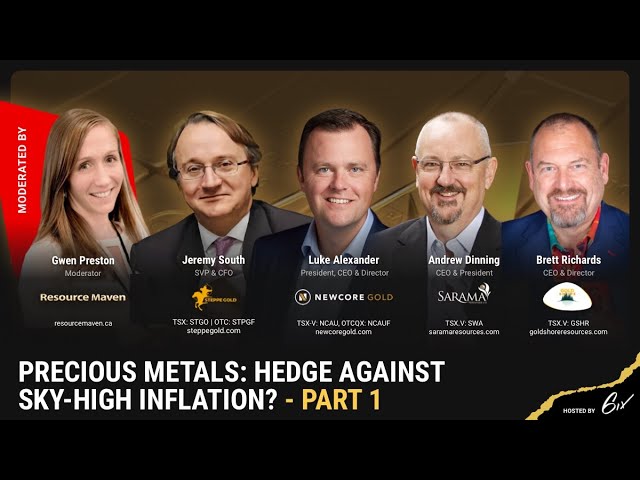
Automated transcript · Written by software from the replay's audio. It can mishear names and figures; the replay is the record.
25:13 We've embarked on a 100,000m drill program to date. When I look at the economics, the economics are stellar with a $600M post-tax NPV of the existing resource at $1,700 Gold. And that was updated by West Dome last year. And that is the base that we're building upon. So I'm quite excited to buy our project. We've got multiple mineralised zones in the land package. We've got known Copper Gold mine, a North Gold Stream mine up in the northeast, and we've got significant Copper Gold expressions in the Southwest and Hamelin as well. We have quite an extensive program in front of us to not only define the extent of the mineralization and expand upon it, but put all this together in a project over the next 12-months so that we can update that PEA this time next year and present it to the market in Q1 of 2023.
26:09 Our role is about 18-months of creating value in a low-grade 1g deposit. We have a low-grade bulk tonnage project here, but these types of projects are highly geared and highly leveraged to the Gold price. When we're talking about inflation, we're talking about the impact, Gold Shores project is going to really be geared to an inflationary environment and the gold price. Thank you, Webb. You're on mute. I think we'll let everyone do their presentations and then we can go back to questions for everyone at the end. So Andrew, could you please let us know a bit more about Cerama?
26:58 Oh you're muted, Ann. Okay, very good. So Cerama is a TSX listed company, although we're based in Australia. It's been a bit of a journey for us. I think Luke might've actually been involved in the company when we floated it, kind of way back when in GMP days. But we've got a large land position in Burkina Faso in the Hyundai belt. We've got a couple of thousand square kilometres of pretty prime real estate, so 100% owned. We're kind of proximal to Endeavor's mines, which were Taranga and Rockgold and also Centipho. Our main project is Sanitura.
27:43 It's got close to a 3 million ounce resource on that. We've just put a resource update out on that. The grades are good, there's a lot of oxides on that. About a third of the resources oxides, we've got a pretty solid starting position but we've also got a lot of exploration runway ahead of us. But probably the biggest value play here really is finishing putting this region together. So we've got Endeavour immediately to the west of us. They have their Bantu project there. So there's about 4 million ounces within a 5km radius. So I guess that's something for a future discussion with Endeavor. We've got a clear base case for development. And I think the other kind of thing that people need to pay attention to is we're listing on the ASX.
28:30 So A fair part of that is we're based in Perth. We think the ASX is an exchange. I guess I understand the jurisdictions where we operate. We're using Euroz Hartley's, who have backed a number of companies into that part of the world. So we've done a bit of a pivot. You know, we're an Australian company kind of moving home. Looking at the, I guess, the near term for us, post the ASX listing, we've got quite a lot of exploration lined up. The aim is to increase the oxide transition and free milling material for the project. We've identified over 30 exploration targets to hit. We think within those targets there's walk-up ounces that sit within pit shells now that don't have the drill density. So we should get 2 or 300,000 ounces out of that with some infill work.
29:23 And then the regional exploration, we kind of look to bring in kind of, you know, 5 to 700,000 ounces out of that. So most of that will be shallow near surface and fairly inexpensive and quick drilling. So as far as the drivers for investment goes, and I think to pick up on Brett's point and I'm sure what will be Luke's point is Gold price leverage. We've got a lot of bounces, the grades reasonable for West Africa. The land holding is quite strategic, a large resource base now, but we see a lot of upside on that as well. We think we're very levered to the gold price with what we've got now, but also with what we think we'll find down the track.
30:09 I guess in short, we've got a great landholding. We've already got a large resource base. There's a clear base case for development, which we think with further work we can materially improve and the ASX listing, we've asked an opportunity to recapitalise the company and get on with business. So we've had a slow couple of years for reasons pretty much outside our control. But, you know, the listing on the ASX gives us an opportunity for a reset and and get on with business. So, yes, with that, I'll hand over. Fantastic. And So many questions, but I'll let the conversation carry on to the next company before we get to those questions. Luke, Alexander, please take us through the quick version of Nucor Gold.
30:58 Yeah, thanks, Gwen. So Nucor, we're an advanced stage exploration project in Ghana. I spent my first 15 years on the investment banking sales side of the business, advising different ASX, TSX, London-listed companies with projects around the world. And one of the things I learned that what you really need is a great asset, a proven management team and good capital market support to push companies forward. And luckily, that's something we've got at Nucor. The management team, Here are a few of the companies that we've been involved in. We're also very well aligned with shareholders through our 27% interest in the business. So ultimately think of shareholders first. We've grown our institutional ownership from 0 to about 40% over the last year and a half. These are tier 1 institutional investors focused on the mining and precious metals space, as well as we've got very strong support from the capital markets. So currently 5 tier 1 investment banks out of Toronto covering us from a research perspective.
31:58 Our project is in Ghana. It's a tier 1 jurisdiction. Don't listen to me, but look at the companies who are currently operating in-country and have significant exposure. You've got 4 of the top 10 largest Gold producers in the country who are producing there. So I think that speaks for itself. There's 2 prolific Gold belts that run through Ghana, the Ashanti belt as well as the Sefwi Bibiani belt. We're on the Sefwi Bibiani belt and we've got great neighbours along trend from us with 5Moz endowment. Kinross 50km to the north of us, Bibiani to the north of that and one of Newmont's 2 producing mines in-country as well. Great neighbours. Our Enchi project, it's a very large project, 214km2 in size. We've identified 25 targets across the project, of which we've only drilled on 7 and 4 of them make up our current 1.4Moz resource.
32:52 A true district exploration opportunity from that perspective. The company is fundamentally underpinned by a PEA that we put out in June. Currently at a $1650 Gold price, you're looking at an after-tax NPV of $212M, after-tax IRR of 42%, but where we're really going to create value for shareholders from here is through the 70,000m of additional drilling that is not included in that current PEA and resource. As Andrew and Brett both highlighted, leverage is something that I'm sure everyone on this call is looking for. If you look at our PEA at an 1850 Gold price, You're now looking at an after-tax NPV of $300M, after-tax IRR of 54%, so very good leverage to the Gold price. We are in the midst of a 90,000m drill program. It is the largest drill program ever on this project. As I mentioned, 20,000 meters was included in our 1.4 million ounce resource update. So lots of additional news flow to come over the next few months.
33:58 The other thing we're very excited about is the opportunity at depth. So all of our, All of our deposits remain open along strike, but for the first time ever, we're starting to drill deeper on our project. And what we see with these Greenstone hosted deposits along the Sefwi-Bibiani belt is where they really increase in size and grow and grade as you start to drill deeper. And that's something that we're excited about and it started to have some very good results from that perspective. We are very active on social media, the various platforms out there, whether it's Twitter, LinkedIn, YouTube channels. So I'd encourage people to go and look us up there or get in touch directly if you want to learn more about the company. Fantastic. Thanks so much, Luke. And Jeremy, I don't mean to keep leaving you last. I just have the names in an order in front of me. So once again, you're fourth, but let's talk about the only producer on the panel. Please give us an introduction to StepGold.
34:54 Great, thanks, Gwen. And I'll be quick so we can get to the interesting stuff. As I mentioned, we're operating in Mongolia, we're a gold producer. I've talked already about the marriage between Mongolia and gold. We've produced over 45,000 ounces of gold to date. We started production last year. We have about 45,000-50,000 ounces in gold sitting on our leach pad on a recovered basis. So call it 90 to $100 million at current gold prices in inventory sitting on our leach pad as we pause production here through the cold Mongolia winter. We have a strong team that's made money in Mongolia before with strong exits. We have a 2.5 million ounce resource and 1.6 million ounces in reserves.
35:48 We are in production and we do have exploration upside as well. This is our project, pretty much as it is today. Very, very active and you can see the construction there as we move into our expansion phase. Step Gold is essentially its primary project. The ATO Gold mine is a two-phase project. It's an oxide project, which we're 1 year into, and a fresh rock project, which is another 10.5-years. We have a 12.5-year project to go from January 1 of next year. We're in production with 100,000oz to go, of which 0.5 is sitting on our leach pad. The Fresh Rock project, as you can see from these numbers and the feasibility study, very profitable with very quick payback. And obviously the payback helped by our ongoing production, which helps fund our CapEx.
36:50 $232M Arthitex CapEx and a 68% Arthitex IRR. With near-term catalysts back into production in the spring, 60,000 ounces next year and 40,000 ounces in the following year as we build out the phase 2. We are increasing our crushing capacity which is bringing out sort of that optionality to accelerate. We can do 90,000 ounces in a single calendar year out of our ADR plant. We have over half of the project finance already secured, And we are looking to expand that to an international project finance syndicate in the course of 2022 with fresh rock production starting in the back end of 2023 and going on for a further 10 years.
37:47 Back to you, Gwen. Fantastic, thanks. So we have projects all around the world, which is going to lead me into my first question. So someone, the question was, diesel, steel, labour, drilling are all getting more expensive in an inflationary environment. So then the question is, are mining companies really a good inflation hedge? And that I think applies to, you know, the same, a similar question applies to developers and explorers, because those things also matter. And so I actually wanted to ask each of you to talk about cost push, what you've seen at your projects to date in the countries, in the jurisdictions where you work. And then maybe also looking back at the previous cycle, We certainly saw some crazy inflationary impacts in the last gold bull market. I mean, there was lots of supply chain issues for mining projects when the gold market was going crazy back in 2007.
38:43 So thoughts from then perhaps related to how majors are approaching cost push or contemplating, hopefully not making the same mistakes that they made last time. But yeah, so what have you seen at your projects to date? How do you think cost push is gonna impact your bottom line or your ability to operate? And maybe any thoughts that you have from cost push in the space previously. Brett. Yeah, thanks, Gwen. Yeah, we're certainly seeing it. We're certainly feeling it. And to your point about the majors making a mistake last time, They're making it again. But we're seeing a number of things. We're early stage exploration. We've got 5 rigs running. We've got a small crew on the ground. But what we do see as getting more expensive, certainly fuel, certainly steel, rods, et cetera, more expensive than they were a year ago, certainly more expensive than they were 5 years ago.
39:39 And the biggest one is labor. And not only is the cost of labor much more expensive than it was, and I'm talking about our jurisdiction in Ontario, the cost of labor kind of throughout Canada has gone up and I'm gonna say order of magnitude, 25% in the last 12 to 24 months, we're actually bringing people in from each end of the country in order to facilitate the needs of what we need in the centre in Ontario. So yeah, it's pretty high. And so we are feeling the effects of it. And we're also not only when does it cost more, I'll say the skill gap, certainly in drilling companies, is because there are so many people out there drilling.
40:27 Drill rigs are at a premium, but experienced and well-qualified drilling drillers is also an issue for us. So we've also had to bring them in from quite a ways away. And we've seen that throughout the year since we started drilling. I know we've only got about a 5 month history, but it really feels like this has been going on all year. Yeah, fair enough. Right. Those stories are everywhere. Yeah, I mean, I guess I might as well ask everyone, Andrew, how is this playing out for you and UDK? Yeah, Canfaso, it's kind of a funny jurisdiction. We are seeing cost price pressure for probably different reasons to what you're seeing them, you know, in Canada or developed countries.
41:16 But Burkina, I guess, has got its own set of challenges at the moment. The stage of where we're at, it's really, I guess, on the rig side of the supply and demand thing. So how much work they've got on is driving pricing more so than what's going on globally. But I think, you know, one thing we do know is that, you know, as far as capital and that goes for where we operate is pretty significant increases speaking to companies that are in the construction phase now. Yeah, we obviously have pretty good contacts with companies in Burkina, but also Ivory Coast and elsewhere. So, you know, seeing substantial capital cost inflation. And the other one is sourcing skilled people. So obviously in West Africa, there's, you know, a couple of big Australian companies that operate there from a mining contracting point of view, but also from a construction point of view. So I know they're having quite significant problems getting the skills required to work there. I'm actually involved with a few things with the CEO of Perenti and Lycopodium, another, you know, probably the 2 preeminent construction and contracting companies there. So they are suffering problems but it's kind of in Western Australia that I think there's something like 40,000 job vacancies in mining.
42:42 There's a massive skills mismatch in Western Australia. It's a mining dominated economy and the workforce comes from all over the country, they fly in and out. So since COVID, the border with the East has been shut. So the labour that was coming in from the East Coast has stopped. That then has a knock-on effect to companies operating in West Africa that are sourcing labour from here as well. So there's very limited capacity, guys are doing long swings. So there's just a kind of knock-on effect all through the supply chain. But I guess the flip side of that is if you look at the 2 lowest cost producers on the ASX, 2 lowest cost gold producers on the ASX, Perseus Mining who operate in Kaurna and Ivory Coast and West African Resources who operate in Burkina Faso. So that probably says something in itself about operating in Africa and what we do there.
43:44 Fair enough. Luke, same continent, What are you seeing? Jeremy, do you want to go so you're not last again? Thanks Luke, you're a gentleman. I think the bigger issue for us is supply chain. Supply chain issues where we operate in Mongolia, we're right next to China, so we enjoy the benefit of having the world's factory right next to us. But we have to deal with borders. That's a bigger issue for us. I mean, there's no question costs have gone up, But we've managed to, I think there's greater competition for services, there's greater availability for services in Mongolia. And also technology, technology is offset. We're able to offset some of the price increases. It's through working smarter.
44:32 Fair enough. Okay. Thanks, Luke. Yeah, so I think for us in Ghana, one of the advantages we've got is it's obviously Africa's largest gold producer, 5 million ounces a year. And it really, given its political security and safety overall, acts as a hub for most of West Africa. So one of the things that we've seen is we've actually been able to attract talent from Ghanaians from other parts of Africa who are working and wanting to get back to Ghana to be within 4 or 5 hour drive of their home. So we haven't seen a big kind of cost inflation from a labor perspective. And I think that's because we do have a very large labor pool to draw upon in Ghana given all of the companies who are operating there, as well as being able to attract people back to Ghana who want to be near their families and that's been a real advantage.
45:31 The other thing from a mining services perspective, there's lots of companies who are used on it as their hub for all of West Africa. So for them to be able to send a rig 4 hours from their main workshop, as opposed to shipping it off in a container to somewhere else in Africa is a real advantage. So from a drilling and assay perspective as well, we've got 2 labs that are within a four-hour drive of us. We haven't seen real cost pressure So far from that perspective. Fair enough. Okay. We'll move on to another question, but Brad, I'm actually going to come back to you because you made a quip about majors repeating mistakes. I don't necessarily want to focus on what they're doing that's wrong. What do you think should be done to try and manage cost push inflation, inflationary pressures in this market?
46:25 Yeah, I think what we're seeing is certain companies, you know, throw money at problems in order to kind of, you know, diffuse them and mitigate them. I don't think that's always the answer. And, you know, I think in our case, we're after people that, that want to have the I'll say the the technical and the professional experience of building a Tier 1 project. And that's important to some people. And I think technically oriented people are going to see that as more compelling than an extra $250 on their paycheck at the end of the month. And that's just simply the reality. So we're trying to promote the quality of our project as an attractive point, rather than we pay the most, you know, and we do the most, we have the most shiny buttons into our compensation and remuneration package. So come work for us. So I think that that's what we're trying to promote. And my VP of exploration, Pete Flindell, who you and I have worked together over the last 18 years on about 10 projects in Africa.
47:30 He's a really big developer of people and he sees this as an opportunity to bring some very young junior geologists up to senior geologists and senior geologists up to the point where they can you know put their name on a much larger discovery. So We just see this as a professional opportunity and that's the way we're approaching it. Doesn't make it any easier, but it's just how we're approaching it. Fair enough. That all makes a lot of sense, especially from the context that Brett and his team have been very focused on team building because they're still a newer company And so it's been a real emphasis at Goldshore in the last little while. Luke, there was a question about the Ireland Central Bank. I don't know if you have more thoughts on that, but the question was about why would Ireland be buying gold?
48:16 It's part of the eurozone. Can its buying actually have an influence on the euro? I mean, I can speak to it as well, but I didn't know if you had had follow on with that. Yeah, I mean, I don't think it'll have a trickle on effect into the rest of Europe. I mean, Ireland Central Bank will act independently of the other European central banks. But I think it's just a positive indication in terms of the fact that they are out there buying, Singapore is out there buying, and we haven't seen this in a number of years. Yeah, I agree for sure. And it's not about trying specifically to influence currencies because they're too small to do that. But it's about that safety side of the issue, right? It's about the backstop in case of what might come, especially in this new sort of strange monetary world that we're in. I think that backstop is becoming increasingly important and COVID certainly fed into that kind of argument.
49:15 Okay, I'll just do 1 or 2, a few more questions. We've been on the line for almost an hour, so I don't want to take up too much time. Let's talk a bit about if this is a gold market going forward. I mean, you all have, I'd say, projects of scale and substance. I mean, you're certainly not in the early exploration end of things. So let's talk about the mergers and acquisitions side of the story here. Again, harkening back to the last cycle, along with being faced with incredible inflationary cost pressures. Gold majors also spent a lot of money buying assets at very, very high prices. This is a bit of an aside from the inflation argument or the inflation discussion, but I'd love to hear each of you, because you have very different projects in different jurisdictions and at different stages, talk a bit about what you're hearing in the M&A world.
50:09 If you have CA's signed, obviously I'm not asking you to talk about who you're talking to, but these are discussions that are on the table all the time, the ebb and flow of interest, what majors are looking for, projects of scale, if this gold market is as substantial and long-lived as we all are sort of expecting that it is. I would just love to hear some insight from those sort of M&A type discussions from each of you. Jeremy, I'm going to be the nice person this time and ask you to go first. Yeah, thanks, Gwen. It's good. I mean, we're a little bit different. We're in Mongolia, So, you know, you either like Mongolia and risk or you don't. And it's somewhat similar to the other guys on the line. But, you know, I think, you know, if you're comfortable with the Mongolian Central Asian story, I think then that's the first sort of hurdle to get over. But there's no question for me, it's more about a capital allocation issue.
51:10 I think we're all being pushed, institutional shareholders all want companies to be larger. There aren't a lot of synergies in mining companies in the same way that you are with much in traditional industrial companies. But I think that, you know, just more in terms of capital allocation, I think, you know, we're focused on organic growth and I think most people on the call would say that as well. But I think certainly the buy side wants to see companies bigger. They want to see companies more diversified. And I think we certainly think about M&A, but in the context of Mongolia, we don't really have a lot of competition in the country. So we're really more focused on ourselves and building our resources and growing the business.
52:01 Gotcha. Andrew, what's going on with, on your side? Well, I think if you look in Burkina Faso, there's been a considerable amount of M&A in the last couple of years. You've seen, I guess, firstly, Semaphore taking over companies and then Semaphore was in turn taken over. You saw Taranga do the same, then they were taken over again. So we're seeing considerable consolidation. So I think you're seeing companies that once they kind of get to that critical size, the opportunities for them open up quite markedly. And I think kind of to pick up on Jeremy's point, about I guess investors or institutions wanting to see, I guess more consolidation and growth in companies, probably the next company you see is Perseus, you know, they're 500,000 ounce a year producers.
52:53 So, you know, most likely way for them to grow their output is through acquisition. You're seeing, you know, Endeavor, I guess, have a pause at the moment, but they've been obviously quite acquisitive. And then you have the outside players in the market, you know, like Shandong or whoever bought Cardinal. This is not your normal M&A market anymore. So, you know, in the past it's been your big companies that you might look to, you know, Barrick and Newmont or whoever, you know, now people are looking east and north and central Asia. So it's kind of an interesting M&A dynamic. I think one thing you do need though is a strong balance sheet and when you are a junior like us balance sheets are always a problem and it very much inhibits your opportunities.
53:45 So once you get over that initial hurdle, then you can start making those steps. But I don't think there's too many juniors that are a success story in sub 10 years. It's normally a journey. So we do see ongoing consolidation just for companies to get that critical mass. Gotcha. Luke, thoughts? Yeah, so I mean, from an M&A perspective, again, I guess I'll just refer to Ghana. I mean, Andrew just highlighted Cardinal Resources. I mean, that was a full-on bidding war between Nord Gold and Shandong, which again, I think highlights the desire for mid-cap and major gold companies to get into Ghana. We also have recently seen Bibiani was sold to Asante and they're fast-tracking that back into production.
54:38 And then we've got Chin Feng who just bought Golden Star, all cash bid. And again, that's in Ghana and then less on the M&A side, but on the investment side, we've got Newmont putting another 750M to 850M into their AHAFO deposit to add another 300,000oz there. So I think Ghana in terms of any jurisdiction globally has seen a huge amount of M&A over the last 12 months, as well as seeing significant investment by majors. So I think, again, it speaks to it being a tier 1 jurisdiction. And that's something that I would expect to continue to see in Ghana is lots of activity given what a stable jurisdiction it is and what a long history of gold production it has.
55:28 Brett? Thanks, Ben. Yeah, you know, and I can appreciate both Andrew and Luke's situation after kind of being in Africa for so long and trying to be transactional there. I think they're right. It is a journey. It takes time. It takes a long time to create and add value. And it's not for the faint hearted because it has other issues. Fortunately, we're in Ontario and Canada, US, tier 1 jurisdictions, I think the market expects that there's gonna be consolidation. And certainly a project like ours where it's going to have significant CapEx, probably when we're done with our program and update our PEA, we'll be well north of 1 billion dollars in CapEx.
56:14 That is not a project that the market is going to allow me to go finance and then go build, although I would love to. It's just not reasonable. There will be consolidation, but there will be other consolidation amongst juniors. We're starting to see a bit of it, but I think next year, 2022 is going to be the year where we're going to see good companies be put together to take advantage of the cost pressures and the cost push we're seeing. So I think we're going to be in an environment where it will be transactional. And I'm very honest with people when I say, you know, our job is to create as much value in a shorter period of time as possible, because there will come a time when somebody will want a tier 1 asset in Ontario and we'll look to be ready for that.
57:08 Balance sheets, obviously, pretty important to defend, but sometimes there comes a point in time when creating a lot of value and then giving your shareholders a liquidity event or an off ramp to realize that value is also equally important. As shareholders, they'll say the same thing. So yeah, I can see that as a possibility. For sure. One last question and anybody, if they have thoughts or insight, put your hand up to answer. The question is, it's nice to see central banks stepping up to procure gold. I have always been puzzled by Canada. Is our role only to supply gold to other countries. Is there any advice being given to our central bank by the mining community or is it just politics? So would anybody have any, I mean, yeah, I was just sort of curious, those of you who are connected to the mining community and that perhaps in that way, Anybody know of any communication in that area?
58:05 Not familiar with any, Gwen. I think this is a question for the Mark Bristow's of the world. The big guys would certainly panel in something like that, where they would have maybe small influence in in central banks. It's not even about influence. You know, there's a bit of a there's a bit of a dichotomy between kind of what mining companies produce and the end consumer. At the end of the day, we don't really have too much of a say in who buys our product. So I think these are really fundamental monetary policy decisions that it's not just mining companies that need to opine on it. It's an all major industry. Gwen, I just highlight the World Gold Council.
58:53 If you look at the companies involved in the World Gold Council and who ultimately funds that, I'm pretty sure Bristow is actually on the board of that. Randy Smallwood, he's the chairman. I mean, you've got most of the major gold companies and royalty companies globally who are all supportive of the World Gold Council. And I believe that they've actually approached the Canadian government and other governments globally in terms of, you know, the value of having gold as part of their, you know, their balance sheets. So that's a group who I know is actively lobbying and provide a lot of interesting research that people on this call might be interested in as well. For sure. I certainly know that looking back in the history of the Canadian Central Bank's gold reserve, it's been a poor investor, specifically on holding physical gold.
59:44 Like it's literally done almost exactly in terms of holdings going down when the price of gold is going up. The track record as a gold investor from the central bank has not been strong, but you know, that's the past and maybe there will be pressures that change it going forward. With that, it has been an hour and I think we've covered a lot of ground and I think I certainly appreciate the time that the audience has put in to listening and we don't want to take too much of your time. So thank you so much for tuning in. Hopefully there was an interesting conversation here. If you want to find get a hold of any of the people on this call, they're all easy to find either through 6 who hosted the event or through their own websites. Absolutely reach out. I'm sure they would all be keen to answer any more questions that you have about inflation and gold or about their projects.
1:00:31 So Brett, Luke, Jeremy and Andrew, thank you so much for joining us here today and again thanks to the audience. I'm Gwen Preston, I write the Resource Maven newsletters and hopefully we will see you again here sometime soon. Bye everyone. Thanks, everyone.