Transcript
Automated transcript · Written by software from the replay's audio. It can mishear names and figures; the replay is the record.
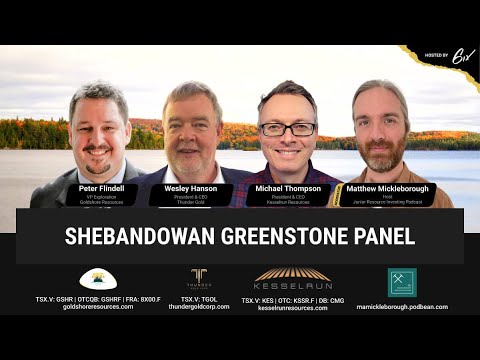
0:07 Good morning, everybody. My name is Matthew Micheloboreau. I host the Junior Resource Investing Podcast. I'm excited to have a few companies in here with me today. We're going to be discussing the Chabandawan Greenstone Belt. The Chabandawan Greenstone Belt, or SGB, stretches roughly from the mining-centric city of Thunder Bay on the northern shores of Lake Superior, several hundred kilometers to the west-southwest. Precious and base metals exploration and production has been conducted for well over a century in the region as old mines exploited the low-hanging fruit of high-grade gold systems found within the SGB. This is unsurprising as greenstone belts around the world are legendary for their gold systems. 1 such example is the famously prolific Abitibi Greenstone Belt that straddles the Quebec-Ontario border and has produced over 200 million ounces of gold from 124 mines in its history.
0:57 In contrast, however, the Chebandawan Greenstone Belt, despite its ideal jurisdiction, located as it is near excellent supply centers for material and workforce and highways and power lines running through it, remains relatively underexplored. Today though, there are a number of junior companies in the region looking to explore above and below ground to gain mastery of this greenstone belt and finally, fully understand the economic potential of these rocks. Joining us today are executives from 3 of these companies who will lead a conversation around the potential of the SGB and then discuss their respective companies' past and future efforts to unlock the potential of the region. Joining us is Peter Flindell, the VP of Exploration from Goldshore Resources, Wes Hanson, President and CEO of Thunder Gold, formerly White Metal Resources, and Michael Thompson, President and CEO of Kessel Run Resources. All 3 of these companies operate within just a few kilometers of each other within the SGB.
1:47 Peter, Wes, and Michael, welcome to you all and thank you for your time for being here. Thank you. Thank you. Thanks, Matt. Good morning. Yeah, good morning to everybody. So as I said, I will be giving you an opportunity to discuss your individual companies in due course, but I just thought it was relevant to start the conversation more with the discussion around the SGB itself and maybe try to provide insights into the geology of the region for potential future investors. Why don't we start with Peter, could you just maybe explain to us just maybe in brief layman's terms the origins and mineralogy of a greenstone belt and why they are so prolific for gold and base metal discoveries?
2:25 Yeah, well, it's something that stumps a lot of people. There are a lot of academic discussions over this particular subject. But I guess if you break it down into simple terms, you need to think of the Archean as the point in Earth's history when it was still being bombarded by meteorites and was hot and was gradually cooling down. And the force that come into play that we see today with plate tectonics and subduction zones and volcanoes and things were starting to come into play. So the earth was hot. There was a lot of mixing of upper mantle and there wasn't really much of a crust or the crust was was forming and we were starting to get island arcs and and all the good things that we see today.
3:15 So that was the environment that we're in. The upper mantle is very metal rich. You know, if you look at a lot of the biggest deposits in the world, they all have a tectonic setting that has an input from the upper mantle. Even the big porphyries in the world, sit on major structures that tap the upper mantle. So the Archean belts, they had that in spades, really. And then I think the other thing is, the other comment to make in terms of it being prolific is that's a relative term. So you're comparing the sort of deposits that form in Archaean belts or cratons to epithermals, for example, or even porphyry coppers that have a lot greater vertical restriction in terms of their mineralised zones.
4:09 Whereas the deposits, particularly the gold deposits in Cayenne Belts, really don't have a bottom as such, they can be kilometers deep.
4:20 If you look at the South African deposits like Wiswater Srand and other ones like that, they're down kilometers. So the deposits that form and the way they form are naturally bigger anyway Hence, hence, you know, Abitibi or the the biggest most prolific Archaean gold belt in the world Mm-hmm So as a follow-up question and then this might be maybe I'll ask Peter I'll shoulder tap you for this one. So, you know, different rocks, different mineralogical complexities involved. Are there challenges in terms of recovery methods or, you know, high capex, low capex?
5:00 What are the Greenstone belts like to actually extract ore from? Well, I mean, I can only really talk from a gold perspective here. The belts are also known for Nickel, Copper, PGMs, particularly Chabanoine is a big PGM belt. But from everything that we've seen on metallurgical recovery of the gold deposits, what we're really talking about is the difference between 85 to 95 percent recovery, which There are deposits around the world that would love to have that problem because they do have true metallurgical difficulties. Here, the difficulties are, we're talking about the final 5%, really. So not really any difficulties.
5:47 No, perfect.
5:49 So what about, and Michael, I'll have you jump in here. Are there any unique properties in terms of just above and below ground exploration, prior to drilling, is there any complexities that would create challenges from that regard, or is it pretty straightforward? I mean, it's pretty straightforward if you've operated in Northern Ontario, it's, there's swamps, there's lakes everywhere. There's overburden, Usually it's not too deep for the most part, a few meters generally. But on the bugs, that's... And in the winter, it's extremely cold. Those are the challenges, but everything's challenging, right? So in general, it's not, it's pretty straightforward, easy exploration.
6:41 Okay. And so if I'm not incorrect, all 3 of you, yeah, You are, I mean, I know that Kessel Run and Gold Shore share a border, that's Thunder Gold, you're just a bit to the northeast, just by a kilometer or 2. I think you actually share a border with Gold Shore as well, if I'm not incorrect. No, no, we're quite a distance away from Gold Shore and from Kessel Run's properties. We're about 60 kilometers more or less closer to Thunder Bay and much closer to the Trans-Canada Highway. Matt, you're probably referring to a property that Thunder Gold has that we're farming into. So we actually include that in our land package at the moment because we're doing the exploration there. Thank you for clarifying. So Wes, Maybe as an apology for getting that wrong, why don't you take a quick, just briefly discuss with us, you know, where you're located and what you're after then.
7:38 Well, our primary asset is Tower Mountain. It's less than A0A cup of Tim Hoff Horton's coffee away from Thunder Bay, about 50 kilometers outside of Thunder Bay. It's easy to get to. It's about 3 kilometers off the highway. We think it's an intrusion, potentially an intrusion-related gold deposit, somewhat different than typical greenstone deposits, which are more in the orogenic class.
8:03 We're seeing indicators both in terms of metallurgy and mineralogy that we're just in the midst of completing that suggests perhaps a magmatic origin for this particular deposit, which would be not unique for the Greenstone belts, but certainly not as sort of not the typical sheer zone hosted quartz vein, you know, Red Lake, Timmins type deposits. This is a much lower grade, more widely dispersed, large tonnage, low grade opportunity that allows for cheap and efficient exploration and the ability to throw ounces in the bank very quickly, so we're quite excited about it. Geologically, it's relatively simple.
8:46 Our concept currently is it's like a donut. So there's a central core intrusion and surrounding that central core intrusion for a distance of about 500 meters is the prospective ground. We feel that geophysics is a primary exploration tool for us at any rate. We're having great success or demonstrated great success by compiling the geophysical data from the historical surveys and comparing it to the historical diamond drill results and surface sampling results and seeing some very strong trends there that suggest that IP is a very valid exploration tool. And we've just financed a small drill program that we're going to go out and test that theory and show to the marketplace, develop some proof of concept of our ideas and theories going forward.
9:33 Thank you for that. And so all 3 of you, if I can just maybe summarize this briefly, is that you talk about the correlation between surface sampling and geo-phys and et cetera, et cetera. All 3 of you gents would be, those are strong, you can say that those are strong correlations that you can build an exploration thesis around?
9:52 Absolutely. Yeah, absolutely. Yeah. That's the job, right? I mean, you've got to take as many clues. This is a hard business. This is a challenging business at the best of times, so you've got to use as many sources of information as possible to try to unravel the mystery of the rock. As a geologist, that's all the fun. To be frank, this is the most fun I've had as a geologist since I stopped being a real geologist working in the field, going back and crawling through this data set and trying to understand it and squeeze out the mysteries. It's like a murder mystery but with a reward at the end. Excellent, love the analogy.
10:36 Michael, I'll ask you this. Let's just transition. So, you know, we have an understanding where the, you know, geologically it's predictable that this is something that can be extracted in an economic fashion, lower CapEx, nothing too expensive for anybody here. So let's just, you know, kind of go, let's step above ground maybe, and then look at this region as a jurisdiction, right? And so infrastructurally, and Wes, you referenced this, but yeah, Michael, I'll have you maybe lead us off here. Can you just explain why there's so many advantages for the Chebandawan. Why are there so many advantages to being here jurisdictionally? Well, I mean, as Wes said, it's close to Thunder Bay. I mean, we can drive to Wes's property in a few minutes, essentially, to Gold Shores and Kessel Run's project. It's an hour and a half tops.
11:24 You got the Trans-Canada Highway running basically right at the top of the Greenstone belt.
11:32 Major transmission line that's currently about to be upgraded, a multi-billion dollar upgrade which is great for increasing the infrastructure and not for eventual mining. And you've got a rail line. A rail line, yeah, exactly. It runs pretty much parallel to the highway. So it's a mining town, Thunder Bay's a mining town. Good support, good people. University. University, yeah. College.
12:08 Excellent. Lots of benefits. I mean, you know, all of these things help us as explorers reduce our average discovery cost and eventually if we're fortunate enough to become developers, we're going to be on the lower decile in terms of our development costs for these projects as well. So, we're not dependent on
12:31 taxpayer largesse to move our projects forward. Also, I would add from a build perspective, and that's probably the biggest challenge for the bigger deposits like ours is, they can be capital intensive if you scale it at the large size. Obviously, our goal is to break that up into a couple of phases and have a cheaper CapEx at the beginning. But regardless, you've got to build mills and you're going to move trucks in and diggers, excavators. And having the port right at Thunder Bay just makes that so much easier and cheaper to mobilize and build. Good point. Yeah, well stated. It seems a lot like real estate. Location, location, location matters, right? And your proximity to these things are so critically important to the economics of it, right?
13:25 Yeah. So why don't we, and I know that, Michael, you had touched on this earlier with your description of the, wonderful description of the bugs that are to be enjoyed there. But maybe Peter, I'll ask you to step in here just because you're kind of, you know, Goldshore is kind of straddling that development exploration line. Could you discuss the ecological complexities, you know, in terms of where you are and what does the terrain look like and what challenges does it present in terms of actually taking this forward? Yeah, I wouldn't say complexities. You know, Canada has a very strict
13:57 sort of legal requirement for permitting of the projects. There's a very good reason for that. There are a lot of uses of the land, a lot of users of the land, and everybody needs to be respected and everybody's needs need to be met. There are species at risk, some more so than others. There are fisheries aspects, there are traditional hunting rights, there are potential archeological sites. So all of these things need to be reviewed and addressed. Certainly when it gets to the permitting stage, and it really comes down to how much does a company want to lead that. So we made a decision when we first started that we wanted to lead that because we knew that we had 3 to 4 million ounces here as a minimum and we see there being a lot more.
14:54 So we wanted to get our ducks in a row and we started our environmental baseline early. We conducted our stage 1 studies of the main potential red light or red flag issues, of which there are none. And building a positive, collaborative relationship with Indigenous communities is a big part of what we do, as well as the local community. So it's, I wouldn't say there's any complexities. I mean, there are a lot of issues at play, but It's largely being open, transparent, and being communicative. Well said. I think that's a decent segue, and maybe Wes, I'll bounce this over to you, but I'm interested potentially in all of your conversations here. Do you just want to explain, I mean, yeah, discussing First Nations, Métis, Wes, do you want to expand on just your efforts in terms of shoring up community support around your project and what, you know, consultation, etc.? Can you maybe just touch on that briefly?
16:00 Well, sure. I mean, you know, it's always not an obligation, but it's a desire of mine at any rate to engage First Nations communities and Métis communities as well into the process and make sure that they're actively engaged and advised as to what it is we propose to do and do it because what we're doing in the field, even though we may feel kind of remote and off in our own world, that often impacts areas of First Nations hunting and fishing and trapping rights and so on and so forth. So we want to make sure that they're aware of what it is we're doing and how we plan on advancing the process and what we plan to do and when we plan to do it so that we can coordinate our efforts and make sure that we don't adversely impact what their plans are and what they're planning to do. So, you know, I think engagement and consultation is an absolute necessity going forward and I'd like to, you know, I'd like to set up Thundergold and I'm sure that Peter and Mike will feel the same way, but we want to set the new standard in terms of engagement and ensuring that the First Nations are participatory in mineral development going forward, and mineral exploration going forward. That's one of the goals I'd like to work towards
17:24 with the First Nations peoples in the area. Nope, well said. I think that, yeah, it's just a reality of 21st century exploration. Michael, did you want to jump in there? Is something you want to add or is that did Wes kind of cover it? Yeah, I mean it's just communicating, you know, being open and communicative with what you're doing and what your plans are going forward and being honest. That's all it's about. There you go. Usually it's a good idea, Honesty. Yeah. Yeah. Yeah. That's what my grandmother always told me anyway. So I have a question from the audience that I think might be relevant to the 3 of you. I might ask Peter to start this off, but this is a conversation for, oh, it just disappeared. I mean, a conversation for all of you potentially, but just in terms of building camps, is this something where, are people commuting from Thunder Bay to your projects or are you building a camp or what does that look like?
18:19 Well, from an exploration perspective, I think we all have camps out on site or near the project.
18:26 Perhaps Nikita was really talking about when this gets to be a mine or at the development stage. I know the way we're looking at this at the moment is that we would have people in Thunder Bay and be commuting. I think it's a great business opportunity for the people of Thunder Bay. The spin-offs from these kind of businesses are huge. So that's what we will be looking at. We're actually in the fortunate position of being a little closer to Thunder Bay. So most of our people drive back and forth from Thunder Bay every day. I mean, I can vouch for the fact that Peters has established a beautiful camp in an absolutely beautiful location, and I suspect that Michael is the same, although I have the privilege of visiting Michael's property yet, but we'll take care of that before the bugs come out.
19:17 Preferably. So this would be a question where, I'll cycle back to Michael here, but this would be 1 that I welcome all 3 of you to chew on and discuss. But why is this an overlooked jurisdiction then, right? Why is it that Chubandawan has not seen as much historical exploration as other regions? And maybe why is that changing now? Yeah, it's a tough one. I think a big part of it was that it was chopped up into such small pieces. You know, The proximity to Thunder Bay is a blessing in a lot of ways in the exploration development cost and that. But the detriment is that previously there's a lot of small prospector players, a lot of juniors, you know, Kessler Run's project, the previous vendor, the person or the group that I bought it off, they put the package together from 14 different groups.
20:14 So it was 14 small little packages that they amalgamated back in the 90s. You know, I know Goldshore's project was was, you know, the history of it. It's it's, you know, been put together over many, many years. So I think that's the main problem with it, that that's, you know, hindered, you know, a concerted exploration effort on it. Absolutely correct. We have a prospect right in the middle of our land called the Boundary Prospect, which just shows you that it was all broken up.
20:53 It was a quilt, patchwork. Yeah, and we all face the same challenge, But I also think that a lot of the early exploration in the district was focused on a different type of target than perhaps what the 3 of us are looking for. And, you know, more of the classic Red Lake type, high grade, Goldvane type systems that, you know, offer spectacular results, but, you know, are difficult to stitch together in any continuity in order to make a tonnage of sufficient size that you can go ahead with mine development. So I think our focus certainly with UnderGold is developing this large tonnage low-grade opportunity
21:35 and taking advantage of what nature actually put in the ground. And that's what our focus is going forward is trying to evaluate that large tonnage low-grade opportunity. I think that's a point well made, right, that consolidation from desperate, disparate, prospecting tiny packages into larger, economic, 21st century style exploration that requires that the economy is a scaler of size, right? So I think that's a point well made. We're gonna take 0.5 step back here. Another good question, just for clarification here, Paul from the audience is asking, can we just, he's asking about permitting, and obviously Ontario, I think that, you know, Peter, you referenced this, that, you know, it's a, Canada has very stringent, but usually fairly predictable permitting processes, But he's just wondering, just are there permitting issues in that area that are different from the rest of Canada? Or what, maybe just maybe a general walkthrough on what that process looks like.
22:28 Well, there's all sorts of permits.
22:31 From a project development perspective, so to take it from an exploration project to a mine is the biggest permitting prospect or biggest challenge. So you have, depending on the scale of the operation, it can be a provincial permit or a federal permit. The limit's 5,000 tonne a day operation.
22:54 People obviously look to see if they can scale it at a level that requires provincial approval only but at the end of the day, the processes are very similar. It's really about, as I said earlier, ensuring that the users and the uses of the land are all being protected, all the rights are protected, that every possible option has been looked at to ensure proper use of the land and the resource and that there are no negative outcomes of the project. No, excellent. And from an exploration perspective, Wes or Michael?
23:40 I mean, the permit- Michael, can you lead it off? Yeah, the exploration permits are fairly straightforward. It's part of your engagement and communication with the First Nations as well as the government of Ontario. You apply for a permit, you say what you're gonna do and that's about it. It's pretty straightforward, pretty easy actually.
24:00 I can vouch, I'm sure that you're all stuck in this, but there's certain advantages to working in Canada, and there's certain advantages to working in Ontario, and a lot of those advantages are deal with land title and permits, and just less drama. It's just more, it's an established system that's been in place for almost, well, centuries, as a matter of fact. So, that's one thing I don't really, that doesn't keep me up at night, let's put it that way, the permitting and licensing and security of title.
24:38 Lots of jurisdictions do for sure. Yeah, no, absolutely an advantage of Canada is, yeah, complexity and challenging, but predictable, right? That you're not going to get bushwhacked by the government at some point, or at least less likely, shall we say, right? Let's transition now to just like, I'll give you an opportunity here to do a like a project by project, company by company rundown of your work. So if for people who aren't familiar and haven't maybe picked up on it right but Thundergold and Kessel Run are exploration phase and and Goldshore, like I said, you're starting to straddle into development where they have a more defined resource. So it's going to be 2 different conversations, I guess. But why don't we, yeah, why don't let's start with the explorers. Wes, do you want to just run us through what ThunderGold has been up to? And I guess maybe focus on, you know, if this area has been explored for over a century, what are you doing right now that makes it different and makes it important, I guess, in terms of what your thesis is developing in a different fashion because of what you're doing?
25:41 I think what we're doing sort of feeds into an earlier point that was made about the you have a number of small landowners that had different mining claims of different sizes that are all running individual exploration projects that are independent of 1 another. And there's no coalescence of that particular dataset. So, you know, when, when Thundergold acquired these properties in 2020, essentially, that was the first step was to bring that data in together. And there's a wealth of knowledge there, but there's some work involved in bringing it all into a common format and then, you know, evaluating that data and interpreting that data and trying to squeeze out the pertinent aspects of that data set to allow you to make more informed decisions from an exploration perspective.
26:28 So, you know, a couple of the points that came to light with us is one of the first things I initiated when I joined was started metallurgical testing to see, you know, to establish the fact that there were no issues in terms of metallurgical recovery going forward. That sort of helped, helps us set the goal posts in terms of what size deposit we're looking for in terms of a potential mineral resource, looking at the geology and leveling all the geology to a common, for lack of a better word, nomenclature so that you can interpolate from hole to hole and section to section and try to build a picture of the deposit in 3 dimensions. The empirical data, make sure that it's all accurate and correct and meets the standards for future 43-101 technical report writing, and then start laying out clues, like what clues, what are the best clues we got? Is it a visual clue?
27:26 Is it a chemical clue? Is it a geophysical clue? What clues are pointing you in the direction of where the dominant mineralization is located within the three-dimensional space. And at Tower we've been fortunate that I think the geophysics is a very good tool for us. It perfectly defines airborne mag, perfectly defines the intrusion, which we believe is controlling the mineralization. The mineralization sort of sits around that intrusion, surrounds it in a halo-like environment, so you've got 500 meters of perspective ground that surrounds this intrusion. And we've only looked at maybe 20% of that in terms of the historical work that's been done. And that historical work has indicated long, broad intervals of low-grade mineralization, like hundreds of meters of 0.5, 0.6 grams per ton on average, with several tens of meters upwards of a gram plus, that is a viable exploration target. Because you're looking at the 2 major mines in Canada today, the 2 largest gold producers in Canada today are both large tonnage, low-grade open pit mines, in the Arctic and Detour Lake.
28:39 All of the development projects in the region, Spring Pole, Greenstone, And even stretching out into BC, you've got the Blackwater project in British Columbia. All of those projects are under a gram in terms of their average grade, and they've got 15, 20, 25-year mine life, 5, 6, 7, 8 million ounces of resources and reserves. I mean, those are what I term low drama projects. And I've actually built those projects, and I've operated those projects, and that's exactly what they are. They become a vertical assembly line. And you're just making widgets, but your widgets just happen to be very desirable golden widgets. Well said. So maybe I'll follow up with you and give you an opportunity just to discuss, Wes. So 2022, what did that look like? What did you accomplish? And then maybe set us up, tee us up what 2023 will have for your company. Yeah, 2022, we basically went in and did about 25,000 meters of re-logging of the old historical core.
29:42 It was all stored on site. So that was a huge benefit. We're still going through the process of interpreting that and looking for additional clues. But currently what we focused on in the latter, the last quarter of 2022, was expanding our induced polarization, induced polarity survey, expanding that coverage, doubling it because we feel that's a very valid exploration tool. And we're looking at basically targeting chargeability in that dataset. So we've expanded it to the northeast and south of the intrusion that we believe is controlling the gold. That's currently being interpolated by Abitibi Geophysics in Quebec, and we're expecting to have additional targets to drill coming from them in the next coming weeks.
30:28 We start our drill program next week on Monday, so it's quite an exciting time for us. We're getting everything ready. We've got about 8 drill sites already located, targeting a high chargeable response that was not previously drilled by the historical drilling, so that's a great situation. This target is 600,700 meters in length and a couple of hundred meters across and it's virgin territory. And it's the highest chargeable response that we have in the existing dataset. And the information to date sort of suggests opportunities for enhanced grade within that high chargeable response. And that's because all of the drill holes that have been drilled historically, sort of are on the peripheral edge of that chargeable response.
31:15 And it's a premium exploration target that we're looking forward to releasing results as good, if not better, as to the historical results that we've been releasing for the last couple of years. Excellent. And this is a follow-up from the audience here, which I'll ask all 3 of you as we go through your turns here. But just one quick follow up here for you Wes, is Eric's asking any NSRs or other royalties attached to your property? There are NSRs. I mean, you can't acquire land now from landholders without giving an NSR. But, you know, they're more or less industry standard type NSR deals 2% with a buyback option for a certain amount of cash. So yeah, not pretty bog standard yet. Good. And so then we'll switch over to Michael. Do you want to run us through just what your company has been up to? Well, And again, kind of framing it around this idea that Chabannes and Lord Runder utilized, what are you doing differently than previous developers or previous explorers to prove Kessel Run has prospective land or has something down there worth exploring?
32:16 Yeah, I mean, so We've got an old historic mine. There's a historic resource on the project. The mine produced about 30,000oz back in the 1930s. When we acquired the project in 2016, the bulk of the data was still paper. So that was a good indication of, as Wes said, nobody had really taken the big, looking at the big picture and really synthesized the data. So we spent the first couple of years, you know, getting boots on the ground and really trying to figure out what was going on and, you know, ground-truthing and digitizing all the data, build a proper 3D model of the underground workings and that, you know, really taking a scientific approach. We were one of the 1st UAV mag surveys done in the province back in 2017.
33:12 A little test 1 from a university student at Queen's. So yeah, so we kicked off the drilling in 2020, did a little 3000m program, hit some very good results. 20,000m in 2021 and 13,000m last year. So right now we're you know spending we just got the data from a geophysical survey, MAG and NUTEM, same survey that Pete did on his property to very good success. So we saw his success on that and decided to mimic it. So we're building our model and digesting the results and looking at the geophysics and getting ready for 23, where we've had great success in expanding all the zones we've been drilling you know these zones that when we got got the property were you know 100 meters by 100 meters tops so we've expanded you know the Fisher zone to 600 meters down to 250 meters. We've got the McKellar zones.
34:25 We're quite excited about it. It's out to 1,200 meters now. We've still got kilometers of strike length that's relatively unexplored, I think there's 1 drill hole and that's it for kilometers. There's still a lot of virgin ground out there, a lot of work to do, But yeah, we've had great success the last couple of years in expanding all these zones and showing its potential. Excellent. And then Peter, hand it off to you. Same question, where have you been and where are you going? Well, yeah, so the Gold Trail probably, or Moss Lake, really is what it's called. It was originally explored in the 80s and the 90s by Narranda, and then was broken up and explored by a number of smaller companies and individuals.
35:19 Back in about 2015, I think it was, West Dome pulled all of the land together and gradually consolidated the land package and built—did a review of the Moss Lake resource. It's a large, low-grade project. 80 million tonnes at 1.1 was the original resource back in the day. Based on a sort of a reasonable but not detailed understanding of the geology and a lot of selective sampling, no complete sampling of any drill holes. And so they concluded that, well, they're high-grade underground miners. This is not their jam.
36:13 So We pulled it together with our board, Gail McNamara and a few other people pulled this together and brought Brett Richards in to build a company and to take this to the next step. And I was asked to look at this in December 2020 and saw high grades in the data sets. There's definitely a high grade distribution here. We worked out that if we could possibly understand what's controlling the high grades, then we had the potential to model this differently and to give us a way to look at ore scheduling as a simple way of bringing grade forward in the mine process. That would just improve the economics, very simply.
37:05 So we got on the ground, we completed the deal in May of 2021. We got on the ground, we started our environmental baseline survey. We started drilling in August. Before we started drilling, one of the things we did was this VTEM mag survey that Mike alluded to. I've always been a fan of understanding the context, the geological context and framework for a deposit. So that was our first step. I'd worked with these guys before, and it really provided the only systematic data package that we had across the whole project. So that enabled us to understand where the intrusions are, where the structures are, which different parts of the sequence are we in.
37:59 We're fortunate in that we control what we call a central belt, which is a higher part of the Archean sequence and it's all intensely folded and sheared and everything in our ground is sheared. Whereas in other parts of the belt, a lot of the gold mineralisation is related to extensional structures and is a little bit different. So yeah, so we did that and then we started drilling. We've drilled about 75,000 metres on the project. There are large parts of the project that remain only briefly explored and we've been trying to expand on that as well. There are a lot of prospects in our land package that haven't been touched and haven't been drilled, or maybe historically have had a couple of drill holes into it.
38:52 That's continuing in the background. But for us, our priority has been advance this project to the point where we can put an economic valuation to it. We put out our mineral resource estimate in November last year. It's 4.2Moz at 1.1Moz is the headline number. But within that, we were able to model these high-grade shears that comprise 2.2 million ounces at 2g. So we now can do engineering studies to look at ore scheduling to bring grade forward in the mine plan. And that was based on roughly half of the drill results, a little less than half of the drill results we had received to date.
39:45 So we've now stopped drilling. We are focusing on the studies. We're doing more detailed metallurgical test work at the moment, including looking at the potential for heap leach, potential flotation, gravity recoverable gold. We know we have free gold in the system and seeing how we can improve the leach kinetics. And all of our data should be coming in sort of end of this quarter. And we'll do a mineral resource update with all of the data and have a lot more indicated in the model and should be a slightly bigger model. Just for context, the volume that we're looking at here is, It covers a strike length of 3.5 kilometres and it's about 500,600 metres wide, but that's within a belt that has been drilled that's 8 kilometres long, with gold hits all the way along those 8 kilometres. So There's a lot of upside along strike and there's a lot of upside through parallel structures and we'll continue to develop those once we get this project to the point where we understand the value and we understand what does our phase 1 operation look like.
41:01 What's our capex, what's our throughput going to be, Where does that leave us with respect to everything else? Then also we'll come into this MRE, we have a project 13 kilometres away called East Cold Stream that had a historic resource of about 800,000 ounces at 0.8. That will come in to the MRE. Then we have the North Cold Stream copper mine. It was mined in the 50s and the 60s. We've done a little bit of drilling on that project to understand what it looks like, in part because it has significant cobalt numbers with it, and in part because we have several targets within our VTEM dataset that look very, very similar, And we want to understand how to drill those going forward.
41:50 We have a lot on our plate. There's a lot that we could do. Ultimately, we believe there's 10 to 15Moz on this property, But we need to get the project to the point where it's got an NPV on it and people understand that this is a major Gold project and it's going to be a big mine. Thank you. So just for clarity's sake, I'm going from memory here, so please correct me if my memory serves to be faulty. West Dover PEA released in 2013? It was actually Moss Lake Gold that did a PEA in 2013. And that was based on the 2011 mineral resource estimate. Now that estimate, the guys had no ability to really model the different grades within the deposit.
42:42 It was really modelled as 1 lump of 1.1 grams per tonne. So the PEA basically just 1.1 through the mill from day 1 to the end of the 10-year mine life. And they produce their MPV and it's pretty vanilla. But if we can put, even if the whole life of mine average is 1.1, if you can start with the first few years by putting 2 or 3 grams through, that seriously changes the economics. And then just one more clarifying thought, just for the sake of clarity. Can the market expect 2023 to have a PEA released from Gultron? Yes. Sometime in Q2, we'll have an MRE update and then in Q3, it'll be a PEA update. And then we'll evaluate where we go.
43:33 And ultimately, we want to bring this into PFS. We do have to do a lot more infill drilling to bring everything up to indicated to support that. But we need to define what that project looks like first. Thank you. Wes and Michael, I'll transition back to you guys here. Just a question from the audience here again that I might try to transition into more of a general conversation. But it's also a challenge because I know that when you're at your stage, it's difficult to start to wrap your head around, you know, when you transition to development, but just asking, this was for Wes, but I'll pose it to both of you for both of you guys. I mean, how many more seasons of drilling do you anticipate? You know what, I guess the question they're asking is, which I think is probably almost impossibility to answer with any precision is when do you foresee your product becoming a mine?
44:22 But I think that maybe if we're trying to find like the core question is, you know, how many more seasons of drilling or how much more drilling is required for you to gain a proper understanding of your projects? And Wes, we'll start with you and we'll switch to Michael. Well, that's actually relatively easy to answer in some respects. I mean, large tonnage, low grade deposits, there's a lot of, There's a lot of comparables out there in Ontario. Let's look at the 2 that are closest to us right now, which are Greenstone and Springpole. Both of them have over 180,000m of diamond drilling. We're sitting at about 30,000m currently. We've got to do 150,000m of additional drilling just to get to the stage that they are at. The logical way that I always look at this, the way that I learn with majors and with engineering firms is look at five-year plans.
45:15 We are looking at a five-year plan, probably ending up in year 5 with a proven and probable resource of some size, hopefully on the North of 5 million ounces with about 5 million ounces of measured and indicated resources and at least a pre-feasibility level, if not a feasibility level. That's a tall order. And really, without being overly, without oversimplifying the case, We need money to do that. We need investors who are behind the story, who believe in the story, who believe in this abandonment camp, who see the opportunity and want to share in that upside with us. You're looking at probably an exploration and investment just in diamond drilling and technical studies alone, up north at $50M.
46:04 So that's my job, is go out and find $50M, drill 150,000m of drilling and demonstrate a resource of around the 10Moz mark. And that's our goal and we're taking the first step in that starting next week. Perfect. Michael? Yeah, I mean, we're actually fairly similar. We've drilled just shy of 36,000 meters since 2020. So using the 150 to 200,000 meter ballpark, yeah, we've got a ways to go. We're barely scratching the surface, you know, getting started. And then this is one more here And then I'll bring it back around for you. You guys have an opportunity here for final thoughts, just to close us off here. But classic question, do any of you actually anticipate building it yourself? Obviously, you'd have to bring in different personnel, different skill sets, right? But I mean, Is that something that you are interested in, or is this you're going to be hoping that you can just prove up a nice little resource and sell to the highest bidder and kind of move on down the dusty trail?
47:11 Well, I guess that from our perspective, We believe there's a bigger, there's a detour sized project here. That's a project that Goldshore is not looking to build right now. But within that, there is a smaller, higher grade project that Goldshore can build. If we can get something that's in the capex of sort of 300 million range, that's a project we can build. We've done it. Brett and I built a project in Malaysia, Indonesia, in Burkina Faso. With those numbers, we were quite comfortable doing that. And my feeling is, you need to be working towards building a project, whether you get bought out and sell it at the end of the day.
47:59 We're here to make mines. It's like Wes said earlier, there's 2 kinds of rocks, those that make money and those that don't. From my perspective, I've built 7 mines and operated dozens more. It's hard. It's difficult. It takes a lot of time and the right team and a lot of money and a lot of dedication. I think you've got to go towards that path. I think that's your obligation in order to maximize value for shareholders is to try to demonstrate to the market what it is you have. And you have to go through the various engineering studies and some work to demonstrate that potential. So I get to a major, you know, when you get an offer from a major, if you're fortunate enough to get one, that you're getting a fair offer and your shareholders rights are protected.
48:53 That's our job. Yeah. You got to move the project forward and create shareholder value. And you, You do the studies that are necessary. You bring on the people that can execute. I'm an exploration geologist. As we start moving the project forward, we'll bring on other management that has expertise in different areas. Not well said, yeah, whether you do or don't, you have to act as if you are, Yeah, no, point well made. So like I said, we'll finish off here. I'll just give each of you an opportunity, just anything that maybe you wanna touch on that wasn't touched on or anything you want to let us know here. And so Michael Weston, and we'll end with Peter. So Michael, what are your final thoughts here for us?
49:38 Well, I think it's a belt that is going to garner a lot of attention in a rising gold sector. It's under-explored. It's got tremendous potential. I think all of us are starting to show that potential. Goldshore is moving the ball forward quite well. Kessel Run, I'm a firm believer that that project's got good legs, and from what I've seen with Wes's project as well. Yeah, I think there's a lot to like about the Shibandu and Greenstone Belt, not the least of which is the geology and the opportunity that offers. I mean, look, I'm approaching the end of this wonderful adventure of a career and, you know, it's really nice to be able to get on a plane and get to the project site in 2 hours, door to door. I mean, you can't really beat that. Michael's even closer. So he's in an even better position, but you know, infrastructure's in place, a modern city within, you know, an hour of the project sites, highway access, rail access, power access, all of that basically means you're in the lower quartile in terms of your discovery cost per ounce. And you're going to be in the lower quartile in terms of your development cost per ounce. And you're going to be in the lower quartile in terms of your production cost per ounce, which means more profit, which means more value, which means everybody goes
51:08 home happy at the end of the day. Yeah, well said, I can't really add much more to that except to say I love the project so much, I love the potential so much, I've moved my family to Thunder Bay and become a Canadian taxpayer. I'm sorry to hear that. No, Excellent. All 3 of you guys, thank you very much. Peter from Goldshore, Wes from Thunder Gold and Michael from Kessel Run. 3 strong companies just based on my own kind of due diligence and all 3 of you guys, projects that are definitely worthy of people's time and consideration. As for me, yeah, one last pitch here. My name is Matt Michelbrou. And yeah, please check me out, Junior Resource Investing. Guys, thank you very much for your time.