Transcript
Automated transcript · Written by software from the replay's audio. It can mishear names and figures; the replay is the record.
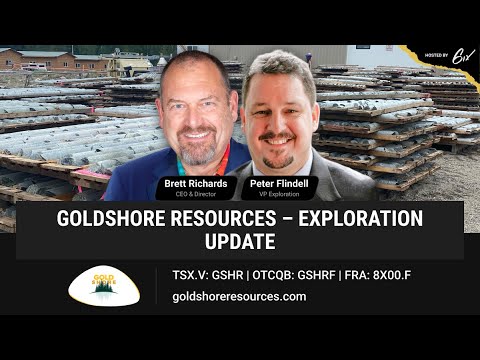
0:08 Hello everyone and welcome to Goldshore's live summit today hosted by 6. We're joined today by Brett Richards, Goldshore's CEO and Director, and Peter Flindell, the VP of Exploration of Goldshore Resources. Brett and Peter are going to walk us through a company presentation and after we will be accepting questions live. So just as a reminder, you can submit your questions at any time using the Q&A panel on the right hand side of the screen and we'll get to them after the presentation is over and as always the summit is recorded and available to watch afterwards on six.com but without any further ado I'll just pull up the slides here and pass it over to Brett. Yeah thanks Dasha and thanks to everyone for taking the time this morning or the afternoon where wherever you are. And I have to apologize. I always get a lot of text about my colorful shirts.
0:56 And today, you got the absence of color. So I apologize.
1:01 I'll live up to the standard next time. Today's discussion is really going to be around where we are and where we're going. And for those who really don't know the story, I can quickly walk you through who we are and what we do. I want to make clear that everyone should refer to our website for the forward-looking statement disclaimers and other statements that we make on disclaimers. For those of you who are not aware, you know, we acquired the Moss Lake project from West Dome over 18 months ago. And at the time we put together a team of people both at the corporate board level and on the ground. And we started working on our program of identifying what we had bought, analyzing what we had bought, and then putting a program together to further advance the development of it. The Moss Lake project is in Ontario, and as far as mining jurisdictions go, this is kind of one of the best in the world.
2:08 And what we acquired was 1.47 million ounces of indicated historical resource and 2.5 million ounces of inferred historical resource. So that was really everyone thinks that's our starting point. And I think everyone needs to be clear that that's a guide, a historical resource. You know, you don't build on a historic resource. You have to validate it and you have to verify it. But it is as good a guidance as you're ever going to get. So Pete and our team put together a pretty comprehensive exploration program. And that exploration program started with, first of all, the analysis of the data and digitizing the existing data.
2:54 And then we flew a VTEM survey, a MAG survey over our entire property to give us the context, the geological context of the Moss Lake project, as well as East Cold Stream, which is part of the aggregated 4 million ounce historic resource. They have 500,000 ounces at East Cold Stream. And as well, the VTEM survey is designed to also give us context of some big conductors like North Cold Stream. But it's a guide, and the guide leads us to the work we're going to do. In support of all this, we raised $25 million initially at the transaction time, and subsequent to that, we raised another $25 million to be put in the ground.
3:44 So $50 million has been raised over the past 18 months. I'm going to jump a lot of these slides because I think if anybody really wants to know some of the history and some of the detail it's all on our website but things do start with teams and Pete and I are here today to talk to you and you know you can look at our experience and you look at what we've done over the years and the wins that we've had and the wins of our board and the companies they're running today and our advisory board. So I'll leave people to go to our website to do that. Where is the project? The project is about 120 kilometers west of Thunder Bay. And When I do assessments on projects, yes, I look at people first and foremost, but second to that, it's certainly about the deposit.
4:39 And when you start to look at the deposit and whether that deposit's gonna turn into a project and whether that project's gonna turn into a mine, I always look at infrastructure. And Moss Lake has probably the best infrastructure possible for any potential mine. We are on the Trans Canada Highway. We're 130 kilometers away from Thunder Bay which has an international airport, an international port, it has international rail that is almost on our site, And one of the most important things is we have the luxury of having Ontario Hydro, 10 cent kilowatt hour power going by our doorstep. And in comparison to mines that have to generate power through either diesel or hybrids you know diesel power today is around 70 cents US a kilowatt hour and hybrids around 50 to 60 So it's 5 or 6 times the power cost of what we have available here. I don't think you'll ever be able to find a spot with better infrastructure.
5:41 So it's akin to being able to build a big district-scale mining camp. And I think that is what we see kind of the vision and the long-term vision of this company. We see this company turning into a large camp. Real quickly on the cap structure, We've got a 27% shareholder in West Elm, who we acquired the project from. Board and management own 11% of this company. And the balance is split between institutional investors and retail investors. Today, I think we're trading at about 30 cents. You know, it's been up quite a bit since October 31st when I did this slide, and I apologize, it's not up to date. Which is about a $43 million market cap, and nothing else has changed. And as of October 31st, we had 5 million in cash, and burning about 750,000 a month.
6:34 Just some shots of the site where Pete has built up a core shack and a camp for our team. And another thing we take very seriously is ESG. Our commitment to the environment has been strong from day 1. Our commitment to our host community First Nations has been strong from day 1, maybe even day minus 1. I think we were in contact with them before we actually listed. And we have signed exploration agreements with our host community First Nations. And and we use an affiliated consultant to our indigenous community, who's been conducting our environmental baseline study for, I think, about 18 months now. So we're very collaborative, very inclusive with our with our communities and Pete and his team have a very good relations with them.
7:25 So back a year ago Pete engaged with Geotech to fly a VTEM survey, MAG survey over the entire property. And I must say, and I'll just make a footnote, we acquired, we signed an earning agreement with White Metals to acquire a bolted-on piece of property as well, and just most recently, we flew a 550-kilometer VTEM survey over it as well. And what the original VTEM survey gave us was a number of targets which we focused on. And you know some were conductors and you know with copper And there's a lot of banded iron formations on this property as well. But there's a lot of gold signatures very similar to Moss Lake as well. That's what we were following. And that's what we're using the data. We're using the drill hole data. We're using the VTEM survey as a guide to try and help us, you know, with the prioritizing our drill program, our 100,000 meter drill program.
8:25 But there is mineralization all the way from this area in Moss Lake all the way up to East Cold Stream and and we do have we do have historic scout holes that are mineralized but never pulled into the resource due to the distance and spacing of them. In around April-May we started to get assays back with in certain areas with some significant high-grade intercepts. And I think where kind of Pete started to make the pivot here with his team and his focus was, you know, these high-grade areas, these high-grade lenses started to really hang together. We took a greater focus on them, rather than at the time stepping out or infilling the massive 3 1⁄2 million ounce historical resource at Moss Lake, we started to really focus on this high grade. And you can see these high grade envelopes illustrated here on the slide.
9:29 And they do hang together quite nicely. So you've got this high grade resource that is sitting in this sea of low grade resource that is, you know, under a gram but above cutoff of 0.3.
9:46 So looking at the section, you know, this is also quite open at depth. A 350-meter pit shelf that we've used for this resource, the mineralization goes quite far beyond that. And I'll let Pete speak to some of that downhole and the potential that we have at depth.
10:12 East Cold Stream has kind of a similar setting. It's certainly, today, it's not as big, but it has this high-grade mineralization sitting in this halo of low-grade material. One thing we're not going to talk about today is North Cold Stream because we haven't really done anything more than drill a few holes and put a press release out. And, you know, this all comes down to priority for us. This is a really exciting hole. It's a really exciting deposit. You know, we have 62.8 meters at 0.88% copper equivalent, and it carries some very good cobalt grades. And our thinking was that this is most likely like a VMS-style deposit, and the cobalt's a bit of an anomaly.
11:00 We probably have to do some more work as to kind of why there's a cobalt readings here. So this was a historic mine that was run many years ago for a period of time, run by Miranda and picked up by Xtrata. And you can see the historic mine there. But there's a lot of work to do here. And again, we have to prioritize capital. We only have so much money. We can only raise so much money in this very difficult macro environment. And I think everybody has felt the pain in 2022 from the macro environment, whether it's the geopolitical situation that's going on in Russia and Ukraine, and then the heightened increase of inflation to the point of hyperinflation, where everything has really gone pear-shaped.
11:47 And although, you know, although, you know, everyone's heard my view of kind of the monetary systems around the world and my view that the U.S. Monetary system is quite broken, they're going to, you know, run a deficit this year of about $4 trillion and they have a $32.5 trillion debt load to service going forward. And the intention is to run an even larger deficit in 2023 and 2024. We'll see when we get up to the primaries in the presidential election. But I think it's encouraging because, you know, we think the, you know, our view is that the geopolitical situation will temper over the next 6 months. And leading into the primaries and leading into a presidential election, the Democrats are certainly not going to allow for a recession to happen in the US irrespective of where inflation is.
12:35 And that means one thing to me, that means they're going to have to print more money. Quantitative easing is around the corner. We're not sure how far the street is before we get to the corner, but it is around the corner and they are going to have to be, they're going to have to print money in order to, you know, stem the recession and create some economic stimulation prior to a presidential election. So all of these macro factors are starting to turn the corner in favor of 2 things. First of all, a good gold price, because gold has been held back. We've seen the floor around $1,600.
13:09 And then I think gold has been held back because of the strength of the US dollar. And it's not really the strength of the US dollar, it's the macro factor on the euro and the pound and the franc that you know, the US dollar is the cleanest shirt in the dirty laundry hamper. And that's the metaphor that I use because they're all broken and all the shirts are dirty just that the US is a little cleaner than others. So I really think we're setting up for a very good gold environment. And I really, I think we are going to see, we are going to see the second thing, and that's gold equities start to perform. And we haven't seen it yet. But I think at 1620 we thought we may have seen the bottom of gold.
13:55 And and we've rebounded since then. Although gold equities had a good day last week. I think it's it's it's not, you know, 1 data point doesn't make a trend and I think we need to watch this play out for the next 6 months. So we are cautious. We are going to be very cautious with how we move forward, But we have a very, very exciting story here. And we put out a press release yesterday on our updated mineral resource estimate. And we announced an open pit constrained inferred mineral resource estimate of 121 million tons at 1.1 grams per ton and 4.1 million ounces of contained gold at the Moss Lake deposit. And this is just at Moss Lake, it doesn't include East Cold Stream, it doesn't include anywhere else just the Moss Lake deposit.
14:47 But the story within the story is this. It contains a higher grade shear domain of 34.7 million tons at 2 grams and 2.2 million ounces of contained gold. And when I look at that grade, and I look at mining that grade, focusing that grade, that project, that as a project, that is extremely attractive. And it's extremely attractive within the realm of our peer group, who, let's face it, those in production, producing whether it's the Cotes, the Rainy Rivers, the detours, they're running 0.72, 0.75, 0.8, 0.9 grams per ton. They're low-grade bulk tonnage style deposits.
15:33 And I think we may have the opportunity to capture a higher grade project in a very, very small contained area and put a much smaller CapEx project together down the road that focuses on this high grade. Now, what does that look like down the road? I don't know yet because we're not done yet. And everyone thinks that you put this out and you're done. I'll tell you why we're not done. Although we've used the historic resource and we've used the data for it, there was a lot of work to clean that data up. But out of our 100,000 meter drill program, and we've drilled about 75,000 meters, plus or minus, you know, the last few days of production.
16:22 But you know, we've only used, we've only used 48 holes from our 75,000 meter program to date, and we still have 52 holes that are not included in this estimate because the assays have not been received to date, or they were received after the cutoff point of establishing this mineral resource estimate. So in essence, what we're saying, and maybe what we should have titled was this is an interim mineral resource estimate. We're not done. We're far from done. And we still have half of the drilling that we've done in the last 18 months. We still have half of the drill results to be put into another mineral resource estimate. But we felt it was important to provide our shareholders with information on where we were. You know, the lack of information is always is always bad news in my view. It's why we're out here doing summits every month.
17:21 It's why we're putting press releases out every 2 or 3 weeks. We want to communicate with our shareholders. And I think we've done a good job of that. The problem is the market has not been our friend. It hasn't been anybody's friend. And we're seeing gold equities traded 52, 52 week lows and some of them still there. So I have a lot of empathy and a lot of sympathy for our shareholders who have been with us all along and I thank you for being sticky and being along all this way. But the journey really now is just starting. You know, even though we kicked off in June of 2021, The journey is now just starting. And there is so much that we still have to do. And we're going to frame this a little more a little later on in this call. But the first pass at this increased Moss Lake with 35% more tons and 33% more contained gold. And that is, I think, a tremendous result of our team, tremendous result of Pete and his people who have, you know, they've worked diligently since we started in trying to understand this better. So we still have many targets along strike.
18:40 The current resource is still around 2.5 kilometers long, but we have 11 kilometers of strike that that we need to test over the next period of time. And cold stream as well. There's the distance between cold streaming. And Moss Lake is about 11 km. So we this is open along strike. It's open at depth. And there are a number of potential parallel shears that will be available to make this even wider because Pete has stepped out on some holes. We found mineralization, we've reported it in the market, And quite frankly, I think there is opportunity here in every direction. And although we know there is an underwritten resource here, we were not reporting any underground resource at this time, but the mineralization goes quite deeper than the 350-meter shells we use. So as I said, I'm excited. There's so much optionality right now for this company.
19:45 We have optionality at Moss Lake in every direction. And we're
19:56 going to see our focus on the next drill campaign expanded even bigger. But like I said before, there's only so much capital we have and only so much time. And in this marketplace, this is very difficult. It's very difficult to raise money, but, you know, so we have to prioritize our capital and we are prioritizing it at Moss Lake. We will be doing some scout drilling. Maybe later on, we will get up on top of the ice, hopefully this winter. If we can raise the appropriate amount of capital. But But I also think that we have an opportunity here, an optionality here to really expand the global resource over time. This is, you know, I said back in the spring, I think this is a tier 1 asset.
20:45 And we're starting to prove that. Not only that, this is potentially one of the highest grade open pit development projects in Canada. This is going to be quite significant. So our focus is on making it the highest grade open pit development project in Canada. So, you know, rather than processing 0.7 or 0.8 or 0.9, we're trying to put something together that's a little different and the strategy will align with that. So, you know, I'm going to turn it over to Pete right now. Again, I thank everybody for listening and we're going to try and get everyone's questions in in the hour today. But I am really excited about where we are and where we're going to. One of the things I haven't talked about and we originally thought that you know we were just going to drill this out to a global resource and pick a number you know whether it's 10 million ounces or greater whatever the number is we're just going to drill it out to as big as we could because we thought that would get value.
21:48 The market has changed. The market doesn't want another 10 million ounce 0.8, 0.7 gram deposit. They're not giving us value for it. But I think this high grade, potential phase 1 project, will the market will, will give us value for it because grade is a real driver in all of this. And I think that's where we separate ourselves and differentiate ourselves with our peers is going to be in grade. And if we can maintain this 2 plus grams a ton as we grow the resource, that is going to be a significant result. And so doing a PEA, and this is what this is a bit of a pivot from what we've told the market back in the summertime, because we didn't have all this information.
22:37 Doing a PEA in February, March of this year, I think is not the right use of capital. And I'll tell you why. You know, it'll cost about $70,000 or $80,000 to do, first and foremost. I think that money is better spent in the ground. Second of all, it's a snapshot in time. And we can take a PEA and say, hey, yeah, we've got
22:58 2.1 million ounces of 2 grams, and we're gonna try and wrap a project around this because we have this big sea of low-grade material to work with as well. So let's put a project on this and we can run the CapEx and build maybe a $250 million project and a good production profile and good cash flow. And that all sounds good and is nice. But the reality is we're just starting. And why spend that money on a snapshot in time that's not gonna be relevant going forward? Everyone can do the back of the envelope math on what that project would look like at 2 grams and 2 million ounces. Everybody can do the back of the napkin calculation on that. So I think what we're going to do is wait. We're going to wait until we get the rest of the data and the updated holes from the wintertime. And we can do a proper, a full mineral resource estimate, and then take a look at where we are from there.
23:56 And then reprioritize our drilling, reprioritize our strategy. Because if we have 50% of the data still to come in you know this this could grow significantly at Moss Lake and I think that is that is the the the whole rationale why we're not going to do a PEA and our new presentation we're going to be putting out tomorrow on our website will reflect that. And you'll see the current presentation reflects that we were going to do a PEA in the first quarter of this year. And I think we're changing our mind from that because I just don't think there's value in it. So I'm gonna flip it over to Pete and he can walk you through some of the more granular detail of
24:42 this press release we just put out. Okay, hi everybody. My part of the presentation is going to be a little bit technical. My background is with feasibility studies, and so we've very much taken a look at this project as to what it requires to get it into production. Just to start off with, this is the resource that we inherited, the Innovex BLO model from 2013. It was based on the data that everybody had to hand, which is based on a limited understanding of the geological controls. When we came in, what we saw was an opportunity to get our head around the geology, to understand where the high grade is, because we understand that the high grade is what makes a mine. We certainly saw more potential for higher grade zones in this than I think people perhaps recognised.
25:47 This estimate, this historic estimate, is still a good global number. The average grade was around 1.1 grams per tonne, and that's what we've found in our larger resource. So the mineral resource stacks up very well. What we've done is identify the grade distribution in a much better way. So, this is the footprint of our model in the same area. You can see, if I just go back and forwards a few times, you can see where we have expanded the footprint of the resource, particularly through the parallel structures, a little bit on strike, and certainly in the south-west where we've done a lot more drilling and we've been able to build this out a lot better.
26:40 The red zones in this model are our high-grade shears. You will have seen from the drill intercepts that Brett reported earlier, that we do have significant zones of high grade in here. And by building those out, it enables us to look at scheduling in a mine plan to bring all of those ounces forward. That's part of what the PEA will review. But as Brett says, we still have a fair way to go before we get to that PEA stage. And I'll just say at this point, the more options that you can evaluate in a PEA, the more effective it is in building the framework for a pre-feasibility study.
27:27 Right now, from a metallurgical standpoint, We've done bottle roll tests only. The recoveries are between 80 and 90% across the deposit. The lower grade zones typically have better recovery, but for this study, this optimisation, we have used 85%. We want to evaluate gravity recoverable gold in here. We want to evaluate flotation. We feel that we can do better with the cyanide leaching. And we also want to look at heap leaching of the low grade as an option. It's not something that's been done in Ontario, but, and it may be that it's just not possible, but we want to have a look at it.
28:15 Basically, because we see a system of where mining this deposit, we would prioritise the higher grades in the mine schedule and either stockpile the low grade or leach it. This is our statement. You would have all seen this in the press release yesterday. Just to put some flavour behind this, of all the money that we've spent on the project to date, This has basically cost us $5.75 an ounce in addition to the $13.20 that we acquired the project for. Most of the money that we've raised has gone into the ground, as it should. When we evaluated the project, we used fairly conservative costs.
29:07 CSA Global, who did the work, are a very professional outfit. They've got their finger on the pulse of where costs are these days. So our processing costs are, in US dollars, $2.50 a tonne for mining, $12.50 for processing, $2.50 for G&A. They're roughly double the costs of what other companies have used over the last few years for their constraining pit shells. But we feel that that's prudent in this inflationary environment. The other thing that I would add is there is potential for 0.8 to 1.4 million ounces of additional mineralisation that's sitting underneath the pit. It's just that at this stage in the project, our understanding and the amount of drilling that we've done beneath this pit shell is insufficient to be able to quantify that as a resource. But there's certainly that upside to this number.
30:15 Where does that put us in the grand scheme of things? So we've looked at all of the NI43-101 reports over the last 10 years for the other deposits in eastern Canada. We've subtracted out the underground resources and just looked at what they have in open pits so that we're comparing apples with apples. You can see that our total resource sits in here at 4 million ounces at 1.1. We have the potential, we feel, to grow the deposit in this direction, slightly higher grade and more tonnes. This number comes from a much broader search that we did, a search ellipsis that we used, so it's immediate potential for a mount drill program.
31:07 Importantly, the higher grade component, the shear zone hosted component of this deposit sits right up here as one of the highest grade resource subdivisions that we have in Canada. So this is what it looks like within our pit shell, with everything built around the high grades and the lower grade zones coming in. We certainly see potential for these pits here to join and for the south-west zone to be bigger. We also have drill intercepts out here in the south that we are yet to drill around and add into the deposit. Cross-section-wise, you can see that the high-grade shears, there are several within a parallel zone through here.
32:02 We've built the low grade as like an alteration halo around this. You can see that we have other zones out here in the south where we have not yet modelled high grade shears. We feel this is an area where we will add. Certainly it grows at depth, but as I've said many times, to be able to make a deep pit, you need to go wider. We certainly see the potential for that. This pit for this time around has grown from the previous whittle shell of about 450 metres wide to 650 metres wide. So we've certainly grown the tonnes in this deposit, as well as the grade. Within the district, we know that we have gold mineralisation and drill holes all the way along this trend to the north-east and to the south-west.
32:58 We have grade in holes sitting in here. So we see this whole structure in here as live. We certainly will be looking to step out and evaluate these zones in the coming sort of 6 to 9 months. We do have a parallel zone. This extends up towards East Coldstream and it extends down towards Hamelin. We have a number of geophysical anomalies just off the bottom of this slide that have moss affinities, and so we see this growing down in this area in the south as well. So a lot of upside. That's an 8 kilometre strike just within this zone.
33:45 The 11 kilometres that Brett referred to is adding a number of other structures onto this, particularly in the south. I think what we're finding is it's probably much bigger than that. We will know more when we get the results from our summer soil sampling program and will have had the chance to have built out and prioritised our exploration targets. My last slide here, just sort of putting our program together, We have commenced metallurgical studies. Osenco is taking the lead on that. Once we get that data in and we've had a chance to assimilate the historical data, which we are re-logging, re-surveying, re-sampling, We will build a new resource update and then move into a PEA in sort of end of Q1, Q2 next year.
34:43 At the end of the day, what we're really looking to do is to accelerate this into a PFS. And all the work that we're doing is supporting that, including our environmental studies. And that's really the technical story of Moss Lake. Back to Brad. Okay, Pete, yeah, thanks for that. You know, even walking through your slides, it continues to amaze me just the sheer potential that this project has. And we've always believed it. And early on, when we started to look at data and we conducted the VTEM server, and we started to kind of hang all those together, I kind of got laughed at by saying, I think this is a potential tier 1 asset.
35:32 But this is a higher grade starter project that probably sensitizes down to a 14, 13, $1,200 gold level and is still profitable. You'd make a construction decision at $1,200. But that's where the low grade kind of fails down. These low grade deposits don't sensitize down that far. They all look good at $1,800, $2,000, $2,200 gold. But what we're trying to do is come up with a project that we can do anytime. We can start now and we can work a schedule to get that into production as soon as possible. And you have this low-grade optionality that if the gold price ever does run, then you could make decisions to scale up and scale up significantly because they will be big earth moving exercises when we get around them. So, and then let's not forget what I said earlier. You know, this is in an area that's on the Trans-Canada Highway that has 10 cent kilowatt hour power around it. So building a big mining camp here is, I think it is inevitable.
36:39 And I don't take the view that gold's going to go to $4,000. I don't take the view that gold's gonna see $3,000 anytime soon, but I also don't take the view that gold's gonna go back to 12 or $1,300 either. So I have said in my mandates many times that I think gold's gonna trade between 1,800 and $2,200 for the foreseeable future, And I still believe that. I said we were gonna have pullbacks under $1,800 and blowouts over $2,200, but they won't be sustainable. And this is what I think we've just seen. We've just seen kind of a 10-month pullback based on the macro, and I think we're going to see a smaller, stable gold price going forward as the U.S.
37:24 Starts to pivot prior to the election. So that's really what we wanted to update everybody on today. I think it would be really good to take some questions and if we've missed anything to give people some deeper granularity. So I'll turn it back to Dasha. Great, thank you both so much. We have a couple questions here, but if you do have a question, now's your time to submit it. The first question we have here is from Eric. He says, love the NRES today and very pleased to be a shareholder. With the resource being open on strike in depth and having 35 kilometer trend, how big do you think you can grow this deposit? I got to calibrate that. We don't have a 35 kilometer trend that we know of yet, but from toe to toe of our land package, It might be close to that, but we don't have a 35.
38:21 If we include the Vanguard ground, it's 35 kilometers from Hamlet. I thought it was a little bit less than that, but anyway, but whether it's 30 or whether it's 35 I know one thing it's quite big and how big can you grow this? I don't think people put an answer to that and I certainly won't put an answer to it. But you can start to see the fabric of how this can grow. And it has to grow with stages. It has to grow with drilling. It takes time. You don't build a detour in 5 years. You don't build, you know, gold strike in 5 years. You don't build Nevada gold mines in 5 years. These are generational size mines that grow and flex and pull back.
39:07 And, and sometimes you, you have multiple, operating areas. You have multiple and possibly underground and open pit at the same time. These are mining camps And look at Timmins and look at Val d'Or and look at Red Lake, although all very different in their own right, and the Chabano on Greenstone Belt being more typical of what we're seeing. But I think we've just taken the blanket off a big camp. And we've got an extremely large land package here as well advanced on the understanding of development. So you know, we're not done yet, and we're far from done. So yes, we'll be able to continue to grow the resource.
39:53 And and it's a function of time and capital to be able to do that. And and market willing and and capital markets available. We will continue to pursue this as fast as possible. The sooner we get through this program, you know, the faster we can make other decisions. Great, thank you. Howard is asking, do the cost of the estimate of resources use Canadian dollars or US dollars? Sorry, yeah, they're Canadian. Yeah, that's by some not Canadian budget. Yeah. Great. Thank you for clearing that up. Greg is asking what percent of the $50 million is going into the ground versus administrative and other costs? Yeah, I would say, first of all, $12.5 million of the $50 million went to West Elm as part of the transaction.
40:51 I would say that our corporate costs are extremely small. You know, I work out of, I don't work out of an office, I work out of my house. We have a small back office in Vancouver that manage our accounting. And that's it. And we have other costs at the end of the day. If I broke down the $50 million, or let's call it $45 million, We may have put $36 million into the ground and we still have $5 million in the kitty. I would say we burn anywhere from probably $100,000 on average, $100,000 to $140,000 a month for corporate and G&A. That is strictly whether there's conferences, whether there's advertising, whether there's other media, the things we do.
41:41 If we're leading up to conference season like we are right now, and I'm at a conference right now, then I think we'll see obviously higher costs. But we strip all that out, like we did this summer, we were burning $50,000, $60,000 a month. So on average, it's very low. Put a number to it, probably 92% of the capital we raised went in the ground. All right, thank you. I don't see any more questions here. If you have any, now's your time to submit them. I see some nice comments in the chat, but no more questions. So if that's it for everyone, I just want to thank both Peter and Brett, obviously, for the presentation and for everyone who joined today. We will be sending out the recording, like I said. And if you do have any other questions, feel free to follow up directly with Gold Shore. And if not, you