Transcript
Automated transcript · Written by software from the replay's audio. It can mishear names and figures; the replay is the record.
0:04 Okay, as folks are filtering into the room, I will say good morning, good afternoon, or good evening, depending on where in the world you're logging in from. I know we have attendees from Alaska to Australia tonight, so the sun never sets on this webinar. Thanks so much for making time, whatever time of day it is for you. I've got with me today, John Skeet, CEO and Managing Director of Mithril Silvergold and James Barr, the company's VPX and resident rockstar. Today we're gonna be discussing the recent resource upgrade and exploration news the company put out this week. Before we get into the protein there's just a bit of housekeeping for me and then I promise I'll let these gentlemen take it away. So first this is an interactive event. There's a chat button at the bottom of the screen. We're trying to aim for about 45 minutes or a bit less for today's event so if you do have a question please throw it in. We'll try to get to it if we can today. If for whatever reason we can't get to your question, either it's off topic or most likely we just run out of time, I'll make sure the Mithril Silver Gold team still gets those questions afterwards and they'll be able to get back to you using either the email or phone number that you signed up with on registration.
1:01 Other thing I'll say is this event is being recorded. We'll be available for replay likely tomorrow, that's July 1st at about 1 or 2 p.m. Eastern time. You can expect it at the same link. It'll also be on Six's YouTube page. Format for today is I'm gonna let these 2 gentlemen run through a presentation outlining both the company for new investors, but also the more recent news. Then I've got a few questions for them based on that presentation, but then we'll get into those audience questions as quickly as we can. I think you've heard more than enough out of me. I'll hand it over to John and Jim to run us through a presentation. Thanks so much.
1:35 Thanks, Romeo. Thanks everyone for joining the webinar. Just gonna run through a slide deck, incorporating the recent news we've had regarding our Target 1 resource upgrade. So just to summarise what we're building here, it's a high margin business because it is a silver district, like the title slide says, but it's got high-grade gold and that's what, this was a standout for us when we first optioned this property as a private company back in 2017. It's a silver district like there's literally dozens and dozens of these all throughout the Sierra Madre all silver trend. But this particular one had a lot of historic mining activity from about the 1850s until a time of the Mexican Revolution, the beginning of the 1900s, and saw quite a bit of activity there.
2:22 We flew LIDAR over the district early 2024. That revealed there was actually a lot more historic activity there, about a dozen multi-level mines, but very high grades of Gold and Silver. It's a well-preserved epithermal system. Hasn't had a lot of erosion up on the, particularly up on the eastern side of the property, 70 square kilometres. And it is a big, it's evident that there is a big epithermal gold-silver system. So we've done most of our drilling at the first target area and we've continued to focus on that. We quickly came up with a high-grade resource there after about 14 months of drilling when we started in 2020. And then we looked to significantly upgrade that. We were a bit more optimistic that we were going to get quite a bit larger resource there by the time we did upgrade it, but it was a bit more complex geologically. We needed to focus on getting the geology right so that we could get, when we finally did put out a resource there, we did have confidence that it would then transition into a mineable resource, having good continuity as well as great analysis.
3:26 And we've successfully achieved that. We took the extra time. We put now, we had about 18,000 metres in the maiden resource there or initial resource. We've now drilled 60,000 metres there. Still with that amount of drilling, we're still are all in drilling and assaying and management costs there is still less than US$20 per metre, sorry, per ounce of gold equivalent there. So it's most of the values in the gold there. So indicated about 75% of it is in the indicated category in this upgraded resource. A good chunk of metal there, very valuable, high grade. And as we've sort of highlighted there, it's properly constrained in underground mining soaps and we've fully diluted it. We have got some opportunity there to improve the, on the mining methods there to optimise those to improve the grade a little bit. But that's a good starting point as we transition this into some economic study work. We've got 2 land positions there that are close together. We have Copperkin, our flagship property, 70 square kilometres, and we have another 20 square kilometre property adjacent to this called La Dora, which we optioned for very low cost in December last year. Similar geology there, a little bit higher in the system, but it does host a very high-grade past-producing mine over 4 levels.
4:52 So, we're going to continue to de-risk the Target 1 resource in Coppelkind. We've done some metallurgy on it. We'll be doing some more. We'll be looking at variability. But already on the composites there that we tested a couple of years ago, we got 96 per cent gold recovery, 91 per cent silver recovery, just using conventional flotation and sanitation, the same flow sheet that's used at a lot of these similar types of deposits in this region. We've done about half of our 25,000 metres that we planned to do throughout this year and another 12,000 metres left. A good chunk of that will go into some of these system-driving targets that we've been developing, utilising all the mapping and sampling we've done across the district, as well as the aerial magnetic survey and structural studies that we've done.
5:42 So a quick snapshot of the company, about 83% of the stock is held by the top 100 shareholders. Just under 40% is for global mining institutions and water management advisors, we've got about 15% between us. So we're dual listed on the ASX and TSXP since September 2024. We did the TSXP listing and we're also on the OTC in the US. So a quick summary of our ESG commitment there. We support, we've been operating now, first it was a private company and then we vended our private company into Mithral in 2020 and took control of that. We've been operating there for 8 years and we've put up excellent relations with all the local people. There's no ajidos there. There's none of these landowner cooperatives, but we do treat everyone's possessions that they have as if they're legal possession.
6:40 And we've got 40 local people, which is pretty much most of the working age adults in the district are working with us and they have been doing so since 2020. And a good sign that we've got everything in good standing in Mexico, particularly the way we employ people, our environmental permitting and so on, is that we get all our evaluated tax refunded by the government. That's very difficult for foreign exploration companies. 16% of all our expenditure, a lot of companies do end up writing that off, but we're up to date with that. So there's always a few months lag and the government will look at everything. They want to make sure there's no fraud, that everything is legitimate and you have to have everything perfect and we get all our value added tax back, which has amounted to several million dollars to date.
7:31 More board, We've got 4 member board, 2 Australians there, myself and Craig. Craig's in Melbourne. Myself, I'm actually based in Mexico and just an hour and a half Cessna flight from the project. David and Megan are in Vancouver and Ottawa, respectively, and with good capital markets, public company experience in Canada as vital for our dual listing. Simon Katz, also a very committed shareholder, is responsible for bringing on the likes of Jupiter and Schroeders onto our shareholder register. Colin Jones, our corporate technical advisor has been instrumental in helping us step back and do the groundwork that he can see is evident there in the geology, but doing the work there that helps us to progress this in the right way and to realise the full potential of what we can clearly see we have there in this exceptional property. Gary, I've worked with for well over 20 years. We built a gold heap leach in the Republic of Georgia. And together we did the bankable feasibility study for the Acampo project just to the north of this in the early 2000s. And then we were halfway through the construction of the processing plant and mining operation at Palmareco, which was a company called Bonisi Gold. We very quickly came up with 3 million ounces gold equivalent there and got the authority to mine that halfway through construction. And we had several larger companies wanting to acquire
9:03 for this particular project. Core Mining completed the takeover in 2007 for about $1.3 billion. And that has now became their flagship property and has grown to about 5 million ounces of gold and 300 million ounces of silver. And what's important about that is that when we saw Copperkin, we saw very similar geology and potential there, a geologic lookalike to that, and with the differences, the gold grades are about double what they were relative to the silver at Bamareko. Managing Wires, he there is James, he's on the call. The webinar today has joined us in the last couple of months from, again, similar experience as I had with Bamareko at the Las Chispas property with Silvercrest.
9:48 Again, that was acquired by Cora Mining at the beginning of last year. For a bit more money, it was $1.7 billion. And James took a year off and then has been looking to get his teeth into something at a similar potential there than what we experienced there with soil recreation in Las Chispas. So, made already a big impact on what we've been doing there and progressing this, including driving the upgrading of our target 1 resource. So, locality wise and where we are in the in the in the world we're in the northwest of Durango state, so that's a good mining state. You can see we've got a few number of good operators around us, including you know up there to the north is Pamareka with Core Mining.
10:33 Fresnillo has a couple of operations, San Julian just up the road from us on the highway and La Cienega. We also have Indeda Silver, Guanajuato Silver and of course, the big undeveloped, one of the biggest undeveloped silver deposits in the world at Cordero with Discovery Silver. And we're looking forward to seeing their progress, everything there. We're looking forward to seeing Discovery get their permit to start developing that in the coming months. You can see the 2 properties there very close together. We're about 20 kilometres south of the high tent, sorry, Highway 24, which runs from Chihuahua City down to Kulikan near the coast. And there's also a high tension power line running along that. And then there's some sub transmission line running down to the town of Eldorado Snow, which is about 3000 people, which is where the main town we service the property from. By road and by air, We have an airstrip in the middle of the property as well.
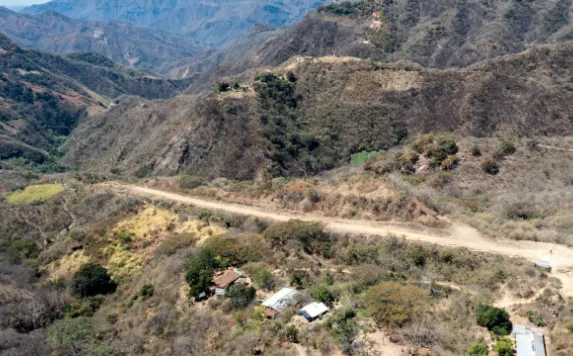
11:36 That's a view of the district there, 70 square kilometres, 10 kilometres east, 7 kilometres north-south. As I mentioned before, we flew LiDAR over the district. We thought there were about 50 or 60 historic mines and workings across the district. There ended up being more than double that. So a lot of surface workings there, but importantly, there's about 93 mine edits that we picked up from the LiDAR. One of them, Santa Cruz mine up here on the most easterly extent and also high elevations, about 1800 metres. We sampled in there some very high-grade sampling in the 3 levels of workings there. It's about 2 ounces gold, 2 kilograms of silver, across 0.7 metres channel sample. And that's what was left behind in the inner stoke that it was mined historically.
12:22 And then 9km across down the south-west corner, we're about 600m elevation, much lower in the system there, more base metals rich, much more silver rich, but still some persistent high grade, high gold values down there as well in the old workings. We've also, we've done drill testing down here, we're drilling down there now and we're looking to progress this to potentially a future resource area as we have here at Target 1, where we just released the upgraded resource. And we've also done a program at Druling here at Target 3. Very high level in the system, but some indications there, another resource developing, some high grades, a lot of noise there, but we need to get deeper in the system here and indeed also here across the valley at Target 2 where we made a high grade discovery back in April last year.
13:10 We want to tackle that from a lower elevation where it's a bit more continuous and we can progress that also over the coming years. This is just looking at Target 1 where we've done most of the drilling. So out of the 75,000 metres of drilling we've done to date since the middle of 2020, 60,000 of that has gone into target 1.
13:35 Those are some of the highlights there. The 2 that have been highlighted there, hole 77 ended up being the number 7 highest grade gold intercept reported in the world in 2021. And hole 159 down lower there was number 16 in the world in 2024. So 2 impressive world class gold intercepts there that we had on just on this one target area in the entire district. So we've got a lot of upside there in the district. This is 1 target
14:05 area. But you can see there the gold grades, the widths and the silver grades, you know, very high grade. And this is what sort of has made this such an attractive, you know, not just exploration but a future development proposition. As I mentioned before, high gold and silver recoveries, high confidence, a fully constrained, diluted resource there that we've produced from this and we'll continue to develop that both to expand it exploration-wise but also progress it to a future mining development at some stage in the future. This graphic on the right-hand side of the slide there just really just shows the progress there. So all those coloured areas, that's all the high grade mineralisation in the blocks there from the block model for the resource. Then you can see there, you know, the indicated in red, all in the central areas there, Soledad and Refugia, so all lumped together and good continuity with some, you know, obviously some upside around the peripheries there to convert the green inferred into indicated.
15:10 And there's also some unclassified material that didn't quite make it in due to lack of sufficient drill density there. So we'll be looking to expand that as well. But all these green shapes here, that's really just showing the underground constrained mining stopes. And you can see this, that's why we got such a high percentage of it falling into the underground mining stopes. So that's a good indication of the quality and the continuity of the mineralisation that we have there. So just the details on the resource there. So the top table there is just really just showing the unconstrained, undiluted, or the constrained but undiluted resources there at a $3,300 gold price. That was at a 1.5 grand per tonne cut off. So it was very high grade. So it was actually, you know, comparable to the grades we had there in the maiden resource we did there.
16:04 And then by the time we put the mining shapes around it, and we were fairly conservative with that, we used a more or less a more bulk underground mining technique there to do those. So we did take in a bit of dilution, and we do have the opportunity to improve that as long as it fits in economically to use other mining methods there, such as carton fill, to get the best out of that from an economical point of view. A bit about the Lodura property, which is about 15 kilometres away. We did some, I did do some work there as a private company in 2018, so I was familiar with the property. As I mentioned before, there's 4 levels of workings there. It was a very high grade producer. It started in about 1920s and was mined on and off up until about the early 2000s.
16:54 And quite extensive workings there over 4 levels. We've flown LIDAR over that, the same as we did at the Coppelkinn property. And we've also done an aerial magnetic survey, which is in the process of being assessed now. LIDAR has revealed that there are, again, like we did with Coppelkinn, there's quite a bit of historic mining activity there. There's 18 shafts, 44 adits, and quite a lot of surface work as well in the district.
17:21 We did sample some high grades down here in the southern part when we did some work in 2018. But importantly, there's a good trend of mineralisation up here over 1.5 kilometres, about 300 metres wide And that's an obvious walk-up drill target. So we'll be progressing that. We'll get the permission to do the, we had a permission to do some drilling there. We'll upgrade that and we'll get that current so we can look to putting some holes in that, maybe by the end of the year or early next year, but a good strong walk-up drill target there that's come out of the initial study work we've done on this property. It's just a long section through the middle part of the Coppelkin property. So you can see here, this is where the resource area is at Target 1, which we've upgraded.
18:06 We've drilled, we did some drilling there a couple of years ago, a kilometre out to the west at El Gallo workings. Got some very nice near nearest sort of surface intercepts there, good grades, nice looking core. And we can see that the east-west structure that this is hosted in runs from Algaia
18:24 all the way across for several kilometres right up here to Target 3 where we've done some drilling. So there's a big structure there and we can see some cross-cutting features there. We've had some scout drilling. We have achieved some very good high-grade intercepts there at target 3 in here at Los Reyes. We also had a high-grade intercept here that's not shown on the slide at Los Pinos. And then, and we'll be looking to expand this, particularly out to the west here, where we've built some roads and we'll be looking to do some pads there and doing some further work out there. As well as, while we're doing that, we'll also be looking at some of the system driving targets, which is the sort of structures that we want to see that are responsible for this widespread gold and silver that's all across this 70 square kilometre district. This is the southern part of the district.
19:11 Down the south-west corner where it's more silver rich, we've done some drilling down there, sampling in the old workings, some good high-grade intercepts there, much more silver-rich base metals coming into the system. And then up here on the other side where we drilled at Target 2 back in April last
19:25 year, we did 11 metres of 8.5 grams gold and a couple of ounces silver in the first round of drilling we did up there. So that's shaping up to being also, there's a lot of noise there, and that may be another potential resource area as we continue to progress the work. In the northern part of the district where we haven't done any work yet, we also see some good opportunity there from some of the geologic features, also from the LiDAR, and that's all greenfields. And we'll be looking to get up there in the next mapping season at the beginning of next year. So really what's next, just summarising it, We've already upgraded our target 1 resource. We were hoping to get that in this first iteration to quite a bit larger than in terms of ounces and what we got.
20:11 But what we've ended up doing is getting a much higher confidence and more robust geologic model there that's more predictive. And now we can use that to confidently, you know, more systematically expand that resource and we look to, you know, in the next time we do the iteration, we probably will get close to what we've always sort of initially thought to be the potential layer of that target 1 area. Target 3, we've completed that first round of drilling there, quite high in the system there, and we're looking to see if that can develop as a similar analogue to target 1. Target 5, as I mentioned, is more silver-rich down the southwest corner. We got some great results there late last year that we reported. We're back down there again now looking at that to see whether we can potentially get the continuity there along the strike there that we can start to build some answers and possibly put out an initial resource on that in the coming months, maybe before the end of the year or early next year.
21:07 And then we can see, you know, we've always can see we're clear. We've got a big system there. There's an event system running right along the district in the middle there, indications of that with some of the geologic features. And we want to start with a structural study we've done, the aeromagnetic survey and all the mapping and sampling we've done across the district is start to target some of those key structural areas. And that'll help us to demonstrate to the market that, you know, we do understand and we do see that we do have a, and we've confirmed it with the draw bit, a very large epithermal gold-silver system there. So we're fully funded to complete the drilling we had planned for this year. We're halfway through that. We've got another 12,000 metres to complete in this second half of the year and a lot of good news flow should be coming out of that. So pretty just summarizing what we got there. You know it's a high margin, high grade district already sort of demonstrated with this high grade resource at Target 1 and all the work we've done across the district. A lot of noise there. We want to prove the district scale with the drill bit over the next 6 months. We've got leadership there, you know, with a lot of successful years operating in Mexico and a number of successful projects that we've been involved with and know how to, you know, what has to be done to progress these types of properties into something that's hugely valuable as these other ones in the past have become.
22:29 Got a tight share capital structure, 83% of the stock is owned by the top 100 and good long-term supportive shareholders. So that's a quick view of the district there. All the mapping and sampling we've done just on the southern part of it. So really that's just highlighting the amount of work we've done there. This is where the resource is at target 1. And then we're looking to expand that. We can see some key structures running right across the district, these north-west trending cross-cutting structures. So we've done a huge amount of work there. We hired 8 geologists at the beginning of last year just to go out there and do all the mapping and sampling. And now we're really getting a good handle on the geologic controls there and looking to demonstrate the potential we have here in this district.
23:17 Thank you. Awesome, John. Thanks so much. Now I know for the few dozen people who came in a bit late during today's event, I appreciate your time. Just want to let you know, you can request a meeting with the Mithril team by pressing the request meeting button at the bottom of the screen. You can also ask questions in the little chat box throughout today's event, so keep that in mind. But I have a couple of questions for you gentlemen, myself, if you don't mind, before we get into some of the ones that came in through the chat already. I know this resource upgrade is being described as a major de-risking milestone. Of course, people hear that quite often. What I'd love to know for folks in the room, what's actually changed on the ground with the project?
24:00 Dan, would you like to?
24:02 Sure, yeah, I'll jump in on that. You know, I think de-risk is one of the major focuses here. So de-risking and building confidence kind of synonymous to 1 another. You know, the main footprint of Target 1 has been infilled with a lot of drilling and the benefit of that is we've convinced or shown ourselves that the grade continuity and the thickness of that particular zone is quite similar between the previous resource and this new resource. But along the way, we've been able to get the drill spacing a lot closer, which gives us a much better understanding of what's actually happening there. And there's been a couple of great realizations in the geological model that help us understand going forward
24:51 and really just setting us up now for the next kind of the next stage of, of, of the project. We don't want to get ahead of ourselves. This isn't a mining study per se, but, But building that confidence really sets us up with a good foundation to move the project forward in an economic assessment. Awesome, I appreciate that. Jim, I'm gonna stick with you for the next one. This will sound like a riddle, but it's a strategic question. Why do you think a mind-constrained and diluted resource is better than an unconstrained resource estimate? So as a geo, what's your personal perspective?
25:22 Yeah, well, I mean, better, you know, better is always a subjective choice. From our point of view, it's better because it gives us a bit more of a realistic expectation of what's happening in the deposit. I mean, look, there's all sorts of improvements and future studies to do, but this is a first pass. It gives us the geometry of a potential underground mining shape, and it gives us a realistic understanding of what kind of grades might be extractable from the ground by the time you dilute it out to a mining shape. Sometimes with unconstrained resources, the resource that's being announced is constrained only to a geological shape. So grades can be emphasized and tons sometimes don't show the full picture. So for us, again, on the theme of de-risking and confidence, this to us gives us a much better understanding of what we might expect in a mining scenario. So again, setting us up for the next stages of the project.
26:21 Not helpful strategically, I appreciate it. And for folks who aren't as familiar with the project, I know it seems like about half the room here is maybe introduced to Mithril for the first time, indicated resource increase by almost 200%. For the folks in the room, why is that important, especially at this time in the campaign? Yeah, well, sorry, John, I'll give you a break. I'll keep going here. You know, again, it's this very similar theme. This is a confidence theme. We wanted to get that closer space drilling. So indicated resources are a higher confidence. It's based on closer space drilling. And there's always a balance here at this stage between confidence and cost. It's very expensive to drill these holes from surface because you're trying to hit a very narrow vein or in this case a 4 meter vein from surface from 300 meters or 400 meters away in some cases just based on that topography.
27:18 So there's a balance point between drilling to a level of confidence versus just saying, okay, we've got enough confidence and to get that closer space drilling, we might need to wait until we get into an underground scenario. So, you know, underground mines are drilling, you know, 10 or 15 meter spacing before they actually mine. So we've gone from a 65 meter average spacing down to about 35 meter average spacing in this. And it gives us that confidence again because the vein thickness and the grade hasn't changed much. So that jump from inferred into indicated is, again, just a great confidence booster for us. And, again, not getting ahead of ourselves, but indicated resources are at a level that we could use it in a reserve if we wish to do so in the future.
28:09 Oh, great. One question I always love asking geologists at this point in the campaign. So you've got 60,000 meters of drilling. What have you learned so far? What would you say you've really grasped based on this campaign so far? Yeah, well, I mean, I'll speak to the last 3 months of the 60,000 metres, but I've only been on board for a little bit. But in the time I've been here, what I can see is that the geology team on site has probably learned the most. I mean, it's quite a capable team. They're very inquisitive. They don't hesitate with throwing out an interpretation or ideas, which I love. That's not common on all projects, that people have the confidence to throw something out. So there's been a lot of great development there with the team on site. So that's probably the biggest thing we've learned.
28:54 In the big picture, again, on the deposit, I think we have a much better understanding of the alteration system here. It's a very big alteration system. The quartz breccia that hosts the deposit is narrower, but it's a very big alteration system. I think understanding the scale of that has been important. Understanding this post-mineral dike that we've mentioned in recent news releases and in this most recent one with the upgraded mineral resource, that's been an important factor here. This is something that's come through and displaced the deposit. It's late and It kind of displaces volume as well, which has been a challenge. I think we'll be open to admit that it's been a challenge.
29:40 But again, we understand it now. We've got great control on it. More importantly, we understand it's late. We have age dating on it. We know it's well past, it's about 20 million years younger than the mineralization, sorry, it's about 7 million years younger than the mineralization. And we've been able to drill underneath it in several instances and see that the deposit continues. So that's another great lesson is that the mineralized zone we know continues past this dike. Whereas the previous interpretation was that it was part of the volcanic system. And so some of the interpretation was that the zone was just lost and that the zone was done. So that's been encouraging and we look forward to testing the extension of that in the future. That's great. Shows what 60,000 meters can teach you. Love that. Yeah.
30:30 For folks trying to plot, yeah, for folks trying to plot Mithril Silver Gold on the Lausanne curve, it's always kind of a tough question to say exactly when you shift stages. But from both of your opinions, would you consider Mithril now a development story rather than exploration story? Where would you personally define it? I know it can be tough sometimes. I think we've got the best of both worlds there. And you look at a lot of these districts here, like Palmare is a good example. That was put into production on that initial deposit there. But there were 2 other deposits that had already been found and would look like they were gonna be future mines. And then, you know, there's probably a dozen mines that have been developed all across that district there and they continue to do exploration and keep expanding the work there. Same with Visla's property, you know, cause they've got a good, very, very attractive resource to start there on, but there's a huge amount of exploration upside there and that will be going on for many, many years while they're in production. So it's the same sort of thing here. We're very happy to have something that's looking robust enough and quality enough that we can progress that as being the first development there in the district. It will be very high margin, depending on the metal prices you use, we're looking to something that's going to be quite significant in terms of ounces, gold equivalent ounces per annum and also having a very high value after tax and everything. So that will sort of underpin the value of the district. But by means that the most important thing we want to do there is continue the exploration work to demonstrate that this is just really just the first small part of the whole
32:03 pivots there, not only just in Coppelkyn but also with La Doura. So, you know, we can see we've got a very big, you know, when you look at the map there, you see the percentage of the area that we've actually drilled, put the 60,000 metres into, it's quite small compared to the known structures we had there in the middle trend and also the southern trend, not even considering the whole northern area there that's largely unexplored. I appreciate that very much. As you said, this resource is only from target 1. So how significant is that for investors in the room thinking that's just the first number target? Tim, you wanna talk about that in the geological sense? Sure, yeah. I mean, when you look at the size of the concession, 70 square kilometers, this is, you know, roughly 800 or 900 meters by about 400 meters. It's a small portion of the big system. And As John pointed out on the maps earlier in the presentation, we're seeing evidence of high-grade, certainly elevated, if not high-grade gold and silver across the entire length of the deposit.
33:15 This style of system, in my view, there's enough alteration, enough evidence of significant gold and silver mineralization that a deposit like this doesn't sit by itself. So Target 1 sits in what we call an east-west structure. It's between about 800 and 1200 metres elevation and maybe about 1000 metres is kind of the highest grade portion of that. But what we're seeing underneath at Apomal, Zaragoza, a lot of these other projects is we're seeing true vein-constrained mineralization in Northwest structures. So there's several phases of mineralization here. We're seeing veins that may be feeding up into a big breccia structure, this east-west structure.
34:05 And there's a really exciting story here. It's a confusing, complicated puzzle, but we're working on it. And I think that's what gets us all excited, because once we figure the puzzle out, then it's going to be exciting. Oh, awesome. Appreciate it. I always love when geologists get excited. People don't know geologists. Excitable bunch. Love to see you guys, please. 1 number that stood out to me that I want to talk about, I think not enough teams report on this number. I think usually because it's not quite as good. But the discovery cost, I understand, was less than $20 US per gold equivalent ounce. So I'd love if one of you could speak to why that's noteworthy, just for folks who aren't used to that number being reported. Yeah, look, I guess, yeah, we report it because we know it is an impressive number.
34:50 It is quite significant in that it does highlight the efficiency that we've done there and that we do have very good cost control. We have a good, very capable drilling contractor there that we've stuck with since we first started drilling in 2020. So we've really partnered on this. We've kept the costs under control and we're very experienced there. And we do drill our holes. We don't just go out and do it because of the topography there, we can't really do it, but we don't just go out there and do a grid pattern and just see what we get. We're very targeted with our drilling and we take the time to get the road access, we get the pattern there and we very quickly carefully plan our drilling. And that's really, that's what sort of come out and really is sort of enabled us to produce this number there. That includes all the assaying, the drilling cost and the direct supervision and overhead there that's associated with all the drilling we've done there at the Targa 1 resource at 60,000 metres.
35:48 Great. I do want to zoom out for 1 2nd, just to talk about jurisdiction for a second. What gives Management at Mithril confidence working in Mexico? Look, both Jim and I have spent, you know, a good chunk of our careers in Mexico. Myself, I first came here in 2002 and we had some good successes there. We had a nice project there that we sold our interest back to the partner at that particular one, did a bankable feasibility study on that. And then we picked up Palmarejo and Palmarejo just was an incredible run. We didn't see it as being that potential when we first started drilling there. But as I said before, we very quickly got 3Moz to find inferred in the first 12 months, got that mostly measured and indicated in the next 12 months of drilling there. And then it was just perfect timing. Gold was tracking up to $800 an ounce. When we first started doing the work on that, we were using $350 gold price, hoping it was going to be that for our cash flow models.
36:48 And then by the time CORD took over, it was around $800 an ounce. So, there's those opportunities there. The Sia Madrigal Silver trend is hugely underexplored and there's a lot of opportunity there. There has been quite a bit of historic activity. So there are indications of things going on and existence of these types of deposits there. But what we liked about Coppelkin and these opportunities come up, it was very simple landowner or concession ownership there. So it was easy to deal with. We didn't have to sort of consolidate a big land position. And, you know, we quickly found that just coming back in 2017 to look for a project. We came up with that as being available. So Good opportunities, you know, it's efficient to work here, good skilled workforce.
37:35 Jim talked about our geological team. You know, that's just typical of what I've found in all my time here. So, you know, very well-educated mining professionals all throughout the country. And you can really get things going here. And it's a good, well-developed permitting system there, even though the previous administration was a bit hostile towards mining. But we are seeing that sort of changing. And we've had good success navigating the permitting system and understanding it and also success in getting projects fully permitted either for exploration or for development. I appreciate that. Certainly all indications show that President Scheinbaum seems more amenable to mining from certainly everything that I've witnessed. One last question out of me and then I will shoot it to some of the great questions from the chat before we close off. Keep in mind we are aiming to be done in about 7 or 8 minutes, so keep that in mind if I don't get your question.
38:27 That's really one quick 1, that's what should investors watch for next, What's the next big piece of news people share their eye out for? Oh, we've got 2 drills operating there. So 2 things we'll be doing there is doing the exploration drilling, we'll be looking at advancing the other targets where we've done quite a bit of work, getting those towards being potential down the track resources. We want to do some, you know, some further follow up, some expansion opportunities at TARGA 1 where we've already got the high grade resource. But the thing that I love, and probably Jim as well, but I'm not a geologist, but I can see the opportunity there is that these system driving targets, finding the, I guess more simplistically is looking at the feeder system that's responsible for all this noise we've got across the district, which is all these hundreds of historic mines and workings, the mapping and sampling we've done and the drill testing we've done, the scout drilling all across, particularly that east-west structure that runs right through the middle of the lower part of the district there.
39:31 We want to find that plumbing system that's responsible for that. So that's the thing that's really, I think the thing that we would like to demonstrate and I think that would be the most exciting news we could put out to the market when we do finally do achieve that. Awesome. Let me jump in real quick to just a couple of questions from the chat before we close today. First question from Barry. It was already answered during the presentation, but asked, are you funded through to the end of this drill program? So I'll give you one more chance to say yes you are? Yes, we are. Yeah, we're with, yeah, we said at the end of the last quarter we had with our VAT refunds that came at the end of the last, after the end of the last quarter, possibly we had cash on hand. So around about $12 million, we're burning about that $1.2 million a month, Aussie dollars per month with 2 drills running there. So we are funded to complete that 12,000 metres of drilling and still have a good cash bounce.
40:27 Appreciate it. Somebody, I'm sure when they were looking at who owns what in the company, They want to know which institutions own the biggest pieces. They made up, I think, more than a third of the company's stock. Yes, so Jupiter Gold Silver Fund out of London, that's a $60 billion fund. The Gold Silver Fund is about a 2 or $3 billion component of that. They've got 12.5%. So that's by far the biggest shareholding. And then there's a bunch of others with between 2 and 2% and 3% there on that list there. That's on the company snapshot slide. Great. Appreciate that. T from the chat says simple metallurgy is good, couldn't agree more. Complex project, good. Simple metallurgy, even better. But they wanted to know if they missed it, is this project an open pit or intended to be underground?
41:16 It'd be an underground mine development. There is some very high grade near service mineralization there on the eastern part of that deposit. So it wouldn't be, you know, if we do mine that, it wouldn't be as a pit, it would be more as a, just a cut taking off the top part of that, the crest of that ridge there, which hosts the mineralisation. So that would be just really, and we sort of would want to be creating some flat space there anyway. But largely, the most of the deposit would be tackled from a lower elevation coming in horizontally, about a 600 metre tunnel is what we've sort of, from the preliminary conceptual studies we did a while ago, and then we would mine up into the ore body as we've defined it currently. So we can take advantage of topography. So it's not a vertical shaft underground mining and we can use very efficient mining techniques with that approach.
42:10 Awesome. Thanks. The last question from the chat is actually for you, Jim. Simon asks, how transferable is the geological findings to the other target zones? And also, given there are several targets, what order do you plan to explore them over the next 6 months? Yeah, good questions actually. So transferability, I'm hoping high transferability. There's been a lot learned And one of the big lessons is just the stratigraphic column, as I mentioned earlier, kind of the relative timing of these different rock types, what's intrusive and what's kind of a pre-existing. So there's been a great level of understanding there, understanding alteration. So these are all tools that we can carry with us to these other areas and understanding major structural corridors and kind of how those structures intersect.
43:00 We're hoping these are all tools in our toolbox that will be transferable elsewhere. And with some of the drilling that we're, now that we've stepped away from target 1, you know, I think there's some early signs of success with that transferability. So, you know, We'll learn more along the way, but we're building up our tool belt. Then in terms of the order of testing, right now we're starting to the west. We implemented what I call an eight-week look-ahead plan, So we have 8 weeks of drilling kind of more or less on the books and then that changes as we go. It's typical exploration that you have a plan and as soon as the plan's finalized you change it. So 8 week look ahead that's a bit dynamic and then a larger kind of 3 month look ahead with the big plan of areas that we'd like to hit. So starting in the West and the South Target 5 in the Western part of Target 1. We're hoping to get some mapping in the northern section to start opening up that area is John John mentioned there really hasn't been any work there, but there's a couple of interesting targets we've seen based on structural and magnetic and remote sensing review. So we'll systematically work through kind of a list of prioritized targets and hopefully get some success.
44:15 Awesome. Well, looking forward to it. I hope to see those results pop out. Jim, John, thank you so much for going through the presentation, but also letting me in the audience grill you a bit. I think it's generally great hygiene for mining companies. I really appreciate you joining us tonight. And to the audience, I know people signing in from all around the world really appreciate your time, especially those in Europe late at night and Australia early in the morning, really, really appreciate all of your time. If I didn't get to your question or if you think of the perfect one to ask right after the event, as I often do, please do feel free to send it in. I'll make sure the Mithril Silver Gold team gets it. But John, Jim, thank you so much. Hope you have a wonderful end to your day. ♪