Transcript
Automated transcript · Written by software from the replay's audio. It can mishear names and figures; the replay is the record.
0:07 Good morning, good afternoon, good evening, depending on where in the world you're tuning in from. Today's event features Katango Ores, President and CEO Rick Van Nuenhuysen going through a deep dive on the Johnson Track project. Rick, it's great to have you on today. Romeo, it's good to see you. We'll go ahead and get started and share the screen here. Now, as you said, we'll take a deep dive into Johnson Track. It's our latest acquisition. Obviously we'll be making forward-looking statements and Just by way of a quick review, our Moncho project has been our flagship. It's now in production. We're just closing out a little bit more than a month of processing there. We want to get on to developing our other 2 projects, Johnson Track and Lucky Shot.
0:56 Let's take a deep dive into Johnson Track. Location-wise, Johnson Track is located just off of Cook Inlet, southwest of Anchorage. You can see the location of our Montreux project. And then the red star is of course the Fort Knox Millet, just here in Fairbanks where I'm located. So Johnson track, a nice ore body, a million ounces, 9 grams, good grade, thick ore body averaging 40 meters wide, will be underground mined. A lot of exploration up site in this district. We'll talk about that. And of course, it's located right on the water. So it's fairly easy access to get this ore transported to a location where it can be processed. So a very good fit for our direct ship ore model.
1:50 And I just want to talk about that just briefly before we dive into Johnson Tract. This, what we're calling our hybrid royalty model, we think we're more like a royalty company in that we have a small amount of people producing a fair bit of Gold on a Gold production per share basis. We want to go about this by selecting high-quality projects that fit this DSO approach, the direct ship ore. And for that, so we go through a series of questions that we look to evaluate how. So it's got to be near infrastructure, railroad water. It's got to have sufficient grade to be able to be transported as a run of mine material. So you just mine this material and then transport it to an existing permitted processing facility.
2:37 And the other thing that makes a good quality project ores is that it's a simple ore body from a development standpoint, but also more importantly, from a permitting standpoint. So You can get this done in a short amount of time and not take forever. We'll focus on assets in North America. Maybe down the road we'll look at Europe and South America, but I think we'll stay close to Alaska, BC, Yukon and maybe further out West later on. Gold, Silver, Copper, we like. Obviously, Greatest King. I say Cashflow is Queen in that that gets to a good quality ore body. A 40m wide ore body like Johnson is going to make for good margins on mining this material. Another principle we work by is, if you've got an existing mill and they're processing 5 grams per tonne and you're gonna bring them 10 grams per tonne, there's a business deal to be done there. So the result of this approach, reduce environmental footprint, which reduces our permitting risk, reduces the capital outlay because you're not building a mill in a tailings facility.
3:41 And obviously if it's a good high quality ore body, good grade, thick intervals, you're gonna generate good cash flows. So that's what we're looking at for, and that's what Johnson Track fits to a tee. It's good grade, 9.4 grams per ton, it's a million ounces, it's good recovery. It's on land owned by an Alaska native corporation, Ciri. I'll talk about them in a bit. That obviously facilitates permitting. It's close to the water, so you've got marine transport as one of the cheapest forms of bulk transport. A lot of other mines with existing facilities are located on the West Coast of Alaska and down in BC. And again, the ore body itself, it's thick, it's above the water table, and you're going to mine it from the bottom up. So gravity is your friend in that situation.
4:34 So I mentioned Ciri, Cook Inlet Regional Inc, one of the Alaska Native Corporations, one of the very successful Alaska Native Corporations. Our agreement is with them. It's currently still in Highgold's name. Our CFO, Mike Clark, is working on rationalizing that from a tax point of view and we'll be updating you on that later. But again, private land owned by by Siri and Alaska Native Corporation. They'll receive a royalty and have a right to participate in the project in the future, when we make a development decision. So let's dive into the geology. So starting with the state of Alaska here, you can see where Johnson is located in Southwest Alaska.
5:21 Alaska is a mishmash of tectonic terrains. Its geology is really influenced by 3 main things, the Pacific plate or the oceanic plate to the south that has brought in an accumulation of different terrains over time as subduction has been from the towards the east and now it's towards the north and west that brought a series of tectonic terrains to accrete to the North American craton. The other influence is Asia. In this part of the world, Alaska is the focal point of the North American continent crashing into Asia. And that's created some interesting geology. And parts of Alaska probably came from Asia. In fact we know they came from Asia.
6:07 The other element is the Arctic Ocean. We're in the polar region and the Arctic Ocean has been opening over time, rotating Alaska to the south, which kind of gives it the characteristic curvature of the mountain chains there and the geology. But it also, that means you've got an advanced accelerated collisional event going on because you've got opening from the north, pushing things south. And then you've got the Pacific plate pushing up North. That makes for a rapid collisional event that makes for a shallow tectonic subduction plate, which heats that super heats the crust. And that's a great place to form mineral deposits. So we zoom in on the Johnson Track geology at a regional scale. Here's Cook Inlet. You can see Anchorage there and Kenai, 2 of the Anchorage, of course, the largest city in Kenai, one of the larger cities in Alaska.
7:00 So great infrastructure locally. The Belt of Rocks is what we call the Talkeetna Formation. It's a mafic to felsic series of volcanic rocks that created what we call the Talkeetna Arc, which was an intra-oceanic arc. So it's one of these terrains that I mentioned earlier that came along with the Pacific plate or the former Pacific plate and got incorporated into Alaska. The arc was active for about 20 million years from 183 to 164 MA. And then importantly, the other main feature is what we call the Broon Bay Fault, a major tectonic structure that bounds the area and the tectonics of the Talkeetna Formation on the west side there. And we'll dive into that and take a closer look at that here.
7:51 So Talkeena Formation, immunization is of that age. It's early Jurassic. So in that 180,160 time frame, the lower sequence is volcanic. So it may be to felsic volcanic sequence. And then on top of that is a stack of Jurassic sediments. They dip kind of gently and rolling. There's some open folding in it, but it dips gently off to the, to the, to the Southwest there. And then you can see in that cross section, especially you can see that Bruin Bay fault, high angle reverse fault that just really smashes the Talkeetna terrain up against the Alaska Aleutian Bathyleth, which is a major igneous feature that sort of cores the Alaska Range in this part of the world.
8:41 You can see that fault is very dynamic, and it's rotated the Talkeetna section from a gentle dip up into near vertical and actually in some places overturned stratigraphy. So a major major tectonic feature active in this in this part of the world. We look a little closer at this cross section, you can see the JT deposit or the Johnson track project there on the west side of the pretty much an east-west cross section. And you see the Broom Bay fall and you can see how the Stratigopi is kind of rotated vertical and actually even in places overturned. Now that day site tuff unit, so it's a series of volcanics, is lower andesite, day site, andesite, just a sequence of mafic and felsic tuffs.
9:32 But that purple day site tuff unit, what's interesting is it's the host of the JT deposit. But as you look at the other prospects in the district that have been worked on, in particular, Ellis and Difficult Creek areas, they're way up in the stratigraphy. There's still in the volcanics, but they're quite a ways up in the stratigraphy. And that's interesting because the most productive horizon we've seen to date is that dayside tuff horizon. So it's underneath those other prospects. So that's obviously things that will excite us from an exploration standpoint. But we're going to stay focused on JT for right now. Now, what is JT? What kind of deposit is it? And again, I use this word hybrid. It's what we refer to as a hybrid epithermal BMS deposit.
10:23 So you're in the, you're in an oceanic plate. This is an intracatronic,
10:29 interoceanic plate that was developed in the Jurassic. And I mentioned that when you open the Arctic Ocean, you kind of have this acceleration of a collisional event between the oceanic plate to the South and
10:46 the Alaska, you know, the Alaska continental material, that made for superheated crust. And when you have superheated crust like that, it's thin to begin with, because it's oceanic crust, but then your hydrosomal fluids are making it a lot high up into the crust. Because you have these big structures there, you're under hydrostatic pressure. And so you basically get sort of a telescope, I call it telescope system. It's a pore-free system that gets really high up into the crust and You get a very special alteration assemblage with that. It's basically an advanced argillic kind of alteration dominated by anhydrite. Peripheral that you have Ceracite and Chloride alterations, sort of classic porphyry types, styles of operation.
11:33 The mineralization that Johnson tracks is focused in the core of the zone, along these structures, and if something leaks out on the surface, that's why you see the oceanic ocean there and the fish in there. Some of that is actually VMS style deposits. The bulk of it is underneath and is in veins and breches and associated with intense silicification.
11:58 On the left there is an idealized section when this deposit was formed back in the drastic. And then today this thing's been rotated up along near vertical position along or adjacent to the Brune Bay fault. And it's one of the things I'll point out here is the alteration association.
12:16 Again, just cord with a solicitation, big zone of anhydrite and then the sericite pyrite alteration around that and then prophylactic more far afield. The types of deposits that are very similar geologically to this are the Pueblo de Viejo, the huge Pueblo de Viejo deposit in Dominican Republic and the Romero Project also in the Dominican Republic. So really characterized by this intense anhydrite, which is obviously indicative of, you know, really high sulfur contents and oxidized fluids.
12:57 So this bulk mineralization is vein breches,
13:04 very coarse sulfides, chalcopyrite, sphalerite, galena, pyrite, associated with silicification, and this makes for really good metallurgy. The Mineralization is fairly coarse. You can see some of the super fine banding in there. Those are jerk fragments. That's again, something that's very typical of the BMS sort of end of this
13:27 style of mineralization. But most of the mineralization is actually cross cutting and vein breccia styles. Another example here, you can see the Stalorite, the brownie coloured mineral, and then the Brassy Copper there. Very, very coarse grained and that makes for good metallurgy. Now we've got a lot of great intersections at Johnson Track. Again, it's a thick ore body, so you get these
13:54 massive zones of mineralization. We're drilling on the project right now and we're seeing more of this same kind of material. So we're very, obviously very encouraged with what we're seeing with the drilling program today.
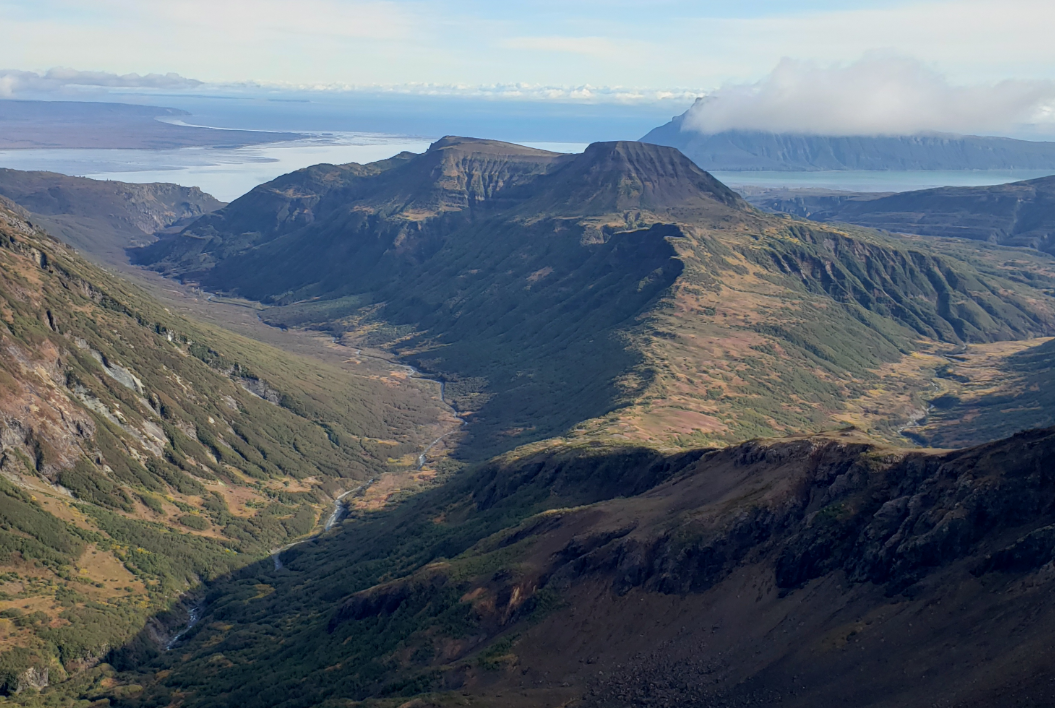
14:11 So this is a view of the deposit is behind that hill there. Now, just a little bit of history here. This project was selected by Siri based on early work they did with Resources Association of Alaska. This was back in the seventies when they had the right to select land.
14:30 Anaconda then came in in the 1980s, early 1980s. I actually worked for Anaconda at that time. I remember when we first worked on this, built a nice camp. That camp has just been augmented over time. Anaconda left and actually disappeared as a company, but some of the principles of that, including John Profitt, whose name you saw on the cross-section there, John's worked on this project a lot.
14:59 He had a group of investors here for a little bit and then Westman was here and they drilled a lot of holes. In total, there's about 267 holes drilled on the Johnson project, but two-thirds of those are actually at the JT deposit itself. And then the other third are around some of the other prospects.
15:19 It's about 80,000 meters of drilling. We have all that core on site there, you can see that. So there's obviously a lot of work doing and a lot of good data there. Our plan now is obviously we get the drill program underway that I'll talk about in a bit here, but the other thing we're doing is permitting an access road between the campsite,
15:41 and you can see the existing airstrip there, and then the proposed portal site there. At the base of the day site dome, that's a post-mineral day site dome. The deposit itself is located on the other side.
15:56 This 3D perspective shows it a bit better. You can see Camp and the airstrip and that view that we were looking at previously. And in the middle of that, above the JT deposit is that post mineral day site dome. You can see how the geometry there, when you want to drill deeper on the JT deposit, you've got to go way uphill and it's very, very steep terrain. So that's why we want to get underground. We're proposing a 1.5km tunnel. And just for perspective, that's about the amount of work that we've done at Lucky Shot in terms of underground development. It's something that we've done. It's not an order of magnitude bigger or anything. We're permitting that now.
16:42 Of course, that will not only give us access in the footwall of the JT deposit, but it's also going to open up a huge area of exploration that's basically underneath that dayside dome that we really can't drill from the surface very easily.
17:03 The permitting work is underway. We expect that it will be wrapped up by the end of the year. This year we want to drill for 2 main purposes. To do infill drilling, particularly in the upper part of the deposit, we're drilling about 10 holes, 3,000m.
17:22 The short holes will be in the upper part of the deposit. Those are basically just infill holes to upgrade inferred and indicated to measured and indicated resource category. We've got a couple of deeper holes there. You can see on that cross section, I think I mentioned in the earlier that we had that copper-rich zone. We want to drill some more holes in that. When you're mining this, when you're thinking about mining this thing from the bottom up, if we've got some of those grades that we're seeing there in that lower zone, we call it the footwall Copper zone,
18:01 then that would be a good place to start mining. And I'll show you some of that core in a minute. We've got a lot of other work going on that's related to characterizing the ore from an environmental standpoint, acid rock drainage, metal leaching, a lot of geotech and hydrology work going on. And in the map there on the left side, you see the camp, the road access that's being permitted, and then the portal site, and then the green line is roughly where that portal would go in the footwall of the Johnson track deposit. So that program is underway,
18:41 probably wrapping up in later in September. I mentioned that footwall zone.
18:49 They've tagged it a couple of times and we want to put a few more holes in it. It is, as you can see in this box of core here, it was a 20-metre zone, averaged over 2% Copper, an ounce of Silver, 0.18g of Gold and almost 5% Zinc.
19:10 A very good zone. We'll put a few more holes in that and see if we can augment, put a resource around that. Currently, it's only in the inferred category, but a few more holes in that and that might be a good place to start mining from the bottom up. Now, of course, there's a lot of other targets here. I mentioned them when we were looking at that cross section earlier. It's basically about a 10km long zone
19:38 of mineralized trend along the main JT trend plus these other Easy Creek and Kona targets. This is an MT survey, so you're looking 200m, 300m deep in the crust here. There are big alteration systems associated with these systems. We'll stay focused on JT for right now, but we certainly see the exploration upside. Maybe next year we can see some drilling on some of these other targets.
20:09 Johnson Track is a great fit for our DSO model. 1Moz, great grade, almost 9.4g per ton, good widths above the water table, so a relatively easy project to permit. Good metallurgy, private land, I think that does facilitate permitting and, of course, close to the water. It fits our model.
20:34 When you look at a 5-year plan, and this is a rough 5-year plan, I'm not trying to say we'll get all this done in 5-years, we'll certainly give it our best shot. We've got Moncho in production now. On average, we're going to produce 67,500oz of Gold a year. Today's metal prices will generate over US$60M of free cash flow. Part of that Gold is hedged, but about 60% of the next couple of years is hedged, but you get a blended price of $2,100 with the current price of Gold. We're going to generate a lot of free cash flow. We can use that to advance Lucky Shot, develop a resource there over the next 2-3 years, sorry, a reserve there and put a mine plan together, looking at starting 30,000oz to 40,000oz of production in the next 2-3 years, and then continue to advance Dawson track a couple of years later,
21:28 5-6 years, developing that million ounce deposit and looking at something that would be on the order of 100,000 ounces of gold equivalent production. We are starting a preliminary economic assessment to scope the project and see what sort of a scale would make sense, what our mining costs are, transportation costs, etc. To try to basically frame this thing and see
21:53 how well, basically want to demonstrate how good a quality project this is. We have a five-year plan and to augment our level of production, We've got the free cash flow to do it. And I'm looking forward to keeping everybody updated on our plans here. So I will stop there and ask for, to go over to questions, Romeo.
22:18 Awesome. So there's quite a few questions from the audience here. I got a couple of my own, if you don't mind, then I'm just gonna get through before we get to these audience questions, but I think we should have time to get through all of them today. First one up, based on the press release, it looks like you'll be targeting 20 holes, most if not all are infill. So I'm curious if you're at a point where you think it doesn't make sense to drill for any potential new discoveries at Johnson Tract. Yeah, so I guess I'd point to that lower football copper zone.
22:47 That's exploration. It's not certainly in the current resource. And so, we wanna get a couple of holes in that. And if we hit there and we're offsetting it by 50, 50 plus meters, you're gonna develop that into a nice ore. It's really good grade and it's at the bottom of the system. So it's where you're going to start mining. So I point to that as that is exploration.
23:14 Next year I would see us doing a few more holes directed at pure exploration, some of those other targets that are out there. I'm really intrigued with the fact that the Dayside Tuff is well below, which is the productive horizon for the JT deposit, is well below those other prospects at Kona and Easy Creek and Ellis.
23:36 So Milkbone as well. So yeah, there's really good prospectivity there and we certainly, that's not lost on us. So, you know, let's say, I don't know, 80, 90% of the dollars in the effort will be on JT and advancing that to production. But we'll get a few exploration holes in there as well. Okay, great. My next question, this is from a layman. I noticed that you in the PR said some select tools under hydrological testing and monitoring to characterize the overall surface and deposit hydrology and water quality. Can you just elaborate on
24:07 why that's a necessary step so investors understand? Yeah, sure.
24:11 So next step is for next year, it'd be permitting the underground access. So That's a permitting process with the state of Alaska. This year, we're permitting the road over there in the laydown area for the portal, but next year we want to be permitting the actual tunnel. In preparation to do that, you need to understand, you're gonna be mining material and you're gonna be placing it on the surface. You need to know what the water quality,
24:38 or sorry, but the acid front drainage potential and the metal leaching potential is of that material. And so that's why you do all the characterization studies, but you also need to know how much water you're dealing with. And so hence the hydrology studies and the geotechnical studies to understand how much water there is and where is it flowing from and to. So
25:03 it's all of that is related to really permitting the mining of the tunnel. We're not processing at this point. We're just mining it. We're technically we're mining. So we're building that tunnel and that material's on the surface and we have to be able to demonstrate that it's not going to harm the environment. So that's hence all the studies. Great, I appreciate that. You're also going to be collecting metallurgical samples during this program. So far, previously, has there been any network done at Johnson Direct? Yeah, it's actually been a lot. I mean, Anaconda did a fair bit. Anaconda did a full full study of this thing.
25:43 So did Westman. And interestingly enough, when Westman looked at it, they were actually looking at it with a similar DSO type model in mind. So in general, it's good metallurgy. It's coarse sulfides and coarse sulfides always make for better metallurgy.
26:02 There aren't like a lot of extravagant minerals here. There's not a lot of arsenic and anemone and mercury and things like that. So those are all good things. We just want to optimize it. Now what we do have is It's a thick ore body and there's different parts to it. So we're going to build a good quality geometallurgical model from top to bottom so we understand how to sequence this and how to blend the ore, different ore types,
26:31 so that you can deliver a consistent or to an existing mill. Right, that makes sense. 1, I noticed you're quoting the press release to have permits in hand by end of year to allow the team to build the access road to the portal site. Now you've got a lot of experience in Alaska obviously. Is this a straightforward process? Are there any risks in that department? I mean it's always risk in permitting so can't say that there aren't any.
27:00 I think we're substantially through the permitting process. It is on private land. When you go out to site, there's not a lot of wetlands. So, we're disturbing a minimal amount of wetlands. There's a lot of gravel material. We're at the foot of the Alaska range. Water's coming out fast and there's
27:22 a lot of gravel to work with. So I think it will be reasonably straightforward and I think where our expectation is that we'll be wrapped up with the permitting of the access road over to the portal by the end of the year. Great. I got one question just because I'm familiar more with your previous team. Who are the team working at Johnson Tract? Are they experienced operators?
27:44 Give us a bit of color for that group? Some of it is the same people.
27:52 Chris Kennedy is really helping out there. Of course, my manager at Pogo worked at Fort Knox and Green Streak, so he's got a tremendous amount of experience.
28:02 Dave Larimer is also working on the project. They're overseeing things. But the team there that came from Highgold is just a really high-quality team. They've been operating in Alaska a long time. They all work down at Palmer in Southeast Alaska. They've been working here since 2019.
28:23 Allegra has been doing all the permitting related work. She's continuing. Nathan Steeves is the overall project manager. It's just a really good team, solid team. They know the project well, and they've been doing it for going on 5 years here. So
28:42 it's a solid team. I sleep well at night. That's important, That's important. I know you already touched on it, but just a kind of belt and suspenders approach. I was like to reiterate it. What is the broad timeline to production at Johnson Tracts? People have a sense of the timeline. Yeah, it's a little early to try to put too hard a numbers on, you know, things. I think, I think, you know, give us 5, 6 years, I think makes sense. I'll just run through it. This year we'll get the work done to be able to permit the tunnel, which we'd permit next year.
29:18 Then build in 25, then build in 26, and get the drilling done by the end of 27. That's all the drilling feasibility level work. And then, you know, then at the same time, we're obviously looking for a place to process this material. So we got plenty of time to do that and plenty of time to work out an agreement to do that. And then so I think, you know, 29, 30, you can be in production. Great.
29:48 2 questions. It's just while the team's busy at Johnson Track, I'm curious if you could give us an update on Lucky Shot. What are the plans for that project, just so investors have a viewpoint into it? Yes, we're on hold. It's on PR maintenance right now. It was actually just up there the other day and things look good. It's a nice summer day, so they always look good on a nice summer day.
30:09 We're just on hold and we're making plans to get back underground drilling and get the surface drilling done, But that'll be a next year event. It doesn't really, when we looked at it, we said that we'd like to do something this year, but obviously we wanted to make sure that we had the cashflow from Montreux and that there wasn't gonna be a delay or something going on there. Start-ups are always tricky.
30:36 Things can always happen and you want to just make sure you want to plan for the worst and hope for the best. I think that's the way it turned out. We had good success with the first batch here. We'll actually be putting out a press release here in a couple of weeks with the finale of the batch process for the first batch. So all the stats associate how many ounces, how many tons, and et cetera. So it should be a good press release, maybe another reason to have an update for everybody.
31:09 But yeah, so we wanted to make sure we had that cashflow before we started with Lucky Shot or started back up with Lucky Shot. And it didn't really affect the overall timeline. So that was the other thing when we looked at it, we said, well, we could do more work on it this year, but we'd put ourselves at risk if things don't go smoothly at Mancho, but now that they have, we'll get planning and get that underway next year.
31:33 Great. Actually, my last question was an update on Manchuria, so we're all set. There are quite a large number of audience questions, so I'll try and get to all of them in an order that I think makes sense. First, just a housekeeping thing. Somebody asked if there's going to be a recording. Yes, I should have said at the beginning. The recording will be available first thing tomorrow morning probably 9 a.m. Eastern. You'll get it directly to your inbox and it'll be easy to share from there. But into some of these questions, Tony asks, how does Johnson Track compare to other ore bodies in the region? I'd say it's a little unique. I'm sure there are others out there.
32:07 But this hybrid, what I refer to as hybrid epithermal BMS style,
32:16 I'm not aware of another one in Alaska like it. There's certainly some things in BC that look like it. I'd say Eskay Creek is a similar, it has a lot of similarities. It's obviously really high arsenic and so it's different chemically, but has that similar feel to a very high level,
32:38 epithermal BMS style. And as I mentioned, the stuff in the Caribbean, those are dead ringers for it. And obviously, when you see something the scale of Pueblo Viejo, that gets your heart racing because that is a monster deposit. And so these things can get big. Like I said, they're porphyry scale systems that are just really, really close to
33:01 the ancient surface, the Jurassic sea floor surface. And because they've got that, along major structures, you've got a hydrologic link. And so you get those hot fluids up high in the crust and they just, they can go everywhere. So I'm really encouraged with the exploration potential that we see in the rest of the district. Yeah, great. CJ from the chat asks, he says he likes a lot of the, he likes the multiple targets here. He's curious what sort of geophysical surveys that you think are the most useful for a Johnson track type mineralization? The MT survey was probably the best survey done. That was the most recent, most modern. There certainly historically has been a lot of IP done out here and IP is a good tool, but it tends to be really everything that's pyrite is going to give a good IP response.
33:53 And of course,
33:57 the ore itself, the gold rich ore specifically, is sort of central to a big pyrite halo, if you will. So that's finding a needle in the haystack, just using IP. So the geophysical techniques can get you in the neighborhood and get you focused, but
34:18 you're going to have to do a lot of drilling to define these things. And if our suspicion is right that we're looking at things like Kona and Milkbone and Ellis Zone, Difficult Creek are high level above where the main productive horizon is in that day site, tough unit, that's pretty exciting because that means the full ore bodies below you. I don't know how much the Johnson track got eroded, right? So we know that Copper rich zone would tend to be at the base of the deposit, in the throat zone, if you will, in the feeder zone. But in those other systems, you might just be looking at the very, very top of it. So yeah, exciting for a geologist to think about. I'm sure the geos out there are gonna be bugging me to drill those things soon.
35:07 Yeah, I was curious, the curious bunch. There's a couple of questions in the chat and a bit of a conversation back and forth. Just looking for your clarity on people mentioning that the project is within a national park. So just looking for you to elaborate on what that means, whether there's opposition, just to explain the situation. Yeah, sure. So this gets back to Syria. And The reason the park is there is because Siri allowed it to be there. And Siri allowed it to be there under some special circumstances with their right to access their selected lands, and they're on the edge of the park next to the next to the water, obviously next to the ocean. So and that is 100 percent series responsibility.
35:52 And that that's that's what they're working on is is getting access from between the Johnson property itself and and the and the ocean. So that that works in process. And we'll be meeting with Syria here in the next next few weeks to discuss how that's advancing. But it is a very prescriptive process that was outlined in legislation specific to this area and specific to Siri. Thanks. Anybody in the chat? I hope that answers your question, but let me know if it didn't. Terwizga from the chat, we've kind of gone over this, but good to go over it again. She wants to know if you can tell us anything about when you start digging the tunnel and when you're actually gonna start mining ore at Johnson Track.
36:46 Yeah, so We'll be permitting the tunnel next year, gathering information this year with our current program. Obviously, there's been prior work as well, but the main objective this year is to gather the data to be able to permit the tunnel in 2025, and then with hopes of then building the tunnel in 2026. Now we're mining then, we're mining the tunnel to get access to drill out the ore body and complete a feasibility study. So give us a couple of years to do all that. And so, like I said, 28, we should be in a position where we've got a mine plan. And again, our plan is not to build a mill and a tailing facility and a power plant to run all that. We'll obviously need some power out there, but not near as much as you would if you were building a mill.
37:38 With a direct ship ore model, with a feasibility study and a good mine plan and a place to send it, we could be in production in 2029-2030. It's a realistic timeframe. We'll complete a preliminary economic assessment. It'll be an SK1300, not a 40P101 since it's US listed, but same thing. It's an order of magnitude, scoping level study just to demonstrate that this is a viable project and this is a viable plan, specifically referring to the DSO plan. Makes sense. Jay in the chat asks, where is the ore going to be shipped to? Yeah, don't know the answer to that. That's one of the things we'll be working on over the next, you know, 3, 4 years.
38:29 Perfect. Christian in the chat asks, how difficult is a port to be permitted at Johnson Direct? You know, this is, again, we're learning as we go here with the relationship with Siri, and that is Siri's responsibility, and they're a good partner. They're a big native corporation. They're one of the most successful Alaska native corporations based in Anchorage there. So we'll get more of an update on that, I'd say, towards the end of the year. And what the timeline is, what that's looking like. Perfect. So be a bit patient there. We've got to develop our working relationship with Siri and before we start talking too much about what they're doing. Makes sense.
39:17 Linus from the chat asks, if last year's geophysics provided any additional indication of how deep the offset at Johnson Track may have dropped down? Short answer is yes, but that's probably not going to be a focus of our attention right now. As I said, we like that footwall zone. It's got a couple of holes in it already. We'll get a few more holes in it. And if we keep seeing those 20m of 2% Copper and an ounce of Silver, we'll pursue that and put some more holes in it. The main thing is to get the underground permitted so we can complete a feasibility study on that. As I said, next year, I would say we will dedicate a level of drilling to drilling new exploration targets or extending existing targets.
40:13 LS Zone is a pretty nice looking zone. There's some good mineralization there. And I said, you're still way up high in relative in that strategic base. So maybe we'll pop a deep hole and see what the thing looks like below. Christian got a question that I've often thought as well. So I'm glad he asked it. And this is about Manchoa. Are there any security issues regarding the stockpiles? It's a lot of value lying around. I'm just curious, what does the security situation look like at Mancho? First of all, it's on private land. It's a gated situation, so you can't really get on the property. There's only one road in, you only get in on that road. So there's good security there. And of course at Fort Knox, there's good security there as well. Again, it's a road that's dedicated to Fort Knox and there's security.
41:02 If you're driving, if you're like a public vehicle or if you're in your minivan or something, security is going to come up and ask you, what are you doing here? Yeah, I can't just swing by. Who are you here to see? I got lost. It makes sense. One question in the chat, how are you searching for more VMS deposits? I like VMS deposits. Because of their polymetallic nature, they're sort of a built-in hedge, if you will, for when the economy is doing well and everybody wants Copper and Zinc. And then when you're looking at, oh my God, we might be hitting a recession like people are worried about right now. Well, hey, we've got Gold and Silver, so you're kind of recession-proof to a degree there. They're great deposits.
41:51 They tend to be small and high-grade. By small, I mean small in the sense that we're not competing with Barrick and Newmont for assets that fit that geologic type. When we look at our DSO model, if we look in this 1Moz to 2Moz type of deposit, whether it's ounce or ounce equivalent in terms of BMS type deposits, we're not competing with Agnico Eagle and Barrick and Newmont for those. Those guys are looking for 5oz plus million ounce deposits. To a degree, we have the space, but not a lot of competition. So, yeah, I like BMS deposits and I like these 1 to 2 million ounce type systems where we don't have a lot of competition.
42:49 Great. I'm gonna lump together a couple of questions here from the chat about environmental preservation in Alaska with this project. One question about bear feeding and mating grounds. One question about fishing and ecotourism. Just generally curious the approach you're gonna be taking to maintain preservation in the region. Yeah, so I'll step back and say that I think Highgold and Siri have done a great job with this project from the beginning in terms of working with the local lodge that's a silver salmon lodge it's down the Johnson River. And there is a bear viewing area there. There's several in Alaska like that. This is certainly one of them. It's relatively close to Anchorage and Kenai, so it's fairly easy for people to get to.
43:35 Basically, we're going to avoid it. We're not gonna go anywhere close to it. So we won't be bothering the bales, the people watching the bears might bother the bears, but we're not gonna bother the bears. Our infrastructure will be always away from the bear viewing area and the salmon run and the Johnson River itself. And so, yeah, we're sensitive to that. There's people who make a living at Silver Salmon and we respect that and we'll just stay away from it. Our DSO model approach should go towards demonstrating that we're not building a tailings Sicilian mill. That's not our plan. There's a lot less concerns about water quality and things like that. Tailings stands breach if they're not there.
44:33 I'll be meeting with those folks here shortly. I'm trying to get a meeting set up now and with the Silver Salmon Lodge. And so, yeah, well, my motto is always, meet early, meet often, and let everybody know what you're doing. And sometimes when you meet early and often, you don't have all the answers. And so you have to just develop the relationships and keep an open dialogue. Great. Jan from the chat asked one of those crystal ball gazing questions, would you expect any takeover bids in the near term? We can't speculate on that. We've got a good business model that I really want to execute. If somebody loves it and wants to pay our shareholders a nice premium, it's not up to me really, then it's up to the shareholders to accept that offer. So it's not something I worry about or I'm concerned about.
45:30 If it happens, it'll be a good news. There you go. Somebody in the chat just for clarity sake, I just want to confirm whether Johnson tract is underground mine. Yeah, we don't see this as an open pit situation. Your body does actually go up to the surface. There's a nice exposure on the surface, which is how it was found, of course. That's why we're putting in the tunnel. I get underneath the ore body and mine from the current resource reserve up. Like gravity, it does most of the work. As I said, it's a fat ore body. So one of the main areas we want to focus on is a geometrical model to understand variation in the ore types.
46:16 So we'll probably have a lot of different subtypes, copper rich, zinc rich, gold rich, et cetera. Great. To the degree to which you can answer, Christian asked if there's any royalties to any project of Contango held by management board members or related persons. No. Great, thank you. The royalties on the project, but not that we own. Great. M. Neheuser from the chat, sorry if I butchered your last name, really do apologize, asks if there's expansion potential at Mancho. That's Mike Neheuser. These names are similar to mine, You can't mess that up. One at a time. I'll get them all. Sorry, just repeat the question. Is there expansion potential at Mancho? Oh, Sure. Yeah, there's a lot of exploration upside at Moncho. It's a whole district. It's this, you know, again, I've said this many times, it's private land, size of the state of Rhode Island.
47:11 I'll be at a small state, but there's a lot of exploration work going on right now, actually. They're probably starting to wrap up the exploration program at Moncho, but we'll look forward to releasing some results on the drill program this year. There is a $4.7M exploration program this year. The lion's share is probably getting wrapped up here in the month of August. So yeah, good exploration upside there. And as there is on Lucky Shot and here at Johnson, I'm really excited about the exploration upside at Johnson. We might bump into a Pueblo Viejo down here. It's that scale of system and the size of those geophysical anomalies, the MT survey anomalies, they're very substantial. They're tens of square kilometre type anomalies.
48:04 So big, big anomalies. Great. 2 questions all around Manchot. Can investors expect any short-term returns on Manchot now that it's in production or are the proceeds from Manchot to go to future projects such as Johnson Tract? Well, The first order of business at Montreux is to fund working capital, so that's being done. The second order of business is to pay the bankers off. We borrowed $60M to build Montreux, which is about a tenth the cost of what it would have cost if we built a mill and a tailings facility there, just to put it in perspective. So first order business, pay them off, and then obviously advance the other projects. My hope and my objective in the next 5-years would be to get to a place where we could pay a dividend to shareholders.
48:52 One of the reasons we want to keep our share count low, we've got about 12M shares outstanding with the closing of the high-gold transaction. That's a small amount of shares for a company generating about $60M of free cash flow a year. That's on my mind. I'm a significant shareholder, so I like the idea of a dividend. But we've got to pay the bankers first. Got it. That actually covers other questions in the chat. S. Kazeri from the chat asks, how many batches for Mancho in 2024 and 2025? So We're looking at 2 more batches for 2024. And hopefully the last batch is, you know, sort of November, December timeframe.
49:40 And then we don't have a specific plan next year, but the general plan is for 4 batches. So, and I think we're looking at sort of mid-quarter. So like February, May, September, November. Great. Joe from the chat asks, if you're not able to permit a port, do you have alternatives? Short answer is no, you need to get to water. So I'd say the mission is to, for CERI is working on that. And like I said, we'll be meeting with them in the next few weeks here. And once we have a, you know, once we understand their plan, we can maybe talk about it more, but I'll just want to be respectful.
50:30 It's their job and their plan to get that accomplished. So we wanna give them some space to do that. Awesome. As we're getting to the end of the hour, I know there's a couple of questions. 1, some specifics on the bear impact. I'll make sure that the team at Contango gets that question and they'll be able to give you a written response as soon as possible. So you can expect that soon. But otherwise, just before we jet, what are you most excited about this year? Well, production. I mean, holding that bar of gold in my hand was pretty cool. And knowing that there's going to be a bunch more, that's certainly the highlight of the year. I'm excited about the exploration potential at Johnson and I'm really curious to see how that lower copper zone plays out. And like I said, if we can add another million tons of 20 gram equivalent kind of material there, that'd be awesome.
51:27 Great, well, Rick, thanks so much for a deep dive. And We got into the nerdy stuff. I appreciate you taking the time to go through that with everyone. For those questions we didn't get today, I know there are a couple, 3 or 4. I'm going to send them to the Contango team and get back to you as soon as possible. Thanks for joining for your detailed questions. If you have any more that come right after the event, as I often do, please send them through, I'll get them to the Contango team so they can answer right away. All right. Thank you. Thank you.