Replay available
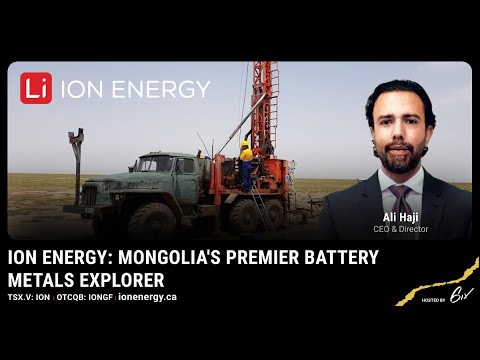
ION Energy: Mongolias Premier Battery Metals Explorer
Join us for a great event!
- Company
- Osiris One Metals Ltd. (TSXV:OSM)
- Date
- Thu, Mar 24, 2022, 12:00 PM ET
- Replay
- Watch the replay on this page · 39 min
On 6ix: 6ix.com/event/ion-energy-mongolias-premier-battery-metals-explorer
Replay
Transcript
Automated transcript · Written by software from the replay's audio. It can mishear names and figures; the replay is the record.
0:08 Hello, everyone, and welcome to Ion Energy's Live Investment Summit today, hosted by 6. I'm pleased to introduce our speaker for today, Ion Energy's CEO and Director, Ali Haji. Ali will walk us through a company presentation and then we'll be taking questions live. Remember, you can submit your questions using the Q&A panel found on the right-hand side of your screen at any point during today's presentation. And as always, this event is being recorded. It'll be available to watch on six.com in the coming days. Without further ado, Ali, I'm going to hand things over to you. Get us started. Thank you, Cam. It's a pleasure to be here and to provide the platform essentially to give our shareholders an update. So thank you for all that have joined. I'm Ali Haji, as Cam pointed out, Chief Executive and Director of Ion Energy, also a co-founder of the company, co-founded the company in 2017, with the sole purpose of looking for lithium in Mongolia.
0:57 From a bride perspective, we currently hold a massive land package that we will cover in just a few seconds here. But again, thank you for being here. Typical disclaimers that you expect to see whenever a presentation of such nature is being made. I think it's important to talk about leadership. The team that we've assembled, hopefully at the end of this slide, will resonate well with you and show you that we've built a team that is in fact quite formidable, to say the least. I've had 13 years of international asset management experience, stemming from different roles at Invesco, having done mergers and acquisitions, among other roles, having lived in Hong Kong and London as well. But importantly, my father has been in mining since 1998 in Zambia in the copper belt. So it somewhat runs in the blood. I now sit on the board of a number of other mining companies as well.
1:52 Matthew Wood, my executive chairman, the chairman of Stepgold, which is also in Mongolia, as well as Avangin Resources. He is a Rio Tinto Gold Scholar that understands geology rather well, but also understands the banking side of the house. So he's had a number of significant exits around the world. More recently, the sale of Ivanko Resources to Oz Minerals in Brazil For about 440 million Aussie in March 2018, a massive exit in Mongolia that we will cover in the following slides. Wendy Lee, a very recent addition to the group and the company, we're very happy to have her. She represents a background that stems from the Noble Group, which is a commodities trading house, one of the larger ones in the world.
2:39 She spent a fair bit of time in Mongolia, but also was able to arrange offtake agreements between Mongolia and China for copper gold and coal. So her her remit and her position allows her to build those strategic relationships with China as far as lithium is concerned as is the focus of the company. But a tumor or 2 is 1 of 2 Mongolian directors that we have on our board. We think it's important to have local representation, irrespective of jurisdiction. Bata is a seasoned mining entrepreneur. He's been part of Matt Wood's stable, if you will, in terms of in-country success. He's also the chief executive of Stepgold, which is a current producer in Mongolia.
3:25 Essentially the premier precious metals producer in Mongolia. He was an advisor to the Ministry of Mining in the prior government. He was reappointed in the new government. So we are politically agnostic in country. Irrespective of who is in power, we're able to get things done in country. Anil Varach is my investment banking professional. He sits on our board and has worked for the Dundee Goodman group of companies, having raised over 1 billion dollars for multiple mining companies around the world. And Tushin Kishik-Suren, my 2nd Mongolian director, is an individual that's had over 30 years of exploration experience in that region, highly accredited for having found multimillion ounce gold deposits along the border with Russia in Mongolia.
4:10 He's sort of tasked with ensuring that we have the necessary equipment and personnel for our success in country. John McVicker, our CFO, XEY partner, happy to have him on board. And the next 4 individuals are really where our Lithium experience should speak to you, our listeners. Paul Fornizzari was the original chairman of Lithium Americas, now valued at about $5 billion, instrumental in bringing in the investments from Mitsubishi and Magna that ultimately formed this $5 billion behemoth. Beyond that, he was a founding director at Neo lithium, the Argentinian asset that you may or may not be aware of, that very recently sold to Zijin of China. That sold for about $960 million in the last quarter.
4:56 So essentially very much considered a pioneer in the brine space as far as the Americas are concerned, and very happy to have him as chief advisor, mentor, and now a dear friend to us in the company. Don Haynes is our chief technical advisor, an individual that in the lithium spheres is very much considered Mr. Lithium because He has worked on a number of lithium assets around the world, particularly in the brine space. He's also worked with the OSC to define what a 43-101 for a brine company should be in order for them to go public. So Don currently designs our exploration programs, reviews the data from those exploration programs, and then ultimately looks to build on that to further de-risk the assets that we control in-country. Dr. Hashbeth Dasht-Tserin is a PhD lithium hydrogeologist in-country that now sits on our advisory board. He has spent a fair bit of time at Akita University in Japan, studying the extraction methodologies for the various resource types in the country. He works with Don hand in hand to ensure that his instructions are carried out, and then ultimately provides that data on to Don.
6:00 One of our more recent additions is Dr. David Deeks, senior vice president or prior senior vice president and chief technology officer of Lithium Americas. Prior to that, he was at Tesla where he was instrumental in building Gigafactory 1 in Nevada. We've built a skill set of not only the geological expertise, but also the strategic expertise, as well as those that might be part of the supply chain. And hopefully that's evident to you, our listeners here today. We started the company in 2017 on the back of recognizing that lithium, like every other resource, would be cyclical in nature, Mongolia being a Basque country. I was advising Step Gold, a producer in country, at this very moment through their Gold public transaction, and my chairman and I looked to Mongolia as a source for lithium. Having understood the geology to be very similar to the lithium triangle, we started the company and sure enough we've had a lot of investment from governments around the world in this space as a result of the pandemic, which ultimately has spurned or spurred this green clean energy revolution.
7:07 And thus we find ourselves in a very advantageous position. We currently control 110,000 hectares in country. We are one of the largest land package holders in country. We're first movers in the brine space. Nobody else has been out there for brine. And we started exploration shortly after we went public. For the vast majority of our listeners, be you a shareholder or otherwise following the market, I think it's evident that we are moving towards a cleaner, greener future. And we're seeing that more and more with Ford and GM now putting $55 billion into essentially Detroit and Michigan to retrofit factories to allow them to produce EVs. We're seeing 1 trillion dollars across multiple economies being printed in order to incentivize and subsidize the cost of electric vehicles.
7:56 The price of lithium, for those of you that follow it, was about $8,000 to $9,000 before we went, or rather, 2019. And now we're looking between 40,000 and 48,000 per ton for lithium carbonate equivalent. So there is a massive demand and supply is lagging. Some would ask, for those of you that are new to the story, why Mongolia? Mongolia is a country that we've been in as a group for about 13 years now. It's 1.5 times the size of Ontario, for some semblance and relevance, with a population of 3.5 million people, 3.5 million people almost centered entirely in 3 major cities. So it is quite sparsely populated. And as a result, only 3% of the country has been explored for minerals, which in our view, makes Mongolia an untapped potential for lithium given its similarities geologically to that of the lithium triangle.
8:54 We've been in country, like I said, for about 13 years combined as a management team, about 100 years of experience in Mongolia. Mongolia is very dependent on mining because 20% of their GDP comes from the mining industry. 80 to 90% of their exports are accounted by the mining industry as well. So you have a lot of skilled labor in country, which means you don't need expensive expats to come in and actually get things done. If you're following Rio Tinto, a global major in the mining space, they've now looked to forgive the government of Mongolia for a debt that is in and around the range of $2.4 billion. But beyond that, they've offered to buy out the remaining equity from Turquoise Hill for about $2.7 billion. So when a major is investing close to $5 billion in an economy, that really helps to validate and de-risk that jurisdiction.
9:50 We've seen the government change on multiple occasions. You call it 3 or 4 times in the last 13 years. We've spoken to different members of different political parties and they continue to sing the same song, which is Mongolia is open for investment. And I think it's evident in what we've been able to accomplish over the last decade or so. Given the fact that we're very close to China, China today consumes 53% of the world's lithium. They refine 75% of the world's lithium that ends up in batteries for the EV industry and otherwise. So our proximity to that market makes us far more competitive relative to those that would be in Australia or in the lithium triangle in Latam. My chairman's first foray into Mongolia was in 2009 as a Rio Tinto gold scholar looking for gold.
10:36 He ended up being in country in 2010 and raised $20 million during the last coal boom on the ASX with no assets, so similar to what we would call a CPC for our US listeners, SPAC. He went into country, acquired a number of coal-bearing assets, de-risked them through exploration, and ultimately exited the Banpo of Thailand for 500 million in cash 18 months later. When I joined the group in 2016, we looked to an asset in Dornor Province that was owned by Sentara Gold, Altansagan Ovo. That was acquired using a streaming agreement from Triple Flag Mining Finance. They gave us $20 million to acquire that. In 2018, we took that company public on the main board of the TSX, very tough resource environment.
11:23 Most were very focused on the cannabis space. We were able to list the company and ultimately in March 2020, that was pouring gold. So 1st gold pour was achieved using 100% Mongolian staff. June 2020, commercial production achieved, again, 100% Mongolian staff. So the skill set in country is quite relevant, but we've also shown that we can have successful exits from a resource indication all the way up to bringing assets to production. The ION story, we went public in August 2020 as I mentioned, and the goal there was, you know, let's acquire as many lithium bearing licenses as possible, let's ensure we can de-risk, come to an early resource indication and ultimately bring on strategics that allow us to expand or ultimately exit. So ION very much mirrors what we did with HUNU.
12:11 STEP is entirely a production story and hopefully you can appreciate that, about 3% of mining projects around the world go to production. So we went public on Baba Yol. Baba Yol is our flagship license. It's 81,000 hectares, about 5 times the size of Vancouver, located in the Gobi desert, 23 kilometers from the Chinese border. So the Gobi being quite arid, meaning very minimal precipitation, high evaporation, 250 days of sunshine and very high winds. The work that was done historically on this asset stems back to the 1950s where the Russian government, when Mongolia was part of the USSR, did some drilling, found an aquifer that was quite saline in nature, but ultimately chalked it down to, this is not potable, you can't drink this stuff, let's move on. In the 1990s, the Russians and Mongolians revisited that site. They found the very same macropur.
13:05 In 2016, the University of Science and Technology did some very rudimentary surface sampling, and they found a maximum grade of 811 ppm, quite close to surface, low impurity ratio with lithium acids around the world, chemistry is everything. So potassium, magnesium, sodium, boron, and the other impurities that you might consider were quite low. So essentially making it an economically viable project. Brine tends to be cheaper as far as the production costs, and the fact that it, again, it is in the Gobi, would lend itself well to evaporation. But we are in conversation with multiple direct lithium extraction companies to evaluate whether or not our brine that exists on our assets would work through their pilot plants or ultimately their lab analysis for recovery rates.
13:56 We went public in August, as I mentioned. In October, we started to explore. Shortly thereafter, We did some geophysics. We identified a number of different targets that we would be drilling. We had a bit of a hiatus as a result of COVID. And in May, we were able to drill a number of holes, 832 meters drilled in total, really to identify the stratigraphy and de-risk essentially what was told to us historically, which is let's prove the hypothesis that in fact those aquifers exist. So we drilled those holes. There was minimal assaying, if any, done at that time. But the key thing to show you as our viewers and listeners is the fact that we did strike those aquifers. And if you look at this area here around the drill, you see a fair bit of sort of white evaporites, if you will. And that is indicative of very high mineral content.
14:47 So we did prove that the hypothesis exists as far as those aquifers existing on surface. And then at the tail end of last year without having access to country, hydrogeological sampling for brine is something that is quite new to Mongolia as a nation. They've historically had copper, gold, coal, and oil and gas but the hydrogeological sampling is quite a specific sort of exploration exercise. So what we did at the tail end of last year is allow ourselves to go to our sites and do an auger program that ultimately covered about 70% of the asset. That auger program was quite shallow. It allowed us to pull samples from up to 6 meters in depth.
15:32 But importantly, we found anomalies, which we're now calling White Wolf as our discovery, of up to 1,502 PPM. And that's important because if you look at the asset historically, the maximum grade obtained was 811 PPM. So we've almost doubled that. And that excites us as a board, as a company, and ultimately I hope it excites you, our shareholders. As a result of having found that 1,502 BPM, what we're aiming to do this year, in fact those plans are somewhat set in stone. Myself, Don Haynes, Paul Fornansari, an analyst out of the UK, hydrogeologist out of Dublin, alongside some other sort of specialists, if you will, will be in Mongolia. We fly out on April 15th. We will return on April 26th.
16:20 And the goal of that program is to kick off a capital-intensive exploration program whereby we have the ability to train the team on the ground to ensure that they're doing things to the caliber that you would expect for a lithium-ion project. So now that the borders are open and we're able to get out to country, we expect we will have a significant sort of upside with respect to not only exploration, but also news flow. As a company, we've been trading for sub-two years. We've had news flow every couple of months, if that. And now we're in a position to really let the rubber hit the road, and we expect a number of good things to come as a result of this visit. That's some of the equipment that we've used on site. Those are the holes that have been drilled historically.
17:08 You've seen this image before. Now, to check off that box as far as acquiring as many in-country lithium assets as possible, much like the HUNU story. In February last year we acquired Urgak Naran. You know Babayul, which we've talked about already, is a paleo-solar, so it's a solar that exists below surface in an endoheric basin. Urgak Naran is a surface solar, very similar to what you would find in the Atacama. This was acquired in February last year. It is very sort of similar to what you would find in the lithium triangle. We have yet to explore it as a result of not having the right sort of skill set and team on the ground, which is about to change quite dramatically, if I may. And the early sort of indication is such that it might be more promising than Babayul.
17:55 Of course, it has yet to be determined, and nobody can sort of have a crystal ball with respect to that. And the exploration program that will kick off here in the coming days, if not weeks, will be a 73-hole shallow auger program across the entire Salar where we're collecting not only physical samples, but brine samples as well, using hydrogeological sampling to get a good sense of ultimately what this might be in the future. So we're very excited about this this prospect. It checks off the box of us acquiring as many assets in country and exploration as I said is about to commence. Mongolia low cost environment. We've seen that through a number of different operations. If you look at Stepgold as an example, they're all in sustaining is very competitive, if not somewhat the best in the world in terms of infrastructure, where we're located, very rich, our Toronto listeners are like to joke that the roads in Mongolia, even the dirt roads, are better than the vast majority of the roads that we have here in country. And again, I think let's not discount the fact that China today imports the vast majority of their lithium from Latam and Australia. So our proximity to that market is very important indeed.
19:10 We entered into a joint venture agreement with a company named Aranjan resources. That's a Mongolian copper company. We did this on the back of our exploration program that we held not so long ago that I talked about, our auger drilling program. During the course of that auger program, we found anomalies in the copper and nickel space that were on our asset outside of where we saw the lithium sort of anomalies. This allows Ion to not only leverage the capital expenditure that would go into the expiration of Ion's licenses to better understand not only lithium, but also allow us to monetize any copper or nickel that would be found on our assets as well. From a cap table perspective, it's quite a tightly held structure, 60 million shares outstanding today, 25% in the hands of management and insiders.
20:01 We are fully escrowed. We participated in every financing. We continue to buy on markets. We have our skin in the game, so to speak. We did our raise when we went public in August 2020 at $0.30 a unit with a $0.40 warrant. Some of those $0.40 warrants have converted. There is no not looking to accelerate. Last year in March, we did a bought deal with PI Financial and Stifel GMP where we raised, we put out a note for 3 million. We had demand for 10 million in under 8 hours. And we took 5 million with the over allotment option of 750,000. We brought in 5.75 million in March last year. That deal was done at 50 cents a unit with a 70 cent warrant. Those warrants, if they were all to convert between the 40 and the 70 cents, we would have about 10 million back in the treasury.
20:51 At the end of last year, we had $4 million in the treasury, which in Mongolia and the way that we operate our company, which is very lean, that gives us about 24 months of operations, both in terms of exploration and marketing as we are doing here today. Our market cap today is about 23 million Canadian, so not that large. There's still a fair bit to go. We've brought on Mongolian investors for the ride, which I think is extremely important as they are supporters of ours in country. We have family offices in London, Zurich and New York that are part of the company as well. And from an institutional perspective, Delbruck Capital, Spartan Funds out of Toronto, Alpha North, that's Steve Farmer out of Toronto, Bob Sango of Maxit, Ixios of BNP Paribas out of Paris, as well as US Global. So the Holmes group out of Austin, Texas as well are our holders. So a lot of long money as far as that's concerned, and we're just about to get started in terms of our ultimate exploration and exponential growth, I would hope.
22:00 So hopefully you can tell that we started the company in 2017. 2020 we went public, we now control 2 assets, we've drilled about 250 holes, and it's been quite an aggressive growth strategy to say the least. And we're excited to see what's to come. So in April this year as I mentioned we will be on site, myself alongside our advisors alongside some analysts and bankers as well. We're going to start exploration of Urgak Naran which is our secondary asset. We expect to do hydrogeological sampling on Babayul as well as Urgaq Naran. The goal is that we have an early resource indication in and around Q3, Q4 of this year. And that will allow us to really attract those strategic institutional investors that might be keen to either take a toll in the organization or ultimately acquire us in our entirety. So we're well on track. Yes, we've had a bit of a delay, but which mining project around the world has not as a result of COVID.
23:00 As a junior mining company, I think it's important that we have paid coverage and we've done so with Calura Capital in Vancouver. As of December, I believe it was $1.13, so apologies for that not being updated. Fundamental research in New York, about $1.04. Zach's small cap research in the US has pegged our OTCQB listing at about 48 cents, so significant upside based on where we're trading today. Stonegate Capital, very similar to that if you were to crunch the numbers. A comparison that I'd like to draw your attention to is a company named Wealth Minerals that operates out of the Atacama in Chile. As of a few weeks ago, we're seeing more and more pushback from the Chilean government to allow anything in that basin to come to production due to environmental issues. And as a result, it remains to be seen what ultimately comes to production in that area.
23:56 Wealth today controls 46,000 hectares. They're limited to surveying, so no drilling has been done on the asset. The maximum grade obtained for their neighboring assets is about 1,250 ppm. They are 15,000 nautical miles from the largest consumer on the planet, that being China. Their market cap today is about 120 million US. For ion energy, we control 110,000 hectares. We've drilled close to 250 holes. We've assembled a team of world-class experts. We're 23 kilometers from the largest market in the world and our maximum grade based on our drilling is 1,502 ppm and this is why we're having these conversations with new and prospective shareholders as well as current shareholders to show you that there is a valuation gap as far as the company is concerned, as are of course the analysts.
24:51 So based on that, in summary, hopefully you've gotten from this conversation that we are fully funded. We're not looking for equity. We're looking for eyeballs on the story. Our location, I think, speaks for itself given our proximity to China. Hopefully, I've shown you that the team is experienced and has had a number of successes in the lithium space. Lithium, as I mentioned, went from 8,000 to now 46,000 US per LCE ton equivalent. The margins in Mongolia can be kept quite low as a result of the skilled labor in country. And we believe as a company, we are well positioned for shareholder value. So that's my contact detail. I'm happy for you to get in touch with me directly. And Cam, thank you for hosting us, but I'm open to questions.
25:38 Wonderful. Thank you, Ali. I'd like to remind everyone in the audience that you can ask any question you like using the Q&A tab found on the right-hand side of your screen. Well, let's get started with some questions that have already come in. Ali what are your thoughts on the current situation of Ion Energy's stock. So the stock has you know in quite fairness has not performed as well as everybody else in the lithium space. But you have to realize that that Ion has only been trading for about 18 months, right? We're a very young company that is just about telling our story to everybody. The fact that we have institutional holders that came in at a higher price that continue to hold because they believe in the story and the management team should be indicative enough of a win in the future. Now, I would also like to sort of divert attention towards certain companies or certain industries that might choose to be overly promotional.
26:29 We're not that company. We control 25% of our company. We continue to participate in every financing. So our goal is it's quite fundamental in nature. We expect to see us grow alongside our shareholders and ultimately provide an exit. So in terms of our share price, if you're going to ask that question, we're massively discounted. Take a position on the on market. Okay, fair enough. Thank you. The next question, Mongolia still sounds like a risky or an unknown jurisdiction. So why do you think investors should feel confident in ION's value proposition, given that it's an unfamiliar region. It is an unfamiliar region but it is one that has you know spent successes for Ivan. Look at Robert Robert Friedland for instance. Right. This gentleman is now one of the top mining sort of investors in the world. And as far as mining goes perhaps has one of the highest net worths in terms of mining, and that ultimately came from Mongolia.
27:22 Mongolia has seen a period of change where we found that political parties have sort of democratic elections, and we've seen now that the Prime Minister that's in power is between 40 and 43 years old. He's a Harvard graduate, quite believes in capitalism as opposed to the socialistic values that the USSR may have imposed on the prior generation. But that's not just indicative of who leads the company, that's indicative of the general populace that is now at the forefront of essentially running assets and being part of the economy. So on that remit alone, I think you're going to start to see Mongolia really turn the tide. And as I mentioned earlier, Rio Tinto, a global major, has now opted to put $5 billion essentially back into the Mongolian economy.
28:10 And if a major is willing to not only validate but de-risk the jurisdiction, given the fact that their proximity to some of the largest consumers on the planet is within essentially a you know arm's reach if you want to call it that. I think Mongolia is just on the cusp of really surprising those that think it might be a risky jurors jurisdiction. OK thank you. You just entered into a strategic alliance with Arijan Resources and have become the CEO of that company as well. So what does that mean for Ion's lithium bride focus. Well the focus for Ion remains lithium and brine. And the reason that we brought on the Arangin sort of JV is for a number of reasons. The chairman is the same for Ion and Arangin.
28:59 We looked at this as an opportunity to monetize the copper and nickel that exists on IONS licenses. But Arangin is also committed to spend a significant amount of capital drilling IONS assets, which means we're essentially getting a free carry in terms of exploration. Whatever work they do will allow us to better understand our asset. Given the scale of the asset, I think it just makes sense and we can cut across both companies and slice essentially the underlying costs that would be deemed overhead. So it's a win-win situation for both of us, and the reciprocal mining rights allow us to de-risk our assets, but also gives us an additional 30,000 hectares to look for lithium in Mongolia. All right, well, sounds like a good setup.
29:46 The next question, with a newly appointed director at Asia, are you getting closer to potential partnerships with strategics? Yes, yes, absolutely. And I think, you know, this is a question that I have to answer quite carefully, and I'll try to articulate it as best as I can. But given the fact that, again, we're on the doorstep of China that consumes the vast majority of the world's lithium, the goal for us as a company is to ensure that We are bringing on the right strategics that give us the right intellectual capital to better understand our assets, but ultimately give us an opportunity to understand either an offtake agreement or an ultimate exit, which has been the goal of the company from day 1. But we have to take these conversations in our stride. We have to take them quite in a measured approach. We're not going to go out there and try and strike a deal at today's currency because obviously we're massively undervalued as I've shown you with the comparisons of others in the industry.
30:47 So we're going to forge those relationships. Wendy's doing a fantastic job of introducing those strategics to us. Paul Fornizzari, of course, has had multiple engagements with the likes of Zijin, Mitsubishi, Magna, and others. And so this is really us saying we're here, we're relevant, we want to have these conversations occur, but we're not keen to move in a hurry because we don't need to. We are fully funded, We have the equity or the cash in the treasury that is required for us to succeed over the coming years. And there's enough interest in the company for us to slow roll these relationships and ensure that we bring the right partners before we look to any equity sort of raise or placement, if you will, from a strategic.
31:34 OK, well, sounds good. There seem to be a lot of starts and stops to the Ion exploration timelines in 2021. And that's understandable that COVID played a role, as you said. What are you going to do to create momentum in 2022 around these vital activities so that investors can get a better sense of your assets? Of course. And Cam, like you said, I mean, COVID is not specific to Mongolia. COVID is a worldwide phenomenon. We've seen this start and stop things all over the world. I mean, Toronto, for instance, has had 4 lockdowns, right? I can walk around downtown Toronto today and not find a Starbucks because ultimately they have shut down. So COVID is not a Mongolia problem, it's a global problem. ION, in much the same remit, suffered from those very issues.
32:20 What we've done as a result of not having access to country is we were able to drill those RC holes where we got a good sense of stratigraphy. We were able to strike those brine aquifers, ultimately de-risking and proving the hypothesis that in fact those aquifers exist. Then we did that auger program to scratch the surface of a massive license, 5 times the size of Vancouver, as I mentioned. That gave us the focus to really plan out what we would do from a more sort of calculated manner. And so in April, as I mentioned, we will be in country, myself alongside our senior advisors, as well as some very critical individuals that understand the lithium space quite well. We're kicking off a program that is quite capital intensive. So we could have spent a lot of money last year to start an exploration program, but why would you do so without having experts on the ground? So this year, in terms of news flow, last year you might've seen a release from us every 2 to 3 months, maybe every 6 weeks.
33:18 This year, now that we have access to country and we're able to actually spend the capital to better understand our assets, the shareholders can expect us to put out results on a 2 to 3 week basis. And that would be spurned off of the visit that we have planned here in April. So fantastic question, whoever asked that. Thank you. All right. This next question is regarding China. You've mentioned it several times. Proximity, it's the largest battery manufacturer, and ION's new strategic advisor. Is that the only country of focus for you, though? Well, you have to consider where we are. Mongolia today is bordered by Russia in the north and China in the south. The Russian situation is extremely unfortunate, And we feel, you know, we're extremely sad for the current situation in Russia.
34:07 China being the border to the south makes it a sort of a primary partner to align with, if you will. But China is also building what's called the 1 Belt, 1 Road or Silk Road initiative, which stems from areas in China, Beijing included, all the way to Ulaanbaatar and then ultimately St. Petersburg in Russia, which neighbors Finland. Norvolt is up there. They're building batteries for the European market and so you would have the infrastructure in place for you to ship your lithium out to the European market. But obviously that part of the world is undergoing some stress and so that's not something that we would hang our hat on at least for now. The Chinese market as it were consumes the vast majority and yes they would be primary suitors given proximity but some of The other countries that should be of interest to us and are of interest to us are Korea, for instance. Samsung has a presence in Mongolia.
35:10 They have fantastic relationships with the government of Mongolia. They produce batteries. Panasonic and Sony of Japan, also big supporters of the battery metals industry. In fact, the Japanese government built the airport in Ulaanbaatar. So fantastic sort of governmental relationships there. You look at the Germans, they have a great amount of history with the Mongolians and they've signed trade agreements. In the previous US administration, Mike Pompeo was over in Mongolia also securing a trade deal for battery metals as well as rare earth elements. You also look at the Indian government. Narendra Modi, the prime minister there was in Mongolia about 3 years ago doing much the same. So Mongolia as a country, given the fact that they are sandwiched between Russia and China, have put in place what's called a third neighbor policy, where they incentivize Mongolians to do business with countries outside of Russia and China. So there is a potential for us to work with other countries, but given proximity and given demand and given consumption, Obviously China is at the forefront of our potential strategic advisors or partners. Fair enough. And it makes sense.
36:25 This next question comes from the perspective of an attendee or an investor or potential shareholder. How can I meet with a member of the Ion Energy team? Great question. My contact details are on the screen. I'm one of those rare individuals that answers my phone, irrespective of who is ringing. So give me a call, drop me an email. If you're in Toronto, we can meet in person. Otherwise, we're doing a number of different roadshows as well as marketing initiatives. Now we'll be in at one-to-one mining next week in Las Vegas so you know Nevada is a big lithium jurisdiction So I think that that conference will be quite fruitful given the number of meetings that we have arranged. Beyond that, we'll be doing Mines and Money in London, Swiss Mining in Zurich, in Daba as well in Cape Town, and then ultimately PDAC. So at PDAC, we will have a booth. I will be sitting right in front of it and if you're here, happy to meet you in person. Alternatively, drop us an email, visit our website and get in touch.
37:27 No, absolutely. Well, Ali, I think that's all the questions we have for today. So I want to thank you for taking us through your presentation and this Q&A session. I want to thank everyone who submitted questions. If you don't find a chance to ask your question or if you think of 1 just now, you can find today's presentation in the handouts tab on the right-hand side of your screen, which includes contact information, allowing you to reach out directly to the Ion Energy team, as Ali just mentioned. You can also of course, find more information on Ion Energy's website, ionenergy.ca, but Ali, I'm gonna hand things back to you for the final word before we sign off. Thank you, Cam, and Thank you to all our attendees and thank you for your time. Ultimately, we're happy to have you. We're trading on the ION, begging your pardon, we're trading on the TSX Venture Exchange, we're on the OTCQB about to graduate to the QX.
38:15 We're also in Frankfurt. We are well positioned to provide shareholder value given the gap in valuation, if you will. And we look forward to you following our story. So thank you
Follow Osiris One Metals Ltd. into a list and get an email when it puts out news.
Latest news releases
- TSXV:OSM — Osiris One Metals to Acquire Island Range Copper Gold Project · Mon, Oct 19, 2026
- TSXV:OSM — Osiris One Metals Executes Definitive Agreement to Divest the Urgakh Naran Project · Sat, Jul 11, 2026
Companies on this call
More from Osiris One Metals Ltd.
- Nov 22, 2023 Powering Tomorrow: The Lithium Triangle – Extraction, Processing, Recycling
- Aug 25, 2023 Lithium Trade: Understanding Market Dynamics in China, US, EU and Canada
- Jun 08, 2023 Technology in Mining
- Jun 01, 2023 EV Projections and Critical Minerals Strategy
- May 24, 2023 ION Energy: A Diversified, Global Lithium Story
- Feb 01, 2023 The Digital Conference Experience