Replay available
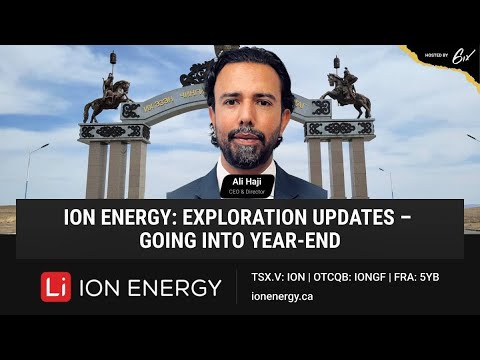
ION Energy: Exploration Updates – Going Into Year-End
Join us for a great event!
- Company
- Osiris One Metals Ltd. (TSXV:OSM)
- Date
- Tue, Nov 8, 2022, 12:00 PM ET
- Replay
- Watch the replay on this page · 55 min
On 6ix: 6ix.com/event/ion-energy-exploration-updates-going-into-year-end
Replay
Transcript
Automated transcript · Written by software from the replay's audio. It can mishear names and figures; the replay is the record.
0:07 Hello, everyone. Welcome to Ion Energy's live investment summit today, hosted by 6. I'm pleased to introduce our speaker for today, Ion Energy's CEO and Director, Ali Haji. Ali is going to walk us through our company presentation and then we'll be taking some questions live. And I'd like to remind you as the audience that you can ask any questions you like using the Q&A tab found on the right hand side of your screen. As always with the 6 Summit, today's event will be recorded and available on demand in the coming days on six.com. Without further ado, Ali, I'd like to hand things over to you to get us started. Thank you, Cam. Always a pleasure. For our investors, both current, perhaps perspective and existing, Thank you very much for joining us today. We're happy to have you. Today's presentation will revolve around telling our story once again to those that are prospective investors, but also providing an update to those that have been following our story or even invested in the company.
1:02 So Ion Energy is Mongolia's 1st lithium brine explorer and developer. It's a company I co-founded in 2017 during a visit to Mongolia. Typical disclaimer is there for those that need to review it. The team consists of myself as CEO. I've had 13 years plus of asset management experience across the world working program governance as well as M&A. My father's been in mining for the last 4 decades, so it somewhat runs in the blood. Matthew Wood, my chairman, is also the chairman of Stepgold, which is a gold producer in Mongolia today, chairman of Arangen Resources, but also a serial mining entrepreneur, 1 that found the Mirabella nickel deposit, but also exited a bank of resources in Brazil as early as 2018 for $440 million Aussie.
1:56 And more importantly in Mongolia, back in 2012, an exit of close to 500 million US with the company by the name of Honu Coal. Wendy Lee is our Asian counterpart. She works alongside the company to ensure that we have the necessary strategic relationships in that region of the world. Of course, we are in Mongolia and we require that. She was ex-Nobel where she worked on various off-take agreements for Mongolia between Mongolia and China for copper, coal and gold. Batatu Muroche, one of our 2 Mongolian directors, We believe it's important to have local representation on your board, irrespective of your jurisdiction. And Bata is the CEO of Stepgold, the producer that I mentioned earlier, but more importantly, has been an advisor to the Ministry of mines across various governments. So we remain politically agnostic.
2:50 Anil Varach is an investment banking professional, ex-student, ex-goodman, having done a fair bit of work there for various organizations, particularly in the mining space, as well as the liquid space as well. Ankitushan Kishikeswaran is our exploration director. He ensures that we have the necessary equipment and personnel in country to ensure that we have our exploration take place without deferment or issues. John McVicker is our CFO, XEY partner. We're happy to have him. But I'd like to draw your attention to the next 5 individuals who are very much lithium experts and well-recognized lithium experts, I should say. Paul Fornansari is a senior partner at Baskin, one of the major law firms in the world with respect to mining. Importantly, the original inaugural chairman of Lithium Americas, a founding director of Neolithium, and the lawyer on file that helped the transaction between Neolithium and Zijin.
3:54 Don Haynes, an industry recognized professional that has worked on lithium assets around the world, He understands hard rock, brine, as well as clays, so having him on our team is vastly important. Don currently designs our exploration programs. He was on site, if you recall, for our existing shareholders, on site about a week, week and 0.5 ago, looking at the exploration program in country in Mongolia. Dr. Hashbat Dasht-Etserin runs our exploration program alongside Don in country. And of course, Dr. Mark King, the qualified person at NeoLithium, when it sold to Zijin was also on site in April and helps design our exploration programs while we are in country. Dr. David Deke, the ex-CTO SVP of Lithium Americas, but also an individual that works at Tesla to help define and build Gigafactory 1, remains one of our key strategic advisors.
4:50 I was in Mongolia in 2016 advising another organization, Stepgold, through their acquisition of Sentara Gold's ATO asset, which ultimately now is in production. And my chairman and I looked at each other and said, well, we reside in an endoheric basin, very similar to what you would expect to find in LATAM. And as a result of that, there is no exit for any precipitation to an external body of water, call it a river that ultimately ends up into the sea or the ocean. And as a result, you could expect over millions of years that lithium may exist in the region. We were at the tail end of the last lithium cycle. We looked to build a lithium country purely because commodities are cyclical. But we've now seen that it's no longer cyclical for lithium. And I say that quite unequivocally.
5:38 Lithium prices in China hit 81,000 dollars plus as of yesterday pre pandemic 4000 dollars. So they are moving very quickly. And of course, now we're not in a cyclical environment. We're in a market that actually dictates or will ensure that the consumption of lithium will continue. Mongolia today is about 1 million and a half square kilometers for our Ontario listeners. That's 1.5 times the size of Ontario. Only 3% of the country has been explored, given that it is in an endoheric basin. We believe it has unlimited potential with respect to battery metals, specifically lithium. Of course, we know Oyutolgoy, the asset owned by Rio Tinto and Turquoise Hill, third largest copper gold deposit anywhere in the world, exists in Mongolia as well. So it is very well endowed from a resource perspective.
6:29 Their growth rate has been accelerating at essentially an exponential rate. It continues to grow based on mining. Geopolitics, of course, makes Mongolia rather important. It is a buffer zone between both Russia and China. And it is, as I said, underpopulated and very well in doubt. We've seen a lot of confidence with respect to the Mongolian government and what they're proposing from a mining perspective, as most of our historical listeners would know. I was in Mongolia last month, I had the ability to go to site, we had some really good visits to look at the exploration program in place, but more importantly we had an opportunity to meet with the Ministry of Mining and discuss how critical battery metals are and what that means for the future of Mongolia.
7:18 Having seen some indications and anomalies of lithium, of course, the government is rather supportive of what we're doing in country. Historically, Mongolia did not have the ability to bring in investment from, say, the Chinese, but as a result of cooperation agreement between the Mongolian government and the Chinese government, we've now seen Zijin, which is a major Chinese company, invest in Xanadu earlier this year. But more importantly, a major such as Rio Tinto has now doubled down on their investment in country, ultimately proposing to put back about $8 billion worth of value in the Mongolian economy. So it is an economy that's open for investment. We see that continually, and the government is indeed supportive of that mandate.
8:05 As a group we've been there for over a decade. We've had a fair bit of experience in Mongolia. My chairman, Matthew Wood, went in 2009 to set up a gold company, being a Rio Tinto gold scholar, ended up finding coal during a coal boom and started a company by the name of Hunu Coal with a 20 million dollar listing on the ASX with no assets. He acquired a number of assets, drilled them significantly, came to an inferred resource and ultimately sold to Banpo of Thailand for 500 million in cash 18 months later. When that company was sold, he had 300 employees and 3 expats, so very much a Mongolian company. Mongolia's exports are vastly mining related and so you have the necessary skill set in country that allows you not to bring in expensive expats.
8:55 When we went there in 2016 to look at ATO, Althansoga Novo, on behalf of Step Gold, once again that company was built as a Mongolian company. In fact, it went to production using 100% Mongolian staff. Currently, there is 1 expat in Mongolia running overseeing operations for Stepgold. And the goal there, of course, is to grow to 700 odd people with minimal expats. With Ion Energy, we went public in August 2020. In the height of the pandemic, we were all working from home, from our various Zoom locations in our homes. And we went public on the back of government spending in the electrification space. And that allowed us to really press forward.
9:41 And I think the goal for ION today is to de-risk our assets. And we'll touch on that in just a second here as well. The license we went public on is Babayol. It's 81,000 hectares, so consider 60 kilometers wide by 20 kilometers tall in its largest space, 23 kilometers from the Chinese border, Sukhbaatar province, which is essentially part of the Gobi desert, and an area in which the government of Mongolia is building 1 of the largest wind farms in Asia. The results that were seen prior to us sort of acquiring the project and going public showed an average rate of 426 ppm, maximum grade of 811 ppm, and clays and evaporates down to about 6 meters in depth. So not very deep, but rather exciting, given it was in the end of, or it is in the end of the Basin.
10:36 The impurities that we've seen so far, potassium, magnesium, sodium, calcium, boron, favorable, unlike those that you may experience in the Qinghai brines, which are about 1500 kilometers southwest of Arasat today. We know the aquifers based on historical drilling are rather shallow. We do know that it is brine related, so there is an aquifer that is brine beneath surface. And of course, we went public in 2020. And 1 must recognize that we did not have access to country or Mongolia, the world was vastly shut down until earlier this year. And that's important for our viewers, our listeners and everybody else to note because you look at LATAM, the lithium triangle, you look at Nevada and other jurisdictions, the necessary skill set existed in those jurisdictions for those assets to progress.
11:28 So they did not have to bring in expats to continue their drilling and and their ultimate de-risking exercises, whereas on behalf of ION or with respect to ION, the skill set did not exist in country. So what we opted to do was drill a number of auger holes across the entire asset. And for a sense of scale, that's about 5 times the size of Vancouver. We drilled 222 holes across the basin, covering around 70% of the landmass. In that process, we unearthed a result of 1,502 ppm, almost double the 811 seen historically. But importantly, we also found copper and nickel. And for our viewers that are following battery metals, copper, nickel, and lithium are all required for the clean green energy revolution. So very exciting stuff there without having access to country, without the necessary scale set. And it continues to be a priority of the company and we will explore that further in 2023.
12:27 Last year, we came across a project that was rather intriguing. That is Urgaknarran. Urgaknarran is in a basin, about 29,000 hectares in terms of the size of the license. The actual basin is about 17,000 hectares. And we've talked about parallels or the team that represents some of our historical successes. And as I mentioned, Paul Fornazzari, being the founding director of Neolithium, if you look at the scale of this asset, Neolithium is based in around 17,000 hectares And Ion Energy's Urgaknarran asset, as you're looking at here today, is in around 19,000 hectares. Of course, NEO's fed by a spring, so it is vastly different. But the fact that what we're seeing at Urgaknarran is fault-bound, It's shown very high anomalies on surface, which I will get into in just a second.
13:21 And then 19,000 hectare basin is rather encouraging as well. So on the back of acquiring this asset, myself, Don, Mark, and Enki, who's located in Mongolia, understanding that we'd had, we would have had access to the country this year, designed an exploration program that would mirror very much the skill set that you would expect to see in LATAM if you were de-risking a brine project. And so we started designing our program back in November of last year. We went outside in April this year. Those images are on the presentation that I'll cover shortly. But importantly, if you look at that image there on the right, that's very much a salar. It's very much what you would expect to see in LATAM. So it is a salt crust evaporate sort of basin.
14:06 You have a number of low precipitation zone. I beg your pardon. The entire region has low precipitation and very high evaporation. It is in the South Gobi. We collected a brine sample that you see there in the image on the left. That was 918 milligrams per liter of lithium, the highest grade ever collected in Mongolia. Now, 1 must explain that in fact, this is on surface, and as a result, it does evaporate and concentrate, and so those grades may be higher than what we might find beneath surface but at 918 milligrams per liter that is world-class grade. The vast majority of projects that we're seeing coming online in LATAM beyond you know the NEOs of the world between 300 and 400 maybe 500 up to 600 below surface. So having 918 on surface, of course, very encouraging.
15:01 We started exploration in April this year, including a number of drill holes, but more importantly we did a geophysics program, which is TEM, and that has shown us across 8 lines that we completed of 82 kilometers total length that we have resistivity starting at about 0.2 ohm. And 0.2 ohm is an important number for our viewers to take back. And that's because the vast majority of junior miners in the lithium brine space will report in and around 7 ohm as their cutoff. When we had 0.2 ohm, that was highly encouraging. We saw the 918, again, very highly encouraging. The low resistivity zone was defined and we're seeing very many similarities across what we have on our assets as opposed to the lithium triangle between Bolivia, Argentina, and Chile.
15:52 That encouraged us to do an additional line, 16 kilometers across all 8 lines to better understand from sort of a three-dimensional structure what that low resistivity zone looked like. And the results of that were at a half-ohm cutoff, we had 9.9 billion cubic meters of low resistivity brine. At 6.5-ohm cutoff, we had 22.7 billion cubic meters of brine. Those numbers are important for our viewers and our listeners, because if you look at any project around the world today, and it's the view of our board, that if you have shy of 10 million tons of lithium carbonate equivalent, it does not justify the capital expense or the capex necessary to bring that asset to production.
16:39 With respect to what we're seeing here at 22.7 billion cubic meters at 6.5 ohm, if we had an average grade of 100 milligrams per liter, which I will admit is low, but the technology exists to bring that production, that gives us 22.7 million ton of lithium carbonate equivalent. So, rather indicative of something that could be brought to production given the CAPEX justification. In terms of a half-ohm cutoff at 9.9 billion cubic meters, again, at 100 milligrams per liter, that gives us just shy of 10 million ton lithium carbon net equivalent. Very just on the cusp, if you will, of what would be relevant for something that requires funding to come to production. So we're very excited with those results. And the last summit, I believe I was presenting this to you, we talked about getting out to site and ensuring that we have a drilling program in place for us to better understand our assets, but also collect various assay results.
17:38 So I was on site, call it 4 weeks ago or so, and we were reviewing the drilling program. We had the diamond cores turning. We had the tricone bit as well turning that builds the water wells that are bentonite sealed all the way down, steel pipes all the way down as well, slotted where we saw porosity, and those holes continue. You can expect an update from the company in the coming days with respect to what has been completed and how much work has been achieved. But all in I think in terms of management and board we remain highly encouraged with what we're seeing. We're seeing various porous or regions of porosity that ultimately are similar to those that you would expect to find in La Tame.
18:26 We completed the visit. We did 2 lithological holes and the lithological holes for our listeners are ultimately those that allow you to understand the stratigraphy. So you're looking at the ore body of the rocks and you're trying to determine exactly what that makeup is. The water wells are more focused on the brine aquifers that exist beneath surface that would be part of that low resistivity zone that we've just talked about. So having seen the accumulated gravelite and porous zones starting at 184, showing us about 80 meters contiguous in the very first hole, UNDH01, is rather exciting. And I think you will start to see a fair number of press releases that highlight just what we expect to see here, but more importantly, this drilling program allows us to work toward the inferred resource that I mentioned on our previous conversation as well. So the inferred resource for those that are new to that calculation, ultimately you drill through the basin.
19:27 You find out the lithological structures where the lithium bearing rocks are. You also look at where the porosity is with respect to the water wells. And that porosity allows you to better understand where the brine that is being leached out of those rocks that are lithium bearing will reside beneath surface. Once you have a column of brine down to depth, and of course for those that are following our story, we're drilling down to about 300 meters. So when you have that column of brine down to 300 meters, the density of brine of course changes. The heavier brine that's more, you know, resource or mineral rich will sink to the bottom or settle. And you're able to go down using a Baylor system, which is going to be on site very shortly, to pull up those brine samples from depth, encapsulate it, and then ultimately calculate the average grade across the entire column of brine.
20:21 That alongside the volume of the low resistivity zone allows us to move forward with calculating an inferred resource. So stay tuned on that. That should be, I wouldn't say imminent, but of course we said pre the end of the year. The last thing I want to do is put out news during Christmas when everybody is knee deep and eggnog. So the holes have been drilled, as you can see here. These images that you see on your screen now were taken last week when Don Haynes, as I mentioned, one of our technical advisors that develops our program, was on site alongside Enki and the rest of the team, of course, taking some measurements and collecting samples, all of which will be released to market in due course.
21:08 I think it's important to note a couple of things around Mongolia. I think we talked about it being highly underexplored, but of course, given the fact that a number of their exports are mining related, your cost of operating there is rather low. But from an ESG perspective, we think about lithium today, we think lithium comes from Latam, so the lithium triangle, but also from Australia. Those are the best sort of producers today. And the clean green energy revolution is one that is ultimately allowing us to move towards this mandate of lesser carbon emissions. And so if you start to calculate the carbon emissions of shipping, say, either ore that needs to be refined or any sort of concentrate that needs to be, again, processed in China to come to battery grade, This is being shipped on the back of bunker burning freighters that have to travel 15,000 nautical miles to China, who is the largest consumer of lithium on the planet today.
22:15 Having our assets within, call it 23 to 150 kilometers from the Chinese border, of course we can reduce that carbon footprint. And I think that's an important thing for everybody listening to take away from this conversation. If you recall, we talked about the auger holes that we did on Bavaul, when we had no access to country. We did 222 holes there. We also found on that asset, which again is a significant piece of land, very strong indications of copper and nickel. So strong, in fact, that we partnered with an organization in Mongolia by the name of Aranjin Resources. They are a copper explorer with 2 assets, plus now, of course, a carried interest in Babayul.
23:02 And the copper-nickel deposits that are being seen there are rather significant. The victory deposit that was announced is about 2.5 kilometers by 2 kilometers, so rather significant. If you look at some of the grades obtained there, again, very important, copper, nickel, lithium, all 3 elements very required for the clean green energy revolution. And so this joint venture came in place for a number of reasons. 1, we brought the teams together to ensure that we didn't have overhead that would be detrimental to our shareholders. And 2, we have the necessary resources and skill set in country to allow us to advance these. But importantly, Ion Energy gets a 20% carried interest on all copper nickel found on any ion asset. And the Ranjan Resources is obligated to spend 3 and 1 1 million US over 3 years on these assets, exploring them.
23:55 So it's a free carry for any. Yes, we didn't have the opportunity to advance it at the level that we've done for Ogak Narain over the last year, but we now have a free carry on a copper nickel discovery that is rather significant as well. As a company, 60.5 million shares outstanding today, warrants are priced at about 11, at 70 cents for 11 and 500,000 warrants. Every option or any sort of instrument issued by the company has always been at a premium to the last issue. And we will continue to follow that mandate to not dilute shareholders. In terms of ownership, we control management insiders, about 25% of the company. We escort ourselves to ensure that we're not exiting as we start to have a bit of a run up because We're shareholders, we're owners, much like yourselves. We want to exit along yourselves and ensure that we're all getting the best value for the organization.
24:53 Mongolian investors control about 9% of the company that have put in their equity. These are individuals that are part of the previous few stories that we've had in Mongolia, including Stepan Hunu. Family offices, London, Zurich, New York, about 8%. Gelbrook Capital, when we did our bought deal last year, the PI Financial and Stiefel GMP, price at 50 cents. So let that sink in. 50 cents a unit with a 70 cent warrant control about 5% of the company. Spartan Funds out of Toronto, Alpha North, Maxit, Broma, which is the Lundin family, as well as Ixios out of Paris, own in and around 2% to 3% each as well. We're currently trading, if I'm just going to glance over here, about $0.18 a share. And as I said, the last bought deal was $0.50 a share, where we raised $5.75 million.
25:47 Our market cap today is around between 9.5 and 11.5 million dollars, depending on the day and our share price. So vastly under, let's call it vastly less than what it would have been when we raised capital for the company last year, before we acquired Urgatnar, before we found 918 milligrams per liter on surface, before we found the volume of brine that shows 22.7 billion cubic meters at 6.5 ohm cutoff. And before we've drilled now in excess of 1000 meters. So we've done a fair bit of work to de-risk our assets with world-class geologists. And so our market cap as represented here today, of course is rather low.
26:36 In terms of a catalyst, what you can expect from the company, I would say a number of organizations provide promises and what have you. And I think for those that have been following our story, I hope that you've seen that we have continually done what we've said we'd do. So we started trading on the OTCQB in 2021. We found the white wolf prospect. We started the JV agreement with Arunjan. We also found that 918 on surface, we've been to sites. Of course, I've been to Mongolia twice. I might be going out there before year end as well. We're going to start to do a fair bit of work on Babayul next year to better understand the asset using world-class skillset as well as technology. We had a visit with site, we had a site visit with partners that are looking to use a specific DLE technology which again is vastly more DLE friendly, vastly more ESG friendly than perhaps the traditional evaporation ponds that you see in LATAM.
27:38 We are having conversations with various strategics as to how we may partner with them. We expect to have an early resource indication before year end, an inferred resource in Q1 of next year, measured and indicated on Urgaknarun in Q2, and then of course, scoping and pre-feasibility on Urgaknarun in Q3, Q4. But one thing that is missing here, and I apologize, is next year we will be spending a fair bit of time, money and effort, better understanding the Bava Yola asset, now that we have access to countries. So that's one of the catalysts that, one of the other catalysts, I should say, that our readers, listeners and followers should be paying attention to. In terms of our current share price, I think if you look at various organizations and the run-ups that have happened in the lithium space, you will find that, I wouldn't say we've lagged so much. I think, you know, we've all had to run a fair bit at the end of last year and we started to come down with lithium prices of $81,000 per ton in China.
28:45 Of course, we believe we're vastly undervalued and so do the analysts that cover us. So Kuluara Capital out of Vancouver puts us about $1.12 as of May. They have yet to update their report as a result of the drilling that's been conducted. Fundamental research out of New York and Vancouver as well around $1.18. Zacks small cap research, it's about 42 cents a share. And that is, of course, almost 3 times our share price today. So that's a rather large multiple with respect to where we sit today. And I think that's rather scarce or hard to find with respect to various companies around the world. And then Stonegate Capital out of Dallas, once again, if you were to do the math in terms of their EV per hectare analysis, well above our current share price.
29:39 The slide on the right that you see there, I think, you know, it is, or rather the images that you see on the right, they're a bit dated, put together in and around the time that we had our bought deal. But the numbers and the ratios haven't changed much. If you look at what's on the screen there, there's a company up in the Atacama, and they control about 46,000 hectares. They have yet to drill a hole, but they're banking off of their neighbors or proximity play as we call it in the mining space of 1,250 ppm. Why that's important, they have the proximity play. We're first movers in Mongolia. Nobody else has gone out to Mongolia looking for lithium. Nobody else has done any drilling for brine or anything of that nature. And of course, when we went out there to drill, there is no proximity.
30:30 There is no other player. And we found, as you've seen on the previous slides, 918 milligrams per liter of brine, which is rather significant. We control now 110,000 hectares in country. We're located between 23 and 150 kilometers from the Chinese border, that being the largest consumer of the planet. And we've drilled, call it 1,000, quite literally, 1,000 auger holes across both assets. We've drilled now 3 deep diamond holes. We're in the process of completing our water wells, which again go down to about 3,350 meters. We've been outside a number of times and we're on track to have an inferred resource. So we have no proximity play, yet we're vastly undervalued.
31:20 This is a cap table that was put together by one of our analysts that covers our stock. Again, you see that we are at the bottom of the barrel here with respect to our valuation, despite building a world-class team, as well as progressing our assets through exploration. So with that, hopefully for our viewers, both new or existing and experienced, those that are investors, either again, existing or potential, I hope you get, we're reiterating the fact that we are funded. We're not looking for funding at this time. We're still happy to continue operations for at least the next 12 months. We've now completed the vast majority of operations at Urgak-Narin, and that allows us to focus on both the evaluation of Urgak-Narin, but also look at a strategy for Babayu.
32:12 We're located, as I've stated, rather strategically between Russia and China. And of course, there are consumers in the region. So not only the Chinese, let's talk about the Taiwanese, let's talk about the Koreans and the Japanese that are in the region. And for those that may not know, the Japanese in terms of their experience in country, they've helped build essentially the airport, some infrastructure in place there. In terms of the Koreans, the longest standing offtake agreement on the planet is between Korea and Mongolia for copper. So they've been there a fair bit as well. Hopefully I've shown you the team is experienced and we've had quite the track record not only in country but beyond. We know lithium is rising in demand based on the price that we've just discussed at $81,000.
33:01 Given the skill set in country and if you look at the all-in sustaining costs of perhaps Step Gold, you will see that the margins in Mongolia would be rather significant. We look at DLE as the option, and I can chat about that in the Q&A, or perhaps I'll touch on that independently. But we believe we're well positioned to create shareholder value in the short, medium, and long-term. So I will stop there, and Cam, over to you for Q&A. Absolutely, And as a reminder to everyone in the audience, if you'd like to ask any questions, please do so using the Q&A chat found on the right hand side of your screen. We already have a bunch of questions, though, so let's dive right in. First one from Marcus. In regards to ion production based technology, Is your production based on previously evaporated surface brines or slurries and conventional extraction technologies?
33:54 Good question. So the what you're seeing on surface, as I mentioned during the presentation, is very much a natural evaporation form. So what you have there is, is the the lithium-rich aquifer sort of leaching into the surface, and then ultimately, because of low precipitation and high evaporation, that lithium concentrates on surface. And as a result, you have very high grade. And yes, you could use evaporation ponds. And that's a fantastic question Cam because I was just about to talk to DLE and I think why it's important for us to note that DLE is a sort of the better option going forward and for very many of us you know DLE 5 years ago was a pipe dream. It was something that we would have looked to evaluate with respect to production of a lithium asset.
34:40 But we're seeing more and more that organizations that are multi-billion dollar market caps that have had the ability to divert funds to research and development have now been able to develop DLE technologies that will be in commercial production by 2025 at the very latest And doing so at a cost of 3500 per ton, of course recognizing the price at 81,000 today, that's a massive margin. And it's also less detrimental to the environment. So you're not sucking out the water table, you're not depleting what is beneath surface, you're pumping back the brines that have had the lithium extracted from them and you tend to maintain not only a small footprint, but the ultimate topology of the region that you operate in. So, great question, Marcus, Thank you.
35:34 Absolutely. Another question about current cash burn. How long will we be able to work on current cash balances? So with current cash balances, as I mentioned in one of my closing statements on the last slide, We've completed exploration and that's fully paid for on Org.Nurm. Our financial statement should be posted. Now we have just over 1 million dollars at the end of September. Our cash burn is rather minimal given the fact that we, I'm essentially the only paid executive. Everybody else is along for the ride and continues to buy on market. But that gives us sufficient capital to come to at least a measured indicator. And then we start to work towards scoping and pre-feasibility. But I would suspect that on the back of the work that we've done and of course events such as these, it won't be long before we have an investment at a premium.
36:25 So unequivocally, I will state to everybody that's listening the organization today is well funded and we will not accept any equity investment unless it's at a premium to the last raise that was done at 50 cents Canadian with a 70 cent warrant. All right, great. Jason wants to know how your visit with Strategic 1, Can you please elaborate on the interest shown? Are there any future visits planned, etc.? Anything you think important? Of course. Yeah, no, that's a good question, Jason. I think what you should take away from this is, of course, Mongolia being a jurisdiction that was never known for lithium and for us to be able to even take strategics with market caps as I mentioned, you know, sub or plus 8 to 12 billion dollars US.
37:11 That was a fantastic sort of opportunity for us to leverage their skill set, better understand what they've done around the world and sort of pick at their brain with respect to the programs that were running. Not to say that our team lacks that in terms of exploration, Dawn, Mark, Paul, these guys know their stuff better than most. But having them there and of course, introducing them to the ministry of mining, I think was rather important. And that sort of checks a number of boxes. It says, you know, Mongolia is now ready for that foreign investment. And importantly, I think based on the work that they've seen in country, we're under NDA, so we can't speak to that, of course. But they were very pleased with what they've seen. We have a bit more work to go until we can sort of, I wouldn't say re-engage, because we're currently in conversation with them on a weekly basis.
37:58 But they are rather excited with what they've seen, and we look forward to building a partnership with the strategic soon. Absolutely. Another question, how do you view the Canadian government requiring Chinese companies to sell off assets and lithium investments? Will this affect ION? Good question. It's 1 that I've obviously been grappling with from both my current investors and perspectives. I think you look at where we are today with respect to the announcement that was done last week. 3 companies were singled out. Of those 3, 2 had assets and operations here in Canada. And if you deem something critical or of national importance, it makes sense for you to look to protect those assets in country. Of the third company that was identified, that is a company out in Chile.
38:48 We believe that the narrative there is one that is being developed. It is one that is perhaps dictated from a political perspective. We also know that that organization in Chile had an interest from of course China at the time of over 20 percent. Of course these decisions are not made within hours or minutes. Those that are thought out quite 1 would hope profusely. But that said I think adding a number of individuals to your board, whereby they may dictate or swing or sway the operations of that organization, may be one that could be detrimental in the eyes of the Canadian government.
39:33 The way ION sees it today is we're located in Mongolia. The Mongolian government is highly supportive of any sort of investment coming in from the Chinese. Of course, we are a Canadian entity and we continue to operate that way. But I believe that it's not so much detrimental to us at this time. In fact, it's not something that's been keeping me up at night. I think there are, we're still early days. We still have to calculate the inferred and measured and indicated. And on that basis, of course, we'll evaluate what the risks or necessary pivots are for us to progress in terms of strategic investments. Absolutely. Have you done any work with direct lithium extraction just to even show that it works on your brine or in your brine rather?
40:24 So we have not done it with our brine. I think I mentioned this at the start of the conversation is we've drilled on Urgaknar and we've drilled 3 diamond holes for lithology. We're in the process of completing the water well holes which are ultimately what allows you to extract that brine. We've had various conversations with various DLE technology companies from Israel, Alberta, the US, China, Russia. I may be forgetting a couple, but we've had conversations with organizations that have that DLE technology, I beg your pardon, France as well. So 6 to speak of those that come to mind immediately. And they have a requirement for a certain volume of brine that they will require for them to ultimately run through their technology to see the viability of their processes.
41:19 And we have not completed our water wells as I indicated. So once those are done and we're able to extract those brine samples from depth in a encapsulated manner, we will be sending out brine samples to those various technology partners for them to run our brine to evaluate their DLE technology. Right, absolutely. Can you discuss the flow rate of brine from the resource? The attendees' understanding is that flow rate can be even more important than lithium concentration. That attendee is absolutely correct, and flow rates are extremely important. I will tell you that having been on site about 4 weeks ago and, of course, bailing out the hole, pumping out the hole, and then ultimately revisiting it to determine those flow rates or essentially get an understanding of the flow rates.
42:07 They have yet to be calculated and signed off by the QP, but we are encouraged. Right. Is it your plan to analyze both Brian assets before exiting? Will you try and realize value of Babayu before exiting? What would your preliminary idea of fair value for both assets be as well? It's a great question. I think it's all our view and the board's view that asset level sales tend to be detrimental to shareholders. And the fact that we are shareholders with management and insiders and we can insiders and we control 25 percent of the company. We don't see this as an asset level sale. It's not something that we're considering at this time unless we received a massive premium that of course would be of opportunity to our shareholders, including ourselves.
42:58 But We have a number in mind. We sort of know what our fair value is with respect to comps that have been put together by not only the bankers that did our bought deal, but also the analysts that cover us, alongside the analysts that may cover us once we are at inferred resource. And so fair value, I will not discuss in the public domain. I apologize. But I think we're well below fair value as far as companies concerned. Right. David wants to know if there are any geopolitical dangers facing Ireland? Geopolitically, not so much. I think 1 has to understand that, as I mentioned earlier, you know, Mongolia is a buffer state. It resides between China and Russia.
43:45 The Western world, as we know, will more than likely never want to see China and Russia share a border, especially when it's that large, given the various nature of those 2 countries. But importantly, from a geopolitical perspective, the Germans are highly invested in Mongolia. Mike Pompeo, when he was Secretary of State, he was out there trying to build some sort of agreement for the trade of materials, primarily on the mining front. You had Narendra Modi of India out there right before the pandemic as well. As I mentioned in previous comments and statements, the Koreans, The Japanese are also very heavily involved. In fact, they built the airport and Mitsubishi has had a presence there. Samsung, of course, has the longest standing offtake agreement in the world in Mongolia as well. So it is very much a buffer that is protected as a democracy that continues to operate.
44:48 I will actually be in during my last visits, as I've mentioned already. I met with the vice minister of mining who met with the strategists that I was with. And in fact, that individual will be accompanying Ion Energy in London, England at the end of this month at the Minex Forum, which focuses on Eurasia and that region. But ultimately the states that, you know, we're independent, we're sovereign states, and we don't see geopolitical issues affecting our operations in country. Great, this next question is a clear reference to an answer you gave previously in the Q&A. What is keeping you up at night about ION? Well, I just wanna press on with the inferred resource.
45:34 Being first mover, sometimes there are moments where we don't have the necessary equipment in country and I have to sort of hustle to locate it, source it, acquire it and then ship it over to country to ensure that we're on track for what we're planning to achieve. I think that's the primary objective as first movers. And if we look at Urgat Naren as essentially a virgin piece of land when it was acquired with no lithium exploration done on it, that kept me up at night. And now that I've been to site twice and my advisor has been out there 3 times this year and we're seeing the necessary indications based on the fantastic work that our team is doing in Mongolia as well as our advisors providing them with the necessary guidance.
46:22 I'm sleeping a bit better. Well, that's good to hear. Could you compare the cost of drilling your brine holes compared to your competition? It sounds like your resource is close to the surface. I wouldn't go that far. I wouldn't say it's close to surface. I think you'll see that in the following press releases. But what I will say before I touch on cost is the fact that a number of assets in Argentina, Chile, Bolivia today that are not considered Tier 1s of the past, their brine bodies commence around 600 to 800 meters below surface. Based on the press release that hopefully our listeners have seen, we put out last month, we start about 180 meters below surface. So of course, you're not going that deep. Now we don't know how deep they go, but we want to get a sense of what's down there before we start to spend more money to get deeper.
47:10 In terms of our cost of drilling, in and around 110 US for diamond core per metre, including assay. So very competitive, in fact, perhaps cheaper than most are used to. All right. And what criteria does Ion have, if any, to provide brine samples in order to examine potential DLE tech? What criteria? The criteria depends on the DLE technology partner. I would say that some have asked for up to 20 cubic meters to start. Others have asked for between 1 and 2. And those would run through their laboratories or their pilot programs. Others have come forth with proposals of building pilots on site whereby we don't have to ship Ryan.
47:56 So the logistics are different. And I would say again, for my previous statement, that we are in conversation with various TLD partners. Right. What's Mongolia's appetite to partner with Asian organizations for the development of assets that are in-country? Good question. I would say that historically you would not find direct investment from perhaps China with respect to mining operations in country. And that was a result of ensuring that the social license is being checked off and that you are hiring local, you are pressing on with developing and advancing essentially the socioeconomic status of those in country. That continues to be a priority for the Mongolian government.
48:43 I will also say that The president of Mongolia has been to China twice in the last sort of 10 or 11 months. His mandate there was to encourage cooperation agreements. Given the vast majority of exports from Mongolia go to China, in terms of resource and everything else. I mean, you look at cashmere and the beautiful fabrics that are that are sold in Mongolia, the vast majority are the wool is sent to China and then comes back as a sweater or what have you. So to touch on the importance of Asian investment, as I've said, the Koreans, the Japanese, they're already there. In terms of the Chinese, that is rather new with respect to Mongolia. We're now seeing that The Chinese are openly investing in Mongolia.
49:34 The government of Mongolia is mandating or rather encouraging that. We saw Zijin come into Xanadu Resources, which is a copper explorer, earlier this year. They put $26 million into that company to help fund it for drilling. And that was publicly announced. It's probably one of the first times that a Chinese investment directly into a Mongolian company or a Mongolian asset was announced in the public realm. So to answer that question in a very sort of succinct way would be that the Mongolian government is very open to Asian investment. Right, and what has it done, the Mongolian government again, to encourage foreign investment in the last year specifically, given its track record, especially in 2010 with Oye Tolgoi?
50:23 Yeah, so you talk about foreign investment in the last year, but let's take a step back. Let's go back to 2016, the Foreign Investment Protection Act that was put in place by Canada and Mongolia was signed. And what that did was protected Canadian investment in Mongolia. We talk about Oyutogoy as perhaps the sort of scapegoat for Mongolia and why we think that, you know, Mongolia is not a safe jurisdiction to invest in. Well, I'll tell you that that Oyutogui Rio Tinto investment in the country was one that was put together on the basis of a massive capex investment that drew down on the GDP of Mongolia in a significant manner that did not allow Mongolia to see any return on their investment for a number of years. And that sort of, it ruffled some feathers and ultimately government and politics decided that perhaps this is not what we want and they threatened to nationalize things back in 2012 or so.
51:24 But they've learned from their mistakes. I mean, you know, we've been out there since, I've been going out there since 2016. I've met with the Prime Minister in public forums, the President in public forums, the Minister of Mining at every PDAC where we've hosted them or they've hosted us for Mongolia Day and what have you, and that's changed now. The Minister of Mining, of course, has changed since 2016. And unequivocally, the messaging there is we've learned from our mistakes. We cannot go in there and do a deal where it's a big part of our GDP and we're highly indebted as an economy and as a country without any return until the $5 billion project is completed. So let's work together and find an arrangement whereby government benefits.
52:11 But importantly, I think there's another angle to that, Cam, and for you that asked the question is, you know, Mongolia today imports the vast majority of everything they consume, including toothpaste. There are no manufacturers in country. Everything, as I mentioned, including cashmere sweaters comes in from China. So we're in a position today with respect to ion energy to build potentially or partner with somebody that builds potentially an operation that produces lithium carbonate in country at prices of 81,000 per tonne, employing locals, paying taxes, giving back to the economy. The opportunity is vast, and the government recognizes that, and they're highly supportive. That's great to hear.
52:56 Another question, though, how does the chemical makeup for Bavayol and Erdark Naran compare to the Chiang Mai in China? Chiang Mai brines are a little more impurity-driven, So the impurities there are significantly, let's not say significantly because that may be interpreted by others as something different, but they are different. So the impurities at Qinghai are higher than those at Urgaknarin, which is encouraging, because the impurities ultimately add to either, if you're using DLE, the reagent costs, or if you're using refinement methods that might be smelting related, again, energy related. But what we're seeing today at Urgat Naren, the impurities are vastly less intrusive or detrimental than what you may find at Zhenghai. All right. Well, Ali, that looks like all the questions you received for today.
53:51 So as we wrap up, I'd like to hand things back to you for some closing remarks. But before that, I wanna thank you for coming on, of course, as well as everyone in the audience. Thank you, Cam, and thank you for our listeners. In closing, I'd just like to say I appreciate your time. Thank you for joining us here today. Hopefully, what I've presented to you shows you an investment proposition that perhaps you've not heard about or ultimately answers questions for those that are on the fence. And for those that are current investors, we appreciate your support. As stated before, we have a number of catalysts coming up this year, including an early resource indication, some drilling results, and we will continue to market. So again, thank you very much for your time and much appreciated.
Follow Osiris One Metals Ltd. into a list and get an email when it puts out news.
Latest news releases
- TSXV:OSM — Osiris One Metals Ltd Announces Name Change to Osiris Copper Corp · Mon, Nov 2, 2026
- TSXV:OSM — Osiris One Metals to Acquire Island Range Copper Gold Project · Mon, Oct 19, 2026
Companies on this call
More from Osiris One Metals Ltd.
- Nov 22, 2023 Powering Tomorrow: The Lithium Triangle – Extraction, Processing, Recycling
- Aug 25, 2023 Lithium Trade: Understanding Market Dynamics in China, US, EU and Canada
- Jun 08, 2023 Technology in Mining
- Jun 01, 2023 EV Projections and Critical Minerals Strategy
- May 24, 2023 ION Energy: A Diversified, Global Lithium Story
- Feb 01, 2023 The Digital Conference Experience