Transcript
Automated transcript · Written by software from the replay's audio. It can mishear names and figures; the replay is the record.
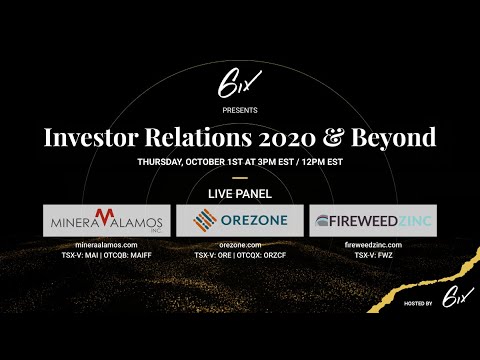
0:05 My name is Bianca Mischola. I am the COO of 6 and welcome to Investor Relations 2020 and Beyond Part 1. I would like to start by introducing our presenters. We have Vanessa Pickering from Arizona Gold, Brandon McDonald from Fireweed Zinc, and Doug Ramshaw from Monero Alamos.
0:25 You know what? I cannot give you guys enough justice in terms of your introduction, So we'll start today by going around and and having you guys introduce yourselves for our attendees. Why don't we start? Right. I don't know if the same position as everyone else but below me is Brandon. So we'll start there Yeah, I'm above you in the thing. So it's not the same position, but I'm right Donald CEO fireweed zinc I'm a geologist by trade but some of the digital stuff plays a bit into my background because during a downturn, geez, 20 years ago it started, I spent 5 years as a computer programmer as well.
1:04 Cool. Vanessa, over to you. Hi, I'm Vanessa Pickering, and I manage investor relations for Orzone Gold Corporation, and we are developing Burkina Faso's next gold mine at our Bamburi Gold Project. I unknowingly fell into Investor Relations. I took a two-week position at a company to help them. They had just gone public. They needed somebody who had some office experience, someone to mail out share certificates, and get them ready for these 2 things called Roundup and PDAC.
1:41 So 16 years later, I am still in the industry and helping people tell their stories, whether it be digitally, print, whatever. Very cool. Doug. Hi, I'm Doug Ramshaw. I'm the president of Monero Alamos, and I definitely have the worst internet that anyone's dealing with today. If I do start buffering, it normally only takes a couple of seconds, not long enough for you to go and get a cup of tea or something.
2:11 And whilst I'm a mining geologist by training, I've been on the corporate side of companies for 20 plus years, all the advent of the internet and the early days of the internet and mining and how it co-existed or didn't, as the case may be, and I've witnessed that evolution and been part of that evolution over the last 20 years. Yeah, I think Doug and I are both recovering geologists.
2:41 Have you recovered yet? No, no. Cool, well folks, really, really excited to have you all on the line here today. So the topic of our conversation is investor relations 2020 and beyond, but obviously the focus here is on how digital has transformed the industry. So to kick things off, I'd love to know, over the past decade, how do you feel IR has changed with digital as a new feature?
3:11 I don't know, less paper cuts from mailing off shareholder letters, that's for sure. I don't use the fax machine anymore to fax people my news releases. You remember when that was a thing? Well, over the, like, I remember being in my dad's office in the 90s and he, my dad's, you know, worked in junior mining his entire career. And I can remember trying to arrange, or he was trying to arrange, or his buddies were trying to arrange this mass fax program, right? Kind of like how you might do an email blast now. They had somehow tracked down, like bought a list of 5,000 fax numbers of investors or something like that, you know, so it's, but the last 10 years has not been probably as big a shift as the 10 years before that.
3:59 I agree. Yeah, Yeah,
4:01 I think the last 10 years, things have become much more dynamic. Things have become much more real time. You know, I mean, you're seeing it from, you know, even from a trading point of view in the 90s, people get their stock quotes in the paper the next day.
4:20 And from that, you got the advent of online trading and everything. So that, you know, what in parcel with investor relations has become, people expect stuff to be at a flick of a switch now as opposed to in the old days where it was very, very static. You saw in the early days of Stockhouse and Stock Group during my age here, because they were 2 different companies doing the same thing in the old chat rooms. Then they merged and made Stockhouse.
4:51 Now you've got these which are of a similar type, but it's real-time conversations people are having. So I think that's the biggest shift now, although the major one was 10 years ago as we got used to the internet. From an investor relations point of view and marketing a company, it's really on demand kind of what the investors are looking for. Well, I think that's the last 10 years has been the rise of, sorry, Vanessa, I told you I'd talk over you. Yeah, I know you did.
5:23 I was just saying like the 10 years, like, as I can remember, in the 2000s, we were already doing like ad spend, like less, you know, you didn't have the retargeting, etc. That you do now, but we're still doing it. I think the last 10 years has been social, the rise of social and the responsiveness investors expect from management IR through social channels has been radically different. Well, and I would say that it used to be that the only place that you could get information about a company was from the company itself. Now you have all these different places, avenues, and that
5:59 aggregate your news, aggregate information on your company. So people have a choice. They don't have to come to me. They don't have to come to you as presidents and CEOs of companies to get their information. They can get it a myriad of places. But at the same time, Whilst that's true, I think it also, investors, rather like companies shouldn't use social media to replace traditional contact with shareholders and stuff. I think investors shouldn't use social media as, you know, it's no substitute for picking up the phone and calling the company, you know, and seeing how responsive management is because, you know, if you're going to put some of your hard-earned off-the-tax dollars into a company, I think the least you should expect is that company to
6:50 actually communicate with you and not feel like social media replaces the traditional approach. They work together. Yes, I agree with that, absolutely. Speaking of responsive, I can see Robert Livingston said he missed the first 5 minutes, but it appears I haven't missed anything. That's like, that's a deep cut, Robert.
7:16 It's just immediately assumes we've accomplished nothing. I mean, right?
7:23 Well, you know, it's funny you guys are talking about the difference between the last 10 years and the 10 years that came before it. I remember a distinct memory in 2017 having a conversation with the CEO of what was a pretty large mining company and having to convince them to get on Twitter because of I think what exactly you're saying, the obligations or the perceived obligations around that immediate communication. Some people are still a little scared of that and what that opens themselves up to. So I'd love to hear more about your experience in terms of coordinating with investors on social, whether it be Twitter or anywhere else, and how that's impacted your relationship with the investor.
8:11 You know, it's kind of a preamble. It's funny that the Securities Commission recommends that management do not engage in social media or anything like that. I aggressively disagree with that because any management who's going to say something on social media that they shouldn't, you know, whether disclosure rules or whatever,
8:34 is certainly going to say it over a beer at the bar. They're certainly going to say it to someone who approaches their booth at PDAC or VRIC or something like that, right? So at least on social media, we have a, it's documented, right? In terms of disclosure violations, it's there for eternity. You can try to delete your tweet, it's preserved, right? So I think it actually is a, yeah, responsive, but it's a great tool for keeping management on this too in terms of how they talk about things. Yeah, like why would you say anything different
9:06 on social than you would in a meeting anywhere else? If you're a professional you should know better, I think.
9:15 Yeah, and the odds are if you can't say it on social Why are you saying it in a meeting unless if the person less the person's under CA? Yeah, I mean there was the interesting thing last week with Tom Collier of Pebble You know someone said don't say anything that you know because you might they might be cameras filming It's like you should always be talking as if.
9:38 That's loading. You should always be talking as if you're loading. Cameras are rolling. Yeah, no, so You should always talk like there's a camera, maybe 1 with better internet. But think about that. It's the same, I mean, the old rule was don't say anything you wouldn't feel comfortable putting in a press release. I think that should apply to any form of social media. I mean, one of the, to Brandon's point, I mean, we're seeing it with the president down South. He has, there's a tweet for everything. There is an archive of everything that's ever said on Twitter. So, you know, maybe 10 years from now, we'll all be digging up Brandon's tweets from now and saying, well, there's a tweet for everything on Brandon's feed.
10:25 But part of it comes from the fact that those original BCSC rules existed at the time of Stockhouse and Stock Group and they've never really evolved. We've seen the industry and the internet and all aspects of how the 2 coexist, evolve over the last 20 years, but those rules from the Securities Commission haven't evolved, just like CEDAW, you know, which should be anyone's first place to go for researching on a company and then answer questions of management and check hasn't evolved. And CDI hasn't evolved. Those rules from the commission haven't either. And it doesn't mean that
11:09 you shouldn't adhere to common sense policy of expect that you're being filmed or expect that say stuff that should only appear in a press release. But, you know, and it's made for a lot of company management to miss out on an opportunity of augmenting their traditional marketing with social media engagement, Because there is that nervousness.
11:38 Yeah, you know, I think that one of the really interesting things that social media has allowed us to do is you can get a lot closer to investors, but also they can get to know you on a personal level as well. One of the things that I think is very unique about the 3 of you is that you, in addition to being superstars at your respective companies you have a very distinct personal brand, each of you. So I would love to hear more about how you endeavor to build out that brand, what is that brand, and what that whole process has been like for you.
12:13 I think there's, Doug was kind of talking about it a little bit, but there's, you know, the authenticity is kind of critical, right? Like there's a lot of CEOs or whatever that are on Twitter, et cetera. All they do is share company updates, don't respond to stuff.
12:30 This is almost, I don't know, maybe investors can have their own opinion on this. I think it's almost worse than not being on it because you're just saying, like people who have 0 or follow 0 people and have 1000 people following them, it's like Clearly you're not going to Twitter for information. You're just going there to dump your opinion and you don't want feedback.
12:52 So I think it has to be a two-way street and you have to be authentic. And I like to think if people know who you are, they feel more ownership over their shares in the company and they are stickier, right? They don't have to love who you are necessarily, but at least if they get some comfort with what you represent, as long as you seem to represent something reasonably good. Yeah. Talking about authenticity, I remember, so it was Rob McLeod, so the president and CEO of Heatherdale Resources, that is very big on Twitter, and he encouraged me. He's like, Vanessa, you gotta be on Twitter, and this is when I worked with him at IDM. And I guess I'd been a little, you know, a little scared, whatever, of, you know, taking that next step into my social media life.
13:39 But I remember writing the first tweet and, you know, asking Rob to look over my shoulder because I thought it might be a little too sarcastic, not on the IDM Twitter, on my personal Twitter. And he looks over my shoulder, he's like, yeah, that's a Vanessa tweet. He's like, dude, the second somebody meets you in real life for the first time, if you're just spouting kind of a corporate byline, they'll know it's not you. But with a little bit of your character, whatever your flavor, people know it's you and that's authentic. So I have to give big props to Rob McLeod for getting me started on this path for good or bad. Yeah, Rob's for me, he's my OG of Twitter. Like he got, I started looking at it because he was on it.
14:30 I watched how Brandon preceded me in terms of how he interacted again, via Weed in chat rooms and social media, you know, and so I watched and I learned, But the absolute key thing, and this goes back to when I actually did play some online video games at one point in my life, I noticed when people are online, you know, in a game agreement or on a Twitter environment or whatever it might be, because there's a certain anonymity behind it, or, you know, at least for some people, they take on a different persona. And I think anyone that would have met Brandon or myself or Vanessa in real life, will go, you're just like you are on Twitter. Or you're just, well, yeah, because you're not trying to be anything different. And that's to your point about authenticity.
15:21 And I think that, you know, behind these companies we invest in and shareholders, backers and everything else, you know, it's important to think about them. It's good for them to understand during all the trials and tribulations of the markets we operate in that we're real people too. And I think it's really important to have a human persona behind what we might be choosing to do, which is using a Twitter feed to occasionally talk about FNC football or your mining company, but to Brandon's point, not go on Twitter and just think of it as another way to layer your company's story out there. You know, that's not this dynamic change that we've seen in the world. That's this path of static, these early days of the internet, and times are a-changing.
16:16 And if you don't, you know, like people are trusting you with their money, like they're investing in your company, right?
16:23 That's their savings. That's their nest egg. You have a certain responsibility to them. And I don't think it kills you to show a little bit of yourself, right? Like a little bit of who you are. I think that's kind of the least you can do. You know, you don't have to be full disclosure, right? I think there's definitely TMI, you know, whether you're doing patentless or shirtless photos, you know, that's Not for everyone. But yeah, I think if you don't want to be authentic and let people know who you are, there are lots of jobs out there where you're not the face of a company, right? True. I know that this is going to segue into what we're going to be talking about next, but it's kind of been very interesting during COVID to get that kind of eyesight into everyone else's lives as well.
17:13 You kind of feel like bankers and maybe fund managers kind of walk out of their houses in the morning looking like 1 million dollars, looking like they represent billions of dollars. Now you're seeing this insight into people's houses and seeing how they're just real people like us.
17:31 All right, You're looking for the billionaire behind you, Doug? No. No, I'm looking for the fat behind me, but I changed my computer position. But it's been really- It's about to get very real at Doug's house. Not too long, that's for sure. It's just been good to see that, to see the realness on the other side, not just from us as people representing companies, but, you know, to see a kind of insight to other people's lives that maybe you hold on a higher pedestal. And I think, you know, you talk about
18:07 social media should be a two-way street. Get to know your investors who communicate to you through that and see their authenticity. Because look, I don't think any of the people present here are prone or have any inclination to shady business, right?
18:23 But if there was a little greedy little voice in the back of your mind, knowing your investors personally is gonna go a long way to shutting that voice up, right? Because then there's a face and there's a real person and a friend that you're going to be screwing if you do something dubious, right? So another good reason to be wary of CEOs or management who doesn't want to get to know you, right? Because they don't want to know who they're crossing. Yeah, I mean the highlight of my day, you know, is when it's a shareholder that calls. You don't get enough, they don't engage with management enough, But those are the ones which to me especially, because as management running these companies,
19:08 I think it helps on a daily basis remind us exactly why we're doing this. I mean, there's a great responsibility, corporate fiduciary responsibilities of what we do. But I mean, if we're in a sector where you can change people's lives and, you know, and I do regret that people, you know, don't engage management enough. So, you know, yeah, when they take that trouble to to ask questions, that's going to take that trouble to get to know them, know your investors, you know, it's, you know, so yeah, I don't know if social media helps that or not. I, you know, it's because I think we as companies get less and less down-to-earth now as a result of people feeling like they have this connection and not making the genuine connection.
20:03 So, fortunately, for the DMs, just the general Twitter feed comment section, does give you that. I'd be interested in tracking kind of inbound phone calls as opposed to an acceleration of
20:21 other contact with your shareholders and they're both valuable. I think it's, you know, that's why this is, these opportunities are good because I think, you know, shareholders should demand to know the people behind, you know, that are running their company. And I hope that social media doesn't make them lazy and wanting to push for those kinds of questions. I see Ken's making a point there, he's saying sometimes CEOs push out too many memes and jokes. I mean like I feel personally attacked but also because legitimate point there I think there's a a limit of acceptable irreverence on social media right and I think that the 3 of us probably skirt that line
21:09 right I guess you know but that's you know, for what you were saying, Doug, that's very reflective of our personalities, right? Like, I don't think anyone would would say like, oh, Brandon, Doug and Vanessa, so self serious, right? I just not we are right. And yeah, look, you gotta
21:28 gotta know there's sometimes things that don't, you know, you can take it back down a little notch, right? But yeah, and it's a difference between a corporate social media account and your personal 1. And I'm not saying just because you have a disclaimer on your personal 1, which I don't at all opinions of my own. But I mean, you know, there's corporate which is stuffy, you know, and that's why, because that should probably be, you know, there's your news releases and everything else. But I think the bigger problem, you know, I definitely won't change my approach on Twitter. I think people oh I certainly am a culprit.
22:15 Honestly, I think the world needs to laugh a little bit more. We're going through a tremendously tough year for so many people in many ways in the mining industry. I've said this in interviews recently. I feel like gold mining companies, we're like arms dealers at profit off of war. Like when gold's doing well, it normally means that people are dealing with misery
22:37 in 1 area, aspect of their life or whatever. I've always said that I think that the world needs to laugh more. That doesn't mean that, you know, I should try to attempt to be a standout comic because I'm not that funny, but I will use other people's humor, memes that they've created, to hopefully inject a bit of humor into the day that's relevant to a particular bit of news we may be discussing on Twitter, just because I think, you know, the world would do a lot better
23:06 if it smiled a lot more and smiled at each other, and especially 2020 and all that it's thrown at us. So, you know, I might not be able to use that excuse in 2021, but I'm most certainly a culprit of that, and I make no apologies for it. ≫ I would like to see the memes that come out of this panel.
23:26 This wouldn't be a panel in 2020 if we didn't talk about COVID. So I'm going to talk about COVID. We've kind of alluded to it already, but I'm curious because I think my experience is probably similar to you. I had a full travel year planned. I knew where I was going to be and then that all kind of got wiped away. So how have you all adapted
23:46 and how have you stayed connected to your investors in spite of the world pretty much locking down? Can we start by agreeing that PDAC was an awful idea and like that we thought collectively as an industry we dodged a massive bullet, right? That was at the, oh man. Like by the time I got home, I was like, this is, this was stupid. I jokingly brought a mask to PDAC, like as a joke and took a photo. That is like clearly not a joke now, right? Like, but no massive. Yeah, like, you know, I think and I honestly, I mean, PDAC is an interesting one, because I think I, no offense to any PDAC organizers that are on this call, because, you know, I almost made this comment to someone who's organizing virtual PDAC next year. I did a little jig when I heard that PDAC's going virtual. It's one of these conferences you feel you have to be at, you know, and I've always got value out of it, but at the same time you're not going to shed a tear next year
24:51 This is going to be the new normal for quite some time to come and You know has it impacted people I think I think actually for all 3 of the companies here, I would imagine they all have these strong rolodexes and everything leading into this. I think it's probably been less impactful in the day-to-day business, certainly it has been for me, than for companies trying to get visibility in this marketplace, they're trying to develop a broader network where the virtual conference environment's not necessarily as conducive. I think people are getting used to these kinds of webinars and stuff. There's probably been lots of them, but by this point, I'm assuming everyone has completed Netflix. So, what else is there to watch, but mining CEOs and IR people coming on and giving them the latest spiel?
25:54 You know, I I think we have to prepare for the fact that this is our new normal going forward and rightfully so as we try to reset the world. Well, and I think that there was a period of erratic price discovery early on with the virtual conferences. And without naming any names, some companies, someone mentioned that the G&A saved on travel and budgets and stuff like that. And it's like, oh, we're going to charge 10% less for a virtual conference. Because think about it, you don't have to do flights and hotels. And it's like, Yeah, but your costs have also gone way down. Like to them, a virtual conference, that would have been a gangbuster to 10% off. So there was a period where some were, I think were being highly opportunistic with their pricing. And it's since normalized to, I think, I don't know what, about 0.5, I think as it seems to have come down to.
26:51 It's okay. And one of the things that's missing is, like you say, PDAC's kind of one of those conferences that you feel like you have to go to, but it's the happenstance, it's the who you bump into at the water cooler or the after party or the whatever. All my meetings that I've scheduled in advance, I can do over Zoom or whatever, right?
27:15 It's the meetings that, it's the Rumsfeldian unknown unknowns like the people you don't know that you haven't met yet, that the in-person conferences are still very valuable. I think we've seen enough of each other on webcams. Like it'd be enough to, it'd be nice to see each other in person. Yeah. I was talking to some of the IR people and people I work with, and there's just been a fundamental shift in how you can communicate with your shareholders. So it would have been seen prior to COVID as a bit of a slight if you didn't go visit your major shareholders a few times a year, a couple times a year, do an in-person update for them. And now I think it's, we know that we can update them from the privacy of our own living rooms or offices or wherever we are. And we can do that now. So I think it's obviously going to cut down on, you know, that 30 to 40% of travel, but we're really going to be lacking in the making those new connections like you're talking about, just bump into somebody at a bar or a reception or at the water cooler, those kind of relationship building that we're really going to be missing out on because there's going to be turnover in this industry.
28:34 There always is.
28:36 I'm going to use this as the chance to tell my story that I promised to tell. So for those, no one would know except us 4, I was talking about a good story about a webinar. This actually predated COVID and the perils of webcams. So I was doing, through one of the New York-based,
28:56 you know, online webinar companies, I was doing a presentation and my webcam's on and I got my presentation up and there's like 20 people there and they're all muted and their webcams are not even supposed to be on let alone anyone seeing them. So I'm on like slide 5 and someone coughs and as soon as someone like makes a noise it brings up their webcam right I don't realize I was the only one who could see it but their webcam kind of popped up in my corner my screen and it was a big naked man and obviously was unaware his webcam was on. And so, oop, losing my earpiece here. So, this needless to say, completely derailed my pitch because I'm like, what? And like, he wasn't going away. I'm moving one of my windows over the corner of my thing so I can't see him. Cause I'm like, you know, and this like first off. So this is a lesson for everyone whether you're an attendee or a presenter make damn sure you know whether your webcams on and what it's showing a second the old thing if you're nervous
29:59 just imagine your audience naked Do not do this. I have seen my audience naked. This is not what you want to see. It does not make you less nervous. So Neil, who is doing IR for us, talks to me afterwards and says, like, what happened around slide 7? Like, you just went quiet and started stumbling. So anyways, so as an aside, yeah, and you know, it's not something that happens in in-person meetings. People don't accidentally show up naked in person meetings. But it is, you know, it's good, I think, for like you said, Vanessa, the updates, right? Like I think I did it this morning, for example, no need for it to be in person. And in fact, when you're giving a presentation, like when you walk into say a broker's office
30:45 And their projector is VGA only or some stupid thing like that, because they last updated their projector in 2005. And you're seeing if you've got a, is there a dongle? Their IT is coming in to get the dongle to like get your thing hooked up. And like, it's actually I think for most presentations, not only is it just as good, like through a Zoom or Teams or whatever, might actually be better. Like we use verify for part of it and I'm able to like draw on screen and I'm not gonna turn my thing and everything like,
31:18 I think it's great. And I think the ability to do way more updates in a day also helps. Yeah, sorry, Doug. I was just gonna say our marketing has been amazing during this time. Like the amount that we've been able to get through and the accounts we've been able to see, that would have been crazy with my boss's travel schedule. Anyways, sorry, Doug. No, no, I mean, again, I think we benefit, perhaps some of the companies presented here benefit because we we've had a lot of that initial contact. When I'm meeting someone for the first time, it is nice when you've met them in person. They can, you know, they can pick up a genuine passion, enthusiasm in your body language, in your face, it maybe gets lost a little in, you know, over a Zoom call. But I did notice that, you know, as the months passed, you know, I was missing the human contact.
32:15 And so phone calls I'd be having with people, I said, you know what, why don't we just do it on Zoom? Because I knew then subconsciously I was missing that human interaction and just another phone call just wasn't doing it for me. And so a lot of phone calls have just become Zoom calls, you know, to kind of, I think, deal to a limited extent with that lack of human contact. And I remember one time I felt like, you know, I hadn't seen someone's face in a week other than family and you know I'm on this call with someone and it was such a relief because it was a little taste of what we were losing in this period of being locked down but no I mean most conferences honestly like our conference budget you know was relatively limited this year, but it'll be dropped, and I'm factoring in very limited next year, replacing.
33:16 No, Doug's loading. Digital marketing, everybody. With these opportunities, some of these webinars, and it probably be even more lack when I buffer out when I'm about to speak, but, you know, so we're seeing it from a company side. I think investors too are missing the fact that sometimes it's a reported presentation or whatever. It isn't the back and forth. And so that would be something, you know, that, you know, I think as these things move forward in this new normal, coming up with ways to make it as interactive as possible for the people listening in or watching in, will be an important step to make. Agreed.
34:02 Well, folks, it's about that time. Are you ready for some questions from the audience? I did see a question from Trevor earlier. Actually, he was talking about whether we see a use in something like Instagram. Yeah, I have it here. He was saying, how about Instagram and other visual content media networks? We don't see a lot of juniors slash minors on these networks. Is it possible? We use it, which is to say that Bianca manages it for me. Full disclaimer. But it's, I mean, Instagram's not really two-way like Twitter is. It's for like pretty pictures, which I think is useful, right? Like, hey, here's a great photo from site. You know, here's one of our employees we're pretty good proud of, et cetera, et cetera, right?
34:54 But it's definitely like, if I was gonna suggest to someone who's like, okay, I wanna get into social media, What does our company start with? It's like you start with Twitter. And then, I mean, Twitter, LinkedIn, I guess, you know, page to follow, but it's not hard to simultaneously post on those 2. And then something like, yeah, I think Instagram is kind of a distant one after that. I mean, my connection again is going. What I would say is that I think one of the biggest benefits, and full disclosure, I too use Bianca and her team because they do an absolutely top-notch job.
35:42 I found it in the past that you do a presentation. Okay, I'm back. It's a good point, so bear with me. Bear with my internet connection. You do a presentation with a different, and you put it out on your Twitter and then that's it. And that link gets lost in someone's feed. And I always, you know, we talked about retargeting earlier, but also repurposing media that you've created. You know, sometimes it's just a little two-minute vignette from that. People don't even link through to the full presentation in that time, but there are lots of ways to use Twitter and social media channels more effectively.
36:30 And I think that's helpful for shareholders, but I think from a company's perspective, you're getting far better value for that conference you might have given that presentation to with a little bit of incremental value pushed into social media. And so I know a lot of the questions here about DNA and, you know, is I argue this suddenly, but put it this way, if you look at any company's financial statement now and you're still seeing a very large travel budget, that's a big red flag this year. You know, I know it from the miles I put on my car or the lack of travel my company's done. Some normal marketing is definitely being pushed into other channels. But I still think it's, our budget should drop this year. I mean, if they're not, well, part of the problem is you're seeing a lot of companies raising money right now. I saw 1 today and they just closed a $500,000 financing and they hired, the next press release is hiring an IR group for 15 grand a month. You know, it, yeah, we're in the wrong business, Vanessa, I think.
37:40 But, you know, no, IR budget should drop, But it doesn't, I don't think it's going to be dramatic. I think there's better, more efficient ways to use the same amount of money, you know, or maybe modestly less. You are getting corporate DNA savings from reduced travel and other aspects for sure, you know, but I don't necessarily expect to see a straight line drop in IR costs. I think you should always be just treating every dollar you spend like you did when you were down to fumes. Yeah, well, I think you... The mistake a lot of companies make is they get a bunch of money, like we've seen a lot of money being raised by juniors in the last few months. And suddenly they're doing things like hiring IR groups for 15 grand and they're forgetting about how they treated their dollars when they were down to their last few hundred thousand. If you suddenly have $5 million, treat it like you treated that last couple of hundred thousand dollars, you use it more effectively, it will go way longer.
38:47 And that's probably completely off topic for this conversation. But it really is in answer to the G&A question, don't suddenly expect to see G&A, you know, IR budgets cut like travel budgets. I think, look for companies that are using dollars effectively and wisely in this environment. Well, I would- Yeah, go for it, Vanessa, go for it. I was gonna, sorry, Brandon. I was gonna say that like, just because you have access to this digital marketing or you made, you know, a bunch of money on a financing and now you're hiring this hire firm or whatever, like you shouldn't as a company, you shouldn't lose hold of your story because you have so many other venues to get it out.
39:32 You still should be planning your story, you know, like as if you were down to fumes or as you know your news flow or how to create the momentum going forward. It doesn't, What's the point of hiring a huge firm to do this big marketing push for you if you don't have the news flow as a company to support it? That means that you're just recycling kind of fluff. Well, look, the big digital marketing pushes, whether it's AdSpend or something like that or eBlast or something like that, you're targeting the long tail of investors, which is the retail. You have to, you need liquidity there, but where in the digital age you will struggle to target is the so-called whales, the PE funds, etc.
40:20 Those people you're not going to close without a face-to-face. And they're not ones that you're going to, with a little bit of extra spend on digital ads, you're not going to capture them. And that's the challenge of like, yeah, look, I can, you know, put your point, Doug, I can spend as much as I did before, and I can cut back on travel for sure. But it probably means I'm reaching more retail, but I'm reaching less of the big people. And both are important. And per Vanessa's point, I think it's a very important thing to distinguish between your story and your audience, Because if all story, no audience is a special kind of tragedy of like a spend money, like start spending money and telling people, right?
41:11 You have to, but then the opposite strategy is, someone's convinced a company that is no story that if you have all audience, you're gonna move. And it's like, well, no, right? So look, it's up to the management to create the story and then craft the narrative of it. But then the marketing these days, digital heavy has to get an audience for it. Yeah, I see Pete asking, Brandon and I, if we're tired of telling the same story in 100 plus Zoom calls. I, Yes, I feel at some point like I'm a comedian that needs a new new comedy set. Fortunately in my case I'm coming out of 6 months of talking about a development story and I can see how it's evolving next year and you can't wait to talk about it. It's a very different animal.
42:07 But, you know- That actually relates. I had a call with Pete and some other people 3 weeks ago, I think. And Pete made the point that, hey, I like the presentation, it tells you what I need to know, but my dad doesn't get it. Like he doesn't understand the narrative, right? Like he reads through your presentation and it's all very specific stuff about your project. And it's not a gentle introduction to the company and the project and it's like he doesn't know why he's buying this company, right? And this is actually where we talk about the communication with shareholders. That's critical. We actually had a good conversation about it And I completely revamped our presentation and I actually used Twitter as a testing ground. I was like, hey guys, like what do you think of this slide? What do you think of this slide? And there was a lot of feedback and actually unintentionally gets people really engaged because then they really scrutinize your presentation, right? Which is like, how do people pay that much attention to your presentation they don't normally?
43:08 So that was actually critical and I think our new presentation is a lot better. But that came because of a willingness to listen to investors, right, which seems to be lacking frequently, right? Absolutely, you gotta put yourself out there for sure. Question here from Brendan Creen in a similar vein. Well, now that we're putting ourselves out there, we're using all this new technology. He's asking, do you believe there's a need for disclosure rules to be updated to reflect new technologies? Yes, I do. I mean, you know, I think to Brandon's point, Twitter actually should be embraced by the regulators because there is a complete track record.
43:54 You know, as opposed to some guy saying what they shouldn't be saying to some other guy at a pub in Vancouver or on the street, Twitter actually has a complete record. I mean, we are, I would like Cedar updated, I'd like Cedar updated, and I would like the BCIT Securities, you know, rules on this, which were built around early chat rooms in the late 90s and early 2000s, to consider the evolution of how this happens. Because otherwise you will get companies that abuse it and companies that are using it the right way and they're always bad apples. It's time for them to be refreshed.
44:41 So no one is left in near certain terms as to what they should and shouldn't do. And as part of that, websites and the rules on what goes on websites and that. I see so many, I mean the BC Securities Commission does routine scrapes of company websites and you'll call the company out and get them to remove stuff should it not be on there. There is a lot of stuff which, you know, I see websites routinely that are breaking the rules, you know, and maybe having a fresh up to date, here it is out there for the industry, which will send a message to retail, and investors that we are trying to do right by you guys, is it's timely at this point.
45:32 I definitely agree that like SETI and CDAR, I keep joking, they were made by someone's nephew in 1999, right? There's just so awful and there's just like, it would not be that onerous to have them updated. I don't, I don't understand. And they're vital for people doing their research. I mean, I get, we've all got used to typing in 5 letters and numbers to view a CDOT, you know, you know I don't like doing it, but I can live with that in a big scheme of things. But I mean, come on, like, you know, at least just have the I am not a robot button at this point. So it's 1 mouse click, you know. Yeah, given what valuable sources of information they are, for investors to double check what a company is saying on social media or here today or wherever it might be, they should be made as user-friendly as possible.
46:29 If We are trying always to safeguard investor interests, give them easy to use tools to hold companies to account for what they said. And certainly everyone's got all this time on their hands working from home during COVID. Yeah, I think like you look at the US and disclosure there, their quarterlys goes through, what's it called, EDGAR? Is that the system called there? Why don't we have that in Canada? Like, you know, if you want to find, compare a bunch of companies, cash positions or whatever, it involves an excruciating amount of work to go through their financial statements one by one, right? Like, you know, we're in a digital world, investors want information, they wanna be able to compare stuff.
47:24 This is arming them with what they need to make decisions. Why isn't this happening, right? And it's not cutting edge, right? No. Michael Gray once said to me when I was a fledgling IR person, don't make me work for your information. Why can't it all be very straightforward, what the rules are, BCSC? As a person who came out with a film production degree that then went into mining trying to read through like the TSX rules of disclosure, the BCSC, I'm like So can I post a research analyst report? Can't I? You know, it's very nebulous still, and it shouldn't be. You are allowed to do this. You aren't allowed to do this. Companies that don't adhere to this are on this list. Look at it. And then we should all have, you know, we would have a standard to go from.
48:23 Yeah, absolutely. Another question here. This one is from Jeffrey Franklini. He says, so now the water cooler is out. Is there another way that you're getting that interaction or is it just done in a digital age? Yeah, I mean I think that the happenstance meetings now or maybe are a little less so than before but it's you know I get it from people seeking me out on Twitter or something like that right it's not the the problem is is that that's still someone seeking me out, right? What's what's the I remember being at a conference 3 years ago literal Bump into someone at a water cooler. They weren't looking for me. I wasn't looking for them. Neither of us knew each other What do you do? What do you do? It's like oh we should exchange cards And it was an extremely fruitful connection, right?
49:20 So where is that serendipity now? And that's the problem is that I'm just not seeing that. And maybe that's not important at all sometimes, but sometimes it can be the thing that makes a company, right? Yeah. Absolutely, absolutely agree. Another question I got, I got it from someone who was on a call with who isn't able to join today. She was asking specifically about Twitter and specifically about building a following. I know we've been talking about Twitter on and off throughout this whole conversation. It's certainly the platform I think of choice, arguably, for you 3. But Specifically, how do you build a following there? Slow and steady wins the race.
50:07 Yeah, I mean, I could tell you we're heading into a bull market, but how my following's accelerated. Look, what I can tell you is by how I follow people back, which is I don't follow people back if they follow me because I have no idea, like, I don't know who you are, right? If you're appearing in my feed, if you're appearing in my feed, it's because you're responding to my stuff. You're responding to something a friend of mine wrote, or something like that, and so I'm seeing what you're saying, and I'm like, oh, this person has something to say, and I follow them, right? Which is the exact opposite of what we're talking about. The person who shows up and follows knows nobody and does nothing but post-company updates. They're not gonna get a follow, they're only gonna get the following, the bare minimum following you would expect based on who they are and what they're doing, right?
51:03 But if you make the effort to interact, try to be insightful, respect people, communicate, change your mind, change other people's minds, you're gonna build a following, right? And it just takes time. And support your industry, support people and other companies and projects, friends that you know, that you like their projects, support the projects that are in the country that you're developing your project in, be a good neighbor. Like I learned that from Rob McLeod, absolutely. The guy can talk about every company in 100 kilometer radius of him.
51:49 And that's a really good thing. We should be building each other up more and that's one way to get a following. Who else do you follow? What are you interested in? Yeah and I am, it's funny like I indirectly I got the job I have now because of Rob and it was Jesus 2014-15 something like that I was really struggling to find work I decided that instead of playing more online video games I was gonna spend at least a little bit of my day unemployed on LinkedIn and I created a Twitter account and I started trying to be interactive there. And that got me introduced to Rob, Was through social media, right? And that's because he's like, oh, who's this branding guy? He seems to have things to say, right?
52:38 And that got me an in-person meeting with him and we got along and then he needed some work done at IDM And so I joined IDM and then one of Rob's very good friends was one of the people who was creating Fireweed and they were looking for a CEO and Rob recommended me, right? And if I had just continued to remain anonymous that chain events would have never happened, right? And this is critical. I fully respect people who choose to be anonymous and who don't want their photo out there, who don't want to be on Facebook, et cetera, et cetera. But this is a powerful tool for building, as much as I hate to say, like it's such a cliche, but your personal brand, right? Like you have, people have to know who you are and know what you stand for and are about.
53:29 Agreed. I mean, I used to use Twitter basically as like a lot of people did, a news aggregator, and that was world events news, financial news, fantasy football news. And then suddenly, I think it was actually... Always just as he gets into it. Otto Romm, there in Germany as a follower. And it's the only time I can honestly feel like a millennial and say my mentions were being blown up. I was driving somewhere for 30 minutes, my phone was just ping, ping, ping, ping, ping. Suddenly I saw I had all these followers and I really didn't know what I was using Twitter for at the time, but I deleted all my fancy football stuff and everything else and decided to make it much more of a mainstream mining thing.
54:26 And, you know, very rarely talk about my own company. I do now from time to time, but again, to me, it's a personal one. So I would prefer to look at my 25 year career and think about my more intelligent mining tweets and more like generalist PSAs about folk box issues I have with the sector and we've all got them. And I use Twitter there rather than talking about specific other companies, which I think is an area that I don't think I'll ever really get into, and some do and some don't, but my most popular tweets were a picture of a beef burger, and you know I was very proud to have cooked.
55:13 My wife and I were expecting twins and junior company PSAs for investors, and you know, And I think in many ways I look at that and I go that's the perfect blend of what a CEO should be to all those early points we were talking about. So, And I have promised at some point to give a lamb korma recipe and I'll live tweet it at some point on Twitter. And I don't care that that's not Manera, but it's absolutely me. And so, but yeah, Mark Turner did create a monster. It's true. Awesome. Thanks Mark for all this. Yes, thank you. We're at the final stretch here, but we have one last question I'd like us to end on as sort of the final thoughts.
56:02 This question comes from Derek, Derek of B-Metals. Hello, Derek. He says, do you all agree that digital marketing and virtual conferences are gonna stay the norm even past COVID? Yeah. Yeah. I think, I'll always say less so than now, but I think people are going to be traveling a little less. Look, it's a total thumbs up, two thirds of travel of before, I'm guessing, because it's the like, oh, I should go to Toronto and update my people travel that you're like, no. It's like, I'm not just going to Toronto for 10 meetings and coming back. I can do those 10 meetings over Zoom, right? That stuff for sure is going to be virtual conferences for sure, but I still think the in-person conferences is going to be meaningful.
56:55 I agree. Like I still, I cannot wait to go back to Precious Metals. I think you get a really great, not only is it a great conference, super well run, very productive meetings, fun to be with all your friends, but you really just get a sense of what's happening, what the buzz is in the industry. You get to see all the Toronto bankers and everything like that and really hear what people are putting their money into. I think that it's not going to completely go away, but do I personally need to go to Australia or maybe South Africa or anything to do a conference? If I'm traveling from Vancouver, no.
57:44 There's no need. Maybe my boss needs to go, but I can do it virtually from, you know, maybe a hybrid where you only send one person. Yeah. Yeah. I mean, I think there's an outside chance Beaver Creek and Denver go ahead next year, but with the lead time for these things, I actually am being pessimistic and thinking it's not going to happen. That's one of, there's a few conferences during the year that I think are more valuable attending in person. Other ones I think can be handled in the form that we've been used to. I look forward to the return of those particular ones and I won't shed too many tears for the other. Very early on in my career as an analyst, I used to look at DNA and I used to think of how many meters of drilling that that could have paid for.
58:35 I think, you know, finally we've got companies raising a bunch of money that, you know, that can actually deploy it into work as opposed to marketing. And you know what? Get good results, it will market itself. So maybe as a result of COVID, we actually don't see some of the sins of the past, you know, done again when companies raise money and plough it into marketing efforts, but what are we actually marketing? A story without success. It's difficult to be ahead of the story and make the story as a result of deploying capital wisely. I agree, I think the new model will be a hybrid of what we got used to this year. And I think that's actually gonna be beneficial in terms of how capital is deployed.
59:30 All right, folks, we did it. Thank you so, so much, Vanessa, Doug, Brandon. You all are amazing. You know how much I'm a fan of each and every one of you. Thank you to everyone who attended. If you have any questions for any of them, I'd be more than happy to answer them directly. You can reach out to any of them. If you go to FireweedSync, Banera Alamos, Orzo and Gold, you will find them. And folks, just have a really great rest of your day. I really hope we can see each other very, very soon. And thank you so much for taking part. Thanks, everyone. Thanks, everyone. Take care. Take care. Thanks everyone. Thanks for having me. Take care. Bye.