Transcript
Automated transcript · Written by software from the replay's audio. It can mishear names and figures; the replay is the record.
0:10 Hello everyone and welcome to the live Gold Group panel hosted on behalf of 6, where we have the CEOs of the Gold Group companies, Volcanic Gold Mines, Radius Gold, and Metallum Resources presenting today. The Gold Group is a group of mineral exploration and mining companies discovering, developing, and producing base metals and precious metals in the world's key mineral regions. Led by Simon Ridgway, the Gold Group have been involved in numerous discoveries in Central America and have raised over 450 million in the European, North American and capital markets. Joining us on our panel today is Ruth Smith, President and CEO and Director of Radius Gold, Kerem Yousenmez, President, CEO, and Director of Mattelum Resources, and Simon Ridgway, Founder and CEO of Volcanic Gold Mines and The Gold Group.
0:56 Following their presentations, we will have a live Q&A, so you can submit your questions anytime in the Q&A panel on the right-hand side
1:03 and we'll get to them after the presentation. This event is being recorded and we'll be able to watch afterwards on SIX.com. So without further ado, I will hand you off to Simon who will talk a little bit more about the Gold Group. Good morning, everyone. And thanks for participating in this 6 session on the Gold Group. I formed the Gold Group back in the mid-90s with my business partner Mario Schorlender as a place where geologists and prospectors with a passion for exploration and a good idea could find some seed financing and get housed. When I say get housed, I mean, you know, have a place, a base to work from where their corporate needs are taken care of and G&A costs minimized by shared infrastructure and administration.
1:49 Therefore allowing the exploration is to focus more of its time and money on the job at hand which is making discoveries in developing mining projects. I'm very proud of the successes today. It's led to a number of great gold silver discoveries, such as the San Martin deposit in Honduras, the San Jose mine in Mexico, Cerro Blanco deposit in Guatemala, and also to a few very successful companies, such as Fortuna Silkmine, a billion dollar New York listed mining company. It's also led to me meeting some of my favorite people in the world. It's been a very fun 25 years and continues to be so, because I still have a passion for exploration.
2:36 And so do the people you're going to meet today in the Gold Group CEOs. So on that note, I'll pass you back to Amber who can introduce these individuals.
2:46 Thank you, Simon. I will now welcome Kerem, who will talk about Metallum Resources. Thank you all for tuning in. My name is Kerem Youssef-Metz. I'm a licensed geological engineer in Canada with diverse technical background in exploration, development of mines and production, as well as some drilling and rack mechanics. Metallum is a zinc and copper focused base metal company listed on the TSX under the ticker MZN. And being part of the gold group, Metallum certainly benefits from the expertise in finding world-class deposits and expanding resources at a very low cost. Our flagship project is an advanced polymetallic superior-late project with incredibly high grade zinc and copper resources, located near the town of Shriver in Ontario, just east of Thunder Bay, about 200 kilometers, and just 20 kilometers off the main TransCanada Highway with a built-in road right to the mine site.
3:43 We are operating basically in a very safe jurisdiction and have the full support of the local and indigenous groups where there's highly skilled workforce with all kinds of mining suppliers nearby. This world-class high-grade project is basically at the bottom of the development stage of the Latent curve with great upside potential. We acquired this project and started basically trading in April. The previous owners did an Australian compliant feasibility study in 2019 on this project. And we are currently converting this feasibility study into Canadian standards, which is expected to be published by the end of this month in June.
4:30 Since the acquisition, we also started drilling the initial targets that are outside of the known resources and that were never drilled before with highly, highly prospective upside potential. This is an old mine that was in production in the 90s and closed basically due to the low zinc prices at the time. I mean, when I say low zinc prices, the zinc was around $800 per ton at the time, and today it's over $3,000 and it's expected to go even higher. The mine also had historic high recoveries at exceptionally low cost of production. The grade is so high that during processing, they needed to dilute it at times so that they could process it. One of the biggest advantages we have is that there are lots of infrastructure already on site. The location is on grid.
5:24 There are transformers on site, water treatment plants, main shaft, tailings dam, polishing pond, and about 16 kilometers of underground workings right to the deposit, some ventilation shafts and like I said before road right to the mine site. It's pretty much ready to go. That alone gives us the low CAPEX advantages as well as shorter time frame to open the mine. I also want to touch base a little bit on the potential to grow the resources hence the mine life. As we move towards opening the mine we decided to go after the potential targets here, which all the indicators, the old geological indicators are there, that there is more. We're sitting on a really good potential here.
6:15 Just to give you an idea, only 2 horizons were discovered to date, Winston and PIC deposit. Winston was mostly mined and PIC has the remaining higher grade at about around 19% zinc and more than 1% copper. So it's basically waiting for us to mine out. That's just what we know. What is interesting here is that in these type of VMS deposits, there are usually 2 to 4 main big horizons and multiple other smaller horizons or lenses around it. We currently have 5 main highly indicative targets that we are drilling at the moment. I mean, when I say drilling, we're basically just barely scratching the surface. Just to give you an idea, on the Midstone mine site, there were more than 1500 boreholes to identify the Winston horizon, and there were only 247 boreholes to identify pig deposit.
7:18 To give you a perspective, in a flim flam world class, another bigger but lower grade deposit, they drilled about 8,000 boreholes to come up with 35 million tons. So we're talking about 1500 boreholes here and only 247 on the peak side. So the upside potential is enormous. That alone shows you the potential. We are currently drilling and going after those targets that are not included in the resources. So far, like I mentioned, all the indicators are that there is more than what we have in the resource, as we know today. As we move towards opening the mine, exploring the high potential to add resources will give us the boost we need as we move forward. So that's a high level and I'm happy to answer calls but thank you for tuning in and watch for updates and assay results in the next little while.
8:13 Please subscribe to our mailing, sorry. Please subscribe to our mailing list on our website, metallumzinc.com as we move forward with this world-class project. Before I hand it over to Amber, I want to say this. It's one of my best quotes, But if you're looking for investing in a base metal company, this is the right time, right project and right commodities. Like Wayne Gretzky once said, skate where the puck is going, not where it has been. Thank you, Kerem. The next company under the Gold Group banner is Radius Gold and I'll leave it to Bruce Smith, CEO, to take it away.
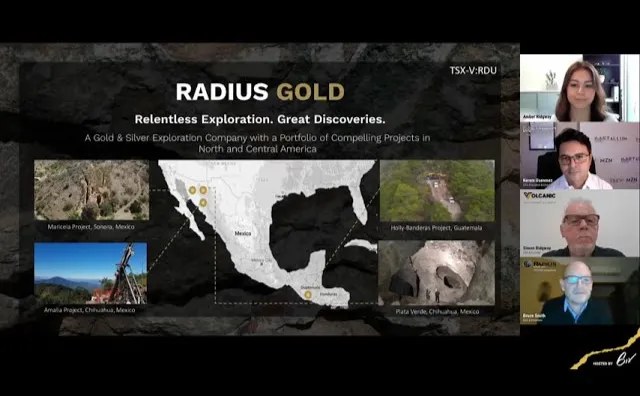
8:55 Okay, hi everybody. My name is Bruce Smith. I'm the present CEO of Radius Gold. I'm an exploration geologist and I've been exploring for around 30 years globally 20 years of that time I've been exploring with Simon, Latin America So Radius Gold is a tier 6 V listed company. We've got 4 compelling projects where we're drilling in sequence over the next 12 months. So, you can expect to see a lot of regular drill results coming out of RADIUS. And I'd like to talk about all the projects, but I have time to just briefly touch on them, and then I'll talk about our latest discovery.
9:43 So the first project I'd like to talk about is the JV we have with Volcanic Gold in Guatemala. We hold 240,000 hectares of licenses and applications. Volcanic, our joint venture partner, will spend $7 million in the next 48 months on just 2 of those projects, with a minimum of 3,000 metres to be completed in the next 6 months. Volcanic is currently drilling and the historic but shallow high-grade gold and silver drill results, and you'll hear about that from Simon a bit later. Next project is Amalia where we have Pan American Silver, one of the world's largest silver mining companies, is funding exploration.
10:29 Amalia is a classic Sierra Madre high gold epithermal gold silver project. Pan American is due to make us a payment of US$400,000 in the next couple of days and I think that demonstrates their commitment and interest in this property. We've drilled 4 rounds so far with Pan American, 10,000 metres and 31 drill holes, and we've had some spectacular results in that drilling. Hole 10 cut 44 metres at 12 grams gold and 308 silver. That was one of the best drill holes anywhere in the world during that year, last 2019. So we've defined Amalia a high-grade chute going from surface to 350 metres.
11:17 That chute has now been closed off and the next drilling will start soon on El Cuervo in California veins. It's a large property, it's 10,000 hectares and multiple targets and so far only one target's been drilled. We expect that drilling to start in the next month or 2 when it starts to rain, as we need rainwater for drilling. The next project we have is Plata Verde. We acquired an option from a local geologist to acquire 100% of this property. Like all of our properties, Palo Verde is what I call a grassroots discovery. Nobody's ever worked there before us. It's a silver only epithermal system.
12:04 In March last year we discovered this huge system of underground mines where it was historic in the 1800s, perhaps into the early 1900s, miners produced silver from breaches and stockworks. It's a little bit hard to believe, but we even found silver bars lying on the floor of those mines, a couple of them. So they must have abandoned them quickly, probably in the Mexican Revolution. And they haven't been worked since. The mines are large, they cover, they're a flat-lying manto so they go into the ground, they're covered by post-mineral volcanics and they cover an area of 500 metres by 200 metres and up to 30 metres thick.
12:51 The access is difficult
12:55 and because they're covered, they were lost and hadn't been found. So We are currently building roads, developing the geology, and we'll be drilling in the next 12 months. Lastly, I'd like to talk to you about Murray Seller, which is our newest discovery. We identified that just earlier this year, a few months ago, we're developing it rapidly. We found large, rich, gold and silver veins and breches and stock works on the margins of one of the world's largest copper porphyry deposits at Kandanaia.
13:30 It's hard to understand the scale of Kandanaia, but it's been mined since the 1700s and today still has several billion tons of resources and reserves. It's the third largest copper deposit on the planet, and these big porphyry systems are the engines that are genetically related to the epithermal gold and silver deposits found nearby. The Arizona Sonora copper belt has excellent infrastructure with power, roads and many producing mines. Within just 50km of Maricela, there are over half a dozen big gold and silver mines. Equinox Gold, Mercedes, First Majestic, Santolina, and a new discovery, Silvercrest at Las Chispas is 120 million ounces of gold and 1.3 million ounces of silver, an amazing 745 grams per ton equivalent. So it's a great address and those are the kinds of deposits we're looking at. At Murray Cellar, if you can see on the screen, there should be a photo, we have a low-sulfuration, epithermal gold-silver system. We've got multiple intersecting large-scale veins, and between the veins we've got breches and stockworks.
14:48 We have both high grade with rock chips up to 12 grams gold and 3.8 kilos silver. And between those veins we have stockworks and breches with mineralization up to 25 meters wide. And it's where those veins come together in the intersections that make compelling drill targets. To date, we've documented about 8 major veins with combined strike length around 5 kilometres. And those 8 veins and 5 kilometres of strike length are actually packed into a tight area about 1200 metres by 600 metres. So that makes an ideal open pit target with potential for high-grade underground development underneath. So Marisela is a compelling project with multiple drill targets. We have a team on site right now mapping, developing the drill targets. We've got environmentalists on the site preparing the drill permits, and we've got site visits from drill contractors this week.
15:47 So we plan to start soon drilling as soon as we can and it's probably in 2 months when we get permits in hand. So Radius is a great company with 4 projects being drilled in the next 12 months that should give us you know a really fantastic chance of finding a great deposit. So thanks for listening and I'll pass you back to Amber. Thank you Bruce and finally Simon will talk about volcanic gold mines.
16:20 Now we get to the most exciting part of the summit, volcanic gold mines. Trades on the TSX under the symbol BG. It's got 45 million shares issued and a cash position of just over 10 million. It's also got another great asset, a group of Guatemala techers, local geologists, some of whom have been with me for over 2 decades. And they also have a passion for discovery. As you just heard from Bruce, you know, the volcanic hazard joint venture with Radius, we picked up a large land position, a good part of which is under application, but there are 2 projects that are granted concessions, and that is the Holly property and the Banderas project. I'm going to focus today on the Holly property because that's where I was this morning. Yeah, I'm down in Guatemala at the moment watching the drills turn.
17:14 I just got down from the hills a little while ago. So these 2 projects, the Holi and the Banderas, were discovered, grassroots discoveries made by RADIUS in the early part of this century. Sounds a bit odd, doesn't it? But that's like 20 years ago. The Holi was discovered in a road cut that it was exposed, it exposed very altered volcanic tuffs as the road cut across what the Hockatantl fault zone, a major east-west structure that historically formed part of the boundary, plate boundary between the North American and the Caribbean plates. So this fault brings 2 very distinct rock types together, some old Paleozoic schists and to the south volcanic rocks. And it forms a very broad red-shaded fault zone in the area of the Holly concession.
18:05 The concession also sits at a location where the Ipalag Raban, a north-south structure, intersects this Hockatan fault zone. So a very well-structurally prepared set of rocks, a well-developed plumbing system. To the north of the Harkintan Fault, like I said, the Paleozoic schists are exposed on the road cuts all the way up the hill, mostly phyllites, highly altered in the area of where the Hoko and the Ipala Faults come together. And to the south of the fault, the Toshi Volcanic Rocks, you've got a series of rhyolite domes that kind of form a little bit of an arc about a kilometer back from the fault itself. And in that distance between, we've got a series of mudstones and rhyolite floors and tufts.
18:57 I believe the volcanic domes are the engine pumping at these high-grade silver solutions into these well-prepared structural domain. We drilled it initially with a joint venture partner back in 2002. You can see a list of holes on the screen. I'm not sure you can read it. It's quite small for me, but the best hole was 6 meters of 43 grams gold and over a kilo and a half silver. This was to the south of the fault in that mudstone I just mentioned. Another hit was a high-grade pennant structure, one of the northwest structures that is part of the Ipala grab and structure, full zone. That cut 3.6 meters of 22 grams gold and 700 grams silver. And a couple of other great hits. However, the company, the J.B. Company defaulted on the initial payment to Radius back then.
19:50 So the property reverted back to Radius, and a year later, Radius Geo was put 8 RC holes into the project. But it was a poor time in the market, and radius was poorly financed.
20:04 So we did a hurried and I must admit looking at it now a badly thought out program. We put 8 holes in and we didn't really able to intersect any of those high grade either along strike or down dip. So we kind of left the project sit. I've now had 20 years to take a look at the data and look back at the project, and I really believe it to be an excellent target. Like the Banderas property, only needs a well-funded company to take on the property, not like previously hoping to hit the glory hole in the first couple of drill holes. We need a well-financed company to work with the data we have from that historic drilling and attack it properly. I really believe there's a couple of discoveries to be made in the Haleana Benderos property, and that's what we're about doing.
20:54 You know, historically, I've missed a couple of big dust deposits before. The team I'm working with now in Guatemala, we found the Escobar vein. But again, we had a badly financed company, so we put
21:06 a couple of drill holes in and didn't make the discovery that was sitting a little deeper for us to make. Now that the Escobar deposit is a world-class silver deposit worth a billion or 2. So we're not going to make that mistake again. We're here with a wealth finance company attacking these projects that are basically owned by radius, but we were in volcanic is earning into them. So stay tuned. Like I said, this drill program has been 20 years in the planning, so hopefully we'll see some success. And thank you for listening to all these Gold Group companies. But before I hand back to Amber to start the question session, I want to mention a new Gold Group company that's about to take flight.
21:51 It's called Goldhawk. Right now it's Rackler Metals, R-A-K on the TSX, but we are making an acquisition, and with that acquisition, the name of the company will change. You can see the presentation on Rackler's website. Thank you very much. If you want more information, we've got a question session coming, so I can answer any questions at that point. Amber, back to you. Thank you. Well, that concludes the presentation section. We'll now jump into the Q&A. So if you have any questions, feel free to submit them in the Q&A panel on the right-hand side. The first question that we have is from Brent Cook and he asks, at Maricela any previous drill holes?
22:39 It seems that until Pan American gets Escobar back online, Guatemalan mining potential is limited. What are you hearing down there?
22:49 At Manusvilla, there's no drilling. We don't think anybody has ever explored before. So those mines, it was a big surprise to find them on the edge of the Cananeia Porphyry, but I think that they've not been drilled or explored before because they've been held by big porphyry copper miners who are not really interested too much in the silver gold potential. So that's for Murray Seller and I'll let Simon answer what he's hearing about in Guatemala from Pan American. Yeah, I think, well, to be honest, let's talk about Pan American. Historically, Pan American has liked to keep their silver in the ground to give them value of the share price. And I think they're kind of still in that mode as far as the deposits they purchased in Argentina and in Guatemala.
23:41 If you take a look at Bluestone, Bluestone is rapidly processing, progressing with their application for the open pit at the Sarab Lanka deposit about 40 kilometers to the south of us. They're getting great support from the communities as we are around the Hale and the Banderas property. The new government that came in this year in January is very pro-mining, pro-development.
24:06 They want to see their populations go to work in their own country, not have to go to the USA to get work. And I think that they got voted in because the population wants the same. So I think we'll see a change in Guatemala going forward. I think, as we've seen throughout Central America, you know, we read in the newspapers that it's violence that's driving people north and across the border. And many of them just go through very, very great hardships to get there. But actually what it is, they want the economies that we have. They want work. They want to be able to go to work and feed their children and buy houses and live like we do in North America. But unfortunately, you know, we have a lot of money pouring in from Europe and some of these anti-mining, anti-development groups who would rather see this country remain harsh. The people that live here, the children of their children, and don't go to the USA to get a proper living. It's unfortunate.
25:03 Anyway, that's my 6 months.
25:07 Thank you, Simon and Bruce. The next question is addressed to Metallum for Kareem. And it's, what makes Metallum different than any other base metal company? Thank you. Yeah, that's a great question. Well, apart from being in a Tier 1 jurisdiction and having one of the highest grades in the world for zinc as well as copper, our main project is close to production. We have a very strong management and technical team with enormous background on finding growing deposit as well as opening mines and growing companies. So I think those are our biggest assets but also the upside potential is enormous in this property.
25:50 Like we have the feasibility study, all the infrastructure is there to open but the upside potential is incredible. Okay, Thank you. And there's another question addressed to you, Karem, and it's, do you expect any metallurgical problems that could cause issues during processing? Yeah, so that was one of the first things we looked at, actually. We have the technical board. That was one of the things we early on we discussed and having that background in our basically in our group is enormous. So based on historic production as well as recent metallurgical studies, it is expected that the project will produce high-quality concentrates.
26:36 That's given. With free of deleterious elements, with low impurities of critical elements such as arsenic, antimony or mercury. Like I mentioned before, the main problem they had during the processing was the high zinc rates, where it was hard to process, that they needed to dilute. That probably is the only problem that we're going to have in terms of processing. But we're looking at new technology to sort it underground. So the impact is also less on the surface. And I mean, yeah, the dilution and I mean, The high grade or nature could be a problem, processing, but it's a good problem to have.
27:23 Definitely, okay. Thank you, Kerem. And the next question is for Bruce Smith about radius and it's when is your drilling expecting to start on the Plateau Verde project? Well I just saw pop up a question from Martin about the surrounding ground on Murray Sella, so I'll answer that first. We don't have the surrounding ground of Murray Seller and what we've found is nobody can get it. The Murray Seller license is 157 hectares, it's 1.5 kilometres long by 1 kilometre wide and that is amply big enough to locate a mine and an open pit. So I was just at the Wahi mine last week, that's a 2 million ounce gold deposit open pitted and we could fit about 4 of those pits on our property. So the Murray Seller licenses cover all of the, majority of all the known veins.
28:24 So the license is big enough to host a standalone deposit. If you have a look at the, the first majestic silver deposit to the south there, open pits only about 400 meters long. And so although we would like to have the surrounding ground, nobody else can get it either. And we're likely to buy the land rights off the property owner, so I don't think we've got a good standalone target there. In Plata Verde, when are we going to drill? We've just completed building the road, so we're not far away. The reason I've delayed a bit is because I think Murray Sella can develop much more rapidly with the infrastructure existing.
29:12 Plata Verde is just a little bit more difficult to get to. Although we've almost got the road there, we've also got some interest for some other parties who would like to take it on. So I'd just like to see what their offer is before I decide whether I want to drill it myself. But I think we'll be drilling both first Maricela and then Plata Verde. Thank you, Bruce. And the next question is for Simon, and it's how does the geology of the Holly Project compare to that of the Eskobal mine that is nearby? It's the same volcanic belt. And I think the Escobar mine is a display of the Hacatán Falls, so I would call it the same structural domain, basically.
29:58 The difference being the Escobar mine is completely in volcanics, and we're at the contact between volcanics and the Schistos rocks. So, that makes a difference. It's also the Escobar mine is a silver-rich base metal project, so it's got an intermediate sulfidation system, and I think we're in a high level, high sulfidation, I mean, low sulfidation, high level system at HALI. OK. Thank you very much. And another question here for Mitalem, for Kerem. Do you expect any ground-related problems after dewatering during operation? Not really. I mean, my background is rock mechanics at a master's level and ground stabilization. So that was one of the first things I looked at personally, because I'm interested in that.
30:55 The ground conditions should be stable. The rock quality is good to very good in this mine. And there were some handing-over dilution at times on Lindstrand's side due to some chart alteration. But that happened only once in a while and we don't see that same structure associated, alteration associated on the peak horizon or anywhere else from what we know. So dilution is expected to be even less on the peak side where we are going to start mining and all the other information that we have indicate that it was only contained along the Winston hanging roadside. So no, we don't expect much dilution, less than Winston for sure. And the advancements on blasting, cost and timing, as well as ground support timing and cost should be way less than Canadian standards.
31:52 Okay, thank you Karim. And another question here is from Oki Reiners. When do you expect drilling results from the Holly Project? That's for Simon. I keep checking my email every day. I expect them pretty soon. We sent the first 3 holes in about a month ago so it really in the next week, 10 days, we should have the results back and then after that we probably get results every 2 weeks. There'll be 7 of them in every 3 holes, certainly on hole 11. So anytime soon. All right. And another question from Brent Cook. This one's for Bruce. As I recall, Plata Verde is in a deep canyon. How do you plan to drill it? The exposed mines are actually, the canyon where the mines are exposed are only about 50 meters deep. There is a huge Canyon to the south of the project, but overlying the historic mines is a cover sequence of volcanics and it's a flat plain. We can sit up on the top and easily target through there.
33:01 It's probably only, well, I planned some drill holes the other day that were 400 meters long, and they were planned to go through about 100 meters of cover into the projected historic Manto style mineralisation, and then on and through into where we projected the feeders to be, and in total those holes were 400 metres long. But from the surface cover area that's flat and easy to drill from, it's only about 50 meters to the first mineralized area. So it's not difficult to drill. The road access initially, there wasn't road access, but road is now within a kilometer of the project. So we're not far away. It shouldn't be hard to drill.
33:51 Okay, thank you, Bruce. And another question here for you, Kerem, is what are your thoughts on ESG? Yeah, yeah, our team and the whole group as a whole, I mean, I can say that for the whole group, has always been ESG focused. I mean without protecting the environment, social impacts and sustainability, we just cannot move forward. That's always been the case and it's just being more talked these days in the mining industry, which is great so that the focus is there. But I mean the management and the board believe at Metallim it's a fundamental part of who we are and how we want to operate basically. So we recognize that if done properly, the results become better outcome for everybody, for all stakeholders. For example, we are proactively utilizing local and First Nations businesses.
34:42 What we do so far, what we have been doing is focused on that. So our current drilling contractor is a First Nations owned and operated drilling company. We're working with another First Nations affiliated surveying contractor for to get the last step of the conversion to mining lease, as well as direct local First Nations person for water monitoring in and around the site. When we have strict internal controls to rehab the drill sites and so forth. Great, okay, thank you, Kerem. Another question for Simon, and it's, there have been quite some conflicts in terms of violent confrontations with Canadian mining firms in Guatemala. What makes your company any different than these ones?
35:31 Well, I've been working in Guatemala for some 20 years and we really have had no problem at any of our projects until we had the Tambor mine put in production. Like I mentioned earlier, I think a lot of the anti-mining sentiment is financed from overseas and really the people in the area where we're working, especially in the eastern part of the country, there's no issue with the locals. They want to see mines, they want to see if they want to work. So I don't imagine we're going to have any confrontation unless those groups are allowed to finance them, plus people into the areas as I've done for other projects. But I think so far we've got a great relationship with the people we're working with, great relationship with the mayors of the towns we're working in and the people we're employing, you know, we're presently employing a few hundred people and them and all their families are very happy.
36:28 I don't think they want to see them lose their work like the people did for the Escobar mine. I mean, you have to take a think about the people that worked at the mine there. 1,500, 2,000 people, they get a job, they finally have some steady work, they get themselves possibly into debt by trying to build a house or taking a mortgage, and by terrain, by land, and then it all goes to pieces because foreign companies, foreign governments, foreign individuals finance the closure of those mines. So those people are now left with no work, only going bankrupt because of the house that the dead sea got into. You got me on my favorite subject, Amber, but I think that where we're working, we will have no problems. We will move forward. Okay.
37:14 Thank you. And another question here, this one is for Gold's group. And what are the greatest advantages of all companies operating under this banner? So anyone can answer that one. I'll leave that to Carol and the group. Well, one thing to start with is we have low-cost administration and stable management. The team that runs our back office in Vancouver have been together for a very long time. I think our Corporate Secretary, Sally, might have been there for 30 years. She's certainly been around longer than I have, and that's 20-something. Chief Financial Officer, Kevin, he's been there for as long as I can remember, I think probably 15 years.
38:03 Our accounts and office management staff, I just know that the back end of our companies run smoothly and without problems and I don't have to worry about it. So that allows me to forget about the financials to some extent, because I know that there's no money disappearing. I know that things are well managed and I can concentrate on doing my job as a geologist, which is finding deposits. The other thing about Gold Group is that we have a diverse group of companies with lots of different people, so I'm introduced to different people all the time with different skills. The boards of the companies, a lot of them, I'd say for the board of radius, Simon and Bradford, they've both built mining companies before.
38:54 They have a vast network of financiers and mine building skills and things that I can tap into. So it's the people behind the company, that behind Gold Group that help us. Yes, I'd like to add a couple more as well. I mean, I'm relatively new in the group, but Metallum, when we started, I mean, it's everything was there. Like Bruce mentioned, all the professionals to run the company in the back office they're very efficient, very cost-effective, shared office, shared cost, so that that provides all of us, all these companies to to operate in a very lean manner so that the GNA is very very low compared to our peers.
39:46 But what I also like about this group is the professionals. Yes, the team, the working relationship is fantastic, but the history, the accomplishments of all these individuals that I can benefit from is enormous. Like I can call Bruce anytime about geology. Our board has geologists, our board has mining people that I can I can just give a call? And Simon, I mean, he's what is not to learn from Simon, there is also that. I mean, it's that side also that we benefit from. So we can focus on moving things forward in a very fast and effective ways.
40:34 Great. I believe nobody mentioned the summer parties. Well, they are. Yeah, those are great. And they're coming back this summer. So that's something to look forward to. Perfect. That's great. Thank you, everyone. That concludes the Gold Group panel. I wanted to thank our speakers, Simon, Bruce and Karem, as well as everyone who joined us in the audience today and submitted their questions. To find out more information, I urge the audience to click through these websites and subscribe to stay on top of most recent news from The Gold Group Companies.