Transcript
Automated transcript · Written by software from the replay's audio. It can mishear names and figures; the replay is the record.
0:07 Well, hello, everyone, and welcome to Metallum Resources live investment summit today, hosted by 6. I'm pleased to introduce President, CEO, and Director Kerem Usenmez. Kerem will walk us through a presentation, and then we will be accepting questions live. So as a reminder you can submit your questions at any time on the Q&A panel on the right-hand side of the screen and we'll get to them after the presentation.
0:30 And as always this event is being recorded and will be available to watch afterwards on SIX.com. So, without further ado, I'll hand it over to you, Kareem. Thank you, Dasha. It's a pleasure to be here, and thanks for everyone to tuning in. I just wanted to give you a quick update on where we are with our exploration program as well as go over the recently published feasibility study metrics. So we are a zinc and copper-focused base metal company for the audience that are not familiar with us. Recently listed, we did the acquisition, we completed the acquisition of Superior Egg Project that is located in Ontario, one of the highest grades zinc projects in the world.
1:15 So the former producing mine. I'll talk about this a little bit as we go, but that's our flagship project. And yeah, like I mentioned, our focus is zinc and copper. So I strongly urge the viewers to read the cautionary notes. This presentation will be available at the handouts. And so yeah, our project is high-grade zinc and copper project that is located in Ontario. Because It's a former producing mine and pretty much half of the mine has been depleted from the known resources. There's a lot of good infrastructure in place. It's located east of Thunder Bay, about 150-200 kilometers east of Thunder Bay, just off the main Trans-Canada Highway near the town of Schreiber. It's about 20 kilometers with a well-maintained road, gravel road, right to the mine site from the highway.
2:18 And there is a lot of infrastructure, tailing dams, all the CAPEX heavy surface infrastructure, as well as 16 kilometers of underground development right to the ore is there. That gives us a very good advantage in Capex numbers as well as the timeline that we're going to be covering as we go. So we just updated the feasibility study that was done in 2019 under Australian standards that the previous owners did. So what was updated was the mainly the cost, the cost aspects to date that was updated. And other than that the exploration potential. It's shockingly underexplored.
3:04 I'll show you in the next slides, as we always talk about that. But as we learn more, we find more potential to find more high-grade in the vicinity of the known deposits, known horizons. So currently, it's sitting at 2 million tons at 18% average zinc and 1% copper with some precious metals. So it's a typical polymetallic project, the VMS setting, so only 2 horizons known to date. So the red areas, locations in this map, show our tenements, the claims that we own. Our focus has been, is going to be in the near term, going to be superior project, Peak and Winston.
3:51 So we don't currently own Winston Lake patents, it's under 1st Quantum, but we had the option to acquire. Hopefully we can exercise that soon. But where we are sitting here is we've been doing some exploration on Pick Lake, and the whole project feasibility study was updated. The other tenements that you see here we own, but that's going to be our secondary option. So this map also shows the area where we are located in relation to Shriver, as well as, you know, Hamlow, Marathon, and some other projects. This is more at a district scale where we sit. So Wawa area is very hot these days with gold, you know, north, northeast, as well as western.
4:39 But don't underestimate the Shriver location because there's some real good activity going on. As far as I know, Panther is already or has started drilling there. There's some other good projects in the area mainly gold but a lot of polymetallic there's nickel there's copper and then ready-set gold has really really good numbers good projects in the southern area to us. But the whole region is really, really underexplored. In the 90s, There was some activity, but after that, nothing really. There's hard gold. So this whole area, base metals and precious metals, rich, as we know today.
5:27 Where we stand in terms of VMS activity, so all these dots as well as the, I don't know what this icon called, Google Map Location icon, those are showing the Archean VMS district. Archean is the age that this occurred for us. So those are the big and high-grade VMS deposits that are known. So Pig Lake is one of them. So that is 1 indicator. Could be an indicator that there could be more. For our geologist friends, they can help us out here to explain. But mainly, it's an activity related to the magma. So what's our known resource? Our known resource is at 2 million tons, like I said, 18%, zinc, 1% copper, and some precious metals. So there's 2 horizons to date. I'll try to draw.
6:23 Can I draw? Yeah. So this is Winston Lake, mainly mined out here. That's what Inmet later on, 1st quantum, mined. About 3.3 million tons and 14% zinc and 1% copper and some precious metals. They mined in the 90s. At the end of 98, 99, they closed the mine due to very low zinc prices at the time. And no work was done after that. No exploration since then. They stopped exploration, I believe, around 1995-96. Literally no exploration until recently some geophysics was done prior to us acquiring it. So what they did was they developed all these infrastructures you see here underground and identified Pick Lake. So Pick Lake was discovered as a secondary horizon to Winston.
7:21 What's interesting is they are not exactly the same age. There's a quite a bit of age difference. So that shows us or indicates us that there should be more for that same age. So Pit Lake right now as it sits 19% as you can see here being the higher grade out of the 2 with 1.8 million tons left here. But What happened over the years is there's only 1,800 diamond drill holes drilled on this property. Just over 1,500 boreholes were drilled into Winston to identify that 3.3 million tons that they basically mined. Only 247 diamond drill boreholes were drilled into Peak Lake deposits to identify this 1.8 million tons. That alone tells us that Peak Lake could be bigger than what we know today.
8:19 So what I mean by that is I'll just skip that. I'll go back to that. There's a bit of a way I present it doesn't really flow. So This shows what I'm talking about. The solid, I don't know what this color is, gray areas are the known resource. The light gray areas are the ones that were depleted, mined out. And the dashed zones are the known targets based on geophysics and minimal drilling that was done. So that's an interpretation. So what we did was we drilled 1 borehole around here and a couple in the upper sections, roughly about 200 meters in this direction to the closest borehole that was drilled into the resource. So we drilled. We did a drilling campaign, started at the end of April until June, early June, and went after the targets outside of the resource. I'll show you on map shortly.
9:30 But that alone indicates us that we need to go after this. We see the higher potential in this area, obviously the middle section, and some other areas. If we look at, yeah, this shows another angle of the same potential. Also, Winston, as you can see, is open at depth and dip, but also strike the pick leg. So here, we wanted to show the high grade nature of the pick leg. The borehole names are here, UP, but the P means pig.
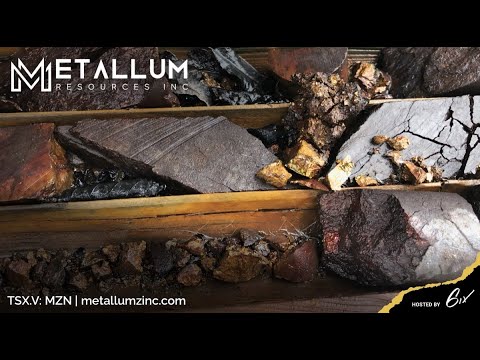
10:07 So upper pig and lower pig. Those are historic numbers, not the recent drilling. The recent drilling we got 28.8% zinc where we drilled just here. It's in here. That's the honey stellarite that came this is from the this the photo in here is from the recent drilling that we did. That's 28 that came back as 28.8. So on the left-hand side, the black dots, as you see here, are the recent boreholes that we drilled. There's actually 6 boreholes. You see 5 dots here. But in this area, we have 2 boreholes in 2 different directions. Just to understand, that's the very top section where we know there's surface anomalies from geophysics between surface anomaly and the top section of the Pick Lake. So that's where we targeted.
11:03 We got some real, real good indicators, a lot of alteration we need to follow up on here. And on the right-hand side, well, the red lines on both maps indicate the surface expression of the horizons, the interpretation of the horizons that are known. So we, there's lots to go after basically, that's what I'm trying to say. And the pink, this is Pick and this is Winston reflected on surface. But as you can see along strike, even this area, this area, this area, along dip are all open for
11:43 exploration. So we wanted to do this exploration. We want to go after those. We want to do more drilling and more geophysics as we move forward developing the mine. So in order to do that, we needed to update the feasibility study that was done 2 years ago under Australian standards. We converted that into Canadian standards. That's not a very straightforward conversion. So what happened was all the QPs that can sign off in Canada had to review all the data in detail. Some aspects, they have to redo the studies, such as tailings, water management, reviewed environmental, all the production, rock mechanics, pretty much every aspect, the financials, everything.
12:35 So the financial model is complete. Everything is pretty much complete. A couple of QPs, we're waiting for sign-off. So we expect it to be fully finished this week, and all the QPs sign-off, basically. That's what I mean. And then publish it. What is ready to go is the main aspects as well as the financial metrics and the schedule. So Based on that, what we used is we used very conservative commodity prices. Even though all the analysts say they're going up, they're going to continue to go up in the next 2, 3, maybe 5 years, we kept it as 2 years ago's
13:16 conservative numbers. Conservative numbers. Right now, we used for this US dollar 1.22 per pound for zinc, 3.31 for copper, 1,635 for gold, and $21 for silver. As we all know, the numbers are way higher than these and hopefully remain higher. But even then, the CAPEX numbers, the operating expenses have gone up, the study still shows very robust, very profitable production, partly because of the CAPEX-heavy infrastructure being in place. That lowers the CAPEX numbers, but also the efficiency as well as the high great nature of the deposit as it sits today.
14:11 So based on that, NPV at 8% discount, which is conservative, still comes back as 131 million Canadian. And after-tax is 23% based on these numbers. If you apply today's numbers of Zinc, which is close to 1.4, this after-tax rate of return goes up to 33%. It's incredibly high on that front. And the current numbers predict three-year payback period. But obviously, if the prices are higher, it's going to be shorter than that. But even then, it's 3 years. And the KPACs, initial KPACs that is required, including all the pre-production and everything in basically, is 145 million Canadian with an 8, 8.5 year mine life.
15:06 And the average EBITDA is 44 million Canadian over the course of the mine life of 8.5 years. So it's very attractive. We're very excited about these numbers. It confirms how profitable and how good, robust this project is as we move forward. So we talked about these. Where do we stand in comparison to other good high-grade projects? As you can see here, the grade is at 18%. It's almost a double as the closest one.
15:54 It sits at 9.5%. But yes, our resource is a bit low here, 2 million tons. But there is so much potential to increase that. Well, hopefully here, but there's a potential. There's a good potential to increase that. That's what we are working on as we move forward. I mentioned the EBITDA number of $44 million per year over the course of the mine life. And yeah, we talked about that. It's incredible NPV and the rate of return. So again, this is another way to show the grade, the cost, the cash cost on the operating front in comparison to other good high-grade projects, basically.
16:51 What's interesting here is the other than the high-grade nature, the initial KPACs, those are US numbers, just to keep it uniform, and the cash cost, very low cash cost in comparison to other good projects. So what's next? What do we expect from Mitzollam and Superior project is we're going to publish the feasibility study, full feasibility study, hopefully next week. As per the schedule, once all the QPs sign up, this was done by many, many QPs, different experts and different aspects of it under DRA Global's management.
17:38 And we just recently completed some borehole EM on selected boreholes that we recently drilled. And we are in the process of scheduling or programming second phase of our exploration program. Hopefully, we can start sometime in October and wrap up before the year end so we can get some results in the new year. As we move forward with the exploration, we're also updated the application for the dewatering. So we expect that to happen in the new year. Hopefully, we can start dewatering the first half on the Pig Lake side at least and exercise the option so we can move forward in a relatively short amount of time.
18:26 And the long-term goals are we're looking at some other properties, projects, if anything that comes on it'll be also exciting. So yeah so that's pretty much it and the management, who we are, it's me I'm a geological engineer licensed in Ontario and Manitoba. I've worked all aspects of exploration as well as developing mines and deposits within Canada as well as some globally in Turkey, in Europe, Africa 1 project and some Latin America, Guyana, Peru, Chile, Mexico. Our geologist is very well known and he's very experienced in that area.
19:15 He's based in Thunder Bay. He will be, going forward, he will be our main exploration manager, Andrew Timms. You might know him. Some of you might know him. But our board is very, very experienced deposit finders, mine developers. Simon Ridgeway, I mean, he's been very, very successful on discovering deposits and building mines in Latin America, mainly. Ralph and David, they both are very good geologists. I have the luxury to be able to call them and ask their opinion all the time, both especially David on the BMS front. But also our advisory board, Mark Cruz, he started and built Trevally Mining and other Zinc company from exploration to being one of the top 10 zinc producers in the world, with a market cap in excess of $1.5 billion.
20:13 And he's currently the CEO of New Pacific and the chairman of Whitehorse Gold and Jim Pichel is our advisor on the geology front. He was one of the paramount people for the VMS discovery in Flintlawn and David Lang is going to help us out with the mine development as we go. So further, I'm open always for discussions and you can either contact me or Amber and our website is metallumzinc.com and follow us on social media. Great, thank you so much Karem. So now we're going to open the floor for a live Q&A, so if you do have questions feel free to submit them now. I also want to remind you that a copy of this presentation is available for download under the handouts tab. But Karem, what is your timeline for opening the mine?
21:03 Yeah, that's a good question. So based on what we know from the feasibility study, if the permits go somewhat smooth, we're looking at 15 to 18 months. Great. And will you have a camp on site? Yes so that's one of the things that was re-evaluated in the recent updated feasibility study. That is what is being proposed 180 people capacity camp and all staff through Mitele. Because there's enough talent and skilled workforce in local community as well as in the region.
21:49 Okay, great. But will you be looking into doing an agreement with the smelter or sell the concentrate? Yeah, that's up in the air, to be honest. It's, there are some smelters that we could use. In the feasibility study, it was proposed either to use Montreal, Quebec, or Western Canada, and potentially in the States. But there are some interests for the concentrate we are currently in talks with. So we will see how things go. Currently our goal is to produce the concentrate in a way efficient and environmental friendly way. Okay, great. Yeah.
22:34 Scott has a question. He just says zinc smelter. So hopefully that answers his question. We also have another question here. What is the cutoff grade of the mineral resource? And what is the operating cost, dollar per ton, for the planned production? So the cut-off grade was 3%, 3% zinc on the mineral resource. It's available, I believe, on our website as well. But we could provide that as well. So for the operating cost per ton, I have to be honest. I have to look back. For per pound, it's 35 cents, US.
23:27 I have to double check. Not on the top of my head right now, per ton. Sorry. I'll just, I'll give you the email of the person who submitted the question so you can reach out to him afterwards. And will you be building your own team or using contractors? We will be looking at that as we go because really the cost is all over the place as we all know. But current plan is to have our own staff but we are open to look at alternatives in the near future. Okay, great. Raymond's question is, to produce 1 concentrate, zinc, copper, or 2? So right now the flow sheet goes sag mill and then it separates off that into zinc and copper. So there will be, I think, yeah, zinc and copper concentrate separately as far as I know.
24:28 Okay, great. Well, that is all the questions that we have. But if anyone does think of a question after this presentation, we will be sending out a short survey and Kareem will be happy to follow up with you directly. And as I said, this presentation is being recorded, and so you can rewatch it on CYXO.com, but also stay tuned for many more updates from the talent resources. And I'll pass it back to you, Karim, for the final word, any last remark. Thank you. And Yes, any questions that are up in the air, I can always, I'll be happy to discuss further. And thank you for tuning in and listening.