Transcript
Automated transcript · Written by software from the replay's audio. It can mishear names and figures; the replay is the record.
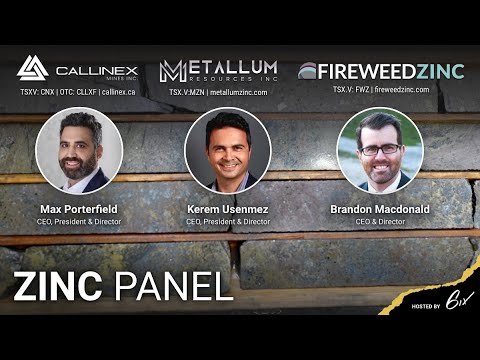
0:11 Hello everyone and welcome to the Zync panel hosted by 6. We are joined today by the leaders of 3 Zinc-focused companies. We have Kerem Usenmez, CEO, President and Director of Metallum Resources, Brandon McDonald, CEO and Director at Fireweed Zinc, and Max Porterfield, CEO, president and director at Kalanix Mines. In this panel, we will hear the insights from these 3 industry leaders as they discuss the current state and future of Zinc. So to kick things off, Karem, can you please introduce yourself and your company? Yes, thank you. We are very happy to be here. Thanks for tuning in. And yeah, Metallum is excited about this panel being part of these 2 other great companies and presenting here. We are, Metallum is a zinc and copper focused exploration and development company listed on the TSX under ticker MZN.
1:06 Our main asset is Superior Zinc and Copper Project. It's a very high grade zinc and copper project that is located east of Thunder Bay, just about 150 kilometers east of Thunder Bay. And it's an old mine that was mined in the 90s with really good high recoveries and exceptionally low cost of production. And it's just near the highway and there's a port, there's a train station and the main highway is just 20 kilometers off of the project site where there's a road right to the mine as well as all the infrastructure being in place, such as the tailing stand. There's a transformer on site, it's on grid.
1:53 There's a main shaft and underground development about 16 kilometers right to the ore that is left. So there's 2 horizons that was discovered to date. It's a typical VMS deposit. One of the horizons mostly mined out. They mined about 3Mt at 14% Zinc and 1% Copper with some precious metals. In the past, over 9-year mine life in the 90s. And they closed it due to low Zinc prices at the time. And then there's about around that horizon is 300,000 tons left with about 10-11% Zinc and just under 1% copper. And the other horizon happens to be the higher grade, 19% in average zinc with 1% zinc, with 1% copper and some precious metals at about 1.8 million tons.
2:45 But what is interesting about this project is there's a very minimal exploration done that was not only to the second horizon, which is PIC, but also in the vicinity of those 2 main deposits. Absolute no drilling. Some geophysics were done with the previous owner. So we acquired this project at the beginning of April when we started listed trading on the TSX. But the upside potential is huge. So what we're looking at here is we're doing some exploration at this moment. We're wrapping up our phase 1 of drilling. We expect to have the results by July in the next few weeks depending on how early can the the lab can deliver the results, but
3:40 There's some exciting stuff that we expect from that because we are drilling outside of the resource Which has the highest potential areas more than 1 actually targets But what is also interesting is that there is a bankable feasibility study that was done by the previous owners under Australian standards of drug compliance, which has really impressive numbers. But we are currently updating, we started that study early April as well. It's in the process to be updated into Canadian standards. We expect that study to be published in the next few weeks, hopefully, like by mid-July at the latest. Depending on that, we're gonna move forward opening. So we have some of the permits, but we are looking at getting a dewatering permit for the mine currently flooded by the end of this year, and hopefully we can do our first quarter of the next year. In the meantime, we are going to go after these already known targets, as well as we are currently identifying other targets that could be drilled in our second phase of program, which we expect to do in this fall.
4:54 So yeah, I mean, that's a very high overview. I don't want to take too much time for the other presenters. Yeah, we'll go on. I don't think we have time to answer any questions, sorry. Yeah, thank you so much. We're gonna go into more detail about each of your companies soon as well. But Brandon, can you tell us about Fireweed Zinc? Yeah, Fireweed Zinc is a Canadian-listed junior mining company focused on the McMillan Pass Project in Yukon Territory, Canada, symbol TSXVFWZ. In McMillan Pass property is, we believe fundamentally a zinc District. It was assembled and is now about 940 square kilometers. We did deals with Hudbay, Newmont Tech, and a variety of juniors to build a land package that traces about 40-ish kilometers of a major Silurian Devonian age basin bounding fault that's a conduit for the sort of fluids that produces these deposits.
5:53 So we originally just started in the east of the project on 2 deposits there we bought from Hyde Bay which are the Tom and Jason deposits. So those 2 we did a resource update in a PEA in 2018. So that resource was pretty massive. So between Tom and Jason, 11.2 million tons indicated, 39.5 million tons inferred at around 10 percent zinc equivalent. And that was the basis for a preliminary economic assessment which showed healthy after-tax IRR, nice healthy $450 million after-tax NPV, and a long 18-year mine life. So this looked pretty great,
6:35 but not content to stop there. We continue tracing this fault to the west and what's been exciting recently with Fireweed was the discovery or kind of rediscovery of the boundary zone about 15 kilometers west of Tom and Jason. This is a large potentially open pitable deposit, some really staggering intersections there, 100 meters from surface of 8% zinc, you know 6 meters of 42%
7:05 zinc below surface, So this is an extremely intriguing deposit that we think has the potential for sort of nine-digit tons in terms of scale. So when we're thinking about this project, what the new economics might look like with the integration of boundary zone, we think this is going to look pretty significant, potentially getting into sort of the top 10 largest sink mines in the world sort of scale. And we're not done there. This major fault that I mentioned, we see hints, whether geochemical, geophysical, structural, et cetera, hints of another 345 potential deposits there. So this says, McMillan Pass has the potential to be a real true district. So we're pretty happy and this year we're gonna be doing a bunch of drilling focused on boundary zone and we hope you follow the story.
7:58 Great, thank you so much and Max. Oh Yes, thanks for having me today. Talonix Mines is an exploration company based in precious metals, exploration company focused on exploring some of Canada's most prolific mining jurisdictions. Namely, we've got an emerging high-grade Copper, Zinc, Gold, Silver deposit called the Rainbow deposit. It sits within a mineral lease just outside of Flint Fawn, Manitoba, which has a very long production history. But again, their flagship mine is operated by Hud Bay, is going to be shutting down next year in April or May. Again, that's a 5,000-pound per day processing facility that's in deep need of some new feed. And this will be the first time there isn't a new discovery to feed into that facility. So we're rapidly expanding that. Some of the grades that we're hitting at the rainbow in terms of Copper grades are quite exceptional, between 8% to 21% Copper,
8:51 as well as it does carry Zinc, Gold and Silver as by-products to that. And then in the Bathurst district of New Brunswick, we actually have a PA stage Zinc-lead asset at Nash Creek or Nash Creek deposit. And then on a district scale, we've hit near-surface Silver diamond mineralization that also do carry Zinc lead as by-products there. We actually just announced a drilling that will commence there to follow up on those 2 near-surface silver discoveries today. And then to wrap things up in Point Leamington in the Buckins District of Newfoundland, we've got a historic 14 million ton resource
9:25 that grades just over 6% zinc equivalent historically. And we're working on an updated resource there as well as doing some regional exploration targets and refining those for eventual drill testing. All right. Thank you so much. So, yeah, just to get this conversation about Zinc started, I want to know what excites you most about the future of Zinc? And if Kerem, we can start off with you. Yeah. I mean, what doesn't excite us about zinc, to be honest, when we look at it in terms of the use of zinc, it's Historically, mainly it was used for galvanizing and strengthening steel, which happens to be used in all industrial applications, not just construction.
10:10 But that's one thing. The other secondary is the nutritional value. You know, zinc, I've been taking zinc over the weekend. I got my second shot. So that helps with immunity as well. And, but there's also what's happening around the world with the electric revolution and the green economy. Zinc will be one of the main metals to boost that. Right now, you're looking at a bunch of states in the US alone are converting into zinc air batteries for energy storage on a safely and cheaply manner. Like zinc is not toxic, it's non-flammable, it's very easy to transport and
10:56 non-hazardous. It has a long lifespan for batteries or energy storage. We're looking at 15 to 20 years, and very flexible operating temperatures from minus 30 to plus 60 degrees Celsius. Fire resistant, I mean, it has low emissions. So this will fuel the green economy, which is more exciting. Plus the stimulus packages that are coming, I think it's a very exciting time for Zinc. Absolutely. Thank you. Brandon, what excites you about the future of Zinc?
11:29 Yeah, I guess the future of zinc, I think a lot of what Karim noted there is pretty noteworthy. The infrastructure stimulus that's coming out of the US, China, et cetera, CRU estimates that 18% of infrastructure funds go to galvanized steel. So when you're talking about $10 trillion of global stimulus, it's a pretty hefty amount of galvanized steel that's gonna be deployed in the next sort of 3 to 10 years as these funds start to get rolled
12:00 out. So I think that's critical. You know, I maintain that if you're an infrastructure bull, if you think that China's gonna continue to grow and build, if you think the BRICS, if you think Africa, if you think South America, et cetera, are all going to continue to grow their infrastructure as they modernize. And if you're an infrastructure bull, you are a zinc bull. So it's a bit of a sleeper metal. You know, it doesn't have the sex appeal of a copper or nickel right now. But it is a very heavily cyclical metal. And I think it's going to be a pretty big favor in short order. Great. Thank you. And Max, anything else that excites you about the future of Zinc? Well, I think both of the presenters have covered it very well. But On the supply side, I am quite excited about the supply-demand fundamentals behind the price action moving forward for zinc.
12:51 Obviously, the demand side of the equation has been highlighted by everyone else in terms of the electric revolution and the infrastructure spending, which is going to be a big shift. I think when policymakers make decisions, they don't really have the foresight to see what is the long-term impacts on the decisions they implement. And then on the supply side, I think there's been a lack of investment on exploration
13:11 for the base and precious metals, probably the base metals. In Zinc's case, they're more challenging to discover. Zinc is non-conductive, so you have to take different vectoring approaches to discovering them. And there is a big constraint on the mine supply side, which is underappreciated from the market perspective.
13:31 Great. All right. Thank you so much. Lots of things to look forward to. So despite the increased Chinese plant production, experts expect the demand growth of zinc to outpace production levels. What is your view on this disparity? And I was wondering if I can start with you Max. Yeah. So in terms of what's been kind of the headlines more recently is kind of China's selling of some supply on the market to kind of temper the price action in both the Copper markets, Zinc and Aluminum. I think really this highlights things because really what they come on and announce, they're going to sell roughly, I estimate, 2% of annual demand. So with that being said, you're talking about 140,000t of Zinc are going to be put on the market. Today's Zinc inventory is around 250,000t.
14:22 And that, I think, is going to probably temper those type of markets more briefly, if they actually do that. On the Copper side, they're looking to do 20,000t in this auction coming up early July. And kind of in perspective, the annual demand for copper is 23 million tons. So I again, I think that the demand is going to outstrip it. I don't think the supply in above ground stockpiles is really going to be able to temper the big move that you're having in the metals coming out of this this over risk, you know, kind of forced recession, so to speak. OK, thank you. And Brandon. Yeah, you know, it's the Chinese selling of inventories that Max mentioned that I think is kind of a desperation move by China, and it's a bit of a bluff. They're trying to convince, they're trying to spook these speculators in physical metals in order to temper prices and make it easier for them to keep
15:14 their economy going at the level they want. But it fundamentally fuels long-term crises. Like, if they're selling their inventory now, it's just pushing the crisis a bit further down the road and making it a lot worse. So China is a big outsized player in the zinc production market.
15:34 They're producing a lot from very, very small mines. In fact, there's only one mine in China that would be considered a large zinc mine, more than 1000 tons – 100,000 tons of zinc contained a year. So it's a tough market for supply. And I think that, you know, continuing going forward, there'll be blips, but the long term, medium to long-term story is the same. We're under investing in exploration and demand continues to grow. Thank you. And Karan. Yeah, there's not much to add, really. I agree with both Max and Brandon. It's just a short, short period of manipulation. But in the long run, it's absolutely going to be underproduced and we will need more mines. I mean, South American, especially Peruvian interruption
16:28 that that depleted the supply. So we will need definitely more mines in the very short term timeline to meet the demand. So about a third of the world's zinc production is used to galvanize other metals. Do you think that this will continue to be the case, or do you think that there'll be a shift in the future demand for zinc? And Brandon, can I start with you? I think galvanization is gonna continue to be the main driver. I think there's some new use cases. You know, it was mentioned in the first question, zinc air batteries, definitely a potential impact there. Expanded use of zinc in fertilizer, which is a potential big use case. That's growing as well.
17:14 But Ultimately, I think it's still going to be galvanization. And I think when you think about, you look at a Tesla Model S and you think, well, that's aluminum framed, right? So we're going to see a shift in the vehicle market from galvanized steel frames to aluminum frame. But the Model 3 is steel framed, right? So as will likely be all inexpensive EVs.
17:39 So galvanization is still gonna be a very, very dominant use for zinc in the future, and is still a big part of electric vehicles, the frames for windmills, etc., and for the framework for solar plants. So I think you got to keep an eye on those new uses, but I think galvanization still is the big story. All right, thank you. Max, what are your thoughts?
18:08 Yeah, I agree with Brandon on galvanization. I think if you look at it in terms of why metals are used, it's because of their physical rock properties And that hopefully uses in their application. And you think corrosion is the big winner for zinc and why it's used so readily around the world. I think the infrastructure, particularly in the United States, the last year infrastructure build out in the United States occurred in the 1950s.
18:32 That's a big driver for demand. You've seen the Chinese government use infrastructure build out over the past 20, 25 years very successfully in terms of job creation, both growing their economy. I think this infrastructure plan being put in place, while I'm not a big fan of pretty continuous spending, which we won't get into, I am a proponent of infrastructure because we drive around the United States and here in the U.S. Right now.
18:57 It's obviously clearly obvious that the infrastructure is dated and it needs to be spent on there, and it's going to be a big driver for the zinc business. Thank you. And Kerem, any other thought? Yeah, I agree with both presenters. It's definitely galvanization. As the stimulus package is being introduced primarily from the United States as well as other countries, Africa, Europe, and even Canada. That will still be the main, I think, use of it. But as the zinc-air batteries try to get more traction, which we are currently seeing, like in California,
19:36 in New York, and in other parts of the world, as well as in Canada, I think there will be more shares of use that's gonna come for the electric revolution. But yeah, so that will probably take over from other shiny metals in the area. Thank you. So Prem, I'll throw this next question to you. What is your view on ESG in the zinc mining industry?
20:08 Yeah, I think ESG is the main focus, not just zinc, but in the mining. Even though mining historically had the ESG in their focus. That wasn't just the main thing that everybody talked about. Obviously, we are fortunate that it's being talked more so that we see every company that is focusing on that. I mean, for Metallica, for example, it's very, very important for us as we move towards opening the mine to have the sustainable operations on every step of the way, but also social impacts. I mean, we have a very good relationship with the First Nations in the area. We're using the First Nations drilling contractor owned and operated. We have been monitoring the water. Every contractor is affiliated with them so far.
21:00 That's the main thing. If you're not bringing value in a sustainable manner to the communities you work with or in your area, it means nothing. So that's the idea, I think. That's the focus. Absolutely. And, Brandon, your view on ESG?
21:20 You know, I think one of the major components of ESG that's going to be increasingly important is I think you're going to see more institutional funds being driven to invest in companies that are taking ESG seriously. So whether or not as a company or as a management team you're driven by the moral imperative of ESG, there's a financial imperative. I think you're gonna start to see things like cradle to grave tracking of emissions for the inputs into metals and the tracking of where a metal came from. Not just treating metal purely fungible based on its physical properties but also based on its production and carbon intensity. So I think companies that are based in a place like Canada that have strong power options in terms of renewables, et cetera, hydropower available in most of Canada, that's going to make a big difference in terms of your coal to grave emissions for your project. And I think that what we're also seeing is a shift
22:25 in exploration slowly back into the more traditional mining countries like Canada and Australia, etc. I mean, BHP just moved their global exploration headquarters to Toronto. South32 moved their corporate development headquarters to Vancouver. What they're seeing is that a country like Canada is, you know, incredibly wealthy in minerals and it's a bit slower to get your permit than it might be elsewhere. And you have to take engagement with Indigenous communities seriously. But your permit's worth something when you get it. And I think that matters a lot. And so I think you're going to see a kind of a new boom in exploration in Canada, driven
23:05 not just by geology, but by the ESG underpinnings of being in a country where you can take that sort of thing seriously. Absolutely. It's very interesting. And Max, what is your view on ESG in the Zinc mining industry?
23:20 I agree with everyone else in their statements. I mean, in terms of Calinex and our operations, we've always been focused on long-term job creation for these local mining jurisdictions and communities that are void of these discoveries, like I mentioned in the Flint Fawn case. For example, that nearly 100 years of continuous production, and now the town's got 5,500 people and they're going to have no jobs in the next few years. They're going from over 750 jobs in Flint, Flaunet, at the 7 mine, down to 50 jobs by 2023. I think the fact that the Rainbow discovery has been made with an old mineral lease, it provides advanced permitting within 200m of a hydroelectric power line and accessible existing roads. So, all that capital and environmental concerns in terms of taking the infrastructure out there and being able to really leverage discoveries on existing infrastructures are our ultimate goal. And the same can be said with our other operations, in New Brunswick, for example, we're 25 kilometers away from a deep water port rail line,
24:25 as well as a historic lead smelter that's due to shut down, perhaps that can be changed moving forward into the future. So it's coming at the right time. The world's shifting very, very quickly. And it's really our job to play catch up if we're not already there. And I'm thankful for our position in terms of what we're up to. But I do think it's a big opportunity moving forward.
24:45 Great. Well, thank you so much. So we have a few more questions left in our panel discussion, but if any of you attendees have a question, please submit them now. So, Graham, why do you think people should invest in this? I think all the reasons we just talked about, I mean, it is really not in the spotlight, but like the great one said, don't skate where the puck has been, skate where it's going. All right. I think the next medal that will have the best returns will be Zinc. I think that's the fact. Thank you. And Brandon, why should people invest in Zinc?
25:34 I think it gets a bit of a bad reputation for being a boring metal, but it's also, as I mentioned earlier, one of the most cyclical. So when it swings, it swings rapidly. As we saw in 2016, 17, and the first part of 18, after the closure of Lachine and Century, the metal price moved rapidly and inventories depleted rapidly. I think we're heading for another crisis in Zinc and probably starting 2024, 2025, just because we do not have the cupboard of development stage or advanced exploration stage projects to fill that gap. So for investors who are willing to play this slightly longer term game.
26:19 There are going to be some very, very outsized, you know, returns possible investing in what are quite honestly, very high quality projects that are quite beat up right now and ignored. All right. Thank you. And Max? In terms of Zinc, I think that everyone needs to make an investment in terms of basket metals, Bates and precious. I think it's obviously provides an excellent hedge to inflation, which I think we're in the midst of seeing. And it's building blocks to the global economy. Really, if you walk around, if you touch it, it's either been mined, pumped out of the ground, or grown. And I do believe you should have an investment in those type of operations and opportunities because again, it's a critical need for our society.
27:07 And I think the supply and demand fundamentals right now favor and a nice moving equities. Great, thank you. So Just before I open the floor up to the attendee questions, I just wanted to know what the catalysts are on the horizon for each of your respective companies. I guess starting with you, Max. So for us, we're very active this year. We have a 30,000 meter drilling campaign in Manitoba that's focused on expanding the Rainbow Discovery, which is again, a high-grade Copper, Zinc, Gold, Silver discovery outside of Flintlawn. We've announced results for 10,000m of that, so there's a lot of news flow, and that is an open-ended program. It's fully funded. We just recently completed a financing. And then in New Brunswick, we've got a 4,000m drilling campaign that's going to test 7 different target areas.
27:55 That's a long strike on the same green controlling fault that hosted 2 near-surface Silver discoveries. Keep in mind that this is adjacent to, in very close proximity to the Nash Creek deposit that we have our 2018 PEA on. And then in Newfoundland at the Buckins District at Point Leamington, we are working diligently on an updated resource. It's gonna be a pit constrain resource, which is new. And there's some things that we looked at that were, I think, incorrectly modeled historically, and that'll be coming out in the very near future. All right, great, thank you so much. And Brandon. Yeah, we are just now kicking off a big exploration program on our project this summer. So like I mentioned in the intro, this is going to be focused on the boundary zone, although we are also going to be putting holes into Tom and Jason.
28:43 So this is going to be an exciting year for us. This builds up towards eventually putting out a updated PEA that includes both Boundary Zone Tom and Jason, which will be a substantially different PEA than our past 1. So this is, you know, a project that's emerging as one of the premier undeveloped zinc projects in the world. So I think it's going to be an exciting one to watch. All right. Thank you. And Keren. Yeah, we are wrapping our first phase of exploration in the property that we just acquired in April. Those, we are very hopeful about this first program. We expect the results in July, in the next couple of weeks.
29:28 Based on those, we are going to go after the targets to increase the resource, which is around the peak zone where we will be targeting to open initially, where the really high-grade zone is. You know, it's 18%, 19% average, with grades up to 40%. So that will be our focus probably in the fall to increase the resource. In the meantime, we will be releasing, publishing the updated feasibility study later in July. And then based on the resource calculations, we might update it again later this year if we can increase the resource with our full program. And also in the new year, we will be looking at dewatering the mine and opening it slowly by doing some more exploration.
30:16 But also we're evaluating a couple of other projects to roll into the roaster. All right, well thank you all so much. We're gonna jump into these questions from our attendees here. Our first question from Harar is What is the situation of the zinc smelters worldwide? Is there enough supply of zinc for the smelters to produce the metal for various uses in the future? This is open floor, so whoever wants to jump in. I would say no. I mean, certainly a medium term, there's just not. This last year has been particularly interesting because COVID caused a lot of disruption in the concentrate market. That's obviously, let's hope it's a one-off, But going forward, I think it's going to be tough. You've already seen Chinese smelters cutting back production because they can't get the concentrate they need.
31:14 So I think it's going to be a big issue. At the end of the day, the smelters have to produce for the physical market and the mines have to produce for the smelters. So there's always going to be a dance and an ebb and flow of the power balance between smelters and miners in the future. But I think it's going to be shifting pretty big time towards miners. Anything to add? No, I agree with what Brandon says. I mean, these mines are very, very difficult to find. And when you have a decade plus of lackluster investment into an industry, any industry, that's a big, big ramification of longer term. Really, when you have a big shift in demand, it spreads very, very quickly. And that's what's going on based on the market right now. All right, thank you. Mallory is wondering if any of you have current exploration projects in the Western USA?
32:07 No, not at the moment. Not yet, Mallory. OK, Wayne is asking if any of you can comment on zinc ion batteries. I think it's an emerging technology. I think obviously lithium ion batteries have the market share right now. In industrial applications where lithium ion batteries are just not going to be a viable source because of how unstable they can be. I think that's where zinc ion batteries will shine ultimately. But I think in terms of technology, I think a little bit earlier from an adoption standpoint than lithium ion. But from a supply standpoint, just pricing standpoint, I think we'll be able to do the zinc battery in the future.
32:55 Yeah, I would add that there's exciting work, actually, in zinc batteries being done in Canada. I think the zinc ion, it's maybe salient energy that's doing work on that. But it's definitely a different technology, different kilowatt per dollar sort of densities than lithium ion being a little better, but worse in terms of kilowatt per kilogram or unit space. So it's a different use case. Not going to be used in cars, but could be in big industrial electric, you know, big industrial uses. Okay. Ron is asking, what are the projected prices going forward necessary? What are the prices necessary to support future supply growth?
33:45 I think you need over $1, $20, $25 zinc. I think the world needs to be happy with that. I think oftentimes everyone wants higher prices, which are great to see, but I do think that you'll see more exploration right at these levels. And I think, you know, If you look across the board, a lot of the PEAs that were published in the last cycle and both Firewood and Calenix published their PEAs and their properties. Those are the base case scenarios that we've used. And that's, I think, indicative of where we think long-term fundamentals need to be for zinc. Right, I agree. I mean, it's 1.2 would be very conservative and good number to predict, but all the indicators are there. I think it's going to be a lot more than that.
34:31 We are floating around $130k. It was almost at $140k a few weeks ago. Since the beginning of this year, it's been going up. So just because of Chinese manipulation, it went down a little bit. But in the long run, I think we'll see an uptick on the price. Yeah. And you look at the price shock we had last year got down to 86 cents 84 cents something like that but but half the half the market you know the producers in an all-in sustaining cost basis like when I take into account their sustaining capital was underwater at that price. And it's not a whole lot better at dollar zinc, right? So that's not a viable long-term price when so many producers are underwater.
35:22 So in terms of incentivizing new production and what a likely future price is, I think 120, as was said, is pretty good for the medium term. But I think it's worth noting that historically, zinc prices have beat inflation by about an average of 10% over a decade. So what is 120 between now and 230 becomes 130 between 230 and 240, et cetera. So when you're looking to build out these long, you know, mine life projects, you do have to think of a pretty aggressive price might be appropriate. Okay, thank you. Brandon, we have a question for you. In an ideal world, would 2028 be a realistic target for production? Yeah, I'm gonna fold into that question. Another question I saw, which was about when do we put our big boy pants on and do a feasibility study.
36:17 These 2 are very related. If we had not found boundary zone or the new discovery of boundary west there and thought it was as appealing as it is, I think 2028 would have been very reasonable and very achievable for Tom and Jason. You know, we did the PEA in 2018, a decade to get production, even in a not exactly speedy permitting jurisdiction of Yukon that could have been done. Now with boundaries on where we are, and I think it's going to take a few years at least to drill everything off to indicate it and get into the PFS, I think 2020 it's going to be a little aggressive. We wouldn't expect it to be too long after that. So, you know, I do know that sooner or later we have to stop playing the Explorer game and build it. And we certainly intend to do that.
37:06 But we think that there's just a little bit more work to be done on boundaries before we do that. OK, thank you so much. Derek is asking, So he says that TCRCs can have a significant impact on mine economics. What is the trend that you are all seeing? Well, it's very, I mean, TCRCs, I think spot TCRCs are very low right now. And I know there was a pretty big battle between tech and Korea's Inc on that, trying to set the benchmark this year because of COVID disruptions. What I mentioned earlier about the ebb and flow of the battle between smelters and miners, Yeah, it's hard to predict what the future is going to be. I think a $150 to $200 US treatment charge is probably the ballpark for long-term prices.
37:59 We've seen spot go down to $50. We've seen spot go up to 300 bucks. But certainly if I was going to be doing another study, it would be that 150 to 200 range. Anything to add? All right. Max, we have a question for you about the Rainbow Project. Cohen is asking, copper equivalent grades come from a mix of 4 different metals. Did you do any metallurgical work to define how much of each metal can be recovered? Or when will you start these studies? So the Rainbow Discovery was made last August, August 8th of 2020. So we only have about, you know, just over a dozen drills into the deposit right now. So to that end, we haven't done any metallurgical work on the deposit. That will happen in the near future. Our focus right now is just on stepping out and building the size of the deposit itself.
38:56 But kind of looking back at history, I think there's a couple of things to note. One thing is that the Rainbow deposit sits within about 500 metres or so of the Pine Bay deposit, which was briefly mined in the 1960s. So there was no issues to that end, as well as the Centennial Mine that's on the same mine horizon to the south was a path through some cut bay mines. In the area, there's been 32 deposits of mines historically that have operated. So metallurgy has never been an issue. You get good recovery rates of all the metals, historically in Flint Lawn. While they are more challenging, just like all of the impasse that find grain, Flint Lawn never had a big issue from a metallurgical recovery standpoint. Great, thank you. And Karam, a question for you. John says he looks forward to the revised resource and updated FS for the Pickleck deposit.
39:47 Long term, might the original Winston Lake shaft be used for access or a new decline be developed? That's a great question. I mean the previous feasibility study suggested a decline from the Winston side, Hanging Mow side into the pick zone where the to break into the underground openings that are already there, right to the mine. We are actually looking at doing a trade-off study to see which one makes more sense in terms of timing, the cost and the sustainability point of views. We might look at 3 options. One of them is the Winston shaft to be rehabbed and opened. The other one is another shaft, maybe on the pig side where the more ore is remaining with the higher grade or do we put a decline into the pit openings?
40:39 It's partly going to be determined by also what we find in this exploration program. So we're working on that. Hopefully later this year we'll have a definitive answer. Great, thank you. Albert is asking what are the average profit margins of the zinc mine currently compared to the 50% margins of copper mines? Yeah, I would just thumbsuck on that because I was just talking about, you know, at 85 cents, 50% of the zinc miners were underwater on an all-in basis. So I'm guessing that makes the average roughly, I don't know if the weighted average is going to come to that, but that's certainly the median is about 85 cents per pound. So at the current price they've got about a 30% margin, maybe 33 to 35% margin at these pretty good prices.
41:34 So it's not high, which kind of reflects perhaps the need to lift the average zinc price. Any other thoughts? Melanie is asking, any thoughts on the Chinese selling its zinc. I think Brandon touched on that earlier And I did it a bit as well. I think that they're just trying to cool the market. I don't think it's going to be anything that's going to be long-lived. In terms of their estimated reserves, they're estimated to have 350,000 tons of Zinc. In copper, there's 2 million tons estimated for copper. But again, if you look in terms of the mine supply, it's 23 million tons for copper.
42:26 I don't make much of it other than trying to suppress the price action in the short term. Yeah, well, I mean, how much metal does the Chinese SRB, the Strategic Reserve Bureau, have on their books? I mean, nobody knows, right? Because it's not like there's a warehouse with SRB painted on it, right? So it's held by various state-owned enterprises that may or may not be frank about what they've been told to keep versus what they were keeping for their own uses. Like I said, I think it's a bluff. I think that they're trying to suppress prices And I don't think it's a good long-term play for them. And I was screaming about this on Twitter, literally all caps, like this is bullish, this is not bearish, right? That they're trying to suppress prices like this.
43:14 So yeah, just to reiterate what we said earlier. Great. All right, thank you. We have a question here. Mark's saying, the thing typically comes to credit medals. Are you getting much interest from royalty streamer individuals on funding via small streams? Yeah, I mean, we are close, sorry Max. We are close to production. So we have been getting quite a bit of interest for various parties As it is a polymetallic project that we have. But it's too early to say anything, too early to evaluate those at this point for us. Yeah. And I guess following up with that, Dennis is asking, do you offer royalties or bonds for investing in your ventures and why not?
44:06 Yeah, I think all of us, the stage we're at now, you're kind of getting pennies on the dollar if you sell royalties or streams. I think a great example is, you know, Royal Gold paid 250 million US for the silver, 80% of the silver streamed out of Cooper Canyon's Providence and Botswana, and that was a couple years ago. And that was $17 silver when they did that. And that's a silver stream, or silver production comparable to what we would do at MacPaths. Now, I just told you I don't think I'd be in production by 2028, so am I gonna get 250 million US for it now when my market cap is 35 million US? Nah, I'm gonna get nothing, right? So that is the best, you know, we've had a lot of interest and generally people who are actually making real offers for us now, it's just kind of like, why would I take that? It's just not going to make any sense for me to take it. So we'll hold out to use, you know, keep that arrow in our quiver to be a potential critical part of our project financing when it comes time.
45:12 Great, thank you so much. Our last question here before we have to wrap up. Ron is asking, how do you view M&A Outlook in the Zinc space since it's not a dominant player? And what are the chances of roll-up of small to mid-sized producers and explorers? I think, yeah, go ahead, Max. I can see you open your mouth. Smiling at you. I know, I think M&A is gonna be more and more prevalent and I think, you know, case in point, as Brandon mentioned, South 32 moving to Vancouver and then BHP moving to Toronto is indicative of the fact that they need to build a pipeline. And I think it's going to be healthy for the industry. I think that's something that's left the industry. I mean, that was around the 1980s and the kind of heyday for exploration companies partnering up. But I mean, I think back then there was more of a working relationship with the majors and the explorers.
46:09 And quite frankly, I think since they've gotten away from that as an industry wide kind of phenomenon, it's gonna come back to bite them. And I think they readily admit that too. Yeah. And you know it's so 32s acquisition of Arizona mining for 2 billion Canadian was a high watermark in you know acquisitions of single asset companies for quite some time, right? So when Zinc plays are good, they definitely transact for a lot. And it's not a coincidence that that transaction happened right at the near peak of the Zinc price in the market. You know, these corporate development departments of majors don't have mandates to buy zinc projects when zinc is 90 cents. You think that maybe they should, that they should go bottom feeding, they don't, right? So what happens is zinc hits a buck 40, a buck 50, and they're getting pressure from the major funds that own them to make some moves.
47:05 So that's when the corporate development departments go out and get mandates and take us out. So that's the thing to watch for. You know, little companies like us now very quickly become not little. I mean, Arizona mining 20 cents to 6 bucks in 2.5 years, right? So when that cycle comes, you know, it's a real whip effect and you'll see some significant revaluations. Now, do we look at roll ups in the meantime? Maybe, you know, you got to convince a lot of people to play ball and a lot of people to accept that their relative valuations are fair. And then the marriage needs to come with some sort of dowry, so to speak, because just adding more hungry mouths to the same company, you save a little bit on G&A.
47:52 But what you save on G&A, you've lost on transaction fees and change of control fees, right? So it is an interesting idea if someone comes to you and is willing to back it for sure. But as a general purpose like, hey, let's roll up and hope for the best, no, I think that's a dangerous move. All right. Kareem, anything to add? Not really. I mean, they summed it up pretty well, what happens. But yeah, we might see some majors approaching and it's going to all depend on evaluation. But we are all, I think, we all have good teams, good projects, and we're moving forward to production. So that's our mandate.
48:41 Great. Well, that is all the time we have for today. Thank you so much to our great panelists, Karim, Brandon, and Max, for all your insight and discussion today and taking us through the live Q&A. I also want to thank everyone who joined us today and submitted great questions. If we didn't get a chance to answer all your questions, we will forward them to these presenters. I'm sure they'll be able to follow up with you directly after the presentation. And as I said in the beginning, this is being recorded and will be published on 6 dot com to watch afterwards. So Thanks again, everyone.