Transcript
Automated transcript · Written by software from the replay's audio. It can mishear names and figures; the replay is the record.
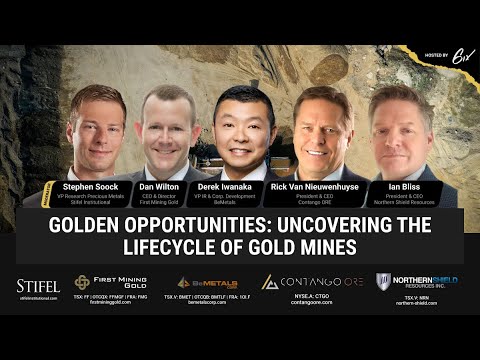
0:08 Hello, everyone, and thank you for joining us today for this panel, Golden Opportunities, Uncovering the Lifecycle of Gold Mines. Thanks for joining us. We've got a great lineup for you today. My name is Stephen Sook. I'm an equity research analyst with Stiefel GMP based out of Toronto. My background is as a mining engineer. And for the last 6 years I've been covering the junior side of the Gold and Silver space, junior producers, developers and exploration companies. Joining me today, we have Ian from Northern Shield Resources, Derek from B Metals, Dan from 1st Mining and Rick from Contango Ore. We'll give them each a few minutes to introduce themselves and their companies and then launch into any questions. So reminder, if you do wanna submit questions, please do so in the chat and they will make their way to me to present to our panel today.
1:01 So with that, maybe Rick, we'll start with you. My name is Rick Van Ewenhuis. I'm the present CEO of Contango Ore. We're a New York, NYC, American listed company. We're developing
1:14 our Macho project in Alaska. It's a high-grade, open pit mine. We're delivering about 8g per ton ore to the mill. We have a joint venture with Kinross. We selected Kinross as our joint venture partner to be able to process our ore at their mill. We have short-circuited the whole process of building a mill in a tailings facility and raising capital for all of that. That has allowed us to basically short-circuit the Lassonde curve and get into production relatively quickly and for relatively a small amount of capital by not having to mill in a tailings facility or permit those things. We'll be producing about 67,500oz of gold per year over a 4.5-year mine life. We've got lots of exploration upside because we basically have about private land package with the Tetlin tribe that is about the size of the state of Rhode Island. So we have lots of exploration upside to go.
2:16 We're under construction now, We're fully permitted and we look forward to this panel discussion. Thank you. Great. Thanks, Rick. I'm going to pass it over to Derek.
2:27 Hi, my name is Derek Iwanaka. I'm one of the founding executives here at B Metals Corp. I almost said 1st Mining just because my previous company actually that I was working with was just prior to Dan Wilton joining. So I was previously with 1st Mining Gold for 3 years there. But now my career started with Bima Gold, which is important because Bima Gold then was taken over by Kinross and eventually became B2 Gold. And so I've stayed with that same group or come back to that same group now for over 8.5 years. A little bit about B Metals. Our company is exploring for Gold right now in Japan, which is fairly, I guess, unique. There's only a few other companies operating in Japan, at least from a foreign standpoint.
3:15 And then we're also exploring for Copper right now along the Western extension of the Zambian Copper Belt. So, yeah, we have a pretty unique portfolio. We have the backing here of B2 Gold. So B2 Gold is our largest shareholder. We get a lot of technical advice and support from them, as well as financial advice and support. So a good position to be in right now. Thanks. Great, thanks, Derek. Ian.
3:45 Thank you, Stephen. Good afternoon, everyone. My name is Ian Bliss. I'm president and CEO of Northern Shield Resources. Northern Shield's flagship property is the Moon Settler Project located on the Burren Peninsula of Newfoundland. The original mineralization was discovered by a local prospector, but has never seen any methodical exploration by a junior mining company prior to Northern Shield's involvement. The properties have been explored for epithermal type Gold mineralization, as well as porphyry type Copper. Epithermal Gold and Porphyry Copper are the end members of the same system. But usually when you see the epithermal Gold, you don't see the Porphyry Copper because it's much too deep. But occasionally and very fortuitously, you can get the Copper or the Gold telescope or various mechanisms side by side or on top of 1 another. And that seems to have happened at Root & Sellers, both at Gold Project and Tellurium.
4:37 More importantly, recent work has suggested the system is what we call an alkaline-driven, epithermal and Copper-4-free system. That's very important because alkaline-related systems tend to form a unique combination of both high-grade and large tonnage. The deposits and systems, Cripple Creek, Oregra, Emperor in Fiji are all examples of these. If this is an alkaline system, it's actually the first type in Eastern Canada. As a side benefit to that, alkaline-driven systems often have an element called Tellurium. Tellurium is now a critical metal. It's actually about 8 times more rare than Gold. And I say it's a critical metal, but it's probably one of the ones that we've heard about least, but I think in the coming months, or perhaps even in a year, we can hear a lot more about Torium. And certainly, Northern Shale is going as far up the food chain as we possibly can.
5:25 We like to explore the unexplored. Sounds good. Thanks, Ian. And Dan, last but certainly not least, over to you. Thanks, Stephen. And thank you, Ian, for doing a bunch of work for me. I'll describe our Springpole Gold project, one of the most advanced projects in our portfolio. So 1st, Mining really is a project developer, advancing our most advanced project, the Spring Pole Gold Project in Northwestern Ontario, which is actually an alkaline
5:56 porphyry system. One of the largest undeveloped gold projects in Canada, and actually one of the next projects in Ontario to be permitted. We have a lot of Tellurium too, which we're starting to do some research ourselves to help quantify, but significant amounts there. We're moving forward on that. That's an advanced-stage project approaching Feasibility level. We're about 90% done a Feasibility study and advancing through the environmental assessment process, targeting EA approval in 2025. And then earlier last year, we acquired 100% interest in the companies that own the DuParcay Gold Project in Quebec, which is another 5Moz plus large open pit with some underground potential gold project in the heart of the Abitibi Gold Belt in Quebec.
6:53 If you drive from Rue Noranda, Quebec to Timmins, you actually drive directly over the top of this project. So kind of right in the middle of it all. Again, large project, large scale, which we're moving forward on a PEA
7:05 right now. So should help define some economics around that project later this year and kicking off our inaugural drill program tomorrow. So lots of talk about there, but really kind of squarely in the developer camp is where we'd situated us in this group here. Great, thanks so much, Dan, everybody else, giving us a kind of a quick snapshot of where your projects are at. And that's actually a really good lead into my first question. We're talking about the life cycle of a developer and explorer. This starts with prospecting and super early-stage grassroots exploration, progressing through eventually to mine construction and production. We'll go in reverse order here. Dan, you touched on a little bit in terms of feasibility and upcoming permitting.
7:53 Can you expand on that maybe a little bit and talk about what the hurdles are at your stage of project for Springpole and how you manage those at this point in the cycle. Yeah, it's interesting. Although I think technically, if you were going from most advanced 1st, Rick would go first, because I think his timeframe to production is still quite a bit shorter than ours. But we are right in the middle of this environmental assessment. And I think what a lot of investors don't appreciate, that is a very time-consuming, costly, and at times challenging process to go through. First Mining entered the Springfield project into the environmental assessment process in 2018. So we're 5 years into it.
8:39 We think we've got a couple of years left to go for EA approval.
8:46 And we were blessed with the fact that the company, even the predecessor company that had it, Gold Canyon, had started doing environmental baseline studies for years and years before 1st mining acquired them. We've continued on those baseline studies. So this, you know, this is a project that's basically been in continuous environmental study for 12 years. So it there's an amount of work that just needs to happen and, and amount of data that needs to be collected in order to make these real scientific discoveries. So, or this, the, you know, have the scientific background to go through those environmental assessment processes. You know, so it's a lot of work, but, you know, and it's a lot of cost.
9:33 But in the end, every step that you get closer, I think takes more and more risk out of these projects. And that's something that I think is important to understand when you're looking at a development stage project versus an exploration stage project is there's just
9:48 so much more that's understood about those projects. And I think gives investors an opportunity to really assess those risks. I think that makes a lot of sense. Obviously, you know, de-risking is kind of the whole nature of the business at the highest level. That's great. Thanks for focusing on that a little bit. Now, I'm going to go up and down the order we went through initially here. Ian, maybe if you could just talk to some of the challenges at your stage of project, obviously going to differ greatly from those Dan was just addressing. Yes, we're really in the pre-discovery stage. Obviously, we got 2 commodities, very different projects. It's basically 2 projects in 1. The Gold is more on the pre-discovery, discovery size. So if you go back to the Lausanne curve, we're hopefully just at the base of that, ready to take off.
10:41 At this stage, early stage projects, it's all a matter of access to capital. When times turn tough, it's usually the early-stage projects that get turned off first. So it's a matter of accessing that capital through all markets. We can't just go away. It's accessing that capital. And then it's also retaining investor shareholder interest during those tough times. And you know, basically we need to understand and perhaps do a better job at communicating with shareholders that results, especially in early stage projects, they are risk, but obviously with risk comes reward. But the results can be disappointing without being bad. We base our work on a lot of science and even the science may be right. Disappointing results may not be bad results. That doesn't mean the model is flawed. And so it's a matter of retaining the shareholder and investor interest during those tough times, which also again leads into access to capital for those projects. But we try to de-risk things as much as we can by using a model-driven approach and other things, just looking at jurisdictions, we know it is high risk. So we look at a lot of other items that are reduced risk to ourselves, the shareholders and the environment.
12:00 Yes, it makes sense. Access to capital is clearly an ongoing endeavour for earlier stage as you try and progress that to de-risking process and move through the exploration portion of the project.
12:13 Derek, maybe over to you, obviously at a bit of a different stage and then in a bit of a different jurisdiction. So you just speak to some of the challenges at the stage of your project. Definitely. I guess, actually, similar stage. We are at the pre-discovery level right now, where we haven't made any major discoveries yet in either Japan or in Zambia. But some of our projects I would consider brownfields. They were past mining operations. As some people may or may not know, essentially Japan was shut down from mining. There was actually quite a lot of either gold or copper mining or both in Japan prior to World War II. And then once the war erupted, all mining basically ceased, unless it was for specifically for war operations. So a lot of those gold mines were never restarted in Japan.
13:10 And so you have a lot of, I believe, at least a lot of potential for either restarts of mines or in our case to make a discovery. So some of the properties we have a portfolio of 5 in Japan, some of which have been passed mined and some of which are basically new exploration properties. So I'd say we're still on the earlier stage of the Lausanne curve. So as Ian said, we're just on the runway to go on the upwards trajectory. In our case, we've done a lot of research before we picked up these properties. So those projects,
13:50 with the due diligence, it was to look at, A, well, technically, are they sound? Do they have the potential to actually become a mine? Because a lot of people, I would say, hesitate about Japan because they consider Japan as a highly densely populated country where it's going to be very difficult to find a mining operation that can get permitted. And in our case, we're in pretty rural areas of Japan where past mining operation obviously have been done and hopefully can be done again. And so permitting, I think we've kind of mitigated at least part of the risk there because some of those mines have been permitted before in the past. And technically, our team has done a lot of due diligence before we picked up those properties. So we want to make sure that there's Gold there. And more particular I guess in our case is that the Gold is hopefully hosted in imports, in silica particularly because copper smelters in Japan are actually in great demand for that silica or sulfur silica. And so if you can get that delivered to them, direct ship or to the smelters, they can use that as flux. And you can avoid, similar to Rick's case, you can avoid building mills and the tailings and the typical things that you'd see at a mining operation. So I think we've mitigated a lot of those risks. Yeah, that's interesting looking at kind of the whole
15:22 slate of opportunities in front of you, beyond obviously, mines are there to make money, not just produce a one-set metal that you might be looking for. So, it's interesting to evaluate that broader scope of opportunities. I am not sure if we've got Rick with us here. Rick, if you're on the line, I know you're having some technical issues. If you are there, if you could just address some of the unique challenges at your stage, at this production pending stage, and what you spend your time on in terms of trying to mitigate some of those challenges. Looks like we might have lost Rick for now. So if he hops back on, we'll jump back over to him.
16:13 Okay. Thanks guys for kind of running us through what you're focusing on there. You mentioned the Lausanne curve a number of times. I think that's a well-known concept in the value creation of junior mining. But it's interesting that there's a broad slate of companies available for investors out there. And there are those that are able to surface significant value and those who are not. So, I guess, what do you see as one of the key differentiating factors from those who are able to raise their market cap, raise their profile and advance their project and those that end up kind of stagnating to some degree. Maybe Ian, we'll start with you this time.
17:00 Well, I guess it goes back to the question is once you raise or obtain that interest and move your way up the Los Angeles curve, is it easier to keep that interest to keep yourself up there or is it easier to say you haven't hit that curve yet? Is it easier to attract money
17:21 and further investment? So, I mean, the other gentleman on the panel will know better and maybe have a viewpoint, but it's a matter of, if you've already obtained that interest, keeping yourself afloat, compared to early stage like Northern Shield, which is attracting the attention in the first place. Obviously, from the market conditions we see today, it's easier that once you gain that foothold, it's easier at least access to capital, whether it's easier to keep that access and ensure that our interest is another question. Right, yeah, definitely engagement is key and being able to keep some momentum when you've got it, can be a major factor. Dan, any thoughts on differentiating factors from 1 company to the next in building that value creation, being able to progress through those peaks to those peaks in the Lausanne curve? Yeah, I think what's important to recognize is the Lausanne curve kind of has 2 peaks to it, right?
18:26 And we are sitting with our development projects kind of in the trough in between those 2 peaks. And that's kind of the long, hard slog of development. You know, what really differentiates that once you kind of establish that you have a mineral resource, you establish, you know, you gotta establish A, that you have it. And there's a lot of excitement in that establishment of those understanding the size, understanding the grade, understanding the cost and the economics around it. But that, you know, that discovery phase is a real opportunity to create value.
19:04 The real trick is once you have something and then you're going to try and turn that excitement and deposit into a mine, there is that long road of de-risking that we and others marched down. So what really differentiates that I think is investors can look at an early stage on a deposit and say what are the characteristics that are going to have this be successful and ultimately be a strategic deposit that either investors will fund into production or partners are funding the production or someone will want to buy. And I think those criteria are size, grade, economics, jurisdiction
19:51 would probably be 4 of the top. And then having a team in place that actually has the capability to move it through to those critical milestones. So that's something that we really focused on in the last few years, is really building those critical, bringing in those critical members of the team with experience in having moved projects through environmental assessment, having moved projects through Feasibility Studies to start scoping what it would look like to build those. I think at the outset, are the projects big enough to be meaningful and significant? Are they in a place that larger mining companies are going to want to own and operate mines. Those are a couple of really good criteria to look at. And I think when we look at our portfolio, not just Springpole and DuParcay, but all the rest of the projects we have in the portfolio, million ounce plus resources in Canada, It's a great place to be starting from.
20:49 Yeah, that's true. And I think you touched on a key thing there too, is we get lost, especially I'm guilty of this on the technical aspects. You end up down that rabbit hole, but that having the right team and the right people in places can be equally if not more important. Rick, it looks like you're back on here. We were just talking about value creation and how companies differentiate themselves to be able to hit those peaks and rise head and shoulders above the rest to be able to get that recognition. Obviously, you've managed to do that quite well, progressing into production on the horizon. So maybe you could give us your perspective on how you're able
21:28 to differentiate yourself and drive that value creation to where you are now. Yeah, we made a discovery in Alaska on the Settland tribal lands, private lands, a little over 1 million ounces of gold. Nice high quality deposit near surface, near infrastructure, which for Alaska is an important thing. And so we made a decision to, rather than the project ourselves, to partner with Kintrosk, and an existing mill, underutilized mill at Fort Knox. And that actually shortened the whole Lausanne, that we're still subject to this Lausanne curve, but we've managed to shorten it because the permitting timeline was much shorter because we're not permitting a tailings facility, which typically would take 5 years in the United States.
22:13 We're not building a mill and a tailings facility and all the infrastructure around that. So we were able to get done what would normally take sort of 5 years. I think that's a realistic timeframe to permit a project. We were able to get that done in 2 years. And we formed a joint venture with Ken Ross in September of 2020. We quickly got a feasibility study done. We quickly got our 404 wetlands permit from the Corps of Engineers in a matter of 9 months. Again, not building a tailings facility really simplifies, lowers the environmental footprint and simplifies the permitting process for the project. Our project now simply is at Mont Jeau is a basic quarry operations, a mining operation.
22:58 There's it's run a mine ore that gets loaded into trucks and then transported up the highway to the Fort Knox mill. So that's sort of half of our story. The other half of our story, and I think to sort of combat the Lausanne curve, which is a real thing, there's no getting around it, especially not for a junior company, is to have a second project that you can create the exploration excitement with. And for us, that's Lucky Shot project. It's relatively small. Again, it's on infrastructure in Alaska. It's high grade. It's a historic mine that produced 250,000 ounces of
23:38 40 gram per ton material. So very high grade material. Relatively small, but this is something again, we're fully permitted. We've got this, it's on private land. We're fully permanent to mine. If we, again, don't build a tailings facility, we can throw rocks in a box and haul them up to the Fort Knox Mill, which is again underutilized. We have the advantage of the railroad on the Lucky Shot, where Lucky Shot is located. We're about 20 miles from the railhead. Transportation-wise, it'll be a lot less expensive to transport the ore. I think that has to be part of your strategy to beat the Lausanne curve, to minimise its impacts on that long, low period that you have between discovery and production.
24:27 That's how we've managed that process. It makes sense. I know sometimes it's intimidating as you're starting to head into the trough. He said kind of an inevitability, Dan, that you have to go through that in order to get to the higher peak on the other side. But certainly something that needs to be dealt with from a market strategy standpoint. Now, Rick, you mentioned something interesting here, kind of a second project, and you obviously would have had to kick a lot of tires to find that second project. Just in case you drop off again here. We'll start with you. What are some red flags you look at when you're trying to evaluate projects and have opportunities brought to you? Some things that are kind of the hard line in the sand or things that start to raise eyebrows for you that you might shy away from versus are attractive?
25:19 Well, I mean, it already starts with the geology. I'm a geologist by background and that's what I look at when I look at any opportunity. What's the geology? Do I understand it? Can I outline a plan and put together a plan that says, what do I want this to be? Do I want it to be A0A million ounce resource? How many dollars does it take to test that? And what plan do I have to put in place to achieve that? That's basically what we've done with Lucky Shot. It was a known resource. It was pretty decent quality where it had been drilled. So just putting the infrastructure in place to explore, continue to explore the down-dip exploration upside is what we had to achieve. And it wasn't inexpensive.
26:13 It cost basically $10M for us to get underground, refurbish the underground and put in the drifts in the footwall to be able to get the underground drilling underway. We started that process last fall, the drilling portion of it, and we plan to continue that later this year when we start back up in the summer, hopefully.
26:38 To me, it all starts with the geology and understanding, having a good geologic model that you test And obviously communicating that to your investors and your shareholder base is important. And achieving the various milestones that you can set for yourself and doing what you say you're going to do is very important for investor confidence. Definitely. Ian, maybe we'll come back to you. When you're evaluating projects, what are some things that are big check marks or big red flags as you go through your process? Well, I think as Rick said, a lot of it comes down to geology and understanding your geological model. In our case, we either generate our own projects or we acquire them from prospectors. It's one thing to have numbers, whether it's Gold, Nickel or anything else, but do you see the system?
27:34 We are all after, particularly if you are trying to reduce the risk for these early stage projects by going after bigger targets. Everyone does. No 1 on this panel is going to say, yes, we go after small targets, but if you are going after big targets, does your geology support that? Your alteration, your geochemistry?
27:53 Is the geology, does it support your theories along with all the other geoscience factors? And then obviously, jurisdiction plays a key role too for us. Even if we find it, can we get it out? I'd say most of our past work was in very remote areas. We felt that you had to go to these remote areas If you like to explore in the unexplored, but there is an exploration cost to that. And there's a question of, if we find it, can we get it out? And so Nolan Shields started looking for places, particularly in Canada, that were underexplored, but still had that infrastructure nearby, which is, you know, the continental scales are there and reduces your risk. But you really got to understand the geologies of these systems and the model. And you can adapt your model going through, But you need to have a model to start with before you start chasing these things.
28:51 Yeah, makes sense. You mentioned something kind of leading here to Derek, jurisdiction Ian. So Derek, Japan is kind is a unique opportunity set within the global mining, global mining investment universe. Does your process differ or are there additional social considerations because of the country you're exploring that are more to the forefront?
29:18 Obviously, geology is important, but good geology is no good if you're never able to mine it either on the other side of the coin. So maybe if you could speak a little bit about how that factors into your decision making process. Sure. I mean, I have Japanese background, So I've actually lived in Japan before I can speak the language, although not exactly fluently anymore, but I can still get by. So I do understand kind of the cultural challenges that are in Japan. I would say that the biggest challenge that we faced, at least in the last 2 years since we kind of got into exploring in Japan, was at the outset of COVID, the country was shut down. So effectively, no foreigners were allowed into the country from about March 2020 all the way up until I think it was March 2022, where they started to let some foreigners to come in.
30:12 So that, that was definitely a big restriction on us. We weren't able to kind of get it boots on the ground and actually do our drilling work. That was probably the biggest challenge that we really faced in the last couple of years. During that time, obviously, there wasn't a huge amount of work being done there since we could only do early-stage exploration, groundwork, service sampling and stuff like that. That was part of the biggest challenge. But in terms of permitting, the permitting is actually pretty straightforward there. Although you don't see a lot of mines permitted in Japan, They do host one of, if not the highest grade Gold mines in the world. The Hishikata Gold mine is operating in Japan. From my understanding, it started at 80g per ton head grade. So you as an engineer, Steven, you probably appreciate that. That's going to make some serious money.
31:01 And it's been producing for over 30-years now and is still producing between
31:08 20 to 30g per tonne. So still pretty significant head grades. My understanding is it still has pretty good reserve life. So when we were looking around the world, we were looking for what areas had potential and certainly Japan had that potential on a technical basis. It had a good permitting regime, which we understand. And probably the biggest point right now would be you get your prospecting rights, which is good for 6 years. And then after that time, you basically have to either renew that license or you would have to go for what's called either digging or mining rights. And then that would give you the rights to actually build and mine. So it's a pretty straightforward process.
31:54 It's not, I don't think as complicated maybe as some North American jurisdictions, But you do have to follow each process. And if you follow every step, you should get your licenses and permits. And that so far has worked for us in terms of the exploration side. It's interesting the disconnect between the jurisdictional ESG risk perception and the reality if you actually understand the system in which you're working and how to advance projects. Often that comes down to investor education, just over time being able to get people to recognize the reality and positive reality of what you're actually working within.
32:39 Now, I'm kind of talking, jumping around a little bit here, but coming back to you, Daniel, we've talked about the Lassonde curve and kind of managing that trough. And It certainly seems like the peaks are maybe getting higher and shorter-lived and the troughs are becoming more abrupt. I don't know if that's just my perception or if there's a change in the market dynamic over the last few years, But maybe if you can just speak to that, that's something you're seeing, how you've dealt with being in that, like you said, trough development phase ahead of the re-ramp. Yeah. I think you've seen a good number of exploration successes over the last couple of years, which has generated a lot of excitement. And that's good for all of us. That's an important mobilizer of capital for the industry. And so, never begrudge someone a few hundred meters of 2 or 3 grams to start generating some excitement.
33:43 When you look at the long, hard work of going through an environmental assessment or a permitting process or a project development process. You know, the reality is there are no shortcuts. And every project that is going to become a mine is going to go through it in 1 sense or another. Sometimes you can mitigate that kind of like Rick has with project scope and that's important. You know, it is important to understand when you're operating in a jurisdiction where there is excess milling capacity, where there are projects that might have existing tailings facilities you can use. We look at that more and more with our DuParquet project in the Abitibi, because there does appear to be a surplus of milling capacity in the Abitibi. And we happen to have 100Mt of
34:43 1.5g plus open pit material that we think should find a home. So I think you need to look at opportunities like that. But the one thing that I think a lot of people forget is that if you are looking at companies that are at advanced stages going through this environmental assessment. Every step that you go further down that path puts you further ahead of someone who hasn't started it yet. If you assume that's going to be a 5 to 7 year time frame, And I think it's getting longer, not shorter for permitting projects almost anywhere in the world. We've been at it for 5-years and the reality is in 2019, 5-years away seemed like a really long way away. We've had a little bit of timeline slippage, but you're now kind of within 2-years.
35:38 And I think that's where investors can kind of start taking a view on the value and that timeframe and start focusing on the fundamental values. Because one thing that we're not short of in a company like FirstMine and Gould is fundamental value. I think we've got $2Bn worth of fundamental value. You're looking at NPV of projects. Everyone who's been in the industry for a while knows that when you get those projects to certain milestones in rational markets, they will trade hands at $100 to $200 an ounce. You're now sitting with 12 plus million ounces in 1st mining Gould, but $6 an ounce. At some point, the greed factor will kick in more than the fear factor of, are you going to get there through this process?
36:32 And every day we get a clearer view of getting to the other side of that process. So yeah, it is an inevitability for every project that's going to go through it. There's ways that you can creatively manage it. But at some point, it's just understanding that process and being able to invest in the times in that process and at the values that companies hit going through that development process that provides the most opportunity. And I guess it's encouraging to know that there is proof is in the pudding that you can look at a slate of companies who come into production over the last few years and seeing them re-rate in the market. So there is that light at the end of the tunnel as you're able to de-risk. I thought it was interesting you touched on something there that these ounces do transact at $100 to $200 an ounce, broad goalposts depending on the project.
37:25 As a whole, my developer, Exploreco Comps, has averaged EV per ounce of $35 US an ounce. So you do see that kind of multiple expand as the de-risking process continues. And senior producers, and Rick, this is something I'm sure you can appreciate, are willing to pay for those de-risked ounces rather than take on cheaper ounces at an earlier stage. So I think that's an important part of the dynamic at play as all that work you do every day gets recognized further and further along. I've got an interesting question coming here from the audience about the mining timeline narrative more geared towards generalist investors. We're talking broadly as people who know and breathe the industry.
38:17 But, you know, asked here, is there any thoughts on kind of flipping the strip a little bit to frame project development more in line with call it a traditional business, something like a widget factory or real estate development and how speaking mining language, is it kind of a positive or a negative here to try and attract generalist investors, which I think we all recognize are we need more of in the industry. Maybe Rick, we'll go over to you first. I think mining legacy language is probably not the best.
39:02 We have things like Waste and Slag, and there's a whole host of names that are probably not well-suited for the modern world here. Maybe a rebranding would be appropriate. That's beyond my paycheck. I certainly see the opportunity That's beyond my paycheck. But I certainly see the opportunity for mining to, what we see in Alaska is mining has done really good things from an on the ground ESG perspective. And That means mines like Red Dog have created a whole self-governing borough in northern Alaska. The Northwest Alaska borough is mostly Unipac, Eskimo, Alaska Native and they self-rule.
39:51 It's a borough government, 90 plus percent of the people there are Inupiaq and they have benefited from the Red Dog Mine And we see the same thing happening with our project at the Tetlin lands. Again, the Tetlin lands are about the size of the state of Rhode Island. The private lands are owned by the tribe. It's a bit of a unique situation in Alaska. And they are 110% supportive of the mining project, our project, and they see the huge benefits that this project will bring to their tribe. It's a tribe of a total of 300 people. They'll receive royalty, they'll have jobs and training, And the jobs and training are probably the most important aspect of what mining brings to remote communities.
40:44 Because frankly, there's not a lot of other jobs out there besides government jobs. Mining jobs pay really well. In Alaska, I think the average mining job is $130,000 a year. Those are the boots on the ground and it's hard to do an ESB check the boxes exercise sometimes for mining companies because they get sidetracked with objectives that are not necessarily important to the objectives of a local community, which is to sustain the community. And that takes jobs and capital. That's kind of where my mind goes when I hear questions and concerns about how do we adapt the mining business?
41:32 I think we need to look at it. It's an important aspect, but I like to see results on the ground. And that's what gives me the most pride when we're working in remote places in Alaska. And I think that's really important too, that investors often look at the ESG side from a risk perspective and not necessarily fully appreciate the opportunities that come with those in terms of, like you said, providing opportunities from a social standpoint, remote locations, or sometimes even cleaning up historic environmental mishaps that are a legacy of old businesses that are coming and actually remediated as part of a mining development project. So I guess it's both sides of that coin have to be appreciated. Another kind of pointed question here a little bit, maybe this goes to you, Ian, which is more personally frustrating, obtaining financing or obtaining permitting?
42:30 Oh, Ian, you're muted. Sorry about that. Financing. I mean, Permitting has been fairly forthcoming for us in most of our jurisdictions that we worked in, Ontario, Quebec, Nova Scotia was a little bit problematic. Newfoundland is probably one of the most welcoming places business-wise for mining that I've worked in, both with permitting and the overall attitude and response to mineral exploration. Permitting at the early stages can sometimes be a little bit slow, but it's nothing that can't be overcome. So it's right now, I'd say it's the market conditions and the access to capital, which is more frustrating.
43:26 Thanks for that. That makes sense. And Derek, maybe same question to you, I know you touched on the permitting process a little bit, but again, kind of a balance of focus and frustration, permitting or financing for your projects. Well, it's super important, but I think let's just touch on permitting because in Japan, I think you have a really bad problem there where you have all the young people leaving the rural areas and migrating down to the cities. And so you have Tokyo that's turned into a mega city that has the population of almost Canada. And then you have these rural areas that are basically abandoned, where you have, in most cases, a lot of senior citizens that are kind of running the show in these small towns.
44:17 And when we were speaking with the mayor and also with other government officials in the areas that we're in, most of them were quite actually positive on mining. So, a lot of people were thinking that it couldn't be done. Nobody's really done a lot of mining in Japan. And yet you go to some of these rural areas and they said, if you can get some of the young people to come back to these areas, we would be all over that. So we're seeing a lot of support so far for, as Rick pointed out, to get jobs back into these areas. Mining tends to have pretty good paying positions and they have quite a few positions to fill. And so if you can get a lot of these young people to go back to these rural areas, we find that there's good support for it, both on the kind of municipal level and also on the federal level. In fact, I just saw recently in an article that Japan, the government is paying 1 million yen to individuals that are younger that will leave the cities and move to the rural areas.
45:26 And part of the reason is if there is ever some major destructive event in Tokyo, for example, a large-scale earthquake, you would lose almost a third of the population in 1 fail swoop. So they want to try to mitigate the potential damage that could do and so they're trying to encourage people to leave some of these areas. So I don't know, it's a unique position for us to be in operating in Japan. Yeah, definitely. It sounds like there's potential for partnerships there, you know, with the government to kind of a win-win for both. You get a workforce, the government gets some of the diversification objectives from a geographic standpoint. Dan, we'll go over to you here. I've got another question, changing tack a little bit here on the use of technology and how that's kind of shifted the landscape in mining, you know, obviously scoping out a large scale project.
46:20 I imagine you're evaluating lots of kind of new, new exciting technological opportunities within the mining space. Maybe if you can speak a little bit about that and what you see as kind of the biggest technological game changers when you're looking at developing a project compared to even 10 or 15 years ago? Oh, it's interesting, because this is an industry that is, in fact, one of the least technology adopting industries anywhere. They still more or less crush rock in the same way that we've been crushing rock for 50 years. When we're looking specifically at the development side, you often face this tension between looking at a new technology that could enhance the economics of a project or increase throughput or whatever the benefit would be, but it gets weighed off against the perceived risk of, oh, it's a non-standard flow sheet. So, I can't believe your pre-feasibility or feasibility numbers now because you had to make some assumptions around this technology which is not widely adopted.
47:38 I think if you wanted to point to the ones that I think are really sort of on the top of adoption and sometimes probably get talked about in a few too many cases where they may not be entirely applicable, but things like ore sorting and as the capability for those ore sorting machines to further and further differentiate different material that goes through them. I think that has a huge opportunity at very low cost to open up a bunch of different processing routes or direct shipping in some cases. One of the things that we're looking at a lot with our project in Ontario is power efficiency and minimizing diesel usage.
48:30 This comes down, as Rick had said, to a lot of the talk about how you're talking about projects and trying to convey a sense of societal value to what is a massive employment opportunity, large revenue opportunity for local communities, and importantly, employment skills building and things like that. But the perception is still of the mining industry as kind of an environmental bad actor. One of the things I think that can change that is, if you're operating in places where you have good grid power, it really does open up the opportunity to scope very efficient mines of the future. And it's still a little bit harder and big open pit mine. But if you're an underground mine today, I think your base case is probably looking at electric infrastructure, as long as you're close to a grid, right?
49:27 Just because there are such tangible savings in terms of real costs of ventilation and underground development that come with being able to use battery electric vehicles. So yeah, I mean, whether it's how you're powering the projects, we're doing studies on renewable power generation opportunities around our mine. It's looking at how you are going to close mines that are operating now and integrating real ESG principles into utilizing that infrastructure that's in remote areas to provide further economic development opportunities for local communities. Those are the things that I think you get a lot of traction on, rather than, here's a new piece of crushing equipment that might knock 50 cents a ton off your operating costs.
50:16 In terms of narrative and excitement, I guess that's the bigger piece. I did say something that I think will resonate with everyone. Every company wants to be the second one to adopt a new piece of technology. Those first adopters, there's obviously much to be gained, but also kind of an increased level of risk. Maybe Rick, kind of same question over to you. And then the process of kind of developing Manchurian Mansion, are there certain technological game changers or things that you think, wow, that's really cool. We'll do that now. Here's some massive benefit compared to what was available a decade ago. Yeah, Dan mentioned ore sorting, and I think that is the technology that we'll see come more into the forefront of mining.
51:04 Unfortunately, I think for ore sorting, the unfortunate thing is if you have a mine, an existing mine and an existing operation and the flow sheet, it's hard to integrate ore sorting into that flow sheet because it changes the rest of the flow sheet. So I think that's a bit why there's been a slow adoption of ore sorting up front. And as Dan says, you know, you don't want to be, it's hard to be the first guy to say, okay, I'm going to put ore sorter in here and make this work. And if they want, oh, okay, I guess we'll see. And we'll see, like you said, the 2nd or 3rd guy, maybe can get away with it. So, we actually did look at ore sorting for the Montreux ore and it just didn't pencil out. It wasn't a good enough upgrade. We can deliver an 8-gram material without ore sorting, but with more selective mining.
51:54 That's fairly new technology. When you blow up rock, You don't want to blow it up and have it scattered all over the place. You just want to kind of fluff it. And there's new software now, new software packages that basically monitor how a rock moves pre and post blasting. And so there's a lot of new technology out there that if you want to do selective mining you have to know where the rock is and then where it is after you blast it. So those are important new technologies that are being applied to the industry. And for us, that was a, it's an important part of being able to selectively mine 8 gram material and just, you know, run a mine, direct load it up on the truck and haul it up to Fort Knox.
52:45 And I think there's a lot of tweaking. And I think Dan said the same thing. There's a lot of tweaking we can do, but until we can learn how to, you know, crush rock fundamentally differently, you know, we're always, you know, we're all, that's the first thing you have to do to be able to separate the minerals that you want from the minerals you don't want. Yeah, so a lot of good technology out there to reduce it. And Dan also mentioned power, and that's one of the, you know, we discovered the Donlan project 25 years ago and the bloody thing still being permitted. So, that's one of the reasons I've kind of shifted my focus to working on the grid, working on the highway network, finding things that I can get into production and cash flowing in my lifetime.
53:32 I'm hoping that Donovan will get into production before I pass on, but I'm not convinced it will. It's kind of like the old joke where the mining engineer and geologist are talking and the mining engineer says, it's a really great deposit, but next time can you find it closer to the road? Yeah, it makes sense that the infrastructure is key in terms of advancing it. Maybe we'll stick in the same vein, Ian, go over to you. From the exploration side, technological advancements that you see is really providing a whole different set of tools compared to banging on rocks and just the drill bit. Is there new technology that you're looking at utilizing or new processing or interpretation methods that are helpful from your perspective?
54:20 Yeah, I think it's just these are more just incremental changes. I mean, particularly along the geophysics, I mean, none of this is really new with this IPEM, but it's just these incremental changes that allow us to see deeper, see better resolution, be able to model these a little bit better. Obviously, various 3D tools, it's helping out a lot, even in early stage projects. And the sort of instantaneous ability to log and communicate this data from the field to head office or to consultants. I mean, a lot of core can almost be almost virtually logged. I don't think it's a good idea, but it's the speed of which data now can get from the geologist in the field or from the core logger to head office where we're already seeing some very rapid changes. But otherwise, these changes, it tells you more and they're more incremental. As I say, it's minor advances in geophysics and other tools. And we don't see that rapid sort of advancement that perhaps the oil industry is seeing, but it's sort of incremental changes that nonetheless are important in this industry.
55:26 Yeah. Every little bit of extra perspective or depth or ability to interpret helps as you're trying to get a sense of the whole system. With that from the exploration side, maybe Derek, I'm not sure if this is something you guys utilize, but obviously drones are something that are available in the last couple of years for industrial applications that weren't even 10 years ago where you were tied to a helicopter and a pilot and all the logistics that come with that. Are you seeing the use of drones for mapping or LiDAR or even just kind of visual surveys? Is that helping at all from an efficiency and cost perspective at all for your projects? Yes. I guess in our case, the projects, a lot of them haven't really been touched since World War II. So almost anything we use is kind of modern technology, I guess.
56:13 Using drones for sure. We've actually just recently flew a drone magnetic survey over our Toshido project, which is down in Kyushu, and it did end up generating a number of targets for us to be drilling. So without question, you know, using some of this technology has helped. I actually was recently down in Cape Town at the mining in Dabin and got to watch some of the samples that were using drones that were flying into either past mining operations. And they could go pretty far. I think they were going 4 or 500 meters where they're completely out of line of sight. And yet they were still able to control these things underground. And they were able to map out the entire underground of some of these structures. And for sure that was bringing back some valuable information that nobody would be able to use it previously or nobody was able to access before and I think that's something that we're going to be looking at because some of our minds actually have added said they're still in place but you know they're either kind of dilapidated or falling apart. And yet, while the average human probably doesn't want to go too far into these things, you could easily send a drone down there and do some surveys and get some valuable information. And that's actually exactly what we're looking at doing in Japan at some point.
57:37 So that's probably the best use of recent technology that I've seen that could be used pretty easily for us at the expiration stage. Even I might add one more thing on that too, is portable XRF machines, or the TerraSpec which is used in mapping. We no longer have to wait a week sometime, at least to get rudimentary results back, or then help vect you in the field for further exploration and mapping. And that's another fairly significant advancement that's happened in the past few years. These things have been around a while, but certainly the analytical thresholds have been getting more and more, you know, The accuracy is getting higher and they're much more useful now for that sort of instantaneous assay result that you get in the field.
58:24 Yeah, that's a good point. Seeing them appear more and more, mentioned more and more for different teams that I talk to. Again, not a full assay sweep by any stretch of the imagination, but does give that real-time, okay, do we want to put another hole here or not, based on that initial feedback. That's a really good point Ian. Well, guys, we're coming just kind of up on the hour here. So I just want to thank each of you for logging in today. It's been a really great discussion. Great to hear about each of your projects, your thoughts on the industry and being able to surface a value for investors and what's involved broadly when evaluating opportunities. So thank you very much, Dan, Rick, Derek and Ian for joining me. Thanks to all of our listeners and hope to see you