Transcript
Automated transcript · Written by software from the replay's audio. It can mishear names and figures; the replay is the record.
0:03 So good morning, good afternoon, or good evening, depending on where in the world you're signing in from today. I saw everywhere from Alaska to Singapore on the sign up list. So really appreciate folks joining us in all hours of the day, because I'm lucky enough to have with me today, Tara Christie, President and CEO of Banyan Gold and John Robbins, the company's strategic advisor. Tara, John, how are you today? Wonderful, thanks for having us. Great, thanks. Awesome. And here's how today's gonna work for the folks in the room. So 1st Tara's gonna run us through a short presentation. Then I have a couple of questions just based on it. Hopefully we'll leave today with a great update about exploration at ORMAC. I've got questions for both Tara and John, so I'll be both ready for a bit of a grilling. But today is also an interactive event. So there's a chat button at the bottom of your screen. Please feel free to ask questions at any point during today's event.
0:52 We'll try to get to as many as I can. If for whatever reason I don't get to your question, they ran out of time or it's way off topic, I'll still make sure that the Bandian team gets those questions. And they'll be able to get back to you using either the phone number or the email that you sign up with. There's also a request meeting button at the bottom of the screen for those of you who are joining as an attendee. You can press that at any time during today's events, and it will log a request. And I'll try to get those requests over to the Banyan team as quickly as possible. And again, I'll try to reach out to you. Only other thing I'll say before we get into the good stuff is this event is being recorded. We'll be able to replay
1:25 in the near future, likely tomorrow morning Eastern time at the absolute latest. Could it be as early as today? It'll be both on this exact same link. I would also be on Six's YouTube channel. But enough out of me, I do want to get to the protein. Zatero, I'll throw it to you to start our presentation. Thank you very much, Romeo. You know, we wanted to make this a little bit different. So not our standard presentation. We really wanted to focus on exploration potential and really show the generational potential of ORMAC and the fact that, you know, we're in a district that, let me get the right screen there, there we go, Hopefully you see that now. You know, Banyan's ORMAC project, brief overview of it and what we're doing this year, which many of you probably already know, I think it's a pretty significant re-rating year for us. We've seen that a little bit in our share price, But again, I think we've got lots of catalysts driving us this year, starting with that new resource with an indicated component of 3.6 million ounces and 5 million ounces of inferred, showing great increase, showing a component within it of higher grade and a more refined lithologically constrained geological model. That was something that the market was waiting for from us. We're coming up on that Maiden PEA for the fourth quarter now. We've got a strong Treasury through 2027, So lots of tailwind behind us. We've seen some benchmarks with what other people think about the value of our company and the project with Franco Nevada's purchase of that NSR. And
2:57 we've got a big drill program this year, 70,000 meters. We've already 40,000 meters into it. We've got, we started with 6 drills focused on ORMAC and now have pivoted to a skid drill at ORMAC and 3 fly drills on our Nitra project. Lots of news flow into 2027 and we've already put out drill results. And that regional drilling discovery is something that I want to talk about. 11 drill targets and VG and sheeted veins in the first 2 drill holes on 2 of those targets already. So that's something I wanted to bring John in to really talk about this regional potential and his expertise on these deposits and big deposits. We picked up the generic Gold property, which gives us more exploration potential for 2027 with the exception of the Seattle and the Goodman projects, which are right adjacent to our Nitra project. You can see them here. That's, we'll put a little bit of work into them this year. Of course, we have Lugdash again over next to Sitka and everybody knows we're beside Hecla and the Victoria Gold Mine.
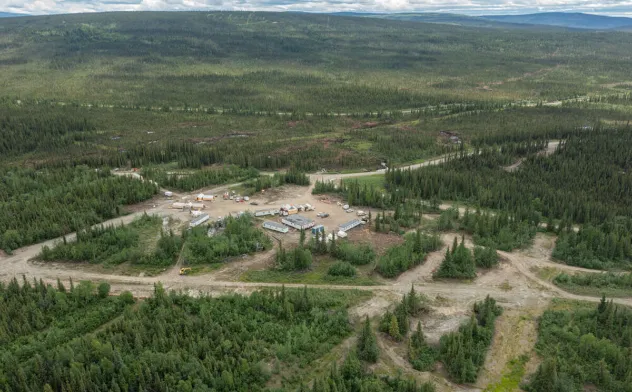
4:01 You can see that fabulous infrastructure. That's a main highway across our project. There's cell phone service and a power line across our project. And in fact, the hydro dam is just off our property boundary. There's that high grade core. You can see that we focused on drilling out last year. Those of you that have been following knew that with a 0.55 cut-off, we've achieved that 5.2Moz of 1g in the centre. But this deposit has lots of room to grow both at depth and in all directions with only 2 deep holes. There at a 0.25, you can see the potential for the 10 million ounce deposit that gets us into that giant category. But we know we haven't drilled at depth on this project because we were drilling it out at much lower gold prices. And that's illustrated very well by this cross section where we're looking east, you can see the high grade zones where the red and the pink are right near surface in those red circles.
4:52 Those are areas where we know these these lithologies that have higher grade are occurring and where we've been focused on drilling out to indicate it. But what jumps out here is that on the left-hand side, you're looking at the Airstrip deposit where we have this high grade where when you went from the red line, which is a 2050 Gold price pit of our resource last year, to the white line, which is our $3,500 Gold pit of our 2026 mineral resource. Airstrip went deeper to accommodate that high grade and we can see that high grade in this hole, which is a big step out. It's almost 400 meters and ended in 15 gram material with a stronger bismuth ratio. We can see that you'll likely drive that pit down. But why didn't the powerline pit change with such a significant change in Gold price? Well, that's one of the things we can change this year. It's because we were drilling it off when you wouldn't drill deeper than 200m at $1500 gold. Now, all of the holes that we're drilling to get indicated in power line in these zones, we're taking deeper below the pit to get inferred at depth so that we can more fairly represent that this, we believe this deposit continues at depth. So lots of exploration potential, those holes to the southwest of Powerline that we just put out in the first 2 news releases showing that it's open, there's high grade, that's completely outside of the current mineral resource.
6:15 And why are we continuing to add ounces? Because they're higher grade ounces and we're also looking for areas for infrastructure which so far that area to the southwest was originally meant to be an infrastructure area and it ended up being a high grade zone. So I won't belabor that but take a look at the resource and compare it to other projects. At the sensitivity, we saw the quarter, which gets us close to that giant status, but at 0.85, you can see there's 4.5 million ounces at 1.4, So a very significant number of high-grade ounces. And when you compare that to projects, open pit projects in North America, where are we going to land in terms of mineable ounces is the key question. We're excited to see the Yukon having Talmor's coffee project built with a 2.8 million mineable ounces at 1.4 in it. There's lots of projects in that 3 million ounce range. How many are in that giant range and which also have over 5 million ounces that are mineable?
7:19 That would put us in a very rare territory if we're able to achieve that in our PEA. That's what we're thinking. This deposit has lots of room to grow and it's very unique. And then our regional targets, you know, you saw those projects that we purchased from Generic Gold. So the Seattle and Goodman, we do have a target on the Seattle Creek project, which we acquired, but we've already made 2 discoveries. On the 11 targets, we've drilled 2, the Seattle Creek zone and the Roaring Fort zone. And both of those, the very first holes had visible gold in them and sheeted veins. And they are 25 kilometers from Ormac and 5 kilometers apart from each other. So very big district scale. And why are we bothering to add more ounces? Well, showing that our project has potentially other areas that have high grades that are additive, that will make a mill, if it's built here, run for even longer without having to acquire other projects is a significant value add for it. We think that many of these targets actually have the potential to be higher grade, potentially host that 500,000 ounces of a gram that is another starter pit or a very additive to the existing ORMAC project.
8:30 You know, And looking at this region, this region is very prolific between the Eagle Mine to the north, Sitka over to the west. And I'm going to show you a section line from our Ormac through here and then up through Sitka's Rasgabal deposit. And this is conceptual, but it shows you the potential of these very big deposits. You know, Ormax over here with Powerline and Airstrip, and we see that there's both structural features, which are probably concentrating fluids and known intrusives across the deposit. So here's our roaring fork and Seattle Creek, and 25 kilometers away. And then we are also drilling another target, another 15 kilometers to the west, which has, we think, the potential for polymetallic veins similar to what they're seeing at Hekla. So this is a really exciting time to be unlocking this major geology.
9:25 And the original hole hitting 1.62 grams over 5 meters in your first hole with visible gold. There's lots of projects, greenfield projects that never hit visible gold. So that is a stellar result. Our targeting we think is based on a combination of what we know from ORMAC and what we've learned from the geophysics as well as the geochemical ratios. And here's just the veining in Seattle Creek and pretty dense veining and again, visible gold. We're awaiting results for this. And meanwhile, we're now on our tenth exploration hole on the project. So I'm gonna let you ask questions, Romeo, because we really want this to be interactive.
10:07 If he's still there. I am, yes, just sneaking in the background. Thank you very much, Tara. I really appreciate you running through that presentation. I do have some questions for you. There's also a very large number of questions that came in in advance over email. So just letting people know, I'll try to get to as many as possible, but we'll see where we end up towards the end of the hour. But I'll start, And again, appreciate running through the deck. I know it's been a busy couple of months at Banyan since early June, you've closed an acquisition, started drilling a brand new project, found new high grades on the power line, kicked off the PEA. I'd love if you could give us just a quick version of where the company sits today compared to, let's say, the start of summer?
10:51 Well, we started drilling in February. So the start of summer, we were pretty well into our program already as we had 6 drills through March and April. But compared to where we were at the beginning of the year, we now have a very strong treasury. We're funded through 2027. We've got that new mineral resource, which will be the basis of the PEA. The 2026 drilling is going to be post PEA, just for context for listeners. It takes quite a lot of work to run your mine plans and then do all the economics based on that. So the fourth quarter PEA will be based on that. And then we'll be able to say all of the work that we're doing this year is making it better. But it's a really different place to be this year than say last year, because we are thinking ahead to catalysts in 2027, 2028.
11:41 We're thinking about how to make the economics better, how to really shorten the timeline for ORMAC and de-risk it and what are the key steps to do. And the fact that we have money in the treasury and great shareholder support means that we can be solely focused on that and not worrying about the day-to-day perturbations of the market which have been pretty dramatic over the last little while. And that means we're being even more efficient with how we're spending our time and our money on ORMAC. So yeah, I think we're
12:12 in a really great place and the market's starting to appreciate it. We've seen it in our share price And we're still, I think, undervalued for where we are. But we'll let our shareholders dictate that. I appreciate it. And thanks for the quick summary. I really do appreciate it. John, I want to get you in here because you've got some very impressive bona fides. And I'm eager to get you into the conversation. From my perspective, looking at your history, you've had your pick of projects over career, includes Coffee, Kaminak, Great Bear, some of the big names that I think most people on the line right now probably recognize. And in February, you chose to put your name behind Banyan as a strategic advisor. What did you see in ORMAC that convinced you that this was the next big feather in your cap? Well, you know, I've been an investor in Banyan
13:01 for a while. You know, A little bit of background for me, I've been working in and around the Yukon off and on for probably 35, 40 years and seen a lot of ups and downs in the Yukon. Yukons have in the past lots of short-lived boom cycles. And it really wasn't until, I think, Kaminak was actually one of the seminal sort of discoveries in the Yukon that really kind of put it on the map and kind of broke that cycle of boom and bust in the Yukon. But I've spent most of my career working in the North.
13:49 Yukon, you know, compared to Nunavut and the Northwest Territories, you know, it's not as remote. It's not as challenging a place to work. But nevertheless, I look at Coffey. We discovered that. Well, I think it was 2006. It's a long time ago. There's still not a road into it. There will be, with Fuerte it's on the path to construction, but there's still not a road into it. And I think a lot of investors don't do enough homework to look at infrastructure when they make their investment decisions.
14:28 And I've been following Banyan for a while, but I've not been to site. 2 years, 3 years ago now, I guess, I did a motorcycle trip up to Tuk Tuk, and I did a side trip to Keno Hill because it's such a cool historic spot. And as I was riding along, I saw the sign for Banyan and it's like wow, you know, it really drove it home You know, you've got an all-season Yukon Highway Bisecting the property there's power line, you know, there's a power station there as Tara mentioned dams down the road these things people don't pay enough attention to and I don't know what grade factor you could apply but I always look at a project that's got an infrastructure
15:23 benefit like that, is like having an extra whatever it is, 0.1 grams, It's significant. The other thing is it's the timeline, because time is money. And when you've got to permit roads and infrastructure, those all take an enormous amount of time. And Yukon is no different than the rest of Canada. It's challenging. It takes a long time. You've got to work with First Nations to do all those things, and that all erodes the value of your project.
15:55 Terra's got a road right to site, got the power right there. It's also really fairly mellow terrain, so you're not working in a rugged mountain environment you're not having to move rivers or you know any of these things so it's it's about as ideal a location as you can get for a deposit. The other thing to me that is an absolute standout is the expiration upside. So, you know, the world is awash in million ounce deposits. There's lots of them.
16:33 By the time you get to 5 million ounces, you're starting to get into a pretty narrow group of companies. And when you get beyond that and start moving towards 10 million ounces, you really are dealing with really, really big mineralized systems. And I believe that once you get to, say, north of 5 million, you start approaching 10, the potential then is there because you're already demonstrated there's a big system that this thing could be much bigger. And I could see the potential here for possibly 20Moz. It's a big system. It's wide open. It's open to depth. And as Tara mentioned, the only thing that constrained the resource to depth was just drilling.
17:23 You know, none of the holes bottomed out. You know, the mineralized systems carry on to depth. That'll just be a function of gold price. But the higher the gold price goes, and there's a lot of people believing it's going to go a lot higher, those pits are going to get driven deeper and deeper. But it's open a long strike. You've got that silver potential. You know, some of the holes that have been drilled that have Hekla style or Keno Hill style, silver grades, that's kind of a wild card. And now with the exploration work that's going over at Nitra,
18:00 we don't even have a clue how big that system can be over there. So
18:08 the 2 things for me is like unbelievable exploration upside and these things that are this size are very rare. In this market, the big companies, their minimum is 5 million ounces for their M&A. And there's very few out there that have this sort of scale. So, I mean, those are the kind of things that really drove it home for me. And, you know, a big part as well is people. I believe, you know, that life is important. If I can't work with people that I really enjoy being around, that have integrity, you know, technical savvy, you know, I don't want to do it. And the one thing is working with Tara and she's got a phenomenal exploration team. Like it's a real pleasure to be associated with Banyan.
19:01 Oh, awesome. Yeah. And I think I'm gonna make a lot of money on it. So I also like that.
19:09 Hey, that's never hurt once. And you're calling out infrastructure. One of my favorite quotes in a webinar ever was from Byron King at Paradigm. He said, visible gold's sexy, but a highway is always going to be sexier to me. I just thought that was really funny.
19:22 But John, I got another one for you because I do want to get into nitrous because it's obviously the newest chapter. I know you've seen a lot of deposits in your career. The very first hole at Roaring Fork came back with 1.62 grams per ton over 5 meters, including a really high grade shot of 17.8 grams per ton. And the mineral association seems to match what you're seeing at Ormac, a good 25 kilometers away. So what did that first hole tell you about, like you said, how far the system might extend? And worth noting for viewers, Seattle Creek then made it 2 for 2. It was visible gold log from just 36 metres down and there's still assays to come. So I'm just curious, What is it telling you? What are the rocks telling you right now? I think it's reaffirming what I've always felt, this tremendous exploration endowment.
20:12 When you look at the soil geochemistry over there, this system is huge. Now, Is it the same system or is it a Parallel system. I mean, I don't think we we have we have any idea yet You know for all we know They're all part of a single large system. We just don't know that. I suspect maybe it's
20:37 a separate pulse of activity along a major structure, but the geochem there is such an enormous footprint that it wouldn't surprise me that down the road it rivals Ormac in size, but we're just early stages. Those holes just reaffirm, I think, what we all suspected. I mean, I think, honestly,
21:01 You never know in your first hole. I remember looking back at Eskay Creek, which was one of the great seminal gold discoveries in British Columbia, and I was lucky enough to be involved peripherally there. It was hole 109 that made the discovery. So, you know, some of these systems, you know, you can drill a whole series of holes that are unimpressive and still be right next to a major system. The fact that we hit on the first hole, I mean, it's pretty good.
21:38 But I mean, when you look at the size of the Geochem anomaly, it's not surprising that we would have hit. What grade we would have hit, that was the wildcard. But there's a massive system at work there.
21:54 The challenge I think that Terra has probably had over the years is, up until recently, you had limited resources. You've got something concrete. Do you really take a drill, fly it over across the other side of the property and roll the dice when you're already dealing with a known deposit? Now that she's got a treasury that allows her to do that, she's able to really demonstrate there's a lot more potential to be unlocked. That's what the majors are looking for.
22:31 It's not my decision where the company goes from a corporate M&A side, but the shareholder, if we got taken out at 10x from here, I'd probably be okay with it. No pressure. No pressure, Tareq. But the reality is that the big players are looking for monster deposits, and this is showing all the signs of being 1. Great. And talking about what the majors are looking for, again, to make you blush and speak about your bona fides a little bit, John, you're a part of the team that found Great Bear, a discovery that obviously kept surprising people well after the market thought it was fully understood. But in June, Banyan, as we talked about, found an entirely new high-grade zone southwest of Powerline, 5.58 grams per ton over 21.7 meters, at a deposit that's been drilled for years.
23:26 So, from where you're sitting, what does it mean when a project this
23:30 mature is still producing new zones like that? I would argue the term mature.
23:43 In the exploration sense, a lot of the projects that we look at have been explored for decades.
23:53 They'll have had multiple stages of drilling, multiple owners working on it, all kinds of work being done. To me, Banyan's in the first couple of innings. It's not that long ago that Tara mounted her first serious drill program on the project. You look at the growth profile over time in terms of ounces built there's not many projects I mean Great Bear was 1 for sure but they're rare and these surprises are gonna keep happening because you know this is early stages These surprises are going to keep happening because this is early stages. It's like first couple of innings and 90% probably of all the expiration dollars have been focused in a very small area on a huge project.
24:52 And the more we can drill outside of ORMAC and test other targets, the more discoveries are going to get made. So it's not surprising me that it's happening. It's making me very happy, but it's not terribly surprising. I think it's one of those things that just you have to drill
25:12 to make those discoveries. And now We've got the treasury to do that. We've got the team to do it. And that's I mean, it's a super exciting time. Awesome. No, appreciate that very much. And Tara, I'm eager to get you back in, because I know in July you formally engaged AMC, Lycapodium and BGC to deliver the maiden PEA and Q4. Now that the team is assembled and working, walk us through, I know there's a few hundred investors in the room, walk us through what happens between now and delivery and where the biggest levers on the economics currently sit. Well, it's a fairly continuous process. You know, they start with the mind planning and then, you know, from that, they look at sequencing so that they can determine how to optimize grade and strip ratio and all of that. And through that, as we're going through that, our team is actually using that information for our drill program this year to make sure that, oh, this this one block, you know, it has kind of a high strip ratio. And it's Because many cases in this, because we simply haven't drilled very much because we haven't drilled. So we, things that get classified as waste, we can already convert to ore. And then as you, after you do the mine planning and sequencing, and then you go into part of the economics part of it, and there's various iterations, It's not a linear, you know, you're done on this. Sometimes you have to go back in the process of a PEA. People just think, oh, it's just a report. It actually requires quite a lot of iterations. But we
26:43 have a great team, people with experience, who've worked in the North, who understand, who are working very well together.
26:52 You know, we're looking forward to getting these initial economics out so that we can finally say here's our, you know, talk about it because there's always been that perception on grade and If you can show that you've got compelling economics
27:07 with a PEA and actually be able to finally say, here's our NPV, here's our IRR, here's the payback period, etc., that's going to really help us with being able to talk about this project. And of course, I get the question as well, why are you doing a PA when you know you're making it better with what you're drilling? Well, we've got to get an initial PAO because we really want to advance this as fast as we can with the additional drilling, with the knowledge of how we're going to make it better for the PFS and eventual FS.
27:36 Oh, makes total sense to me. One question. I know earlier this year, Franco Nevada paid $52.2 million for the royalty on ORMAC, And you hold an option to buy back most of it for $10 million. So when one of the most famously disciplined royalty companies in the business writes that check on a pre-PEA asset, what do you think that tells the market that, you know, you can't necessarily write in a news release or put in a headline. What do you think is the message there that's being sent to the market? It shows that they believe our asset has a lot more value than we're currently valued for in the market, even with the way our share prices come up. So they bought a 10 million dollar future payment and a 1 percent royalty for 52.2 million dollars. And our whole market cap right now is $750 million market cap. So what does that put our current discount at? And that was when they actually bid on that, we didn't have our current resource. So it was mostly an inferred resource, which, you know, there would have been a greater discount for. So I was really encouraged by that. And having Franco as a royalty hoarding holder, they consider themselves partners with people that they have royalty, and they like to typically get involved or be part of financing in the future. So it gives us additional optionality for what happens with this project and the company down the road.
28:56 And they are very smart technical group. So that's also very useful to have. No, I think it's great. I just want to make sure we got that in so folks in the room know. I'm sure they want to be on scale too, so they probably don't like that I'm drilling on my nitro property that doesn't have a royalty on it. So that's another advantage. No, that's true. Absolutely. John, getting into your history again, I know you sold Kaminak to Goldcore at roughly 240 an ounce in 2016, way back when gold was, I don't know, kind of unthinkable at $1,300. Agnico just bought Rupert when gold was $48.20. And Fuerte, backed by Piero Lassonde, picked up your old coffee project from Newmont. Bandit right now trades around $50 an ounce today. As somebody who's been on the selling side of these deals before.
29:47 And I know you said earlier you weren't necessarily going to speak to M&A, but I'm going to ask you to if you don't mind. How do you read this M&A cycle and where does a project like Ormac fit into it with where we are right now? Well, I mean, there has been for a number of years a real scarcity of assets out there that are north of 5Moz, which is what all the big companies are looking
30:19 think we went through a period where a lot of the bigger companies were forced by their shareholders to kind of retrench, cut costs, not get drawn into crazy M&A deals that we saw in previous cycles. I think now we're coming out of that and the pressure is getting on to transact. They're making record-breaking profits. A lot of them have depleting long-term resources. But there's very few tier 1 assets out there. I mean, they're rare.
31:07 And you look at in the Yukon, I mean, of course, Snowline is one of the greatest new discoveries
31:17 in Canada. Fantastic deposit. That's one of those tier 1 assets. Doesn't have a road to it. It's still early stages. It'll get built for sure, but then that goes to the time as money comment that I had. ORMAC is one of those tier 1 assets that's Unlike a lot of deposits, they get drilled out and they don't really show a sign that they're going to continue to grow. Ormac is just a function of drilling, drilling to depth, drilling along strike, drilling at Nitra, drilling at these other targets, it's going to get bigger.
32:05 That's exactly what the majors are looking for. It's a big commitment for a major to move into a new jurisdiction like Yukon. In the case of coffee, it was never a Newmont-scale project. That was the challenge. That's why Newmont sold it. It's going to be a fantastic deposit, but it's a 200,000-ounce-a-year
32:33 project. It's probably got a 10 to 14-year mine life. The exploration upside – we did a lot of work there. Not to say it won't get bigger, But I think it'll just get incrementally somewhat bigger. I don't see it doubling.
32:54 In the case of Wormac, I could see the resources double. That puts it into the monster category. Now, Terry touched on 1 thing. One of the concerns, especially in a lower gold price, was grade. But then it was kind of a function, you know, it was a time where, you know, it was making things bigger and not being as focused on grade. Now people are a bit more grade focused and we've demonstrated the ability, understanding the model better. We've already got 5 million ounces at really good grade, that's going to continue to grow. But once you get that infrastructure built, then all that lower grade material still gets developed.
33:49 So some deposits, well, coffee is an example, there's 5 million ounces there for,
33:56 probably they'll mine 2.5. The other material probably isn't, you know, it may or may not get mined. In the case of Ormac, you're gonna, there's gonna be a big, big mill there. And that's gonna allow, once the initial capital's paid back and the beauty about the way the geometry of the deposit here is that you're going to have reasonably quick payback because of where the high grade is sitting. And then you've got all these other things around that are going to ultimately feed into it. I mean, one of Terra's challenges is where are you going to put a mill? Because every time they drill a new target, a new area, they find something and have to rethink where infrastructure is going to go. Kind of a Hollywood problem.
34:47 Yeah, I mean, I think the M&A cycle is it's we're, I think we're in the, in this cycle, we're just getting into it. Great. The challenge is, what are they going to buy? Yeah, there you go. It'll probably list 5 companies out there right now that have deposits big enough for the majors to get really excited about. Yeah, it's a small pool. I do want to talk about Yukon generally for a second because I know, John, you've watched the territory through a number of cycles, as you said, going back, coffee discovery, quite a while ago now. Right now, territory's got pro-development government, permitting's moving fast as it has in years, real serious capitals coming in because of names like you mentioned, Snowline, SITCA, Tombstone Belt, people are talking about is a 30 million ounce district.
35:35 I'd love if you could, just for the folks in the room, make the case for why you think this Yukon moment is happening. Well, I think deposits like the Snowline Discovery Tier 1, it's going to get purchased by a major, there's no question about it. You know, Kaminak, now that the coffee deposit's in the hands of Pierre Lassonde's team, that's going to get built. Fireweed, which I was a co-founder of, which is now a Lundin company. It's not gold, but it's zinc. And of course, they've got the MacTongue tungsten deposit.
36:23 You've got one of the world's great mining families making a big stake in Yukon. That's a world-class zinc deposit. MacTongue is the world's highest grade largest tungsten deposit. A lot of eyes are on Yukon right now. The federal government's paying attention finally. I think the current government is federally is starting to do some of the right things and pay attention to the needs of Yukon. Yukon needs a grid intertie. No question. I think it's a given that we're gonna see it. And probably the timeline for that, it's gonna dovetail beautifully into Oromax development schedule.
37:16 The good thing is they don't have to build the line, it's right there. We just need the electrons to feed into it and that's going to happen. So I just I think Yukon is finally, after decades, has finally got to the point where it's maturing as a jurisdiction. You mentioned the government. We had quite a period of time with a very inept government that's gone now, and a very pro-mining government in place. So all the stars are lining up, and I think we're going to see gold go a lot higher. And the jurisdiction is a great jurisdiction to work in.
38:03 You know, most of the land claims are settled in Yukon. The relationships are generally fairly good with First Nations, I would say. And yeah, I mean, it's a jurisdiction that I love for a whole bunch of reasons, and it's just getting better. That's wonderful. I appreciate it. I've got one last question for both of you, and then I do want to get to some of the questions that came in in advance over email and some of the ones in the chat. So a quick one. I want to close from my questions on the runway. Between now and year end, there's the rest of your 70,000 meter drill program. Assays pending from both nitro zones and the PEAs landing right now scheduled for Q4, I believe. Tara, I'll start with you.
38:53 Which result for the rest of this year are you most impatient to see? Which one's keeping you up at night? Oh, there are quite a few. Some of these nitro holes, certainly I'd like to see what the grades are. The fact that you got visible gold, some of the deep holes that we're gonna drill that have been drilled and some of the expansion holes. So Yes, lab times have slowed down. We've actually engaged a second lab, which is gonna give us some shorter timelines on some of our assays. So that'll be a help, but yeah, we're gonna have drill results, I'd expect through March of 2027, because we're gonna keep drilling through November. 70,000 is our target, but we've got enough money in the till to keep going as long as the conditions are good and the people aren't too tired, so it's safe.
39:42 We've got a pretty exciting runway with drilling and no shortage of targets. That's for sure. So lots of, yeah, I'm equally as excited about both of them. ORMAC is really the prize. And I've been asked by shareholders, are you getting distracted by the exploration? Well, it's 10,000 meters of 70,000 meters. So it's not the bigger part of the budget. It's yes, it's a distraction during these few summer months, but then by about middle September, we'll be back to all ORMAC so that we're really maximizing that. And just for clarification too, Nitra is road accessible. There's lots of historic classroom mining out there. We chose to use a helicopter to minimize the disturbance, get to these targets faster, because 11 targets is a lot to try and hit in 1 season.
40:31 So I'm pretty excited about, you know, even if we get 9 of them, I will be really happy about that. Great. And John, same question. What's keeping you up at night with excitement for the rest of your opinion? Well, I think Tara kind of summed it up there. I mean, I'm an explorationist at heart, and I love the whole process of discovery. And once you get into the meat of just drilling off a deposit, I've got a bit of attention deficit, but you know, I kind of, you know, you know it's gonna get bigger, you know, it's gonna get better, but it's the new discovery that really gets my attention. So, I mean, I'm watching all, like this 10,000 meters to me is like super exciting because there's going to be more discoveries for sure.
41:23 Certainly exciting. One question from Brian London, editor of the Gold Newsletter and editor of the New Orleans investment conference in the chat. He's wondering if Terran team are looking at the outlying ex-ORMAC projects as potential spin outs. When, if or when, I think there's a highlight on when a major comes in to buy ORMAC. He says it seems like it's a great way to continue building value after a big win. It's absolutely something that's in our options and we've got, you know, John's done that before, spun out something that you didn't get paid value for. So we're absolutely thinking about that in our options. It was a great deal for our shareholders and Those are projects that have lots of values and over the winter we'll continue to develop the ones that we aren't looking at hard during the season this year. But you've got to have options because it's finding business. There's not always a straight path.
42:15 We are building the team for Banyan to be able to advance and de-risk this as if Banyan is going to build it, which is an option for us. Yes, ORMAC might get purchased. Yes, we could spin our other properties out into a Banyan too. We're thinking about all the options that are going to get the most value for our shareholders. Great, thank you. A couple of really specific questions on the drill campaign that came in over email. So I'll just run through a couple of them. How many holes total did you drill up to now as part of this drill campaign? Oh, I think we're close to 100. We go more by meters. We're at about 40,000 meters because not all holes are the same length. And we're the total project meterage, we're now up at 200,000 meters in total into Ormac.
43:05 Great, I appreciate that. One person wanted to know how many meters of the 40,000 so far were infill? Well, our infill are Also serving other purposes, particularly since they're going deeper and testing some of our, you know, below the pit. So they're adding inferred at depth. So I would say at power line of the holes drilled to date, probably 80% have an infill component and an expansion at depth component as well. If that's an answer. Airstrip is, we haven't got as many holes into airstrip yet. Airstrip can be drilled at different times of the season, but probably there, I don't know, probably 70% infill because we're drilling some deeper holes where more of the meters are going at depth.
43:57 Great. One person wanted to know what current relationships are like with Indigenous groups on site? So we have 1 First Nation, the First Nation of Nacho Nayak Dun, which is a settled First Nation. We are working very collaboratively with their Lands Department on all of our baseline environmental programs. We've had community meetings that the chief made a visit to our site already. So those are relationships that we work really hard on and we think they're good. We're making sure that we're communicating regularly and providing lots of information. But it's something we take extremely seriously. We do lots of work in the community, lots of work with the school, and making sure that we're using First Nation owned businesses and their development owned businesses.
44:42 So that's something we're very much aware of. Great. Now, the next one is an amalgamation of, I'm going to say, 6 or 7 different questions that came in over email. And that's some version of, when will you find the intrusion? Or what news do you have on the intrusion? Well, maybe it's 1 intrusion. Maybe it's multiple intrusions. Some of our deeper holes will give us more information on that. You look at the different element ratios, just like we did in that 1 350-meter deep hole, where we could see, you know, it was closer to a heat source potentially. And getting the story regionally from some of these other targets will also help us put it in context of what the bigger picture structural story is. Where did these fluids come from?
45:30 It seems to be, yeah, we do have some targets from the geophysics that we'll be drilling off to see if we can get closer to that. So do we have the answer yet? No, we haven't hit it at ORMAC yet, but working on it. Awesome. I know A lot of people capitalize both the T and the I for the intrusion. So it's taken on mythical quality. And so the question is, one person wanted to know, I know you already mentioned that you're fully funded through to 27, but I think worth reiterating. Somebody said, thanks for everything you do for shareholders, Tara. Are you anticipating any dilution for the rest of this year? We're not anticipating at this particular moment. You know, we've got a very strong Treasury and, you know, we have enough flow through and actually some of it will go over into 2027. So, you know, we don't want to raise too much flow through because then you end up having a penalty that you end up paying. So we're in really good shape for the program that we're going to do and for the program for 2027 that we're currently thinking about. If we want to upsize in 2027, then you know we'll be thinking about that probably late 2026, early 2027.
46:38 We've got lots of value to add here in the next little while the financing we did this year, we think has saved us a year in time by being able to accelerate the drilling, the baseline work and some of the engineering and technical work that we needed to do. So there's lots of reasons for why you might raise money in the future. And we're going to be very focused and make sure we're doing it when we do that on optimal terms for our shareholders. Great. I appreciate it. 2 last geo questions, then I'll end on a fun one from the chat. Somebody wanted to know what's the significance of the sheeted veins in relation to the type of potential mineralization that you're searching for? Well, the sheeted veins are, maybe you should answer this, John, but they're pretty typical of these reduced intrusion type deposits. You saw them at Snowline with that very dense occurrence across the core and then at Powerline, We do see generally it correlates with grade.
47:33 And of course we could see them pretty strongly at the Seattle Creek zone as well. But I know, John, is there more significance than that? No, I mean, I just think it's indicative of the deposit style and It's the density of those sheeted veins that drives grade and the gold endowment. Great. One last geoquestion. What's the deepest hole that you're going to drill in 2026? Oh, well, so we don't actually, we have a target depth for our hole and some of them are 600 meters, but we look at every hole as we're drilling it. And if you can see dense sheeted veins at the end of it, we'll push it deeper. So I don't know the answer to that yet. I know a lot of the holes that we've now drilled on Powerline, which had target depths, we've pushed a lot deeper, partly because gold prices is continuing to go up. And you know that we might have that same problem again, oh, you didn't drill deep enough for the gold price of your pit. So I can't tell you the answer yet, but we're going to look at every hole. As we drill it, we do a daily quick log. And before you shut down a hole at target depth, you want to know what's there.
48:50 Of course, no, I appreciate that. A last one, fun 1 from the chat. This is from Mike. He asked right near the beginning, but I thought we'd close out, I think it's fun. He wanted to know if you've ever thought about a Banyan Club offering gear, like hats, key chains, et cetera, to encourage long-term holding of Banyan, or is that something you think is gimmicky? Well, we have actually been asked by lots of people to buy swag. And we didn't really have a lot of cash for a long time so we didn't spend a lot of money on extra promotional items to give away because they're actually anyways but yes we have had requests for that so we are thinking about what can we give out to shareholders we recently got some mugs and some water bottles which we gave out and keychains and of course some swag t-shirts and we gave all of our crew t-shirts because a lot of them proudly wear it in the community because we're really lucky we've got over 50% of our staff are from the Yukon which makes us pretty unique.
49:47 Fun, You can see me with a Banyan mug, hopefully in the near future for those. Yes, right. They're fancy. I would tear up, John. Thank you so much, not just for running through the presentation, but obviously for letting me and the audience here grill you for a good 40 minutes afterwards. I really, really appreciate both of your time. For everybody in the room, thanks so much for joining. I know there are a lot of you. If you do want to hit that meeting request button at the bottom of your screen, I will try and get you in touch with the Banyan team shortly following this webinar. For the one person who had sound problems, I will bug you afterwards just to make sure we can get your sound working. Thank you