Transcript
Automated transcript · Written by software from the replay's audio. It can mishear names and figures; the replay is the record.
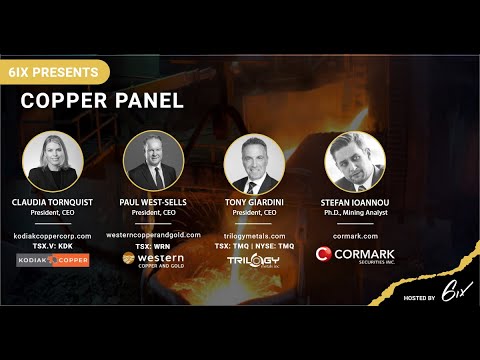
0:12 Well, hello everyone and welcome to the Copper Panel hosted by 6. Before we introduce our wonderful panelists today, I want to remind you that you can submit your questions at any time on the Q&A panel on the right-hand side of the screen. And as always, this panel is being recorded and will be available to watch afterwards on Sixx.com. So to kick things off, I'll hand it over to our moderator, Knox Henderson, investor relations of Kodiak Copper, to get the panel started. Thank you, Adasha. And good morning, everybody in the West Coast and good afternoon in the East Coast and good evening overseas, wherever you may be. So today we have a copper panel hosted by 6 Social Media. It's a very exciting time for copper. Actually in the news today, copper has hit over 410 a pound, which is almost a 9 year high because Chile had to close its border, the number 1 exporter of copper. So copper very much in the news, and we've got an excellent panel today with some seasoned veterans.
1:12 The good thing is we have representation in the Yukon, in Alaska, and in British Columbia. So these are 3 very prolific mining districts in the Northwest corner of our continent. And we have projects at different stages. We've got early exploration and we've got it all the way to feasibility and moving into the permitting process. So I'd like to introduce our panel. First off, we have Tony Giardini. Tony is the president of Trilogy Metals.
1:39 Trilogy has their projects in the Ambler District of Alaska. Good morning, Tony. How are you? Good morning. Great. Thank you. Great. Also, we have Paul West-Sells, who's joining us for the second time and due to popular demand. Thanks for coming back, Paul. Paul's project is a casino project in the Yukon, advancing a rather large-scale copper-gold porphyry. Morning, Paul. Morning, Nox. And finally, we have Claudia Tornquist, President and CEO of Kodiak Copper. Kodiak is advancing the MPD project in Southern British Columbia. How are you, Claudia? Hey, well, good morning, Knox. Good morning, everybody. And eventually joining us will be Stephan Ianu.
2:24 He's just gonna be logging on shortly. Stephan's gonna be giving us a macro view of copper supply and demand, But we'll just change the order around a bit here just to get things going. So we'll start with you, Tony. Maybe you can tell us a bit about your project and walk the folks through your project. Knox, thank you very much. And thanks to 6 for having us here. I look forward to giving you a bit of an update on Trilogy. So let me start by just forward-looking statements and just highlighting that we'll be making forward-looking statements. First slide really just gives you an overview of Trilogy. And Trilogy is focused, as Nox said, on the Ambler Mining District. The Ambler Mining District is located in the great state of Alaska.
3:10 Trilogy owns a 50% interest in that district. And I'll talk a
3:15 little bit about our partnerships in that district. And what we're talking about in the Ambler Mining District is high grade copper, zinc, gold, and silver. And we have 2 advanced projects, 1 that has a feasibility study that was prepared by Trilogy in 2020, and then Boronite, which is an advanced exploration project. So what I'll do in 10 minutes is give you a quick overview of a company, ticker symbol is TMQ, we trade on New York and Toronto. And for more information on Trilogy, I encourage you to go to our website, trilogymetals.com, where we'll have a copy of this presentation. So with that, let me get started. A little bit about the capitalization of a company. We're very well capitalized, sitting in with about $11 million of corporate cash. In addition, we have a joint venture, and as I said, we own 50% of the district. And the joint venture itself is called Ambler Metals. It has $140 million in cash. So when we look at the see-through value, taking our share of that 140, plus the cash on hand against the current market cap of actually more around 330 million right now, we're looking at an enterprise value of $250 million.
4:24 We've got some major shareholders, Electrum, Polson and Bauer Post have been with us from the beginning. Self32 is our partner in the Ambler Mining District, owns 11% of the company as well, and we have other significant shareholders that have been with us from the start. And as I said, we're in a very good position in terms of capitalization and financial position. I mentioned partnerships, there's 3 of them, South32, NANA and the State of Alaska, and I'll just quickly walk through those. South32 is our partner in the district. In essence, what South32 has done is invested $145 million to earn a 50% interest in the district. In addition, they have funded an exploration program of $30 million and they own 11% of the stock. So all told, they've invested about $200 million to earn their 50% interest.
5:15 And they're very much focused, not just on Arctic, but boronite and the exploration potential in the district. And I'll speak to that as I go through the presentation. The second partnership is with NANA. NANA is a native corporation located in the northwest part of the state. NANA has a rich mining history. They represent the Northwest Arctic Burrow, and that's where our projects are located. Having Nana support and having support of a North West Arctic Burrow will be key. To the success of developing the Arctic mine and the district as a whole, and we're very focused on working very closely with the communities focusing on their subsistence hunting and fishing considerations. As we look to the development of the infrastructure to open up the district, and I'll speak a little bit more about how Nana fits into the economics of a project later.
6:03 In addition, we have a partnership with the state of Alaska through a development agency called ADA. ADA was involved in the development of the road and the port that allowed for the Red Dog Mine to be built. By the way, Nana is a partner in the Red Dog mine with tech largest sink mine in the world, located also in the northwest part of the state, So we're working with Nana on the same basis where we're looking to develop a road that will be private industrial use road only. This next slide shows you that road. The road is a missing link to effectively opening up a district and things are moving along quite well. A permit was granted last year which was the last federal permit required And we're starting on the detailed engineering this year, where ADA and Ambly metals are each funding a total of $35 million, each $70 million to cover the detailed engineering that's gonna be conducted over the next 3 or 4 years. We expect to have more news on access to private right of ways and the budget for the current year, which is going to be released shortly in terms of that detailed engineering. So things are moving forward quite well. And the way the road will ultimately be developed is that be private industrial use for, then there'll be a toll road that will be built and funded by ADA with the Ambler Mining District basically being opened up and companies like Ambler metals and others that may develop mines in the future, ultimately
7:33 paying for that road through tolls. The remaining infrastructure is actually quite good. Dalton Highway, a 2 lane paved road that connects you to Fairbanks, where there's a railhead and then in Anchorage there's a port that would allow shipment to many different markets in terms of concentrate. This is what the road is projected to look like in terms of going through the district. All of those red dots, swears, stars, are potential targets in the district. Sun is privately owned and Smucker is owned by Tech. Everything else in the district is part of the Ambler Mining District and owned jointly by South32 and Trilogy Metals. I mentioned the feasibility study. This was produced last year and what it shows is a 12-year mine life.
8:20 I'll speak to the ability to extend that mine life considerably. We use the same prices that we used in the price tech in the 2018 pre-feasibility study. And what we end up with is a $1.1 billion net after tax NPV with a 27% IRR, 32 cent copper cost net of by-product credits. If you look at this based on current spot prices, that NPV jumps to around 2.2 billion, the IRR goes to around 40%, and those cash costs become negative 24 cents. A number that I also like to focus on is a capital intensity ratio. And what that shows is the initial capital per ton of copper equivalent. And this is very low by any standards out there. We'd be producing 3 products, a copper concentrate, a zinc concentrate, precious metal con. This is very much a copper mine, but there are significant contributions from other metals. And if you look at this, the percentage of revenue right now, it's based on the base case scenario. If you look at it at actual spot prices, the gold and silver component would increase, zinc and lead would decrease, copper would be somewhat larger as well. So there's a number of opportunities that we have because of the other metals that are available through the concentrates that will be produced.
9:40 When we look at the mine itself, we expect to start the permitting process this summer. That would hopefully put us in a position to make an investment decision towards the end of 23, early 24, we're looking at a permitting period of roughly 24 or 30 to 36 months. There's 1 federal permit required, it's for a wetlands permit. The other major permits are state permits. We have no federal lands. We're primarily on state or borough or native land. And so the process will really be to kick off this permitting process later this summer, put ourselves in a position to make an investment decision. While we're doing the permitting, we're also looking to advance the project itself through additional work in terms of the feasibility study that was done and additional technical work to advance the project.
10:30 This is the district itself. It's over 172,000 hectares. You can see the Arctic and Boronite deposits. Arctic, I mentioned, is 43.4 million tons, 4.2 percent copper. It's a great asset. As you can see from the feasibility study details, Boronite in and of itself is not a slouch either, 180 million tons, 1.5 percent copper equivalent when you put the inferred and indicated together. In addition, there's a number of satellite deposits that have historic resources. And coming up this year, we'll be spending $27 million in the field. We're going to be conducting 14,600 meters of drilling, 7,600 at Arctic and then 7,000 at other targets. So we're really just beginning to scratch the surface of the exploration potential in the district.
11:17 When you look at Boronite, as I mentioned earlier, South32 had spent $30 million in exploration. It was mostly focused on the Boronite deposit. You can see that there's 60 million tons at roughly 3% copper equivalent. So what we also want to do is look at how boronite ties to the Arctic and other deposits in the district, and that's part of the additional work that we'll be doing there. And in addition to copper, boronite holds a sizable cobalt resource of 77 million pounds. In terms of how this deposit compares to other volcanic mass of sulfides, you can see deposits, you can see flimflam, you can see naranda that have had very long mine lives in those districts, 75 to 85 years. Hokeruk was
12:01 another district that similarly has had significant development and production occurring over a long time period, and we believe the same to be the case for Arctic and Boronite and the other deposits in the district. And looking forward in terms of upcoming catalysts, it will obviously be focused on the optimization of a feasibility study. Those study work that was done by Trilogy is now being optimized by Ambler and moving the project forward in terms of next step. We're gonna have a summer drill program, 14,600 meters, and that's part of the $27 million that's going to be spent. We also expect to commence a permitting on the Arctic project later this summer, and then we should have some announcements out shortly with respect to the road and the money that will be spent on the detailed engineering for the road this year, an additional focus on right of ways. So those are the main focuses. We didn't have a drill campaign last year because of COVID, so we're really excited to get back out in the field. And we expect to be on the ground in May through to September, possibly October. And with that, Knox, I'll pass it back to you. Thank you.
13:12 Thank you, Tony. Great summary. Obviously lots going on with 14,000 metres of drilling coming and all that permitting process, so that's a great introduction. Meanwhile I think our our analysts from core Mark. Stephanie Anno is now on my knee there, Stephen. I am. Can you hear me? Yeah, sure. You might if You can turn it up a bit. That would be good. Okay, how's that? That's good. Okay, well, actually, I'll manipulate the slides for you. So we'll go to your first slide here. Okay, great. I apologize for the technical difficulties on my end. But I just wanted to talk about a general macro overview of copper. We've got 3 great copper stories on the lineup today, and I just wanted to set the backstage as to why we care about copper in the first place. Obviously, it's the base metal of base metals, and there's a compelling theme emerging as well that adds to that with the whole electrification green energy dynamic that we see a lot in the news.
14:10 On my second slide, I'm just to set the stage. One of the things that is always bulls and bears, and one of the bearish arguments when it comes to copper is that supply demand is interesting, but from the supply side there have been a lot of new large-scale marquee mines that have either come into production or are about to come into production over the last few years. And that is definitely true. And on this slide, you see on the left-hand side, some of the namesake mines that are quite topical right now. And as they're integrated into the current sort of copper world as we know it, they definitely tend to keep sort of that supply-demand narrative and balance over the near term, I'd say sort of you know through 2023 into 2024. But if you look on the right-hand side of that slide, the bar chart there, what really catches my attention is that as you get into that 2024-2025 timeframe and these new sort of this current generation of new projects is integrated into the copper world as we know it, the next generation is actually quite far behind. And So you see an emerging supply deficit in that medium to longer term outlook. I think that's really where the sweet spot for copper is going forward and very interesting when you start thinking about marquee developers.
15:27 If you go to the next slide there, Nox, one thing to keep in mind is the copper price itself. Just to set the stage, keep in mind that not even talking developers, but just looking at current producers, if we see copper pricing drop below $2.75 a pound, you get to a point where about 25% of the world's current production is no longer economic. Big majors can tend to weather the storm for months or 0.25 at a time, but when we see prolonged periods of low copper pricing, even the majors start to run into problems like we saw a few years ago in say 2015 where I can remember every conference call the only real question that was ever asked was how long until you're bankrupt type of idea. And that's the producers.
16:12 And if you go to the next slide, Nox, slide number 4, when we look to beyond the current producers and even beyond that sort of current generation of new projects, look to the next generation beyond that. This is a list of some of the larger scale, you know, copper projects that are out there. And it's a busy slide, but I think the only thing I really want to highlight here is that when you go through the numbers, you know, a lot of them, if not all of them, need, you know, copper pricing well north of $3 a pound just to incentivize development, generate, you know, a meaningful IRR to actually get these projects off the ground. To go to the next slide, Knox. So bottom line, something has to give, and I think it starts with the copper price itself. And again, this is a pretty cartoony supply-demand projection. This is total copper supply now, too, so obviously bringing in things like recycled copper into the supply picture. But nevertheless, we can see demand far outweighing supply over this sort of medium to longer term.
17:15 If you go to the next slide there, Nox, this is slide 6. One interesting new dynamic in the copper world and the base metals world period is this whole electrification and EV narrative. And obviously, when we start talking about green energy, the first thing that comes to mind is your Tesla and electric cars. It's something that's very granule that we can all grasp and seen and probably have been in 1. And you know, we're talking the batteries in these electric cars. I mean that the predominant metals are things like lithium, nickel and cobalt.
17:43 But copper don't don't under don't underestimate copper as well, especially when it comes to the the infrastructure that's going to be needed to support those batteries and electrical vehicle charging stations and everything else that goes with it so you know we have a current demand outlook where you know sort of call it base load demand is increasing at anywhere from 2 to 4% per annum. And on top of that, over the next decade or 2, we're going to see an incremental increase in additional demand coming from this sort of new sector, if you will. If you go to the next slide, Nox, slide 7. You know, and again, when we're talking electrification, don't just think EVs. It's an easy trap to fall into, especially when it comes to copper. In the case of copper, it's just basically electrification period. You know, it's copper wires that we use to get the electricity and move it around with. So anything from solar panels to wind farms to the cars themselves to big, you know, stationary battery storage, All that stuff is going to require a heck of a lot of copper going forward.
18:45 What is the bottom line in terms of what does this actually mean for copper going forward? The thing to realize is right now the copper market is around 23 to 24 million tons a year of supply and demand. When we look at the incremental new copper demand coming out of the whole electrification narrative. It's on the order of 2-4 million tonnes a year of additional copper that we're going to need to source. So it's around a 10-15% increase above base load demand, if you will. And again, that's going to come on over the next 10-15 years. And again, when you think back to that first slide, I showed you the bar chart with just basic mine supply rolling over and call it 2024-2025. And then layer on top of that, this new incremental demand coming on in sort of the same time frame over the next decade or so. Again, something really has to give and I think it's going to have to start with the copper price itself to incentivize new developments.
19:39 Even then, again, that next generation, that big long list I showed you, a lot of those projects, some of them are into detailed engineering and permitting, but a lot of them are well shy of that. You're probably realistically facing 7, 8 to 10 years of timeline before they actually ever see any copper coming out of the ground. Maybe on the next slide, slide number 9, just want to touch base. Thinking about electrification, the green narrative, and just something we're seeing a transition in the market in terms of what makes a good project a good project these days. And you know when I think about the sort of old trifecta old sort of checklist of what you really wanted in a project, you know economics are still were important and are still very important. But I think is you know in this new world that we're entering, we're seeing at CoreMark, when we talk to institutional clients, one thing we're seeing is a lot more emphasis on projects that are favorably located, so an ESG favorable jurisdiction, projects that have optionality on a low carbon footprint or a green narrative to support ESG practices from an environmental point of view.
20:56 And then strategic importance, so not just buying a copper stock for the sake of having exposure to a pound of copper, but having exposure to a greater underlying theme like EVs or electrification, for example. So I think when you think about investment opportunities, key questions going forward are A, is it in a favorable jurisdiction? B, is there an argument or is the company doing anything to demonstrate environmentally favorable production of the specific metal? C, strategic importance. Namely, big projects that can offer long-term supply certainty. One thing we're really seeing now is, you know, groups like Tesla, for example, or end users really start to move upstream towards the mine side of the equation because it's pretty clear that they're quite scared that there's just simply not enough near to medium-term metal out there to meet their business plans in terms of building batteries and building cars and building electrification, if you will.
22:01 And so to them, cost is almost secondary. It's just securing long-term supply certainty is job number 1 for them. And don't forget, it's the cars themselves or the batteries or electrification where they actually make their profit anyway. It's not the actual pound of copper per se. So you know kind of the new world where location trumps grade and carbon footprint trumps cost I think are some key takeaway themes. And then just to finish off with one last slide, slide number 10, you know just again just to sort of you know emphasize that point this is just a recent survey looking at non-specialist institutional investors and what they're looking for when they look at mining stocks. You can see top of the list there is exposure to key macro themes, in this case the battery narrative or electrification.
22:47 And then number third on the list, which jumps out at me as well, is again that importance on ESG favorable jurisdictions. It's becoming more and more a non-starter for projects that are in tough locations around the world to get any institutional interest these days. So even if you have the A-Team that's demonstrated the ability to operate and have success in challenging parts of the world, a lot of the institutions these days are just saying no right off the bat to those. So one interesting thing about the panel we have today with Trilogy, Western Copper and Kodiak. Again, you kind of check all the text checkboxes I mentioned there with again, you know, fabled location, big scale projects that can, you know, offer supply certainty over the longer term. And again, you know, just carbon friendly footprints, whether it's access to grid power or other key factors that I'm sure the companies will touch on. So with that, I'll leave it there.
23:40 Great. Thank you very much for that insight, Stephan. We'll certainly revisit this as we go along here. Our next presenter is Paul Wessels, as the President and CEO of Western Copper and Gold, with its casino project in the Yukon. Paul, are you all set to go here? There we go. There we go. Yeah, I'm here. All right. I'll disappear and let you take it on. All right. Perfect. Well, thank you again, Knox. And thank you, Stephen, for a great introduction. So I'm going to talk to you today about Western Copper and Gold and our casino project up in the Yukon. I will be making forward-looking statements, so please review this before making any investment decision. So just to sort of get a couple of things sort of out of the way in terms of the structure of the company.
24:30 So first of all, we're listed on both the TSX and the NYC American. I always point people to the NYC American to really get a better idea of how much we trade. Most of our trading is on that. We're starting 2021 with around a little over $30 million in the bank. That's on the back of a pretty large financing that we completed in November of last year. Share price, this is back in March around $1.80. We're down a little bit from that, not much. Gives us a market cap of around $250 million. Where are the shares? Really on the back of that financing, so we did a 28 million dollar financing in November that brought in Fidelity, Franklin and Copernic on this list. So they're now very significant shareholders And then the founder of the company, Dale, who's our chairman, and Mike Fatton, who is one of the shareholders that assembled his position at the beginning of 2020 and then came on the board mid 2020 are also key shareholders.
25:34 To sort of summarize the project, so the significant Copper Gold Project, this is one of the largest Copper Gold Projects in Canada. We have a new increased resource I'm gonna talk to you about. This is a very straightforward project, big open pit, standard flow sheet, very simple to execute. Located in the right place, Yukon is really an emerging mining district that's really sort of come into its own over the last couple of years, fairly straightforward permitting And we as a company have continued to add value. We've added value with the drill bit. We've added value with the engineering program. And it's a really good time to invest right now. We're in the midst of a PEA, which will be out in a couple of months here. And then that will roll immediately into an updated feasibility study, which will be out near the end of the year.
26:27 So just to sort of, in terms of some of the headline numbers, in terms of contained metal, This is a significant copper and gold project. Starting with the gold, there's 21 million ounces of gold and then 11 billion pounds of copper, so significant for both the copper and the gold. Often get asked, is this a copper project or a gold project? It's pretty close to 0.5 and 0.5, as you can see here, in terms of where the value is in the ground. The other thing I'll point out is molybdenum, or moly, is a significant part of the story at around 20%. So I don't spend a lot of time talking about Mali, but it's a key part of the overall project as well. Stefan did a great job talking about the copper market. I'm not going to spend any more time other than to point out, When we talk about casino, this is a large project.
27:23 Stefan was talking about 2M to 4M deficits per year, and 5M tonnes. That's 2 years by what Stefan was talking about. It's 65 mines the size of a casino based on our copper production. So back to his theme, no one's really sure where all this copper is going to come from and all that should translate into a very positive impact on the copper price. And when you look at the copper space, and I'm missing some projects here for sure, but the key takeaway on this slide, and this is really TSX and TSX Venture listed copper projects that are controlled by junior mining companies. The big takeaway here is there's just not that many. And then as you know, by what Stephan was talking about, you sort of screen for jurisdiction and size and economics and it gets to be a pretty small list.
28:16 The other key market of course, with our deposit is gold and big gold. And with 21 million ounces of gold, it puts us in the largest, it puts us in the top 10 undeveloped gold projects that are controlled by a junior mining company. And again, you know, you screen out jurisdictions you want to be in and projects that have good economics and that list gets even smaller and we're still on it. A few comps here and just to put people into the picture of really how to think about casino. And I can spend a lot of time here, but really if you look at Copper equivalent, we're similar to the size of SolGold's Cascabel. And then when you look at Gold, we have 21 million ounces of Gold, they have 24 million ounces of Gold. So just as a close comp, we're a similar sized project to SolGold's Caskabel.
29:11 They're a block cave in Ecuador, we're a big open pit in the Yukon. So Depending on your view of the world, that's a plus or a minus. Just to put you into an idea of the size and the scope of the casino project. Going down to the new resource, first of all, this is an oxidized copper porphyry. The top of the deposit has been depleted in copper and enriched in Gold. We mine that off over the first 2 years before the main milling operation starts. That goes on a Gold heap leach. That's 220Mt at 0.3g per tonne Gold equivalent. But the real value is below that in the Supergene Sulfide and the Hypogene.
29:58 And as per the new resource, that is 2.2Bt at 0.36 copper equivalent. And we'll talk a little bit more about that, but before I leave this, I just want to point out this breccia here in the center of the deposit. I'm going to come back to this. This is the core of the deposits. It's very key. It's very key to the economics of the project and because it runs quite a bit higher grade. So a little bit about grade. I think if you asked people who are familiar with the project, they'd say, oh, casino, it's this big, low-grade thing. And it's certainly large. But part of the reason that the grade, the 2.2 billion tonnes, is at 0.36 is that it's just such a large deposit and everything is ore. If we actually carve out the first 1.3 billion tonnes, you get closer to around 0.5 Copper equivalent.
30:51 And the other thing I'll point out is that in Western Canada, and we're just north of British Columbia and the projects there, and Copper Mountain, Gibraltar, Highland Valley, These are all operating mines. And you look at something like Highland Valley, it's been operating continuously for over 50 years. They're running a little over 0.3. Copper Mountain, Gibraltar, a little under 0.3. Some newer projects here, Mount Milligan, Red Crest, sort of very similar to the 0.5% that we're talking about for our first billion tons. A little bit about flow sheets. I mean, we did a full feasibility study in 2013. That's what's in the permitting process right now. That's what the PEA will update and the feasibility at the end of the year will update.
31:37 But fairly straightforward, it's a large milling operation for the mill. You can see here, relatively medium to soft or conventional circuit here. Recoveries is what you'd expect for a project of this size. And then he pleads again. You know, low grade. He pleads. Recoveries are sort of. Consistent with that.
32:02 Talk about the district. I always like to stop real quickly on the slide. This is what it looks like up there. This is the top of the deposit. This is probably the first material that would be mind. 2 takeaways here. Not that mountainous in this part of the Yukon and actually semi arid, so we actually bring in water here. So I always say this is a much more similar to Chile and up in the mountains than other jurisdictions. Just real quickly on the Yukon, the Yukon, I keep calling it an emerging mining district, but it's actually an established mining district now. There's 3 operating mines. The Belcano mine just started up last, this, well, I guess the end of last year. Of course, the Eagle Gold Mine has been very, very successful. So It's really turning into a pretty significant mining district.
32:49 And we've been up there for 14 years. So good relationship with the First Nations. We've actually won some environmental awards, support a whole bunch of initiatives up in the Yukon, which I think modern mining companies and certainly all the companies on this call do very, very well. All that work has really ended up in
33:12 a great funding for our access road. And so the Prime Minister, shown there, Premier of the Yukon. This is 2017. They announced $130 million funding package for our access road. Flash forward now, because we all know governments are great at making announcements, but not necessarily great at following them up. There's agreements with the First Nations on the first part of the road. It's through environmental assessment, and they're going to be breaking ground this year.
33:41 And then just real quickly on the district itself, if you look at the district, here's us here with Casino. Next to us is Newmont's coffee project, which just got through environmental assessment. White gold with a bunch of exploration triumph just south of us. So and this is a 50 km scale bar. So to put you in the picture, the takeaway here is this is an emerging district. There's 30 million plus ounces of gold, 10 billion plus pounds of copper. This is an exciting district and we're by far the largest player in the middle of it. So just real quickly, you know, as I said, you know, we've been had this for 14 years and moving forward. We've got APA and a feasibility this year and then and then restarting permitting.
34:31 We did some exploration last year,
34:34 added to the north, so this is additional resource up here and over in this corner here. But really, the key thing which we really reiterated and further delineated is this core zone. This is that breccia I was referring to. If you sort of carve that out and look at that as the resource, that is 0.7 Copper equivalent, 330Mt.
34:58 The way to think of this deposit, Don't think of it as a big low-grade deposit. Think of it as a core at 0.7Mt, 330Mt. Then at 1Bt, you're around 0.5Mt. At 2.2Bt, you're at 0.36Mt. And then there's actually another 1.4Bt of inferred. So a very large Copper-Gold project. And then lots of exploration potential. We acquired this project next to us last year. We just done a couple of holes last year in that, so certainly lots of potential there. And then some deep potential. These are IP targets that look very, very promising as well.
35:37 So just to summarize, you know, this project that hits a bunch of the boxes, significant copper and gold. We've been making steady progress on it and upcoming catalysts, PA a couple months out, feasibility study at the end of the year, and then back into permitting. So thank you very much. Well, thank you, Paul. That was a very good summary as always. You've already answered a lot of the questions I had in my back pocket, but I'm sure we'll keep the dialogue going. So next up, we're going to go back to the other end of the scale, early exploration.
36:12 Claudia Tornquist, President and CEO of Kodiak Copper, exploring the MPD project in Southern British Columbia. Hello, Claudia. Over to you. Thank you, Nox. So as Nex said,
36:25 Kodiak is an exploration company exploring for copper and gold in North America. We recently made a discovery that was a real game changer for the company at our MPD project in southern BC. Our share price jumped from 50 cents to over $3 and It really was a transformative event for the company. And we are now busy drilling and have the largest by a margin drill program underway that was ever done on the MPD project. So very exciting times. Before I dive deeper, please keep in mind that I will be making forward-looking statements and read the relevant guidance on our website before making investment decisions.
37:17 I'd like to start out with the Lassonde curve to illustrate what Kodiak is about. We are a very different proposition from Trilogy and Western Copper and gold, the companies you just heard of. I'm sure many of you are familiar with
37:37 the Lassonde curve. It shows when value is created in the lifecycle of a mining project. And typically, there are 2 stages where investors reap real rewards. That's starting from the right, the bump at the time of production, when a mine goes into production, and cash is generated. And then earlier in the life cycle,
38:04 another bump in the curve, that's at the exploration and discovery stage. And that stage Kodiak has just entered. I've drawn this yellow rectangle onto the curve. We made our maiden discovery last year and as I said we have a very large drill program underway and we'll have many more results to come and I'm confident we'll be able to move our shareholders up this curve and generate value at the door bit.
38:40 Before I dive deeper into our project, I'd like to say a couple of words about the people behind the company. First and foremost, our founder and chairman Chris Taylor, who many of you I'm sure know from our sister company Great Bear, one of the big discovery successes in North America or worldwide, really, in recent years. Chris, many people think of him as a gold guy because of Great Bear, but what's good to know is that his home turf as a geologist is actually in copper porphyries, i.e. Exactly what we are doing with Kodiak. Chris started his career as a geologist with Imperial Metals, drilling copper porphyries all over North America.
39:26 And Chris is leading our technical work and his experience is invaluable for our company. My background is with Rio Tinto for many years. And my background is more on the financial commercial business side. I worked on some of the largest copper prophy projects for Rio Tinto. I did some work, for example, on Escondida and also on Oyo Tolgoi. So some copper experience in my background as well. And last but not least, I should also mention John Robbins, who is an important part of our team, shareholder and an advisor to the company, and John put together the Discovery Group of which we are part.
40:13 You see here the members of the Discovery Group. It's a great group of companies, some really successful companies in there. We are an informal alliance. We all work out of the same office, and it's just a fantastic network of support, whether it's for technical expertise, contacts, capital markets, access and expertise. It's a real great network to be part of. And I'm very much convinced that Kodiak is a much stronger company as part of this group than we would be just out there on our own. And now, without much further ado, some more about our NPD project where we made our discovery last year.
41:04 You see here the map where the project is located. We are in southern BC in a very established mining district between 2 large copper and gold mines. To our north is the Highland Valley mine and to our south, Copper Mountain. So very established mining area, which is fantastic, because all the infrastructure is right there, whether it's electricity, water, workforce, everything you need for an exploration project. And the project is very accessible. You literally turn off the highway onto a logging road and a couple of minutes later you're right at our drill pad. You can get there year round. And that, of course, is fantastic. It makes the hurdle that this project has to make to eventually become economic so much lower than it would be for a more remote project.
41:58 So we're very very happy where we are. That was one of the location was one of the key points why we acquired the project when we did so a couple of years ago. What's also important to know is that MPD is not a greenfields project. It has been historically drilled over a long time, over almost 50 years, since the 60s, by a whole lot of different companies at different points in time and on different smaller land packages. I won't bore you with the details, but there are 2 important takeaways. Firstly, copper and gold has been drilled near surface over a large footprint. You see the black dots on the map, that's the historic drill holes, and they span an area of 10 square kilometers, so large footprint.
42:49 And secondly, all of this historic drilling was shallow. Most of it only down to between 100 and 200 meters in depth. And that is where we took a different approach and where we saw the opportunity, we drilled deeper, down to 800 metres, and we were successful right off the bat. Here is our hole number 4 that we released last year in September, and that was, as I mentioned, a transformative event for the company. At the time, it generated a huge amount of excitement in the market. We then did a large financing of 12.7 million dollars and tech came in as an investor, took 9.9% of our share capital and invested 8 million dollars, which of course was a great vote of confidence to have a large player like TEC invest that early in our exploration progress.
43:52 Keep in mind we've so far only drilled 10 holes, so we're really only at the start. And here on the slide you see what we drilled with hole number 4. In total, the intercept was over 500 meters, 535 meters of 0.76% copper equivalent. And just to put that into perspective, the neighboring mine Copper Mountain, their reserve grade is 0.24% copper. So this intercept was roughly 3 times as much. And Very importantly also within this very long mineralized intercept, there was a significantly higher grade zone in the center of 282 meters of 1.16% copper equivalent.
44:45 That was, of course, a fantastic start. And we have since released more results. We drilled in total 10 holes last year, 6,700 meters. And you see on my next slide, a summary of some of those results. This is the same cross-section you saw before, and hole 4 is in the middle of this fan there. What you see here are a number of holes that we drilled from the same setup and then 1 to the west, a vertical hole. The dark green and dark red zones are high-grade mineralization. And the long and the short is essentially that we intercepted this high-grade zone over long intercepts consistently with all these holes and have now drilled high-grade mineralization over 300 meters in width approximately and down to 800 meters.
45:46 That's of course only just over 10 holes into the drilling, still very early, but very encouraging because these dimensions, 300 meters times 800 meters, that's already significant in size. And so, yeah, very encouraging. And of course, lots more work to do. What's important to understand is that we have only tested a tiny sliver of the large anomaly that underlies, overlies this, the mineralization we have drilled. You see that on the slide here. The pink shaded area, that is a copper in soil anomaly that's related to the high-grade mineralization we drilled.
46:36 And at the northern end of it, the black lines are the drill traces of the holes we drilled last year. And as you can see, we've only started at the northern end and drilled so far about 100 meters of this anomaly. And it's in total 1,000 meters long. So 90% still to be drilled. And that's what we will be doing this year. We have 30,000 meters drilling planned and are fully funded for it. And as our exploration VP said, we will be slicing the loaf of bread. So we will work our way systematically down this copper in soil anomaly and see how far and in which directions the high-grade mineralization extends that we have drilled in our initial couple of holes.
47:31 So lots more drilling to come, lots of news flow. And this is only at the gate zone where we made our discovery last year. We also have other targets on the property that we will be testing as well. And you see a bit of a bigger picture on this map. To the left, the sort of peanut shaped area is the gate zone that I just talked about with the large pink copper in soil anomaly. And then underlying it, the green blue shaded area is a magnetic and resistivity low. So that's where we're drilling at the moment. That's where we started this year's drill program. And we then have another very similar analogous target at Dillard, which you see at the bottom of the slide in the center. It's very much the same signature, geophysical magnetic resistivity low with a big copper and soil anomaly on top, and a number of shallow historic drill results with promising results.
48:38 So Dillard, we actually meant to drill last year already, but we then had so much success at Gate that we never got around to Dillard. Dillard also this year is very high on our list, and we'll be joining that too. And then we have other target areas such as Dillard East as well. So we are not short of targets. It'll be a very, very busy year for Kodiak with lots of great results, lots of news flow to come. Last but not least, our capital structure. A couple of things to point out. We are a very tightly held company. On the left, you see our shares outstanding, just over 45 million, fully diluted just over 50 million.
49:25 We are fully funded with 14 million of cash in the treasury, fully funded for this year's work and beyond, which is of course a fantastic situation to be in. Our shareholders, large shareholders is tech resources and then management and board about just under 9%. And at the bottom you see our share price. As I mentioned, last year's discovery generated a massive amount of excitement. Our share price spiked at over $3. It has since pulled back to the $1.50 area and arguably a good buying opportunity. I would say the market is simply waiting for us to generate more results and we will be back with more news in the near future with the drill results from our ongoing project and then more news to come all the way through the year.
50:20 So it's very exciting times. I can't wait for our drill results and for our drill program to progress. And I'm very confident we can make this a good year for our shareholders. Thank you. Thank you, Claudia, and thank you, everyone. So right now we're getting to the question period of our webinar. The questions are starting to come in. I just thought I'd give it another minute or so just to allow people to ask their questions. But, Stephan, are you there still? Can we hear you? I'm here, yeah. Oh, Okay, great. Because I thought this first question, you know, it pertains to you. And it might not be fair right off the top of your head, but the speaker projects a 3.5% annual increase in the future copper demand.
51:15 What is the rate of annual increase in the copper consumption in the last 10 years? I'd have to look back, but the current projections when you look at it are anywhere from 2% to 4%, right? Obviously, the bearish being the 2% and the bullish being 4% to even 5%. And I think you can get towards that more bullish end of things. That one picture I showed you is a bit of a cartoon. You'll see a similar looking graph all over the internet, but the actual, whether it's 2% or 4%, depends on whose data set you're looking at. But I think there's an argument that as we move a little bit further out, the idea that it could be, you know, closer to the 4% end of that with the EV narrative coming on stream as it sort of ramps up over the next decade, like I kind of showed in some of those graphs. So I'm not sure if that exactly answers the question.
52:04 I can look back and find out what the exact number is over history, but it has been growing fairly steadily at anywhere. I think that's a fair answer, given that we're putting you on the spot here. So The second question is directed to Western Copper and Gold. As I've understood, WRN is in the beginning stages of permitting. Do you think this affects the company's ability to find a buyer slash partner? And is the company at the moment actively looking for a buyer slash partner? Well, maybe I'll put that in reverse. And I guess I think every junior mining company is always looking for a buyer slash partner. And certainly, a project of this magnitude and the feasibility study in 2013, the capital cost was 2.5 billion.
53:00 And we'll see with the updated PEA what it comes in that, but it's in that order of magnitude. So, I've been pretty public in saying that, the best way I think for this project to go forward is with a partner or in the hands of a major. In terms of where we are in the process, I don't think that that has any impact on those discussions. We have a number of discussions underway and have had in the past, and I think that what's exciting for me is that when copper hits $4 consistently and back to what Steph was talking about with just not a lot of good projects out there, suddenly the majors become buyers of copper projects And we now have those things in place. And so, you know, certainly I think at least from my experience where I'm seeing a lot more interest.
53:56 Thank you. And Tony, how might you answer that question without giving away trade secrets or, you know, how are you seeing the market? Yeah, I think it's interesting to hear Paul speak about having a partner. We're very fortunate that we have South32 as a partner in the project. And effectively we believe South32 has already done the pass over that, you know, tech is doing with respect to Kodiak, for example, they've come in, they've done their due diligence as part of a process. They made a staged investment of $30 million in exploration, and then they put their money on the table to earn a 50% in the district by putting $140 million in. Then we also have the NANA partnership, which is really gonna be key. And I think it's a key for all of the companies represented here in terms of having strong relationships with the native communities and having that. So we feel like we're in a really good position. We're starting the permitting process this year.
54:50 That sort of kicks us off into making an investment decision, which would come at the end of a permitting point of view. And our objective is to add value through the drill bit, like Claudia was talking about. And we didn't have a drill campaign last year. We're going to have 1 this year. We already know we have a high grade. We just want to find more of it and extend mine life at Arctic and see what Boronite really is and how it ties into Arctic. So That's what we're focused and excited about. Right. And Claudia, you know, Tech's a big partner with Kodiak. Why do you think they came in so early in the game, relatively speaking? Well, they came in after just 4 holes at the gate zone. That's obviously very early. And it's fantastic to have them as a partner. They know the area intimately.
55:39 Their big Highland Valley copper gold mine is, sorry, copper moly mine is just 50 kilometers to our north. And what I think they liked is simply the size potential. They are a big company. They wouldn't be interested in a small project. They looked at the footprint that we have at NPD and they could see this to have the potential to be a big mine. That's what got them interested. And obviously the grades we drilled with our first couple of drill holes were very exciting. We were fortunate to hit a nice high-grade zone right away, which has since already shown quite some size. And so that's an exciting start. And I feel very fortunate to have gained Tech as a partner. They have been very supportive and are a great partner to have in the vote.
56:34 Great, thank you. This next question is to the panel. And maybe, Tony, you could be the first to answer this one. Do we think North America can realistically compete with South America on copper? Wow, I think so. I mean, North America, we're very fortunate. We've got great jurisdictions, whether you're in Alaska, Yukon, BC. There's a strong rule of law. There's high environmental standards. But that's the way it has to be. And then we're working very closely with the communities. And I think all of us are in the same position in terms of doing that. And I think the other major consideration is, as we talk about EV and electrification of a grid and infrastructure is really important to have your own source of metals. So I think whether Canada or the US, there's going to be a desire to have a Canadian sourced or American sourced copper, cobalt and these very strategic metals that are going to be necessary for electrification of our grid. So I think we can be absolutely extremely competitive.
57:40 And I feel we have a huge advantage in terms of being in the great state of Alaska or being in British Columbia or Yukon, I think we're very fortunate to be operating in these jurisdictions. Paul, do you have anything to add to that? Well, Tony did a great job answering it, but yeah, just to reiterate a couple of points, I mean, absolutely competitive. And the thing that I would point out is that a lot of South America, particularly Chile and Peru, has seen a lot of exploration activity. I mean, there's been a lot of money poured into that area. Whereas, where are you seeing big discoveries here? Well, these 3 here, I mean, we're in Alaska, Yukon, under-explored areas, and even British Columbia, which is continuing to show promise with Kodiak. So yeah, I mean, there's been a lot of exploration in South America previous and now there's a bit of a shift in a lot of great discoveries coming out of North America.
58:40 Thank you. Actually, I wanted to talk about ESG, which is environmental sustainability and governance. You had a slide on that, Paul. So maybe I'll start with Clodagh on this. ESG, and Stephan alluded to this, that the matrix are really kind of pushing away from IR and economies of scale and really emphasizing ESG moving forward. It's becoming an absolutely critical thing. So maybe discuss your philosophy about ESG and what are some of the things that you're doing to instill it? Sure. Well, ESG is crucially important at any stage of an exploration or mining project. There are many mines or would be mines in the past that never came into being because of local opposition, because the operators just didn't do the ESG side well.
59:37 And for me, ESG is just the most important of all. I would put that the highest priority, we work already at this early stage very closely with First Nations group before we even put a spade to the ground or disturbed ground in any way, we would consult and get a heritage survey done. We're also looking into hiring First Nation into the project team as we are growing the project team. And we've started, even though we're only a couple of holes in with environmental baseline work and to make sure we really cover the environmental side as well. So yeah, I think ESG is just crucially important. Stefan highlighted that as well. And as a company in today's time, not paying attention to ESG is just not right.
1:00:37 Yeah, it's interesting that we've got all 3 jurisdictions here with the Yukon and Alaska and BC. Maybe, Tony, in Alaska, you know, what is your philosophy? You know, what are some of the programs that you have in place to, you know, on the ESG side? Yeah, I think we're very fortunate. My predecessor, Rick Van Ewenhuis, had a great job of working with the Northwest Arctic Borough and Nana and the communities. And I mentioned that Nano is our partner in the district. So they actually are either going to be an economic partner in any of the mines that are developed to as a direct ownership interest, if that's the path they take, or they can have a net profit interest of 15%. So it's a great situation for them in the sense that they're going to economically benefit from a development of the mines directly from the development of the mines. And then the other benefit will be obviously through employment and procurement opportunities. But the key for us is really gonna be working very much with the native communities, the shareholders of NANA, and making sure that we're respectful of their subsistence hunting and fishing, particularly as we look at the development of a road in the district. That's going to be a key. And a lot of work has been done. A lot of outreach has been done.
1:01:47 And we like the other companies obviously have a lot of Aboriginal or native employees, and we'll be looking to put training programs in place once we move these projects forward. So those are gonna be the key steps. It's very much the interface with NANA, North Dakota Borough and the state in terms of advancing the project. And then lastly, in terms of environmental, we're planning to start the permitting process this year. A big part of our focus is really on water management and tailings management. And we wanna make sure we get those areas down pat before we start the permitting process. So we're effectively revisiting the work that was done in the Trilogy Feasibility Study in terms of determining the path forward in both of those areas, which are gonna be key from a permitting point of view.
1:02:33 Great, thank you. And Paul, anything you'd like to add in the Yukon that you haven't already touched on? Yeah, I mean, the only thing that I would say is that, you know, particularly in Western Canada and Northern communities such as Alaska and the Yukon. I mean, working with Indigenous groups and the First Nations is basically built into what you do. I mean, you just don't advance your projects unless you have those good relationships. As an illustrative example, for our tailings facility, we actually went through a process that took us 18 months where we worked with the impacted First Nations and the regulator looking at all the options. We started off with 385 options on tailings and mine waste and ended up with 1. And that took a year and a half, which was some valuable time. But if you don't take those steps, if you don't take the time that it takes to make sure that everyone understands your project, it's not gonna go forward, you're gonna get opposition.
1:03:35 So I think, you know, that's what we do, that's what all the companies here that you're talking to do. Excellent, nice, well-rounded answers, Thanks. So finally, I guess, you know, as we're getting near the end of this, you know, I guess people want to know, you know, why would they want to look at your stock right now? What are some of the catalysts moving forward? So I'll start with you, Claudia. What are some of the catalysts that investors can look at with Kodiak Copper? Well, the answer for Kodiak is easy. It's drill results. We are drilling as we speak. First results will come in later in spring, early summer. And as we are ramping up our drill program and adding drill rigs, the news will accelerate through the rest of the year. So lots more drill results. And keep your fingers crossed for more high-grade results and long intercepts.
1:04:33 And Paul, anything in the near future that people should be looking out for? Yeah, you know, we're all excited internally because, you know, this PEA, which is, you know, Q2, which, you know, we're now in, so pretty imminent. And I talked to our VP of engineering last week, and things are progressing on schedule. And this will be the first economic study since 2013. It'll have a new resource. It'll have the new tailings facility that I just referred to that was developed with the First Nations. And a bunch of other things so that that will be excited and then an updated full updated feasibility study by the end of the year. Thank you. And Tony for you. Yeah it was on my slide, but I think the biggest thing that we're focused on is drilling this year. We didn't have a field season last year. We're going to have 14,600 meters, $27 million program.
1:05:28 It's really about finding more high-grade, connecting Boronite to Arctic. We brought in a consultant, Dr. David Broughton. David and I worked together at Ivanhoe. He was a co-discoverer of Kamoakakula. And this is right up his sweet spot in terms of capuchy type deposit at Boronite. So we wanna see how that connects. I think there's lots of opportunity there. So that's a story. And like others have pointed out, we think from a SharePrice point of view, the developers really haven't seen an uptick in their share prices, even though we've seen some upward movement. A lot of the focus has been on operating and developing companies, so we think this is still a very positive time to come into the story. Great, well thank you very much. I think that's probably, we still have some more questions, but we will answer these directly for people because not all these questions are relevant to everyone in the audience. So with any questions that we have that haven't been answered now, we will respond to them via email.
1:06:27 And of course we have everybody's contact information on this slide, or you can contact 6 after the webinar. But thank you all and Stephan, thank you for joining us when you could and appreciate your insights in the macro market. So with that, I will- Thank you for having me. Yes, thanks. So with that, we will sign off and thank you everyone for listening.