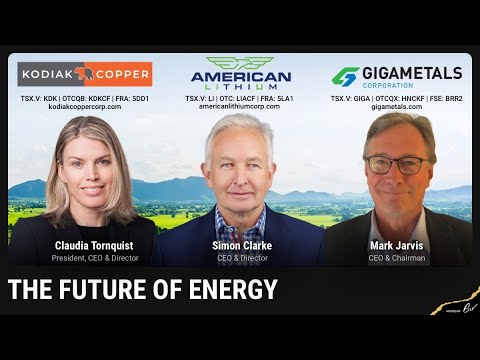
Automated transcript · Written by software from the replay's audio. It can mishear names and figures; the replay is the record.
13:34 the development of battery metals. And I know that our biggest infrastructure expense, when we look at our project, is accessing the BC Hydro line. I think it's, I think in our PEA is something like 250 million US dollars. Well, if the federal government could come in and help BC Hydro extend that line further up Highway 37, that would be supportive not only of us, but there's a number of mining projects up in that part of the world that would benefit and be accelerated by access to that BC Hydro line.
14:21 That would be brilliant. And in fact, we are talking mostly at the provincial government level about how we can help advance this deposit. And I think from the experience I've had before, that if industry works with the province and coordinate with approaches to the federal government, that can be quite a successful approach to actually getting some of that money spent in the ways that we would like it spent. So that's just one example. There's all sorts of research dollars available. We're looking at different processing routes and different end products for our Nickel, where we would take our concentrate and further refine it to things like MHP.
15:12 You could create briquettes and so forth. And there's research dollars available for that. So we're looking at all of that. It could all be very helpful. And Claudia, how about for Kodiak Copper, how will this budget impact your operation? Well, it's certainly a big positive. It's a big commitment, serious commitment financially by the government and a real show of support for mining and exploration in the critical mineral space. For Kodiak, the flow through tax credit, the increase from 15 to 30% doubling of the tax credit will be significant. That really raises, sorry, lowers our cost of capital and we can raise finance with less dilution.
16:00 So it's a real bonus, not only for us, but also for other exploration company. It's a real stimulus. So very pleased with that. Right. Just a reminder, if you do have questions, feel free to submit them. We're going to open up the floor in a bit to Q&A. My next question for you all is, do you think the energy and technology revolutions are increasing demand faster, the new mines can be brought on stream? I'll throw to you, Claudia. Well, I would say at the end of the day, it's all a question of the commodity price. In our case, copper price. There is at the moment in the copper space a lot of demand, not very much supply.
16:45 And looking forward, also relatively little supply in the pipeline as in projects that are being developed and mines that are being built. And that really means a high copper price is needed to incentivize this new production, new exploration, new development. And you've seen a significant jump in the copper price, which has hovered sort of in the last decade between 2 and 3 dollars and is now 4, 4.5 going towards 5 dollars. And that's, I think, a situation that will stay. We're really in a new paradigm here and you won't see the historic prices anytime soon or at all.
17:32 Really, there are higher prices needed to incentivize the amount of copper to be produced that's needed for the green revolution. Thank you. Simon, what are your thoughts? So I mean, in the lithium world, I think the issue with Lithium historically has been not supply or occurrence of Lithium around the world. There's lots of Lithium in a number of places. The issue has always been it's not easy to extract and it's certainly not easy to extract it economically. I think you're seeing now in Lithium, there's definitely a big concern in the market about supply shortages. There aren't a lot of new major Lithium supplies coming on in the next year or 2 here.
18:23 And the demand for Lithium-ion just continues to increase exponentially year on year. I haven't seen any analyst forecasts that would suggest that isn't set to continue. So I think, you know, for Lithium, I think, you know, we've got to build everything that's out there. I think there's lots of projects in development, but I think anything that can be done to help fast-track those projects, be it permitting or other incentives to help, I think are critically needed. And again, I think a big theme for Lithium, again, has to be for the Western supply chain in the lithium-ion world, has to be domestic and allied sources of lithium, nickel, cobalt, copper, all of the above. So, you know, I see those as big trends and I don't see the supply demand side of things coming into balance until that happens.
19:25 Thank you. And Mark, what are your thoughts? Is the demand increasing faster than new mines can be built? In a word, yes. And it's not only the total supply. It's also where the supply comes from. Right now, As far as I'm aware, the major supply crunches for the development of electric vehicles and that whole supply chain are Lithium and Nickel. Those are the 2 that people are most concerned about. When you talk to battery makers, when you talk to car makers, those are the 2 things that they are the most concerned about, and for good reason. Now, China has done a very good strategic job of securing supplies of Nickel, Lithium, Cobalt and so forth.
20:23 And they are a huge supplier of batteries. So they've done a very good strategic job by building things, even when they weren't really economic in Western terms, but they would build a long-term supply that would be there through many market cycles. So particularly with what's happening in Europe right now, it's a reminder to everybody that geopolitical risk is real. So how are you going to feel if you're an OEM and you are looking to expand your electric vehicles, and your supply of batteries comes from China, and they decide to invade Taiwan. What happens then? I mean, people are thinking about this now.
21:20 So really, there's a tendency to desire, if you're an OEM or a battery manufacturer, Western OEM or battery manufacturer, to have your supply chain close to home and in jurisdictions that are safe. And if you look at the amount of gigafactories that are planned for North America and the amount of Nickel that they will need. And then you look at the known Nickel deposits in North America, you could develop every single Nickel deposit, even those that are currently designed as supplying Ferronickel for the stainless business. You could change the engineering on that and say, OK, well, what if we designed this to supply cathode material for the battery business?
22:13 If you develop every single deposit in North America, it's still not enough by a long shot to supply just the gigafactories in North America. So, you know, and what's taking up the slack, if you will, is LFP batteries, you know, lithium iron phosphate batteries, which are not as good a solution as Nickel-based chemistries if you want range, but they're suitable for, you know, like buses, you know, taxis. I mean, you know, they're suitable if you're going to be recharging a lot because they can go through a lot of recharging cycles.
22:59 And they're suitable if you don't need a lot of range with 1 chart. And so, but I note that lithium iron phosphate batteries also contain lithium. So again, the electric revolution is going to require both those chemistries, the Nickel-based chemistries and the Lithium Iron Phosphate. And no, there's not a... The supply of raw materials is the constraint now on the development of the electric vehicle business. All right. Thank you. Okay. Before I open the floor to some of these attendee questions, I have a question for all of you. If you can leave the investors on the call today with 1 message about the Green Revolution, what would it be? I'm going to start with you, Simon.
23:46 I think for me, and I think Mark and Claudia both alluded to this as well, is, I mean, you could have argued over the last several years, perhaps, about whether the new revolution was with us, but I think we're now at the point where it's absolutely clear that it is. And as Mark said, it's critical that we continue to provide the funding, to help the permitting, to do everything we can to get these projects built so that we have the raw materials that we need for the revolution to roll out and not become stalled. I think for me it is real. It's here. It's not going to go away and we need to be very proactive in what we do moving forward.
24:34 And as Mark said, you can look at whatever Lithium-ion chemistry is out there. Lithium is obviously a huge part of that. I think all those projects that are in development now need to be fast-tracked and come into production as quickly as possible. Any means that I think can do that. Otherwise, we're just going to continue to stumble into integrated supply constraints on these critical minerals. Thank you. Claudia, what about you? I would very much echo what Simon says. I think at this time, 80 percent of the world economy is on a net 0 emissions target of some sort. So this is a real mega trend. If you think of the last big economic boom, the China boom, that was really one economy that drove that, albeit a big one, whereas the green revolution is happening everywhere on every continent, in every developed economy and many developing ones.
25:40 So a real, real mega trend and that will have impact on commodity markets for years to come, for decades to come. And many, many mines will have to be built to really feed this green transition. Thank you. Mark, what's 1 message you want to leave with the investors in the call today? Well, I think something to bear in mind if you're talking about a green revolution is how the metals used in batteries to support the green revolution are sourced. If you are thinking that the Green Revolution is a way to save the world, it's quite interesting. A huge amount of nickel is now mined in places like Indonesia, Papua New Guinea.
26:30 These are islands in the Pacific and within what's called the coral triangle. So very environmentally valuable and sensitive area. And these mines are strip mines. They're not pit mines. So they mine a thin layer of clays and soils, go on for mile after mile after mile. And quite often what they're doing is they're churning down tropical rainforests to get out the nickel and the cobalt. And, you know, and also on these islands, I mean, the biodiversity, you know, the species that exist in 1 valley are different than the species in the next valley. There's just so much biodiversity.
27:17 And if you're just going and mowing down these tropical rainforests from valley to valley, I don't know if anybody's keeping track of how many species are being destroyed. And then, because it's too expensive to do proper tailings facilities in these tropical and wet environments, in many cases, the tailings are simply dumped into the ocean and nobody knows really what damage has been done there. And you know, it's just, it's just, you're not saving the world. You know, buying Nickel that is sourced that way. There is a difference between Nickel that is mined from sulphide deposits in the Western world and from laterite deposits in the Coral Triangle.
28:10 The economic advantage to them is that you can get permits quite easily there. In Canada, of course, you've got to go through an extensive EA process, environmental assessment process. But the thing is, so that makes it economically more difficult. But I think it makes it from a green perspective, more attractive. And I think that is starting to matter to people more. And I hope that's true. Yeah, absolutely. All right, thank you. And open the floor up to some attendee questions. If you do have a question, feel free to submit it. Some of these are open for anyone who wants to answer and some are directed about your company. But what is your opinion about Tesla moving to mining exploration business for battery metals?
28:59 Whoever has an idea. Who are you asking? It's open floor to whoever. Well, it'll be interesting. I think, you know, in fact, I understand they are hiring some, some are looking to hire some mining engineers. And so that's a necessary step. I think car companies in general are starting to realise that if they're going to be in the electric vehicle business, they're going to have to do vertical supply chain integration. They don't have a choice. If they're going to supply, you know, otherwise, if they build these big gigafactories, they're going to be these multibillion dollar warehouses full of machinery sitting idle. If you don't have raw materials, what are you doing?
29:55 So I think that's a very, very logical move by Tesla. And I don't know if it's as well publicised, but I'm aware that there are other car manufacturers that are taking the same approach. Yes. Absolutely. I mean, I think every Lithium project on the planet or certainly a development project has been visited by Tesla. We would be the same. We're 3 hours away in Nevada. We know that they've looked at a lot of clay stone deposits like ours. They've talked about doing some themselves. And the latest intelligence we have is that, you know, Elon specifically has mentioned his concern about the rising cost of the commodities. And quite frankly, I also see it as a failure on the government part that we are in this point where we don't have enough domestic supplies.
30:50 I think the car companies are having to start to take matters into their own hands. We've definitively heard that they will look to get into the Lithium supply chain. There were announcements this week that I think Ford and GM are looking at Sonoran Lithium in Mexico, and Ford is also in discussions with Lake Resources in Argentina. I think Mark is absolutely right. It's a trend that's going to continue. And it just shows that the major autos and OEMs have to take matters into their own hands now to make sure that they have the supply of these critical minerals that they need for these chemistries. Yeah. A follow up question just came in.
31:36 I think you just answered. Will we see General Motors exploration in Ford and Nickel corporations soon? Yeah. I, again, if you really think about it strategically, if they don't go that route and really mining is so far outside of their wheelhouse, I mean, there's no in-house expertise. But if they don't do it, will they even be in existence 10 years from now? I mean, I think it's that existential and that strategic. So Tesla is making a very good move. And I think the others are starting to recognize that they need to be doing something similar.
32:24 Totally agree. Thank you. Simon, I have a question for you from Stephen. Would you mind updating the status of the permit approval in Peru? Yes. I mean, we've been we've been mobilized with our rigs in the field now in Peru, waiting to go for several months. We've really we've really been interested in the change in government down there. We've seen a situation where there's been a number of ministers changed out in a number of departments. And for us, we're in the final process of getting permits approved. I note that Stephen mentioned some document being posted on CEO.ca, which I'm not aware of from an M, but we're at the point where we believe that we will see permits to start the next phase of drilling at both Falchani, Kalkaya and also Makassani.
33:22 We believe we'll see those permits being approved in the next few weeks here. So we've said it before, but I do believe we're close to getting those done now. Thank you. Tristan is asking, is EV really a greener option compared to an internal combustion engine, knowing that 1 out of 3 of the world's is still powered by coal power plants? Well, I think people talk about energy transition, which is obviously huge. And I think you see these swings in the commodities where people forget that there is a period of time where we're still reliant on coal and oil and natural gas. But again, I think what's been highlighted out of the conflict in Europe is just how much we have to move away from the traditional sources of power. And that's not just from a pollution perspective, which is obviously first and foremost, but you've got some key countries in the world that control the supply of it, again, of those commodities.
34:37 And Europe is being held hostage right now because of its reliance on Russia. And that's just something that shouldn't be allowed to happen. So to me, I think it does show, yes, there is a need for a transition. But both from a pollution perspective and from a security perspective, we have to hasten that. And I would also submit that As well, we're talking here about EVs and that side of the revolution, but we have to also do something about the base load. You know, solar and wind are great, but are they ever really going to be viable? And I think that means, you know, Again, slightly talking our own book with a uranium project, but I do think you're going to see uranium and nuclear power again becoming more and more to the fore as a key provider for baseload.
35:29 I would add that whether an electric vehicle is or isn't a green option very much depends on the energy that it's powered by and that goes into the materials it's produced from. And that then, for example, if you're in BC, where 95% of the electricity is generated from hydro and 0 emission, that's obviously a big, big bonus. And that's something people will be looking for, locations and yeah, the green energy that's used for production, for the commodities, for everything.
36:16 Yeah, and again, you know, I would also add that, I mean, you also, to answer that question, you have to look at the carbon footprint of how you get those batteries. So in addition to, I'm sounding like a bit of a critic of Nickel produced in Indonesia, Papua New Guinea, and the Coral Triangle. And I guess I am, because part of it is also generally they've got a very high carbon footprint. And particularly if you want to look at taking Nickel pig iron, as Xingxuan has threatened to do, take the Nickel pig iron, make it into matte and then supply the EV, you know, supply the battery supply chain that way.
37:03 I think that it's something like 60 to 1, 60t of Carbon per tonne of Nickel produced. I mean, it's outrageous. Whereas, in our deposit, we've got a real, we think we've got a real shot at getting to 0 carbon because the combination of access to hydropower, but also silicate tailings, such as we will produce sequester CO2 directly from the atmosphere. And the silicates turn into carbonates, a different form of mineral with carbon as part of the mineral structure. The CO2 has gone basically forever.
37:50 And so if you start measuring that into the equation, I don't know if we'll get to 0. We're certainly low, but we think we've got a real shot at getting to 0. And that matters. Great. Thank you. Mark, just 2 questions about Giga. One is, have you been approached yet by any auto manufacturers about possible GVs? And also, are your latest drill results going to be released soon? The answer to the first question is yes. And we have a lot of conversations going on. I can't get into specifics, but there are a lot of conversations going on and it's just a very, very interesting time right now.
38:35 Our drill results, I'm not sure yet. We don't have all of them in yet. Once they're all in, we'll release them all. But I just want to say it's all infill drilling and with a deposit like ours, an ultramafic intrusive, you know, it's quite homogenous. You know, the differences in the lithology are very gradational. And in my entire time since 2004 with this, I have never been surprised by an infill drill hole. So basically we're drilling mostly towards the edges of the deposit to convert inferred to indicated so that we can advance to a pre-feasibility study with those resources.
39:28 And, you know, it's, I don't expect any surprises. It's it's really more than you know, it's it's You know, I'm not expecting any wild, you know high-grade pull out of you know bolt out of the blue and But anyway, so I'm hoping that we have them soon. I don't know the exact timing of it. Thank you. Raj is wondering, what about silicone metal on the for the future of power in the world. Anyone? As you hear about all sorts of alternative battery technologies every day, I'm quite good friends with a fellow named Dan Blondell, who's the CEO of Nano 1, which is a local technology company, your battery technology, battery manufacturing technology company.
40:27 And this guy is extremely plugged in. And what he says is, you know, a lot similar to what Simon said earlier, you know, lithium ion is it for the next 20, 30, 40 years. I mean, you look at what happened with lithium ion. It was invented in the 1970s. Gradually, it got commercialized until it was starting to power small electronics like laptops and phones. Only now are we getting to the point where it's being produced at scale for EVs. Any experimental technologies that don't involve lithium right now are at least 20 years away from being commercially available. And more than that, to being scaled up to something like electric vehicles.
41:18 Does anyone have any other thoughts? Okay, thank you. Simon, is there any news on the New York Stock Exchange listing? It's a process we started in the fall, Dasher. I think we've gone through all the hoops, so we are expecting to hear final news on that in the next couple of weeks here. And hopefully we'll be trading sometime in the next few weeks on one of the bigger exchanges in the US. So again, it's a process. We've been through all the hoops now and we're just waiting to hear back, confirmation of timing and everything else. So as soon as we hear, we'll let people know.
42:10 Great, thank you. One more question for both Claudia and Mark, And then I'm going to wrap up with the final one. Claudia, will there be great money flow from Great Bear to Kodiak, knowing that you're under the same group as Discovery Group? That's an interesting question. Great Bear was founded by Kodiak's founder and chairman Chris Taylor and was obviously a fantastic success. 1.8 billion takeover by Kinross, largest pre-resource takeover ever. So great success for Chris. There's certainly a number of shareholders and investors who follow Chris closely and are looking for his next deal. And that's really what Kodiak is about. So I think there is certainly a positive effect just from from this big success that that Chris brought home. At the end of the day, people back teams.
43:12 And that's certainly, yeah, that success is fantastic for Chris and gives people a lot of confidence in his knowledge for good projects and in his abilities as a geologist. And that's really also what he brings to bear at Kodiak. It's a very important part of our success and very much oversees our technical work. Thank you. Mark, what is the timeframe for when the lack of nickel will slow down the battery metals makers? I think we're there. I think we're there right now. I think every bit of Nickel that is produced that's easily convertible to cathode material, whether it's MHP or briquettes, it's just as fast as it's produced, it's gone. I think this is happening now. I mean, it's been interesting because for the last 3 or 4 years, you can see it coming, right? It's just one of those demand supply things.
44:22 In the market, it is rare that something is really, really obvious. But once in a while, something is truly obvious. And that's where we are with Nickel right now and also with Lithium, I believe. Where it's, we're at a critical crunch point. And as fast as you can bring it on the market, it will get bought. Thank you. I'm just going to quickly translate this one question from Spanish, but while I do, can we just go around the room and if you could highlight any upcoming catalysts that each of your companies has, starting with you, Simon? Thanks, Dasha. Yes, I think for us, we have a few catalysts coming up. I think in Nevada, we are in the process of finalizing our preliminary economic assessment.
45:16 We had some delays in terms of our drilling related to COVID earlier in the year, and assays in Nevada are taking up to 3 months. That has slowed things a little bit, but we're still targeting very much mid-year to get that economic analysis out. I think it will be a key indicator of the ability to economically produce from TLC good quality Lithium products. That's key. In Peru, as one of you, as Stephen mentioned, we are still waiting for permits. Our indications are that that will happen very soon. And then we'll launch a big drilling program, both on the Falchani-Lithium side and then later in the year on the Uranium side.
46:08 And that will also feed into updated PAs on both Falchani and Makassani. And once the PA is updated on Falchani, we'll then move that project straight into feasibility. Actually, we've started the economic work now under an EIA that would form the basis of feasibility work. So we've already started down that path. It's a robust project that can precipitate battery grade material, and it's ready to go into feasibility and beyond. So lots to come from us. Great, thank you. Kodiak, what about for Kodiak Copper? Kodiak really is all about discovery. We've made 1 discovery at the gate zone, which certainly was transformative for the company and have still lots of room to expand and make the gate zone bigger than what it is now with further drilling.
47:08 That's certainly something to look out for. But more importantly, the gate zone is one of several targets on our property. That's the one we started with. And this year we will also drill these other targets that we have lined up. We have several of them and they have just equally as much discovery potential as the Gate Zone. So that will be very exciting. There's a potential for 1 or several new discoveries. I'm very much looking forward to that. So we'll have a steady flow of exploration results. The next ones will be in the next couple of weeks and then throughout the year and at regular times news from our exploration. And yeah, as we unlock the discovery potential of MPD.
47:54 All right, thank you so much. And Mark, what about for giga metals? Well, you know, as we've discussed before, if you look at the Lassonde curve, we're in a very boring part of the Lassonde curve, the development phase. But the real, you know, and as I said before, I don't think that our assays, when we do release them, I don't think those are going to be transformative because they'll be unsurprising. We'll simply move resources from inferred to indicated category. I think the transformative event that I anticipate happening sometime this year is a strategic alliance with a partner. We're talking to so many people right now, there is so much interest. And I don't think I'm speaking out of school if I say that it's kind of obvious that, the big companies have to do something.
48:52 And certainly we think our deposit, although it's still early stage, is the premier, or certainly one of the premier North American deposits, if you want Nickel and Cobalt for the cathode. And so that will be the game changer for us is who will be the strategic partner that we get involved in this project. All right, thank you all so much. The one question here from Roberto, hopefully I translated it correctly, but he's saying very interesting conversation. Could you please speak about fusion energy and the new agreements to supply Russian gas to China. Anyone has an idea?
49:45 OK, well, I'll leap in then. Fusion Energy, it's interesting. I mentioned Dan Blondell, who's the CEO of Down01. He used to work at Fusion Energy. He's an engineer. He's a very, very, very, very, very talented and smart guy. I mean, Fusion Energy, if you ever crack the code there, that is the magic answer to all our energy needs forever. You know, the byproduct of Fusion Energy is water. And, you know, it's been a technology that has been 20 years away for the last 60 years. I think they're making some very interesting progress in it right now, but the jury's out.
50:33 Wouldn't that be fantastic if we could have fusion energy? And in terms of Russia selling gas to China, is anybody surprised? Yeah. All right, thank you. Just underlines this whole theme, Dasha. We've got to move to this new energy revolution, and we have to cut down dependence on a number of these supplies from countries and other jurisdictions that don't have our best interests at heart. It's all about domestic supply and security of supply. As Mark said, you're going to end up seeing a premium for cobalt and nickel and other minerals that come from, you know, safe, secure, but environmentally friendly or better processes.
51:26 And, you know, I think, as Mark said, it's really no surprise that Russia and China are aligning on this. Right. Well, really interesting discussion. Thank you all so much, Mark, Simon, Claudia, for all your wonderful insight from the chat. It seems that a lot of the attendees are also Really appreciative. Thank you also to everyone who joined and asked questions. If you do think of another question following this panel, feel free to reach out directly to any of the companies. You can also, of course, find information on their website. And this has been recorded and will be available to rewatch because I know there's lots of information discussed on six.com. But with that, I'm going to close out and just thank you