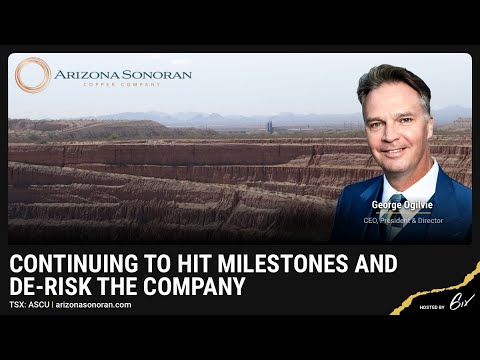
Automated transcript · Written by software from the replay's audio. It can mishear names and figures; the replay is the record.
0:38 it off. Hey, great. Thank you so much, Dasher. And thank you for the opportunity once again to join you and the 6 listeners here today. So it's Arizona Sonora Copper Company and the title of our presentation is Copper, Invest in Sustainability. We do make some forward-looking statements so I'll draw your attention to the cautionary language. Our share capital structure remains relatively the same, what we presented several weeks ago. Still only 71 million shares issued, 81 million fully diluted. Very strong treasury. Today we're sitting with approximately 14 million US dollars cash in the bank and we're funded through until the end of the year in the delivery of a bankable feasibility study. A very strong treasury as well. Balance sheet only 1 million US dollars in debt which is due to Tembo Capital.
1:38 We currently have 4 analysts covering the company with a target price of $2.95 to $4 Canadian. We recently had an analyst tour to the property where 12 analysts came through the site about 10 days ago and we would anticipate in the next 2 to 3 months that another 2 or 3 analysts would launch coverage on the company. Tembo Capital remains our largest controlling shareholder and they're very supportive of the company and the management of the company. Thank you, Alison. A little bit on some of the events that have occurred in the beginning of this year. We recently announced that we'd received a JDS, which is a jurisdictional determination survey.
2:25 This was official confirmation from the US Army Corps of Engineers that there were no waters of the United States, and therefore there is no federal permits required, and therefore no federal nexus on this project. I'm very happy to say as well that a couple of weeks ago, we announced that we had acquired our aquifer protection permit. That was a major de-risking event because from the application date, which was mid-October, until the actual award of the permit, which was the 31st of March, that took approximately 5 months to be awarded that permit. And we went through a 30-day public consultation period where there were absolutely no concerns raised by the public.
3:14 In order To improve liquidity, we also now trade on the OTCQX under the techer symbol ASCUF. We would see that over time liquidity will improve as we get our DTC eligibility, but we see that over time as a stepping stone up to one of the main boards as we become a producer here in the next couple of years. Obviously, we've been putting out great results on Park Salier and we'll talk more about that, but we're definitely seeing something that's going to be very regional size scale and that no doubt might attract various mid-tiers and senior base metal producers. The drilling program is still underway at the Cactus site itself.
4:02 We're targeting infill drilling from indicated up to the measured category ahead of a bankable feasibility study at the end of the year and we're still on track to deliver our pre-feasibility study. Probably sometime the high level results will go out in August of this year, and we're anticipating filing the technical report just after the Labor Day weekend in early September. Remember the PEA told us that once the project financing was in place and the project was given a green light, it would be approximately 18 months of construction and development. And that would put us into first production towards the back end of 2024. And the company remains on track to execute on those plans.
4:51 So the project's located 3 kilometers west of the city of Casagrande. That Casagrande has a population of 55,000 people. We maintain a very strong social license from within the city and the Maricopa and Pinell County. The project is 45 miles south of Phoenix with a population of 4.5 million in the greater Phoenix area and 75 miles north of Tucson with a population of 1 million people. The site is very well serviced by roads and infrastructure. And indeed, we have the main hydro electrical line actually running right through the mine site.
5:37 You may remember or know that Arizona ranks very highly on an annual basis on the Fraser rankings. And of course, it supplies over 70% of the US domestic copper supply. So a little bit more on the permitting. When we applied for that permit in mid-October, within 5 days it was administratively accepted, which started a clock ticking. And we've always said that with no federal regulators, the state regulator must give us a response within 180 days, and that includes a 30-day public consultation period. And as I said earlier, on the 31st of March, we were awarded our amended aquifer protection permit, which basically gives us the authorization to mine the surface stockpile, the pet layback, and the underground component while protecting the aquifers within the area.
6:34 The other key permits, we're still on track to apply for those in the next couple of months. Those would be the construction and development permit and also the mined land reclamation permit. We can only apply for those once we have a line of sight on our pre-feasibility study, which obviously would be built from maiden reserves. And therefore, we would have a lot more confidence in the plan. Assuming 1 to 2 months to have the applications administratively accepted, That would take us to July and August of this year. And then running through the 180 day process as described earlier, means that in the first quarter of next year, we would be in possession of those various permits, the bankable feasibility study would be done, project financing would be lined up, and therefore we could start construction development in the first quarter of 2023.
7:31 So as I alluded to earlier, we conducted a perception survey in December of last year. There were 500 respondents from the city of Casa Grande and Pinel County. This was a follow up to a survey we conducted about a year and a half ago with 400 respondents. And you can see on the page here that 83% of those respondents were in favor of seeing the mine coming back into production. And That was down slightly by 3% from the prior survey, which gave us an 86% favorable response. But the pollsters seem to think that these results were excellent, given that over the last couple of years with COVID in the US and the US politics with the Biden-Trump election.
8:19 The general public in the US is a little bit more negative and skeptical and a lot more pessimism. And they felt that maintaining an 80-plus percent favorable rating was extremely good. So we have a very good, strong social license from within the community and great support. Our land package obviously hasn't changed in the last several months. Still 4,800 acres, but you can see there where we currently are drilling at Park Salier. The mineralization trend runs from the bottom left hand corner up to the top right hand corner here and of course we picked up the Bronco Creek properties where you see that little 158 acres. We would anticipate that probably sometime in May of this year, once the initial 12-hole program is completed at Park Salier, we now have the legal authority to put a drill onto the former Bronco Creek properties and I would suspect that we'll be drilling there sometime from May of this year to see if that mineralization trend runs over onto that property.
9:28 To the south of us We have Robert Friedland and the Ivanhoe Electric Group, which is drilling immediately south of us and also south of the Maricopa-Casagrande Highway. We would expect, given that's a private company, that it'll come to the public markets sometime before the end of this calendar year. And given that organization is being led by Robert Friedland, we suspect it's going to bring a lot of attention to this district, which I think in the medium and longer term is going to be extremely positive for the Arizona Sonoran shareholders. So just to recap on the global resource, we have 3.5 billion pounds of metal in the ground in all categories, and that also consists of oxide enriched and primary sulphide, which we're not currently targeting at this juncture in time. So we have 73 million tonnes of 0.72 total soluble copper, giving us 1 billion pounds of leachable material in the indicated category.
10:26 And then in the inferred category, the grade is slightly lower at 0.42 total soluble and 980 million pounds. That's the infill drilling that we undertook last year and that completed in February of this year. We would expect in the next 2 to 3 weeks to have received all of the remaining outstanding infill drilling from last year's program, and those results will come to the market. And they're important because they're going to feed into the PFS and updated resource statement, and of course, made in reserves that will be part of the pre-feasibility study. Just a reminder on the economics, we ran the resource at $3.15 and the copper, the financial and economic model was ran at $3.35.
11:17 Essentially we had an 18-year mine life and 56 million pounds of copper cathode produced annually. It's early stages yet within the PFS but we are seeing a little bit more of a robust production plan at this early stage. Our C1 cash costs in the PEA was $1.55, and the all-in sustaining costs was $1.88. After the initial CAPEX, we saw 16 years of sustaining capital at $340 million. Now, On the capital, we are seeing an increase in CAPEX within the PFS as expected. Some of that is due to inflationary pressures, and some of that is going to be due to some additional fixed assets that weren't included in the PEA, namely a primary crusher, secondary crusher, and we're looking at conveying and stacking the material on the leaching pad and not running big trucks up on the leaching pad where the porosity and permeability can be badly affected through compaction.
12:24 On the economics, at $3.35 a pound of copper, remember the NPV8 after tax was $312 million, and the IRR after tax was 33%. Since our last discussion on this platform, the copper prices have remained well above $4.50 a pound, which would put the economics of this project on the extreme right of the page. And therefore, we'd be looking at a NPV 8 after tax, well in excess of $600 million US, and an IRR above 50%. Now we come into Park Salier. And I'm sure you've been following the exploration results of this program. They've been extremely exciting.
13:09 Just to recap, ASARCO drilled 2 historical holes, S200 and S201, which are highlighted in the upper right-hand quadrant of this slide. About 15 months ago, the company drilled 2 holes, number 18 and 19,800 feet north of those 2 original holes, and went through the same massive copper porphyry system. And again, those results are highlighted on the right hand side. And then in December of this year, we announced that we were embarking on a 3 million US dollar exploration program, specifically at Park Salier, where we would drill an additional 12 holes. 2 of those holes had been drilled in December, early January.
13:58 The results went to the market in February. And those are holes number 45 and 42 that you can see on the screen. And then approximately a week ago we had received 2 follow-up holes which would be number 57 and 65 and we put those out to the market. And since then, 3 other holes have been finished. The core has been logged and split and prepared and sent off to the laboratory. So we're waiting on the results for those 3 other holes. And I believe there is another 4 to 5 holes still to be drilled and we would expect that drilling to be completed sometime before the end of April and that's where then upon we would move on to the Bronco Creek properties. But as you can see in all of the holes we've gone through some significant oxide, the enriched material looks extremely exciting, We've gone through hundreds of feet and all of the holes of somewhere in between 0.9 to 1.3 total percent copper and there's obviously some significant molybdenum as well associated with the enriched chalcocite material.
15:07 And then although it's not part of our current mandate, we've been drilling these holes the full extent all the way down to the basement fault. That's adding in another 4 to 600 meters of primary chalcopyrite, which is not currently part of the plan, but we do see an opportunity at some juncture down the line that some form of trade-off study is going to be done, particularly at these copper prices, as to whether we look at going back to a conventional flotation mill to actually process some of the primary sulphide at a much later stage in the project and the company's growth profile. Thank you, Alison. So we've conducted geophysics, geochemistry, sonic soil sampling on Park Salire.
15:53 We end up with a strike length of about 1.2 kilometers of open ground. Width-wise in plan view, we're looking at something that's over a kilometer. And the top of the mineralization generally occurs about 300 meters down the hole and continues on till about 6 to 800 meters down the hole. So we've got 5 to 600 meters of vertical intercepts of mineralization. We took a volumetric calculation, and then we reduced it by 50% in order to be conservative. We took the 6 holes that had been drilled at that time, and we know the specific gravity. And that gave us a volumetric calculation of 40 to 90 million tons that might be sitting there of leachable material between 1% to 1.3% copper, which would yield an additional 1 to 2.3 billion pounds of copper in the ground.
16:49 Over and above that, there's the potential for an additional 150 to 750 million pounds of primary chalcopyrite copper in the ground. If we add the 2, we're looking at somewhere between 1.2 and potentially up to 3 billion pounds. And that's on a 50% volumetric calculation. So if we were to add that to the current resource at Cactus, if management can execute on its plan at Park Salier and what we hypothetically believe could be there, I believe in the next 12 to 18 months the company could easily be looking at additional or in the region of 5 to 10 billion pounds of copper actually sitting in the ground. And then if we look on section here on the extreme right-hand side, you can see hole 45, which we put out there in February.
17:40 The most significant mineralization there was 595 feet at 1.2% total copper. And you can see the molybdenum associated with that as well. One of the new holes that went out last week, hole number 57. You can see that just to the left. And there, the most significant mineralization was 302 feet at 1.23% copper. And then if we swing over to the left-hand side, you'll see hole number 65 that went out last week, 439 feet of enriched material at 0.92% copper. And even in the oxide cap, we went through several tens of feet but some really nice grades of well over 1% approaching 2% in some cases.
18:26 And then just to draw your attention to it so you can see it in a pictorial format If you look down at the bottom in the dark blue grey area, you can see 600 feet, 400 feet of 0.2 plus percent of primary chalcopyrite material that's not currently part of this existing plan, but certainly could be an option if copper prices remain on a go forward basis at these type of levels, if not higher. And then in section, this is over a full 4 kilometres of strike length. I think another opportunity the company has that we'll start turning our attention to sometime towards the end of the year, given how much we have on our plate just now with the main cactus project in Park Salia, would be the Northeast extension.
19:15 Again, here, a sarco drilled historically into that extension. They hit the copper porphyry system. Many of the holes were not drilled to the full extent down to the basement fault. And therefore, we haven't picked up the full extent of the primary chalcopyrite there. But I do believe there's an opportunity that when we start exploring there, we're going to find the same copper porphyry system and it will all be connected to the Cactus East, which ultimately we see within the PFS, PEA and PFS as an underground mine. The other thing to note here is that immediately below the pet, a sarco only drilled a couple of hundred feet into the primary sulfide. Since acquiring this asset, our focus has been on the oxide and the enriched chalcocite material.
20:03 So therefore, any drilling that we've done in around the pit has not drilled the full extent of the primary sulfide to the basement fault. So there exists the potential below the pit for many, many hundreds of feet of primary chalcopyrite to extend all the way to the basement fault. And I think if we start to consider that as a reality, I think we're gonna be pushing upwards of 10 billion pounds here across this entire 4 kilometer of strike length as we drill the deposit out over the next 12 to 24 months. And just on valuation, remember the current PEA has 56 million pounds of copper cathode production. We're expecting that to increase within the PFS.
20:52 Ultimately, at the end of the day, we see ourselves getting up to 80 to 100 million pounds of copper cathode production. Right now, the company only has an enterprise value of just under 100 million US dollars. If we could get up to that type of production profile and compared ourselves to a copper mountain, you can see their enterprise value is in and around 580 million US dollars. So I think if management can continue to de-risk the project and execute on our plan, I think there's significant upside from these levels today where we still trade around $2.20 Canadian with a market cap of only 150 million US dollars. There's definitely significant upside for both the existing shareholders of the company and any potential new investors looking at an investment in the Arizona Sonora.
21:47 So just to recap on the YASCU, obviously, it's a brownfield site. It's in a tier 1 jurisdiction. We have 1.6 billion pounds of copper in the indicated category. And that's supported by 1.9 billion pounds in the inferred category. The PEA revealed very robust economics. For the PFS, we do expect the capex numbers and operating costs to increase in these inflationary times. However, we are going to have the advantage of using slightly more robust copper prices than the $3.15 a pound we used to calculate the resource 18 months ago and the $3.35 which we used for the financial and economic model.
22:35 Remember, the entire land package is on private land. There's no federal nexus. That completely simplifies and streamlines the permitting process. And I think we've demonstrated in the last couple of years in the permits that we have achieved, they've been granted in very quick order, and there's been no major public concerns over the last 2 years with the permitting of the project. The infill drilling program, we believe will be successful in converting inferred material over to the indicated category ahead of the PFS. And we're now embarked on a similar program this year for indicated up to measured ahead of the Bankable Feasibility Study. And we're starting to see some significant exploration success. For example, if we could add, let's say conservatively, 1 billion pounds of additional copper in the ground at Park Salier, if the company was only given a 5 cents per pound of copper in the ground valuation, that would be 50 million US dollars. It doesn't sound like much, but on 150 million market cap today and only 70 million shares issued and 80 million fully diluted, it can add significant value on a per share price basis for the shareholders of the company.
23:54 And I think just lastly, one thing to touch on, I think everybody understands the fundamentals of demand and supply when it comes to copper. It's obviously a sad situation in Ukraine and what's happening in Eastern Europe, but I do believe that the westernized countries of Europe will now accelerate their decarbonization thesis and the drive for renewable energy will become even more apparent very, very quickly as the West tries to remove themselves from Russian oil and gas. And I think that's going to create one hell of an amount of demand for battery type commodities. And obviously, copper is going to be absolutely fundamental to the whole green energy space. And therefore, I believe that we're in the right commodity.
24:43 It may take North America a little bit more time to catch up. But in the long run, the decarbonization thesis that has started with the Biden administration is gonna catch fire here in North America. So that concludes the formal part of the presentation and I'm very happy now to open up the floor to any questions that we may have. Great, thank you so much George. There's a bunch of questions that have come in, but if you do have a question and haven't submitted it, feel free to do so now. What is the overall tonnage of copper expected at Park Slayer? Well, as we said in the presentation, it's a bit of a kind of an extrapolation of what the possibilities could be just based on the geophysics and the sonic soil sampling, but when we do our volumetric calculation, right now we are calculating that there's between 40 to 90 million tons of potentially reachable material at Park Salier.
25:51 And when we take the sort of average grade, which is in and around 1% to 1.3% total copper, We know the specific gravity of the ore. That would give us somewhere between 1 to 2.3 billion pounds of additional copper that could potentially be in the ground at Park Salier that's leachable. And then when we consider the primary sulphite, which is a chalcopyrite, over the same sort of volumetric calculation, much lower grades, however, at only 0.2 to 0.4, I think we're in and around about a 0.35 is the weighted average grade, would give us somewhere between 150 to 750 million pounds of additional copper that might be present at Park Salier and the primary sulfide.
26:47 So compared to a 3 and 1 500 million pound resource right now with cactus, I mean, essentially there's the ability there to double the resource in the next 12 to 24 months as we aggressively drill out Parpsalia. Great, thank you. And a question here is, are copper prices likely to plateau? And how quickly do the copper prices changes affect Arizona-Sonoran copper's value? Well, my thesis, I mean, predicting commodity prices is very, very difficult and no matter what I say here, it won't be the right answer. So this is just George thinking, but I think that The copper prices probably have been supported of late because of the supply chain disruptions.
27:36 We are seeing a general slowdown in the economy, which is what you would normally expect copper prices to fall. But I think because of those supply chain disruptions and inventories being quite low, both on the London metal exchanges, the various bonded warehouses and obviously in Asia, I think that copper prices going forward are likely to stay at these levels, or certainly well above $4 a pound of copper. And if you may remember back to the presentation, we ran the base case PEA at $3.35 a pound of copper. And that gave us an NPV using an 8% discount factor of $312 million after tax and an IRR after tax of 33%.
28:28 If you run the numbers today at spot prices, which is around $4.70, the numbers go well in excess of $600 million US, and the IRR after taxes is approaching 60%. As I alluded to in the presentation, we will see capital cost increases in the PFS, which was always expected, and we will see some operating cost increases as sulfuric acid is a big operating cost and on a per ton basis that has gone up in price due to supply chain issues. But we will have the luxury or be fortunate to use a more robust copper price. So I believe that for the PFS at the moment, we're looking at a $3.50 copper price for reserve calculation.
29:19 And I believe long-term copper pricing, there's 40 to 50 banks that cover the copper space. Right now they are forecasting $3.65 long-term copper price, which obviously is over 10 percent above the 3 dollar 35 that we actually used within the P.A. For the financial and economic model. Great, thank you. Lots of questions here, So Richard is asking, what is the history of the Freeland local investment? Was he before or after Arizona Sonoran?
37:28 Great, thank you. Stephen is asking, how are you looking at crushing the material on the leech pad? Is it a single stage or a two-stage crush? Well again that's a great question. This was a bit of a lacking in the PEA. So in the PEA we were taking run-of-mine ore from the underground and from the pit, which typically would be 6 to 12 inch miners, and it was then being trucked onto the leaching pads. And as we did now detailed engineering, and within the metallurgical laboratories we're obviously looking at size fragmentation we see that as the material gets smaller we think between 1 to 2 inch minus as the optimum size we we see better recoveries So at 1 to 2 inch minus, that therefore means we're gonna have to put in a primary crushing plant and probably a secondary crushing plant.
38:27 And that's part of the reason as well why the CAPEX numbers will increase in the PFS, given that those fixed assets were never built into the PEA. The other thing that we're doing is that rather than trucking and depositing ore on top of the leaching pads through truck dumping, which causes a lot of compaction and we therefore have to rip like a farmer plowing a field the top 5 to 10 feet of those leaching pads. We're going to convey the crushed material and then stack it onto the leaching pad so that no equipment actually drives on top of the leaching pad. So again that's either an additional capital cost or we might consider bringing in a contractor with the crushing equipment with the conveying and stacking equipment and and they would actually do that work for us. And of course, that would then go into the operating costs. So that's been identified in the PFS as a missing, and it's definitely being built now into the plans as far as for the mineable reserves and how we plan to mine this deposit on a go-forward basis.
39:41 Thank you. Dale's asking why is Osarco no longer involved and sold the site? And sold the site. Yeah, so the history of this asset was that it was discovered in the late 1960s. It went into commercial production in 1974, and then the mine closed in 1984, not because there wasn't significant mineralization in the ground, but at 60 cents a pound of copper, the mine was uneconomical. Sarko was sinking a shaft at the time. They encountered water in the basement fault and they were having to do a lot of cement drilling ahead of themselves and therefore the progress in the shaft was quite slow and it was taking up a lot of dollars for them.
40:28 They ultimately decided to close the asset in 1984. Sarko kept the asset and then in 2004 they ran into financial difficulties and they filed for chapter 11 bankruptcy protection in the US. At that time a lot of their assets were acquired by Grupa Mexico and they're actually still mined in the US today. But this asset was not acquired by Grupa Mexico And it therefore fell into a state trust. There was still remediation at that time required on site to close up the mine. So ASARCO and the administrator gave the Arizona state $20 million US to remediate the site.
41:19 And that money was essentially spent by the Arizona Department of Environment and Quality, which is one of our main regulators on this project. And they were the ones who gave us recently approved or granted the amended aquifer protection permit. So the site's been relatively fully remediated, and the good news is we're not responsible for any small environmental legacy issues that may remain, but there aren't many. And that's how the company came to acquire the asset from ADETU in late 2019 and that's why today ASARCO is not involved with this project given it fell out of the company's asset list when they went into administration in the early 2000s.
42:09 Great, thank you. Another question here. What is your current cash position And how far will this get you on your roadmap for this year? Yep, so the current cash position in the company is approximately $14 million US. We're funded through till the end of the year and the bankable feasibility study. Within that $14 million, we did indicate to the market at the beginning of this year that there was $3 million being allocated to Park Salier and the exploration campaign. We would anticipate that the $3 million on Park Salier will be spent, including all the assay data, sometime in May and June of this year.
42:56 So it's looking like later on in the year, we might want to raise some additional monies to aggressively drill out Park Salier so that we can bring it into a compliant resource at some juncture for the bankable feasibility study. The plan would be to bring Park Salier in as a compliant resource, probably in the inferred category within the bankable feasibility study at the end of this year. Perfect, thank you. Dale's asking, have you decided on a construction or engineering company? Yeah, on the engineering company, as far as the technical reports are concerned, we continue to use the same groups that assisted us for the PEA.
43:44 So that would be STANTEC engineering, principally their Phoenix office, although I believe they're also pulling expertise from their Salt Lake City office and Vancouver. And then within Nevada, we're using another group called Samuel Engineering, which is doing all the metallurgical work for us. So they did the PEA, they will do the PFS. And then, as I said, hopefully we can roll into the bankable feasibility study at some juncture in late summer here. We haven't gone as far as looking at EPCM groups for a full turnkey project, if we decide to green light the project on the back of a bankable feasibility study and project financing, but I'm quite sure, you know, probably sometime after the summer, we'll be having those discussions internally within the company.
44:40 Great. Thank you so much. Another question here. What is the status of alternative leaching strategies, for instance, the JETI resource process. Are you evaluating and testing these? And do you expect alternative leaching methods to be a part of the upcoming financial studies? Yep, so we have engaged with JETI Technologies under an NDA. We have sent them a bulk sample last year in November. We are anticipating sometime before the end of May that we'll receive the first report on what we're calling phase 1 testing. There is another group which has now approached us for further testing. They also claim to have patented technology for the heat leaching of a primary chalcopyrite sulfide.
45:33 And they also believe that the 73% to 78% were seeing recoveries of the enriched material through a bioleach. They believe their patented technology could potentially improve those recoveries as well. So there's a second bulk sample going off with this second group, but we wouldn't expect to get the results back from that other group, probably sometime until after the summer of this year. What that means is that for the PFS, we won't have any of those results or opportunities built into the pre-feasibility study, but depending on how the testing goes, there might be the ability to build something into the bankable feasibility study as an opportunity or some blue sky potential.
46:24 You know, the sort of heap leaching of a primary sulphide is a sort of holy grail in the copper space. A lot of people have been experimenting and trying this for quite a few years now and I don't think we're quite there yet. But certainly for old mine sites that already have you know material that's drilled and blasted and sitting on surface similar to our oxides and enriched material, I certainly think this technology would work for those operations, given that there's already a significant sunk cost in what you could deem as a waste pile, although it does have economic value. I think I touched on this earlier, but certainly if the copper prices remain at these levels on a go forward basis and the investment community starts to get comfortable that $4.50 plus or $5 plus copper as the new normal, this company will definitely have the option at some juncture down the line to consider a trade-off study to look at putting in a traditional copper concentrator and eventually going and mining the primary sulfide through a copper concentrator again, particularly as I said, at $4.50 plus a pound of copper.
47:43 But that's not our initial plan here, but it definitely is an option on the price of copper at some future junction. Great, thank you so much. Another question here, what is the general experience for acid consumption for similar ores? Any insight from metallurgical studies done by others? Yeah, so we've been conducting bottle roll tests and the column tests now for well over 2 years. I believe for the enriched material, we're seeing somewhere in and around 12 to 16 liters a ton on the sulfuric acid consumption.
48:30 And then for the oxide material, it's anywhere between 18 to 22 as the number. When compared to other heat reach operations in Arizona, For some of them, that is a little higher. On some others, that's a little low. So we seem to be right in the range of what comparable operations are seeing, certainly with copper porphyry systems for oxide and the same similar style ore within Arizona. Great. Another question here, what tax rates have you used in the NPV calculations? That's a good question.
49:17 I don't know what the tax rates are off the top of my head, but I can tell you that we have factored tax into the numbers, both local municipal tax and state tax and then federal tax. So the numbers have been checked by external tax accountants and those would have been signed off within the PEA. So I've got to believe that the numbers are reasonable and fair. And then of course, when we come to the PFS, we'll be building in the tax component as well. Great. Thank you. Mike is asking, given high NPV and relatively modest current market cap, Any thoughts on the approach to minimize equity dilution for initial capex given inflation, please?
50:11 Yeah, I don't know the exact split at the moment, because we really need the mineable reserves and we need to see the sort of metal plan. But we believe it will be a little bit more robust than what we're seeing within the PEA, which was 18 years and 56Mlbs of copper cathode production annually. So, you know, I think the nice thing is with this project is we are gonna be able to put debt on the project. As you're all aware, the company only has 1 million US dollars of debt right now. And I would expect before the end of the year, we would be paying that debt off so that when we are negotiating with the project financiers, particularly on the debt, we're negotiating with them being debt free, which is important.
51:00 But if you think about a typical 60% debt to 40% equity on a $150 million, let's say, Capex spend, that would be approximately $60 million in equity that would have to be raised and 60% the remaining 60% would be in debt. I definitely think with a plus 15 year mine life and the robust economics that we are looking at here And I think we're in a very safe jurisdiction. I think copper is a great commodity to be invested in at this stage. So I would be confident that we can get the project financing and the debt component in place and therefore minimize the dilution for the shareholders of the company.
51:49 An additional $60 million in equity, if we were doing that at a $3 share price, it would be an additional 20 million shares on top of the 70 million we have issued today and the 81 million on a fully diluted basis. So be confident we could put this into production for somewhere between 100 and 120 million shares issued and outstanding. Great. Well, George, we're approaching the end of the hour. So I just wanted to say thank you so much for taking us through the presentation and the live Q&A. And also thank you to everyone who joined and asked all of these great questions. If you do think of any questions following the summit, feel free to reach out to the company directly. There's more information on their website, of course, which is ArizonaSonoran.com.
52:36 And of course, this is also being the recording is being uploaded on Six.com to watch again following the summit. But I'll pass it back to you if you have any closing remarks. Hey, thank you, Dasha. And thanks to you and 6 for the, again, for the opportunity to present here today. I think this is the 4th or 5th presentation that we've made in a relatively short period of time since we became a public company in November of last year, And I would urge the listeners on the call today to go back to those previous presentation and really listen to what management said they were going to do. And I think you'll see that there's a common theme here and that we said we were gonna do one thing and we've actually delivered on it. So the company, the takeaway should be that the company continues to de-risk this project.
53:25 We can continue to execute on our plan. That's not going to change. And I believe that these current share prices and company valuation, there's a hell of a lot of uplift for the shareholders of the company over the next 2 to 3 years as management continues to execute on this project. You