Andrew Pollard
President & CEO at Blackrock Silver Corp
Replay available
Join us for a great event!
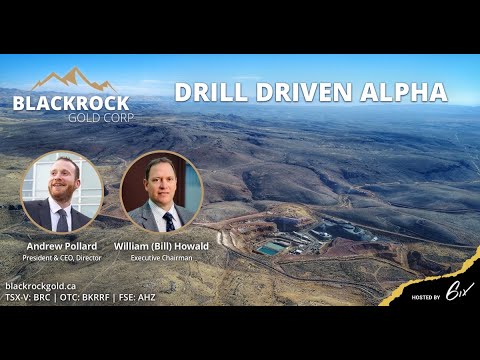
On 6ix: 6ix.com/event/blackrock-gold-corp-drill-driven-alpha
Automated transcript · Written by software from the replay's audio. It can mishear names and figures; the replay is the record.
0:12 Hi, everyone. Welcome to BlackRock GoldCorps Live Investment Summer today, hosted by 6, Drill Driven Alpha. I'm pleased to introduce our speakers for today. We have Andrew Pollard, President and CEO, and Bill Howell, Executive Chairman. Andrew and Bill is going to walk us through a company presentation, and then we will be taking questions live. Remember, you can always submit your questions using the Q&A tab on the right-hand side of your screen at any point during the presentation.
0:41 And as always, this event is being recorded and will be available on SIX.com afterwards. Now, without further ado, I'm going to hand it over to Andrew. Thank you very much, Jane. It's great to be here. And it's good to be in front of all of you very punctual people. It's 11am right on the dot and we're going to get started. This is our first presentation that we've done on this platform, so I'm hoping it's going to be a lot of new investors, but I'm hoping this will serve as a good update for those that are already holding a position in the company. For those that don't know, we're already trading on the TSX Venture under the symbol BRC, and we're also available on the OTCQB under the symbol BKRRF. So hopefully something for everyone.
1:29 So of course, we're gonna be taking a step into the future here. I know most investors generally only look to the next news release. What we're going to take you forward is our vision for the company over the next year. And we're also going to be taking a step back in time to about 100 years ago when our flagship property, Tonopah, was front and center in the mining business, certainly in the US precious metal scene. This is a really, really good point in time for us to be in front of you, and I'm actually excited. This week is often seen as a turning point for investors in the mining sector. I mean, you go back 18 of the last 20 years and gold always seems to go on a run from about mid-December to just past Valentine's Day. And there's a number of reasons for that from a seasonal point of view.
2:19 But it makes for a very interesting point in time now, especially as an investor in stocks, because we're coming to the end of tax loss season, which is, you know, we've seen some real countervailing forces over the past few months, from Gold losing about $250 an ounce and Silver going from $29 all the way down to $22, I think at one point in November. But we're sort of seeing some light at the end of the tunnel now with the final meeting of the Fed this afternoon, and everyone's got an eye on what they're gonna say. We've got stimulus discussions, which is something that is unique to 2020, and could be a real shot in the arm for everyone once they finally get a deal done. And last I checked the news this morning, they said they were hours or a day away from announcing that and you never know until it's done. But that could be something really, really good. But most importantly, we're coming to an end of tax law season, which gets rid of that final sort of anchor that's holding down, you know, not just us, but everyone. And once you snap that, you know, I think we'll, you know, I think the sector itself can go on a bit of a run here, you know, between stimulus fed and tax loss. I mean, that's what we in Canada call a hat trick when investing.
3:34 We're an exploration company. And as you'll see by our stock chart there in mid-July, that's what it looks like when you make a discovery. We're now drilling 2 different projects that we have right now. We've got a lot of arrows in our quiver that we think we'll be able to start releasing either towards the end of this year and certainly we'll have a lot lined up next year, right as hopefully the market's coming back. Lots of enthusiasm. When we hit our discovery hole at our Tonopah West project, it was when Gold hit its all-time high. That's when Silver went from, oh, $14 in March, all the way up to $29 at the end of July, and then everything since corrected then. So now makes a great sort of point in time to be looking at deploying capital.
4:23 Certainly for us, I think we've got, you know, we've been doing the hard yards for the past few months, putting our result after result after result and building value. I think that's spring stirring the coil. Once we can cut this tether, I think we're set to go on a bit of a run here. Join me with you while we give you an update. Blackrock, If you haven't gathered it already by the cover page, we're focused on Nevada. Why? Well, as Bill likes to say, the mining business is hard enough. We don't need to make it harder. Nevada, if this were Roman times, Nevada would be Rome in the Gold mining business. It accounts for about 80% of all Gold production in the US. If it were a country, it would be the 4th or 5th largest Gold producing country in the world. As jurisdictions go, we're sitting pretty. It's obviously very pro-mining.
5:19 Though everyone thinks of Nevada for Gold, anyone that's been down there knows that Nevada is still to this day known as the Silver State. It's known as the Silver State for 2 reasons. One is the Comstock load and the other is Tonopah West. And guess what? In February of this year, we picked up half of an interest in what's known as the Tonopah Silver District, which is our Tonopah West project. And we've been turning it into Swiss cheese over the past few months drilling it. So, Being in the exploration business, too many companies out there focus more on the business and not so much on exploration. We're drilling 2 projects right now. We're very much focused on exploration and adding value through discovery. We've done that significantly this year, as you saw by our stock chart.
6:08 We started the year around 20 cents. And you know, if you told me last December that I'd be pissed off, that I'd be finishing 2020 at 65 or 70 cents or wherever we end up, I wouldn't have believed you, but that's where we are right now. We've added a lot of value, but the best part is, this is the beginning, it's not the end. We're just getting started. So I'm gonna spend the bulk of the presentation today talking about Tonopah West, and I'm going to come in and focus on the macro, and then I'm going to hand the baton over to Bill, who's not only our Executive Chairman, he's our Head of Exploration, and he's down in Reno, which is a good place to be having that job because that's the halfway point between our Tonopah West project and our Silver Cloud project in Northern Nevada there, as you see.
6:58 We hit this year in a big way. Our very first drill hole went to Tonopah West, hit 30m roughly of about just under 1kg per ton Silver equivalent. We call that the $100M drill hole because that's what it added to our market cap in the span of about a week there. What's going to happen is I'm just going to take you through the project quickly and then I'm going to hand it over to Bill who's going to show you our updated model of what we're drilling into, which has now been informed by over 40 drill holes and we're now set on delivering a resource on it by this point next year. So we're hoping to have a re-rate. We've been, as the first group to drill into this so far, we've been hitting at an ultra-high rate. We've released 40 drill holes. We've got 30 plus significant intercepts ranging from 1m thick to 29m in thickness and grades up to 4,600g per tonne Silver equivalent, meaning any time we're reporting precious metals grades in kilograms per tonne, you're on to something. And obviously being in Nevada, you expect to get that Nevada premium should things keep going the way we are in terms of delivering ounces in the ground.
8:13 So Tonopah West, This is the largest consolidated landholding in what's known as the Tonopah Silver District. The Tonopah Silver District, this time 100-years ago, was one of the most significant precious metals districts in all of the US. It was the place to be. As you'll see, it's literally halfway point between Las Vegas and Reno. There's a highway that goes right through us and we're in the heart and soul of the Walker Lane trend, which hosts about 80Moz of Gold resources. They say the best place to find Gold is near Gold mines. Well, not only are we near Gold mines, we've got multiple historic Gold mines on our property. This is a Brownfield mining camp, which were the first group to go in since production shut down about 100-years ago, not because they thought they ran out of resources, but it was due to the fact that Silver prices absolutely tanked in the mid-1920s, straight through the Great Depression, and there were some technical issues of the day that would be a cakewalk in modern terms.
9:20 We're the first group to go in there and breathe some fresh life into it and so far we've been hitting it out of the park. Tonopah itself is known as the queen of the Silver camps because it's second only to Comstock load in Nevada in terms of historic Silver production. The district as a whole produced 174Moz of Silver and about 1.86Moz of Gold. So it's about 100 to 1 Silver Gold ratio in terms of historic production. That makes it very unique because it's a Silver primary mining camp. Normally, Silver produced is a by-product of industrial metals and base metal mines. Those are generally found in far-flung places of the earth. We're a pure play precious metals district and we're not in a far-flung place. There's a highway right around us and we're in probably the best mining jurisdiction on the planet. Now Tonopah, in addition to being one of the largest Silver districts in all of North America, it's easily one of the highest grade too.
10:25 It's averaged over 2kg per ton in head grade in terms of what it was producing. That's what made it so unique. As I said, this is one of the most significant precious metals districts in the US. That's not me saying it. This is a newspaper clipping from around 1912.
10:48 Even in Nevada to this day, this is still one of the most significant discoveries made. And that's, you know, that's got some serious contention with the Carlin trend and all the other massive open pit mines. Now, the reason Tonopah was so significant isn't just because of this discovery, this high-grade Gold and Silver play right at a time when the state needed it. Tonopah came about in 1900, about 40-years after the Comstock load was discovered And really the Comstock petered out in around the 1880s and Nevada was, it wasn't doing too well, it needed something. Tonopah was discovered in 1900 and this discovery was significant but it led to some serious discoveries nearby including gold fields and bullfrog.
11:38 Gold fields which is around 30 or 40 miles away from us grew to become the largest city in Nevada in the early 1900s and the reason those discoveries were made was because of the prospecting rush that happened on the back of Tonopah. This is a crucial part of Nevada's history and we own half of it. So on I guess the left hand side of your screen is the guy who discovered this. It was a prospector named Jim Butler. He was a rancher, he was a lawyer, and apparently he made one of the most consequential discoveries in Nevada history. Now, the story goes that he actually didn't make the discovery, his donkey made the discovery in the sense that they were walking in the middle of nowhere and the donkey ran off, he chased it, stumbled over an outcropping vein, picked up a piece of rock and realized that, well, he realized he had something.
12:32 You know, Tonopah itself is so significant that any of you guys can go on Amazon right now. There are countless books talking about the history here, both fact and fiction. There's some murder mystery set in the town, which is right next door. As I said, not only was it known for its grade and the fact that it's silver primary and the fact that it's burned so many other discoveries right before the emergence of World War I and the Great Depression. But it brought some very interesting characters through here. Tonopah itself has had some serious figures of modern history, I guess, through there. Charles Schwab literally was the largest shareholder of one of the companies whose assets we now own. He personally financed the mill that was on the property and subsequently burned down. Howard Hughes owned a big chunk of our property in the mid-1960s.
13:32 He never did anything with them. He actually was attracted to our property for the mine dumps and tailings that were at surface. But we're the first group to go in since production shut down and actually target the underground vein systems where production left off. This is what Tonopah looked like in 1912. You'll see it's a smattering of claims. Now what's interesting is the vast majority of Tonopah is on something called patented claims. They're privately owned. We own half of this, so literally draw a line down half of this and we own the western 0.5. Now that's significant because Tonopah itself is an east-west trending set of veins and they're thick.
14:17 One of the veins on our property, which was the thickest, was about 80ft wide. Where they started mining it in the mid-1920s, we were told that, well, all the historic reports indicated that the vein itself was 24m thick. What did we do for our first drill hole? We pointed the drill right there and we hit something 29m thick at around a kilogram per ton. We thought they didn't shut down because they ran out
14:42 of Gold and Silver and it turns out we were correct because we pointed the drill about 20m or 30m from the last of the historic workings there. Now, what's interesting about this is Tonopah is an East-West trending set of veins. The discovery by Jim Butler was made on the East side of town. In fact, the town of Tonopah is built on the east side of town where all of these discoveries were made. And what did they end up doing? No 1 drilled these things back in the day. We're the first group to go and drill into most of these historic mines on a property. They mined these veins straight from surface. They were thick and they were gold rich. And What they did was they followed them from surface on the eastern side of town and they followed them down, down plunge and a long strike all the way to the west. The eastern side of town not only now has a town on top of it, but those were the mines that were mined out early on, and then production followed westward. So the west side represents the blue sky potential, it represents where the last of the historic production took place, and it represents the 0.5 that we have, luckily.
15:46 We also don't have a town on top of us. So not only do we have the patented claims, which allow us not to have to deal with the BLM, which is the government in terms of, you know, we're able to really just guide right through permitting our stuff so far, but we've got a lot of room to run here. So this is what our claim package looks like. Now, the secret sauce behind what we have here isn't so much the exploration because I mean, we nailed it from the first drill hole onwards. We fit, we drill 40 drill holes into the project all over it, we fit veins all over it. In fact, as the first group, as I said, they didn't do any drilling back then. They just mined these things using drifts and cross cuts when they lost the veins. As the first group to actually drill into it, we're hitting veins all over the place that they didn't even know were there when they were mining it. But what you'll see here is we've consolidated a number of different independent parcels together for the first time in history. And the biggest piece of the puzzle is what's in blue.
16:48 The blue puzzle piece there represents the holdings of the Tonopah Extension Company, which is one of the biggest producers in the district. Now, no one has had these holdings since 1928. They've been held by the same family, passed down generationally since that company went belly up when Silver prices went from about $1 an ounce in 1923 down to $0.35 an ounce. So, we picked the project up when a company called Eli Gold Royalties consolidated this district. They had those 2 claim parcels down there. The green represented the holdings of what was known as the Tonopah West End Mining Company.
17:33 Howard Hughes once owned those. They had those pink claims there. But really the most exciting parcel of our package is the blue claims, because no one's been into this since production shut down. And every single piece of data that we had said that they didn't stop mining those many mines on there because they thought they were out. It was due to the business of the industry. So, most people when they're talking about mining talk about whether they've got a power lines or their proximity to a paved road. We're literally halfway between Vegas and Reno. We've got a highway that runs right across the property. You'll see that's our drill rig in between the Comfort Inn and a Subway sandwich shop. Literally, in terms of infrastructure, it's too good to be true.
18:21 For us, it's not about proximity to infrastructure, it's about proximity to casinos. There's everything down here. Not only that, in the Silver business, most of the Silver business got bent over a barrel earlier this year with COVID
18:36 because of the plurality of all production comes from Latin America. Well, Latin America shut down due to COVID. Nevada didn't shut down. Nevada's an essential business. So not only are we targeting high-grade stuff, but we've got the infrastructure in place that should allow us, should we keep putting 1 foot in front of the other and delivering something really good, a very high margin Gold system. So These are our targets right now. We commenced a drill program in June, our maiden drill program on here, and we're coming up to about 30,000m on our maiden program. We only started out to drill 7,500m, But when you hit like we have, investment comes in. Eric Sprott called us after we released our very first drill hole. He wrote a check for $5M personally and has since financed us to this point of the year where we now think that We've breathed enough fresh life into just one of our target areas that we think by this time next year, we'll be able to deliver a maiden resource. We've got 3 drill rigs down at Tonopah.
19:44 Those are spread out between 5 different target areas. The Victor target, that's where we hit our very first home run hole, but our DPB target is what we've always said going into this is going to be the big kahuna in terms of ounce potential. We think that DPB will either be hold the majority of ounces or certainly the plurality of ounces of the project. And so far, we've been proven correct on what we're hitting. Victor itself is something quite compelling. And here's what we've been hitting. This is the entire project overlaid with our drill results so far. What does that show? It shows that this is, well, there's veins all over the property and they're at a serious grade. As I said, we've released 40 drill holes. We're averaging right now across the property at 794g per tonne Silver equivalent.
20:32 We've seen grades up to 4,600g per tonne Silver equivalent. That's 26g Gold and over 2kg pure Silver in one of our intercepts. The best part is, this is our first round of drilling.
20:48 We thought we went hard this year, we think we're going to be going pedal to the metal next year. I'll show you Victor here. So Victor is where they stopped mining. This was the thickest mine in the district. It was over 80 feet wide at a certain point and it's the site of our first drill hole which put us on the map. We're drilling this out and what's the best part is we keep hitting veins that even the historic miners didn't even know were there. They stopped mining at around 1880 feet where they encountered water and they sent away for these long lead items which included diesel generators and water pumps. It took about 2-years for them to be delivered. Those are consequential 2-years because that's when Silver prices tanked from $1 down to $0.35.
21:38 They were able to install them but they weren't able to pay off the debt by that point because Silver prices have tanked so much. What did we do? We pointed our very first drill hole just past where that first working was, and we nailed it. We got 29 meters. What we're trying to do now, and we haven't been able to replicate it so far simply because we're trying to play slalom with the drill to avoid the workings, but hit the down plunge section of where hole 1 left off. We've got 2 holes at the lab, which are targeting that thick structure that we hit in hole 1. Both look like we've been able to navigate away around the workings. Hole 61 is gonna cross right back and try and nail it just under where hole 1 hit and we'll show continuity of that thick structure, but we've also hit a second vein zone there, which no 1 knew was there until then. Now, DPB, this is the target that, as I said, we think is the big kahuna.
22:33 Going into this, we thought there was going to be 3 veins there. We've now encountered 6 vein zones. This is also home to the highest grade intercept on the property to date along the Merton vein where we hit 4,600g per tonne. Now, this is just 1 section of this area. We've now got 3 sections in place so we'll be able to follow these down plunge and along strike. But what you see here, not only is the grade that's really, really, well, puts it in a league of its own like Tom Hanks and Gina Davis, but it's the continuity between the veins or along the veins. You're always going to see variation in these low-sulfidation epithermal vein systems in terms of grade and continuity. But what we're seeing now is we're, you know, along the Merton vein, for example, we've got hits a metre and a half, let's say 385g per tonne, then you go, you know, 50 to 100m down and you get that same metre and 0.5, but you get 4,600g.
23:32 Then you get lower grade vein zones around there where you're hitting 12m of 250-300g.
23:39 This is perfect because what we want to see is about the plurality of the drill holes. This is how you build up a resource. The high-grade hits mixed with the lower-grade hits in between but at workable grades. With that, I'm gonna hand it over to Bill, where he can get in the micro and he's gonna debut our new model of LEAP Pro. Yeah, thanks, Andrew. We're gonna go through and look at our geologic model and some of the information that led up to that model. As Andrew already pointed out, we're halfway between Reno and Las Vegas. The location is fantastic, lots of infrastructure.
24:16 What I'd like to point out is Tonopah is one of the largest silver districts in North America. It's often said that Comstock put Nevada on the map, but Tonopah kept it there. And as you can see from this distribution of silver in the state of Nevada, Comstock and Tonopah are obviously the largest 2 deposits in the region, and hence the name, the moniker for Nevada, the Silver State.
24:43 Andrew went through and mentioned the history of the district. This is looking at the history with regard to production and what was actually happening on the ground. There's 4 distinct periods that we see in the district. Once the silver finds were discovered back in 1900, the people, Jim Butler and his wife, Bill and Audie Tasker, they decided that mining was quite difficult. So they decided to lease out their claims. And they did that for a revenue of about 25% of all the gold and silver that was found. They also leased those claims out by the foot, so it was kind of interesting. Anyway, you can see why Audie Tasker became the governor of Nevada in his later years.
25:29 Once the kind of the discoveries had been decided and refined, A lot of companies started to put their stock on the Philadelphia Stock Exchange, raise the capital, come out and start to buy up lands. And that's really when we started to see the companies come and larger production come to fruition. And you can see that in the black line of the graph where production starts to increase from about 1902 to 1910. After that, like most mining camps, companies started to devour each other and consolidate the district into much larger components. And that's how the Tonopah Extension Company became to be. They were the amalgamation of a number of smaller companies and then they amassed a large land position on the western half of the district.
26:23 What's interesting is we're not really starting with a clean sheet of paper. There's been a lot of work here from, as you can see, from 1900 up and through the 1950s. And there's been a lot written about the district. And in fact, some of these are just quotes that I've taken out of a book, which is 50 years of production history of Tonopah, Nevada. So you can see, We knew there was an 80-foot wide vein that was being mined, and they ran into a bunch of water, and they had to stop mining. They also bought some diesel pumps to handle the water, and because of when those pumps arrived, they really weren't able to finish mining on those great vein widths. And so those things were left and that became what we know today as our victor target.
27:10 We can see there was a lot of geologic work done in the past in that they had workings, they produced maps and cross sections, and were able to use that information to help us move forward into the next phase of exploration. They really didn't do any drilling on the property, it was all through drift and crosscut. So once they got onto a vein, they followed it. When they lost the vein, they ran a crosscut until they found the vein or another vein. And that's really how the district progressed from east to west. We've been able to take a lot of that data and digitize it. So what we've done is we've digitized everything and we've put it into a 3D model. And this is what it looks like. There's about 34 miles or about 55 kilometers of underground workings heading out towards our property.
28:02 And as you can see, we're able to use all that information, put it together and start to build our geologic model. And now we're gonna go through and look at the geologic model in a little more detail. Okay, so here's our geologic model in Leapfrog. As you can see, this is looking down from the sky. Here's the town of Tonopah on the right-hand side. Here's Interstate or Highway 95 going through town. Our Victor target is here. Our DPB target is here. The core target is down here. Over here is the Ohio vein, and this is what we call the step-out area here. We're going to take a slice through the deposit and look at our drill holes and how some of the veins are coming together.
28:56 Okay, so this is mainly through our DPB zone. The red areas that you see here are the veins. This is the Denver vein, the Paymaster vein, the Bermuda vein, and this is the Merton vein here. All those veins are in red. Those are the ones that we knew about. The ones in orange are veins that we're delineating that are brand new. So this is vein 1 and this is vein 2. The blue areas are faults that we're putting together. This is the Pittsburgh Monarch Fault, McCain Fault and the 76 Fault. What you can see in our drill holes is we have grade, these are our grades, and you can see here Some of them are quite spectacular.
29:46 Here's silver equivalent of almost 2.4 kilos of silver equivalent. So we're hitting some very good grades. In our logging, you can see these red areas. These are where we're logging quartz veins, and you can see some of the new veins that we're picking up here. Let's take another look at our property. Let's look down on it so we can get an idea of where these veins are going. So we'll take another slice through the model at an elevation. And now we can see all the veins and faults together in a plan view. So this is what's called the extension fault, the Pittsburgh Monarch fault, McCain fault, 76 fault.
30:42 This is our victor vein and merger vein right here. And you can see we've identified another vein up in the victor area. We can move up through the model to see how these come together. You can see our 2 or all of our new veins are in orange and the known veins are in red and here comes the surface across again. So here's the town of Tonopah again.
31:16 So there's our model in 3D. So hopefully that's helpful. And as you can see, we're finding brand new veins as well as delineating and additional strike extensions and depth extensions to the known veins. And with that, I'll hand it back to Andrew.
31:35 I never thought red and orange would be my 2 favorite colors, but that looks good. I wanna go back here because I forgot that I had the capability to draw. And what I wanna do is just show you what we've got in the lab right now in terms of what we're targeting. So you'll see 41C, that's a core hole. We're testing the downplunge extent here. Hopefully we're able to connect with these other vein zones that we hit. But we've also got another one which isn't listed here and that's hole 61. And we just finished hole 61.
32:09 This will be out in 2 to 3 weeks maybe. But what that's testing is the down plunge portion of what we hit in hole 1 there. The secret behind that is trying to navigate your way through the historic workings and I think we managed to do that there. In terms of the model, what we did there was we've now realized through some of the drilling that we've done that that structure probably steepens out, it dips at a higher level. So if we're going to hit something in line with what we did in hole 1, holes 41 and 61 are the ones that could do it. And that might be the thick, thick intersect of a really good grade gold and silver that the market's been waiting for.
32:56 And that might make for a very Merry Christmas and a Happy New Year for people. Now, I don't wanna take too much time on SilverCloud other than the fact that we're drilling this right now. And if Tonopah is the steak and potatoes in terms of value driving the company, SilverCloud could be the dessert for everyone because We're testing some targets that have never before been drilled. And they're about as compelling as you can get in terms of grassroots targets. Silver cloud itself is in, you know, it's not an elephant country. This is Brontosaurus land in terms of where we are. We're right at the tip of the largest Gold mining complex in the world, Carl and Trent, where on one side of us you've got the biggest Gold mines in North America, but we're right where it intersects with the Northern Nevada Rift. This was 45km2, was compelling enough to excite Newmont, Tech and Placer Dome. They drilled 3 different target areas and they hit Gold in all 3 areas from 1g per tonne all the way up to 12.5g.
34:00 This project has been sitting in purgatory literally since Bill made a discovery. Now, for those that don't know, Bill used to be head of exploration for Placer Dome, which was the mover and shaker in Nevada at the time of their takeout by Barrick for $10 billion US. I'd say maybe a third of all these mines listed on this map were probably under Bill's control at one point or another. He's added over 100Moz of Gold through his career and he actually made a discovery on Silver Cloud in 2002, which is still the highest-grade intercept on the property yet. We're right next to Hollister. Hollister is owned by Hecla. So is Midas. If Phil Baker, CEO of Hecla, is looking at his claim map,
34:48 Silver cloud is the donut hole in the middle. It also represents the lowest hanging exploration fruit. You'll see on the lower side of your screen is Newmont's Gold Strike mine. That's the largest Gold mine in North America, if I remember correctly. That's crawling distance to us. That's about 15km away. Hollister though is an east-west vein system. It's a series of veins that were, some
35:11 of them were mined up right up to our property boundary. Well, guess what we're drilling? Those veins weren't discovered until after Bill made his discovery in 2002.
35:21 We're drilling the north-eastern quadrant of the property, right where Hollister stopped mining and right where on our side of the property
35:31 we found at surface 8 outcropping veins. There's also a mercury mine up there, meaning mercury for low-sulfidation, epithermal projects is the mother of all Pathfinder elements. This is one of the best undrilled targets in Nevada currently. Most of Nevada has been picked over. We're drilling it right now. For those that don't know, Hollister averaged 34g per ton head grade and produced 450,000oz.
35:58 I think in 2015, according to mining.com, it was the second highest-grade Gold mine in production that year. Those are Fosterville type numbers. We're drilling to see if we have the extension of that. Now, the Midas deposit was no slouch. Hollister goes east-west, Midas, which is to the northwest of us, those veins also point directly at us. We're that donut hole in the middle. Well, guess what? It looks like from a mag and gravity point of view, our project is actually cut down in 0.5 right down the middle. On one side, the Hollister side, we'll go like that, you've got it looking very similar. The Paleozoics are uplifted near surface and on the western 0.5, we've got this big Robin structure which looks a lot like the Midas deposit.
36:48 Now, Midas was such a good deposit in the mid-90s and early 2000s that it made Franco Nevada change their business model and
36:56 get the mine building business. It's one of the only reasons why Newmont stayed so profitable in the early 2000s when Gold was at like $2.50 an ounce. So we've got the best of both worlds and both of these vein systems are pointing at us. Here's our targets. This is the Northeast veins area. I guess you, let's see, Yeah, so here's the Northeast veins area, which is undrilled. There's a Mercury mine up here and the Hollister vein system goes just like that. There's a whole bunch of veins pointing directly at us. And on our side of the claim map we've got 8 cropping veins of surface. We've got a Geochem anomaly which is now about 1.2 or 1.3km to the west. This could be, as I said, this could be the dessert for everyone.
37:47 We also announced, because we've hit at such a high rate at Tonopah, anytime you've got 2 non-producing assets, you're only really getting valued on 1. Well, we're thinking of unlocking value for shareholders. Silver Cloud last year was the reason why Bill and I joined the company in the first place. As I said, Bill had a discovery on it when he was with Plasterdome. He had a discovery in this area called Northwest Canyon. We're drilling there now too. We've got 250m of strike delineated. He had a 12.5g hit earlier this year. We hit about 8.5g over 1.5m there, and we have a new data interpretation down there which shows we also, similar to Hollister, might have an east-west vein system. This time last year, Silver Cloud alone was worth about $20M to $25M market cap. Right now it's getting 0 in terms of valuation for the company. We can unlock that by doing a spin out and that's what's on our radar right now. To complete the spin out, we want to, while we need to for a tax evaluation and analysis purpose, finish this round of drilling, let those results bake in, at which point we might be ready to move in maybe Q1, latest Q2 with a spin out where those shares will be dividended to investors of Blackrock, and you'll get a holding in not 1, but 2 different companies.
39:08 So with that, you know, really we're, you know, as I said, exploration business, too many people doing business, not enough exploration. Well, we've got 2 projects, we're targeting high-grade in both of them. Tonopah is a train on the tracks at this point. We're putting out world-class numbers. There are not many Silver companies out there with projects that are averaging just under 800g per tonne silver equivalent. We are. This will be the standout silver discovery of 2020. Mark my words. But what we have at SilverCloud right now could be the icing on the cake for everyone. But we've got about 20 minutes left, so I think we should cover some ground in the Q&A. And I'd love to hear what you guys have in store for us. So Jane, with that, I'll pass it to you. And maybe Bill, you want to hop on now too?
39:54 Great, well, thank you very much, Andrew. And welcome back, Bill. We did get quite a few questions come in, so let's try to help do it. Our first question is from Joseph. It seems that assay results are a little bit delayed and a little bit slow. Can you talk about what the expectations for turnaround time should be? Yes, We're really picking up the pace right now. I mean, Bill's, he's on the ground so he can tell you more, but we're one of the only companies still drilling in Nevada at this point, which is exciting because what we're doing now translates to assay results in Q1 next year. Whereas most of the exploration companies around, they've shut down. Meaning even if they pass the stimulus, even if tax law selling is done, their only hope of raising is if all boats start rising, with the tides coming back in.
40:46 Well, we'll get that, but we'll have assays coming. If they're not days away, they're weeks away. Put it that way. Bill, we're seeing some good turnaround times, right? Yeah, turnaround times are between 3 and 5 weeks. And as probably many of you already know we've we've released 40 drill holes to date there's roughly another 15 to 20 that we're waiting on so we're pretty pretty up to date. Excellent, thank you Andrew and Bill. Well Denise is certainly looking forward to the next assay results. She'd like to know how much cash do you have left to keep up with expansion and whether you'll be adding more rigs? Yeah well you know We're going pedal to the metal here.
41:34 Our best way of protecting our downside risk is delivering a resource. Right now, even though we've got a monster by the tail at Tonopah, It's not like it's just 1 project. As you saw by that one slide I had, we had multiple historic mining companies' assets all rolled into one. We've got multiple historic vein zones and mines on a property which we're drilling into. We want to deliver a resource this time next year. So we're going to be adding rigs, probably starting in mid-January and going pedal to the metal through the year. Most of those rigs will be focused on DPB, but then we're still going to be expanding at Victor. And man, I can't wait to see what the whole 61 and 41 have in store and testing some other targets. We have the core target and the step-up target. It's obviously going to require some more money, but what's nice about this is our drill results haven't gone unnoticed.
42:32 In the Silver business, we're a rarity in the Gold space. Anytime anyone hits 26g per tonne Gold, that's a good intercept. We hit that plus 2kg in one of our intercepts. Since we came out of the park on our very first drill hole, Eric's Rock came to us literally the day after and we've been chased not just by institutions but by other companies looking at us. We get to pick our opportunity. We're going to go bigger next year than we did this year. All of the drilling, like 95% of the drilling BlackRock as a company has done, was done from June to now. We've drilled about 34,000m maybe, between 2 projects.
43:19 That's just 6-months. Next year we're going to go bigger. Yeah, we're going to finance. I'll put it this way. I own 3.5 million shares in the company. I control about another million and 0.5 or so. I came into this as a shareholder originally, and we're doing everything in a responsible way to add value. The last 2 times we've raised money, everyone thinks that raising money is a bad thing. The last 2 times we raised money were when we hit our 52 week highs. And in May, we announced a 20 cent financing by the time we closed it in June, we were something like 37 cents. And in July, we raised a 72 cent financing that Sprott participated in. By the time we closed that we were 160. So finance things are quite bullish, at least the way BlackRock seems to be doing it. But yeah, we're going to pick our time and pick our moments and all of that. But next year is going to be bigger than this one. Our riskiest drilling was our first few drill holes into the project. We didn't know if the historic reports were going to hit the way they did.
44:21 We've now been informed by 40 different drill results of Tonopah. This is the real deal. We're just trying to fast track this to a resource as quick as we can so that institutions or analysts can start valuing us based off our ounces in the ground. Silvercrest, they're 1 that in terms of grade profile is similar to us. Their resource right now is about 150Moz plus or minus Silver equivalent. Their average grade is 715g per tonne. Now, we think our potential of the project is bigger than that. We'll see if we can deliver that. But our grade profile so far in terms of what we're hitting is 794 grams per tonne silver equivalent. And we're not in Mexico. You know, we're halfway between Vegas and Reno.
45:11 Silvercrest, $1.5 billion company right now. We're 65. That's the re-rate that we're hoping to get 1 day. So yeah, come with us. But yeah, drilling costs some money, so we'll get there. All right, thank you very much, Andrew. And it's a good thing you mentioned how many shares you own as well. Elliot is curious to know how many shares each member of the management team owns. Can you talk a little bit about share structure? Yeah, well it was the share structure, it was my holding in the company that caused me to step into this role in the first place. Now, when Bill and I joined, BlackRock wasn't circling the gutter, it was halfway down the drain. We were a $1.2 million company at the time, and I had a lot of money tied into it. I came into the company as an investor first. I was so blown away by the prospectivity of SilverCloud.
46:08 When BlackRock did the deal, I wrote a $100,000 check into the financing. And it was with a management team I didn't know. And I got burned because my background going into this for 15-years was actually as a consultant to mining companies. They'd hire me to build management teams for them. Well, the headhunter got burned. The company raised a whole bunch of money at $0.10. By the time I stepped in, it was at $0.03 and maybe a $1.2M market cap. I knew the project was good, just no work had been done. I knew that was a task that I had a unique set of skills to be able to resolve. So I set about building a team and I came to the board at the time and I said I got Bill Howell. Bill made a discovery with SilverCloud.
46:56 In terms of Nevada, you couldn't get a better explorationist or general manager. He knows how to scale projects. I joined at $0.03, Bill joined the next week at $0.05. Fast 1.2M to, we hit a high of $0.161 this summer, $0.03 to $0.161 in about 14-months. We've come back a bit, but I think Bill will say, you know, Bill took a position in the company early on too, and he's added value the whole way, but we've got some serious skin in the game. I'd say management would own about 5% of the flow right now. Great, thank you very much. I got a couple of the similar questions here. Are you looking to see this through to an end to an operating line or are you positioning BlackRock Gold for a buyout?
47:47 If you are seeing this through to an operating line, can you talk a little bit about timelines, when you expect to get to production and launch? Well the 1st, Tonopah itself is actually unique because we've got about 50-years worth of historic mine dumps at surface. This is crushed rock that they thought was waste at the time. The signs of metallurgy have gotten a lot better in the last 100-years, So what was waste to them is now sitting at surface at higher grades than a lot of producing heat bleach mining operations in Nevada currently. So there's a short term, maybe infusion of cash there. And We're chasing down some ideas on that front currently.
48:33 But certainly in the short term, the best thing we can do to attract takeout potential is deliver at least a resource. And we'll have that, by this point next year, we should have something really tangible, hopefully high-grade if we keep hitting the way we are. We've got the bench strength on the board. What I did when I joined the company was we built a team from scratch. The entire board has been reconstituted. We've got one of the best mine builders in the world who joined us when we acquired Tonopah in the name of David Lang. He's worked with everyone from Ross Beattie, Mark O'Day, Frank Joostra, Neil Whittier. He's put more mines into production than I can name. You've got Bill who's added over 100Moz of Gold through his career. And one of his projects in Nevada, he had 32 drill rings going at one point.
49:25 But for now, our short-term, we've got the blinders on, we're going to be delivering something pretty good. And then, once again, with silver primary districts are rare enough, let alone not in Timbutt too, but in the infrastructure all around. I'd be surprised if we took it to production ourselves. I think we'd be picked off, but that's anyone's guess. Great, thanks Andrew. You talked a little bit about a spin out of SilverCloud in the previous slide here. David would like to know what's the timing on that? Yeah, we got Silver drilling it right now. We got to let those results come back for an analysis point of view.
50:11 SilverCloud, the lineage there is Newmont, Tech and Plasterdome. This is a major mining project. This was the basis for Blackrock before Tonopahsara took centre stage. Every corporate development team in Nevada and a major mining company knows it. They're watching this round of drilling right now. We're testing some really good targets. That may inform what the spinout looks like. It may inform if we do it at all. What we're going to do is, this is the ultimate hail Mary from a company and the best part is right now it's got 0 valuation baked into our company. So this is as I said Tonopah's the steak and potatoes, this is the dessert. A lot can happen in the next month and a half. If I can create a new vehicle with Silver Club being the flagship and get another vehicle to play with as a shareholder in Blackrock myself, that would be awesome, especially if Gold does what I think it's going to do. I mean, this is 45 square kilometres in the richest Gold mining complex in the world.
51:17 And that alone, I mean, a new vehicle to play with would be fun. So we'll know shortly, but for now, we're not doing financial engineering here. We're not trying to create something out of nothing. We're in the exploration business. The way for everyone to get rich is make a discovery. I'd like to make a discovery. Great. Our next question is from Michael. What is the mineralogy at Tonopah like? Can you produce silver dore on site or would you have to sell a concentrate? Bill, why don't you chime in here? Yeah, well, in the past, they made Dore on site and shipped that off. So I assume it'll be the same metallurgies, your typical silver minerals, pyregrine, polybasite, things of those nature. So I don't see it being too different, but obviously that was back in the 1920s and This is 2020, so we'll have to relive the metallurgy and see what the right course of action is.
52:24 So I see a question in here and it's a good one. No wonder why the chair price did not increase with the recent great results announced. As an investor, I'd be looking at it as a hell of an opportunity. Anytime you see a divergence between what we're actually seeing in results and a market force is holding something down, That's a coiled spring. Because every single time we've put out a news release in the past few months, we haven't put out a bad news release. First of all, Tonopah keeps delivering. The results keep getting better and better. Our first hit, we hit that 30m zone of $9.65. Since then, we've built out 2 big main zones. We keep encountering new stuff. We keep surpassing grades and wits and we're showing continuity and yet the market doesn't seem to like it.
53:14 Well, you sort of get an eye of how the market views these things in the first 30 minutes of trading. Every single news release we put out always opens up higher. I mean, I think our last one, we put it out at 65 cents and we opened at 69. We did a lot of volume. The time before that we put out results, we're at 65. I think we went up to 79 cents. It's tax law season. People, they see liquidity come in and they hit the bid. So our results have been unequivocally good. They're world-class, there's no denying it. Every time I issue the news release in the morning, I get calls or emails from not only analysts that follow us, but shareholders saying congratulations and the stock always opens really green. But then it's just this tax loss. I mean, people see our volume and our volume is massive.
54:14 We're, compare us to any company or side and I guarantee you we're equal. We dwarf most of them. The ones that we don't, we're certainly in line with. But there's lots of people cycling out right now between tax loss and the profit-taking, because we were $0.07 in March, mind you. But for every seller, there's a buyer. I mean, last time I checked, we did some of the 450,000 shares today. We did 750,000 yesterday, we did 850,000 on Monday. Those are people placing bets seeing they see a divergence. The divergence is you have these great results, you're in the tier 1 jurisdiction, but you're not making ground. Well, that's the opportunity here. It's a coiled spring. Let's see what the Fed has to say. Let's see what happens when the tax law season's done.
55:04 But we're on lots of radars right now. People are placing bets. But if I could buy right now, I certainly would be. All right, Thank you very much, Andrew. The next question is from Keith. When do you plan on tracking down some of the previously unknown veins in Tonopah? Well, we already have. As the first group to drill, and I'll hand it over to Bill in a second, but We keep getting new vein zones. You saw in that leapfrog model, you had the red veins, which were known, but you had those orange stuff, which are new. Our very first drill hole, we were targeting that vein where they left off, where we were told it was going to be about 24m thick. Well, guess what? We hit something 29m.
55:50 But on top of that, we hit 2 new veins. One was I think 3,600g per tonne, silver equivalent. The other was 465g. Because they never drilled there, they could only mine what was right in front of their face. And when they lost the vein, they do drifts and cross cuts to find it. But we keep hitting, this is a very geologically active area. So we keep hitting stuff that even these historic miners know. And we've got a lot of past producing mines on our property, lots of shafts. And yeah, you know, it's sort of, maybe Bill, you want to chime in on what you're seeing there? Yeah, sure. So, I mean, we're always looking for new veins.
56:36 The idea here is the way the drill, the drilling is laid out, allows us to look at not only the veins that we know about, but also explore for other veins that might be in between those known veins or off on the edges of those known veins. So, you know, we're, we're continuing to follow things out along strike, but also looking in between and off on the edges. Thanks, Bill and Andrew. Bill, can you also talk a little bit more about why you think the veins are so flat-lined? Do you think that these are rotated post-mineral, or do you think that they formed that flat? Yeah that's that's a really interesting question.
57:23 Obviously there's some extension going on it appears to me that this thing formed in I don't know how geologic you want to get but there was a volcano there, the volcano blew its top much like you might see at Mount St. Helens or Crater Lake if you've ever been there, and everything started to fall back into the crater of a caldera, and those veins pretty much started to form at that time. And, you know, basically you're looking at the margin of a caldera that's hosting the veins. So we're keen to keep following that up. Thanks, Bill. How about our next question from Elliot. When are we going to see drill results that give us better visibility into continuity and length at Victor?
58:13 Well, We've got 2 holes at the lab right now, which we've had bad luck. So we nailed it on the first drill hole and then we've been trying to follow it up. And the models changed a little bit in the sense that we think that structure dips at a steeper angle than originally thought. But to get at that really thick structure that we hit in hole 1, we have to work our way around these historic workings. We've had bad luck in the sense that the follow poles that we've released so far have either bottomed in historic workings that we didn't know were there, or on a few occasions, the drill bit snapped off right as we were getting into the mother load there. We decided rather than try and drill vertically, we went out to the West, I guess, and are drilling backwards at a steeper incline there. And holes 41 and 61 seem to have gotten to where we want them to go.
59:20 So this is going to be testing the downplunge portion of that. But at the same time, we've also hit all these other Uvaine zones there, which I mean, at Victor, that entire area, I mean, we're averaging over a kilogram per tonne silver equivalent. That's in a league of, that's like Orkana grades, which is the highest silver grade gold mine in the world, I believe. Bill, do you want to? Yeah, sure. Yeah, so we continue, as Andrew said, what we have is a historic mining area where up high they have a lot of underground workings and you took out as Andrew said up to you know 30 or 20 meter, 20, 30 meter zones. What we have to do when we're drilling is work our way through that out, those upper underground workings to get to the down dip portion of the area. So it's been a bit of a challenge.
1:00:17 We have been able to do that with holes 41 and 61. And, you know, hopefully we'll see what those 3. I'll put it this way. So The Tonopah Extension Mining Company, which owned Victor, when they stopped mining, which was just before where we hit hole 1 in the mid 1920s, they decided to take out a whole bunch of debt. They took out a whole bunch of debt. Charles Schwab personally was the one who guaranteed that. And they sent out for these long lead items. These were water pumps and diesel generators. Now, if you're a mining company, if you think you've exhausted that reserve, are you going to be sending out and taking up significant debt that would ultimately sink the company when silver prices went south?
1:01:07 Or do you think you're planning for the future and planning for another 5 or 10 years of life? Well, guess what? They never got that chance. What we showed in hole 1 unequivocally was that, yeah, there's a lot of goodness still there. And if they left what was right in front of their face, imagine what is left there. So, you know, they were, we're going into something that they did development on, they just never got around to mining. The fact that it's been sitting there untouched has nothing to do with the caliber of the claims. It has to do with the fact that those claims have been owned by 1 family ever since. Well, guess what? We own those now. Great, well, Thank you very much, Andrew and Bill. It does sound like we have a lot of potential in the project still. A lot of news to look forward to. Unfortunately, I believe that is all the time we have together. So thank you to all the members of our audience that submitted questions.
1:02:02 Unfortunately, we weren't able to get to every single question. So I'd like to ask everyone if you could stick around and complete the survey after we close the webinar, leave your details so that the BlackRockGold team can follow up with you directly. You can also find more information on the website at www.blackrockgold.ca and a copy of the presentation is there as well under the investor section. Now I'll hand it back to you, Andrew, for the final word. Yeah, no, thank you very much. As I said, we're at a turning point, I think, from a macro point of view. I mean, us, you know, you can invest in any gold and silver company you want right now, but if it were me writing the check, I want one with arrows in the quiver. We've got a whole bunch of asses of the lab that we should be able to come out with very shortly here. We're hitting at a high rate so far. And I think once that last countervailing force gets cut, you get stimulus, you get the Fed comments, and then the tax loss.
1:02:59 My goodness. So as a shareholder, I'm looking forward to this. I mean, I'm not here for day job. I'm here to, you know, I don't want to toil anymore. I want the riches. So we'll see what we can get, but come along for the ride. I appreciate all of you watching and staying this long and our fates in Bill's hands. So Bill, don't ask now. All right, thank you very much, Andrew, Bill and everyone live here today. Until next time, bye now. Bye-bye. Bye-bye.
Follow BlackRock Silver Corp into a list and get an email when it puts out news.
President & CEO at Blackrock Silver Corp
Executive Chairman at Condor Resources
William (Bill) Howald is a successful entrepreneur who founded several public companies as well as led the exploration division of a major mining company. He has extensive experience building effective exploration teams and delivering quality resources. As an executive, Mr. Howald has provided strategic vision, planning, and implementation of many values creating programs for junior and senior gold producers. Most recently, he led the acquisition, build-out, and start-up of the Florida Canyon mine in west-central Nevada. To date, Bill has raised approximately $300 million in project financing for properties in Argentina, Brazil, Chile, Peru, Dominican Republic, and Nevada. Prior to creating junior mining companies, he was General Manager of Exploration, the United States and Latin America, for Placer Dome Inc. During his tenure at Placer Dome, Mr. Howald was an integral part of the teams that delivered over 100M ozs of gold resources to the Placer portfolio. Several of these resources, including Turquoise Ridge, Pipeline, Pueblo Viejo, are now mines. While there, he also oversaw the last systematic drill campaign done on Silver Cloud.