Automated transcript · Written by software from the replay's audio. It can mishear names and figures; the replay is the record.
0:28 George is gonna walk us through a company presentation and then we will be accepting questions live. So as a reminder you can submit your questions at any time on the Q&A panel on the right hand side of the screen and we'll make sure to get to them after the presentation. Also a copy of this presentation is available for download under the handouts tab if you want to download and follow along. And as always, this event is being recorded and will be available to watch afterwards on SIX.com. But without any further ado, I'm going to hand it over to you, George, to kick things off. Thank you, Dasher, and welcome to everyone. Obviously, this is a presentation for Arizona Sonora and Copper Company. And the title of our presentation today is Copper, Invest in Sustainability. Obviously, we make some forward looking statements as we go through the presentation.
1:16 So I'll draw your attention to the cautionary language. I'm happy to say that I'm supported by an extremely experienced and competent management team. As you can see, Ian McMullen, our Chief Operating Officer, has over 25 years experience and started his career with Newmont and obviously had tremendous success with Klondex, which as you're all aware was sold to Hecla Mining several years ago. Our CFO, Rodney Prokop, is based out of Phoenix in Arizona, started his career with Phelps Dodge, and had success with Kuprick Canyon. Rita Ariani brings corporate finance and legal background, and she's our Senior VP of Strategy and Corporate Development. Doug Bowden's obviously very important, A 40-year veteran, really knows his way around the Arizona copper porphyry belt systems, and has over 40 years experience.
2:09 Travis Schneider is a chemical engineer, and he looks after our sustainability, and we'll be looking after our ESG strategy, which is going to be a major component of our business plan and success going forward. And of course, Alison joins me in Toronto, Canada, with 15 years of experience in investor relations and marketing. Thank you. When I joined Arizona Sonoran, I was extremely pleased to be joining knowing that David Lang was our chairman. Obviously, Davis has got tremendous success over his 40-year career with Equinox Endeavor, and of course, currently right now is the chairman of Fortuna Silver. I'm also happy to report that the board is currently interviewing independent director candidates, females, that will bring some diversity to the board. We recognize as 5 men and 3 mining engineers, of which I'm one of them, that can be a dangerous situation to be in given how we view the world through our own set of lenses. So I'm very confident that early next year we'll be able to report we've added some diversity to the board.
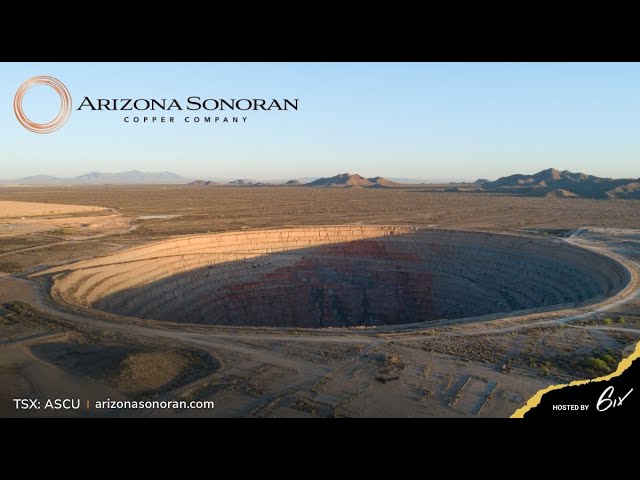
3:15 Thank you, Alison. So I'm sure you're all very well aware that the Cactus Mine was a former producing mine. It was in production in the 1970s through to 84, 10 years of commercial production. On average, it was producing about 22,000 short tons of copper cathode annually. Now, back in the 70s and 80s, the heat leach solvent extraction, electrowinning process that we all know today was very much in its infancy. So when a circle was mining here, they actually had a copper concentrator and the primary focus was on the enriched, but predominantly the primary sulfide, which is a chalcopyrite. So subsequently, any oxide material that was mined in the 70s and 80s was actually regarded as waste.
4:06 So today there's actually a surface stockpile on surface of 77 million tons at a total percent copper grade of 0.169 percent, yielding 224 million pounds of copper that's already been drilled, blasted and hauled to surface in a setting just waiting to be moved onto a heat leach pad. The site was closed in 1984, not because there wasn't mineralization in the ground, but at the time it was uneconomical. And then in the early 2000s, ASARCO ran into some financial difficulties. They filed for chapter 11 in the US. Many of their assets that were in production were taken over by Grupo Mexico. This asset, however, fell into a state trust, which was managed by the Arizona Department of Environment and Quality, ADEQ.
4:56 And ASARCO funded that trust with 20 million US dollars. And essentially from the mid 2000s through to 2019, ADEQ had been spending that $20 million on remediation and closure costs of the site. My predecessor, John Antwi and Paul Hewitt, the former chairman, did a great job in being able to get this asset out of the state trust by paying 6 million US dollars. And I'm sure as you're all very well aware, over the last couple of years, we've been completing technical reports, including a new compliant 43-101. We've put out a PEA in the last 3 months. We've just publicly listed on the Toronto Stock Exchange last week. We're in the process of completing a pre-feasibility study that will come out to the market in the summer of next year, whereupon we will have started the bankable feasibility study, which will come to the market late calendar 2022.
5:52 Once the project financing is in place and announced, the current PEA is showing an 18-month construction and development period through to first production in the second half of 2024, followed by commercial production early in 2025. Thank you, Asim. Why ASCU? Well, obviously, we're in a tier 1 jurisdiction located in in Arizona. It's a brownfield site. Today we have a compliant 43-101, consisting of 1.6 billion pounds in the indicated resource and 1.9 billion pounds in the inferred category. The current PEA shows a very low capital intensity of 124 million US dollars to put this mine back into production.
6:42 And we're currently showing an 18 year mine life with an average annual production of 56 million pounds of copper cathode. You multiply those 2 numbers together, you're going to get about 1 billion pounds of copper produced. That's quite important when we come to talk about the organic growth upside, given how large the global resource is at 3.5 billion pounds of copper. We ran the resource at 3 dollars and 15 a pound of copper and the financial and economic model base case was ran at 3 dollars 35. And that yielded an NPV 8 at 312 million US dollars after tax and IRR after tax of 33%. Of course, I'm sure all of you are very well aware that all of the land that we control in and around the cactus mine is all on private land, meaning that there are no federal regulators involved, no Army Corps of Engineers, no NEPA 404 requirements.
7:42 So subsequently, because we're dealing with only state and municipal authorities, we certainly believe that streamlines the permitting process and gives us defined timelines, which obviously is very important for investors. The other thing to note is that adjacent to the cactus mine, We also have a property called Park Salia. I'm sure you saw just a few days ago, we announced that we've mobilized our first drill. And I would suspect next year, we're going to be able to show some really exciting exploration results on Park Salia. And then, of course, as I said earlier, we're still leaving behind about 2.5 billion pounds of copper in the ground, of which 1 billion pounds of that is leachable. And the other 1.5 billion pounds would be primary sulphide, which we're not even considering as part of this plan.
8:32 And then like myself, I'm sure you're all in agreement that with the whole decarbonization and renewable energy thesis that seems to be resonating and picking up momentum throughout the world, obviously copper is gonna be invaluable and fundamental to see further renewable energy sources. Thanks, Alison. A little bit on the share capital structure. Post IPO, we now only have 70 million shares issued on a fully diluted basis that's sitting at 79 million shares. Obviously, the options and warrants are in the money. And today, the company sits with approximately 31 million US dollars cash in the bank and only 1 million dollars worth of debt, which is due to Tembo Capital and only has to be repaid in calendar 2023.
9:23 Obviously, through the successful IPO, we raised approximately 47 million Canadian dollars into the Treasury. Tembo Capital did significantly support the IPO, although they did suffer dilution. And today, they sit at 38% controlling shareholder. I think it's important to realize as well that both for existing shareholders and potentially future shareholders, Since joining Arizona Sonoran, I've actually put in $2.7 million Canadian dollars of my own money into the company at a weighted average price of $2.48 Canadian. Thanks, Alison. So we have a very strong ESG framework, and it's built off of 4 core principles, responsible operations, positive work culture. We want to be part of the community. And as I said earlier, we want to be part of the renewable energy future.
10:17 We have an overall goal of producing a pound of copper for net 0 carbon emissions. Now, just how we get there, we haven't quite worked out the detail of that at the moment, But I'm happy to report that we've just awarded a contract to a group in the UK, which we'll put out in the press release in the next several weeks. They'll be coming in on site to essentially do a baseline analysis of our PEA, eventually the PFS, and they'll be able to tell us how much greenhouse gas is, what's our carbon footprint looking like, and then from there, management will be able to put in various action plans to reduce our carbon footprint, not just from a scope 1 and a scope 2 perspective, but we're also going to be looking at this holistically and looking at scope 3, which actually involves both our own suppliers and consultants, and obviously at the end of the day, where our copper ultimately goes into the supply chain.
11:17 We have a little bit of a helping hand here when it comes to renewable energy at the site. The main power line which runs through the property in which we currently draw power from, 50% of the power on that line today comes from comes from renewable sources, namely nuclear and solar panel farms. And we didn't consider it as part of the PEA, but right now within the PFS, we are in the process of beginning to look at a tradeoff study where We might even put in our own 8 to 10 megawatt solar panel farm on the site, which would mean from an electricity perspective, if we could justify that additional capex, we would be 100% renewable energy while actually mining on this specific site. Thanks, Alison.
12:06 So here, this is just a little bit more of the detail that I shared with you on the previous slide. Thanks, Alison. Let's jump on. All right, so The project is located 3 kilometers west of Casa Grande. Casa Grande has a population of 55,000 people. It certainly understands and appreciates mining. And at the moment, I would say we have a very strong social license from the community of Casa Grande and Pinel County. You can see there as well that we're 40 miles southeast of Phoenix. That has a population of 4 and 1 1,000,000. And we're 100 miles northwest of Tucson. That has a population of 1 million people. And the area is very well serviced by roads, electricity, and obviously we have access to fresh water.
12:56 Arizona, as I'm sure you're all aware, supplies about 68% of the domestic US copper supply. We think that is only going to increase with the whole renewable energy thesis that we spoke about earlier. And of course, if you go by the Fraser rankings in 2020, Arizona would have ranked number 2 and consistently ranks extremely high year in and year out in the Fraser rankings. Thanks Alison. So now we're getting to look at a Google map of the site and you'll see in the top right hand corner there's interstate 10 that runs right from Phoenix to Tucson. We're about 5 kilometers southwest of interstate 10. On the bottom left hand corner there you'll see the main Maricopa-Casagrande highway which also runs all the way to Tucson And coming in off of that road north, if you follow that vertical yellow line in, that's where our main road into the property comes in, as well as the transmission line and the rail spur that DeSarco was using for shipping out copper concentrate back in the 70s and 80s.
14:02 The main mineralization trend here would run from the southwest corner or sort of a 07:00 on a face dial to the northeast corner or 02:00 on the face dial. And you'll notice that that's going to take the mineralization through Park Salier, Cactus West, Cactus East, which is an underground deposit, and there's obviously a Northeast extension as well. Thanks, Alison. So now we're getting to look down actually on site and in behind the cactus pet there, you'll see that we have wells number 4, 5 and 6. Now, the good news is, is that we have a permit to take water for the next 50 years, which obviously is 2.5 times the current longevity of the existing mine life. And the permit also allows us to take water at a rate of 3,700 acre feet per year. And when we run our water balance, we see that in any 1 year the maximum water we utilize is about 1,200 acre feet per year. So in essence the permit is 3 times greater than the current maximum requirement for water with this current plan.
15:18 The other good thing to note about the water is that the wells on site make continuous water all year round of sufficient quantity to actually satisfy our production needs. Just to the south of the right of the cactus pet, you're going to see the surface stockpile that I referenced earlier. That's that 224 million pounds of copper that Sarko brought to surface as the oxide cap, which they regarded as waste back in the 70s and 80s. We've put in a little rendering there of potentially where the SXCW plant might be situated. You can see how close it's gonna be to the pet to minimize obviously costs of transportation. And then moving over to the right, you'll just notice there the old tailings facility. Now on that, there are no legacy or environmental, historical environmental issues that we have inherited.
16:12 Indeed, we're not responsible for those. And then just in front of the tailings pond, you'll see there's a surface substation where we step the power down and we feed that power into our core shed, security shack and small administrative building that we currently have on site. The power line is 115 megawatts and has excess power on it, more than enough to supply our current production needs. Thanks Alison. So now we get into a little bit more of the permitting. The company over and above the water permit also has a permit known as an aquifer protection permit, but currently right now it's only for the surface stockpile. The reason for that was approximately a year ago, the company under the former management was really only considering the surface stockpile.
17:04 Given what's happened with the copper prices in the last 9 to 12 months and given what's happening with the whole renewable energy theme that I spoke about earlier, we certainly believe that elevated copper prices in the longer term are more than likely. So we've subsequently submitted an application for an amended APP permit, which wouldn't just be for the surface stockpile, but would also be for the pet layback and as an underground component.
26:07 So I think by the time we produce the pre feasibility study within that model, we're probably going to see a couple of percentage points being able to add it in to the metallurgical recovery. The other good news is that the enriched material, which is a chalcocite here, and it does contain some pyrite, is actually self-generating with sulfuric acid. So eventually at the end of the day, we're going to see the net sulfuric acid consumption come down, which is going to help us with our operating costs, because obviously sulfuric acid is a big operating cost in a heat leach operation. But I think we can see some further upside there with the net acid generation coming from the enriched material. Thanks, Alison.
26:53 So now we get into the global resource. We've broken it out at a high level into indicated and then in the second half of the table into the inferred category. And of course, we've broken that further down into leachable material, which is the oxide and enriched. So you can see in the indicated category, there's 1 billion pounds at a 0.72 total soluble copper. And you can see in the inferred category, there's another billion pounds at a 0.417 total soluble copper. And this is really where there's a massive opportunity for us because, as I said earlier, there's about 1.2 billion pounds of contained copper that we mine, of which we recover about 1 billion pounds of that in a copper cathode, but we're leaving approximately about 1 billion pounds actually in the ground.
27:43 I'll explain shortly why that is and why we believe that number is going to increase quite significantly. I'm also happy to report that since producing this report, we further drilled off the surface stockpile onto 200 foot centres and now the 223 million pounds of copper which is in the inferred category in this report, has now been moved up into the indicated category. The measured and indicated category is very important here because only M&I can convert over into proven and probable reserves. And that's why today there's a 30,000 meter infill drilling program currently going on. It's about 80% complete at the Cactus Mine site to move as much of that inferred up into M&I ahead of maiden reserves and the PFS in the summer of next year. Thanks, Alison.
28:37 We've kind of broken out the information in a little bit more detail, but I think the key takeaway here on this one is if you look at the grades and the underground, You can see in the indicated category for the leachable, we're looking at in and around about a 0.95. And when we get down into the inferred, it's about a 0.88. Those grades obviously would be 4 to 5 times higher than the grade in the surface stockpile. And with the average grade coming out of the pet, those grades would probably be in and around double the median grade coming out of the pet. That's why we're able to maintain a production profile above 30,000 short tons with the underground coming in, but you'll have seen in the table of the chart, there's a significant reduction in the overall material that we're actually moving, and it's all through grade coming out from the underground.
29:28 Thanks, Alison. So now we try to explain why we're leaving behind 1 billion pounds of leachable material in the ground. The current strip ratio of the pet is 1.4 to 1, which actually is very good. So 1.4 ton of waste for every ton of ore. The pit shell is actually based on a copper price of $2.27 a pound, which is almost more than $2 a pound less than the current spot price of copper. And the reason for that is that when we tried to run the model using higher copper prices and we started to make the pit shell bigger and bigger and bigger to gain access to some of the deeper leachable material at the bottom of the pit, we started taking too much waste.
30:14 And every ton of waste that you mine costs you the same as a ton of ore, but you don't get any revenue generation from it. So at the end of the day, the financial and economic model was less favorable than the $2 and 27 model that we currently have. Now, since putting that model together, which is more than 9 months old, we've been drilling around the periphery of the pet, and we've actually been picking up oxide material, which is close to surface that a sarco would previously have demarcated as waste. And if you think about it, it makes perfect sense because the oxide cap to a sarko was waste because they had no means of processing it. So not in all cases as we go around the circumference of the pit, but we believe when we come to pull the trigger on our new resource update, we're going to be able to add in new newly discovered oxide mineralization into the global resource.
31:11 That's going to allow us to mine nearer surface material that's newly discovered. It's going to allow us to make the pet shell slightly bigger, and allow us to go deeper into the pet shell, and then access some of that billion pounds plus of material that's currently sitting in the plan, that is currently sitting outside of the plan. Overall, our goal here would be to get above £100 million annually of copper cathode production or 50,000 short tons. And of course, if we could add in any of that material, I think there's every likelihood as well that could push out the mine life probably well beyond 25 years. So this becomes a real cash cow for this company on a go-forward basis to really start growing the company.
31:58 Thanks, Alison. So now we get into just the resource itself with the indicated and inferred. You can see here the cactus pet and there's the underground component. The green would be the indicated and the blue would be the inferred. And as I said earlier, there's currently a 30,000 meter drill program ongoing to convert as much of that inferred material as possible into the M&I category ahead of the PFS. The good news about this project as well is that ASARCO kept fantastic records. We have access to all the historical core. We have access to historical pulp samples. Obviously, we've twinned quite a few holes as well. And we've sent all of that. A lot of that historical core has been quartered.
32:49 The pulps have been sent to the laboratory. When we've got the results, the correlation between the new assays and what was stored historically is a 99% correlation. So the Stantec QP who is leading the charge on the resource model is very comfortable in using all of the historical information that ASARCO actually kept and we have on this project. And that's why we've been able to generate 3.5 billion pounds of a 43-101 compliant resource in a very quick period of time through the access to that historical information. Thanks, Alison. Here you can see a cross section over a 4 kilometre strike. You'll notice the horse and grab and faults there which throw the deposit up or down. You can see the main cactus west pit there and then obviously the fault system is thrown the Cactus East deposit down. And I'll draw your attention at this stage as well to the left extremity and to the right, which is Park Salier and the Northeast extension, which we're going to touch on shortly.
33:57 Thanks, Alison. So now we get into Park Salier. So we've conducted geophysics and geochemistry on Park Salier. The size of the signature that we get back would lead us to believe that we are looking at something that could be as large, if not larger, than the original Cactus West Pit discovery. A sarkle drilled 2 historical holes there, right on the southern extent of Park Salier back in the early 1980s just before the mine closed. You can see the results in the centre of the page. They went through massive copper porphyry system, oxide enriched and primary material. The company followed up on those 2 holes with 2 additional holes earlier this year, hole number 18 and 19. And of course they have gone through the same copper porphyry system.
34:46 We just announced this week that the diamond drill has mobilized here with crews. As of Saturday, we started drilling and we're going to put together a short little six-hole program. We'll then reassess the information and then probably in the latter of the first quarter, early second quarter, when we get those assays and net results back, we'll probably initiate another six-hole program. And the thinking here is that next year, while we're doing the relatively mundane technical studies on cactus and Cactus East, we would want to put out exciting exploration results into the market. If we then could produce a very robust bankable feasibility study at the end of next year and then include within that report a maiden resource on Park Salier that maybe itself was several million pounds of copper in the ground. We think that could be a real value, a creative driver for the company's share price, given that it wouldn't be in the mine plan, it wouldn't be in the financial and economic model, and of course we'd be sitting with a deposit 2 kilometres away from what's soon to be a fully permitted mine with an SXCW and heat leaching pads to accommodate that soon to be ore.
36:03 Thank you. Now, 1 caveat with Park Salier is the 4 holes that we've drilled at the moment, the top of the mineralization is encountered at 1000 feet below surface. And that currently means at present, we don't envisage Park Salier being an open pit deposit. It's not to say with the further drilling that we conduct next year, we don't find near surface mineralization and it becomes an open pit. But right now, we're thinking of it as a large, potentially a block cave operation to further feed our SXCW plant. And then we've got exactly the same situation on the northeast extension. A sarco drilled 2 historical holes, they went through massive copper porphyry system. You can see there the results in the center of the page. I think 1 intersection has even gone through a 3% total copper over about 15 feet there of enriched material.
37:01 We find again the top of the mineralization about 1200 feet down the hole. The good news is however, if there's a mine, underground mine at Cactus East, as there will be, a 1 to 1.2 kilometer drive, horizontal drive across to the northeast extension, certainly gives us access into that deposit. And we could bring it out through the cactus east and then through the twin declines of the pet onto those leaching pads and again, further improve the production profile and likely extend out the mine even further. Thanks, Alison. So when we did the IPO, we obviously did an issuance price of $2.45 Canadian. And when we tried to value the project on a net asset value, that $2.45 Canadian gave us a price to NAV of 0.35.
37:54 And when you compare that to our peer groups, which we would believe would be Foran, Trilogy, the Maramakas of the world, we come up with a peer average around a 0.7 times price to NAV. So what that is telling us is that over time, as we can communicate our business plan, as we can execute on that business plan, as we can put out the pre-PFS next year. And I suspect we're going to be able to put out some very exciting exploration results. I think over time, the next 6 to 12 months, this company is going to get a re-rate. And if it re-rates back up to where average of our peers are currently sitting, with no further shares to be issued, we should be looking at a 50% to 100% increase from the current share price as it sits here today.
38:45 Thank you, Alison. So just to recap, we believe on a go forward basis, the current valuation could represent some significant upside on a go forward basis for the current and any future shareholders in the company. You can see how we're thinking about the ESG strategy, which I think is going to be a very key component of our business plan and fundamental to getting a premium valuation. We've built the ESG strategy around 4 core values. We think the fundamentals in the medium and longer term are extremely strong for copper. We have a very nice, tight share capital structure that's going to help minimise future dilution to the existing shareholders of the company. I think everybody would agree that we have a proven management team that's delivered, you know, a creative results for former shareholders, and we're supported by a very experienced board.
39:42 The project is in a great location, Tier 1 jurisdiction, brownfield site, it minimizes capex, timelines to production are relatively short compared to our peer groups. And of course, we already have some significant permits in place. I think we've got some really robust project economics, despite some conservative assumptions. And there's lots of levers and bells and whistles that I feel that we can pull to further eke out some further valuation upside for our shareholders. Of course, lots of organic growth from that open pet. And I think we're gonna see exploration success at Park Salire. And then I think, you know, a little bit more medium and longer term, I think in this whole area, if you were to draw 100 mile radius out from the cactus mine, there are some former dormant mines.
40:31 There are some other greenfield sites that need to be explored. And of course, there are some other smaller producers, sub 20,000 short tons of annual copper cathode production. And I think further down the line for the right company, the right management team and the right support, supportive shareholders, I think there's definitely a larger M&A strategy for the right company to consider. I see we've got about 20 minutes remaining, so I'm very happy to open up the floor at this point in time and look at some Q&A. Great, thank you so much, George, for taking us through the presentation. So we are gonna jump into Q&A. If you do have a question, feel free to submit them now, but we already have a bunch. So our first question here is from Eric, and he is asking, what is the primary oxide mineralogy of the stockpile resource and the remaining unmined oxides?
41:24 Yep, Ian do you want to jump in there and talk a little bit about the mineralogy of the oxides and the enriched materials? Yeah, so thanks for the question Eric. So oxide mineralogy of the stockpile is really a mishmash, if you will, of the materials in mine during the operating life of the pit. So it's a combination of the typical sort of domains you'd find in a porphyry system. So, there's a leach cap that was poorly mineralized. And while there's some mineralization, it wasn't, I mean, most of that was wasted. Then the other 3 domains, if you will, that feed into mineralogy are obviously oxide, supergene enriched, or primary, or hypergene.
42:13 Oxide is generally mineralized with sort of the typical oxide and carbonate copper minerals you'd find in an oxide heat bleach mineralization. The supergene really is the main drivers there are secondary calcicide and covalite. And then In the primary, we see predominantly chalcopyrite. Hopefully, that answers your question. The stockpile resource, as we see it today, is about 77 million tons of those type of materials, along with your typical gang materials as you built a historic waste dump that we've converted to a stockpile. There'll be some conglomerate and alluvium and other materials of that nature intermingled. So while we're treating it as an oxide facility, there's plenty of other influencing factors within the material.
43:13 Remaining unmined oxides, I assume you're referring to material in the ground. You know, we have about, call it 80 million tons of oxide material left to mine with respect to what we see today. So it's in that range. Thank you. Great. Thank you so much. Our next question is, since the project was acquired from an environmental trust, is there any legal requirements moving forward? Yeah, that's a great question and I think I touched on this in the presentation. Obviously, ADEQ through the ASARCO funded trust put 20 million US dollars into the remediation and the closure of the site. They did a wonderful job.
44:04 And my predecessors did a really good job in negotiating with ADEQ that when we acquired this asset, we did not inherit any legacy or historical environmental issues. So essentially we're walking onto a site that's relatively clean from a mining perspective, and there's no historical issues from a legacy perspective. Thank you. We have a question here from Grant. He's asking, is the exploration upside at Cactus all about targeting additional leachable oxide resources, or is there eventually a much larger underlying sulfide target on the land package? Yeah, it's a great question. Right now, our target is really the leachable materials, which Ian has outlined for us as predominantly the oxide and the supergene-enriched material.
44:57 We've seen very, very good recoveries, as I showed in the presentation, through the bottle roll tests and the column tests, which have been going close to 18 months now. There is a wider sort of thinking within the company that once we can put that to bed as part of the PFS, we think there might be an opportunity down the line to investigate some form of leaching of a primary sulfide. We do know there are a few companies out there who have some patented technology and are experimenting with that. There are a few other copper producers in Arizona who are actually you know running some tests on a primary sulfide ore, namely chalcopyrite, which is exactly the same primary mineralogy that we have within our primary sulfide.
45:48 So we're watching that very closely and I suspect at some juncture next year we'll take that up, that investigatory work. The good news is that if we were to realize any returns on that, then again that would be just nothing but gravy and really the cherry on the cake of what is already a very attractive and robust project. Absolutely. Thank you. My next question is, are there buyback options on the outstanding royalty? Yeah, look, that's a great question and the answer to that is yes, there was a buyback prior to the IPO. The company had 8.8 million US dollars of debt, which was owed to Tembo Capital and RCF.
46:37 And in January of next year, the debt was due. And if it had gone full term, the company, if Tembo and RCF had converted at that time, the company would have had the right to buy back approximately, I think it was about a 0.54% NSR. It would have cost us approximately $7 million US to buy that NSR 0.54% back. Unfortunately, with the IPO process and us raising $47 million, our initial target was to raise $60 million. And when we saw that that was going to be a bridge too far for us, one of the ways in which we could get our use of proceeds down was actually to approach Tembo Capital and RCF and ask them if they would consider converting the debt to the NSR 3 to 4 months early.
47:33 When we looked at it in our financial and economic model, it made perfect sense that they were going to do that. They agreed to that and gave us that in writing, and it actually dropped the use of proceeds by 12 million Canadian dollars, hence the reason why we raised at the end of the day 47 million. Unfortunately, with that, we lost the right to buy back the 0.54%. So right now it's a 3.18% NSR on the property and that'll be there forever in the day. The good news is, as we had it built into our financial and economic model anyway, so it doesn't detract from the financial, the numbers that I shared with the viewers and the listeners today. Thank you. Christian is asking, will the available cash be sufficient to complete the FS?
48:23 Yeah, right now we're in the preliminary stages of doing our 2022 budgets. We see the cash takings out to the end of calendar 2022, when we would envisage having the bankable feasibility and the project financing in place. We do, however, only have $3 million going into Park Salire. So if there were any significant success there, there is a possibility that we might want to expand that program in 2022. But based on the base case budget that we're looking at at the moment, we seem to have enough cash to take us through to the end of the calendar year. Thank you. Grant has another question here. He's saying, briefly you mentioned wanting to be able to get 100 MLBs per annum of cathoid production.
49:13 The number is different from what the average annual production of 56 MLPs. What is the plan right now in terms of how you plan to size the production capacity of the initial solvent extraction and electro-winning infrastructure if you wanted to expand either form there? Or what required any additional permits amendments? Yeah well the base case PEA as we showed in the presentation is an 18-year mine life and that will produce 56 million pounds of copper cathode on an annual basis. As we showed in the presentation, however, we're only really mining about 1.2 billion pounds of leachable material and we're leaving approximately about 1 billion pounds in the ground.
50:00 We believe with some of the infill and expansionary drilling that we've undertaken in the last 9 months, that we're going to see new mineral resource coming into our updated resource model and statement by the summer of next year. And that'll be reflected in the PFS. If that occurs, we think there's an ability to push the annual production up to, over time, 100 million pounds of copper cathode production, with a likely increase over and above the current 18 year life of mine. The plant, as I said earlier, would be initially sized for in and around about a 30,000 short ton copper cathode annual production. But it'll be built in a manner such that it is modular.
50:47 So if we do eventually see ourselves pushing well beyond the 40 and 50,000 tons that we would envisage as part of an expansion, we'll give ourselves enough room and we'll build it into the design that we can just add on at a later stage. All right, thank you. Our next question here is how do Park Sailor and NE Extension geologically relate to the main cactus ore body? Ian, why don't you jump in there and take this one. Yeah, I mean, in short, very simple, or a very similar story. We saw it from that sort of long section that George portrayed earlier, that showed sort of all the horse systems across that sort of 4 kilometer strike length.
51:39 The district, you know, manifests itself repeatedly. So there's, it's the same sort of materials that I described earlier, whether it be a leach cap, oxide, and then the primary and secondary sulfide bearing system. So they all represent themselves very well. I will say that we do see moly show up in the assays of Park Sallier, So that's something a little different than, you know, while we have been seeing that sort of result in the cactus, it's not as prevalent as it is in Park Salyer. So we'll see where that takes us, but at the moment they're all pretty similar in nature. Thank you. Thank you. Elvin is asking, is it possible to get total infill and expansionary drill numbers in terms of meters?
52:34 Ian, do you want to take that one? Yes. I'm in fee here, so I have to calculate it all back. We can jump to another one and come back to that one. Yeah, let's do that. I'll give you the number. Yeah, no problem. So Richard's asking, when will you obtain a U.S. Stock exchange listing? Well, there's been some preliminary discussions within the company. There's been no decision, however, and that'll be part of the board discussions that we'll have in the next couple of weeks when the board actually visits the site and comes down to Phoenix, Arizona. Some high level discussions about possibly looking at an OTC QX listing in the US next year, and then using that as a stepping stone, maybe for 2023 and beyond, of maybe stepping up to one of the main boards in the US. We certainly in the US.
53:31 We certainly recognize having a US asset and a sub in the US. Probably that story is going to resonate, you know, I think throughout North America, but our main target audience is definitely needs to be in the US and I think we need to give them a platform as the retail and the institutional shareholders to invest their shares through a US stock exchange. So no decision at the moment, but recognize it certainly being discussed at high levels within the company. Great, thank you. Ian. Yes. Back to you. So if I include all the drilling for our entire feasibility study program, we're sitting at just over 46,000 meters of drilling. So that includes drilling already contemplated this year, plus the drilling we have planned for next year.
54:26 And Ian, how many meters would have a Sarko drilled? How many, all that historical information, that's another 70 plus thousand, isn't it? Yeah, that's right. Easily. Yeah. Great. Thank you so much. I think we have time for just one more question. Aitor is asking, what is there to consider regarding inflation and studies to be done? Yeah, look, it's a great question and certainly, you know, I kind of touched on this in the presentation. Even if we weren't in an inflationary times, In my 32 years, every time I've gone from a PEA study, which can be plus or minus 50%, to a PFS, which can be plus or minus 25 to 30%, depending on the class of engineering study, and then into a bankable feasibility study that can be plus or minus 10 to 20%.
55:19 There are always cost escalations, if you do the more detailed engineering, and you actually have to go out for firm bids and quotes from companies. So we're going to see some cost creep, there's no doubt about it. As I pointed out, I think we're all very well aware that labour costs and sulphuric acid fuel costs, everything seems to be going up and we're obviously going to have to build that into the project. The nice thing about this project, however, is there are other copper projects out there that are in the development stage. But to put those projects into production is going to cost some of these companies 2, 3 or 4 billion US dollars. If you have a 10 percent overrun on a 4 billion capital cost project, you're suddenly now looking at another 400 million US dollars.
56:10 On a 124 million US dollar project, if we have a 50 percent cost overrun, we're looking at 60 million US dollars. And, you know, what I was trying to indicate earlier is that there's enough upside and margin built into this project that I think we could easily absorb that and still show some very, very accretive and high returns for the shareholders of the company. Great, thank you. I'm actually going to squeeze one more question in before the end of the hour. Yeah. Michael's asking what additional metallurgical test work will the team complete over the next 18 months? Mr. McMullen, over to you. Thank you, Mr. Ogilvie. So, great question, Michael.
56:58 So, obviously, we've done a number of bottle roll tests and column tests to this point. And really the columns continue. We did a number of additional metallurgical drill holes over the summer and to target additional oxide and enriched leaching. Those, I'm happy to say, are all under solution in columns in the lab in Reno, Nevada at the moment. It's that sort of work that will continue in that period to ascertain where we're at with leaching, confirm the results that we saw from the initial tests that we did last year that fed into the PEA and move it forward through PFS. Yeah. I think the key thing there, Ian, and I may have touched on this, is that by the time the PFS comes out, those column tests, some of them will have been going close to 2 years.
57:53 So we're categorically gonna know, you know, what type of recoveries we can envisage over that type of period, you know, time period. Yeah, that's correct. And the columns George is referring to is the enriched columns because, you know, in order to get those going, we have to build what's called a mesophilic culture in the lab. Basically, tiny bacteria or bugs, to be a little more blunt about it. And those get launched in solution and that's those bugs that attack the ferret portion of the enriched or cyanide soluble portion of the assay, if you will, to break that down so we can reach it. So yeah, it takes a while to build that up in the system. Yeah. And maybe we're getting into a bit too much detail, but now that we're into the PFS, Ian and the metallurgical guys are really starting to experiment now with the size fraction to actually further refine the metallurgical recovery to see what particular size fraction actually further improves the recovery. So is it a 4 inch minus, a 3 inch minus, or a 2 inch minus? That goes all into the drilling and blasting design and whether we need some primary or secondary crushing required. So again, by the time this PFS comes out, don't worry, we'll have dotted the I's and double crossed the T's on this one.
59:12 Great. Well, I think that's the perfect place to leave off, and it is all the time we have for today. So I just want to thank you so much to George and Ian and Allison for taking us through the presentation and the Q&A session. I know we didn't get to all of the questions, but I'm going to make sure that I send them over to the Arizona Sonoran team and they'll be happy to follow up with you directly. And if you do think of another question, feel free to contact the, you can use the contact information on this slide, you can email them directly and ask whatever you'd like. But I just want to thank everyone for joining us today. And before we close off, I'll pass it back to George for any final remarks. Well, I'd just like to thank everybody for joining us here today. It's great to see such a tremendous attendance and following of the company. We're very excited to bring this company to the public markets. I think we're off to a great start. You've probably seen some of the early press releases that are coming out. And what I would say at this point in time is watch this space because we're gonna bring great things for our shareholders and any potential future shareholders over the next several years. So thank you ever so much for joining us today.