Rick Trotman
President and CEO at Barksdale Resources
Replay available
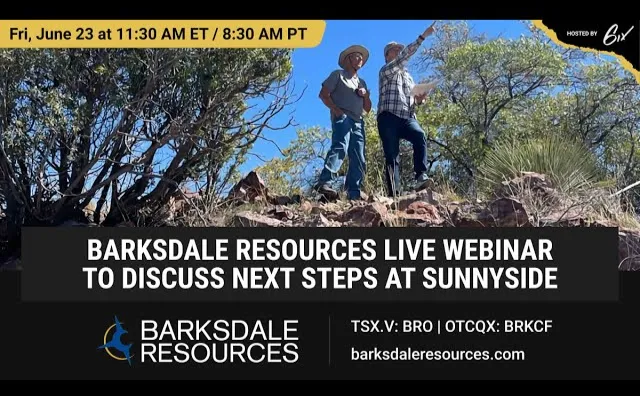
Join us for a live webinar to discuss the next steps at the Sunnyside Project.
Automated transcript · Written by software from the replay's audio. It can mishear names and figures; the replay is the record.
0:09 Okay, we are now live. I'm just going to give it a few minutes for people to trickle in here and then we can get started. But for everyone that's here, hello everyone and welcome to the Barkstair Resources live event. We're joined today with Rick Trotman, President and CEO, to answer questions in regards to the Sunnyside project. If you have any questions, feel free to send them through the chat and we ensure management addresses them on an individual basis after the event. But management has already received many questions prior, so hopefully Rick can provide all the answers you're looking for here today.
0:39 With that being said, Rick, thanks for joining us. It's always a pleasure chatting with you. Why don't you just give us a quick, elevated pitch on the Sunnyside project for the new listeners in the audience and we can take it from there. Sure, well thanks for having me Kyle. Like I imagine everybody that's on this call has at least a high-level understanding of what Sunnyside is and what it means to our company. It's a fantastic opportunity in the mineral exploration space to find something that from an endowment standpoint could be quite significant. So we're looking in the Patagonia Mountains of southern Arizona. Now this is a well established mining district. It's been, you know, little mines and bigger mines operated there for over a hundred years. It's extremely well endowed in mineral. That's what brought people into the district originally.
1:30 Our project is a carbonate replacement style system sitting right next to a big copper porphyry. So we're effectively looking for copper scarns and associated lead zinc silver mantles that kind of stem off from that main porphyry system. We have been working in the area since late 2017 and have been permitting there since early 2019. So we are 4 plus years into working on the project, working in the permitting regime there. And in the past week or 2, we've gotten all of the permits that we need, aside from our plan of operations being approved, to go forward and drill this thing.
2:16 Perfect. That's your high-level pitch. Appreciate the high-level pitch. And like you say, a lot of people, if not everyone joining, wants to know the exact same thing here. We want to know more about the actions being filed against the United States Forest Service. So can you shed some light on this matter? Does this mean Barksdale is being sued?
2:34 No, no, not at all. So what's happened here is the Forest Service has issued us a couple of things. They've approved our environmental assessment. They've approved our finding of no significant, oh, sorry, they've issued a finding of no significant impact, and they've issued a decision memorandum. So those 3 things in conjunction basically say that they've completed all of the studies necessary to allow this project to proceed. And so the groups that have sued the US Forest Service are looking to basically overturn those 3 decisions. They make a couple of claims that the Forest Service, you know, basically has messed up the analysis on a couple of different fronts.
3:22 This lawsuit is aimed at the Forest Service, not at Barksdale, but that does not mean that Barksdale won't fight on the Forest Service behalf. So we will likely adjoin ourselves to these proceedings to make sure that our rights and our, you know, our butts are covered here. We want to make sure that this thing ends and this thing ends quickly and that these baseless claims kind of get dealt with in a timely manner.
3:52 Thank you. So is this a common occurrence that happens in the United States and can you discuss further what they're actually challenging on the, what is it, Finding of no significant impact? Yeah, that look this is this is how should I say it the Forest Service is not a You know litigation is not unknown to the Forest Service They're sued on tons and tons of different things that they approve every year, especially anything related to mineral exploration and mining. These environmental groups, they often target, look, they're lawyer factories. They're looking to make a bunch of money at the end of the day. And so they love litigation because it ties up lawyers for, you know, a year plus on big mining operations, you know, for permits for development, ties them up for several years.
4:42 Meanwhile, they go and raise money from their constituents. At the end of the day, win or lose, they ask the government to pay all their legal fees, and those fees go straight into their pocket at exorbitantly high rates. So they have all the incentive in the world to push through litigation on every project, any project, where they feel like they can have even the slimmest chance of success. So at the end of the day, what they are challenging on our permit is related to 3 different issues, if I can just kind of keep it high level. So the first are cumulative effects. They're basically saying that the forest and their analysis didn't take into consideration other projects in the area when they're looking at the effects on noise, on animals and things of that nature.
5:35 And at the end of the day, they did. We looked at all the cumulative effects that could happen. Now there are projects that are in the area that were filed for permits after our project, and others that are on private ground that we have no access to data from. So at the end of the day we feel very confident there. The other area that they're challenging is related to some of the fauna in the area, specifically Mexican spotted owls. So they're saying that the Forest Service basically didn't do the right type of science and that the noise that the drilling would create would have detrimental effect to these birds. At the end of the day, we did noise attenuation surveys. We know where these nests are. They've been in the same spots for decades.
6:24 The Mexican spotted owl population's actually going up in this area, even though the amount of exploration and development activity is also going up over that same period. We've got years of studies. The neighbors have, you know, plus a decade of study on these birds.
6:40 Basically at the end of the day, the environmental groups are trying to make an argument that their science is better than our science and I don't buy it. The third thing is on the water quality. They're saying that the Forest Service didn't adequately address kind of pre-drilling sampling of the aquifers, which at the end of the day, there are no water wells into the aquifer in our project area. So I don't know what they're arguing against here. We can't sample unless they give us permission to drill and test the actual water and do all those studies. So they're putting the carpet before the horse when it comes to that one. Additionally, we're using effectively drinking water from the city of Nogales in our drilling plant specifically to bypass the issues or potential issues around using local waters and putting those into whatever aquifers may exist on our project site. So again, I don't see how their science makes any sense.
7:48 You know, To give you a bit of background, even in their comments, in our comment period, they griped that we weren't doing water sampling in our diamond program, which makes no sense and shows that they don't understand the process because the entire reason for using bentonite and things like that in the actual drill hole is to keep fluid out of the hole so that you can keep it stabilized. So look, these guys are throwing things at the wall to see what sticks. At the end of the day, I'm very confident that the forest service will prevail and we're going to put our shoulder into supporting them at the end of the day. Great, thank you. I appreciate the in-depth review of all those points being addressed.
8:30 What does this mean in regards to bark stale and the drilling and the plan of operations though? Does this mean it's halted? Nope, not at all. Nothing changes. So the Forest Service needs to finish the plan of operations and they're working on that right now. There are certain things that needed to be updated and they have to go through with a fine tooth comb to make sure that everything in that plan adheres to what is laid out in the EA, et cetera, et cetera. So that's going to take a couple of weeks, at which point we expect to get a notice to proceed and then we'll start drilling. That's the plan. Unless a court tells us that we cannot proceed, our plan is to finish this out and get drilling. And now this lawsuit will still be out there. It'll be in the background, even if we're drilling.
9:18 But it'll take some time for it all to get sorted out, which, look, again, as I reiterated earlier, that's what these guys want, right? They want lawyer fees at the end of the day. Okay. So you can expect drilling within a couple of weeks. It really depends on that one letter state and otherwise.
9:36 Yeah, look, these guys are going to try to get in front of a judge to get some sort of an injunction to prevent us from working. And at that point, The burden is on them. They have to be able to prove that Their case has a significant chance of success and they have to prove that What they are stating, you know from a factual basis, you know has merit and That's a tough one. That's a hard one for unless they get some sympathetic judge that, you know, is basically in bed with them. I don't see how this gets an injunction, quite honestly. So look, unless a court tells us that we can't proceed, we're going forward. Okay, so let's play devil's advocate for just 1 second here. What if the court does approve their challenge? What happens that day? All drilling stop?
10:27 Yeah, yeah. Look, if a court says basically you can't go onto the site, there's a restraining order issued, We can't do anything until the lawsuit is finished off. So that's the downside here. So there is risk. I'll certainly admit that. But look, we will have an opportunity to defend our case. The Forest Service will defend its case during any of those types of kind of requests for an injunction. So we're going to be armed to the teeth, we will fight and we're not going to make it easy for them. And I don't think that they have a very high likelihood of success there. Okay, thank you for that. And South 32, they were actually named in this as well, if I'm not mistaken, with their flux cannon permit. Will you 2 be joining forces to resolve this matter at all?
11:16 Yeah, look, I haven't talked to Pat about this yet. He's the fellow that runs the local subsidiary down there. He's kind of the head honcho. I'll probably talk to him next week on this, but I would be very surprised if they didn't do what we're going to do, which is hire council and adjoin themselves to this proceeding.
11:36 They have a project that's located just near ours on the same access road. They call it the Flux Canyon project. It's right off the old flux mine. But again, it looks similar to ours. It's a previously mined area, previously explored area, working off of a major road system in an area that's been drilled before. So, look, if they didn't fight for that, I'd be extremely surprised. Now, will we team up? I don't think that's how it works in the legal system. I think they'll have their representation, we'll have our representation, and we will fight to make sure that we prevail. Gotcha, gotcha. So is there a significant impact to Treasury on this whole matter? No, I mean, lawyers will cost money. But at this point, we haven't spent any money. We're looking to kind of bring the lawyers on board. That'll cost, I would imagine this whole thing, soup to nuts, will cost a couple hundred grand.
12:32 But the good thing is that we have money in the treasury. We have the ability to fight this thing. And more importantly than that, we have a lot of friends out there in the industry. We're gonna be leaning on all of the major mining associations, the exploration associations, the labor unions, everyone that we can think of that has an interest here, we're going to lean on to help support us and help push back against this basically tyranny that these environmental groups try to invoke.
12:58 Now, Broadly speaking, the mining industry in the market has been struggling, but Broa seems to be holding up well. Based on this news, there's a little bit of a retracement there. But can you talk about the conversations with current investors regarding this matter? What's the overall sentiment like with your shareholder roster? Well, yeah, before 2 days ago, everyone was quite excited that we were about to get turning on the drills, right? We've done 4 and 1 1⁄2 years of very delicate, very deliberate activity pushing this thing forward. It's been slower than pushing a glacier up a hill on a cold winter day. So you know, our shareholders have the patience of God. So everyone's getting excited. I think right now our retracement is, you know, it's due to uncertainty. People see the word lawsuit, they start freaking out.
13:48 And you know, rightfully so. Until there's more information out there to help them make a decision you know I don't blame anybody I think overall we're still in good shape We still are pushing forward on what we want to do, which is to get drilling here, hopefully in July. So, Forest Service has a couple of weeks of work to do, assuming that we get what we expect, which is that notice to proceed. And we have a drill rig with a staff ready to go and turn. We're going to go put our boots on the ground. Perfect. Thank you so much, Rick. Maybe just one last summary about the next steps for Sunnyside project and if there's anything else investors should be aware of, any other imminent catalysts at all? The biggest catalyst in corporate history for Barksdale is getting this drill on Sunnyside and showing the world what exactly we have with respect to this potentially large mineral endowment. So look, at the end of the day, the US has, you know, from even a governmental standpoint, decided that critical minerals are key and they want to keep pushing these things forward to stymie exploration for those same minerals. You know, we'd go against everything that pretty much everyone in this country wants. So this is a case of not in my backyard. This is a case of lawyers seeking fees and trying to make themselves rich off of the system that's out there. So This will get quashed in my mind. This will go away
15:18 eventually. And I think our shareholders have a lot to be excited for still. The narrative has not changed since a week ago. We still have all of the permits. We still are moving forward. We have our plan of operations we need to put in our
15:34 back pocket, and then we're going to move a drill rig onto the site. So stay tuned. We'll have more news out at some stage here, as soon as we either have that plan of operations or any other news that comes up. So yeah, it's exciting times. Perfect, thank you so much, Rick. I think we addressed the vast majority of questions here. Again, if not, management will address them and this recording will be available. So stay tuned for that if you trickled in a little later on into the conversation. But thank you so much, Rick, for your time. I appreciate it. Thanks for having me, Kyle.
Follow Barksdale Resources Corp. into a list and get an email when it puts out news.
President and CEO at Barksdale Resources
VP Corporate Communications at Barksdale Resources
Ms. Welyki has more than 15 years of experience working with public and private mining companies, including Calico Resources and EMC Green Group S.A. She has broad knowledge of the mining industry, including financing, permitting, and stakeholder management and has worked across the United States, Peru and Canada.