Transcript
Automated transcript · Written by software from the replay's audio. It can mishear names and figures; the replay is the record.
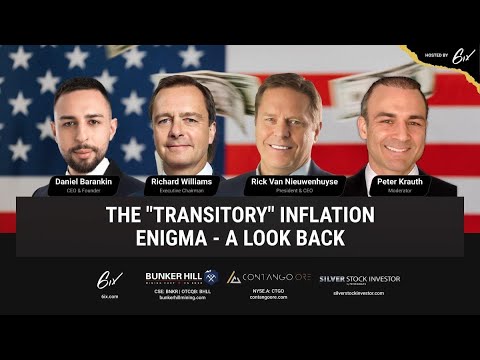
0:08 Hello everyone, welcome to today's investment webinar with Six.com. I'm Peter Kraut, I'll be your host and moderator. Today's topic is precious metals, the transitory inflation enigma, a look back. We have 3 great panelists with us. We have Daniel Berankin, CEO and founder of Six.com, Rick Van Ewinghuis, President and CEO of Contango Ore, and Richard Williams, Executive Chairman, Bunker Hill Mining. Welcome everyone. Thank you. Good to be back. So I think the best way to proceed is I'd like to kind of set the stage by reviewing what we talked about on the last panel with the same group.
0:54 This was back at the end of November last year. We all made predictions. I'd like to give a bit of a scorecard on how we did. At the time, the Fed had finally said that they would stop calling inflation transitory. I think that was sort of the big news at the time. The Fed was saying that it would only raise rates by early 2023 or late 2022. 1 week later we were all gathered to discuss our thoughts and we addressed whether we thought precious metals would act as a hedge against sky high inflation. And since then, inflation has in fact continued to soar to keep rising. The Fed could no longer avoid hiking rates. They did start in fact as early as March and so went quickly from near 0 to 2.25 where we are right now and since December the S&P is down 11% 20-year treasuries are down 20% gold is up about 1% commodities are up about 22% and we've had 2 consecutive a quarter of negative GDP growth Q1 was minus 1.6% Q2 minus 0.9% and now the Fed is resisting calling this a recession.
2:12 So now for our score card. I'll start with some of mine which is mixed admittedly. I said I expected that the Fed would raise rates only slowly and to make it to about 1 to 1.5% by late 2022, so I clearly got that wrong. I did say the markets would sell off slash crash. I think I got that right. I said the Fed would cave and back off. Well, I guess that perhaps the jury is out on that, at least still right now. I said once the Fed stopped raising rates that precious metals would take off. So this is a little interesting one in the sense that maybe that's kind of what's starting to happen now in the sense that perhaps the market is starting to price in the end or near end of rate hikes.
3:06 And I said that we would enter a period of stagflation, weak growth, high inflation, half of negative GDP and continuously rising inflation. Since then, it looks like I may have gotten that one right. So now a Daniel scorecard. Daniel talked about how an increase in the money supply over the previous years had found its home in the S&P. A lot of tech stocks, Tesla was 1 great example, and that the US especially, but I think we could argue much of the developed world, the cost of living had gone down, but wealth inequality had widened, and the implications were that people who benefited were actually mostly the ones who had participated in stocks. Consumer spending had gone down, but that we should expect to see more of that.
3:54 The implication for equities was that when people could afford less, they'd start to spend less. Companies would start to miss earnings, suffer lower profits. Daniel, you certainly got that right. Stocks and bonds are way down. Precious metals and base metals were undervalued relative to the money supply. And you clearly got that right as well and expected that
4:16 these sectors, precious metals and base metals, would attract money. And you got that right. We've seen both the metals do well and the shares in some of those companies, at least, start to do quite well as well. Rick, you talked about a global push to a non-carbon future on all levels of government and that this would be good for metals, especially base, but as well, things like copper, silver, gold. You got that right. Those metals have held up. Gold should perform as an ultimate hedge against inflation. That certainly is right. That in the 1970s stagflation period, that was driven by the oil crisis and that we saw high oil prices and energy prices, double digit inflation, and that we'd likely see a repeat. We're certainly very close to that now, nearly as close as we could get to double digit inflation, but that this time the energy choices were self-imposed and that we should expect more money printing to pay for this, and that oil would continue to be needed. And oil has soared, so you also clearly got that right as well.
5:26 Richard, your turn. So mining stocks, you called them undervalued relative to inflation and to the inflation potential. Clearly got that right. Increased demand for metals to refurbish the world's power system. You talked about how COP26
5:43 certainly pointed towards an increase in base metals and that would be well beyond the current supply that would be very inflationary for producers. We saw lots of base metals absolutely soar and their producers soar that you saw that silver was an industrial metal and its split characteristic
6:02 would support silver. You saw the need to factor in ESG requirements. Today's complexities were different over the 70s and that we'd be entering a new super cycle for base metals and at least so far I would say since then that certainly looks right as well. So overall none of us did too badly. Overall I think quite well but let's look forward. And on that basis now that we've looked back what I guess the first point to look at is what's the outlook for inflation, debt, interest rates and recession at this point. So that's a bit of a larger question, but I would like to get everyone's thoughts on that sort of overall macro outlook. Daniel, why don't we start with you? Certainly. So my view is that given the creation of capital and money and currency in particular that's entered into the system, my view is that there's now a lot of folks that have this capital and have this ability to purchase assets with a recognition that the value of their capital is very quickly going away.
7:07 And so the consequence of that is that those folks who have that capital are going to be trying to purchase assets and do so and put it in places that can be a safeguard against inflation. The challenge that they have is knowing that the value of the thing that they have is depreciating, people are less willing to accept it. And so a lot of the macroeconomic conditions that we've seen over the last 6 months, especially federal policies, things of that sort, have actually in the context of great rising inflation made the dollar itself more valuable in the sense for those who don't have it desperately need access to it. We're seeing for example throughout the world where debt is denominated in the US dollar as interest rates are rising, more folks who already had a scarcity of capital to pay and to offset that debt need even greater access to it. And so what we're seeing is a pretty significant shift in capital where on the surface, everyone can see that the value of the US dollar, the value of any currency printed by any government is declining and evaporating in real time in very close to double digit numbers by official stats and by shadow stats. You can see it's much, much greater and in your own life, You can see that's much, much greater. While at the same time, we're seeing an increase in the demand, especially among those that need to repay debts to go and run and get that dollar. And so what I see unfolding right now is a process whereby as debtors are forced to go and make payments on their debt, otherwise they have defaults, otherwise they lose the underlying assets that
8:37 the debt initially was used to purchase or create. There is going to be a slow transition where the dollar itself still has that value because people need access to it. Once that process is completed, where those who have the dollar no longer need it because they're able to purchase assets and give it to those who desperately need the dollar, that's when I expect there to be a fundamental reassessment of the
9:00 situation, being the catalyst for gold, silver, commodities and everything else. Really, the view that I have is such that those who have are leveraging this entire process to get even more. And once they're able to offload the asset, and in this case, the currency into folks that desperately need it and they're subsequently able not to have it anymore, that's when this readjustment happens. And I expect this process to continue certainly in the near term, and probably into the second part of this coming year.
9:30 Well, thanks for that. Very interesting thoughts. Rick, what do you think about what the outlook is as far as you're concerned for inflation, for debt and interest rates and the risk of recession? Yeah, I think We're probably already in a recession. We've now decided to redefine what a recession is. I guess it's not 0.5 anymore, back to back. So I think the Fed basically is doing its job, probably some would say too little too late. But they have gotten with the program. They don't have Paul Volcker in charge or someone like a Paul Volcker who's going to take the the hard steps, so I think the jury's still out as to how aggressive the Fed gets, whether the more Wall Street starts whining, are they going to back off?
10:26 That will send very confusing messages and the Fed will lose credibility if they do that. They've got to either stay the course or they lose credibility in my opinion. Beyond that, it's not just the Fed. It's not just up to the Fed. The Fed only has a few tools. You have to point the finger at Congress. And they just passed the Inflation Reduction Act, which couldn't be more poorly named, $700 billion. And it's supposed to be paid by taxes. Most of those taxes are on manufacturing and oil. So you know damn well the consumer is going to pay those. So that's inflationary.
11:14 I think The drug piece of the legislation is probably the smartest piece. That's been long overdue. Medicare can use its might to negotiate better prices. But the whole climate aspect of the bill, which is a big part of it, is totally inflationary. Subsidizing industries,
11:40 solar and wind specifically, and giving everybody who buys a Tesla $7,500 back as a tax rebate, those aren't fair to lower income folks. So
11:55 I see Congress not doing its job. And obviously, the vote was right down party lines, and our fate is in the hands of someone like Camilla Harris, which scares the crap out of me.
12:12 I don't see anything as change in Congress yet. Maybe in November, we'll get a different Congress and maybe some things can happen that aren't going to be inflationary. But I see inflation continuing. If we continue to print money, the Fed basically affects Wall Street. It doesn't affect Main Street. And I think a lot of people get confused on the economy. Economy is not Wall Street. It's everybody who goes out and buys something in the grocery store. And when they got to figure out whether they can put gas in the tank or buy food. That's not a good situation. We have a strong dollar now because we have a weak Euro and the Chinese have had this 0 COVID policy that is, I think is probably just another currency manipulation tool to lower the value of the lawn so they can sell their stuff cheap overseas and remain competitive.
13:15 They've got cheap oil from Russia now with because nobody else is buying Russian oil so it's It's an interesting setup there's been 2 main events that have occurred since we last met and that's the Russia invading the Ukraine
13:33 and China having this, implementing this 0 COVID policy or continuing this 0 COVID policy. And that has led, in my opinion, that's led to a strong dollar. And we don't have a strong dollar. We all know we don't have a strong dollar. It's just stronger than all the other weak currencies.
13:53 And so it's a race to the bottom that I guess we're winning, as you might say. So I don't see that we've done anything different. Governments apparently will continue to spend to achieve the green new economy. I think it's amazing to me that Biden would fly all the way to Riyadh to ask the Saudis to produce more oil when he could have just, we could have just, you know, jumped on a plane and gone to Houston and where this country can produce oil with lower methane and lower CO2 emissions than any other country in the world. But yet he goes to Riyadh. We still haven't had 0 discussion in the media or from the White House on how we're actually going to achieve the green new future without having mining.
14:48 The mining hasn't even entered the picture yet. So there's a lot of things that are still yet to come, I think. And hopefully in November, things change in Congress, because I think that's the real, in the US at least, that's the real perpetrator of the inflationary policies. All right. Thank you. Richard, your thoughts, inflation, debt, interest rates, recession?
15:12 Thanks, Peter. I think both Rick and Daniel have covered most of the issues. So in some respects, they're going to be summarizing. But to be to be clear from my perspective, I think the situation of stagflation, which was debated a lot a few months ago, is now absolutely real. And I think rather like we spoke about inflation not being transitory, I think this period of stagflation is going to endure, and particularly in what we characterize as the West. Now endure for how long? Well, it's going to be interesting, isn't it? And linking into Rick's point about politics plays its part here
15:53 and the limitations of what the Fed can do or over in the UK, my old hometown, what the central bank can do there too, all of these things are going to change. And so I think stagflation is not going to be a 12-month phenomenon, it's going to be a significant one for a period of time, driven as it is by the supply shocks in terms of oil prices, but other supply shocks. And you've quite rightly pointed to the war in Ukraine as being the real catalyst for that on the back of the COVID supply shops. And so we're seeing some interesting things in the mining industry. I mean, people talk about the wage to price spiral or the price to wage spiral, depending on which way you're looking at it. I'm certainly hearing rather like 1 did in one's old life at Barrick in Argentina some pretty active moves by the late, not not at Bunker, but around the industry
16:59 for for price increase, wage increases to follow price increases. And we're going to see that. And then in another business I'm involved with, Trevally, it's been quite interesting what's happened to the zinc price because you've got this price increase as a result of supply shrinkage, where the cost of power has gone up so much that the smelters can't afford to take through low grade ore. So downstream of that, you end up with a zinc supply constraint, which drives up the price of zinc. So as we know, and it's impossible, I find, to simplify these complex relationships
17:39 in a short brief, I think we're seeing this going to continue. On a policy side, yes, you're seeing demands for tighter monetary policy, but at the same time, look at the UK, a wish to offer the population growth and sunlit uplands. That's a pretty classic political fork in the road. And 2024, with both US elections and UK elections being, I don't know,
18:07 a classic example of where this fork in the road is going to play out, we're going to see that happening. Rick's very good point about the devaluations against the US dollar on average around about 9% for other currencies again plays into the inflationary issues
18:27 in certain assets, in certain places. And then there's also this demand at the moment which is adding into this or this issue which is adding into this general situation of so-called de-globalization, a wish to move away from a dependency on Chinese supply chains in terms of inputs or Chinese markets in terms of place to sell. This is my view is mainly talk because the practicalities of changing that are exceedingly expensive and politically very difficult practically to move. Although Rick's point about getting more domestic oil versus foreign oil is a very useful counter to that. But in a general sense, what I'd say is over the next 12 months or so, extending through the electoral year of 2024, this challenge of stagflation is sadly going to be what we're going to be living through and how it affects our businesses I guess is subsequent questions but Peter okay well thank you for that Let's move to the idea of the implications that all of this has for precious and base metals.
19:39 Daniel, why don't we start with you and see if you can give us your thoughts on how you see that potentially playing out. Certainly. I think within looking at the last 2 decades we've seen that most of the value on the stock market has very much been the intangible values largely driven by technology by software by innovation.
20:00 And a lot of this these past 2 decades is something that I would describe as the post scarcity era where really energy was cheap and abundant. Innovation was happening everywhere and blossoming and international trade and prosperity was free. And to that end, we benefited significantly from the peace dividend over the last 20 years. And as a result of that, because we had secure supply chains, we had open trade, we were able to really focus on this intangible economy. And to that end, if you look at the S&P 500 composition
20:30 over that period, even the last 50 years, you'll see that there's been this significant shift where most of value is captured in the intangibles. The question I look at is, will the next 2 decades look more similar to the previous 2 decades or dissimilar? And my view, based on everything that Richard and Rick and yourself have said today, I think there's a lot of compelling reasons to think that the future will deviate quite substantially from the past. We're seeing the rise of a new world power that genuinely threatens the United States and the hegemony. We're seeing this transition towards a global desire, especially among many countries, which has always been there, but that's now a bit more practical to achieve of a multipolar world. And we're seeing the regionalization of supply chains, the supply routes, that to Rick and Richard's point, is already producing dividends in the form of cheaper oil for those that choose to side in the case of, for instance, of China and the Russia relationship.
21:25 And so what that means creates this context when when you look at real assets or tangible assets, things like precious metals, things like base metals, we have supply itself being split in 0.5 in a pretty significant way where you can no longer take gold or resources from everywhere. You have to be regionally. And so that itself introduces a supply constraint. In addition to that, you also don't have necessarily the security
21:51 or even the ability to make high risk investments. And so the sorts of investments that are going to be made and the places they're being made itself slows down. And So whenever looking at something like what happens to price in the context of any commodity where it takes resources, energy, labor, capital, etc. To go and produce it, we're going to see all of that increase quite substantially. And I think that the only resolution to that is high prices. And so to that end, I think that across the entire commodity sector, we're going to be seeing a difficulty of accessing those commodities due to that narrowing scope of supply. And subsequently, the price of everything is going to increase. And so to that initial point of looking at the last 2 decades being characterized as post scarcity, I think the next 2 decades are going to be characterized by return towards scarcity.
22:38 And so as sad as I am about that, I think the only inevitable conclusion of that is going to be higher prices and then that affects everything downstream. Well thanks, great comments. I guess Would it be fair to say that investors need to be careful and weary of something we call recency bias?
22:58 Absolutely. Yeah. So so just anyone who may be not familiar with that, it basically means that you need to be careful that you don't necessarily expect that what lies ahead is very or too similar to what we've just lived, just because that's what we're comfortable, that's what we've seen, that's what we're used to, that things can change and they can change dramatically.
23:22 I think there were some comments by Ray Dalio who's behind the Bridgewater hedge fund, the world's largest hedge fund. He made comments to that effect sometime in the last perhaps maybe 6 to 12 months. And he's someone that certainly knows investing and someone to watch perhaps in terms of a big thinker. Rick, your thoughts on what some of these trends that we've just talked about could mean for precious metals and base metals? Yeah, well, maybe I'll stick with Gold and let Richard talk more to base metals. But I think the inflationary environment, I think we're seeing Gold continue to move up over time. You know, it did retrench here.
24:10 All the metals retrenched
24:13 as around, I think, May, around May, they started to really fall down. Gold sagged, silver went off hard, copper went off hard, oil also came off a bit.
24:31 So I think we're still seeing a very inflationary environment. We'll continue, I think the stagflation is gonna stay for a long time. Because if we keep moving towards the green economy, it just requires spending a lot of money. You just don't get there and it requires a lot of metal. So I think it will be good for metals in the long term. I think, you know, recessionary pressures in the short term will certainly affect probably base metals more than precious. I think what were the impact of inflation on building new mines is probably the biggest area of concern for investors. And we've seen that from the big companies of Newmont to the mid-tiers, IM Gold and Core, all having to report our costs have gone up 20%, 30%, 40%.
25:27 So they're not small numbers.
25:30 To put my own plug in here, I think that's one of the advantages that we have at Contango is that because we're using an already existing facility that Kinross has that operates at Fort Knox, we are seeing the same inflationary pressures, but we're not spending as much capital because we're not building a mill, we're not building a tailings facility. So, whereas Ken Ross's guidance a year ago was $110 million of capital, now it's more like 150. So that's the same increase, it's just we're starting from a much smaller base since we're not building a tailing facility mill. So, I think that's, that's certainly the concern that you have, from the investors in the market today and I think why the juniors in particular are still suffering from a lack of investment or a lack of a concern about what you know what what's the future hold and in the sober restriction on capital right now There's a lot of money sitting on the sidelines.
26:40 I think that will change because we need these metals and At some point in time, the politicians will wake up to that fact. Just a couple of comments I'd like to make. One is that I've seen the same thing too as I follow mining companies In the last maybe 3 months or so when I read press releases and I look at
27:08 quarterly numbers both production and financials, I am seeing similar comments. Either they're talking about how yes they've seen price inflation affect their operations or at the very least they're saying that for now they've kind of escaped it but they absolutely see it coming going forward over the next several quarters So absolutely I don't see you know I would not disagree with any of that. It's absolutely what I've been seeing as well. Another point is that
27:41 just this morning I was reading an article in mining.com about how battery metals you know the International Energy Agency is forecasting that we could need, we could, we would potentially need to up our output by about 10 times for battery metals, just to reach 2030 forecasts in terms of usage and build-out. These are just incredible numbers. You can't help but think that we're going to fall short. I just can't imagine otherwise, but that almost doesn't matter. The expectations and the push towards this is so big that even if we fall short, the demand is going to be so overwhelming that this entire space should absolutely do very well. So anyways, those those are just sort of my 2 cents in this in that area and and on your on your thoughts.
28:38 Richard, if you like Rick was suggesting if you'd like to perhaps address the base metals aspect of that, of that outlook for for metals. Sure. And again, I get the benefit going last because I tend to sort of resonate what others have said, but the general demand picture for base metals drivers and it is by, I think, 2 things. Investment in energy transformation and investment in infrastructure with the second being a typical lever that governments pull, whether they're Keynesian or not, to try and buy their way out of recession. How they afford that is a central banker problem that we've spoken about. But it's highly unlikely going forward that you're not going to see government spending an awful lot on infrastructure.
29:30 The government that will drive this the most, of course, is China that has declared that it wishes to transform its energy system.
29:38 So the biggest gorilla in the room who's got the biggest power and spending power to do that is China. And that will drive quite a lot of both infrastructure demand as well as power transition demand. So I think on the demand side, anybody in base or as we transition at bunker between base and we have silver looks at the demand side being pretty strong. On the supply side, however, you do have this. I'll touch on the constraints that Rick and Daniel have mentioned at the moment. Access to capital, permitting challenges and then this new or current inflationary environment. So on an asset by asset basis, if you're an investor, you're going to want to have a look at what the underlying structural cost base is and how it can endure what's going to be an inflationary period in real terms, but in perceived terms.
30:37 And Rick's reference to the fact that he's leveraged off existing infrastructure is 1 very good example of what makes that company different. We, of course, are doing the same. So we can also mention that, but we feed off the Pacific Northwest power grid, hydro, investments made in the 1930s
30:59 that gives us 6.5 cents per kilowatt hour. Or here in Ontario, if you look at the power consumption, the majority of it is nuclear as a result of decisions made in the 1970s. So the reason I mention all that is when we're looking at the supply side realities, which assets are going to make money, it's going to be dependent upon structural investments made 30, 40, 50, 60 years ago. And I think that that's where
31:27 the generalities here become quite distorting, but where the specifics, to go to Daniel's point about real assets, investing in the right ones that have got the right structural cost base, feeding products into a growing market is where investors should be looking. Easy to say, of course, with all that information. But when you are tracking at which people are now, including me and PDU clearly doing it too, people's Q2 announcements from the big companies to the smaller companies, looking through what their cost projections are in and into the structural basis of those or whether they're transitory,
32:05 gives you some clues as to which assets are going to maintain their margins the best over this period of time. Producers versus developers, there's different things to look at, but I've made that general point. Peter? Yeah, thanks for that, Richard. I have a question for you, Richard. If you can think of a government that is not Keynesian, I'd like you to send me, or a central bank, I'd like you to send me your list. Because I've been thinking about that as you were speaking. And I couldn't come up with any for some reason. No, indeed. And one of the challenges we have doctrinally,
32:43 and again, I'm sympathetic to this, of course, is government intervention is in general sense seen as a bad thing because it creates inefficiencies. But government inactivity or lack of focus is equally bad. So if you're in the business now of trying to incentivize Investment in critical metals, just use that as one thing. You kind of look around the world and say, well, which government is really doing it? Or are we just relying on the currently and understandably stressed private capital markets to jump in? And you are seeing some governments moving to encourage, build other infrastructure that could work, but nothing really rapid in this area.
33:29 And so you're right, They often are Keynesian in terms of throwing money into the economy, but it's not necessarily as focused as it should be. Look how disappointing in real terms, all those statements made in Glasgow with respect to turning into real projects are. Virtually none. And again, I'm probably, you know, rightly there'll be some exceptions to that general point, but there doesn't appear to be anything really meaningful happening.
33:56 Well, yeah, absolutely. And I do think that, you know, A couple of the points you made that I think are worth highlighting and perhaps for people interested in investing in the space, metals, mining, energy, etc. That 2 of the big things or takeaways, considerations are, as you mentioned, perhaps to look for companies that have that benefit from large sunk costs, existing infrastructure and low access to low energy costs. Those could be major advantages for the companies that can leverage them. So perhaps let's jump to the next point, which would be what is the current value proposition in mining stocks?
34:45 Daniel, do you have some thoughts on that? Absolutely, I do. So my view is that I think the mining sector as a whole and the primary resource sector as a whole has been probably and arguably the most vilified sector for multiple generations. I know my younger brother, who's a generation Z, they want nothing to do with it, and they have very strong aversion to it. They don't think about it at all. But when they do think about it, it's always in the context of negative press and PR. My generation as millennials have been trained against that as we move towards ESG, things of that sort. My parents and to an extent my grandparents have also moved away from that. And looking at that, you know, the question becomes what happens without those resources?
35:32 And to what extent do we rely on them? And to what extent will we rely on them? And increasingly, we can see that we rely on them very heavily, and that the benefit of these resources, especially the abundance of them, means that people are able to improve their socioeconomic conditions. There's a very strong causal relationship, for example, between the low cost of energy and the ability of people to rise in socioeconomic mobility. It turns out when things are cheaper to produce, you can go and create more gains. As a result, you can sell, you can create businesses, small and large alike. And so there's all of these downstream benefits. And so looking at the metals and mining sector and resource sector as a whole, what's clear is that there has been this very stark narrative that this is villainy. As a consequence of that narrative, there's been significant underinvestment.
36:19 And if you look at the supply side, there hasn't been any significant increase on the supply side by way of discoveries or increases even to meet the projections that were stated earlier, for instance, for 2030, which is in the near term. We look even further in terms of the rising number of people that are going to want to live, like how you do in Europe, how you do in North America, especially in places like Africa and Asia, elsewhere. The demand just rises. And so we're faced in a situation where you have a sector that's being underinvested. It's been underinvested strategically because it's been villainized and you have rising demand. And then looking at it in the context of everything discussed earlier in terms of supply chain issues geopolitics the breakdown of trust and the ability even to transact in a common currency that itself is becoming something we cannot even fully take for granted anymore. And we're seeing the emergence of alternative ways of transactions and commerce.
37:20 What's clear to me is that this represents one of the most significant asymmetrical upside opportunities of any sector worldwide at any time. And so looking at the metals and mining sector in particular, I'm remarkably bullish. Okay, well, thank you. I want to move on to Rick to get your comments as well. But I do want to point out that for viewers, if you'd like to submit some questions, you can do that in the chat section and we'll try to address those in a little bit. Rick, your thoughts, the current value proposition in mining stocks? Yeah, I appreciate what Dan was saying. I think they're spot on and it is generational. And that will probably change as people really actually do make the connection of where the green energy future is going to come from.
38:15 I think it's amazing to me that in the United States, the list of critical metals doesn't include the most critical metal, which is copper. And that just kind of flames it for me. It's like there's, and maybe that list was put together politically, but still it tells you that the politicians don't have a clue still. So for all those same reasons, I'm incredibly bullish on all the metals for, say, the next generation because this transition, it is a transition to a green economy. It's not going to happen overnight. We can't get rid of oil tomorrow. And we vilified oil as well, very much so. So yeah, I'm very bullish on Gold because I think this whole process is going to be very inflationary.
39:09 For very different reasons, as we talked about 9-months ago, when we had 6.0% inflation and now we have 9.0%, That's not the shadow number, that's the official number. That's a 50 percent increase and as I recall you, Peter, pointing out that 9 percent was really 14 percent. Sorry, 6 percent was really 14 percent and 9 percent means that's 21 percent. Running out that 6% was really 14% and 9% means that's 21%. Those are big numbers. We're certainly seeing that in the industry. I think the shadow numbers are actually more accurate of what people actually experience when they go to the grocery store or when they try to go build a mine.
39:57 But all that's very positive for metals. It will be challenging for the junior companies to come up with the capital because people are going to be afraid of what is the real capital necessary to build it. I think Richard's points on established infrastructure and especially power, because now it can only just be power, it needs to be green power. If your mind is sitting on the grid that's powered by coal, not cool. We've made the world a little more complicated. But again, this transition is going to be multi-generational, in my opinion. Which is good for metals.
40:43 Thanks for that. Richard, your thoughts? Sure. On the mining as a value proposition, there was a Financial Times article the other day behind multiple paywalls that basically referred to Glencore's results recently, saying miners benefit from the war more than the military. What it really went was the mining stocks are doing better than defense stocks as a result of the Ukrainian war. And that's as a result of the extraordinary dividends that come from their exposure to coal. In other words, their ability to provide scarce resources into a global economy that will pay for them is what makes Glencore stand out as an investment proposition. Now that analog would apply to other mining assets too, if you believe that we are going into a general situation where global demand for metals is going to exceed supply, which is what we believe in. The point about understanding the structural differences between each asset, which each investor needs to do, is also exceedingly important. But what's interesting, I find, Peter, is we look back to the last, it wasn't the last period of global stagflation, but one of the most well-known periods in the 1970s.
42:02 What also happened in the 1970s, not just a result of the oil price shocks, but look in the United States, the 1969 Environmental Protection Act, 72 clean air, 74 clean water. It wasn't just over that, those 3 years, there were a number of laws that came in. So you ended up with not just stagflation, but you ended up with a whole bunch of new environmental demands placed on mining that really created some significant challenges. It shut down hard rock mining, actually, in most of the Western United States. The issue today is not the same. We've got a demand for green practices or ESG practices, but based on bedrock laws that were set up 40 years ago. And actually, the mining industry has adjusted over those 40 years, to the point at which is ESG practices in the main, not everywhere, but in the main, are way advanced from what they were before.
42:55 But Daniel's point about there being this perception lag in, in certain areas of the world, certain generations, is yet to flow its way through. So I'd say that actually one of the reasons mining stocks are undervalued at the moment is because the investment community hasn't understood this demand supply imbalance. And secondly, there is this perception that mining stocks aren't ESG friendly, which again, there is a perception issue that everybody has to work through. But what I'd say is that would be worked through as a necessity, Look at Glencore's investment proposition, but also in terms of sort of practical, real work that mining leadership is doing on real assets, providing scarce metal to a world that needs it. So again, I wouldn't be in mining if I wasn't bullish, but I think our particular circumstances today in this stagflation is different to what they were in the 1970s because those environmental laws were passed back then, And it's taken some time for us to catch up, but we have caught up in the main.
44:08 Okay, well, thank you. Let's do for now at least one more topic and then we can perhaps jump to a few questions from viewers. So the next question would be, let's start with you again, Daniel. Have the mining stocks, have they bottomed? What is the near and midterm risk for them? So I'd say yes. I think my view is that generationally mining stocks have been dramatically underpriced. The challenge is bottom of what timeline? You know, I look at the metals and mining sector as not something that you day trade or something you have a short term conviction for. I think if you look at even any highly volatile sector within the short term, there's a tremendous amount of noise. And I think we've seen a lot of that noise even now. But looking at the Fed's recent announcement, technology companies are doing very, very well. My view is I don't think people think technology companies are now much better than they were a few days ago prior to the announcement, I think very much there's that short term momentum play. And out of the pursuit of short term profit, a lot of investment is flowing into that sector. Similarly, I think that's the exact same reason why investment hasn't yet flowed fully into the metals and mining sector.
45:15 It's not a short term momentum play. And so the view that I have is that the way to truly create generational wealth is by looking at things that are going to be true across long time horizons. And I think what's clear in the metals and mining sector is that along any time horizon you look at that, let's say, exceeds 3 years or 4 years, what you see is that it's staring you right in the face. The obvious need for people to live a higher quality of life than their parents did. The connection between that quality of life and energy abundance, resource abundance and the relationship between that abundance and scarcity or its opposite. And so in that context, I think that metals and mining companies in particular, as well as the underlying commodities themselves, are deeply undervalued within that timeline.
46:00 On a shorter term timeline, I also do think that we have to an extent bottomed. I can still see a lot. The market is very much still driven by Fed actions. I think at the point where the market stops responding to what the Federal Reserve is doing, that's the point where its legitimacy is completely lost. And whether we get to that point at any time in the future, that remains, you know, I make no comment on that at this point. What's clear, however, is that over the long term, I think there's a lot of opportunity in the metals and mining space. And I think that the recent price action and the result of the current economic situation means that many of the entry points are very, very favorable. Okay, thank you. I think that we will certainly perhaps that will be part of if we do a revisit in the next 6 months. We can address that.
46:49 We can address that point. That should be interesting. Rick, your thoughts. Have the mining stocks, have they bottomed? What is the sort of near and midterm risk? Yeah, I'm not sure if they've bottomed yet. I think the fear of recession or the capitulation that we're in a recession or however that plays out, I think that's probably going to weigh on mining stocks and availability and access to capital. I think it's going to be particularly difficult for the junior sector, the exploration sector, the development sector in general. I think as a result of that, there's probably going to be a significant amount of consolidation, which I actually think will be very good for the industry. I think we have way too many damn companies out here chasing too few dollars. And it's hard for investors to sort of distinguish between this story and that story and select what are the best things to invest in.
47:52 I think consolidation will be a result of this next phase here over the next year. I think that'll be a very good thing for the industry. Thank you. I'd like to remind viewers once again that if they have questions, please submit them in the chat. Richard, your thoughts on have the mining stocks bottomed and what is the near and midterm risk? It's very hard to call the bottom, isn't it, everybody? But I hope it's going to come in close at some point. But I'd say the near term risks are, You know, obviously the inflation that we've spoken about, which is impacting OPEX and CapEx and et cetera, but also Rick's very good point about access to capital.
48:43 An anecdote for that, You know, it happens at this time of year, of course, marketing in New York over August is a difficult thing to do. But I heard this anecdote of one of the large gold mining companies for I'll save their blushes. A multi-billion dollar company went into New York the other day trying to set up 12 meetings with institutional investors and only managed to book 5. And so there is at the moment this sort of fear, I think, in a general sense about making investment decisions. But we're yet to see this realization that we're promoting here, that mining stocks are undervalued and there's a huge value play here. And so what you're seeing is mining stocks to those that are in production larger are trying to demonstrate their yield potential. So lots of dividend and share pie back and so on to attract people into them.
49:39 The concerns that long term investors have with that is it can crowd out essential investment in their assets over the long term, but that's a normal thing to sort of look at. But I think not enough capital, too many companies leads us to consolidation being a driver. Easier said than done, mind you. But it's certainly it's certainly going to be a factor. So into those senses, when you're looking at the biggest risk and pitfalls, is you pick your assets carefully, because if you pick the right asset, there's a very good chance it could become part of a larger company, or there's also a fair chance that it'll get the capital required to advance itself. But again, if you're jumping into mining stocks wanting to see a rapid turnaround over a 12 month time period, you may yet to have discovered that it takes a little bit longer than that. I'm not patronizing anybody. We've all been around the block too many times.
50:40 You know, you're looking for real value that's generated over a real time frame. And I think this is this is kind of where we are. The bottom can't be much farther away, I suppose, I say, Peter. So whether you're entering now, whether you're entering in 6 or 9 months time, the general prognosis that we're talking about will be the same. You might. Thank you, Richard, since we're you know, we've got your mic on, why don't we deal with one of the questions from a viewer? It's addressed to you, but I'm sure Rick will have some thoughts as well. If metals prices continue to be depressed with the fear of worldwide recession lingering. How will that affect Bunker going forward with its ramp up, the risk of cutting back on certain expansion, etc.?
51:27 OK, in terms of this couple of elements on that, we we have some advantages and Rick has the same, in that we're leveraging off existing infrastructure. So if you're thinking of basic business principles, we're doing marginal investment on a vast amount of sunk cost. We also have the advantage of being already connected to Pacific Northwest power. We don't at the moment have enough power facilities for what we need. But in working with Avista, our partners, we're solving that. We bought a second hand plant off off tech recently to, again, leverage off their sunk cost. And we got that at a discount, but anybody in mining knows 1 plant doesn't necessarily work in one place as well as it does in another place.
52:14 So we're having to optimize that through our ongoing process to ensure that when we do declare to the market what our plan is with respect to our processing solution, it's as efficient as it can be. I won't, you know, obviously break any rules by declaring anything now but but within a month or so, you'll see all of that come clear to the market. In terms of other costs, again, we're doing underground development at the moment, linking some of our areas, working with the local contractor, And although over the long term, none of those contract terms are fixed, we're building a relationship with a superb team that we wish to have with us over a very long period of time. And we're able to get real cost data to go into our plans.
53:04 So that helps us. And then the other thing we're finding scavenging, like all juniors should do in these circumstances, we're finding that actually the second hand market for critical mining equipment to get us moving is also pretty active right now because again, people are getting starved of capital and they're laying things off and things aren't working and so on and so forth. So what you should see is what we presented to the market is a low low capex, accurate but rapid restart. And the thing you'll all be watching for anyone interested in bunker is what is that final CapEx number? Well, again, I'm not gonna break any rules or upset my technical team by letting you know right now, but you'll be seeing it fairly soon. And again, given that we're leveraging off all of that sunk cost, you should expect it to be nice and low, which is what we're working towards.
53:55 Again, Rick has those advantages too. All right, well, thank you. So Rick, how about if you jump in and give us some of your thoughts on risks to your operations, potential recession as we've discussed and how it may affect sort of ramping up and expansion going forward. Yeah, I think, I mean, this is such a high grade deposit that we have at Manshaw, it's 8 grams per ton. We're doing very simple things at the Manshaw site. We're mining and we're controlling water on top of a hill so we don't have a lot of water to worry about just what falls on our head. So we put it in the trucks, it goes up to the mill and gets processed. I say the price of fuel is our biggest concern in terms of if we have $100 barrel oil, we will have $5 or $6 a gallon diesel. If we have $200 a barrel of oil, obviously, it will go up. It is a significant amount of our costs, the road trip, the truck travel up to the Fort Knox mill.
55:08 So, that's something we're obviously gonna keep a close eye on. Kinross has buying power because they buy a lot of fuel. I think we'll be able to take advantage of that. We're using $1,500 Gold as a base price. I think that's pretty conservative. Obviously, the short story is we need to raise $50 million for $200-$250 million of free cash flow. That's a pretty easy sell to, I think, in any market to raise the capital that we need to do to get there. So, you know, do we have some things to do? Yes. Do I, am I, does it keep me up at night?
55:54 Not really. I think the price of fuel is probably the biggest one. And That's a big one for the whole mining industry. Right now, the levers there are being controlled in part by folks that you don't have a lot of trust in, Russia, Saudi Arabia, Iraq, the list goes on. It's frustrating to watch this administration not allow the United States and also Canada, its neighbor, to produce more oil and gas. It just doesn't add up. Okay, thanks. So, unfortunately, we can't get to everybody's questions.
56:43 I do have one thing I'd like to get everybody's quick thoughts on. How would you approach this sector over the next 3 to 6 months? And where might we be in a year? Rich, how about if we go with you first? As an investor, again, I'd look for the essential metals or precious metals, both of those, strip it out in those bases and then narrow it down to the jurisdictions that you feel can provide the lowest cost green, ideally energy, work to assets that are either in production or near production, and then understand the base, the structural cost base of each to see how robust they are. And look, therefore, for significant value. You've got some great investment opportunities. We'd obviously say that we are one of those, as Rick would say, and quite rightly so.
57:40 He's just outlined that, but there are many others too. So it's a good place to go. Okay, thank you. Rick, your thoughts? Yeah, I think it's always about quality and it's the quality of assets, it's the quality of management. I think all you can look to there is their track record, how they've performed as a team and what have they been able to accomplish. Everybody can make money when everything's going great, but when things are tough, that's when you really separate out good management from mediocre management. And I think that's a bit of a long process because as we've all talked about, this isn't the day trade type of a business, especially the junior exploration piece of it.
58:33 So I think investors need to keep that in mind and think about where they want to be in a year's time. All right. Thank you, Daniel. Just a minute or so, if you could give us your thoughts on how investors should approach the sector over the next 3 to 6 months? Absolutely. I think that there's a lot of opportunities and a lot of companies are dramatically undervalued relative to the underlying assets, to the teams and to the projects themselves. And so with that regard, what I would do is look at the companies that you think have a very strong macro conviction that aligns with yours, see where you think the world is going on the time horizon that you think it's going to get there, and treat it very much like a puzzle, where it's about putting the appropriate companies and the appropriate dollar amount of investment relative to your conviction that the world is indeed going to get there. I always like to think when it comes to investing that the world is a bit like a slow moving ship, which is it's very obvious to see where it's going to go. But it takes a remarkably long amount of time to get there, longer than you'd expect. And the challenge in these circumstances is remaining solvent longer than markets can remain rational or irrational.
59:38 And so to that extent, think around what capital do you need in terms of a liquid perspective? What capital are you treating as generational? And how do you want to think about the risk around that generational capital? Naturally, juniors can provide a remarkably greater asymmetrical upside than a major. But the upside, I would argue, is probably far more likely in the context of a major than a junior, just if you average it along those cohorts. And so thinking in terms of your portfolio composition, as well as your personal risk tolerance. For me, as someone that's relatively young in my mining career, I'm very bullish on the juniors because I see the greatest upside in that category. And so think through your personal objectives and within that lens, make the appropriate decision that way. Thank you, Daniel. That's a great way to, to top things off. You got the last word.
1:00:28 I there are a couple of questions that are still outstanding. I'd like to invite to Rick and Rich, if you can take a little bit of time to look at those and perhaps reply to those. Otherwise I'd like to thank everyone for attending. I think we certainly covered a lot of ground and got some great outlook and thoughts on the sector but also on where perhaps the world was going generally both in terms of economy, energy, mining etc. And hopefully we can circle back in a few months and revisit some of this discussion. Again, I'd like to thank everyone for attending and we hope to see you