Transcript
Automated transcript · Written by software from the replay's audio. It can mishear names and figures; the replay is the record.
0:10 Hi, my name is Bianca Pashola. I'm the chief operating officer of 6, and it's my pleasure to throw it over to Knox Henderson today who is going to be moderating the State of Copper in 2020. Over to you, Knox. Thank you, Bianca. Good day everybody, this May 20th. My name is Knox Henderson, as Bianca mentioned. I work with the Discovery Group of companies. I represent investor relations for 2 of those companies, 1 being Great Bear Resources and the other one, Great Bear's sister company, Kodiak Copper. And copper is why we are here today, the state of copper in 2020. Certainly we can all agree that gold's on a big tear right now, but as we all know in this industry and commodities and precious metals, it's all very cyclical in nature.
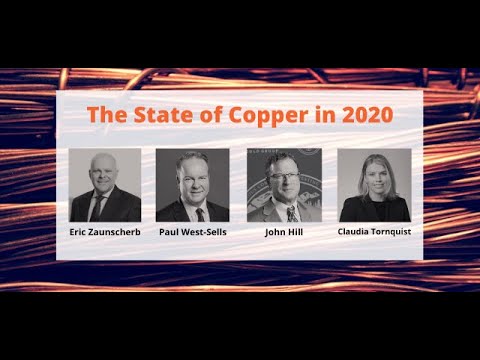
0:56 And certainly there's a reason to come back and bring the dialogue back to copper. And so to launch things off, actually, even before I do that, I want to introduce our panel with us today. On the analyst side, we have Eric Zonjerb, who is a long time analyst with Canaccord Genuity. Eric's worked out of Vancouver and London and Toronto. He's very well respected. He's covered base metals, precious metals, and relevant to this whole green revolution, energy metals. Eric's currently now working on the corporate side. So welcome to the dark side, Eric. On the buy side, we have Mr. John Hill. John's joining us from San Francisco. We're really excited to have John here. John is the founder of Rexero Capital, who is also a partner in Cambrian Capital, which actually managed a $2 billion fund investing in commodities and precious metals.
1:56 John's, he's also worked on the corporate side with the likes of Echo Bay and Inco. He is a geologist that's testified in the US Congress on mineral policy. He's also the chairman of a Denver Gold Group. And it's very impressive resume, John. But what we really like about John right now, he's been a long-term and an ardent investor in copper. He understands the cycles, he understands the different vehicles that you can get involved with. So we're very excited to have John here. So welcome, John. And then on the mining side, on the corporate side, We have 2 different companies in different stages in market capitalization on Copper. On the developer side, we have Mr. Paul West Sells, who is the President and CEO of Western Copper and Gold.
2:46 They have a significant deposit in the Yukon, developing one of the world's largest TSX-controlled Copper deposits in the world. The list is very short. It's called the casino project. We'll get some insight from Paul. And then finally, we have on the junior resource early exploration stage. We have Claudia Turnquist, who is the president CEO of Kodiak Copper. So welcome, everyone. OK, so let's let's move to that copper spot price. Okay, this is the six-month copper spot. And as we all saw, towards the end of 2019, copper is really getting into a bit of a rally, You kind of from 260 up to 280, all of the, on the commodities exchanges, all the shorts were disappearing.
3:37 The longs were coming in. There was lots of talk about China and its infrastructure needs. The whole green energy, electric car revolution
3:46 is really coming into play. Things were looking very bright. And then all of a sudden, come the new year, we heard rumblings about this COVID virus coming out of China. And of course, by the time we got into PDAC, In early March, it was in full swing and then the entire economies around the world have suffered and certainly copper has suffered. So it's a very interesting time for copper, but you see recently there's been a quite an uptick. So I'm going to pass the ball over to Eric Zonjerbs and maybe Eric, you can kind of walk us through what happened, where we are and where we think we're going to go. Great. Well, thanks very much for having me, Knox. I'm not a metals economist, mining analyst for the last 34 years, but I'll give it a whirl. So first of all, looking at production and usage, looking at that slide, you can see that the global refined copper consumption has exploded from around 5 million tons to 25 million tons since 1960.
4:43 And that gap between mined copper and refined copper production is mostly met with secondary copper production, that is to say largely recycling of scrap, as well as changes in inventory. Since 1960, mine production has gone up on average by around 2.8% annually, and that's true for refined production and consumption as well. So basically Dr. Copper does a dance, a dance between copper pricing, mined copper production and the balance between refined copper production and refined usage. And generally it's the GDP that drives the refined copper usage and pricing, which helps predict what the future mine profile will look like. If you go back to 2001 and the dot-com crash, that global recession reduced refined copper demand inventories rose and mine production fell 1.1% in the following year in 2002 as pricing fell from 2002 to 2009.
5:47 The global economy was strong refined copper used to grow inventories rebalanced, and the average annual copper pricing quadrupled. So 4 times, right? Then the great financial crisis hit 2008, repeat the cycle, but the huge liquidity boost provided goose the economy in 2011 and goose mine production. So from 2011 to 2016, years following, we saw average annual pricing fall by 45%. From 2016 to 2018, copper prices rallied as mine production growth slowed and inventories were whittled down. In 2019, the global GDP started to slow a bit on some of the trade wars and the inventory decline slowed and the market at year end was largely in balance.
6:40 The price rally paused, enter COVID-19. And I don't need to tell you how devastating that's been health-wise, socially, and of course, economically. But where to from there? Moving on to the next slide where copper is used, you can see that Asian refined copper consumption is over two thirds of global usage, with Europe and the Americas making up most of the remaining third. Viewed optimistically, you can argue that China, South Korea, Japan, and so on, appear to be emerging from the impact of the 1st COVID-19 wave. Trillions of dollars have been allocated globally now to fight C-19 and to help mitigate its economic effects. A key economic variable going forward is going to be the amount and the target for further economic stimulation.
7:31 In this slide you can see also that equipment manufacture, infrastructure and transportation are key sectors in the consumption of refined copper. Now I mentioned electrification of transport. On average, EVs contain about 3.6 times as much copper than the average internal combustion engine. Government mandates related to that decarbonization, the electrification of transportation and updating power infrastructure is
8:03 extremely important in terms of what copper usage is going to be going forward. This morning, for example, Reuters announced that reported on the fact that the EU has got a big plan in terms of investment in infrastructure, EV production and distribution, as well as in the power charging infrastructure, the network to be built. And of course, China remains equally supportive. For OEMs, for automobile manufacturers, the economics of EV production are much superior to that for production and maintenance of internal combustion engine vehicles. For example, Volvo intends to have 50% of their auto production within the next 5 years to come from EVs.
8:48 So looking forward, it's difficult to say what the GDP growth is gonna look like. And we're seeing wide estimates of what that might be in 2020, 2021. From our perspective, a global GDP contraction of 3.5% for 2020 is conservative, and followed by a rebound of around 4.5 percent in 2021. There's still lots of variables like the inevitability of a 2nd and 3rd wave of COVID-19 and there's a lot of discussion as to what the recovery might be, whether it's V-shaped, U-shaped, W-shaped, or whatever shaped, we don't know. But what we do know is that mankind is not doomed, and it's inevitable that we have some form of economic rebounding. So based on the decline and the rebound that we just talked about, we expect a moderate inventory build, putting average 2020 Copper at around 240 for this year. That would be followed by an economic rebound 2021, which conservatively should give us around 280 average for the year. And that's not great, but it's a good rally nonetheless.
9:53 Now let's get back to where I spend most of my time and that's the valuation of exploration and development companies. So we look at the enterprise value of a company and relate it to the tons of copper in the ground. Okay, we look at this for hundreds of companies, looking at the great financial crisis. So back in 2008,
10:16 2009, we saw that the company valuations collapsed by over 85% during that year and that the price of copper itself fell by 65%. Through 2009 to mid-2011, government stimulation and the economic rebound that followed drove copper pricing up by 2.6 times, showing the leverage in small caps that one can get. The average enterprise value per tonne for copper in the ground valuation increased by 37 times and 48 times for global and measured and indicated resources respectively. Let me say that again. So up 200.6 times for the price of copper and up over 37 to 48 times on average in that time period.
11:05 That's leverage. Moving on to market timing, I think as we all know, it's small cap investing that there is definitely seasonality. We use the S&P TSX Venture Composite and its predecessors as a proxy for small cap mining. The index is around 40% mining, which isn't great, but it's the best we've got right now. Looking at that data since 1983 and focusing on 6 month hold periods, the average mean return swings to positive in July and continues positive into December. So, for example, buying the index in November returns an average 11.3% over the following six-month period. That return varies dramatically from 82% in 1995 to a loss of 28% in 1996.
11:52 If we focus on the Great Financial Crisis as a template for what's going on right now, positive six-month returns started in October, but remained strongly positive through 2009. In fact, if you bought and held for 12 months, the index returned 81% from November, 2008 and 124% from December, 2008. Going forward, we think it's really important that we keep an eye on the government investments that they're going to make as a stimulation for the economy. What are they spending on? Infrastructure, EVs, all kinds of things which are positive for copper. That's what we're looking forward to. Hand it back to you, Knox. Okay, well, thank you, Eric. That's very insightful.
12:38 So we'll move it over to John now, who's on the buy side of all this and has a lot of experience certainly in watching the cycles in copper and when to invest and what to invest in. And so given what Eric was saying here, you know, history of coming out of a crisis and you can buy in October and hang on for the next 6 to 8 months, that definitely intrigues me. So how do you respond to that? Well, great presentation. A lot of interesting perspectives there. Eric is very well known, very well respected in the copper and broader mining industry. I don't know that I have a timing thesis per se, but I think that there's a strong argument to be made from the investor perspective.
13:25 The copper is over-traded, it's over-financialized, very much like oil and silver. Those markets somewhere between 30 and 70 and 200 times traded relative to underlying, depending on which data source you use. It's difficult to assess those numbers precisely for copper because they entail sort of tallying the turnover on the Shanghai Futures Exchange, et cetera. The point is that well before COVID, copper has been a favorite thematic short among global macro investors running some of the biggest funds that we read about and hear about in the media daily. And the themes have varied, but they've all found a negative expression in copper. The unwinding of the Trump rally, the Trump trade war, the China slowdown, which China slowdown year after year, the China slowdown, you want to express a slowdown in China, how exactly to invest that? Many people just would short copper. And then let's never forget the incessant parade of headlines about the Chinese banking or credit crisis that never really seems to happen of 2012, 2013, 2014, 2015, 2016, 2017, 2018, etc. Whether it's the shadow banking system, the social housing, et cetera, the thematic traders who don't necessarily have very much interest in the details of the copper market use it as a tool. And it's found expression in portfolios as growth has outperformed value, as developed markets have outperformed emerging in recent years. And again, it finds expression a lot
14:55 of in the factor driven models that not only are used among the global macro investing community, but also just in terms of smart data funds that did really essentially follow trends in terms of a wide range of underlying investment factors to guide the construction of portfolios. The point of all this is that there's been very little reason to be long copper and quite a lot of reason for many people to be short. But again, a lot of that is very top-down. It's a lot of, it's very economically oriented. And it's not really focusing on the details of the industry. I believe that the copper price at current levels is unhealthily low. It's too low. I believe that mining economics long-term determine pricing.
15:41 We've seen that in most of the metals. I can remember very well when the gold price was $250 an ounce back in 2000. Yeah, well, cash operating costs that year were $178. Similarly, as we look at these poor returns of the major copper mining companies, not to pick on Freeport, it's a great company, but many of those Phelps Dodge mines in Arizona, right now, I mean, their average cash operating cost is $2. Well, it used to be $0.40, and they broke even at $0.75, and then when the copper price occasionally went to $0.90 for a dollar, it was Christmas for shareholders. So Again, I think that mining economics will determine long-term prices. Returns for the companies right now are quite poor from the financial statement perspective. They're unable to cover growth, CapEx, and taxes, and financing costs.
16:30 Incentive prices for new capacity of copper, which will be needed due to the reasons that Eric very eloquently expressed, was quoted about 320 to 350 a pound. And that was pre-COVID and pick your major, minor, using that level in their presentation from BHP down to Freeport, anybody else. So the incentive price, the price required to really bring new capacity on the market, again, was well over $3 pre-COVID. We're going to need that supply at some point. Obviously not in this exact moment, but it's coming. In many ways, COVID has pushed out the deficits and shortage, but almost made them more certain in some ways. And the other thing I would say, examining the financial performance of the major copper miners, and looking at the fact that many are really unable to generate any positive EPS at these levels is the very high, quote unquote, hidden capex burden. And a great example of that would be BHP's Escondida.
17:29 Okay, well, it's $3.4 billion there for Bechtel to build a big desalination plant. They really didn't add to capacity. That just allowed the mine to continue doing what it's doing. So there's a tremendous overhead that's sort of buried in the other parts of the financial statements that work against the economics of copper at these prices. And then I don't think any of us need to be reminded that one of the most likely outcomes of this COVID slowdown is gonna be a yet another wave
17:56 of resource nationalism, not the outright takeover of operations, but cash flows to the mines targeted in 1000 different ways, large and small. We're seeing it already all over the place, Zambia, DRC, PNG, etc. So mining economics should determine long-term copper prices. They need to be over 3 dollars, if not higher. Moving on to the next slide. We believe that in the institutional investment portfolio, copper wins over the medium to long term and it wins versus the metals for a couple of reasons. It has fresh sources of demand, such as Eric described, structural long-term deficits, which are going to show their face very soon, a steep cost curve, terminal markets, and a high proportion of the material being consumed as primary. So we think that copper really wins versus the metals in the institutional portfolio. And much more importantly is the consideration of the dynamic with oil and gas.
19:00 Because when we talk about quote unquote natural resource exposure in institutional portfolios, sure there's some agriculture in there, sure there's a little mining, sure there's some forest land, look, it's all oil and gas. And many portfolios around the world are being decarbonized for a lot of different reasons, poor performance, social mandates, or just the mathematical reality that the high volatility in prices necessitates a much higher discount rate on long-dated reserves. It's not clear whether those are going to come out of the ground at all. And so I think that positions copper to slide in well and take some of that quote unquote market share in the institutional portfolio away from oil and gas and quite easily. So, okay, so that's all wonderful. Much has been said many times before, it's a great idea. It's not the easiest to invest. There aren't the physical ETFs like gold, there aren't the royalty companies. And I've kind of endeavored to kind of lay out the landscape. I apologize for the fine print, but the copper position can be expressed in this matrix with the stupid sunglasses in the middle.
19:59 But there's a commodity strategies, which are mostly futures based, pretty much for specialists. I don't know if that's the subject of this call. There's the diversified majors. Those are great companies. Everyone likes a 6% dividend yield, but there's a lot more going on than copper. The pure play copper companies from Freeport through Arrow, 1st Quantum, et cetera. That's where things get really interesting in terms of stock picking. Also, a differentiating feature is this, there is a credit dimension to copper that is absent from some of the metals. So there's also a possible trade there bonds. There are a couple of decent ETFs. The COPX is not a bad shopping list of the world's copper miners. And then interestingly enough, there's a Peru, all Peru index ETF and boy, it looks a lot like the chart of the copper mining companies. But the problem with these is that this industry is not really that well suited to indexing. If we go through this wonderful shopping list of all the producers, there's some difficult situations.
20:51 There's some difficult social license and environment situations, some very difficult countries that maybe we wouldn't volunteer to invest in on a single stock basis. And so I really think that a mix of the pure play major copper companies and then where we are today with the exploration and development companies is a very good mix and a powerful position. And the reason why is that copper gold ore bodies in particular, better than gold, better than the other base metals, are very, very well suited to what I call the NPV plus model, which is that the project is justified at some reasonable commercial set of commodity assumptions, earns its cost of capital, and chugs along. But the mine life on these projects is very, very long and the people who work at copper mines are very smart and they incrementally whittle away on economics.
21:40 And so over time, given the length of the operation and the fact that a lot of the pre-stripping happens early, hopefully with an enriched cap, We're in a situation where the NPV of the project, but at the same time, we have the opportunity for discovery of parallel structures, satellite ore bodies, or very, very importantly, deep feeder structures that can offer an underground mining dimension off the starter pit. All of these things can add to the NPV very dramatically by adding years, by drawing value forward. And it's a model that works fairly uniquely well for copper, gold, and porphyry ore bodies. So it's something that's worth paying attention to, and it is worth paying attention to companies. There's a lot of ore bodies out there, but a quality project run by serious people, able to hit a series of near-term milestones to position the company to benefit from this.
22:38 I think there's a number of companies, but we have 2 very high-quality companies on the line today. With that, I'll just turn it over to you, Paul. Well, thanks, John. I appreciate those comments. And Paul, certainly John's given some interesting insights, some harsh realities in the copper world. But like Eric, there's certainly a lot of leverage that could potentially be played in the developer stage and in the exploration stage. So with that, go ahead and launch into Western Copper and Gold. All right. Thank you. And I want to thank John and Eric for just an absolutely excellent intro there. I think I'm going to be hitting a few points that you brought up. So just to start off, Western Copper and Gold, very simple company. We've got 1 asset, which is the Casino Copper Gold Project, which is located up in the Yukon.
23:34 We've been developing it for about a dozen years, and I'll go through it right now. Please review this before making any investment decisions. Just quickly to get some of the stats of the company done, so we are traded on the TSX and also on the NYC American in the US, and so certainly if you look at where most of our shares trade, actually most of them trade in the United States. We've got about $3.6 million in the bank at the beginning of the year. We just announced a raise about a week ago, should close next week, adding about another $4.5 million into the kitty. Share price is up a little bit since then. We're sitting at about $1, so it gives us a market cap of around $110 million.
24:25 Where are the shares?
24:27 Management and board at 8%, and then really there's a group of high net worth individuals that have the bulk of the shares at a little under 50%. So you know, this is a, the casino story is an established story, but it's really beginning to take off right now. It's a significant copper gold deposit. We've got a full feasibility study indicating great economics on the project. We're in a great jurisdiction up in the Yukon in Canada and we've got a clear path through permitting. Last year we had some really excellent exploration success, found a new porphyry to the north of us and an additional gold zone. And I'll be digging into those a little more detail.
25:13 And we also got a very clear path forward. We've got an exploration plan for this year and then that rolls into an updated feasibility study in 2021. So to kick off our headline numbers, The top row is the reserve, the bottom row is the inferred resource. You're looking at in total 18 million ounces of gold and 10 billion pounds of copper. So this is a significant copper gold project that we have. Right now, actually, We're marginally more of a gold project than a copper project. Usually we're more copper than gold. Right now at $1,700 gold and $225 copper, which is what we did this slide at, we're about 50% gold and 40% copper. Copper's been on a nice little run here the past couple days, just before I got in here I saw that it was at $2.43, so I mean we're probably getting a bit closer to $50.50 right now.
26:13 And, you know, sort of following on a little bit from what John and Eric were talking about, just spend a couple slides talking about the copper space and the gold space. And talking first about the copper space, and what we've done here is we've taken TSX and TSX Venture listed companies that have a project with at least a PEA. So there's certainly some earlier stage copper projects out there, but projects with at least a PEA. And importantly here, there's 15. You know, this is a different space than the gold space. And if you look at these projects, some of them are good. I'd probably pick about 2 or 3 of them that I would invest in, of course, a hearse being one of them. But a lot of them have some permitting challenges, some economic challenges, some environmental challenges.
27:04 And so when you take those few out, you end up with a very, very small list. The gold space, really, and what I'm talking about here is the big gold space. With 18 million ounces of gold, That puts us in the top 10 undeveloped gold projects with just the gold. This isn't a gold equivalent. And again, if you start to look at the projects on this map and filter out the ones that really have a low chance of being successful, you end up with a pretty small list, and we're on that list. Anyhow, let's talk quickly about the casino project. So this shows a cross-section through the deposit, And this is from our feasibility study, sort of starting at the top in yellow, that's the gold cap that is right at surface. There's no pre-strip with this.
27:56 That's mined off right away. That's 160 million tons at 0.3 gpm gold. Beneath that in the light and dark orange is the main body of the porphyry and that represents around 1 billion tonnes at 0.5% copper equivalent. That's the light and the dark orange together. If you look at just the light orange, that's our starter, that's 170 million tons at 0.7, so 40% better grade, and as you'll see that leads to very good economics. What you're looking there in the reserve, so that's the yellow and the orange, that's 22 years. Beneath that, shown in the red and the blue, that's our inferred resource. We can put a pit around that. You put a pit around that and you end up with 55 years of mine life. So we already have 0.5 century of ore identified. And as you'll see when I talk a bit of our exploration the upside beyond that is significant.
28:54 Economics, I was glad to hear Eric and John talk about the fact you need to make money with these projects. It's not just about having lots of gold and copper, it's about having good economics. 225 copper, $1,700 gold, you're looking at a 27% IRR after tax and a $3 billion net present value. Those seem too high, you want to use a more conservative book, it shows here even if you want to be very conservative, $2 copper, $1,000 gold, you're still looking at a 15% IRR after tax. And this shows some of the production. I mean, gold at 400,000 ounces of gold per year, copper running at 111,000 tons per year, so significant copper and gold.
29:42 In terms of gold equivalent, 1.2 million ounces of gold equivalent. This is certainly a large project. I talked about some of the keys to the project, 1 being that early high grade, the other one is the strip ratio. This is a big, comparatively low grade, copper-gold project, but with almost a zero-strip ratio.
30:06 Big projects certainly have big price tags, and the price tag on this is $2.5 billion, but as John was saying, you know, BHP builds desalination plants for $3.5 billion, so it depends on your view of the world. And what this graph is showing is the capital intensity and just showing that we're average capital intensity. We're not particularly expensive, we're not particularly cheap.
30:33 So that's the project. I want to talk real quickly about our exploration success. Last year we went to do some infill drilling to add some of the inferred ore that was inside of the resource into the reserve, and it's shown here in blue. And along the way we had some really pleasant surprises. And the first one was high-grade gold. We hit 55 grand per ton. This is now the third time we've hit this high-grade gold. It's in the south of the deposit when we've gone back in. We found a number of high-grade intercepts above 2 ground per ton, all associated with bismuth, all within this southern region, and that's certainly going to be a focus of our exploration moving forward here this year.
31:19 We also did a step out to the west, again, hit some of these higher grade gold targets to the west of us.
31:26 And then to the north of us, what we hit here, and so you see this sort of cut in and the red outline is the pit. The reason we hadn't drilled there previously is that the deposit was thinning out and we thought we were at the edge of the deposit. Well what actually happened is we hit another porphyry. So we already have half a century of mining identified at Casino of mine life and now we've nipped another porphyry to the north of us. So significant upside there.
31:56 The other thing we did is we acquired this project to the west of us called the Canadian Creek Project. What you have there, there's really 2 things I want to bring your attention to. 1 right next to our casino deposit is called Casino B. What you see there are some higher grade gold intercepts. This is this continuation of the southern higher grade gold zone and so certainly that's going to be one area of focus. But the other one is Anna and Anna is yet another copper core free target hasn't been drilled sufficiently. Everything makes it look exactly like another casino. So, you know, we've got the casino deposit, we've got the North Casino, we've got the Anna. In addition to that, we have some deep targets. This is just showing geophysics.
32:43 These are a bit deeper, But back to what John was talking about with these feeder systems, you know, we're pretty excited about this. And if we have a little money left over, we'll put a hole into one of these deep targets.
32:57 And I just want to point out the district. Those of you who aren't that familiar with the Yukon, there's a bunch of players up there. It's mostly gold, but you've got Newmont, you've got Kinross and Agneco Eagle, all very active white gold. I just saw this morning announced a big exploration program up there this summer as well. So pretty exciting area to be in. If you look on this map, there's, I say 25 million ounces plus, it's probably close to 30 at this point in time. It's a really interesting emerging district. Just a couple quick slides on community. These large projects don't go anywhere unless you get the community support. I can talk to you at length about all the things we do up there, but really the proof is the fact that we have our Prime Minister, this is the pre-Beard Prime Minister, came up to the Yukon, announced a major funding initiative, and really it was the funding of the road to our mine.
34:01 So I'll end there, but if you look at Casino, this is a project that hits a number of the key boxes. Strong feasibility study, good government and community support. I didn't talk much about permitting, but you know, we've got a clear path forward on permitting and some great exploration success. So moving forward, you know, do some exploration this year, roll that into an updated feasibility study and then get back into permitting. Great, thank you very much, Paul. Very interesting. Certainly with all that type of asset, that large and with that long a mine life and copper and gold, your market cap is still only about $100M right now, is that correct? That's true. So getting back to this whole concept of leverage.
34:49 So with that, let's go down lower in the chain in the exploration side to a market cap of about 10 million at this point with Kodiak Copper. So Claudia Turnquist, this president CEO with Kodiak Copper, is going to talk about her projects in southern BC. Take it over, Claudia. Thank you, Nox. Thank you, everybody, for dialing in. Before I start, just a quick note that I will be making forward-looking statements. Please keep that in mind when making investment decisions.
35:34 I thought I would start with the famous Lassonde curve, which shows the way value is created for investors over the life cycle of a mining project. As you see, there are 2 times when significant shareholder value is created. On the right side of the curve, that's when a project is getting developed and is brought to full value. That's where Western Copper stands at this time and where significant value emerges for shareholders. Kodiak is a very different story. We are about discovery. We are at the left side of this curve here in the orange box where as an investor you come in at a basement bottom level at a very cheap price and where there is the potential for discovery and this famous 10 or 50 bag of 4 investors if successful.
36:34 So that's really what we are about. We are a discovery story.
36:40 And here in a quick summary what our investors like about it, what Kodiak is about. Firstly, we are founded and are chaired by a gentleman called Chris Taylor, who is also the founder and CEO of Great Bear Resources, our sister company, which is one of the greatest successes over the last 2 years in the Canadian market. Great Bear made a major, major gold discovery and great returns for shareholders. Chris is a big part of the success of Great Bear. He is a very smart, very out-of-the-box thinking geologist. And he's very much involved on the technical side as Kodiak as well, and a very, very important part of our team.
37:30 Our strategy at Kodiak is very similar to Great Bear's, but in the copper space, copper gold space, we focus on historically drilled assets in very good locations that are very accessible. And we bring to those assets a new interpretation and new technology. That's what Great Bear did very successfully. And we made it a success in our first exploration program, drill program, and were able to announce a discovery at our NPD project earlier this year. I will talk about that more later in the presentation. So we had a great start to the year.
38:17 We are well financed. We were able to finance before the COVID crisis, so have a cash cushion, our finance to do a summer's worth of exploration, and we also have a very small share count of only 37 million. So we are just gearing up, or just actually have started our summer exploration program and will be drilling very soon in June, have some near-term catalysts coming up in a very exciting summer ahead of us and our NPD project. And please keep in mind we have our NPD project that's the most advanced and I will focus fully on that project in this presentation but we have 2 other projects 1 in Arizona, Mojave, which is lined up
39:07 for drilling right after, and we also have another project in British Columbia called Trepper. So we are not a one-trick pony. We have 2 more projects which have equally as much discovery upside as NPD has. And last but not least, we are a member of the Discovery Group. That's a group of company, a loose alliance of companies put together by John Robbins, who is a very well-respected mining entrepreneur in Canada with a great track record. And for us, being part of this group is invaluable. It gives us great access to contacts, to technical expertise, to financing. We are a much stronger company being part of this big and powerful group than we would be ourselves just out there by ourselves.
40:02 MPD, that's the project where we made a discovery earlier this year. First of all, where is it located? It's in southern BC. You see at the bottom corner of this map the location. It's a three-hour drive from Vancouver, very, very accessible. And what I'd like to highlight is that it's a large system. It's a large property package consolidated from 3 smaller ones. And it's a pool-free project. And I think Paul illustrated very well the size these projects can have. And you see on the map here the neighborhood this project is in. In the middle here, MPD. To our south is Copper Mountain, some 30 kilometers away. Very similar geology.
40:48 One of Canada's largest copper gold mines, and to the north, Isle of Valley is another very large copper mine. So it's an established producing trend, which is for us as an exploration company, very valuable because all the services, everything you need to run an exploration program is right there. This is a zoom in on the claims and it shows how accessible this project is. You see at the top of the slide highway 97, that's not even a kilometer away. Another highway at the bottom here, highway 5A, there's a transmission line, there's plenty of water, there are lots of logging roads that go right onto the property.
41:36 So literally, our drill contractor at our first drill program, he came from Peachland, a couple of kilometers down the road, with the drill rig on the back of his truck and drove right to the drilling pad. That means, obviously, that first of all, it's very cost effective to explore and to drill. And it's also, at this time, with travel restrictions, very, very valuable because we can explore with the local workforce and are not impacted by any COVID-related traffic restrictions. So, very good position to be in. On this slide here, you see some of the historic results. As I mentioned, it's a historically drilled project. I won't bore you with the details. The key points I'd like to highlight is that there have been 129 holes drilled over a period of 50 years, starting in the 60s by a number of different companies at various different points in time.
42:42 But all of this drilling, almost all was very shallow and in the majority of the holes down to less than 200 meters. Why is that? That's very typically how 50, 20, 30 years ago you would explore for porphyries. And that's really where the opportunity lies. When Chris Taylor visited this project, when we were considering acquiring it, he looked at this opportunity and said, you have to drill deeper. That's where there is opportunity. And that's what we did in our first program. And here is what we found. You see, on the left of the slide, our discovery hole that we announced earlier this year.
43:31 It's in total, a hole that went down to 800 meters. It was mineralized top to bottom. The intercept was 764 meters of 0.28% copper equivalent. And very importantly, we also had long, nice intercepts of significantly higher grade copper and gold in there. For example, here at the bottom, 102 meters of 0.68% copper equivalent, or just above 210 meters of 0.52% copper equivalent. So very much higher grade zones in there, which is very encouraging. Now, you might say, well, how does this grade measure up? Aren't there higher-grade mines out there?
44:21 The best benchmark for us are the neighboring mines, in particularly Copper Mountain, which has a very similar geology to what we have here on the NPD project. Copper Mountain has a reserve grade of 0.23% copper. And that's why we were very encouraged by what we saw here in the discovery hole. Our higher grade zones were more than twice that grade and that obviously bodes well for the future and for eventual economic scenarios. So we're very pleased with our first drill program. It kicked the door wide open. This map shows what we have ahead of us this summer and beyond.
45:13 We have this entire 10 square kilometer area that's been previously drilled. You can see these nice geophysical anomalies here and all these black dots that are previous historic drill holes. We have only drilled deeper in this very small zone corner of the project here to the left. That's where our gate zone is. And we have now this entire 10 square kilometer area and all these shallow holes, and we'll pick the best ones for deeper drilling. So a lot of potential there and we've got our work cut out. We have a drill program as I said where we started already with the preparatory geophysics. We've just completed an airborne geophysics survey and we are now gearing up to start drilling in June.
46:07 So, near-term drilling, near-term news flow catalysts. Last but not least, a couple of words about our capital structure. We are a 10 million market cap at the moment. Tight share structure, 37 million shares outstanding. Our share price has been decimated by COVID just like most everybody else's. It's obviously not where we wanted to see. If you look at our entire filings, you'll see lots of insider buying over the last couple of weeks. We obviously see this as a cheap entry point in our stock. We have a lot of news coming up and very near-term catalysts.
46:55 And the encouraging thing in this difficult market at the moment. And despite the COVID crisis is that discoveries still have been rewarded by the market. There were a couple of examples over the last 2 months and that's really what we're aiming for, for some good, nice discovery holes and then onwards and upwards from there. Just to sum up, in a nutshell, we are Chris Taylor's next deal after Great Bear. Chris is a great geologist, one of the most successful geologists in Canada at this time, and a big part of our success. We are applying the strategy that made Great Bear successful in the copper-gold space.
47:49 We made a discovery right from the start with our first drill program, and we will build on that now and start drilling again very soon, next month. And we are fully funded for that. So this summer we should have very good news flow, good results, and we hope to make this an exciting summer for our investors. Thank you. Thank you, Claudia. And thank you, everybody, for your presentations. We're going to now move into the Q&A section of our webinar here. And actually, while the questions are coming in, we've already got a few going here. I just want to ask a general question a lot of people ask. I'll ask Paul first.
48:36 Given the whole COVID environment and COVID protocols, how is that affecting your operations and how are you responding and how's all that going in this COVID environment? Yeah, no, no, that's a great question. And you know, the Yukon, I think, is like a lot of the northern territories, has actually a 14-day quarantine for anybody entering that territory. So it does make it sort of, there's an extra challenge, I think, for people operating in the North that are running into this quarantine. So, you know, of course, you know, for our office, we've got a very, very strong policy and for our exploration program, you know, we've retooled it to deal with the quarantine, but also to deal with just increased cleaning and all of those sort of procedures around making sure that it's a very safe environment.
49:32 We're lucky in that because we traditionally have used Yukon-based drilling company and have used Yukon-based geologists in the junior roles anyhow, we've been able to sort of come up with this sort of made in Yukon exploration program. And when I was off the screen there, I was just looking, we just had A couple of the geologists resumes come in, so I was just taking a quick look at them. But it looks really good, and we're pretty excited about what we can do. But certainly it's challenging, particularly up in the Yukon with that 14-day quarantine. Yeah.
50:18 Yeah, I've noticed that the theme is having local crews really helps if you have people in the Yukon living and working in the Yukon that helps you out. And certainly that's probably the case in British Columbia, correct, Claudia? Yes it is. And from our perspective, we are very fortunate to be where we are with our MPD project, just a couple of hours away from Vancouver. And we are more or less unimpacted by COVID-related travel restrictions. We are obviously for our office team, practicing social distancing, working from home, but our exploration program is going ahead. As usual with the local team, also obviously observing social distancing, but drilling in the forest is actually not very hard with social distancing your distance already by default.
51:15 Great. Well, good to hear that everybody's operating in this environment. We do have some questions coming in. If you, anybody out there has any questions, just click on the Q&A button and type away. But I have a few right now. I think I'll divvy these up if everybody gets a piece here. Well, Claudia, we'll start with you. And I think when you gave your presentation, you sold yourself a little short in that, you know, your own experience, you spent years with Rio Tinto, also with Sandstorm, You've been involved in mergers and acquisitions, obviously involved with larger projects, including copper projects out there. So the question for you is, how can Canadian deposits compete with the enormous copper deposits in South America? Good question.
52:05 It's very important, I think, when looking at any project, any company, any investment opportunity, to look at each project's unique circumstances, because there are very, very big differences in cost structure, in metallurgic recoveries, in capex, in costs for things like electricity, water, et cetera. And All those things together, they eventually determine the economics of the project. So you might have projects, and South American porphyries are a good example for that. They are quite high-grade, but they then don't have cheap electricity. They might not have water. They might need a 3 billion desalination plant that I think Eric referred to earlier, and so have a much higher cost structure than that's found out by high grade. And if you look at British Columbia as the opposite end of the scale, where the cost factor is very low and the grades that are needed to make an economic mind, therefore can be much lower as well. So it's really a question of looking at each project's individual circumstances.
53:21 Yeah, thank you. And Paul, I mean, obviously, you know, you're very familiar with what's out there in the world in the development side. How would you answer that question? Yeah, I mean, I think Claudia hit all the big points on it. You know, you can't overemphasize things like water and the fact that you need to build desalination plants. Labor costs, I mean, this is going back a few years, but I remember hearing that a haul truck driver in Chile makes more than a haul truck driver in Nevada or in British Columbia or the Yukon. This isn't a cheap place to operate. And then you have the elevation. Your average copper mine in Chile is at 3000 meters plus.
54:08 And so there's certainly some great deposits and they've been mining them, but it's also been well explored and well developed in South America, particularly Chile and now Peru. And the other thing that's interesting, and I had a very interesting conversation with one of the big smelting companies, and they brought up a good point and they said, you know, we're worried because we have 90% plus of our copper production is from 2 countries, which is Peru and Chile. And when you look at these 1% to 3% chance of happening sort of things which, you know, we're living through right now, which happened, that gives them, you know, there's a lot of risk with that. So they were actually very happy to be talking to us about a large project up in the Yukon or in Canada because it just sort of distributes that risk, that country risk over a broader group of countries.
55:12 Okay, well thank you. The next question is from Giono Danielli And I'll direct this to Eric. So anyone that follows copper closely knows that the big copper crunch is set to happen in the early 20s, 2021 to 2023, roughly, as a lot of historic grandfather copper mines wind down. Does the COVID-19 situation have the potential to accelerate the impending supply shortage, changes in urgency? Yeah, thanks for the question. I think that's a very good one. And it also speaks to what was just said about diversity of supply. We wanna have a diverse supply and not just have some of these big grandfather productions as you term them in Latin America in particular.
56:06 I've been hearing about that copper crunch for literally decades, and that's true in copper and zinc and other metals as well, that as some of these large mines reach the end of their original lives or extended lives, that all those are gonna be dead in the next 2 or 3 years, and we'll have a massive crunch on the metal being produced. Fortunately or unfortunately, depending on your point of view, we do see these lines get extended. They do pushbacks on their massive open pits, they access more ore. As we see higher metal prices, we see more ore created, if you will, out of resources. So I don't necessarily see the big crunch theory as holding as much as we'd like to see that for the opportunities that other operations might have.
56:56 With respect to COVID-19, I agree with what you're getting at here. And that is that if you shut down a mine near the end of its life, whether it's for COVID or some other reason, interruption in water supply or whatever, it may be that it's just not worthwhile maintaining it through that shutdown and then reopening it, making, having that expense of reopening it for a brief period of time. So it wouldn't be surprising at all to have some operations affected in that way that could actually help create a supply shortage. And that of course makes it more urgent. I think it's always urgent to find new deposits as we're hearing about today from our 2 guest speakers. It's really important to keep the discovery train going, make these new discoveries and advance them towards production.
57:49 So, John, in response to that, do you see the effect of copper prices more from the supply crunch or from the demand push? As we emerge out of COVID, as we have all these infrastructure spending as we try to get out of this global situation? Yeah, boy, I wish I could answer that. Is it oversupply or is it under demand? It's a matter of perspective, but I think a couple of things are gonna come out of COVID. As I alluded to in my prepared comments, I believe that this will, for some reason said by others, that this may push out some of the structural deficits in time but it almost makes them more certain in other ways.
58:40 Also out of this what's pretty clear is happening is a significant disruption in terms of mine inputs of supplies and services and then I expect a fairly lengthy period of dislocation in the in basically the product distribution chain. There's a long way from concentrate at 1 mine through a bunch of concentrate smelting, blending smelters, refiners through a rod mill and into cables in Asia somewhere. That's a long supply chain. And what we saw in the great financial crisis, and I think we're going to see again, is a period where throughout the inputs and the outputs of these mines, everybody's going to have too much of what they don't need and are going to be missing an input or 2. And it's going to cause lags, it's going to cause slowdowns, kind of cause friction, and we're going to see costs going up across the board, both short term. And I think as Paul and Eric very eloquently pointed out that the long-term implications of remote difficult infrastructure and we're talking about building a highway in BC, we're talking truly remote infrastructure is going to be much, much higher than it is in the past.
59:51 We combine that with the pressures of resource nationalism, again, which we're seeing in PNG, Zambia, and the DRC already. We combine those 2. I think there's structural impediments, and I think there's a hit to the financial statements, if not the operating costs of these companies. And I think it ultimately finds expression in exactly what Eric says, that a little bit more segmentation in terms of preferential supplier, security of supply. And as well, that whole issue dovetails very well with the single largest growth area in mining these days, which is in ESG rankings and ratings and security of supply chain and disclosures of not using child labor or engaging in abusive community practices are very, very important. And I think this is gonna essentially create fairly stark winners and losers and separate the winners and losers in a way that we haven't seen in the recent past and in a manner that's gonna be fairly clear to investors.
1:00:52 That's a great point, John. It goes back to that first question that we had about the Canadian deposits versus the big South American deposits. I mean, if we look at the sovereign risk and the high financial threshold, as a result, for new production coming out of Latin America, I would much rather put money in at a lower threshold into BC or the Yukon and move forward in that way. And referring to interruptions to supply chains, you don't have to go back to the great financial crisis. You can go just a few months back when we saw the rioting in Chile related to higher subway token prices. And now that extended to the CIVADORS on the docks that resulted in the difficulties in getting product out of Chile and getting product in or some of the supplies necessary for the operations in Chile as well as Argentina to some extent. So there's a big impact as a result.
1:01:48 So certainly when you look about the, you know, in the US you have that $2 trillion relief package for infrastructure. Is that gonna be, you know, targeted, you know, strictly in the US to keep the US jobs in the US? And what's going on in Canada? What's the Canadian federal government doing to encourage this? And I'm going to put this to you, Paul, because you're developing a massive project and you're certainly obviously looking at the landscape as to who wants to invest and how's the government kind of doing that to help us out? Well, I mean, for us, you know, as I sort of said at the end of my presentation, we were pretty excited when we had the Prime Minister up and announced infrastructure. And it is the largest actually federal investment in the Yukon, in the history of the Yukon is this infrastructure package.
1:02:44 And so For us, that was $130 million, which is committed to building a road. And back to some of the previous comments about some of the infrastructure challenges, I mean, certainly we're a northern mine, and We are more remote than some of the other projects, but really what that means is you've got to build a road. And so in this instance, we've got the government supporting $130 million out of $200 million worth of that road. So, very, very happy to see that sort of investment and that vote of confidence from the federal government. But yeah, I mean, in terms of, you know, sort of broader, more macro things, you know, certainly I think that as we see this infrastructure build sort of move forward, you know, the demand, you know, particularly on copper I think is really going to sort of kick off here.
1:03:46 And if just sort of back to the earlier point, I mean, particularly in the United States, the electrical infrastructure is just completely underdeveloped, and they've been talking about it for decades now, and I think that maybe this is the time they'll actually build something. Great, thank you. I'm sorry, I'm reading these questions, so I'm trying to multitask here. We're at 5 after 11, we'll give it another 10 minutes of discussion because we have a lot of questions and I'm really enjoying this conversation here. Actually back to you Paul, this is from John Gerby for Paul. High grade BI, how does this translate into copper concentrate grade? I don't quite get that question, maybe you do. Sorry, high grade, copper. Bi, BI, apostrophe.
1:04:35 Oh, by probably. By product I assume. By product? Bismuth. Bismuth. Bismuth. Okay. How would this translate into concentrate grade? I mean, so, I mean, when, and this is, you know, In the south of our deposit where we found this high-grade gold, it is associated with bismuth. The bismuth grades there are very low. It's just an indicator, I mean, often with gold it's arsenic or it's antimony or it's bismuth that sort of are good indicators for where you're going to find gold. In this case it's bismuth, but we're talking low parts per million, So it really doesn't have a big impact on the concentrate grades, the bismuth part.
1:05:24 But certainly with the gold, when we look at our, When I was showing you that projected revenue, that's from the concentrate. Right now, at $1,700 gold, $225 copper, 50% of the revenue from that concentrate is actually from the gold. Obviously, if we add more higher-grade gold to that, that number just continues to go up. OK, thank you. So Claudia, another exploration question. Are you going deeper into existing drill holes or only doing new holes? We drill below the existing shallow holes. That doesn't mean we have twinning holes. We drill partly through the same zones, but deeper.
1:06:13 In our first drill program, we had some high grade good holes at the surface and we drilled through those and then further down. And we found the best grades literally just below the 200 meters, roughly. That was the historic drilling horizon. Our best grades were between 3 and 500 meters, which was quite exciting because it's really not very deep. If you just put it into perspective, the neighboring Highland valley mine, the open pit goes down to 800 meters. So yeah, we'll pick the best holes at surface. We are currently doing some geophysics that will allow us to look down into the ground for 500 to 1000 meters, and then we'll go there.
1:07:06 Thank you. Okay, so back to you, Paul. This is more of an exploration-themed question from Frank Pretorius. There has been much discussion about exploration and well done to the firms doing exploring. My question is how much emphasis do the firms put on downstream innovations in terms of enhancements in electoral winning and yield improvement? Okay, so I'm going to put on my metallurgist hat. Before I ran Western, I was a metallurgist. For us, our primary product from the main, so from the surface, it's a gold heat bleach, and from the main mill, it's a copper gold concentrate that we sell. So there's no electro winning in what we do at site. Electro winning is when you have oxide copper and certainly a number of the deposits in South America rely on that. But just talking a little bit about innovation in terms of the things that we're doing when we've looked at how we're looking at processing the ore at our mine. I mean, on our heap leach, for example, we've got, because there's a little bit of copper, we use a relatively new process called SART, which allows us to run a little bit higher copper grades in our gold heap leach
1:08:37 without running into very, very high cyanide consumption. And then, really the innovation on milling and putting together these big mills is around the tailings facilities. So obviously all of the what's happened in Brazil and at Mount Pauly has created a lot of scrutiny on what to do with tailings and mine waste. So we've added a lot of innovation into our tailings facility. This has been done in concert with the First Nations who've been involved, very actively involved, and the regulators in terms of how we're putting together the design on the tailings facility. So that's sort of just a couple of areas where we've brought in innovation. Okay, well that was probably from a fellow metallurgical engineer asking that question.
1:09:25 But speaking of Concentrate, over to you, Eric. You know, China is obviously going to lead the infrastructure build out and the United States. How are they getting involved? Maybe Paul, you can jump in on this, but how are they getting involved? Are they buying concentrate? Are they buying forward contracts? Are they buying deposits? Are they buying exploration assets? How is this starting to materialize? You there, Eric? Helps if I unmute, my opinion. Ah, there we go. Yeah, I mean, it's all of the above. If you look at the Belt and Road Initiative on the part of China, they've been investing all over the world in infrastructure.
1:10:14 And at the same time, they're at another top brand to gain exposure to deposits, especially the very large world-class deposits. Interestingly enough, there's been a big pushback that's growing, if you will, from a lot of the host nations, especially now in light of COVID-19, looking at their balance sheets, countries are looking for delays in payments and delays in interest and forgiveness of loans and all kinds of things like that. So China's really getting caught between a rock and a hard place in that sense, but it has always been their policy to want to control their inputs that they need for their own economy and their growing influence around the world.
1:11:02 Are we seeing them get involved in exploration at the other end? I can't say that we are. I think advanced exploration development perhaps, but certainly not in the greenfield stage. Okay, John, might you have a comment on that? Yeah, I was just scratching down a couple notes as Eric was speaking. I mean, great examples would be Tenki Fungurumi and then, of course, the massive Kamoa-Kapushi discovery, the DRC, which is a JV between Ivanhoe Mines, Zijin of China, some Chinese investors, and then the government of the company, sorry, the country. So very much a consortium model in these massive projects, very similar to the oil industry where there's no real one owner. It makes it a lot easier if you have a production company that's an expert at doing that, then somebody takes the product and then a financing partner as well.
1:12:01 So again, the Chinese have been very aggressive. Latin America, in Africa with these with these couple projects that I mentioned and and elsewhere. Let's think about nickel like Ramo nickel would be a great example of mega mega project. It's been plus and minuses. You've had some funding of some major rail projects in East Africa that have gone well. There's a lot of speculation about Chinese involvement in the iron ore in Simandou in Guinea and how welcome that would be or not. But I think that Eric's point is correct, that the Chinese are helping move forward some of these mega projects in exchange for a piece of the action. And I imagine, Paul, you must have had discussions with these type of partners as well.
1:12:52 Yeah, no, I used to go to China at least once a year, but well, it got a little touchy last year and obviously I'm not going this year, but yeah, I mean, and just to add, of course there was the investment, and this is in the gold space, but of Shandong Gold, buying TMAC, you know, fairly recent Chinese investment in Northern Canada. So they continue to be a big player. I've had numbers of discussions, lots of interest there. It does tend to be, It does come in and out. The last few years it's been actually quite a bit. Before that it was sort of crickets for a few years, and then if you go back even further it was quite intense.
1:13:46 And I think that that's 1 avenue. The other avenue is, sure, the Chinese are trying to keep their smelters full, but so are the Japanese. And so the Japanese, again, have a long history of investing. Claudio was talking about Copper Mountain, you've got a Japanese partner there, You've got Japanese partners in Highland Valley Copper. And they are companies that have shown they've made a few sort of small investments at more exploration stage companies, you know, in Alaska and in Canada as well. Okay, well thanks Paul. We're running out of time. I have 1000 more questions and I'm sure a lot of people do, but this has been a great dialogue and I think this could go on forever and thank you everybody for joining us. I just wanted to give a little shout out to Laura Stein, our friend in New Jersey, who is very well connected in the world of mining, seems to know absolutely everybody and helped us put this panel together. And thank you for Bianca at 6.
1:14:48 Maybe you could tell everybody how if you know they have some follow up questions, how they can maybe ask those questions, where to direct those to. Absolutely. So first off, thank you to all our panelists. Thank you to you as well, Knox. And for anyone who still has questions that we weren't able to answer here today, you can send those questions to friends at six.com. That's the number 6IX dot com and we'll pass them along to Knox and the team and we'll get you those answers. Okay well thank you very much And then I guess we'll nothing left to do but to sign off. So have a have a great day, everybody. Perfect Thank you