Transcript
Automated transcript · Written by software from the replay's audio. It can mishear names and figures; the replay is the record.
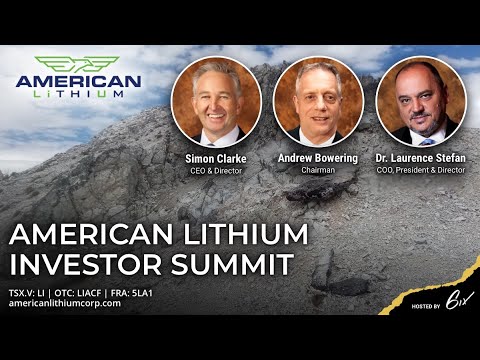
0:08 Hello, everyone, and welcome to American Lithium's live investment summit today, hosted by 6. We're joined today by Simon Clark, American Lithium CEO and Director, Andy Bowering, their Chairman, and Dr. Lawrence Steffen, the company's CEO, President and Director. Team's going to walk us through their company presentation, after which we'll move on to the live Q&A session, where we'll be accepting and answering some questions. You can submit your questions using the Q&A panel found on the right-hand side of your screen. And as always, the summit is being recorded. It'll be available to watch afterwards on Six.com. So without further ado, Andy, I'm going to
0:38 pass it over to you to kick things off. Thank you very much, Cam. Hello, everyone. My name is Andy Bowering, and I am the chairman, founder and a significant shareholder of American Lithium. Thank you very much for attending American Lithium's first town hall meeting. We hope to hold many meetings like this regularly as we continue to evolve the company and develop our great assets. The lithium industry is in its infancy. There is little doubt that the greening of the transportation grid and of the energy supply in general is going to lead to greater and greater investment in the battery metals space. American lithium is at the forefront of this coming opportunity. We see in Nevada and Peru what the precious metals miners of the 1970s saw in the same jurisdictions, an opportunity to build and operate mines at good scale and at the lower end of the cost curve.
1:28 We believe that our current pace of development is on track and fits well into the current narrative that a shortage of lithium is coming in the middle part of this decade. American lithium has had a very successful couple of years, culminating in the acquisition of Plateau Energy metals earlier this year. Today, I have with me Simon Clark, our CEO, and Dr. Lawrence Stephan, our president and COO, 2 great executives with years of experience in the resource development sector, and more specifically, several years of direct involvement in the battery metals space. As Cam mentioned, we will take you through a short presentation on the company and then open up the floor for questions. Before we turn it over to Simon and Lawrence to get us going, I'd like you to know that American Lithium, which trades on the TSX Venture Exchange, the OTCQB and the Frankfurt Exchange in Europe, was number 1 on the TSX Venture 50 in the last 2 years and now we are beginning the process of a US registration with the intent of seeking a stronger US listing this fall.
2:33 Our company has over 42,000 US shareholders and a broad distribution of strategic, institutional and retail shareholder support.
2:42 Today we will make some forward looking statements. So I caution our readers, our listeners, to read our disclaimer at your earliest convenience. And without further delay, over to you, Simon. Thanks very much, Andy. Great introduction. So there We are on slide 4 of the presentation. So American Lithium, our focus is becoming a lithium-lithium developer focused on the Americas. As you can see from the maps here, we have 2 quality lithium projects, TLC in Nevada and Falchani in Peru. Both jurisdictions are tier 1 jurisdictions with Nevada ranked by many as the number 1 jurisdiction in the world and Peru with a very favorable mining regime and extremely prospective from a geological perspective.
3:37 We're excited to have both of those. We're well funded, $17.5 million in cash on the balance sheet and a strong, loyal shareholder base which has supported the company through the last few years and is well positioned to do so going forward. In both jurisdictions, we have excellent infrastructure, both are big mining jurisdictions, lots of skilled labor. And as we'll show as we move through this, we've got a deep management and technical team and the acquisition of Plateau recently really helped most of the technical team and we think we're in great position moving forward. Again, it's a large, diverse resource base. We've got one of the largest measured and indicated lithium resources and obviously a large inferred resource as well.
4:32 And very interestingly, and we'll talk a little bit more about this as well, we have one of the world's largest undeveloped Uranium deposits in Peru as well. So that gives you a snapshot of the company. And obviously for us, the last 12, 15 months in particular have been transformational for the company. We came out with our maiden resource in Nevada at TLC, very large NI 43-101 resource in April, May of last year, and then have proceeded to have very strong news around MET work. Andy will get a little bit more into some of the details on that, but the clay stones that we see at TLC have a number of unique characteristics, which we're finding very, very good as we move through flow sheet and process engineering.
5:23 We did critically early on, we took the view, we didn't want any showstoppers on this project. So we did our baseline biological environmental studies early on, which identified that we have no endangered species or plants, which in today's environment is critical. We've seen with the new administration in the U.S. A desire to really push forward on the domestic supply of critical minerals, but obviously environmental issues and concerns are something that they also want to deal with. So we have to deal with the dual effect of that. And again, doing those studies early was, I think, really, really critical and something I applaud the previous management for.
6:08 It's really helped us as we filed our plan of operations with the BLM. That plan has now been accepted. And Andy will talk a little bit more about what that plan entails for the next phase of drilling and sampling. We also, we were the only company in the claystone space, in fact, in the lithium space to get a U.S. Department of Energy grant. And that grant was to help showcase some new technologies to separate lithium into lithium hydroxide. And again, a very high profile
6:42 opportunity for us to be involved in that. Andy mentioned we were ranked number 1 in the TSX venture on the mining side. We raised in excess of 25 million in capital. And I think as you'll see, we've really rounded out the management team and brought in strong technical expertise. And obviously, in recent times, the acquisition of Plateau, we think adds a really, really strong mix to what we're doing. We love the assets in Peru and we're very pleased with the team that's joined us from Plateau and the technical expertise and background they have. So with that, moving forward, just a little bit on the cap structure, share price around about $2.
7:29 You can see it gives us a market cap of around 350 million. Again, cash on the balance sheet of 17.5 million. In the money, warrants and options in excess of another 12 million. Our recent round was one that was focused on the institutional side. We have a very large base of retail shareholders as well as Andy mentioned, and we're now attracting significant interest from the institutions. And it's key to point out that management and board all have strong positions in the company and we all participate in in our financings. In terms of the analyst coverage, VSA has been a strong supporter. Olly O'Donnell has written a number of pieces on us including a recent piece on the Plateau merger and his contact details are on our website for those who might want to follow up further with him. Echelon was a follower of Plateau and we're expecting them to launch on the company shortly And we also have 2 or 3 other banks that we're in discussions with where we'd expect to see more analyst research coming on over the next couple of months.
8:42 Quickly on the team, Andy who introduced us, I've known Andy for over 20 years. We've worked together on a number of projects, deep history in mining. This office very successfully founded and has driven forward prime mining to where that is today on the gold side of Mexico. And critically for the battery metal space, has an in-depth knowledge of battery metals, was a key founder of Millennial Lithium on the brine side. He also, if we flip over to my bio, was a key founder of mine at M2 Cobalt and raised us a lot of the early capital as we took that company forward and ultimately sold it to Givoir Mining in June of 2019, which really was a key transaction. I stayed with Chevrolet for another year before coming back to join Andy and originally joined American Lithium as a board member and then became CEO a couple of months ago.
9:45 Dr. Lawrence Stephan, a little formal, I refer to him as Lawrence here, deep experience in the mining sector and has been working in Peru for 20 years now and was the key guy who led the discovery team for Falciani and at Makasani, which we'll talk a little bit more later. Philip Gibbs joins us as CFO from Plateau, a strong background in the financial side. Ben Binninger is an independent director of ours and a strong background in Rio Tinto and Potash. He was also an early director of Millennial and then finally rounded out by Ted O'Connor who comes from the plateau side and has a deep history in the uranium side, but obviously was a key part of the team that discovered Falchiani as well. So I think we have a strong team there.
10:43 And ESG is More important in what we do today on the environmental side, as I mentioned, we did our baseline work early in Nevada. We have a firm hired and on retainer to help us with our lifecycle assessment of environmental impacts as we move forward to finalize our flow sheets. And in Falciani and Makassani, both projects were run early on with a view to using hydropower, water and strong infrastructure. And critically in Peru, you can see a number of pictures there, you've got to have great relationships with your communities. We have a strong team of 18 people based in Peru and a very strong general manager.
11:32 And the work they do with the communities is first rate and is a key piece of what we do. So we take ESG very seriously. And with that, I will now hand on to Andy to take us a little bit through the background and detail on TLC. Thank you very much. Thank you very much, Simon. TLC is a 7,500 acre property, and you can see it's equidistant between Reno and Las Vegas. It's a mining friendly region. It's 5 minutes out of Tonopah. Mining friendly community with an abundance of labour. We have drilled 34 holes in it to date to establish the 5.3Mt measured and indicated Lithium carbonate equivalent resource.
12:21 There is an additional 1.7Mt inferred. And then I think that resource goes down to say a 4Mt measured and indicated at about a 1200 part per million grade. In January, we filed a plan of operations to allow us to drill significantly more holes to infill it, to look for higher grade starter pits and to get a better understanding of the bedding of the lithium clay stones. We also hope to bulk sample later this year for our continuing metallurgical testing and flow sheet design. TLC is very close to all of the significant inputs that you will need to operate a traditional Lithium mine. So that would be limestone.
13:16 There's a limestone and dolomite deposit right up the hill from TLC. You've got soda ash from the deposits of Wyoming in the neighbouring state. You've got sulphur from the Gulf Coast. And we purchased 1,300 acre feet of water last year. That's about 52 million gallons a year. And we hope that that's enough for our process water. We are looking at additional water rights, owning your water in Nevada is key. There are several operators that are looking for water now and we're pleased to report that, you know, picking up our water last year was key. While we were doing the drilling, we enacted baseline studies for environmental review and archeological review. We can report that there are no endangered species or endangered species habitat on the TLC claims.
14:15 Don't want to talk about our competitors, but anybody familiar with the state of Nevada and the ongoing lithium permitting there, there are issues with buckwheat on some of our competitors' projects. And then to the North, you get into sage-grouse habitat, and it does present problems with respect to developing. No issues on our project at all. And same with archeological, past archeological review with no outstanding issues. As a result, we're waiting for the plan of operations to be approved by the BLM, hopefully late this month or sometime next month.
15:01 And on approval of that plan of operations, we will begin further exploration and bulk sampling on the project. As Simon mentioned, we are the only North American lithium company to get a US Department of Energy grant for building a pilot plant to prove the efficacy of removing or producing lithium hydroxides from our claystones. We are in partnership with DuPont chemical and American Battery Metals. We provide the clay stones, they're providing the technology and the opportunity.
15:48 That's about a three-year process. And it's not, it's completely separate from our operations and our ongoing plans, but it's another interesting dynamic to the company. One of the interesting things about the clay stones at TLC is they sit at surface. And it's the same mineralizing events or same geologic time that populated the Nevada sediments with precious metals have done the same thing with the claystones for Lithium.
16:33 And I suggest to a lot of people that, and I made this comment in my introduction, is that if you want to go back and look, say, at the precious metal era of the early 70s, when the collapse of Bretton Woods and the deregulation of the US dollar to gold resulted in a significant price increase for precious metals during the 70s. What else did you have during that period of time? You had the advent of Battle Mountain, American Barrett, Placer Dome, Newmont, Franco, Nevada, Kinross, several Gold miners that came into Nevada and started producing the big, low-grade surface deposits, the 1g per ton deposits of Gold that previous to that price increase in the commodity were just not economic.
17:24 The same thing applies in the Lithium trade now. You had a Lithium price of $2,500 a tonne in the early 2010 through 2013 period. And now you've had an escalation in that price to 5 to 7 times that price, and resulting in the ability to produce the lower grade deposits of lithium. And as a result, projects like TLC that sit at surface are likely going to be economic. And so you can look at the cross section on slide 10 and you can see that the lithium pretty well comes to surface. There is very little overburden here. You might have, in some cases, virtually no overburden at all and in other cases, a meter or 2.
18:12 But you have grades of up to 500 parts per million lithium at surface. And then you have grades that go as high as 2,600 parts per million as you go down through this concentrated sequence to 50 to 80 metres down from surface. One of the interesting things about the TLC claystone is that unlike all the others in the region, it leaches very quickly. We can drop out the lithium in a sulfuric acid leach in 10 minutes And you can see from comparison to many of our competitors that there are no others like it. And it's suggested that the lithium is very weakly bound in the clays and as a result, that's what caused it to wash out quickly.
19:00 There's good and bad with that. Being able to leach fast is a minor or a metallurgist dream, but with that comes
19:13 the other elements that leach out quickly too. And so now we've got to spend time and energy to determine the optimization of the leach. So what are your temperatures? What are your acid concentrations? And what are your contact times? What I will suggest is that There are no deleterious materials in our clay stones. There's no mercury, very low arsenic. There's no radioactivity or low radioactivity. So we're dealing with a very clean clay. Now in the past, we've announced some other developments that are quite significant. We are working on mechanically upgrading the ore. So using centrifuge or hydrocyclone technology, which can be scaled to the mining industry and is used in the mining industry, we were able to take a base grade of 1,300 parts per million and upgrade it to 2200 parts per million using a simple hydrocyclone technology.
20:08 The consequence of that is significant. And that was the breakthrough for Thacker Pass. And I'd suggest that that will be a breakthrough for this company because you are almost doubling your grade prior to heading into leach. And so there's continued ongoing work on mechanically upgrading the clay stones. We also suspect that this year's drilling, some infill drilling will result
20:37 in us being able to find some higher grade pockets of clay stones that might work well for startup pits. There are several other processes going on for our MET testing as we develop the project. We have been doing some work with roasting. There has been announcements made in the past from our company on roasting. And we find that you can recover significant lithium once your clay stones are roasted using a simple water rinse.
21:15 You can expect later this year to have much more metallurgical processing and test work being done and that being reported to the market. In addition to the Leach testing and the roasting that we're doing, there are also some tests being done with ionization, membrane separation technologies, and a couple other things. We are not writing those off yet, but Our guess is that this is going to come down to either a simple
21:53 sulfuric acid leach or come down to a roast and a water leach, still to be determined. This is the flow sheet that's typical of processing of lithium clay stones. It's actually quite, it's the process that's also used in the brines. And We have yet to produce a battery grade lithium in the lab, but we have produced a commercial grade lithium in the lab. Now, as I mentioned, this flow sheet requires liming, soda ash, sulfuric acid,
22:38 and all of those components are available inside the state of Nevada or in neighboring States. The only infrastructure that we would need to develop closer to site would be, we would likely need to bring in a rail line and that's about 100 miles or 160 kilometers away and a pipeline, which is about 60 miles or 100 kilometres away. Those are infrastructure developments that we're likely going to have to assess for the ultimate building of a mine here. There is a power plant 2.5 kilometers, I don't even know if it's 2.5 kilometers, it's just north of our property called Crescent Dunes.
23:28 It's a 85 megawatt power plant that's solar powered. It's in receivership right now because it didn't have any customers for the region. And the receiver is looking for opportunities to either sell it or to look for a consortium that can generate, can take power from that. There's a possibility that we might be able to look at that in the future with Round Mountain that sits about 10 miles to our north. There's a couple other miners in the area. So there are some other opportunities for power generation in the region if we were not to develop our own solar power in there. However, there is grid at Tonopah.
24:16 At this point, I've probably said enough about TLC and I'm going to turn it over to Dr. Lawrence Stephan to talk to you about our second asset, the Falchani Lithium deposit, and then ultimately some words on the Makusani Uranium deposit. Before I give it over to Dr. Stephan, I will suggest though that Lawrence is now in charge of all of our metallurgical and technological development and our exploration at TLC. And so any questions to that at the end can be directed to Lawrence as well. Lawrence, over to you.
25:02 Thank you very much, Andy, and thank you very much for passing me the heaviest buck, you know, to reply to all the Q&A. So I really appreciate it. Thank you, Simon, for the great introduction. So probably all of us, you are thinking, what's the relationship between the lithium deposits a couple of good thousands of kilometers south of Nevada, deep in Peru, actually high in Peru in the Peruvian Andes, and actually a tunnel park in Nevada. Well, the relationship was probably due to a story, and all of us, it's ingrained in us human beings to like stories since we are toddlers, so I'll try to tell you a story not as old, not long as those told me, told to me by my grandparents and my parents, but one that probably you'll enjoy and makes all the sense in the world.
25:48 So probably you understood from the initial presentation that we in Peru, the company at the time, Makusani Allocated, that became Plateau Energy Metals, was a very serious uranium player. And although we discuss about that later, I can tell you that actually we host under this roof the only resources properly and well drilled in Peru, uranium deposits, uranium resources, we have probably in our possession 100% of the fifth largest undeveloped uranium project in the country. So we realized very early in our work that actually there is a lot of lithium associated data. When I'm saying that, probably all of us will get confused. Is this a lithium company? Is it a uranium company? I'd like you to understand that the plateau of Makussani that hosts both the lithium and uranium, separated by 25 kilometers, I'd like to make it very clearly the economic concentration of uranium and of lithium on the plateau are not from the same mine. There is no danger to have uranium and lithium and lithium and uranium, although lithium and uranium will mean nothing at the end of the day. They are far away from each other. We have complete flow sheets, complete, there will be probably 2 different companies at the end of the day, It is something that we can discuss about that time too.
27:02 And actually the chances for those to be contaminated, it's very, very slim. However, most of the uranium-bearing rocks at the time before Falciani was discovered, they have a very high concentration on lithium. And because we are curious human beings, We try to understand, is there somewhere on this plateau, an area which has a much higher lithium background? Because most of the rocks and I'm not trying to say nothing wrong against Tonopah, definitely not. But this is the way how lithium is stored in the clays, in the clay stones, the way how they are called in the United States along the Nevada trend. But most of the rocks, uranium-bearing rocks, they have a lithium which is probably close background close to the Tonopah background, but it's very difficult to extract, you know. So we said we must find somewhere some lithium that is much higher and to make the extraction earlier. And we moved about 25 kilometers to the west with a positive conjuncture of events.
28:01 And in November, 2017, we encountered a very interesting rock. And not small as our surprise when we saw that actually the grades were actually close to 4000 ppm, between 3500 to 4000 ppm, which makes it lithium metal, which makes it probably like a poor spodumene deposit, you know, close to 1% lithium oxide. And initially we didn't believe the results, we expected it, but not as well, not exactly the way how it was hosted, we send it to another lab, and funny enough, they came about 10% higher. So we said, look, we definitely caught the giant by the neck or the tiger by the tail, because we realized that actually this deposit is very thick, you know? And then we move and Try to imagine the neck of a volcano where in the middle it's almost 300 meters deep and it goes to the edges like in a ball and actually just a couple of meters but actually it's very very deep. 200,250 it's a normal thickness for this deposit.
29:00 It's almost 3 times the height of the Statue of Liberty in New York, you know, just to have a reasonable understanding of how big it is. And we drilled, we drilled more and more and more and what we've been able to do in 2 years, not only that we, I would say, find out about the first major discovery of lithium in the country, and then we've been able to evaluate it to put the resource together, and then we started running into the course with ourselves, how fast are we going to bring it into an economic understanding? Because what we discovered in Peru was very unique and people do not like unique, but this is a good unique, you know, it's a unique where people can make money. And this is where we are in this business as Explorer and developers actually to find opportunities that we transfer metals into a good cash potential cash flow for our investors and because it was a very unusual deposit because for the first couple of months I have to tell all the people you know look this is not spodumene this is not mica this is not the clay this is not a brine and people ask what is that and we told this is the far changing I would say probably it's for us in order to understand how to process it we had to study and to understand very deeply spodumene extraction refractory micas extraction clay stones extraction and definitely brine the price is strike extraction because it's a very clear, with no deleterious elements, lithium deposit.
30:28 And sometime at the end of 2019, at the beginning of 2020, just before the pandemic hit the world, we've been able to finish our first preliminary economic assessment. And due to some problems that we had with the authorities in the country that we can discuss at a later stage, the numbers that you see on the right hand side, actually there are numbers only for the half of the deposit. So we are looking at, in principle, the most important thing is the extraction cost, and we'll go back to that. We'll be able to produce at about $4,000, just over $4,000 a ton, a ton of lithium carbonate. We'll start with the initial capex of only about 580 million dollars. The mine life is 26 years, but that includes only a very small part of the deposit. If we continue mining in this rate, it will probably take us about 75 years to finish it mining.
31:16 And we intend to start with the 23,000 per year, tons of lithium carbonate that will become after year 7, 40,000. And then moving it after year 10, our intention to produce to 88 to 90,000 tons of lithium carbonate equivalent per year. It's a very big deposit. And the very interesting part of that, that it's very, very, very close to surface. All the tables that you look there in terms of indicated and inferred, Our geological research is not so well put together like the deposits in Nevada in terms of geological resources because we have more inferred resources that measure than indicated, but that
31:56 shouldn't be a problem because it was just due to the very short time when you had the chance to evaluate it. But that deposit can probably be 3, 4 times bigger than it was published. And our intention is definitely to try to mine as fast and as much. We dropped the grade to about under 3000 kPM lithium, which is close to about, I would say, 0.76, 0.78 lithium oxide. And the reason why, because we wanted to introduce the top part and the bottom part of the deposit, and I will make probably a forward statement, for which I would like to be excused. But if you follow our technical presentation, you'll understand why. We do believe that actually falchionite is one of the highest accumulation of cesium and rubidium, those metals from the first group of elements that will make probably a major difference to the NPV of the deposit. And there are also on the list of strategic minerals together with lithium put together by the Department of Energy.
32:55 So where is actually Falchani coming into the story in terms of tonnages, in terms of costs or anything? So you see a small red number, sorry, histogram surrounding a green one, that's our Falciani. On the left of that one, you have mostly the costs per ton of lithium carbonate of the brine deposit, you know, some of them are to the right, but actually, and then starting with probably in the middle, you have the spodumene deposits, and then moving up higher to the clays, which are still probably are the highest, although I do believe strongly that monopap would be a very big, a major difference. So, Kwalchani in terms of costs of dollar per ton produced of lithium carbonate equivalent is probably slightly higher than most of the brines, not all of them, most of the brines, and definitely cheaper than my cousins, spodumene and clays.
33:48 And the very interesting part is that actually the purity of this type, because we produced as opposed to our Nevada deposit that we have at present, we produced 4 times lithium carbonate of battery grade. You know, it's very easy because it's one of the highest purity natural accumulation of lithium anywhere on planet Earth. The next one, we had to invent the flow sheet and as I told you before because we didn't know exactly when we discover for Johnny What does it mean? We had to? Study all the spot We mean the most of the spot you mean processing and definitely to understand what the difference from clays because initially it all the clay but we understood that it's not a clay and I'll tell you now what it is and actually it's very similar to brine once you bring it into solution and actually it's very different from micas which are relatively actually or some of them quite refractory because they they need alkaline leaching not not acid leaching. So after a normal crushing and milling, we will have acid leaching, and you'll see immediately like a long column, green. This is something very important that will happen because it follows by 3 level stages of impurity removals. During the first one, we are able to separate cesium, rubidium, and potassium. And that's very important because we do believe strongly, although the cash flow that you saw before, the NPVs model only on lithium extraction, we do believe strongly that once we'll be able to produce cesium, sulfate,
35:20 rubidium hydroxide, and very important, potash, because during the leaching, a lot of the potassium moves into potash, and you'll ask why is potash so important? I'll tell you shortly why. We are able actually in the first impurity removal and that will be a full different process, we'll hopefully be able probably to increase our NPV and to drop our cost with another 70-80% of lithium extraction because you'll obtain either lithium carbonate for free or actually SOP, cesium sulfate, and rubidium hydroxide for free, depending on what you want to look at it. And we believe strongly that cesium will be probably one of the most after-looked commodities within the next 2 or 3 years from now. Then it's very simple because we have impurity removing 123, we have mechanical evaporation and follows simplistically what's happening in the brine. Then you have the global salt, the extra potassium and sodium being extracted, precipitating, then definitely you'll have a very pure lithium carbonate.
36:23 We produce lithium carbonate from our first precipitation of 99.7% purity. And then in the further evaluation of the deposit we've been able to push it to 99.82. So, it's a very, very high purity and doesn't need any refining, you know. So, if you want to do refining, the cost will increase, but definitely I do not think it's needed but will produce a very, very pure product. Why is foul charn is so important and why is different from spodumene? Because as opposed to spodumene you actually have to roast the rocks to 1050 degrees followed by a lot of other events. This one we have to do it only sulfuric acid leaching. It's true, we do it at pre-boiling at 90 degrees. The PEA, the flow sheet is probably more complicated than tonopah. We have a higher grade that help us to do it. But what I try to say is that actually by discovering Falciani, bringing it into evaluation and actually being able to extract lithium carbonate, we've been able to understand the complexity of lithium extraction on most of the deposits on this planet. And with all that technical knowledge, we've been able, since we started, since we merged on the 11th of May, we applied all that knowledge and we are in the process of doing it for Tonopah. And I do believe, and we cannot talk too much about that because only some of the data have been published, and as Andy emphasized, there is more than 1 way to extract lithium from Tonopah. We believe strongly that with our technical knowledge, we'll be able to make the extraction of lithium from Tonopah much easier and a
37:54 much cheaper process. We do not have to reinvent the wheel because we found, because of the complexity of Falciani, we find out that actually we can apply all the technical, because it's small and bits and pieces of from spodumene extraction, from clay extraction, from brine extractions, and by using all those, all that know-how to Tonopah, we do believe that actually we'll have a very good economic study probably towards the end of this year or very next year at Tonopah. Let's talk about uranium. And Uranium, this is the way how we started. I was actually one of the founder in 2004. I was probably bored and I tried to do something with my life, although I was quite deeply busy with other things.
38:40 And we knew this is the time when actually uranium moved from the historical $2,006 per pound that stayed for a long time after the incident of what it was the nuclear plant in Ukraine in the former Soviet Union at Chernobyl and then we started moving very high and we discovered very funny at a very obscure university in Mendoza in Argentina, has nothing to do with Peru, very far away on the other side of the Andes, a lot of literature regarding uranium in Peru. I didn't, although I worked in Peru for very good many years, I didn't even know that actually there is uranium in Peru. And funny enough, after the Falkland War, you know, that's a long collaboration between the British Geological Survey and actually what it was at the time, Geological Service of Peru, they've been able to put together some intense exploration and they found Makusani.
39:33 And when we took some of the Makosani over and I was part of there were a couple of players, we've been able to consolidate everything put together including the mighty chemical and we've been able to put together a deposit of 124 million tonnes of U-308 equivalent. It's probably one of the cheapest to produce at $17 a ton, sorry, a ton of, a pound, sorry, I talk too much lithium, I have to set my mind into your animatronic eyes. So $17 per pound of you feel weight. Yellow cake. And that will probably make it on the same league with Kazakhstan, which probably all of us, you know, that is the cheapest uranium producer anywhere in the world. It's a very impressive deposit. It's as I said in my initial introduction, it's the fifth largest undeveloped uranium producer in the world. I couldn't say that actually. I discovered it myself. We study literature. We've been 5 companies. We've been able to amalgamate them together into what became later Makosani Yellow Cake Incorporation that became Plateau Energy Metals.
40:41 And from 2006 to 2011, with all the others, we've been able to bring together all these beautiful uranium resources. It's an amazing uranium deposit. I'm not so sure how they will mix with lithium, but I can tell you one thing. The amount of value that it's locked in that uranium at Makussani, it's so high that it will attract either we develop it ourselves or actually we bring people to help us to do it or actually it will be sold, we do not know, but it's not only that it's a great and very large uranium deposit, but it's one of the cheapest to develop and to extract. Where from here, you know? So this is a picture of where Falciani is at present.
41:28 You see some circles. They are part of some craters, as you can imagine, are some collapsed calderas. I do not want to become very technical. That very light blue color is actually the Falciani deposit. And we plan in this year and early next year to continue drilling to bring into the resource what it was undrilled from Falciani, the yellow area, the first ellipsoid in the middle. And then we have a new discovery, kind of very, very interesting. I would call Falciani probably the perfect lithium volcano because every rock, every mineral with the exception of quartz, any cubic centimeters of rock on that plateau has lithium. Whether it's 300 ppm or actually, as we discovered lately further to the west, more than 1% lithium, it's actually the time will say. But it's a very interesting discovery. I'll give you the name is called Khai. And we have great hopes from that. While in Nevada and once as both Simon and Andy emphasized, we have a kind of operation that hopefully be it will be approved shortly.
42:28 We do a lot of metallurgical work because we want, as Andy said, we would like to know which one is the best extraction methodology for Tonopah, not only from the cost point of view but definitely from the environmental fingerprint point of view. So with all our knowledge that we've been able to put together from Falcani, we'll definitely do our best to bring our technical help to the team at Tonopah and we are doing great strides. Our intention is definitely to find before the end of the year the proper and cheaper and most environmentally friendly extraction route for the TLC clays and definitely to complete the PEA and in the process we'll do more drilling because we do believe strongly that actually that resource at Llanopah can further be increased Whether it will be 30, 40, 50, 60% or double, we cannot say, but we expect quite a very serious increase.
43:21 Thank you very much, Simon and Andy. Look, I assume that I have to pass it back to you. If you need me for the Q&A, it will be all my pleasure. Perfect. Thank you very much, Lawrence and Andy. Just very quickly, looking at where American Lithium sits on a measured and indicated resource basis compared to its peer group, obviously one of the largest, the EV Enterprise value to measure and indicate it just shows you how undervalued it is compared to a number of those other players and therefore how much scope we believe there is for the stock price to improve further and Just quickly looking at where we are on a pro forma basis, well, I shouldn't say pro forma, all the assets are now within American Lithium. You can see where we are on a market cap perspective versus some of the other players. Lithium Americas is interesting. Obviously, they've now focusing on their claystones in Nevada and, you know, $1.6 billion. We believe that's the path that we can continue and follow on. And as Andy said, with an uplisting later this fall, we believe that will be a big step on that path.
44:33 So just quickly before I hand over for Q&A, just to sum up, we think we've got great assets, 2 world-class Lithium projects, lots of optionality through a very interesting Uranium project, a great team that's put together and lots of near-term milestones. We're working on all the projects, drilling, moving TLC to PEA and then Feasibility at Falchani, as Lawrence has shown, some more drilling, but also updating the PEA for very interesting byproducts, especially cesium. And then looking to move Falciani into feasibility during the first half of next year. So expect to see lots of ongoing news flow and milestones being hit by the company as we move forward from here.
45:22 Cam, I want to hand it back to you to get the Q&A going. First, I'd like to address a few questions that have come in ahead of time by email. Is lithium going to be the dominant battery metal for years to come or other metals and technologies going to affect the marketplace? I'll take that one. That'd be good. I'm in my early 60s and one of my best friends, same age, did his PhD in Lithium chemistry. He's actually the guy that got me to start Millennial Lithium with our Pastos Grande Brine project in Argentina. Got me for 5 years. We looked at entering this space and we didn't until 2015 because the price movement, we just couldn't deny.
46:12 My friend's the principal scientist for Eagle Pitcher, pretty big US lithium battery manufacturer. And I'll use his summary. Lithium's number 3 on the periodic tables that says it all if you want to use a battery for for Electrification of the transportation grid that means it's got to be mobile to be mobile It's got to be light. Otherwise, we would have lead acid batteries running cars already. Lithium's number 3 on the periodic table. There is nothing lighter except for an inert gas and hydrogen with very low energy density. The other thing about lithium is that it has a very, it's covalent ring, it's outer electron is very mobile. And so since it sheds it easily, it's very effective for generating a flow of electrons for electricity. As a result, lithium, there's really nothing better than lithium to use. The, There are other applications in process. There's sodium sulfur, but that operates at about 300 Celsius right now. And I don't think that the technology is anywhere near ready to be tested in the commercial marketplace.
47:32 And zinc air. And so no lithium is going to be it for my lifetime. The experts all agree. You might have different configurations of lithium. So you might have ferric phosphates or nickel manganese cobalt, but all still Lithium as a significant component of the cathode. That's not going to change. And so we're going to build a company on that. Thank you. Thank you, Andrew. The next question that's come in is, why do you think Nevada is becoming so important to the lithium industry? Yeah, I'm happy to have a go at that, Cam. I mean, I think, I mean, as Andy mentioned and Lawrence, the, you know, the geology of Nevada, obviously the way that lithium is hosted, but obviously what we've seen a lot in the, and certainly in the last few months is all the critical minerals initiatives in the US.
48:29 It's clear that with China in particular, dominating supply chains, that there has to be domestic sources of lithium bought into the US. And Nevada is the primary mining jurisdiction. It's strategically located. It's where a number of the best deposits are definitely hosted. So we think it's the key place you've seen Tesla set up the Gigafactory there. And, you know, we think it's where the hub for the US lithium production is going to be from. Thank you for that. Another question. Do you have any comments on the current stock market conditions for the Lithium and battery metals companies? Sure. You know, Investors and groups of investors all kind of operate the same way. You're either in the pool or you're out of the pool.
49:23 And so whenever you have the tide turns, everybody either jumps in the pool or jumps out of the pool. And so going back and looking at the Lithium trade, forget the early 2010 through 2015 period, not that there was a couple of blips in it, but really Lithium hit the radar in 2015 to 2016. And of course, you saw the price of lithium run from $6,000 to $6,000 a ton spot for carbonates to as high as $25,000 a ton in February 2018. That was the top long-term contracts for US$14,000 to US$16,000. 2 years later, you had the Lithium trade drop all the way down to, or Lithium Carbonate to US$6,500 a tonne.
50:15 I guess the low in it, and that was October 2020, was probably the low in that cycle. And then since then you've had a doubling of the price of lithium carbonate and hydroxides and and and then a resurgence of investment in the stock market. And it went crazy. There was a three-year downtrend of battery metal stocks from February 2018 to October, November 2020. Both Goldman Sachs and Morgan Stanley called the bottom of the Lithium trade about 8 or 9-months earlier. They were a little early, but better early than later, never.
51:05 But then you had this massive run up in the share prices of a lot of companies. You know, my Millennial Lithium ran from $1.40 to $5.40 and it's since consolidated back to $2.80. American Lithium, same thing. We ran to, I think, $4 a share. We consolidated all the way back down to around $2 a share. We even had a little bit of digestion of the merger. You know, There were some ARBs in the merger and sometimes guys that own one company, when it gets bought into another, they prefer to exit the story. We had some consolidation to do, but I think if you look at the Lithium companies now, I think they're rounding that bottom. You've got that rounded bottom. And I think that the trajectory for the investment of battery metals looks pretty good for this fall.
52:03 Great, thanks for that, Andy. Does TLC have the same environmental issues which are impacting some of the other Nevada claystone operations? I'm happy, let me take that one, Cam. So I think TLC, you have Lithium Americas with Thacker Pass, which is on the Oregon border. And so they have issues around some of the native grasses and sage grouse and other species. The nice thing, and then you have Ionea at Rhyolite Ridge, which has similar issues. The nice thing for TLC, it's in the, effectively the desert. And as we said early on, we wanted to make sure there were no showstoppers. So we did a baseline surveys, which has shown there's no endangered species or animals.
52:51 And so we've done the work early, so we don't have those issues that a number of those other projects have. Thank you for that. Another question that's come in, how will Peru's political uncertainties impact operations at the Falchani and the Makusani projects? I assume I have to take that one, being the representative to the table, not that I'm Peruvian, but anyway. So Look, you asked me to dive deeply into the political swimming pool. I think I prefer the previous swimming pool that Andy was talking about with the investors. That's more fun there. You know, so politics is different. We move into very uncertain times. And actually, probably many countries in South America, some of them, they followed a rule that unfortunately had devastating effects to the way how people live more than anything else, their sanity, not necessarily mental but actually physical.
53:52 So there are probably more than 4 million Venezuelans that left the country after the leftist experiments of President Chavez, Hugo Chavez, and Nicolás Maduro, and more than 2 million of them live in Peru. Bolivia didn't cover itself in glory. Definitely there was a very strong inclination to the left by Brazil and Argentina, with 3 presidencies passed up to now with Mr. Sanchez now. So look, I found it very strange that actually Peru wants to experiment with the left. But however, they did a previous experiment. What Peru is very different from all the others, and probably I can see you, Cameron, you are very, very young and probably just know it from the books and maybe some movies. I can recommend some for you, very good ones, and probably our listeners or people who participate.
54:45 But Peru was devastated by the very strong leftist guerrillas of the late 70s, beginning of the 80s, sorry, mid-80s, most of them, the Shining Path, Guatitos, Sandro Luminoso in Spanish. And I think they learned their lesson. And probably their inclination to the left now probably is just following the trend of South America. However, Peru had in 2011 another nationalist president, President Humala, who tried to move the country to their left, and probably he succeeded in many ways. But however, he left the country open to investment, and Peru was able to develop further during President Humala. The currency was very stable. And I do believe that actually it was probably something quite good that happened at the end of the day, because they had the communities and the poorer people. Peru brought under President Humala 70 percent of their very poor people above the poverty line.
55:44 So if Pedro Castillo from Peru Libre will win the elections, and it's a high possibility considering the way how the events happen at present, although we know very well that nobody was declared the winner in the country and the country's still open to anything, I do believe strongly, or I like to believe, rather, that they will leave the country open for business. Peru is a serious mining jurisdiction. All the majors, all the seniors, when I joined Peru, there were 425 juniors working in the country. Then came a very unusual experience, and we never went into that wealth, but many of those exploration projects at the time, now they are mines and they are actually run by medium-sized, very big companies, very large corporations, or even juniors who made the step from exploration to development and to management of mine. So look, I do believe strongly that actually there will be some changes, mostly probably in terms of royalties, maybe participation to the communities, to the state, where there is nothing wrong with what they live now in the country. The most important thing that President Castillo, assuming that President Castillo will win, because we know if Keiko Fujimori will follow, probably she will follow the policies of her father, was able to develop Peru.
57:07 His problems were not with the economics. There were different type of problems. And I do believe strongly that actually Pedro Castillo would like that source of income and actually the alleviation of poverty of the poor, very poor Peruvians, to continue. And you cannot do that following the example of Venezuela and Bolivia. But that's my humble opinion. So I do believe that there is a lot of noise pre-election, post-election, now during the votes are counting, but I would like to believe that logic will prevail. And we've been told, and not only that, but 2 days ago it was a very interesting lithium law approved, probably one of the last major piece of legislation approved by this new government, by the new parliament, and you are probably being stated on the 28th of July, which is the national day of the country, it's only 3 weeks left, and it makes lithium a major priority.
57:57 A major priority, and although I'm not so sure that I like the royalty that I see on those tables, it's very clearly stated at the bottom of that piece of legislation that it will be negotiated between, actually, the developers and the state. So it's actually more than 1 way to skin a cat. And I do believe that Lithium and Peru will probably come together. Peru will become a major lithium producer, and hopefully a uranium producer too, whether it will be us or other people, but definitely is the word that we've been able to put together. And I like to believe that actually it will be business as usual. I know, complicated 1, and I do not want to give false expectations to anybody. Just talking coolly about the reality. Absolutely, Thank you for that. Well, we are almost out of time right now. So if unfortunately, if we weren't able to get to your questions, we will be sending out a quick survey for you. You can get in contact with the American Lithium team through that survey. And of course, more information can always be found at AmericanLithiumCorp.com.
58:51 Simon, I'll hand it back to you for the last minute or 2 before we wrap things up. Yeah, thanks very much Cam and just like to thank everyone for attending and also for supporting the company. It's very much appreciated. As Andy mentioned early on, lots of milestones, lots of news flow going to be generated over the coming months here and this is the first in a series of these summits that we're going to hold to keep you, our loyal shareholders and interested parties up to date with events. So again, many thanks for attending and we will all see you very soon. Thanks again. Thank you everyone. Have a good day. Thanks. Thank you, Rob.