Transcript
Automated transcript · Written by software from the replay's audio. It can mishear names and figures; the replay is the record.
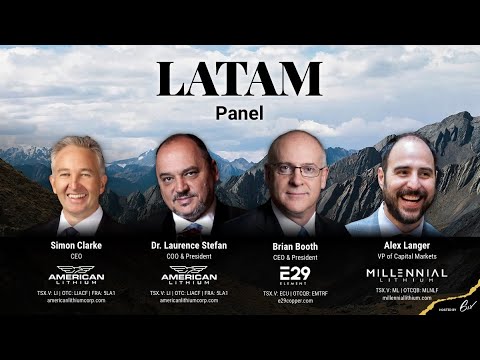
0:10 Hello everyone and welcome to the Latin America panel today, hosted by 6. Today I'm joined by Simon Clark, America Lithium CEO, Dr. Lawrence Stephan, American Lithium's president and COO, Brian Booth, Element 29's president and CEO, and Alex Langer, Millennial Lithium's vice president of capital markets. Today, we're going to be giving each speaker a couple of minutes to introduce themselves and their company. Once we're acquainted, we're going to begin today's main discussion. After, we're going to move to a live Q&A session where we'll be accepting and answering some questions as long as time allows. You can submit any
0:41 questions you have using the Q&A panel found on the right-hand side of your screen at any time. This panel is being recorded and will be available to watch afterwards on SIX.com in the coming days. And without further ado, I'm going to hand things over to Simon and Lawrence so that they can introduce themselves and their company. Simon. Thanks Cam. Hi everyone. I'm Simon Clark, as Cam said, the CEO of American Lithium, and Lawrence is the COO. We were very fortunate to have Lawrence join us recently when we acquired Plateau Energy Metals, which has assets in Peru, which we'll talk about as we go through this presentation. So just giving you a little bit of context and background on us, I want, obviously, there's the usual disclaimers. We are a leading lithium developer focused on the Americas with 3 large development projects, 1 in Nevada, which we call TLC, and more relevant for today's discussion, a large Lithium project in Peru called Falchani, and what is the fifth largest undeveloped Uranium project in the world called Makasani.
1:47 You can see the company highlights there. We're well funded with about 16 million dollars in cash. We love both the jurisdictions we're in. They're both strong mining jurisdictions historically. We've assembled a very strong management and technical team. And you can see from the resource base, again, we've got a very large resource base, both in the US and Peru. So just quickly giving you a little bit on what has happened recently, you can see what a major year for us the last 12 to 18 months have been. We came out with a large maiden resource in Nevada. We've had some very good metallurgical and other work done. Critically at this time in the US, there's a lot of focus on the environmental side as we move through PEA and then into feasibility. And the great news for where we are in Nevada, we don't have any baseline biological issues and we have our water rights secured.
2:48 So a big year for us last year, it did culminate in a strong performance in our stock price, which enabled us to raise significant amount of capital, but also critically again for this discussion, make the acquisition of Plateau Energy and the assets that we have in Peru. And it also allowed us to bring in Lawrence and his team who have been forefront in taking Falchani to battery grade and putting together a very robust economic assessment on that project. And their experience and expertise is also very critical to the stage we are at in Nevada. So jumping through quickly, just to give you a background, you can see the shares out, again, a strong capital structure.
3:39 We were historically a retail, more of a retail company. That started to shift as we've grown and built the company and we're now attracting strong institutional background. We've got a large retail following as well with a large number of shareholders based in the US, obviously with large US assets and the whole critical mineral play in the US. It's been a good place for us and we see a lot of volume on the OTCQB as well as on the TSX. So that's just a little bit on the capital structure. Very quickly on the team, Again, the 2 of us here, myself, Lawrence and I have both had a lot of years working in the mining business.
4:23 Andy Barring, who's our chair and director, has built a number of companies. Interestingly, for today's panel, He was a founder of Millennial Lithium, which Alex is going to talk about, but a lot of experience in battery metals. And then we also have Ted O'Connor, who's a director, worked in Peru, has worked in Peru for many years, along with Lawrence, and has a lot of high level background in the uranium space in particular. And moving through quickly, obviously, we take the whole ESG side very, very, very seriously. You can see a nice picture there of Lawrence with Alex, who was the former CEO of Plateau in Peru. Obviously, community relationships are massive and we spend a lot of time and effort on that.
5:10 We're also very focused in all our projects on bringing best environmental practices together and focus very much on health and safety. So obviously key in today's world. Just wanted to give you this slide. Just shows the dominance in China. Obviously, we have a large project in the US. And when you talk about critical minerals and the need to develop domestic supply, obviously, that's a key angle. But it's not just domestic supply in the US. It's also supply from friendly jurisdictions. And we see Peru very much fitting into that whole plan as we move forward. So that's us very quickly, Cam.
5:56 I know you just wanted us to give a brief background and obviously we'll be around for questions once everyone else has introduced themselves and their companies. Yeah, absolutely. That was perfect. Thank you. Thank you, Simon, for going through that. I'm gonna pass it over to Brian from Element 29. Brian, take it away. Thank you, Cam. And good morning, everyone. Very excited to be here and part of the panel and give you an introduction to Element29, which is a fairly new company, just went public at the beginning of the year. We're a new company but 2 fairly advanced assets located in Peru as well as Simon. We are 2 projects that have benefited from quite a bit of work over the past years and in the past in general.
6:46 So I'll take you through a little bit about why we're so excited about these 2 projects that we're taking to market going forward. So as I mentioned, these 2 key projects, they're located in great locations in Peru. They're close to the coast, low elevation, lots of infrastructure, mining friendly areas with lots, you know, the communities are very knowledgeable about mining and exploration activities, which makes, you know, working with them as stakeholders very, very positive. You know, We have an experienced team in place, which worked really well. I've been working in Peru for the last 12 years. So, a lot of experience in working with the local communities and technical people there. We've assembled a VP exploration, who's a career was a geoscientist for tech corporation, working in Porphyry as well as a country manager, Ricardo Labo that was the former deputy minister of mines, which gives us that other local perspective that moves our projects forward positively. So I'll talk to you a little bit about our share structure, which is fairly tight since we just completed the IPO and the catalyst that we have this year with the money that we raised from that.
8:12 So as I mentioned, I'll start with Florida Cobre. This is located in the Southern Peru Copper Belt. This 100% owned project is sandwiched in between the Cerro Verde mine located about 25 kilometers to the north. And then the Chappie mine, which is on Karen Maintenance about 8km to the south, which is owned by Nexa. So we're an hour and 15 minutes drive from Marikipa, so really good infrastructure, great location, easy to operate, so that makes it very simple for us. This project had a historic resource. It was drilled off with plus 60 holes in the 1990s when the price of Copper was $1 a pound.
8:58 That historic enrichment mineralization, which is mostly Chalcocite, is all above 200m from surface. So we've acquired that and we'll be drilling on that towards the fourth quarter this year. You can see one of the intersections that's from the Phelps Dodge drilling was over 272m of almost a percent Copper. The top part, the Chalca site is running at about 1.4 and then into the sulphide at depth, which is still wide open because it wasn't the target of their project at that time in the 90s. It's been dormant since that time, no drilling at all since we… that's another 156m of 0.58 Copper. So there's lots of opportunity in the Sulphide for very good grades.
9:49 This just gives you a blow up of the project area and the 2 targets that we'll be drilling. The historic resource is called the Candelaria Copper Deposit. It's 57 million tons of 0.67, again, all above 200 meters from surface. So very amenable to open pit mining. We'll be starting our drilling in there in the fourth quarter to modernize that historic resource to 43-101 estimate. In addition, we have a second target, which is our Atravisato Copper Porphyry. It has the same surface enrichment, mineralization exposed and alteration patterns. It's a bigger target, 1.5 by 1.5km. So big potential here.
10:35 We're working on getting that into the drill ready program for 2022 as we move forward. So those are our 2 target areas here. And again, we'll start that in the fourth quarter. We're currently drilling now on our Alita project and that's 100% owned. It was discovered by the company we were spun out of, Globe Trotter Resources. It's located 4 hours drive north of Lima and then 1 hour in from the coast of Barranca. So again, another great opportunity here with, you know, low elevation, good infrastructure, you know, on the way and you can see the pipeline that comes from the Antimena mine and the old Cerro de Pasco belt.
11:20 So again, a mining friendly area in general. This is a much larger porphyry system, 2x2km, it has 5 porphyry centers in it, of which we've drilled 18 holes into target 1. We're now just getting into there because there's several 500 to a meter intersections in there that are in that sort of 0.58% copper equivalent range. So we're tightening that up so that we can get it into a 43-101 by year end. So, and then we'll build road access to the other 4 targets. Here's a blow up of those areas and the 5 targets that are presently on the property. We're currently drilling on the central target 1 with our first hole, we'll be mobilizing a second drill shortly to continue to drill that and expedite the work since we're tightening up everything so that everything is less than 200m spacing on the drilling and then have our maiden resource hopefully by year end.
12:23 And as I mentioned, holes 2, 3, 4 and 5 will be building access to those for drilling in 2022. Both 2, 3 and 4 have enrichment opportunities as well for higher grades. So we'll be exploring for a Chalkasite style mineralization in those targets as well. So both these projects have big deposit potential, certainly starting off with good mineralization and size potential that will be moving forward. As we IPO'd, we raised close to $7M. That's enough money to take us through the drilling to get the resources on both projects. We hope to have the resource at Alida first and then we'll be having the resource after we finish the drilling at Florida Cobre in early 2022 going forward. So excited to be drilling these 2 advanced projects with better than average grade potential here with great locations in Peru and great community support that we'll talk more about, I'm sure, as we get into the panel discussions.
13:36 So thank you very much. That's all I have. And as Simon mentioned, I'll take questions once we get to that stage for the project. Thank you. Great. Thanks, Brian. And with that, I'll hand it over to Alex from Millennial Lithium for him to introduce your company. Alex, go ahead. Cheers, thanks Cam. Thanks everybody. Good afternoon. My name is Alex Langer and I am co-founder and vice president of Millennial Lithium. A little bit of background on myself. I started my career at Canaccord Genuity where I financed a number of companies and projects in Latin America, including Fortuna Silver, which is in Peru, Endeavor Silver, Great Panther, a couple companies in Mexico. During that time, we invested in many countries in Latin America, including Peru, Argentina, Mexico, Brazil, Colombia, even Venezuela. So lots of different spots. But during that time, I got really comfortable with a number of these countries and jurisdictions.
14:32 Currently, I'm also president and CEO of Sierra Madre Gold and Silver. It's a newly listed company. We're developing a number of silver and gold assets in Nairi, which is in Western Mexico. So I'm happy to discuss my experiences in both Mexico and Argentina, the rest of Latin America in regards to the capital markets. So Millennial Lithium. We acquired Pastos Grandes, which is our flagship project at Millennial Lithium, almost exactly 5 years ago to the day. We've been actively working the project ever since. The project had 6 historic drill holes. From there, we did a number of drilling campaigns, a resource report, PEA, another resource report, bankable feasibility study, all while de-risking the project, environmental impact assessment,
15:21 all necessary permits. We even did a fiscal stability agreement with the Argentinian government. We built full operating pilot ponds, a pilot plant, and are actually producing battery grade lithium at a small scale at site. Passos Grande currently contains over 4 million tonnes of lithium, which is quite a bit. I think it's one of the top 3 largest brine projects in the world that's undeveloped. We have a mine life of over 40 years at 24,000 tons per annum. Finally, this is quite important to the discussions today, we received an announce and all cash offer from Gangfang Lithium for over $350 million, which is quite exciting. It's been great to be part of a project kind of from the very start, you know, first drill hole all the way through to successful M&A. So I'll kind of walk you guys through the project a little bit.
16:12 As I mentioned, those are kind of all the salient points. We're located in Salta Prophets, Argentina, which is one of the top mining jurisdictions
16:20 in Latin America. I think when we acquired the project, it was number 3 or 4 in terms of some of those reports. Lithium sector, we can get into a little while later as well. This is the location. One thing that's quite important definitely is the infrastructure and these projects you're looking at. We're fortunate enough that Pasos Grandes is actually the closest salar to the city of Salta. The city of Salta is the provincial capital of Salta, has about A0A million people. We're about a 3 hour drive from site. There's roads, there's even a hauling road for Livent. Just in north of us is Oro Colbrey, as well as Lithium Americas. And to the south is Livent, SQM is over here in Chile. So this is really kind of the heart of the lithium triangle. 40% of all lithium produced annually comes from this area.
17:08 We also have power relatively close by. For our feasibility study, we actually did our energy use using solar power, which is great. Also part of the ESG focus. So in production, once the project is there, it could be the greenest lithium in the world if they decide to use solar, probably a combination of natural gas right there as well. This is a bit on the feasibility study. Turned out really quite well. As I mentioned, 24,000 tons of lithium carbonate production annually, which is a lot. What's nice about this project is you could go higher if you really wanted to. I think that's where the offer came in for the M&A. This project could definitely hold a larger time of January if you wanted to. IRR was over 24% which is great. The CapEx was also reasonable, about $450 million.
18:02 The majority of that was for ponds, actually about a third of it. OpEx were quite low, just over 3,400 US dollars. Again, you're in that lowest cost curve in the lithium brian sector. One thing that also happened recently, which was a big boon for us as well, so we actually got to 99.96% lithium carbonate at site. Anything above 99.5% is considered battery grade. So to have something that high is great. It's what the end users want. And again, that came all into play in the M&A. This gives you an idea of what it looks like, kind of flat in the middle of nowhere, 3,700 meters up in the Andes, which is quite neat. This is our solar, I guess, plant, which houses the energy for our plant and our operations that stands right now. These are some of the solar evaporation ponds. They've been, you know, in pilot operation for the last year and a half.
18:56 As I mentioned, these liners here, that takes up about a third of the total CapEx. This is a community center we built for a community that's located just at the very end of the Salar. It's a gym, there's offices, there's a kitchen. We built a bunch of different programs at local communities, including the universities, which I'm sure we'll get into during our discussions.
19:17 And finally, this is what the Passage Grandis pilot plant looks like. If you wanna see it in full operation, we actually have a really neat video on our website, which is quite interesting. And yeah, that's it for me. Great, well, I'd like to thank you all again for those great introductions and I think we're right on time, but let's begin the discussion. So for today the format will essentially be me leading us through a few conversation points, but as much of a free flow conversation as possible I think is ideal here and I'm excited to hear from you guys and all of your experience in South America and Latin America. But to kick things off let's talk about some of the positives. What do you consider about the South American regions from an economic and business operation as attractive.
20:03 Simon and Lawrence, maybe you guys could start this off for us.
20:11 Yeah, Lawrence, maybe you could also give, you know, I didn't manage to spend much time introducing you a little bit about yourself and the time spent in Peru and then I think it'd be great if you would take that one. My name is Laurence Stefan, I was involved in South America working for the large South African mining house structures at the time, you know, named like Goldfields, Anglo-American, Johannesburg Consolidated Investment Limited, probably heard about those and I had a chance to work in many parts of the world, actually on all the continents and the last couple of years I had a chance to work mostly in South America. I speak a couple of languages, Spanish, Spanish being one of them, so it was quite an easy one. And I had a chance to work from Venezuela to the north at the time when business was easier there. Somebody also was brave enough to do business there, I heard it before, until actually the southern tip of the continent.
21:06 And the reality is that, look, we can say good things, that actually is good to do business in South America, I still believe that it's one of the most progressive, most dynamic, most full of joy place to operate. Unfortunately, the last couple of years, the movement of the government to the left doesn't make life too easy for the private sector. And as we make more and more progress into involving communities, the demands from the government are also increasing. And I'm saying that probably you may think that it's the doomsday in terms of doing business in the mining sector in South America. Not at all. I see that as a challenge, also as an opportunity. It will probably be more difficult for us to operate in the sense that probably it was easy for us to operate in the late 90s and early 2000, the 1st 10 years. But definitely we have to find a different way to involve the communities and the state. You know in some countries like for example Peru that I understand much better than the others although I work in mostly all of them, even of those that actually they do not have a great mining history, like Uruguay or Paraguay, you know.
22:09 So we'll have to find a different way. And that way means that actually the government has to offer a hand in many parts of the world. Actually, they are totally absent and actually have to involve the communities. And I'm very positive that although probably the next 2 or 3 years, it will be a bit more difficult. The deal that actually Milenium just announced in Argentina demonstrate that actually the big mining industry is willing to do business even under those conditions. And I'm saying those conditions, you may probably think that they are very negative. No, they are probably more difficult, but I
22:42 see them as a transition period where actually probably the big mining corporation, they have to accept that actually there is more to given to the state in terms of royalties but also we have to have something in exchange because it will be very unfair for the royalties to increase continuously against the mining industry and actually the state does not to help for example I'm talking specifically about Peru where actually now there are many projects where the government should have probably given a helping hand and probably many of the conflicts with the communities have been solved. Somehow the state decided to be absent. I sense something like that even too much involvement or the Argentinian side or in Chile and actually not the the the the the the rules are slightly different. But as I said, you know, I see it as a positive opportunity. I think all those countries that have great mining, they present, first of all, great mining jurisdictions and they have very good mining laws to operate under and actually that's quite good and even the if probably
23:40 the the noise at the moment it's quite heavy especially in countries like Argentina and later in Peru And let's not talk about others because it's really much worse than that. But I'm convinced that actually after a couple of probably months or years probably be able to find a different way and we'll be able to position ourselves better in the seesaw or actually where business the government and the communities they have to come together to make sure that the progress of the mining projects in those countries will continue for the benefit of all the stakeholders. Definitely so. Thank you. Great. Absolutely. Simon, do you have any more comments? Yeah, no, I think Lawrence has a lot of experience of it. I mean, as I mentioned, the assets that we acquired, I think, speak for themselves. I mean, Falchani is a very unique style of mineralization and great infrastructure, near surface, very strong, robust PEA.
24:42 And Makassani on the Uranium side gives us a lot of optionality. It's not necessarily what we're looking to be. Obviously, we're first and foremost focused on lithium, but that uranium optionality through Makassani is extremely interesting. So, you know, it's a huge area. It's 90,000 hectares that we have, again, with great communications. And Lawrence and the team are very much focused on the green side of things and using the best environmental processes we can. And as Lawrence said, the community relationships, I think, are first and foremost key. But when we acquired Plateau, we looked at Peru as an incredible mining jurisdiction, not just from the geology and the mineralogy, but also a deep mining history. It's very key to the economy of the country.
25:34 As Lawrence said, regimes come and go, but the opportunity is huge. That's really why we made the acquisition. It was also an opportunity for us to bring in a team that at the Peru level has done a bunch of extremely good work in battery metals. I mean, obviously lithium and getting to lithium to battery grade. So we really like where we're placed and We like those assets. Great, absolutely. Brian, I mean, there's a great aspect of this panel, I think that you all have such a diverse experience in Latin America, but Brian, Do you also have comments about this, about what makes Latin America and South America attractive for economic and business operations?
26:23 Yeah, I mean, I've spent most of my time in Peru, so I'll keep my comments mostly focused in that vein. But working in Peru over the last 12 years, I've been through several governments, of course, through that time, and always had the opportunity to work well with the governments at the levels that we work at. There's always been challenges in South America and Latin America in general, as everyone's pointed out. We've always had in general, though, the governments understand the importance of mining to their economies. They do work well with businesses. We have to sort of try and understand and cooperate and work with the stakeholders in new and inventive ways. And I think in startup companies, we do that all the time anyways. And certainly throughout my entire career, I happened to be one of the GEOs that when I worked for INCO that were sent into certain jurisdictions first, and you have to sort of understand where the local communities are coming from and try to work with them and keep them engaged with you, keep them informed. A lot of it is making sure that they're respected and that
27:40 you have a good rapport with them. And we've brought that experience over the years that I've had to Peru, work well with the communities. We've renewed our second agreement for the Alida project in North of Lima for another 5 years and certainly training, and we do different things each time. We talk about helping the community in different ways. We talk to them regularly to understand where they want to go and what they want to do in addition to just hiring some of them for our projects. So, I mean, all of these things culminate with making these jurisdictions who understand mining, especially positive things, positive areas to, to invest in.
28:27 And, you know, just as an example, during COVID, you know, we we made sure that we transported everyone from the community to get their vaccinations so that they had no other way to get to the vaccination. So that's something new that we, but we listen and we provide support as much as we can to those communities and, you know, if you have those relationships you're going to do well I think under any regime.
28:57 Absolutely, thank you for that. You know Alex, you know you're in an interesting position. What are your thoughts? Yeah, I think what everybody has said so far is absolutely true and makes a lot of sense. The one thing I would also add is really just the potential some of these countries in terms of the resources and what they have is why people keep on going down there. You have world-class deposits and world-class teams, and then there's going to be capital ready. And that's why people are looking there. Brazil has literally everything. Peru has amazing mines, Chile, copper. You have the lithium triangle down there as well. So as long as people are still interested in these resources, people need these resources, people are going to be continuing to look where there's abundance of them and that's in Latin America for sure. Great, absolutely. I think we've all touched on it and Alex in your slides you have the great community center and Brian you were just speaking about it, But how do you work with local communities in Latin America and how do you develop
29:55 support for mining and your projects? Alex, maybe if you'd like to elaborate on that community center or any other projects that you've endeavored on. Yeah, no, absolutely. At least for us, we kind of started at least at Millennial with an education component. What we're doing, there are a few other companies out there. It's not so much mining in terms of lithium extraction as it is, honestly, a chemistry experiment. So we're working with local universities and of course, the local community to start building some of that expertise that's going to be needed for once the project's in production. So You're really working pretty grassroots there to build up education. It's just such an important component of any developing country, I believe, is education, number 1. So anyway, we're able to help with that and bringing people up a level is great. In terms of local community and building the community center, we hire them for everything possible that we can. I think they really appreciate that. You're able to help people and you're paying them for work, and they're all excited to have you there. As long as you have great relationships and you're working really closely with everyone, you're gonna get support.
31:04 Even here at Millennial recently, kind of out of the blue, they had a swatch of land, which was adjacent to us at Millennial. And just because of our relationships that we're working well with the local community, you know, there's a value to it and they gave it to us. It was a big piece and allows the project to grow bigger. It was really just because of those community relations we had and working with everybody, that just made a lot of sense and everyone was happy. So as long as you do everything right and you're open and honest, they're extraordinarily happy to have you. I know in Peru, I've been there a number of times. Mining is just such a major part of the economy. If you want to get an education in Peru, you're really looking at mining sector or a little bit of tourism. So it's similar in a lot of these various places. Right, absolutely.
31:52 Brian, you were just touching on it, but maybe you could elaborate. You're just, there you go. Sorry. Yeah, so, communities are so important to the project success and, you know, it's key to moving forward in a positive way. And, you know, in my experience, you know, having that great relationship with the communities right out of the start of the project and maintaining that and listening and having regular meetings with them and lots of discussion. That's gonna go a long way to sending a message to the governments, the central government that we're a good partner, we work well with the communities, we understand, we're sympathetic to their needs and wishes and so on, and we'll find solutions and ways to cooperate together to the benefit of both the company and the stakeholders locally.
32:51 So it is a key part to moving the project forward. And as Alex said, there's a lot of wealth in mining in Peru and a lot of opportunities. You can still walk up to ore bodies there, which is not the case as easily in parts of the world. So certainly a big jewelry box in the country in terms of its wealth and opportunity, which is just going to increase and there's going to be more and more deposits found. We benefit in our projects by the fact that the communities are a little bit more knowledgeable than some others. So in places where I have worked and the communities are not knowledgeable about mining, you have to spend that extra attention and bring a few of them out to see some of the projects and see drilling programs in other parts and transport them there so that they understand what you're doing on a daily basis ahead
33:47 of time so that you can have a meaningful conversation when you go into those brand new areas where mining isn't that prevalent yet. So again, very important. Absolutely. Simon, Lawrence, what are your thoughts on this? Again, I mean, one of the reasons we acquired Plato was they have a very strong presence in country. We have a team of 18 down there, including a very strong general manager that Lawrence just put in place. So, you know, in terms of building those relationships, I'll hand it over to Lawrence, because, I mean, he spent, you know, 15 years on Matt Cassani and then Plateau, building the relationships that we have today.
34:33 So I'd be very simple, and I would say, what are you doing for the communities? I don't like to use so many words as my 2 precursors, but I will say everything. And when I'm saying everything, it's everything. And I should stop, you know, for the nice effect, but we shall continue. So actually when I say everything is everything, from building roads to making sure that actually we have the schools there, the teachers are paid on time, because unfortunately, look, Alex was very kind to show us their beautiful community center, which should have showed us probably the best looking and if not the only one probably in the world, synthetic grass soccer field. So you go to and look 3,800 meters, put another 1,000 meters and you understand the altitude you're operating through. Although it's true, the highest part of our project at Falciani goes to 5100 meters. A lot of people get scared, oh so how? Well it's just altitude, you know, it happens your body to be there, we just have to bring it down. And Tamina still operates in a coach above 5,000 meters. So actually, altitude shouldn't worry you too much.
35:38 So look, it's teachers. Sometimes it's not enough of them, because teachers would like to work in Huliaka. They would like to work in Puno and some of them they start traveling on Monday and they leave on Friday so we make sure that actually those poor kids they have their proper teacher only Tuesday, Wednesday and Thursday. So we make sure that actually by paying those teachers the extra how that the government cannot afford to have teachers there for the kids on a continuous basis. Employing people. We have not 1 community, we have to have 7. And Simon, it's true I worked there for many years but actually it's 18 years on the project, you know, no offense there, you know, we know each other for a short while. I'm joking, I'm joking. But actually we started our early very uranium concessions very early on time. So we had the time where we operate over time with 11 communities of which we have with 7 of them, we have a very close relationship.
36:32 And over time, whether we worked on the uranium side or on the lithium side, we've been able to employ, I would say, probably most of the people. They have a very nice initiative. Women are very much in control on those communities. They have very strong social programs. The area, it's actually, whether the lower side or have all uranium there is still some agriculture mainly potato based because actually corn it's probably to be too high for that once you go to the far Chani to the to the lithium area it's mostly shepherds you know and they have the noble lamas the vicunas so they have to do something with their wool and we've been able to organize some very fancy knitting machines you know training those people and it was not enough. We have to make sure that actually they are very fancy garments are actually and operate and actually deliver not only to Puno and to Huliaca where they achieve let's say 30-40 soles for a garment but we can then go to the larger city. So we try to do whatever somebody who is educated will be able to bring to the communities because the main issue that lags there It's proper education and it's a reality and I'm not saying that as a foreigner But actually the government knows that one very well. And what can we do? We have to educate people.
37:48 We try to employ everybody over time. We try to bring only extremely skilled people that actually the skills were not allowed to not happen to be in that part of the world. So we try to to to to train most of the people in all the basics of anything which is linked to mining. Sometimes we succeed, sometimes we do not. You can imagine since our beginning, because we offer grants to students, we had students that actually we took them from early schools and now we offer them grants and now they are students at universities in Puno or in Huliaca. So when I say everything it's actually everything but look don't forget we are a small company we are definitely not a Peruvian government and we cannot take control and being in charge of everything we are doing our best Now that we are a much larger company, after our joint forces with American Lithium, actually we hope that we'll be able to do more for the communities. The communities appreciate that one. And look, I just hope that with the social programs that we started almost 14 years ago and we continue, actually the areas will probably have some development and probably the best development will be on the mines, will be in production and hopefully that will happen within the next decade. To say the least. Thank you. Thank you.
39:02 Absolutely. I mean, I think that was really great. As you say, everything is wrapped up together. You gotta do everything, I guess. We've talked about positives. We've talked about some of the difficulties and as a result, we've touched on, you know, what it's like to be boots on the ground and what you have to be doing and how you build up your companies. But I love this question. How do you see, how do each of you see investment, the investment climate in South America evolving in the future? And what should investors be excited about? And are there any trends that they should be aware of or following? Brian, I'd love to pitch that to you first. Sure. I think you can't take away from the opportunities that are there in South America and in Peru. Again, I'll talk about where I'm currently working, but the opportunities there are going to just increase. So there's lots of great geology.
39:58 It's gonna produce a lot of deposits. Investors should benefit from that if investing in companies that are coming in there and exploring for those new deposits. The place is second largest producer of copper in the world, so certainly I'm biased towards copper, but there's lots and lots of copper opportunities still to come forward in the country. So investors will benefit from looking at those companies that are doing the right things in the jurisdiction that are well-funded, et cetera, to move the projects forward. So I think it's a great place. Even going forward with new challenges and so on, the world is going to need these metals.
40:45 These are great jurisdictions. They have a lot of opportunity for these strategic metals that we haven't talked about in general that are needed for the economies that the world wants to move into in the next 30 years plus. These are the places where those are going to be found and the world needs those metals that can't walk away from that. So again, a great place to invest and great opportunities still present themselves there. Absolutely. Any other trends from the panel? Any other moments of excitement that investors should be aware of? I'll pitch this to Lawrence, Simon, Alex, if any of you like to hop in. Yeah, I mean, I think from my perspective, Cam, I mean, you know, I've worked in Africa, not as much as Lawrence has or in many countries. But, you know, again, to reflect on what Brian said, I mean, Peru is a tried and tested mining jurisdiction.
41:46 It's got great assets, as we know. And I think, you know, when you look at it from a lithium perspective, in particular, I mean, we're getting a lot of, you know, a lot of interest from the government and locally because, you know, We are the main Lithium project in Peru. And I think there's real opportunity there. And you just have to look around. I mean, you know, you can read in the press that there's some negative governments. But, you know, Alex just told you that Millennial Lithium is being bought at a very nice price. Bacanora in Mexico is the same. So if you have good quality assets and projects, which I don't think there is a better place for these kind of minerals, you are going to attract lots of investment interest and lots of M&A opportunities. And just speaking on the battery metals, if you even look at the most conservative prediction about the amount of lithium and other battery metals we need, We've got to find good jurisdictions where we can process and develop these minerals and produce them.
42:53 And I think South America is really well placed as we're seeing on this end from the M&A side. And I think that's only going to continue as we move forward. Yeah, I would kind of reiterate what Simon just said. Seeing M&A happen, at least in the space, is a big deal for people. We raised $100 million previously over the 5 years of the company, and it shows there's capital out there, Absolutely. And people are willing to risk their early stage capital for higher returns. And we've been seeing that. And as long as we continue to see that, that's great. We were well underway of raising our 450 million for the CapEx. It wasn't easy. It wasn't going to be easy, but we were getting close. And it just goes to show that the funds and the various debt financing tools we were going to be relying on were available to us in Argentina.
43:47 And it's also available, obviously, in other countries as well. But to know the capital markets were out there and willing to have a perceived risk in terms of lending, equity, debt, offtake, everything within Argentina, it was a really positive sign. So I think as these projects start from a drill hole all the way through to M&A or through to production, it just goes to show that the opportunities are there and investors will continue to follow it. Great, absolutely. Thank you for this. I think just looking at the time, we're gonna move over to the Q&A. So I'd like to remind everyone in the audience that you can ask any questions you like, and we'll try and get to them, time allowing. But to start things off, we do have a couple of questions that are to a degree related. So, and I think this is primarily for American lithium, but what's happening at this point with respect to the ruling that we're waiting from Castro in Peru regarding concession dispute?
44:45 Yeah, I think that sums it up. So, Lawrence, if you could take that. Yes, I assume the question is regarding Judge Hermosa, who is actually our judge now on Court 6 of Lima. Look, what can I say? What happened with us in Peru, it was very unfortunate. I do believe that it was very wrong because I wanted to add something before what you do great with Peru and I wanted to reply but somehow you cut me short cam but thank you very much for the opportunity look we just we brought lithium to Peru So you know we did something that I do remember the first hole and we said listen I have 100 meters of lithium in our realization and nobody said it's impossible because the reaction from the geological survey, the chamber of mines, you know, the business circles of the country said no no we know the rocks, you know the country, you know there is no lithium in Peru so well really so not only that we brought lithium to Peru but we brought one of the largest and probably one of the highest purity lithium association of lithium was the in the rocks anywhere in the world, you know, I'm talking about not like like Salar, like Brine, like Alex's deposit, but definitely hard rock. So that was great, you know, anecdotally, we brought lithium to Peru and actually we made Peru making the major step not being associated as a major copper precious metals and other base metals like lead, zinc, tin but also moving into the energy because green energy uranium deposits are huge in Peru
46:15 it's one of its funny enough you know we do believe that both of these deposits are probably uranium deposits. It is the fifth largest undeveloped anywhere in the world. And depending on how you look at the lithium, probably the fourth largest in terms of undeveloped hard assets. But look, Coming back to your question, we thought that we did something great, so we found very unfortunate the situation that actually the geological survey of a sudden said that, well, you know, guys, you have some problems with those concessions. We fought it hard, and we should have probably had a resolution solved by now. Unfortunately, the pandemic hit us on a completely different level. I think we are making good strides. You could see by now that actually all the 32 constitutions are now protected under an injunction. It's called medida cautelar in Peru.
47:00 And we do know that actually for that the ruling of Judge Hermosa is imminent. We expected it actually the last couple of days. There are signals coming actually from the what is called Poder Judicial, the Justice Minister. And we hope it will happen this week if not definitely next week and it was very delayed, it was mostly the pandemic and we are definitely hoping for a very very positive ruling considering actually the tone and the language used when we obtained the injunction over the 32 concessions. And I can tell you to our shareholders that the ruling is probably very, very close, but really very close. Yeah, and I would, Kat, the only thing I would add to that is obviously when we bought Plateau, we were fully aware of this and we bought Plateau on the basis that if we didn't get those concessions back, we still thought it was a fantastic acquisition.
47:56 You know, one of the key concessions involved actually, if it comes back, will add 40% overnight to the already robust Falciani PEA numbers and the robust economics we've got. So it is very meaningful. We took advice at the time that indicated that on the balance of probabilities, we would likely get it back. But again, we made the acquisition based on it not being there, the assets that are there in the team and the potential. Valchanyi, like it's a 90,000 hectare area and we've barely scratched the surface. And as Lawrence says, it's the fourth largest deposit on the planet, even without that 40%. So, you know, it's going to be very material if it does, you know, obviously come back. But again, we didn't make the acquisition on that basis, but obviously hope that it does.
48:47 Absolutely, thank you. Jonathan in the audience was hoping that each company could walk through where they are with study work on each of their projects and timing for the release of their next study. So I hope that applies to everyone here. Alex, if that applies to you, please feel free to kick us off with that. Not particularly. We've kind of completed all our permitting as well. There is 1 permit left and it's really just a construction permit, relatively straightforward. So it's going to be based on what size the eventual purchaser gang thing of our project wants to go. So if they want to build a 24,000 ton facility or possibly a 40,000 ton facility, it's going to be dependent on that. Then you have to get your architectures and your engineers, they sketch it out and you'd submit it. So it's more of a building permit than it is, you know, export permit or environmental permit, all those are already in place. So one thing I can comment on is what I found really helpful and it was kind of led by our management team is parallel track. So as we were, I guess, exploring for lithium, we were also engaging the permitting process, starting environmental assessments early and just making sure everything is kind of in line so that when you're ready to raise the next round of capital and you want to move into production, all your ducks are in a row. So you're kind of constantly de-risking the project with every step of the way and permitting is one of those things.
50:10 Great, thanks. Brian, if that applies to you? Yeah, well, We're not at that advanced study stage, but our next milestones are the initial resources on both projects. And at Alida, we'll be doing the maiden resource there because it's a brand new discovery made in 2016. So it's a brand new porphyry. And so we'll have a maiden resource by year end, hopefully. We're drilling right now. We'll move a second drill on there to expedite that so that we can get that milestone achieved by that timing. At Florida Cobra, we already have a historic resource. We've located all the old Phelps Dodge holes. They're still sitting there with pipes sticking out of the ground, so that was easy. And we'll be drilling in and around that towards the end of the fourth quarter, and then that will lead to a new resource 43-101 for the first quarter of 2022. So those are 2 key milestones. And then Florida Cobra, because it's an enrichment zone, we'll be moving very rapidly to take that project through to PEA in the latter part of 2022. So that one's going to move forward fairly rapidly.
51:26 Alita is all about resource growth. So getting to those other 4 targets after we do the Maiden resource to add more to that overall global resource will be our next deliverables. Great, absolutely. Simon? Yeah, so I'll just talk very quickly. I know it's not directly relevant to this and I'll ask Lawrence, but obviously in Nevada, we're working right now on pulling a bunch of the information together that we need to complete our PEA. The timing on that, the fastest possible will be the end of this year, it's much more likely to be early next year. And I also mentioned along the lines Alex said, it's funny, we talk about permitting in all these other countries, but the permitting process in the US can be pretty protracted as well, as we all know. So we started our next plan of operations back in January, which we, you know, we're still working on.
52:24 We announced today, we, you know, the environmental assessment piece of that is coming together over the next 2 to 3 months here, which will then allow us to do the next phase of development drilling and delineation drilling there. So as we pull the PA together and then move into those operations, we'll then be in very good shape to move forward into the feasibility phase. So, you know, we've thought long and hard and early on we secured water rights. We're looking at all the other permits we might need to bring in gas pipelines and other pieces of infrastructure. So I think Alex's advice is a good one. You've got to be up front. You've got to think of these things early and get moving on it. So, you know, we're well positioned in Nevada and I think we're really well positioned in Peru. I mean, obviously, the projects down there are already through PEA, but I'll let Lawrence talk a little bit about the plans there in terms of the next steps on those projects.
53:23 Thank you, Simon. As Simon said, yes, we are more advanced than what's happening in Nevada. We have on the uranium side, we have a couple of PEAs and we had to do it because we discovered more and more of the uranium, it's plenty of uranium there, we believe strongly that we just crossed the surface and by now Makosani is the fifth largest, I have no doubt that with the right amount of exploration expertise we can probably double, even triple the resources there, making it probably one of the largest uranium accumulations anywhere in the world but the Athabasca Basin in Canada. Falciani is something else, we have only 1 PA but a very good one and it's based only, as Simon said, because of the realities of the judicial problems, on only half of the deposit. And even that deposit, assuming that it will come back to us through the judiciary, will probably be able to...it's drilled only about 60% of it. So the potential for lithium, it's huge on the plateau, notwithstanding another 3 targets that we are planning with a new permitting to drill.
54:24 Probably we thought that we'll start in August, but probably start sometime in September. So in terms of development, I would say probably are definitely more advanced than Brian and I wish him the best of luck. Hopefully he will bring his copper projects into and he will be able to deliver good PEA but not as advanced as Alex's. However what we've been able to achieve, although look in Falciani it was something amazing, now we've been able in 2 years to bring it on a new discovery not only a new discovery but a new form of existence and the currents of lithium on planet Earth into people believing now it doesn't exist now it's real low it's huge oh it's amazing and have a very good numbers back on the 1st PA. And on the uranium side, unfortunately at Fukushima we had to stop a bit the engines because Fukushima didn't do too much good to uranium, Not even to the uranium producer, notwithstanding what's happening with the small exploration companies.
55:22 But I would like to believe that a new focus on green energy, future, and I'm talking about immediate future, 6 months, 1 year, 2 years, will demonstrate that uranium is as green as lithium is not greener because not it has not only the storage of energy but definitely producing this amazing non-pollutant energy. We have to convince the world, You don't have to convince me and probably the speakers around here and I would say probably two thirds of the mankind But look there are people that they still believe that we can go to live in caves, you know I'm sorry to inform them, but if 40,000 years ago mankind could live in caves With slightly more of us today's are not so many caves so we have to do something to allow the planet to develop and we need energy for that we don't know how to do it without energy we live in this type of diverse phase of mankind development to energy it's actually the main part probably in the future will be different but at present for the next 50 100 years we need energy and that's me to ran him is the way to move it so with those said look we definitely were we permitting we never had any problems with permitting actually sometimes they were delayed you know because there is a bit in the past it was easier because you had to apply at the central agency in Lima now each and every minister not only mines but also the environment they have their branches in in the region so we have to do it both at the region and the central level. Right, thank you, Lorenzo. And no, I'll finish now but in principle look we do believe strongly that the PIRMI team, we have to move into
56:53 feasibility study. We have, as I said, successful PAs. We have to do both exploration and actually more development. And I would like to believe that next year will be as Alex's, will be in a pilot plant stages. And from there, the roads to feasibility, the only thing missing, it will definitely be construction. Thank you. Thank you very much. And with that, we are getting close on time now. So I'd like to just pass it along to Oren for a second, some closing remarks before we sign off for the day. For everyone in the audience, I do know that there are lots of questions that have gone unanswered, but we will be sending these questions along to all of our panelists here today. So press assured, they'll have eyes on and they'll be able to follow up with you later. So with that, Simon, maybe if you'd like to give some closing remarks and we'll move around just like we did at the start.
57:43 Yeah, thanks, Cam. And thanks, everyone, for for listening today. And thanks for the fellow panelists. I just finished by saying we obviously made our acquisition of Plateau at an interesting time in the politics of South America. But we are fully happy with that decision and believe as both Brian and Alex and Lawrence have said that the potential is huge and the opportunities are huge. So we're delighted to be there and We'll be moving into our next phase of development, as Lawrence said, and hopefully moving into feasibility at Falchani as we move through next year. So lots to do on our front and you'll see lots of milestones and news flow coming.
58:29 Great. Thank you. Brian? Thanks again, Cam, and to 6 and to all the panelists for all your comments. Again, just follow E29. We're committed to Peru. We believe in Peru and the potential there. Great jurisdiction and we've got some great milestones to move the project. We're on the trajectory to get through to more advanced studies, etc. In the years to come. So it's a great opportunity with a $40-$50M market cap to take advantage of it now. And thank you very much for today. And Alex. Great, no, thanks Cam and 6 and the rest of the panelists. I really enjoyed this. It's very useful learning about some of the other countries and some of the other projects, but I just kind of reiterate everything.
59:16 Latin America potential there is phenomenal. It is. We see it every day. I think Millennial just being a success story where you can see something that, you know, less than 5 years from, you know, first investment all the way through to an M&A transaction, a successful M&A transaction. It's going to keep me and I know a lot of my investors investing and looking at South America. That's why we've moved to Mexico with Sierra Madre Gold and Silver. So yeah, if everyone, I wouldn't be too concerned. I know even myself, the news in Peru came out and then a couple weeks later, first manager says, oh, it's not going to be like that. Then a couple of weeks later, they'd lighten their tone, lighten their tone, lighten their tone. Mining, oil and gas, everything resource exploration is such a big part of Latin America, and it's going to continue to be so. I wouldn't be too concerned about sensationalized stories as they come here and there.
1:00:05 Right. Well, thank you again to everyone on the panel. Lawrence, Simon, Brian, Alex, thank you for coming on. I'd like to also thank everyone in attendance today. But With that, we will be wrapping things up. So I hope you all have a good rest of your day. Cheers.