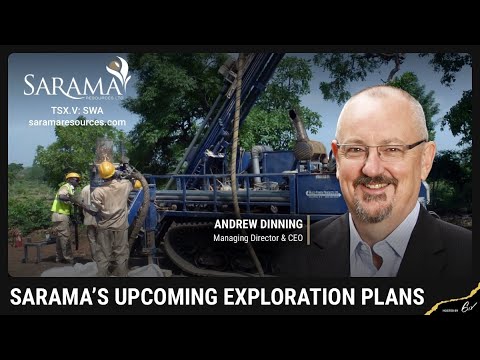
Automated transcript · Written by software from the replay's audio. It can mishear names and figures; the replay is the record.
0:39 Okay, thank you, Cameron, and welcome everybody. Yeah, this is our first summit for the year and looking forward to kicking off 2022 in a good way. Hopefully today's session will be an interesting session for everyone. We try to pitch it at a middle medium level but if you have more detailed questions feel free to ask them at the end of the webinar. I guess quickly though for Cerama over the last couple of months, you know we've hit a few major milestones. We've put out a resource update on Sanitura and pushed that close to 3 million ounces. Importantly the oxides are around 1 million ounces pit constrained now. I think the other key milestones for us has been getting a couple of the key permits in Burkina issued which has taken a while but we've got there so that happened just before Christmas. So we're now well positioned to move things forward.
1:33 So we're in pretty constant dialogue with our brokers and lawyers in Australia with respect to our ASX listing, which will be a secondary listing. We expect to file paperwork for that early February to get the ball rolling and hopefully be on the board on the ASX by the end of the March. So that should put a bit of money in the tin so Jack can get on with work programs that he's got planned now. But I'll just quickly start with the forward-looking statement. You can probably get this off the website and have a read. I won't kind of labour through that because time is of the essence. And we'll move over to looking at what the Santa Tura project is and our plans ahead this year and next year with respect to exploration. So with that, I'll hand over to Jack.
2:26 Okay, thank you, Andrew. And thank you everyone for tuning into today's presentation featuring Cerama Resources. And let me start off by wishing everyone a healthy and wealthy 2022. My name is Jack Hamilton. I'm the Vice President of Exploration for Cerama Resources, normally residing in Ouagadougou, the capital of Burkina Faso, but coming to you today from the sunny shores of Nanaimo, BC. Today's presentation is primarily concerns our flagship property called Sanatura, where we think there's an excellent potential for increasing the project resource ounces with our upcoming exploration programs.
3:12 With that in mind, we have a 60,000 metre drill program lined up with the objective of adding 500,000 ounces of gold or more. It could push the Sanitura project's combined ounce total to well over the presently established 3 million ounces. There's a lot to cover today, so let's dig down into the project and into the program. There we go. The Sanitura project. So Where are we and what is the starting point for 2022? As you can see on the figure to the far left, our projects are located in the Southwest part of Burkina Faso in West Africa.
4:02 And Sanitura project is the one colored in red. The Karen Castle JV project in partnership with Endeavor Mining is in blue. And our Kumandara project is colored yellow. The figure in the center shows the Sanator project sitting over a large area of Burimian greenstone type rocks of the Hunde Greenstone Belt. And the project area includes 2 principal deposits with established resources, the Tancoro and Bondi deposits, and these are shown at the end of the red arrows there. So in essence, we start from a significant project base of approximately 3 million classified ounces.
4:52 And we'll go on to the next slide. Perfect. Regional gold endowment. Well, the project potential comes down in many cases to a location. And it's always nice to have a good neighborhood, to be in a good neighborhood and have great neighbors. So in our case, our flagship Sanitur project and our Cairn Castle JV project are both located in the Southern Hyundai Belt, which is the largest and probably the most prolific greenstone belt in Burkina Faso. And the Southern Hyundai Belt has 3 operating gold mines. The still producing Mana Mine to the north, the high grade Yeramoka Mine just south of that, and the ever growing Hunde Mine just north of our project.
5:44 And The operating mines have production and reserves totaling well over 11 million ounces and probably somewhere between 11 and 15 million ounces today. While the regional defined resources south of the Hyundai mine are above 6 million ounces. So the bottom line, we have a very well located project in a belt of large gold deposits and gold mines. The Sanitour project, well this slide shows the ground position of the Sanitour project outlined in red lines there, the red boundaries. As mentioned, the project hosts a multi-million ounce Gold resource.
6:34 The project area covers almost 1500 kilometers squared. There are more than 5 million ounces of undeveloped Gold resources within a 35 kilometer radius of the Tancoro deposit. So a gold endowment in and around our project area, if you will. Our 60,000 metre drill programme has been modelled to test brownfields and greenfields targets alike. And so the takeaway for us, we have a large ground position where there are proximal undeveloped Gold resources and there's a large upcoming drill program to drive discovery and add to the resource base.
7:24 Let's see, the exploration focus for the next couple of years, where will the new ounces come from? Well, first off, the primary focus will be to increase the oxide transitional and free milling resources to well over 1Moz Gold, mostly with shallow drilling. This will be within 60-70m in a vertical sense. There will be a drilling program to convert unclassified material in and around the Tancoro and Bondi resource pits where the data is limited. And there will be a verification drilling program at the Bondi deposit targeting unclassified resources that didn't make it into the recent resource estimate.
8:15 Mineralized structures at different orientations to the main north to north, north east striking load system are also targeted. And this, what I mean by this are splays, crossover structures, flat structures that could materially grow that total gold resource. Within the Sanitura and Kumandera projects, we have more than 50 targets identified that await follow-up drilling and even their first round of drilling. The bottom line, if you will, there are numerous avenues here whereby we can add resource ounces relatively quickly. This is Surama's pipeline.
9:04 There are 3 project areas here across the bottom of the page, Sanitur South, Sanitur North and Kumandara. Caron Castle is excluded because it's an Endeavour operated project at the moment. There are 6 levels of growth and confidence up the left-hand side of that triangle, from exploration anomalies at the bottom through to reserves and production at the top. The essential takeaway here is that as a junior exploration company, we have a well populated pipeline and these exploration entities, if you will, are advancing with each exploration program. Now, either we advance them up or we advance them out.
9:54 And soon we may be able to elevate many of our prospect type resources at levels 4 and 5 here to the reserves and production level. Okay, a bit of Tancoro history just briefly. The figure to the right shows our degree of drilling over the Tancoro property. Air core holes in red, RC holes in blue and the diamond holes in black. You can see that the drilling is concentrated along what came to be known as the Western or Tancoro corridor. Long story short, Tancoro was a soil survey discovery over unexplored ground and there were no artisanal workings marking the presence of mineralization.
10:43 The resource ounces increased significantly over time from 2012 to 2020. And the takeaway with our increased understanding and modeling of the deposit, we continue to add significant ounces and grow the deposit out. Southern Santour Project. This is the Tancoro deposit proper. Just a high level overview here of the Tancoro deposit. The figure to the left has the mineralized horizons in red marked on top of the interpreted geology map. And briefly, the twazit has a large mineralized footprint. It's been drilled over 12 kilometers in strike length and across 1.4 kilometers of width.
11:34 The deposit also sits within a 30-kilometer long lithostructural corridor in core sedimentary rocks and early faults that are sealed by these gold-associated porphyry dikes. You can't see that on the figure to the left, but there are extensive porphyry dikes cutting through the geology there. Now 70% of the defined resources are within the top 150 meters. We're data limited at depth. So the exploration focus is to grow the oxide transition ounces to well over 1 million ounces. That's a good starting point. There's the goal to extend the strike of the main mineralization beyond 12 kilometres in length, and we have lots of opportunity to do that.
12:28 We have recently identified flat-lying structures in the oxide zone that we need to target. There's numerous targets in linking and cross structures. We are continuing to grow the resource ounces in the eastern mineralized corridor, 10km to the east of the Tancoro deposit, but it's not shown on this figure. The bottom line though, the Tancora deposit has a very large footprint. It has multiple orientations of mineralized zones yet to be fully drilled out, and the deposit continues to grow with each exploration program. A busy figure here.
13:17 It's the exploration areas in the Tankoro Corridor. The map on the left is the gold soil geochemistry map for Tankoro and Wangoro properties combined. Outlined within the black ellipses are regional target areas for which Surama has exploration programs in place, but which are too early stage to go over in a limited time period here. And you can see that includes the entirety of the Eastern Mineralized Corridor. The red ellipse encompasses the main exploration program for the Southern Sanatora Project and is centered around the established resources in the Tankoro deposit along that 12 kilometers of mineralization.
14:07 And the Tankoro targets located on the map to the right, which is a close-up of that 12 kilometer length of soil anomalies associated with the Tancora deposit. This map also has the mineralized lenses indicated as black lines on the Golan soil map. You can see 2 corridors of mineralization there within the broader soil anomaly, and as well as the deposit names along the right-hand side of that figure. This is where a substantial amount of the upcoming drill program will be focused, and there's still lots of potential for adding to the resource base within and along these known deposits. The central Tancoro deposit, and this is just a part of it, The figure on the left is the grade distribution along part of the tank or deposit. Clearly, this shows the wide and strong pods that are the and MC zones.
15:14 The inset figure on the bottom right shows the 12km extent of the deposit and the position of the and MC pods within that deposit and the mineralized horizons around red lines in the figure. These and MC pods represent an important part of the central loads of the Tancoro mineralized system and they could be considered like starter pits in any future development scenario. Future development scenario. And these high grade pods are characterized, they're characterized by wider zones of mineralization, which is thought to be related to the intersection of North, Northeast trending regional faults with localized northeast trending link faults, splays and crossover structures, if you will.
16:14 I will just take you down now into the zone. The figure is our gold soil anomaly map on top of a satellite image. The black dots are the historical drill holes. The green dots are the planned drill holes. Mineralized horizons are marked as red lines. The conceptual pits are black outlines on that figure to the left. Now drilling has produced highlight intersections that you can read at your leisure below and these are significant gram meter intervals. The planned drill program coming up is multi-dimensional and will test extensional infill, near-pit reclassification targets, if you will, as well as splay or linking structures.
17:15 And The purpose of the drill program is to add ounces and gradually merge the pits for the simplification of development and mining. The drill program has been planned to consist of air core, RC and diamond drill holes for a combined total of 9,700 meters. Now we go to the MC zone, which is just to the south and east of the zone. The figure is again the gold soil anomaly map on top of the satellite image. Black dots are again the historical drill holes, green dots the planned drill holes, mineralized horizons marked in red lines, and the conceptual resource pits, black lines.
18:09 And drilling has produced highlight intersections that you can read at your leisure here on this slide. And these are significant gram meter intervals again. The planned drill program is multi-dimensional and will test the extensional infill near pit reclassification targets as well as splay or linking structures. The purpose of the drill program is to add ounces and gradually merge the pits, again, for the simplification for development and mining. And here we have a combined AC-RC
28:01 in the Bondi deposit. This is a long section along the Bondi deposit here and represents the grade distribution and relative depths of mineralization in the major North-South load in the central and northern part of the deposit. The section is approximately 3 kilometers long. The figure also shows that there is still exploration potential at depth by following the plunge of the higher grade chutes that appear to have steep northerly plunges. You can see 3 white arrows on the left side of that figure. In a more regional sense, on the Jarkadugu property, which hosts the Bondi deposit, the figure on the left is the simplified geology of the Jarkadugu property, showing the stratigraphic domains, the main shear structures, and the location of the Bondi deposit in red.
29:04 I'm just using this map to show the location of the 4 main target areas, which are outlined in dashed rectangles outside of the Bondi deposit area. And all of these targeted areas have historical drilling. The Northwest prospect that lies to the north lies along a regional shear structure. It's characterized by a coincident chargeability resistivity geophysical anomaly. There are some historical drill results here from Orzon's time, 2 meters at roughly 4.5 grams per tonne gold, 4 meters at 1.89 grams per tonne gold, and 14 meters at over half a gram gold. To 10 Gold and 14m at over 0.5g Gold.
29:51 Moving south is the Zanawa prospect. It lies along the contact of intermediate intrusion and mafic volcanic rocks that are away from the regional shear zone. It's highlighted by significant drill intercepts such as 22m at 3.85g per tonne Gold, 29m at 1.44g per tonne Gold, 27m at 1.05g per tonne Gold and 10m at 1.24g per tonne Gold. That's a significant discovery that we will be following up on. Then there's the South Extension prospect. It's a southern continuation, if you will, of the Bondi deposit.
30:39 And it's returned drill intercepts such as 13 metres at 1.5 grams per tonne gold, 6 metres at 1.93 grams per tonne gold. And this indicates that the southern extension of the Bondi deposit is not closed off. Then there's the southeast splay prospect, which we now call Malbus. It sits along a southeast trending splay structure that splits from the shear structure hosting the Bondi deposit and has returned historical results such as 3m at 4.7gptG, 3m at 19.6gptG, 7m at 2.43gptG and 6m at 3.46gptG. It represents a prime target for higher grade ounces.
31:30 The next phase program, which is a drill program, is modeled at 10,800 meters, and it will include air core RC and diamond drilling. Okay, just an example now of some of these prospects. This is the Zanawa prospect. This is a cross section through the Zanawa prospect to highlight its good potential really of adding quickly to the resource ounces. You may have seen it in the Cerama news release from a few years ago. The Zanawa prospect is a soil geochemistry discovery made by Cerama. It's 5km to the northeast of the Bondi deposit.
32:16 The prospect has received Air Corps and RSC drilling in the past and the significant drill results include 22m at 3.85gtg, 29m at 1.44gtg, 27m at 1.05gtg and 10m at 1.24gtg. The prospect sits at the faulted contact of an intermediate intrusion and mafic volcanic rocks. Mineralization generally strikes to the north as steeply dipping narrow horizons, but there's a main mass of mineralizations that strikes easterly with a moderate dip to the south. And there's a drill program in place that consists of air core, RCN and diamond drill holes for a combined total of 6,000 meters proposed over this target and targeting extensional and cross structures.
33:21 This is a different property. This is the Bamako 2 property, and this is just east of the Jarkadugu property. And We're going to look at this. It's an early stage exploration target. It has several pipeline prospects on it. The geology consists of a wide band of basalt gabbro rocks wedged between intermediate intrusions to the west and to the east. The faults and shears within the basalt gabbro unit host stacked gold quartz veins with accompanying ceracite Pyrite alteration zones. The various prospects have been explored intermediately over the years and produced highlight RC drill intersections such as 8 meters at 18.4 grams per tonne gold, 18 metres at 1.2, etc.
34:20 The figure that you see there on the left of this slide is the Gold and Soil Survey results, and You can see that the basalt gabbro is the preferred host for mineralization in this area. And there are vein swarms here that we can follow for more than 3 kilometers with the aid of what is significant artisanal mining workings over this particular prospect. Our next phase of RC and diamond drilling will total 3000 meters. Our Kumandera project. Meters. Our Kumandera project, now it's strategically located along a corridor of regional scale shear zones in the east Banfora shear belt.
35:23 And this property is in the Banfora greenstone belt, which is the next greenstone belt to the west of the Hyundai belt. And the regional shears separate a litho domain of basinal sediments to the west. You see that in the figure on the right. These are the brown, brownish and tan units. These are the basinal sediments and they're separated from a mixed domain of mafic volcanic and late stage intermediate intrusions to the east. And the gold soil geochemical anomalism not shown here tracks the main shears in the north, northeast direction.
36:11 Historical drilling has been dominantly in the north of this project area in the Nyanoo and Dabokwe properties. Mineralization is exclusively of the gold quartz vein and veinlet type in steeply dipping zones, as well as flat zones that are blind to soil geochemistry. High-grade drill intersections have been encountered in historical and in our drilling, such as 4 metres at 13.55 grams per tonne gold, 7 metres at 6.86 grams per tonne gold, 4 metres at 10.5 grams per tonne gold, 13 metres at 2.9 grams per tonne gold, 7m at 6.86g of Tungold, 4m at 10.5g of Tungold, 13m at 2.9g of Tungold, 15m at 1.8g, etc.
36:59 And we have a drill program consisting of 77 RC holes here. There's not a lot of sapper light in the zone, so we're using RC drilling for a total of 5,500 meters. And we're proposing to target steep dipping vein extensions as well as flat veins. So in summary, Surama feels that there is abundant exploration upside to the Sanatora project, as well as the other projects also that I've mentioned above, and this will be addressed in the next phase drill program.
37:48 There are more than 50 compelling exploration targets that have been identified by Cerama within the larger Sanitura and Kumandara project areas. Many of these targets will be further explored with the view to establishing multiple satellite feed deposits, if you will. The exploration target expectations in the coming program, We're targeting proximal and near pit drilling at Tanquoro and Bondi. Our target is to provide another 200,000oz of Gold in that program. There is an exploration drilling over multiple targets across all project areas, and we're hoping to bring in another 300,000oz to 500,000oz of Gold.
38:43 A good part of these conceptual ounces I'm mentioning will fall into the oxide and transitional material category, so near surface, and our improved geological understanding and active pipeline exploration gives us confidence in continuing to grow Cerama's assets into the future. And even partial success will bring the Sanitour project to well over 3 million ounces. So again, a 60,000 meter program of air core RC and diamond drilling has been proposed to start in Q2 2022. And that brings us to the end.
39:30 It concludes the view from Exploration Burkina Faso. Thanks everyone for listening. Wonderful. Well, thank you for that great presentation, Jack. Listen, now that we're entering into the Q&A portion of today's summit, I'd like to remind everyone in the audience that you can ask any question you like using the Q&A tab found on the right-hand side of your screen. We've already had some questions come in and I'll begin with this from Ken. Is there a project that can be advanced to production in this gold cycle? Yeah, okay. Thanks for the question, Ken. Well, I guess it depends how long the gold cycle is, but we think there's definitely a project there to be advanced this gold cycle, even if it's a short cycle. This next round of drilling should take us to the point of being able to put a pin in the resource figure and then move ahead and put out a PEA and then roll that straight into PFS.
40:28 I think if you look at the project historically, we've had a couple of holdups in recent years so that there's not been a significant drill program undertaken on it really since 2017. So anyone that's been close to the story since then will have seen that there are various delays caused by a JV partner that kind of ran into problems in Tanzania and stopped work on our project as a result. And then following that, there's been a few kind of holdups along the way with permitting and whatever. So the work that we've got planned now, you know, it's been in the shoot for a while, but most of it's fairly shallow, as Jack mentioned, it's relatively inexpensive.
41:15 And we, unfortunately, we'll be starting kind of a third of the way through this season, but had we started at the beginning of the season, we think we probably would have got it knocked off by June, July, but hopefully we'll get, you know, the key bits done by the end of this season. But yeah, we think that there's definitely a project there to be advanced and really this work now is to frame up what that looks like. Great. Thank you for that, Andrew. John Willett was wondering if you could qualify how far it is from Tancoro from Bondi. Yeah, thanks for the question, John. Yeah, it's about 35 kilometres from Bondi to Tancoro. It's flat open terrain so it's readily truckable.
42:01 As Jack mentioned the run of minegrate on Bondi is going to be quite good. So in the oxides and the fresh it will run between 2.5 and 3 grams. So it's inherently truckable. The cost trucking cost in West Africa at the moment you know it's probably somewhere between 12 and 15 cents a tonne kilometre. So we're kind of internally using $6 a tonne to truck from Bondi to Tancora. So we think that's inherently doable. And I guess in an Australian context, it's pretty minor from a tracking point of view. Right. Thank you, Andrew. Harry Sanders in the audience has a number of questions. We'll begin with what will the budget for the drilling program be?
42:46 Yes, it's the stage 1 of the program for drilling will be about 3 to 4 million. So if you look at the split of that 60,000, that's all US dollars by the way. If you look at the 60,000 metres of drilling, it'll be done in a couple of phases, but a reasonable portion of that will be air core drilling. So we budget around $50 a metre for air core drilling, including assays. So you're probably looking about 70 to 75% of that 60,000 Air Corps. So it's not an incredibly expensive exercise to do this work. And also with Air Corps and RC, we can tend to move fairly quickly on that. And we've had plenty of time to get set up to get going. So one of the things Jack's guys have been doing in Burkina is I guess getting things ready in the background so that once we've completed the assets listing and got some money in the bank, we can get straight into drilling.
43:47 Right. Okay. And a follow-up from Harry on that to a degree is, what's the objective for the company? To expand resources and then sell the project? What kind of scale would you need? Are you aiming at building a mine? Yes. Our aim, if you look at the skills make up of management and the board, you know, we're mining professionals and operators. Our aim is to advance the project into development and get a mine up and running. If Endeavour is most likely a candidate to have a conversation with us about doing something corporately, we think the ultimate value add in this area is to combine Endeavour's southern Hyundai assets with ours, which will give you a 5 million ounce project, several thousand square kilometres of ground and a lot of exploration upside.
44:41 That's probably the ultimate value play, But really for us, it's about bringing a project into production. It's not about drilling something out and selling it. Fair enough. And to that point, Jacques wants to qualify if you have a mining plan and what's the terrain like, especially regarding the roads in between these projects? Yeah. So yeah, from the mining point of view, we would say a staged development. So, you know, we have a lot of oxides, which is obviously important for getting a, you know, a low cost startup. So we would intend to start the operation using a plain vanilla oxide CIL plant. And I guess our aim, you know, this current drill program is to get us to a point where we could run, you know, nominal 120,000 ounces a year of oxide that pretty good cash costs for, you know, the first 7 or 8 years.
45:40 And then we would see an upgrade in the plant to pull in hard rock, and then there'd be a further upgrade down the track to start treating the deeper sulphuric material. So as far as the layout for the project, Tancoro really is the centre of gravity. If you look at in Denver's Bantu deposit that's about 5 kilometres away from our Tancoro deposit. Between them you have around 4 million ounces so that's obviously the centre of gravity for the area. We will position a plant there. The terrain is generally fairly flat. It's, I guess what you view as savannah, so it's fairly open. There's plenty of water, rainfall is about 800 a year.
46:27 And then to the other deposits within the area, the terrain generally is fairly flat and open with established road networks. So we're pretty comfortable with the model that we've set. So you're basically going to have a central processing hub and trucking satellites. It'll reduce your, lower your capital intensity per ounce. And, you know, give us something that's pretty well positioned for a startup, and allow us to give us quick paybacks at the current gold price and probably run down to 1500 bucks gives very good returns. Okay, great. What's the rationale behind splitting the shareholder base between the TSX and the ASX? I wouldn't really view that as splitting the shareholder base between the TSX and the ASX.
47:19 Cerama effectively is an Australian company. We list on the TSX. It's really a legacy from the last company I ran was a company called Mojote Gold Mines. We were taken over by Rangold. We found the Kibale project, actually Jack was the one that found that. So that's a 20 million ounce project. I think that's doing around 800,000 ounces a year now in Barracona. So When that company was taken over, we listed Cerama as a start-up. We put it together ourselves, we're founders, and listed it on the TSX. But really, management's based in Perth, our board's based in Perth. Most of the African skills come out of Australia.
48:08 But for us, it's really a better market for us to service. We'll maintain the Canadian listing. It will be CDIs in Australia. We think there's better appetite for our type of asset in Australia. There's been a lot of success in West Africa by Australian companies. If you look at Cardinal Resources were bought for 600 million. The West African built their Sanbrato project, which I think did 280,000 ounces last year. So that's in Burkina Faso. You have a lot of other companies doing well, like Perseus, Predictive Discovery with a 350 million market cap and a project in Guinea.
48:55 You know, Teodo, 300 odd million market cap with a project that they'll start building in Ivory Coast. Yeah, you can just keep listing the companies off. The brokers we're using in Australia is Euros Hartley. So they're a pretty specialised mining boutique, but they're a big brokerage. And they've been behind a lot of the West African names, which is one of the reasons why we chose them as our listing broker. So I think for us really, it's about, there's a practical side of it, which is servicing the capital markets. It's been impossible for me to service with any kind of respect the North American market since the start of COVID. So, you know, you're running 2 years on that. And I can think you can see that in a share price. And then I think the ASX is a better market for the product that we've got.
49:48 Fair enough. Going back around to another question about the infrastructure, Jacques would like to know about what sort of power sources are available to these projects or in these areas. Yeah, as far as the infrastructure goes, there's a main paved road about 40 kilometres to the north of Tancoro. Well, it's just probably 30 kilometres, I guess, directly. And then Bondi actually sits on the paved road, So road access is good, plenty of water. From a power point of view, we would look to self-generate. There is a new power line going in just to the north bus, whether that have enough capacity to provide a mind and other questions. We think it'd be a hybrid setup where we run from grid, probably renewables and some kind of hydrocarbon based thing like heavy fuel.
50:43 Okay, thank you. Harry is wondering what your thoughts are about the political developments in Burkina Faso? I think Burkina Faso, like a lot of countries, has got varying challenges that they need to deal with. We've operated there for the last 10 or so years, so we have a fairly, I guess, deep understanding of the local politics. I think it's not a secret with some of the problems in the north of the country, in the tri-border areas with Mali and Niger, and also to the east, once again, with Niger and Togo and Benin. For us, we're situated kind of at least 600 kilometres, you know, as a crow flies from those areas.
51:36 Yeah, the politics behind that is quite complex, but my view is it's economically driven. The Burkina mining codes and modern mining code, You can see by the number of mines that have been developed there in recent times that it's actually based on the West Australian mining code, but it's pretty well set out. You're seeing new mines getting built all the time. So you see Orzona moving along pretty well and by the sounds of that, they're running pretty much a schedule and budget. So Paddy's doing a great job there. West African, they brought Sanbrato online ahead of time and under budget. You know, and prior to that, you had Taranga bring Wahineon online on budget and on time. So I think from a mining jurisdiction point of view, you can get job done.
52:29 The optics in the news aren't always great, but from our point of view, we kind of see it as a country where you can operate. You need to understand the local dynamics. And I think the fact that you're seeing mines get financed and built all the time is fairly positive. Great. Thank you for that. You mentioned that the mine on the Hongdae mines are at about the 5Moz mark. Is there scope for your project to get to 5Moz as well? Tell me, Jack, you can answer that 1. 0, well, that's a forward-looking question, Michael. What I can say is we're in a great greenstone belt with obvious gold endowment.
53:14 We have, you know, Like I pointed out, there's 3 large mines just to the north of us. It has all the right geological ingredients. They seem to be in place, so they hint at the possibility of a large target, if you will. So for example, there's a regional scale structure plugged by juvenile type intermediate intrusions and multiple styles of and timing of mineralization, which are all talking towards there being a large deposit there. The deposit is complex to be sure. Now we have drilled to find 3Moz to date and we hope to squeeze another 0.5Moz out of the next program that would get us to 3.5Moz.
54:09 If any of the more than 50 exploration targets start to grow with the drill bit, We could very easily find ourselves moving to the 5Moz mark over time. But that's just speculation at the moment. Right. Well, thank you. Listen, gentlemen, I think that's all really the time we have for today as we come close to the hour. I'd like to thank everyone in the audience for attending today, as well as both of you, Andrew and Jack, for coming on today. If you didn't get a chance to ask a question or if you think of 1 after the summit, we'll be sending out a short survey where you can leave your contact information and the Ceramo Resources team can reach out to you directly. You can also find more information of course at ceramoresources.com. With that I'm going to hand things back to Andrew to close up with some final remarks.
54:56 Okay thanks very much and thank you for the viewers for staying on for the duration of this presentation. Hopefully Jack's presentation has given you a little bit of an overview and generated enough interest to want to dig further into the story. We are very much looking forward to the programs that we've got coming up. We still see a lot of runway in the project that we've got. Our focus at the moment really on oxides and also on Bondi. So I think the long section Jack put up on Bondi that he didn't spend a lot of time on. I think if you go back and have a look at that, you can see there's still a lot of potential there for high-grade material. So we're pretty excited with the program that we've got coming up and we're very much looking forward to getting listed on the ASX.
55:48 We see that as being a big benefit to our Canadian shareholders as well as new shareholders. You know, it gives Canadian to arve out the difference between the TSX and the ASX, which we think for what we've got to better performing exchange. So thank you for putting this on and we'll take questions at any time. Great. Well, with that, we'll be wrapping today up. I hope you