Automated transcript · Written by software from the replay's audio. It can mishear names and figures; the replay is the record.
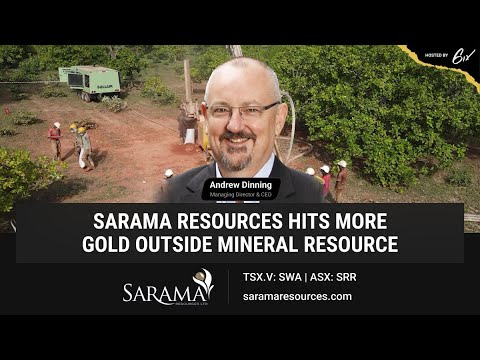
0:38 Yeah, thanks a lot, Kem, and welcome, everybody. I'm very pleased to be able to take you through the drill results we've put out to date from the dual program we convinced in May this year. So without further ado, I'll get into it. I get this presentation has been filed. So if anyone wants to look at the disclosures, feel free to look on our website. So I won't go through that. Just, I guess, to quickly recap on Surama, we're a dual-listed company, so we're listed on the TSX and the ASX. We are located, our operations are located in Southwest Burkina Faso. We have quite a large 100% owned land position there in the Hunde Belt, which is one of the most prolific gold belts in Burkina Faso and one of the most prolific in West Africa.
1:31 The value of the company is underpinned by a multi-million ounce resource on our Sanatura project. I think importantly on that resource, which is just shy of 3 million ounces at this point in time, about a third of the resource is oxide and two thirds is over 2 grams. I think recently post the ASICS listing which happened in May of this year we commenced our first major drill program in 5 years and I think anyone that follows the company will probably understand the delays that we've had just with respect to restrictive JV and what have you. However, that's in the rear view mirror now. So we've completed 20,000 metres of a 50,000 metre planned program on Sanitura. Of that, we've probably put out about half the results, of which I'll talk about some of that shortly.
2:21 But I think importantly, the drilling we have been doing, it's shallow, kind of high value targeted drilling. We're just really looking at oxides, near surface, mineralisation outside the current mineral resource. The drilling has so far delivered some pretty good results. We've got a new geological model for targeting, which is quite exciting, but also quite a few substantial hits that sit outside the resource that I think we'll feel into feeding to that in the longer term. So getting into it, looking a bit more closely at the Sanitura project, as mentioned the resource inventory is just shy of 3 million ounces, but importantly, at a 1 gram cut, we have about 2.3 million ounces at 2 grams or better.
3:13 So there is a high grade element to the resource, which is important from a development point of view down the track. And also Oxide hosted gold accounts for about a third of the resource. And once again, that's important for looking longer term on the development of the project. As mentioned, we commenced our first major drill program in some time, and we're about 20,000 metres into that, probably another 30,000 metres to complete on the first phase. And the drilling that we put out, Sean, we've been hitting near surface high-grade mineralisation, and as mentioned before, we're getting pretty decent results. So the main focus of this drilling is to significantly lift the pit constrained oxide resource which currently sits just shy of 1 million ounces And it's just basically focused on shallow, high-value material.
4:06 We are also looking to identify additional regional greenfields targets out of where we've been working, and I'll briefly touch on that at the end of this presentation. So looking a little more closely at the Tangkoro deposit, which sits in the southern part of the project, that you can see on the image here. It's in the southern portion. It's adjacent to Endeavour's Bantu project. Of that project, we have the Tangkoro deposit. So The primary resource areas here are the and the MC prospects and between those 2 deposit areas I host about 80% of the ounces in this area. The drilling we have been doing has been, some of it has been in between model mineralisation at and in the footwall of the MC area.
4:57 We've discovered new high-grade gold mineralisation within the outside model areas, but also in the footwall of the MC as well. And if you look at some of the historical results we've had in and MC, you'll see that there is a high grade element and that's really what we've been targeting in on with the drilling. So it's really just focused on adding high value material to the resource. So moving along to a little bit closer on the deposit, obviously focus on oxide resource growth. It is a big system. We've got contiguous mineralisation for over 12 kilometres and it's around 2.5 million ounces. Within that there's also a high-grade component, so about 2 million of those 2.5 are above 2 grams and 70% sit within 150 metres of surface.
5:53 Most of the strikes have only been drilled to about 70 metres and our view is that there's ample gaps to discover new mineralised zones in between where we have drilled in the past. And I think anyone who's been following the news releases that we put out, they pretty much support what our thesis is. So really on the upside here is extensions to the current resource, adding oxides and growing all the near-surface high-value material. Looking at, I guess, the first news release we put out, which was in August, we've drilled a whole new zone in the southern part of the project area.
6:40 It's called Obie. We had drilled this originally looking for sub-vertical structures and we were of the view that it may well have been flat. So the last drill program was designed on that basis. And what we've found out of that is we do have quite a high-grade flat structure running in the south there. And I think, importantly for us, we've delineated about 950 metres along strike, but it's also open for about 1.8 kilometres along trend where it doesn't have a drill hole in it. It's also been drilled about 300 metres down dip now. We've got multiple mineralised intersections in some holes so there's scope for stacked loads as well which will obviously increase the ounces per vertical metre in the area.
7:34 And we've also extended the oxide profile to 80 metres depth in this area. And that's also a pretty important metric for us come mining time. I think when you look at some of the grades that we've realised in that area, they're pretty solid, 12 at close to 3, 10 at close to 3, and I think importantly 7 at 11.5 that ended in mineralisation. So we think there's still a fair bit more runway on this and I think when you look at a section on the area, This is what really does get us quite interested. So you can see through here the traditional mineralisation that we have drilled, which is porphyry dykes, is sub-vertical in this particular area, the lower tenor. What we've got here is a flat structure that's cutting across the geological fabric.
8:21 We see a lot of scope for down-dip extensions, possible enrichment zones where you can see there that area that's highlighted where the flat structure looks like it should intercept the sub vertical structures. Obviously we have a lot of open space long trend in front of it. And I think importantly, when we look for analogs of this within the belt, probably the closest analog we see is Endeavour's Kari Pump deposit at their Hyundai mine. The maiden resource on Kari Pump was about 1 million ounces at 2.5 grams. So that had 100,000 metres of drilling in it when they published that. We've only 4,000 into this so far. But I think, importantly, this is blind to surface. It sits in between where we've previously drilled. We've got 2 more areas that look like this. There's still a lot of work to go. We only drilled that in June.
9:14 And given our season, exploration season, is governed by the rains, We did stop drilling late July, early August. So this will be a pretty high-priority target come next season. Looking at the secondary, this is the northern part of the Tangkoro deposit area. So the prospect, so this particular deposit area hosts about 1.4 million ounces at this point in time. This looks quite complex, and I guess structurally it is a bit. What we had seen in historical drilling was some pretty good grades and pretty good intersects that we couldn't really model up or marry up to anything. So we put additional drilling into those areas and identified new zones in between existing modelled zones.
10:02 This is actually quite a substantial area. You can see the scale bar at the bottom there is 100 metres. So once again, you know, we think there's plenty of scope in between where we have modelled stuff up to add new material and that's pretty much what this drilling is showing up. It's pretty high tenor. So, you know, 7 and 8, 12, 4.5, 11 and 4.5, you know, that's all shallow. It's all in oxide. So it's all, you know, super creative to the development picture of the project. And importantly, all this material would fall into an existing pitch shell as it stands now. So all of this adds a lot of value to the project. It's all new and it's all outside modelled areas. Looking at the third area, which is kind of halfway along that Tangkoro deposit area.
10:51 We drilled, and once again this goes back to the thesis of thinking there's a lot more scope to find material between where we have drilled historically and this is a good example of that now. You can see the 2 tracks historically that we've been drilling in the red there that have been modelled up. Here, where we've drilled, we've drilled in between those tracks. We're about 600 metres off trend there, and we drilled 34 metres at 1.65 from 18 in oxide. So this is a pretty exciting development as well. So this once again supports our thesis that there's plenty of scope to add new material in between where we have been drilling historically. I think one of the things that does get lost with this project, because it is such a big system, historically, particularly around the joint venture with Acacia come Barrick, They've just focused on a couple of areas and they didn't really step back and look at the project in totem, which we've had the opportunity to do over the last couple of years while we haven't been able to drill and identify areas like this. So all these areas are pretty important. We think this is probably a cross-linking structure.
12:03 Where these things intercept is at the and MC where we typically get a grade and an ounces blowout. But really these results highlight the potential for new discoveries and resource extension. But once again, if you look at the intercepts there, they're all in oxides, they're all outside the resource, and they all really, I guess, play into the narrative that we're running, which is there's a lot more scope to add material. And I think this fourth area here, once again, we've drilled into the foot wall in the MC area. The MC does have some, I guess, fairly cherry ripe areas to look. But in this particular area here, we've drilled in the foot wall.
12:50 Pretty substantial thickness, a pretty reasonable grade and all in oxide. We do have a couple of significant intercepts there. You can see 17 at 1.4 ended in mineralisation at 43 metres within oxides, 19 at a gram also into the mineralisation. So the grades and the tanner that we're seeing is roughly in line with a bit higher than our average resource grade in this particular area. But I think importantly, this sits outside the resource. It's in the foot wall. It's once again, it's highly accretive. All of this will get mined regardless and it all add ounces. So the 4 releases that I've just walked through, I guess the highlights of then, Obviously you can find those on our website where there's a lot more detail, but I guess it doesn't represent a lot of drilling. So those 4 releases represent maybe half of the drilling that we've done since May.
13:48 But it's 4 new areas, they're all outside the mineralised zone and dotted along that mineralised area. So we think there's a lot of scope to grow these and they'll add super accretive, high value ounces to the development picture and to the resource. The money that we spend now has a disproportionately large impact on what we're doing because we're already over the hurdle from a, I guess, a critical mass size from a development point of view. We have enough ounces now to support an economic study and really the work we're doing now is hitting all the low-hanging fruit and high-priority targets. And I guess speaking of high-priority targets, looking ahead to next year, Given the current state of the capital markets, how much drilling will get done before Christmas, we're unsure.
14:41 But if you're looking ahead though to next season, the Bondi deposit, which was an acquisition from Morezone Gold, has around 500,000 ounce resource on it at the moment.
17:23 A small inventory on it, that's probably a longer term target area for us. Our view is if you've got, you know, mineralisation over 25 kilometres, you know, the chances of finding something, you know, of material value and size there are quite good. But looking at the geology there, it's going to take a lot more work to unravel that story. So that's really a bit of an update on where we're at, just a quick brief. Obviously a lot more detail in the news releases, but that's where we're at at this point in time. So I'll open it up to questions now that people may well have. Yeah, thanks for that, Andrew. As a reminder, I'd like to let everyone in the audience know that you can ask questions using the Q&A chat found on the right-hand side of your screen. But the first question we have, Andrew, is what are majors in the region that you'd court to invest in the project?
18:16 Yeah, there's been quite a lot of consolidation in Burkina Faso. We've seen Endeavor very active in countries. The companies we would most likely be talking with, and one of which was a shareholder before that, bought by Endeavor was Taranga, who were a neighbor to us and very good to work with. Semaphore as well, and obviously Endeavor's bought both those companies. So really the main company for us to talk to is Endeavour Mining. So they have the Bantu project immediately to the west of us. So if I just quickly flip back to the slides, we don't need to go back to this particular slide.
19:05 You can see the Endeavour's Bantu project is just here, and Surama's Tangkoro deposit here is on Sanitura. So in this particular area there, there's around 4 million ounces within a 5 or 6 kilometre radius. So our view is all of that needs to come together and we think at some point in the future that'll happen. I guess the ultimate question for us will be who owns what. But if that project area is put together and it's all a natural fit, then that makes this A55 and 500,000 ounce project at this point in time with a lot of runway left to run on the exploration front. Absolutely. Okay, great.
19:51 Next question, what drill result is most interesting to you from this last drill campaign? Yeah, I think we put out 4 news releases and all 4 are very interesting in their own way. But I think probably the most interesting one for us is that flat zone at Obi in the southern part of the project. It's high tenor, it's inoxides, It's definitely a different mineralising event to what we see. The 10 is very good and being flat, it has the potential to add quite a few low cost ounces. So I think for us, that's a whole new geological analogue that we can apply to the area. It's also blind, so there's a lot of scope to find more of these things. So we think the chance of there just being 1 discrete vein, which is what it looks like at the moment, is a flat quartz vein based on what we're seeing sampled coming out in the air core.
20:50 Being 1 discrete area at 900 metres by 300 metres being the only thing we think is probably fairly low. So we think that's probably the most interesting and most exciting out of all the drill results. And I guess second after that is, you know, we've drilled, you know, that quite significant intercept, 600 metres off trend as well. So that's also particularly interesting. All right. And what's the timeline on the next round of drilling? Yeah, working Burkina Faso is seasonal. So as we have a rainy season and dry season, so it's rainy season at the moment, we'd expect to be able to be active in the field again, before the end of the year. Obviously, given the markets and how they are at the moment, we'll be circumspect on what our burn rates are.
21:39 But it's seasonal, it typically runs from November-ish through into June July, depending on when the rains start and finish. So we would hope to get some drilling in before Christmas, but really it'll be the first quarter of next year when we really start looking to drill in earnest. All right, Andrew. Well, listen, that's all the questions we've received for today. So I want to thank you and everyone who's joined us, especially those who've asked questions. But before we wrap up, I'd like to hand things back to you for some closing remarks. Okay, thanks, Kem. The yeah, I guess just to kind of round out, you know, what was said, you know, where I started, you know, as Surama's viewer, there's a lot of scope within the land package that we've got to add a lot of, I guess, high grade, high value ounces to the resource and the development picture there. I think the drilling that we've put out so far, which represents probably half of what we've drilled since May, does support that.
22:41 We've got a whole new exploration analogue to chase now as well with the OB prospect, so that's very important. But I think the most important thing that we're showing here is that we're adding a lot of new targets, new ounces to the project. They're all shallow, they're all oxides, they're all high value, and that can only lend to, I guess, the development project down the track so I think for us you know it's been we're very pleased with the results we've got so far that they're probably in line with or better than what we thought we would get. And if we can keep up, I guess, with getting these kinds of results, this program will have a decent impact. So historically, our discovery rates have been between 7 and 10 ounces per metre drilled.
23:32 We're doing a 50,000 metre program, so we'd like to think that we'll get somewhere between 300,000 and 500,000 additional to the ounces on that. Obviously, we won't know until we've finished and we've modelled everything up, but it's based on historical numbers. Even if we get the bottom end of that, we'll be pretty happy. All right, then. Well, with that, I think we'll be wrapping up for the day. So Andrew, I want to thank you again, and I hope you and everyone else has a good rest of the day. Cheers. Thanks, Cam, And thanks everybody for listening in. ♪♪