Transcript
Automated transcript · Written by software from the replay's audio. It can mishear names and figures; the replay is the record.
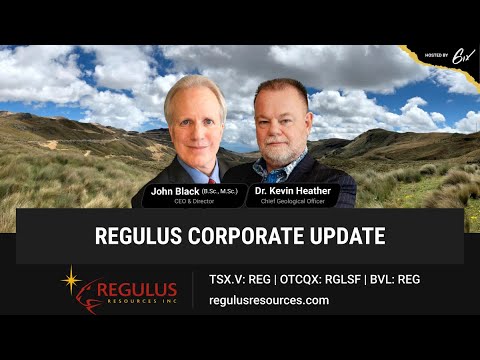
0:08 Hello everyone, welcome to Regulus Resources Live Summit today. I'm pleased to introduce our speakers, CEO and Director, John Black, and Chief Geological Officer, Dr. Kevin B. Heather. John and Kevin are gonna be taking us through the company's latest news, and following that, there's gonna be a live Q&A session. So just as a reminder to everyone in the audience, if you'd like to, please submit your questions using the Q&A panel chat found on the right-hand side of your screen at any time today. As always, this summit is being recorded. It's gonna be available on six.com in the coming days. So look out for that. But to begin, John, I'm going to hand things over to you so you can get started.
0:39 Great. Thanks Cam. And thanks to 6 once again, for providing a platform for us to communicate about what our results are and answer any questions that people might have. We really we really appreciate this format to interact with our shareholders. As Cam mentioned, what we'd like to do today is provide a corporate update. There's been quite a lot of news that's come out of our group over the past few weeks. And I think it's an important point for us to summarize that information. The 3 principal topics that we'll touch on today is reminding everybody that we've just closed the Rio Tinto strategic placement, which puts us in a great financial spot and with a strong endorsement to move forward the project and provides us with a transition into the next phase of how we continue to explore and position this project to be developed.
1:27 We've also completed our phase 2 drilling program and put out all of the final results of that program. And I think that warrants some time today for us to discuss those. That last batch of results we've put out includes step outs to the North, as well as drilling that was done to complete the requirements for the earn-in for the Kokirumi Agreement. So it results in a little bit of a mixed bag of drill results on that, that Kevin will walk us through those results, the importance of those, and how they position our future exploration efforts moving forward. So it'll be a good chance for people to see that, understand it better, and maybe see why we drill things and the way we've drilled those. And then as part of that phase 2 program, we completed the 7,500 meters of drilling necessary to trigger the urn in for the Kokirumi Agreement.
2:15 So that has been announced. We're in the process of working with Buenaventura on that. And I think quite shortly we'll have the resolution. We'll be either moving to a 70% interest in the project or they might call back to a 30% interest by paying us $9 billion to go forward. Either resolution is good news for us as we move forward. So very significant changes in the project as we get set up and we're looking forward to a pretty exciting year coming up. The appropriate disclaimers apply to anything we present today. And we'll all start off with just a little bit of a summary of the company in the position. We may have some people that are new to the company participating in this. Most I think on this presentation are quite familiar with this. So I'll go quickly through the overview of the company. I refer to a number of 6 webinars that are available on our website as well as other videos that Kevin and team have put together to describe what we're doing and what the project is like. So this will be a quick overview. Please refer to that information on our website for more detailed summary of the project and the company overall.
3:17 And in a quick snapshot, why Regulus Resources? We're delivering an outstanding copper project at just the right time right now. We're a group that has a proven step strategy. We've set out to capture opportunities like this, to drill them out, to de-risk them, and then to present them for eventual monetization and get them in the hands of the group that will be the miner moving forward. It's something we've done before, and we're very excited that we're moving towards that same setup on this project as we go forward. And we have a number of quality partners that allow us to move forward as this. We've had a Cisco Gold Royalties as a long-term strategic partner on this project. And then recently we've announced the strategic placement from Newton, a division of Rio Tinto to not only test their Newton primary copper sulfide leach technology, but also to help us advance the project overall. So just a quick few words on that Rio Tinto investment. It just closed a week ago on this, so all the funding's in hand now. This was a strategic placement by Rio Tinto, the Newton division of Rio Tinto, which is exploring the use of this copper sulfide technology, but that represents Rio Tinto overall.
4:29 So This investment was $15 million US with a top up from our principal shareholder to minimize their dilution. I won't belabor all the points on this, but it's clearly an investment that provides us with the cash that we need to move the project forward and a strong technical endorsement of the project. Keep in mind that Rio Tinto has the La Granja project, not terribly far from this area. They're well established in the region, and their investment into us is almost undoubtedly part of a greater strategy as they move forward in the area. This was a very attractive valuation for us and minimize the dilution to our current shareholders. So the resulting capital structure of the company after this placement is that Rio Tinto Newton will now have slightly over 16% interest in the company.
5:16 Route 1 maintains their position as our largest shareholder at about 22% and as management we have about 11%. So when this was announced and settled in, that took our share count to just short of $125 million. Still relatively low compared to the amount of work we've put into the project as we move forward, and a market cap of about $120 million when we announced this with the results that came out last week and the reaction to that, that's dropped a little bit closer to $100 million, but I'm confident we'll recover that in the not too distant future. So just a high level summary of the project for those of you that might be new to come in. It's a large copper gold project located in northern Peru and a portion of Peru that has a lot of active mines and good projects would potentially be developed moving forward.
6:02 This is a closer look at the district itself that we're setting in. Our land position is in the various shades of red and pink with the red claims being 100 percent owned by Regulus. The mid shade pink of labeled Kokirumi on this is the large block of ground where we've had an agreement with the subsidiary of Buenaventura to earn in up to a 70% interest. This is the Koki Rumi block, much of it well beyond where the known mineralization in the district, but fingers of this ground extending into our land position that we own 100%. And that's where we've completed the 7,500 meters of drilling that is necessary for us to trigger that earn in. So we will now become an owner of a portion of a joint venture that includes all this ground. It's part of our strategy to consolidate the district. We have a similar agreement with Goldfields, a little earlier stage on that, where we can earn in up to a 60%.
7:00 What we're working on is assembling a large land position on the northern part of a district that includes the active Tantua-Tai mine, where the Comalichi joint venture is currently mining the oxide cap over a very large copper gold sulfide deposit that's partially on their ground and partially on our ground. I also point out that 7 kilometers away is the Cerro Corona mine of gold fields. So the Cerro Corona mine and the Tantua Tai mine are both medium to large size mines, quite good project, quite good mines for their respective companies, but nearing the end of their mine life. In approximately 5 years, mining will terminate or will terminate in the oxides at the Tantua Tie Mine. They'll stop mining at Cerro Corona and pivot to processing low-grade material.
7:48 So there's an outstanding opportunity in this district to make a transition from 2 nice mines that provide a lot of employment and benefits for people in the immediate area of the project, as well as revenue for the government, to a much larger, much longer life mine by developing the copper gold sulfides that we share. Just a quick snapshot that most of you are well familiar. This shows the pit that constrains our current resource that we've reported, shows how we can show the mineralization on our side of the ground. We do know a lot about the neighbor's ground, but we're not allowed to present that information moving forward unless they've publicly presented it. So it's a large deposit, very low strip ratio, very good high grade close to the surface on it. This stands out as one of the more enticing opportunities for the development of a large copper gold mine. It's in a brownfield setting with that current oxide mine, essentially stripping the oxide cap over the top of the deposit and lowering the strip ratio and setting this up for a transition into a larger copper gold sulfide mine that we believe our portion of the property is integral to the most profitable development of the combined deposit.
9:01 We have a large reported resource that was the result of our phase 1 drilling program. This resource came out in 2019. We can see the numbers down below, 250 million tons of 0.48 copper and 0.29 gold with substantial silver. And a similar amount of material slightly lower grade and inferred. So 0.5 indicated, 0.5 inferred. This is just mineralization in this conceptual pit on the right that falls on the 100% red regulus claims. It does not include mineralization that belongs to the neighbors outside and surrounding that. This is a snapshot of what has been publicly reported most recently by Pomolychi next door. So this is the sulfide resource that they have beneath their oxides, a little over 900 million tons of slightly lower grade with different cutoff criteria moving forward. On the diagram, we can see our land position. So the mineralization that we have is largely reported in the arm of claims that we see on this land position.
10:02 So what we would like to point out is that particularly the combined deposit here is what is really drawing a lot of interest from major copper companies, major gold companies both. Because as We'll see when we look at the total contained resources on this on the left-hand side, we see the antiquary published resources, both as indicated and inferred, broken out correctly and copper and gold. So approximately 5 million tons of contained copper, 4.5 million ounces of gold, slightly larger metal endowment and lower grade on the Tantua Dai claims. But combined, this results in nearly 11 million tons, over 11 million tons of copper. That would be a large copper deposit by itself. And nearly 10 million ounces of gold contained in that. And it's important to point out that both sides of the, the Comalachi side of the district and our side of the district are underreported.
10:58 We've done considerable exploration on both sides since these resources have been reported. And the nature of the inter-fingered ground makes it a little bit difficult for either of us to fully report what we have. An integrated approach to this project would undoubtedly result in the ability to reveal significantly more mineralization than we do with current settings. So our strategy is really to continue to increase the size of the deposit, to work with our neighbors to explore possibilities and how we can reveal the full nature of this deposit, both in terms of gradients and tons, but particularly in the terms of economic parameters and put this into a more visible way to take a look at the importance of the project moving forward. As we can see on this, We're not talking about nearby to a mine, we're immediately adjacent to the mine. We can see the operating Tantua Tye mine in the upper left hand of the diagram, and in the foreground is our land position.
11:56 So this is essentially just taking the cap off of what would be a larger copper gold sulfide mine that due to its size and characteristics has potential to be what we refer to as a multi-generational mine, the type of mine that would last for decades, 40, 50 years or more. And those are the type mines that are attractive to major companies and most attractive to all stakeholders in the area because it provides long-term sustainable benefits moving forward. So what are the next steps at Anticori? And I want to preface this a little bit in that we've just received the investment from Rio Tinto, which puts us in a very different financial position to move forward on the project. And we're in the process of working with Newton Rio Tinto to develop what the metallurgical program that is a key component of that investment for us will look like going forward.
12:46 We finished our phase 2 drilling program at the end of December. We've received all results and put those out right now and we're pausing the drilling through the rainy season and position ourselves to start up at the end of the rainy season with a phase 3 drilling program that will include drilling specifically to obtain the large diameter core for large column testing with Rio Tinto, as well as additional resource definition from our site. So, we're in the process of planning that program and determining what type of access we need, what type of changes to permits we need to move forward. Hopefully in the next month or 2 we'll be in a position to announce what that program will look like and when it will start. A big component of that program is to collect the material necessary to provide the samples to Newton Rio Tino to conduct test work, large column tests and other tests to determine how well their primary copper gold sulfide leach technology works on this deposit.
13:47 It's not initial testing only. We have been interacting with this team for some time now and we have quite a bit of information on the project. It's really moving it to the next phase. That 15 million US that they provided to us as the strategic placement, It's important to note that we're responsible as regulars for acquiring the samples that are necessary to conduct this work, but the cost and the execution of the test work will be conducted by Newton and the cost of that will be assumed by Newton. So the relative cost to us for this portion of the program will be probably between $1 and $2 million. It won't eat up all of that minerals, all of that financing that we've received from that. The rest of that financing is available for us to continue on our normal work moving forward on the program.
14:36 The completion of the Phase 2 program puts us in a position to do a resource update. We're projecting this right now to be completed by the end of this year. The reason that we're kicking that out just a little bit longer is that we're exploring the best way we can do that, whether we do it as simply an update of the resource that we've previously presented using the same conditions, or whether we might be in a position to work with the neighbors and see if we might be able to present something that's a bit more complete on the district. So we're in the process of determining if that's a possibility and that will determine the length of time it takes for us to do that. But we'll be in a position by the end of the year, if not earlier, to provide that resource estimate. The drilling that we've completed, the phase 2 program that we completed, and Kevin will provide a summary of that work and then particularly the most recent results on that. Keep in mind that that drilling was done to make an additional extension to the north to increase the size of the known resource we have, and the initial test holes farther north to determine if we might have another center, as we've theorized when we first set the program up on that. That drilling has met with encouraging results in that we continue to find mineralization, particularly to the north and northwest and west on the project. But we are beginning to close the mineralization off in some directions.
16:00 And the mineralization we're finding, as we'll see in the north, is encouraging geologically, but we have not hit into another large high-grade center. But it's very important to note that that's not necessary. We already have a very significant amount of mineralization in hand in the project and it's important to not forget that. As part of our program going forward will also be assessing the goldfields joint venture. We will be primarily doing surface prospecting and mapping on that is and then setting ourselves up with ADIA permit that will allow us to complete drilling as necessary and indicated on that project. The majority of this is off to the east in an area that has significant old workings, but very little previous work. So there is a possibility that we'll find additional mineralization off to the east of the district. And then one of the major things that we're working on, and one that unfortunately we cannot really report to the market very much about, is working on an eventual consolidation of the district or establishment of collaborative agreements that allow us to better present the full potential of this project. This work is done largely under confidential discussions, and so we're not allowed to really present anything about that as we're moving forward, but it is a very major component of what we're working on right now to unlock that full potential.
17:20 And as we strive towards that, we'll be continuing to de-risk the project as we move forward. As we've interacted with the Newton Rio Tino Group and several other companies that are reviewing what we're doing and monitoring what we're doing. It's become more evident that the major miners that keep an eye on what we're doing are less concerned about how much mineralization we have. Quite frankly, many of them comment that we have more than enough mineralization for to satisfy their threshold to have a project of interest. And the questions are more about what's the best pathway for metallurgically, what is the situation with land in the area, what is the situation with water and communities. There's a strong encouragement for us to push more in that direction, which is part of what we do is de-risking the program.
18:08 Just to remind people of what our strategy, not only on this company, but our previous company and other companies that we're involved with, is to identify these types of opportunities and then add value by expanding the resource and project de-risking. Much of what we've focused on in the past few years is really that expanding the resource and due to the complicated nature and inner finger nature of the district we perhaps have been emphasizing the de-risking portion a little bit less. But the signals we're getting is that it's clearly a time for us to begin to focus more on that de-risking and answering the questions that would be asked by major companies to provide comfort for them that there's a pathway forward and increase the likelihood that we enter into the third and final part of our strategy, which would be to monetize the project by selling it to a major company.
18:56 So we're clearly in a transition point right now. We will continue to work to increase resource. We'll report the new resource coming out later this year. And there will undoubtedly be additional work to do to continue to that. But the value add that we get from that additional work, defining mineralization that might be 30 or 40 or 50 years out in the mine life, is perhaps less important than addressing more immediate aspects of the project on which is the most profitable pathway forward for development. Do we have space to put infrastructure? Can we negotiate a consolidation of the district to allow the most profitable development of the project. I wanted to just take a few minutes and point out that this project is a little bit different. It's a project that is a known district. It had a very complicated land situation to it.
19:48 And throughout the history of this project, we've had a number of points where we've had perceived issues in the project that would be easy for people to determine, well, it's very difficult for them to move forward or this is not solved. And we have systematically been going through and solving those. When we took on this project, we realized the potential for a very large resource and that we could capture a good portion of that. But it did have some challenges that we needed to solve. And I wanted to refresh everyone's memories about how we have been systematically moving through those and progressing on those. And how a challenge, for example, of a consolidation of the district right now may be an easy one for people to say that is impossible or you might be stuck forever. But let's take a look at the history of what we've done. When we first entered into an agreement to acquire those 100% claims, the immediate response was, is you have land that's so interfingered, it'll be impossible for you to even explore and move forward. We solved that by reaching agreements with Komalachi next door and Buenaventura and Goldfields to increase the land position and to allow us to explore that collaboratively and move forward. Big step in the project that unlocked a lot of value and was a major jump in our share price when that happened.
21:04 The project was known to have high arsenic content in much of the mineralization. Many felt that that was a total block on the project moving forward. We've now been able to demonstrate that there are multiple pathways to move forward with our stick, not just in this project, but in general. We're seeing that arsenic is something that companies are becoming more comfortable with manners in which they can be handled. So we're currently exploring at least 3 directions that we can work metallurgically, all appear to be quite viable. And most recently, the Newton primary copper sulfide leach has some very promising opportunities for us to move forward and we'll work very hard on that this year to determine if that's the best pathway. So arsenic is no longer really a block and in fact we've had companies approach us with interest in the project because we have arsenic and they believe that they have solutions on how we could go forward. It was thought early on that would be almost impossible for us to obtain permission to drill to that complex land situation and getting permits in Peru. We were able to establish those agreements that allowed us to do our phase 1 program, largely in collaboration with Comalichi, utilizing their drill permits. And then we were able to obtain a DEI permit that's allowed us to drill to the north and move forward. So then we encountered a situation where one can we expand the resources.
22:25 Is the mineralization there or is there simply just mineralization beneath the mine? And even if we can drill demonstrate that there's mineralization there, we had a slight challenge in how could we report that. It's unusual that we have multiple owners in a district, so we've been able to indicate through our phase 1 drilling and resource estimation that we are able to not only expand the resource, but work with regulatory authorities and the neighbors to be able to present that so you can see the mineralization on our ground. Can we obtain social license? We've demonstrated we can do that, and even survive challenges to that where we we've had situations where things have arisen that might threaten that, and we've been able to, utilize the strong support we have from communities to maintain that social license moving forward.
23:16 And then an important one on this is when we embark on a project like this, it requires a lot of drilling, a lot of work to be put into it. A good question is, can we obtain the financing to be able to allow us to do the work? We've completed over 50,000 meters of drilling on this program and a lot of social activity, a lot of other work on the project. That costs money and can often strongly dilute a company to move forward. But we've been able to demonstrate that we can come up with innovative ideas to pursue non-dilutive or less dilutive financing. We've had the 2 financings we've announced with the Cisco Gold Royalties that were not equity dilutive at all. And then the above market financing we've just completed with Rio Tinto Newton. So I think we're demonstrating that we can manage our share count well as we move the project forward. It's never as fast as any of us would like, and we've had a few challenges with COVID and other issues along the way, but I think it's important to realize the amount of work that's been done on this project, the point that we've gotten to, and the resource that we already have in hand. So we have a large growing mineral resource, we have great strategic partners to move this forward, we're in a brownfield setting which is very attractive to major miners, much easier to envision the development of a major mine extending from an existing operating mine than it is in a completely new area.
24:36 And an important thing to always remember on us is that there's a compelling valuation. We've done all this work, and due to the length of time it's taken and other factors, our market cap right now does not reflect what we have in hand, let alone what the eventual potential of this project is. So it's still a very interesting time to be taking a look at a project like this and a great entry point, even more so just in the last few days as we see a situation emerging that allows easy entry into the company. So that's a quick overview. I'm going to pass it back over to Kevin now to go into more detail on the project itself. OK, so I'll pass it over to Kevin so he can share his screen and he will walk us through the most recent drill results and kind of a summary of where we're at with the drilling program overall. And then we'll return to point where people can ask
25:29 us questions about anything that comes to mind. Okay, hopefully everybody can see my screen. I'm gonna move fairly quickly here. Those of you that have been through some of my previous webinars know that I tend to be able to go through a fair bit of information fairly quickly here, but just to give you some ideas. So we'll just go through kind of a summary of the latest drill results, and then I'll give you some closing thoughts on what it might mean. So just a bit of a summary, when we initially took this project over early on, there was historic drilling from 2 previous junior operators, between the 2 of them, a little over 16,500m were drilled on the property.
26:19 And then when we overtook the project, we had our phase 1 drilling, which was just a little bit over 22,000 meters of drilling and added that to the historic drilling. And that was what we based our 2019 resource on. Also, obviously with access to the neighbors drill holes at the time under agreement, but we never show that information publicly. And then our phase 2 program, which we just completed is just a little bit over 31,000 meters. And that puts us at a total of almost close to 54,000 meters of drilling done by Regulus over the last few years.
27:07 Just to show you that that was partly drilled on obviously 100% owned Regulus claims, the pink claims you can see here, but also as John mentioned, we drilled a little over 7,600m on the Kulki-Rumi claims, the yellow claims of which 7,500 was the trigger point in order to trigger the earn-in agreement that we had with them. Then there were some meters drilled on the neighbour's ground as drill holes passed through their claims onto our claims as we were drilling. Just to jump to the Kolki Rumi earn-in, you can see the disposition of holes. Some of the holes were drilled 100% on the Kulki Rumi claims here in yellow, but other holes were holes that we drilled to target mineralization on our claims and we kept the holes going because they were in fairly good mineralization and those tailed off into the Koki Ruby claims.
28:10 That 7,500m urn has been triggered and Bonaventura has until I think February 22nd to advise us if they want to claw back to 70% ownership for $9 million or give us 70% ownership and control of the JV moving forward. So Just to remind people that the Kokirumi claims, part of the reason why we were very keen on getting those claims and that earning to begin with is that we knew that mineralization probably extended onto those claims. You can see that our drilling has pretty much shown that. I'm not gonna go through all the details of this. This is all in previous either webinars or press releases, but almost all the holes that have been drilled in this particular area on Kokirumi have hit mineralization.
29:08 If we jump, hole 51 was an interesting hole drilled here. That hit mineralization in an area previously not drilled before and suggest that mineralization is still open to both the Northwest here and to the West.
29:30 Just to review the last press release that we put out and some of the drill holes, I'm going to start on the far East end over here and we'll look at drill holes 53 and 55. You can see those were drilled specifically here on Kulki-Rumi ground. These were to test for the eastern extension of possible mineralization. These holes hit very weak mineralization, locally very narrow zones of higher grade, And the alteration was very typical of what 1 might expect to find in the distal part of the system. If we look at this relative to the analytical signal, the vertical integration of the analytical signal, you can see we were also testing this far shoulder here towards the east on that anomaly.
30:22 And then this is the large magnetic feature, the reduced pole magnetics, again, testing over on the eastern edge of that anomaly. Jumping to hole 57, this was a hole we drilled as a natural progression moving down towards the Southeast. The hole did intercept some narrow intervals of relatively low-grade mineralization, but it also indicated that probably the mineralization footprint moving to the east is weakening, both in the easterly direction and towards the Northeast. However, I want to caution people that the fact that we hit low-grade mineralization, some of this mineralization may still fall within a future pit shell and basically any mineralization that's above the break-even cut-off, which typically on our last resource that we did was around 0.12 or 0.15 Copper equivalent, anything above that would be ore. Even though it's not sexy for market reporting, it does have economic impact when we go to the next phase, which would be to float an economic pit on this.
31:45 And again, just to show where that hole was related to the large analytical signal feature and the main reduce the pull magnetic feature. Moving on to drill hole 59, very, very similar, very close to drill hole 57. The reason why we drilled these holes, these were obvious gaps in our block model from our previous resource. And so we did these large step outs to test if there was more mineralization. And you can see there are some narrow hits of mineralization, but again, just like hole 57, this encountered spotty mineralization, indicating again that the mineralization moving to the east and towards the northeast up in this area here appears to be getting to the edge of the system.
32:38 Drill hole 54 was a hole that was drilled out into the middle of the large circular feature. You can see it here in plan view. One of the things that we noticed when we hit this hole, when we drilled this hole, is that we actually crossed a fairly large fault structure here, and you can see there was a significant down dropping of all the stratigraphy here. That possibly has implications. You can see there is mineralization in this hole, but it's down dropped. There were some narrow porphyry dikes, and I'll show you some photographs here in a second of the geology. There you can see the location of the hole
33:26 drilling into the centre of this analytical signal feature and also in relation to the reduced pole magnetic feature. Again, the hole did hit numerous intervals of mineralization. It definitely extends the mineralized footprint to the North significantly. This is a pretty big step out from any known resource. And this will have an impact moving forward and probably does warrant more future drilling. And like I said, these might not be very exciting drill intercepts from a market point of view, but these actually will have a huge impact in terms of any future pit that will push out here. It's better to be moving ore than it is waste.
34:19 And again, just to mention again that we now have a pretty good idea that this off to the north, there's a fairly big down drop in the stratigraphy. Just some rocks to look at again, we're still hitting pretty strong Scarn-style mineralisation and some breches that are milling up that mineralisation. We did intercept some intermediate sulfidation structures that are carrying higher-grade Gold and Copper and base metals. We can see that some of the better mineralisation was down in this area here related to the more receptive Inca formation, and we can see still very strong alteration and replacement by magnetite and pyrite and chalcopyrite.
35:09 We also intercepted some narrow intervals of quartz healed breccias that were mineralized, not that dissimilar to what we intercepted in hole 26 and some other holes like hole 46 that we talked about in previous press releases or webinars. We can also see that the quartz sites down here are actually still mineralized, indicating that the system, although weakening is still affecting these rocks and those that will remember my previous webinars, the quartz site is probably the worst host rock on the planet. And to still see indications of mineralization in this rock is still quite interesting.
35:57 Moving on to drill hole 56, drill hole 56 was drilled here on the corner of this claim. There was a clear gap in our resource model, in our block model for from the 2019 resource that we did. So we drilled this hole to drill into that area. You can see where it is relative again to the analytical signal feature. And we can see it here drilling where the RTP magnetic feature is. And we can see that it actually hit pretty decent mineralization fairly close to surface. This will definitely help to infill the block model and will be within the pit shell moving forward. Then we also hit some higher-grade mineralization down at depth. I think the part that's quite interesting is that the bottom of the hole went into mineralized porphyry.
36:56 This is interesting because it suggests that the porphyry centre that we postulated might be further to the north may actually be sitting a little bit to the south of where we thought it was. Again, very strong retrograde scarn development, lots of breccias develop, heavy sulphide. We also see again very strong silicification and brecciation of the sedimentary rocks and strong sulfide deposition. We can see that even the quartzites, which I mentioned before, are poor host rocks, are locally quite strongly fractured and mineralized.
37:43 I think importantly, like I said, we've intercepted long runs of porphyry intrusion and that locally within those porphyry intrusions there's some actually quite high-grade mineralization and in some places again cross cut by these late intermediate sulfidation base metal carbonate style mineralization. Here we can see Sphalerite and Galena. Up here you can see the rock is silicified and cross-cut by Chalcopyrite veinlets. Moving on to drill hole 58, it's very similar in its objective to 56, again trying to fill in a hole or a gap here that we had in the block model. Again, hit a long interval of decent mineralization.
38:33 This again will have an impact on filling in the block model and fall within the pit. And again, interestingly, the mineralization here ended in strongly mineralized porphyry and breccia style mineralization. Again, we can see the location here relative to the large analytical signal feature and again here with respect to the RTP. Again, hits very strong scarn and breccia style mineralization up in the upper part of the hole, and then transition down into the lower part where we hit mineralized and very strongly altered porphyry looking rocks.
39:21 And again, in many cases, these rocks are strongly associated with brecciation, solidification and heavy sulfide deposition. So what does this all mean? So what I'm showing you here is a Google satellite image. And you can see the pit next door. You can see all the drill roads. I'm going to overlay the claim group on here. You can see the 100% owned claims of Regulus and Red, the Yellow Kulki Rumi claims, and then all this area to the south is the Komolace and Tantawatai claims. This is the reduced to pole magnetic feature sitting roughly up in here.
40:06 So you can see it's kind of centering on our claims and goes over onto the adjacent neighbors claims here. This is the large analytical signal feature that we've shown before. And then I'm going to show you some data here. This is some major faults that we've been able to pull out from the drilling. You can see it's got a very strong tendency this way. This tends to control the orientations of mineralisation and we also think some of the large breccia bodies and also some of the higher grade high sulfidation and intermediate sulfidation vein structures. A lot more detailed secondary structures that I'm not showing you on this particular view.
40:58 And we can see that this also has very strong control. We can see down in our main area where our main resource is, we can see that there's a lot of porphyry diking bodies, and then there's what looks like a larger porphyry feature starting to pick up right in here, and that looks like it's still open to the northwest here. This is the large breccia body that we've been able to define, and you can see it's centring right in the midst of where our claim group is. And then we see some late intrusions that are coming in and these are the ones that are associated with the late intermediate sulfidation and base metal Gold and Copper style mineralization that we know is a late overprint on things.
41:53 Then if we look at Moly, because Moly is a very good indicator, typically of the outer shell or outer halo of porphyry systems, we can see that there's a very defined anomaly here in melidonite, and then also 1 starting to develop here that's open in this direction over here. So that's really in a nutshell, and I've gone back to this same photo here that John just showed us to show that this is really part of a much bigger system, and that this is a significant brownfield copper-gold opportunity. And I'd like to thank you for your attention. And now we'll open it up to questions and answers.
42:40 So yeah, great presentation, guys. To everyone in the audience, if you have any Q&A, please submit them in the chat on the right hand side of your screen and we can get to them. We have already received a bunch of questions so we're going to dive right in on this. And the first question guys, how important was exploration success at Antinorte for Rio Tinto's recent investment? I can handle that one. Rio Tinto was not aware of the last batch of results that came out. They made their decision without knowing that. That wasn't publicly released yet on that. And it really didn't affect theirs. As I pointed out, they've made their decision on the large resource we already have in hand and what they know about that. Many other groups that are reviewing us, we hear similar observations.
43:31 What we show already is more than enough to be of interest. Additional mineralization is great, and we will continue to expand that mineralization as we move forward, but it's not necessary for us to find more mineralization to draw the interest of even the largest miners now. All right, great. Another question, you know, kind of broad, but would you mind, would you be able to say what, would you be able to say what your upcoming catalysts are in 2023? Yeah, I presented those and reviewed them. What we can't say is exact dates on those just yet because we're in that process of putting the program together in collaboration with our new strategic partner, Rio Tinto, and their input, particularly on the metallurgical side on that. But key things are that we will define and initiate the next phase of drilling to move forward.
44:25 And that will provide materials for us to kick off the sulfide leach evaluation of the Newton technology to determine if their technology provides a more economically viable pathway forward on the project. It's quite exciting technology because it could provide a way for us to have produced copper cathode directly on site and reduce water consumption. It provides a number of very attractive alternatives in an ESG sense, and it lowers capital costs and operating costs on the project too. So if it's successful in the manner that Realton, Newton and ourselves view this, this could be quite a game changer really moving forward. As I mentioned, it's not necessary. We have other perfectly viable pathways to go forward on the project, but they believe that they're going to be able to show us that this is the best pathway forward.
45:18 We will have the resource update that will come out later this year which will show an increase in the deposit and not the final increase by any means at all. And then the biggest catalyst on this project, the one that I believe will really make a breakthrough is when we can show that there is a way for this project to be developed in collaboration with the neighbors. And that can happen in any of a variety of different ways that that can move forward. It could even be both parties moving forward independently, but that would not be the most attractive way to go forward. With the deposit we have, the consolidation of deposits is what will really unlock that. That is not something that we can discuss in detail about how we proceed on that, what's going on on that. If we reach an agreement on that, that'll be publicly announced. And that will likely be the type of catalyst that will result in a big jump in the awareness of the project and viewing the full potential. Because what that will do is it'll unlock our ability to show economic parameters around the project as well. To date, we've really been restricted to show how the deposit's increasing and show the size, but it's a little bit difficult for us to show a full preliminary economic assessment of the project without that consolidation.
46:30 So look for any evidence that that consolidation is moving forward. It would be easy for people to feel that that consolidation may take forever to do or something like that, but I remind everyone that the oxide ore does run out in about 5 years, and that it's really an optimal opportunity for all of us in the district is to get this moving forward well in the past. You don't want to let a mine run out of ore and shut down and then try to restart a new mine. It's best to be making that transition and that requires time which means that there's a very good chance that that will be resolved in the very near future. Right. Big long question here from Jacob in the audience, but could you speak to the differences in the prior project that was sold in 2010 and the one that Regulus has now, just regarding the discrepancy in the potential value at lower copper prices and the forecasted potential price.
47:27 Does management, for instance, also think that this project is or will be better? Just your general thoughts. I'll throw out some ideas on this, and then Kevin will probably have some thoughts on it as well. But to me, this project is, each project's different. It has different aspects to it on it. But this one I think is much more attractive than what we had at Akira with Antares, our first go around on that. We have nearly the same amount of metal in this project just on our ground to date. And then what's important is it's part of an even larger deposit. So the overall deposit setting is substantially larger than what we had at Akira. We have a very strong precious metal component on this project. The importance of that is that it attracts attention from not only major copper miners, but also the major gold miners as well.
48:17 And you have a natural situation where if you're producing precious metals and copper at the same time, you have a hedge on prices moving forward. And Perhaps most importantly, it's in a brownfield setting and with a remarkably low strip ratio. And our previous discovery was a good project at Akira, and I believe will become a mine someday, but it had a higher strip ratio and mineralization was deeper on this. And many of the other deposits that are being discovered and talked about out there are really almost underground opportunities moving forward. So this has that high-grade, low-strip, interbrown field setting, that strong precious metal component to it. It just has a number of additional factors, too, that I think make this a project that's very likely to be developed into a major mine moving forward.
49:09 I agree. All right. Fair enough. Absolutely. Question from George. What are the conditions on the Newton agreement that enable them to raise their stake over 20% and under which circumstances is this allowed? It's in the news release that we put out, goes through it in much more detail on that. But they're restricted from increasing their position for a period of time to move forward. We've structured an agreement like this so that we're not in a position where they can take complete control of the project moving forward. They are allowed to have a board seat on this and we view that as very much a positive. Our relationship has already started off well on this and is very interactive and that's the way we'd like it to be. It's a essentially help us move the project forward. They of course are in a position where they are much more aware of the project than perhaps some other competitors, but it does not restrict our ability to attract other suitors for the project moving forward.
50:12 All right, and just staying on the topic of the Newton, Adrian wants to know what the expected time scale is for this work. You know, are the results going to be known in weeks, months or years? I can give a broad brush on that right now. And we're just in the process of really mapping out the extent of the program. And then we have to determine, almost undoubtedly require us to obtain modifications to permits to be able to get the optimal samples to move forward. So it'll be a few more months before we can give absolute parameters. But Once we acquire the drill material that's necessary for this, which is our responsibility and agreement is working with Newton, we will define the samples that are necessary for us to move forward. And then we will execute the drill program to obtain those samples and deliver those to the laboratories that they'll be using to to conduct the work and then they'll assume the costs and execution of the the sampling moving forward from that. Once the samples are landed it's approximately a year to have full results on on the complete program but with interim results available during that period of time. And it's important to note that we are allowed to publicly publish the results of this when we reach conclusion of the program. So, best answer is approximately a year from when the samples are landed into the laboratories.
51:36 OK, great. And this might just be a bit of a reiteration, but George is wondering if there's going to be any drilling campaigning this year, or is the next catalyst just going to be a resource update at the end of the year? There will be a drilling campaign, our phase 3 program on that. We have to define that. It will clearly consist of metallurgical sampling and a large amount of drilling for that. But we do have additional work to do on resource definition, both in terms of expansion and also improving confidence in certain aspects of the resource right now. That's the work that we have in the next few weeks and months to define. We're taking the pause to assemble all of our data and review what we have. There's clearly work to do. What we want to be doing as we evaluate that is determining does the work move us closer to the end stage on the project?
52:25 It's a natural tendency for us, particularly as exploration geologists, always wanting to increase the size of the project. It's important to do that to reach a threshold so the project's economically viable and of interest to major companies. Beyond that, we have to determine whether it's best to use our funds doing that or if it's best to use our funds on other aspects of the project, which may shorten the time frame to development or perhaps an acquisition decision on us moving forward. So we'll be defining that over the course of the next few months, but there will be a drill component of this, and we have plenty of funds to execute that. Great. Another question from Adrian. Would a monetization event involve only the Antiquari resource itself or the whole company? To be determined, it's we're open for a variety of ways.
53:15 These types of opportunities are played out depending on the suitor and the opportunity we are. I will point out that our previous company, Antares Minerals, when we reached agreement with 1st quantum that they wanted to acquire the Hick here deposit. The best way for them to do that was to acquire Antares. And that's most likely the scenario that we'd be in. We're a single asset company. So we don't have other assets associated with this. We're really focusing on this project right now. So many times acquisition of the company that holds the opportunity is more tax efficient and more attractive to us, but all parties involved in any potential transaction will evaluate the way that's best for our shareholders moving forward.
54:01 Fair enough. John, Kevin, I want to thank you for coming on today. We're coming close on time. So with this, I want to pass things back to you for any closing remarks that you might have. Okay, Kevin, you want to go first? Yeah, I just thank everybody for their attention and I know there are some out there that are disappointed that there wasn't some monster drill hole, but I think everything's moving in the positive direction and don't lose sight of the big picture here in the end game. So that's what I would say. I mean, I'm pretty heavily invested as are many other insiders and we don't plan on exiting at any time soon because there's a pretty nice end game coming here at some point.
54:52 Okay, thanks Kevin. I'll echo the same sentiments on that and just remind everybody that we have a large resource in hand in a brownfield setting with very good potential for this to be developed as we move forward. We feel it's important for us to communicate with our shareholders when we have results on this and however those might be interpreted. So if you have additional questions, please do not hesitate to contact us. There are many, many ways directly through the website or our contact details are available in many ways. Please reach out with any questions or thoughts or ideas you might have on moving forward. This is a very exciting opportunity and we couldn't think of a more perfect time to have a large copper deposit. These, these beats are pretty rare now. And it's increasingly difficult for us to identify an opportunity like this, capture it and present it.
55:43 And I believe we're on the cusp when major mining companies are going to become very motivated to acquire projects like this as we see demand for copper increase dramatically and our industry just not being able to keep up with that. So I think we have a perfect storm set up in the not too distant future where these projects will be very much valued and highly sought and we could be delivering the project right at the right moment.