Transcript
Automated transcript · Written by software from the replay's audio. It can mishear names and figures; the replay is the record.
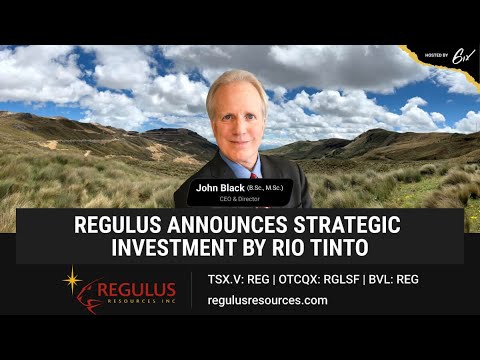
0:08 Hello everyone, welcome to Regulus Resources Live Summit today. I'm pleased to introduce our speaker, CEO and Director John Black, who's going to be taking us through the company's latest news, following which there's going to be a live Q&A session. So if you'd like to participate, please submit your questions using the Q&A tab found on the right-hand side of your screen at any time. And as always, today's event is being recorded and is going to be available on six.com in the coming days if you want to check it out again. But with John, with that, I want to pass things over to you to get us started.
0:34 Okay, hey, great. Thanks, Cam. And thanks to Cam and Romeo and the entire SICKS team for providing this format for us. And thank you, everyone, that's tuning in on rather short notice right in front of the holidays here. We usually don't plan on putting news out this time of year, but we had some pretty exciting news that we were able to capture. And we think it's important for everybody to hear what we've done and what we're thinking about this and the importance and what it can unlock for us as we're moving forward in this next year and then we look forward to any questions you might have so that everybody under understands well what the opportunity that we're having as we move forward. So of course the typical disclaimers of FI we're a publicly traded company in both Canada and Peru so look out for forward-looking statements that we'll mention today. And today's news does lead towards the future, so there will be some forward-looking statements as we move forward. What we're really pleased to announce today is that we're announcing that we've come to an agreement for a division of Rio Tinto. Newton, which is a subsidiary or a venture of Rio Tinto, has agreed to make a strategic placement into Regulus.
1:45 This will be a strategic placement of US $15 million or Canadian $20.5 million. And the terms of the placement will be, they'll be making a placement at Canadian $1.02 per share. So a nice premium over what our trading price has been over the recent past on this. And so it's a substantial amount of money that's coming into the company, and more importantly, a really nice technical endorsement of what we're doing, the potential of the project as we move forward. There are a number of terms that are associated with us that are fairly standard terms for this type of an agreement. When we craft an agreement like this, we work carefully with the party that's coming in to make sure 1, it's a party that's compatible with us, a party that we can work with and trust and move forward with.
2:33 Rio Tinto certainly ticks all those boxes for us. It's perhaps the best group we could think of to be involved with us on this project. And we also, for the type of investment we're getting and the benefits we're getting from this, they get certain rights back. So they will be able to appoint a director to our board, which we think will contribute strongly to our board as we're moving forward. And there are a number of rights that are listed in detail on here and in press release with respect to their shares being tied up for a certain period of time and not allowed to go over certain amounts during that period of time. So we feel this is crafted well. It's an agreement that allows us to have the benefits of this relationship, but it certainly doesn't prohibit us from talking with other groups or attracting interest from other groups as we move forward. So we've spent quite a bit of time on getting this structured right. And Rio Teno is an outstanding group to work with.
3:27 We've been very pleased with all the team that we've been working with. It's a group that's been monitoring us for quite some time, perhaps even since we initially started on the project. And we're quite pleased to have, be able to announce this agreement as we're going forward. So let's take a quick look at the benefits to regular shareholders moving forward on this. As I mentioned, this is a sizable investment by one of the largest diversified miners in the world. I couldn't think of a better group to be giving us a technical endorsement with and a better group to work with us as we move forward on the project. That technical endorsement of the antiquary project is very important. You've heard me talk in forums like this. Oftentimes, we have people looking at us and a number of different companies.
4:12 There's no better way for me to demonstrate that by being able to announce an agreement that gets us started. Keep in mind we're not in a position to yet sell the project. We have a lot of value to reveal in this project, so this is essentially a first step to move towards getting the project positioned better for an eventual sale of the project or consolidation of the district as we move forward. This financing was done in a very attractive valuation for us. That's very important for us right now. For these, when we take on a large project like this, we do need to spend a fair amount of money to continue to drill the project out, to de-risk it. And with this investment, we'll be able to be moving into more feasibility stage activities, the type of activities that are setting the stage for the development of the district. So we need to do that financing, but we have to be careful that we're not diluting our shareholders at the same time. So the attractiveness of this type of a strategic investment is that there are no warrants associated with it, and it's done at an overmarket price versus the alternative of doing an under market financing, which is difficult to do in this environment and often comes with warrants and other things attached to it, which is much more dilutive to our shareholders. So we, between this and the agreements we've recently done with the Cisco Gold Royalties, we're trying to maintain as low of a share count as possible, but still have the funding that we need to do to advance a project like this.
5:41 Many of our peers are chronically undercapitalized to move projects, big projects like this forward, and this puts us in an outstanding position. I believe with this financing and some other events that may happen in the near future, we may never need to do another financing on this project again before we reach our exit strategy moving forward. There's also a great opportunity for shared technical knowledge between Regulus and Rio Tinto on both the exploration and geologic fronts. Also on ES&G, Rio Tinto is a very strong group with ESG throughout the world. And they have a strong presence in Peru, including it's very important to note that they have the large Lagranja deposit in the same province we're in, in Cajamarca province. It's not too far to the north of us. And so They have an active team in the area. They understand Cajamarca and Peru well.
6:34 The recent political turmoil in Peru was not something that was an impediment for us to move forward on this agreement at all. I think it's a good indication of how the major minings, miners are looking through that and towards the future of Peru is a continued major mining presence. As I mentioned, this puts us in a very good position throughout 2023 and beyond in terms of cash and allows us to move forward aggressively on the project without having to worry about where the next financing comes from. And then last, but certainly not least on this, is that the Newton leaching technology, and we'll discuss that briefly in a little bit as well. This is a technology that Rio Tinto has been developing for over 30 years now. Most major copper companies have been pursuing the same type of technique. And what they're trying to do is to identify techniques that will allow them to do heap leaching of primary copper sulfides.
7:30 They're in copper mineralization, they're really sort of 2 styles of mineralization. There's mineralization that can be processed by heat leaching. That's largely oxide copper or secondary copper sulfides. And there are primary copper sulfides that, until now, have required concentration. And concentration is a very tried and true effective method to produce copper concentrates and copper. But it involves tailings, tailings dam storage, a smelter. There's quite an extensive chain of things that are involved within that, and therefore there are high capital and processing costs associated with that. And the attractiveness to being able to move to heap leaching of primary sulfides is you just dramatically reduce your capital cost. It gives you more flexibility on your site design because you're not trapped into having tailings
8:22 facilities that have to be located in certain types of areas. And so on the ESG front, the water consumption front, a number of other things, it's a much more attractive option to go forward. Rio Tinto believes that they've cracked the nut on this and they're commercializing their in-house technology now to begin to test this on deposits moving forward. So we're very anxious to see if Their techniques work well on our ores. We have very good preliminary indications that they will. And I want to emphasize that it doesn't mean we're locked into this technology, nor is this technology necessary for us to move the project forward. We have other alternatives to process our material, more traditional alternatives, or pressure oxidation autoclave type options to move forward. This is just 1 that we think is well worth investigating because it has potential to produce a much more economically attractive mine. But it's not necessary for us to use this technology to move forward.
9:20 Important thing to point out, we won't go through all the details on this slide, but as many of you are aware, we're moving into a situation where in the not too distant future, There's going to be an extreme shortage of copper as copper demand is ramping up greatly as we try to move into an energy economy that requires or produces less carbon moving forward. This means electrification of almost all aspects of life as we see it. And that almost by necessity demands a higher use of copper. So all of the major copper and many of the major gold companies are actively looking to acquire assets that can produce copper. And it's important to note that it's not just the copper companies that are doing this. We're seeing the gold companies move into that space as well. And this is a list of many of the more recent acquisitions that are underway. And we're well aware that there are a lot of groups that are closely monitoring assets like what we have.
10:18 And there are very few of these assets that are available right now. We're not finding new deposits. And there are not many deposits that are in the hands of junior companies, the type deposits that would be accessible for a major mining company to purchase. So as the deposits become more scarce and the miners need or are interested in acquiring new ones and as metal prices go up and they're producing good profits, that we anticipate that we'll be moving into a very good situation where there'll be a high demand for relatively few assets and that positions as well. So we're seeing groups outright acquiring, producing companies or other assets to move forward or positioning themselves by putting strategic placements into groups like ourselves. So BHP is on the list for acquiring Oz Minerals, but they've recently put a strategic placement into the very interesting Filo deposit in Argentina.
11:11 Another one to point out on the L32, They've recently purchased nearly half of an operating mine in Chile, but they've also put a strategic placement into Aldebaran, which is one of our sister companies working on a large copper deposit in Argentina. So we're seeing this increasingly be a strategy that major companies to try to get a toehold in to move forward and move projects forward. And so this is, we think this is just really the start of this type of activity as we move forward. Just, I think many of you listening are probably quite familiar with with our project and what the setting is But I thought it'd be good to just revisit it quickly This is the district that we're in it's the Wagle Yoke district in Cajamarca in northern Peru And on here we can see our land position in shades of red.
12:02 We own 100% of the red claims and we have 2 option agreements that allow us to earn into 60 or 70% of the blocks that are indicated here. One is with Koki Rumi, which is a subdivision or a subsidiary of Buenaventura, where we have an option to earn into a 70% interest in that ground. We can do that by completing 7,500 meters of drilling, which we have completed. So we've tripped the threshold to earn into 70%. And Buenaventura is currently evaluating a one-time clawback option they have whereby they could pay us 9 million dollars US to claw back to 70 percent leaving us with 30 percent of the project and they have until about the end of February to make their decision on whether they would like to do that.
12:48 To do that, they would need to pay us US $9 million to trigger that clawback agreement. And then the second agreement is with Goldfields at a little earlier stage on that week can earn into a 60% interest in that project moving forward. So it's part of a strategy of ours to consolidate a large land position in the northern part of the Huagla Yuc district. We're immediately north of the Tantua Tai mine. And the Tantua Tai mine is a heap leach gold operation that's owned by 3 companies, Buenaventura, who operates the mine, Southern Copper, and Espro, a local family company in Peru. So the 3 of them are combined to operate the Komalachi joint venture, which operates the Tantua Thai mine immediately adjacent to us.
13:39 And beneath that oxide cap that they're mining, they have extensive copper gold sulfide mineralization, And that same mineralization extends onto our ground. So essentially we're splitting a large Copper Gold Sulfide deposit that's partially on our ground, partially on their ground. And they're pre-stripping that by taking that oxide cap off and heap leaching that for gold mineralization. They have approximately 5 years of operating life left, and at which point there's an excellent opportunity to make a transition into a much larger Copper-Gold-Sulfide deposit. And we'll take a look in a moment at the potential size of that deposit. It's one that we consider the opportunity for a multi-generational mine. It's one that could be a mine that would easily last 40, 50 or more years.
14:28 And so Those are the type deposits that are very attractive to major mining companies. Most major mining companies are watching what's happening here and seeing if there's a way that they can get into this district. But one of the immediate things they encounter on this is the fragmented ownership. We have a portion of it, the neighbors have a portion of it, the neighbors are 3 different companies of different sizes and characteristics. And so it gets a little bit hard for a major company to come in and think about acquiring 100% of the project. If we did not have this complicated land position, this would already probably be moving towards being one of the next major mines in Peru. So solving that issue of a consolidation of the district is a really key point to be able to move forward on the project.
15:17 Also important to note that 7 kilometers away is the Cerro Corona mine on the southern part of this diagram. That's a mine owned and operated by Goldfields. It's been one of their better mines historically. It's a milling operation. And they're processing or developing a gold copper porphyry system. They produce about 20,000 tons per day and it's been been quite a nice producer for them over the years but it's also reaching the end of its mine life. They have about 5 more years of mining activity in the pit, at which time they'll stop mining from the pit and they'll begin to backfill the pit with tailings that are produced from continued operation of low-grade sulfide stockpile material. So in 5 years, their production will drop dramatically, and the employment in the mine will drop.
16:06 So the district overall is facing a situation where 2 very nice mines that employ a lot of people in the districts and provide a lot of benefits in the area have the risk of essentially winding up beginning in 5 years. But there's an outstanding opportunity to change this into a larger mine developed from a brownfields position that would be a mine that would last for decades beyond this and provide benefits for the areas. So it's in the interest of all stakeholders in the area to work together, to be able to set the table to produce this larger mine. And we think we have a key component of that moving forward. This is just a quick snapshot of the size of the deposit. This type of information is presented in a number of other presentations on our website.
16:52 We've shown the contained metals in this case, and they're broken out between copper and gold and measured and indicated versus inferred. So we can see these proper broken out and the full table showing our resources at the back of this presentation. So you can see where these numbers come from. But you can see we're sitting on about 5 billion pounds of contained copper mineralization on antiquary and 4.5 million ounces of gold. Our neighbors have slightly larger metal contents at slightly lower grades, and all inferred on their mineralization. But when you Combine the currently reported resources from both sides of the project right now into a combined deposit. We use the word Tantacore for the deposit combination of Tantawatai and Antacore.
17:47 We're looking at over 11 billion pounds of copper and nearly 10 million ounces of gold. So this would be a big gold deposit by itself or a big copper deposit by itself when they're combined. So very attractive metal contents at very high grades. It's located in a Brownfield setting. So there's power already to the area, road access to the area, availability of skilled labor in the area. So it's a very nice setting in that sense. It's important to note that this mineralization is extremely low strip. When we model the resources that we report on this, we get less than a one-to-one strip ratio. So when you have very attractive grades with your higher grades right near the surface at a very low strip, it immediately attracts the interest of major miners as a project that has the potential to be highly profitable to develop.
18:39 There's significant opportunities to continue to grow the size of it. Neither ourselves nor the parties next door have fully drilled out the deposits. And it also is a little hard for us to report our mineralization just from our site only. So an eventual consolidation of the district would be able to reveal that this deposit's even larger than what we can show you from currently reported resources. So what is Regulus's strategy moving forward on this? Is that we will continue to seek opportunities to work with Tantua Tie Next Door to maximize the value for all shareholders. How we can we can integrate our deposits and move forward in different ways to show the full value of the project. We plan to continue to grow the resource on our side, that strengthens our hand in the poker match, if you will, that'll come forward on how this thing might eventually be consolidated.
19:33 And particularly with the new agreement with Rio Tino on this is it will be evaluating different optimal processing methods for the deposit to go forward. This allows us to evaluate the Newton technologies, which as I mentioned, we feel have potential to be highly applicable to this deposit. We've done quite a bit of work with Rio Teno and our confidentiality agreement to get to this point. And now we're able to more publicly continue that work moving forward. So we will get a good look at that. I want to keep everyone reminded that it's not the only possible way that we can move forward on this. There are a number of different ways that we can tackle the style of mineralization we have.
20:18 Much of the mineralization we have and that the neighbors have is arsenical copper gold sulfide mineralization, so it requires some type of additional processing. Historically, those type of ores have been viewed as difficult ores or sometimes even impossible ores. But there have been a number of developments over the past few years that have shown different avenues on how we can process this. We're confident there are several different pathways that we could process this. What we wanna be evaluating is what's the economically the most attractive pathway to go forward. We'll also make sure that we maintain good standing in the district, in terms of our relationships with the communities and government authorities. So this involves many ES and G type activities. How can we prepare
21:07 the pathway for this, the footprint for us to be able to develop a large mine moving forward? So we need to make sure that we're demonstrating that we're doing everything in a responsible way. I'm particularly excited because Rio Tino has a lot of experience in this area and a lot of experiences directly in Peru and in Cajamarca. So it's gonna be fun to interact with their groups and fully understand what a major minor views is the necessities to move this forward. It's a great way to continue to add value to the project. We'll complete our drilling commitments to earn into the agreements that we have moving forward. We've done that for Koki Rumi now. We'll be working forward on the Goldfields Agreement is that, and overall what we're doing is we're seeking opportunities to be able to consolidate or sell in the district. Our strategy is to identify these type of opportunities, drill them out, show the full potential, de-risk them and then ideally for our business model we like to monetize the project by selling it to a major mining company that would be the likely party to develop the project going forward.
22:12 We've talked about that. We've indicated that there are parties that are interested in doing this. We can now reveal Rio Tinto as one of those parties that's certainly keeping a close eye on this and has chosen to help us visibly work forward to moving towards that point in the district. So we view this agreement that we're announcing today as the first step to strengthen our position to continue to seek that consolidation over the next year as we move forward in the project. So just in summary, the antiquary projects, the Brownfield Copper Gold Deposit with Blue Sky Potential, We think we're delivering a project at really a fantastic time. I mean, we continue to see a little bit of softness in the market right now. And the next 6 months or 8 months might be kind of challenging as the financial world gets inflation under control and gets through some challenging times there. But the potential for copper in the sort of a year and beyond timeframe is fantastic.
23:12 So in the next year, we hope to be able to begin to consolidate this district, show the full potential of it, begin to show economic parameters around it and position ourselves to be able to receive the value that we think this project merits moving forward. So we already have a large resource. As I mentioned, we have over 250 million tons of indicated mineralization at 0.4 percent copper, 0.29 grams per ton gold and a pretty healthy amount of silver and another 267 million tons of inferred at some of it's over 500 million tons on our ground with potential to substantially increase that. We have a great set of strategic partners and Route 1, our core investor in the group, as well as the Cisco Gold Royalties and now Rio Tinto moving forward.
24:00 It's in a brownfield setting. So this is a situation where it's easier to permit a mine going forward. And it's to the benefit of everyone, not just the mining companies that might be involved, but the communities that live in the area and the government. Overall, this would be a fantastic opportunity to cement a strong industry into Indiana Cocha. And really important for shareholders to pay attention to right now is that there's compelling valuation. This project has been around for a little while, and we were in a situation where our market cap does not begin to reflect what we view as the full potential of this deposit. This moves us a little bit closer to where we want to be, but there's a lot of leverage that's moving forward. There are many good projects out there, not many, there are a few good projects out there that already have a pretty fully valued project. So they're great projects, but the opportunity to make additional money by investing in them is somewhat limited because they've already made their run. I think here's an opportunity where you can jump in at this stage and have the confidence that we already have endorsement from serious players on this, that we're already in a brownfield situation, and there's a lot of value to be revealed as we move forward. So it's a great opportunity to be taking a look at a project like this. The final page just shows our full resource on here, which ties back to what we reported earlier in the project.
25:23 So with that, I'd like to thank everybody for your time on this and really open this up for questions to see if people would like to understand more details about this or any other questions you might have about the project. Absolutely John, thank you so much for the great presentation and as John says everyone if you do have questions please submit them in the Q&A chat we'll try our hand at them. The first question though comes from Brittany John, Considering the premium paid for this deal, has Rio Tinto seen the pending drill results for the end of the Phase 2 program? No. That's an important thing to point out on this because when we're interacting with groups like this, it gets a little bit tricky at times. We have quite a few groups that are under confidentiality agreement, but when they're under confidentiality agreement, that does not allow them to see results that are not published yet. It allows them to see lots of details of the project that not everybody gets to see, but not new data. So in this case, Rio Teno is not, nor have any other parties seen the data of unreported holes at this point in time. And quite frankly, it was not really an important consideration for them.
26:32 Their interest in the project and their decision to make this investment is based purely on what we already show, and that there's more than enough mineralization that they can see on that, and they're keen on it. Anything else is gravy beyond that. And I'd also like to point out that they do have strategic interest in the country and in the area because they have that LaGrange deposit just up the road on here as well. So they're perhaps thinking a little bit more of a regional play here as well. Absolutely, awesome. Joe is wondering, is the cost for the test work required to confirm whether the mineralization is amenable to the Newton technology covered by the private placement or by Newton? A little bit of both. The agreement that we have is that part of the funds that they've provided to us will be used to acquire the samples that are necessary for the test work. So we will be drilling large diameter core to produce material that can be used. The next state we've done quite a bit of test work on smaller diameter material that comes from our normal drilling. They'd like to move to large column tests moving forward.
27:43 So we are responsible for acquiring the material and providing them with the material, but the actual cost of the test work and the administration of the test work, those costs will be borne by Newton Rio Teno. And the data will be available for us and we'll be able to report the results of that data. We won't be able to provide any information on the more patented technology that's involved in it. Gold's an important part of the potential revenue stream from Antiquary. Is the Newton technology focused on copper extraction and how does it work with gold and even silver? It's a great question and somewhat to be determined on this. We can perhaps describe this a little bit in that there are almost 2 approaches to this style of mineralization right now. We see that Gold companies really favour what's called pressure oxidation technology or autoclave technology.
28:41 It's a technology that optimizes the recovery of both metals, but it comes at a high capex cost and a higher operating cost. So there are costs associated with that to get those both metals out on it. Whereas the copper sulfide leach optimizes the recovery of the copper at much lower cost. And so you could end up with a situation where you have a copper mine or a deposit like ours that you make more money off just processing the copper with cheaper technology than you would by processing for both gold and copper on the other. Now, having said that, there's room to explore the possibility of recover of the gold through multiple leach cycles on the deposit going forward. So it's not that it's only copper, but it's really designed to maximize the copper at low cost.
29:34 Right. So as I mentioned before, I'd really like to emphasize that we're not trapped into one technology or the other with this agreement. There are some restrictions there, as I mentioned. Many copper companies are exploring the possibility of primary sulfide leach. And with this agreement, we have their exclusive rights to Rio Tiono Newton for anything that's related to new technology to leach sulfide. So we can't go out and interact with another company for primary copper sulfide leaching. But we can absolutely continue to explore pathways that involve conventional concentrate production and pressure oxidation or autoclave.
30:20 So we'll be pursuing multiple paths and evaluating which is the best or perhaps a combination of them to move forward on the project. Right. And you might have covered it partially there, but Joe is just wondering, so Regulus is funded to advance Antiquarian 2023, but does Newton have strings attached and how are the funds applied? Or rather, does Newton have strings attached to how the funds are applied? They do have certain strings attached to it. We are committed to working together to evaluate the Newton technology for the copper sulfide leach. So that's an important part of it, but by no means all of the funds that are available there. We will also be free to continue to expand our resource as we move forward and to work heavily on the type of activities that de-risk the project in terms of making sure communities fully understand what we're doing and are happy with how we're moving forward with the project, exploring acquisition of lands that are necessary for the footprint we'll need to move the project forward and other sort of early feasibility activity type things that we'd be doing to move the project forward. So we will sit down with Rio Tindo and other parties on this and discuss that in the early part of the year to work a project forward. But the other strings that are attached is there is a board seat, which we view as a positive and to the company as well.
31:46 We will form a technical committee that is advisory. So we're not obligated to do what the technical committee says it's equal representation from us and from Rio Tindal. But it's a great way for us to get feedback from them and ideas on moving forward. So there really aren't that many restrictions on moving forward. The main one that he did mention was, is that we're not allowed to pursue similar primary copper sulfide leach technology with other companies, many of whom have been monitoring and taking a look at us as well. So they'll have to approach us in a different way. Fair enough. Adrian's wondering if you can say if Rio is helping to consolidate the neighbors, or are you negotiating this on your own?
32:34 I have to be a little careful on that. All of that type of activity is done under confidential agreements and it's also very strategically important to us as well. So I can't indicate what they'd be doing in that sense. But what I can say is that having them as a partner is very much strengthens our position in those type of discussions. Many times when you have a situation where you have a small junior company like ourselves interacting with major companies there's a tendency for us to not have the credibility or the bank account or the presence to be able to negotiate well in this. And now in essence what we have on this is we kind of have 3 big brothers standing behind us in Rio Tinto, Cisco Gold Royalties and Route 1, a large hedge fund. So that that strengthens our position and allows us to to be viewed as a group that's much more capable than simply just a junior company.
33:36 Right. Another question, is the Newton technique necessary to mitigate the arsenic content in the deposit? No, as we've discussed, it's not the only way to do this. This can be done through pressure oxidation as well. All of these techniques have the same component to them. And really, what you're doing is you're taking a primary sulfide or sulfosalt mineral, and you're oxidizing that and breaking it down. And by doing that, you liberate your metals. And that makes the copper and gold accessible to extraction. It also takes the arsenic and sequesters it into a mineral called scoridite, which is inert and stable and environmentally much more manageable as you move forward. And you can do that by Newton-style techniques on this to do heap bleaching of primary sulfides. You can do it by pressure oxidation.
34:32 You can do it by roasting as well. The problem with roasting is that you produce arsenic and then arsenic trioxide, which is more difficult to manage on this. So we have several pathways to go forward on this and we'll evaluate all of those pathways. It's very different than, particularly 10 years ago, a project like this with this arsenic content would have been attractive due to metal contents, but kind of a no-go due to the metallurgy associated with that. That's changed dramatically. In the past 2 years, 3 years, we've had probably 5 different groups approach us because we have arsenic, which seems a little strange on this. And it's because they believe that they have technologies or ability to be able to handle these ores.
35:20 Arsenic levels are increasing in copper deposits throughout the world. And both the miners as well as the processors, the smelters, are developing techniques to be able to handle more arsenic more efficiently now. There are discussions of certain metallurgical complexes being designed specifically to handle more arsenic-rich ore, so it's not even off the table that we could market a high arsenic ore into the market now through blending and other mechanisms to go forward. That would come with extreme penalties. So we think that some of these other techniques offer much more economically viable ways to go forward. But there are groups, including Rio Tindo, that are intentionally looking at arsenic-rich deposits now because they believe they have good solutions to be able to handle it.
36:07 No, absolutely. OK. What's the status of the drilling at the at the Kulkuriyumi claims and the timeline for Buenaventura to respond. Okay, so the Kalkoriumi claims are, it's a package, a large package to the north of us where we're earning into a 70% interest. To get that 70% interest we had to complete 7,500 meters of drilling, which we have completed that now. We have notified Koki Rumi. Koki Rumi is a 100% subsidiary of Buenaventura. So it's Buenaventura only. It's not the 3 parties on the joint venture. We've notified them that we've completed that and therefore have earned into a 70% interest. And we're now in a period of time in which Koki Rumi or Buenaventura have a one time option to determine if they would like to claw back to the deposit.
37:03 So they could either allow us to stay at 70% and they would be at 30% and we form a joint venture and move forward, or they could elect to claw back to 70% them, 30% us by paying us US $9 million to do so. And they have until the end of February to make that decision on whether they would like to do that. So if they choose to do that, they would pay us $9 million to move forward. We view it as a win-win situation. It's We prefer to probably have 70% of the project, and that means you have the controlling interest in the joint venture. But $9 million could be put to good use, particularly as we move to, say, land acquisition and more costly things that need to be done to strengthen our hand moving forward with the project.
37:51 So either outcome will be good for us on this as we go forward and we'll know the answer to that by the end of February. Right. So The news release notes restrictions on Nutan going above 19.9. Does the restriction apply collectively to Nutan and Rio Tinto? In other words, does the restriction preclude Rio Tinto from going hostile on its own? No, they're considered the same entity for that. So it's 19.9 total to any Rio Tinto company. Absolutely. Keep in mind that there are the typical things on that is that handcuff, if you will, goes off in the event that somebody else were to make an offer to us, then that would drop away and they'd be allowed to compete. So fairly standard terms for this type of an agreement.
38:39 Okay, thank you. Jim wants to know when you talk about consolidation, how did the peer exploration parts of your holdings factor into that? Would those portions be excluded?
38:55 I'm not entirely sure I understand the question. So I think what they're referring to the peer. Jim, if you're here still in the audience, if you wouldn't mind maybe messaging me, just any extra context for you, John, and then we can come back to that. Yeah, that'd be good if I could understand exactly what they're asking. They're not quite sure I follow that. No worries. Michael wants to know, when is the company going to be in a position to sell the company?
39:26 That's the magic question. These things always take longer than we'd like them to, but they generally work out to be in the right sweet spot on here. So I can point out some big steps that need to be done in our opinion, before we get to that 0.1 is that right now we can show the size of the mineralization that's on our ground. And the neighbors report what's on their ground. But we can't really show the size of the full deposit in any way right now. So it'd be very nice if we could, through any of a variety of mechanisms, arrive at an agreement where we could show that full deposit size. Groups, major miners that are under confidentiality with us and under confidentiality with the other side can probably put that together, But it's an extra step. It'd be so much nicer if we could do that. And then more importantly, once we can do that, if we can show the economic parameters, a lot of times a project like this moves to a certain stage and then it kind of stalls and it's additional drill results don't move our share price that we need kind of that next step breakthrough. And that can either be done through showing a larger resource, but more importantly, getting to say a PEA stage where we could show the economic parameters. We're incredibly excited to get to that stage because we can do that work in-house. We can see what that type of a project will look like. Frankly, most of the major mining companies looking at it see that as well,
40:57 but we can't reveal that to the public just yet. And with a deposit that has such a large amount of mineralization at extremely low strip ratios and very attractive grades in a brownfield setting, essentially, those numbers, I think, will really open some eyes when we're in a position to do that. So a large part of what we are trying to do this next year is to get into that position where we can have that value of that deposit revealed. And we believe with that, then people will realize how seriously undervalued we are. Because Another key component is that even if we had a company that was ready to buy our portion right now, we probably couldn't come to an agreement on a price. Well, we could perhaps come to an agreement on a fair price, but that price would be multiples of our current value. And that would prohibit a party from buying us because they'd be criticized for paying you know a High premium to purchase us. So we need to have our market cap actually Move up into a position that's within a more reasonable premium for us to be sold on this. It's kind of funny, but if you're too low valued, it kind of discourages a sale. And many of us in the Copper space get into this situation.
42:14 And so what we need to do is through a series of steps, demonstrate that value and get the project positioned well so that we're within striking distance of that. And what we'd like to do that is that we believe this is the first step to show that we're moving towards consolidation. Not that this agreement consolidates the district, but it very much strengthens our hand in that discussion on how we move forward. It gives us more credibility, gives us more support as we move into that. And then we would very much like over the course of the next year to be able to put that together. And I think coincidentally, another year or 18 months is the amount of time that we need to be into a sweet spot with Copper prices rising. Perfect scenario for us is that we're revealing the full value of the project right as copper prices are breaking through $5 or more and companies are getting pretty desperate to move on things and then then you catch that lightning in a bottle at that point in time moving forward. So I we we would like another 12 to 18 months to be able to show the full value on it. And I think that's kind of what the market's set up for as well.
43:21 Great. OK, awesome. Circling back to Jim's question, I think a correct interpretation, just based on the context Jim has sent along to us, I might read like this. Does the far north piece of Regulus's exploration and the goldfields claims factor into a potential consolidation? It does factor in, in the sense that we have mineralization on certainly the Koki Rumi ground. We haven't done much work on the Goldfields ground just yet, but at this point in time, there's not a large amount of mineralization on either, but their proximity to the deposit is important. So having a consolidated land position puts us into a stronger position, absolutely on that. And in terms of if we're discussing things with the neighbors, you might need that ground for infrastructure development or other things.
44:13 It also allows us to interact with communities that underlie those with valid work, valid exploration work that's on those that keeps them in partnership with us on moving forward on the project. So it is, I believe it's critical, whether it adds a significant amount of dollar value to it or not, that's probably open for debate. But it is critical for us to have a more complete package to enter into this type of a discussion. So since you're fully funded now, do you have any plans to significantly expand drilling programs going into 2023? I'll have to defer that question for just a little bit because this is a bit of a change for us right now. And you'll be seeing that we're going to be pivoting much more directly to the deposit. We'll continue to try to expand the deposit, but we now have the funds and the impetus and quite frankly, it's time for us to begin to be looking at the de-risking and presentation of the full project in itself.
45:12 So we have some planning work to do on that. We've currently finished our stage 2 program at the end of the year with our current drilling on this. And we'll take a little pause in the drilling through the wet season until about April, at which point we'll be ready to get back to what would be our stage 3 drilling program, which will undoubtedly have a significant component of metallurgical drilling associated with it as well. But I'm not in a position to lay that out in January and February. We'll review all of this and work with new partners on this to lay out what the program will be. Right. Adrian wants to know if the Rio agreement in any way prevents third party from trying to buy you out. No we're very we're very conscious of that.
45:57 When we when we enter into an agreement like this the last thing we'd want to do is enter into an agreement that gives them such strong control that they're the only, it's nice to have somebody that might want to buy you, but you don't want to have them have so much control that it scares everybody off on this. So we've structured it pretty carefully to allow other parties to be involved or to compete to be involved in this. That's part of our strategy and our job is to make sure that we always are able to create competitive tension and that allows us to best sell our project moving forward. So it does put them in a very good position to be a strong candidate for it, but not exclusively at all. And it's also important to point out that increasingly on projects like this in South America and most parts of the world, it's not uncommon to see 2 or 3 major companies combined together. This will be a very large project, a very long life project. It'll require a lot of capital to go forward. And so sometimes they'll share risk by having multiple partners that each contribute something, particularly when you have a project that has such a strong copper component and such a strong gold component, you could see perhaps a copper company and a gold company combining on this. Right.
47:12 Jacob wants us to circle back to a conversation about consolidation. Is it more likely that a land right agreement for the district will be combined and then an economic study done before a monetizing event? Or would the initial consolidation be a monetizing event for Regulus? I don't think an initial consolidation, well, there are a whole variety of different pathways to go forward. But for those of you that are hoping that we can do an initial consolidation event and receive the value that we'd like to receive for the project, that's probably a pretty big jump right now, based on what our market cap is right now. So I would intuitively believe that this will be done through a series of steps with each step designed to reveal more value for that. And that that would be to the benefit of all parties involved on it right now.
48:07 If all of us that are in the district right now decided to get together and sell the project, we probably wouldn't receive the price that we would like to receive. There's work to be done to show the full value on the project first. And that can be done in a variety of different ways through consolidation or through collaborative agreements or there are a variety of different ways to move forward on that. Could you comment on the political picture in Peru right now? Wonderfully complex. It's probably really referring mostly to the recent changes at the presidential level on this. So for those of you that aren't fully aware on this, We've just had a rather sudden change in president. Castillo, the president that was elected from a far left platform, really driven by communist interest moving forward in the country, was always on shaky ground.
49:02 He wasn't particularly well prepared to be a president and he didn't have a strong infrastructure around him to do so. So we were in a situation where he had continuous opposition and in a very ineffective government, which meant permits didn't move forward, a lot of things. It would have been nice in some ways to have him complete his presidency and go through a normal cycle on it, but we would have had quite a number more years of fairly ineffective government moving forward. And So this change, even though it's abrupt, it's important to note that it's done constitutionally. It's not an overthrow or a coup or anything like that. It's done within the framework of the constitution on it. It will almost undoubtedly result in a new presidency that is more prepared to run the country properly and more pro-industry, pro-mining on this. So it's a good change for us overall, from our perspective as miners, as we move forward. There will be a transition period as the interim president works until elections are held, which will be pulled forward on this. But we believe that there's a very strong chance that we'll come out of this with a much stronger government and a much more prepared and professional government that can move forward.
50:21 And almost all people involved in Peru realize that the mining industry is one of the strongest drivers in the country economically. And it's essential, it's a mining country and it'll always be a mining country moving forward. We believe that this change will put us in a better position. Right now, we note a situation where the reporting in the international press is sometimes a bit dramatic right now in focusing on certain events on those. What we see inside the country is very, I was down there the whole time when this was all happening right now. And there were some unfortunate incidents in certain areas that are driven by political interests more than anything else that are kind of whipping people up on ideas, and they're trying to cause chaos to further political causes on it.
51:10 The current interim government's taking strong steps to discourage that. So things have settled down dramatically in-country, And I think we're moving into a situation which is much better. Awesome, okay. Fadum wants to know what the reason is for the recent real results delay. Partly is because we got caught into this negotiation on it. And when we got caught into this negotiation, which as I mentioned, they don't have access to this results and we wanted to have the conclusion on this as well. It's also been, we're waiting for all the assays to come in on the data that we have remaining. And so we can present it as one big batch and have full context on that. So they will come out as soon as we get the final assays in. We stopped drilling about mid-December, and we hope that the labs catch up through Christmas on this and we'll be in a position in January to put out all of the remaining drill holes.
52:05 Right. Are there many companies looking at the Antiquary project and the wider district scale opportunity for that matter? Yes, there are quite a few. It's done under confidentiality agreement, so I can't name companies or we don't usually even give the number of them, but it's a significant number. Any major copper company or major gold company, if they're doing their job correctly, is monitoring opportunities like this. There are very few deposits that have the amount of contained metal that we're showing in a mining country that are out there. So we'd fit on a fairly short list of projects that companies should be taking a look at. So we're under confidentiality agreements with quite a number of companies. Some choose to monitor us without going under confidentiality agreement, but we interact with them quite a bit.
52:54 And this is part of the process we've seen. Our previous company, Antares Minerals, When we got to the PEA stage, just a little bit beyond what we're doing right now, at that one, I can say that at the end, we had 26 companies under CA and representing 13 different countries. And so when we get onto a project like this, you start to draw a lot of attention and moving forward. And I think today's news will probably result in a few more paying a little more attention to it as well. That's great to hear. Well, listen, John, we're coming close on time at the end of the day here. So I want to thank you for coming on. I want to thank you for having such a great presentation and going through that Q&A session. And of course, I want to thank everyone in the audience, especially those who participated today. But before we wrap up, Andy, I want to pass things back to you for some closing remarks if you have any.
53:43 Yep, great. I'd like to wrap up. The project we're on is a very, very special project, very unique project. This is the largest ore deposit I've ever worked on in my life. And we're only beginning to be able to show the full potential of this. So we're quite excited to be able to show this going forward. It's a fantastic time to have our hand on an asset like this. These assets are becoming increasingly rare, and they're becoming increasingly sought after. So it's kind of a perfect time to have our hands on a project like this. And we think today's news will provide us with the financial support we need to begin to fully reveal what we have moving forward. So we're very, very excited about this opportunity moving forward. And for those of you looking at investments, it's an outstanding time to take a look at it because we're significantly undervalued for what the potential of what we have right now and I think this will allow us to begin to move the project more quickly moving forward. So I'd also just like to thank everybody for for taking a little bit of time today or catching this on the replay. I know we're pushing this right into the holidays on it. So for those of you