Baden Gowrie-Smith
MD and CFO at REFUELS N.V
Replay available
Q3 2026 Results and Q&A hosted by Refuels (Oslo:REFL) on Investor Meet Company, held 2026-03-09.
On 6ix: 6ix.com/event/refuels-nv-refl-q3-2026-results-and-qanda
Automated transcript · Written by software from the replay's audio. It can mishear names and figures; the replay is the record.
0:01 Good morning, and welcome to the REFUELS Q3 twenty twenty six Investor Presentation. Throughout this recorded presentation, investors will be in listen only mode. Questions are encouraged and they can be submitted at any time using the Q and A tab situated on the right hand corner of your screen. Just simply type in your questions and press send. Before we begin, I would like to submit the following poll, and I would now like to hand you over to the management team of REFUELS, Philip and Baden. Good morning to you guys. Good morning, and good morning to everyone watching this live or watching this on catch up. Thank you for tuning in to our q three presentations presentation. Sorry. As per normal, there is an ability for you to submit questions, and we will do our best to answer those at the end of this presentation. And with further ado, we'll get started.
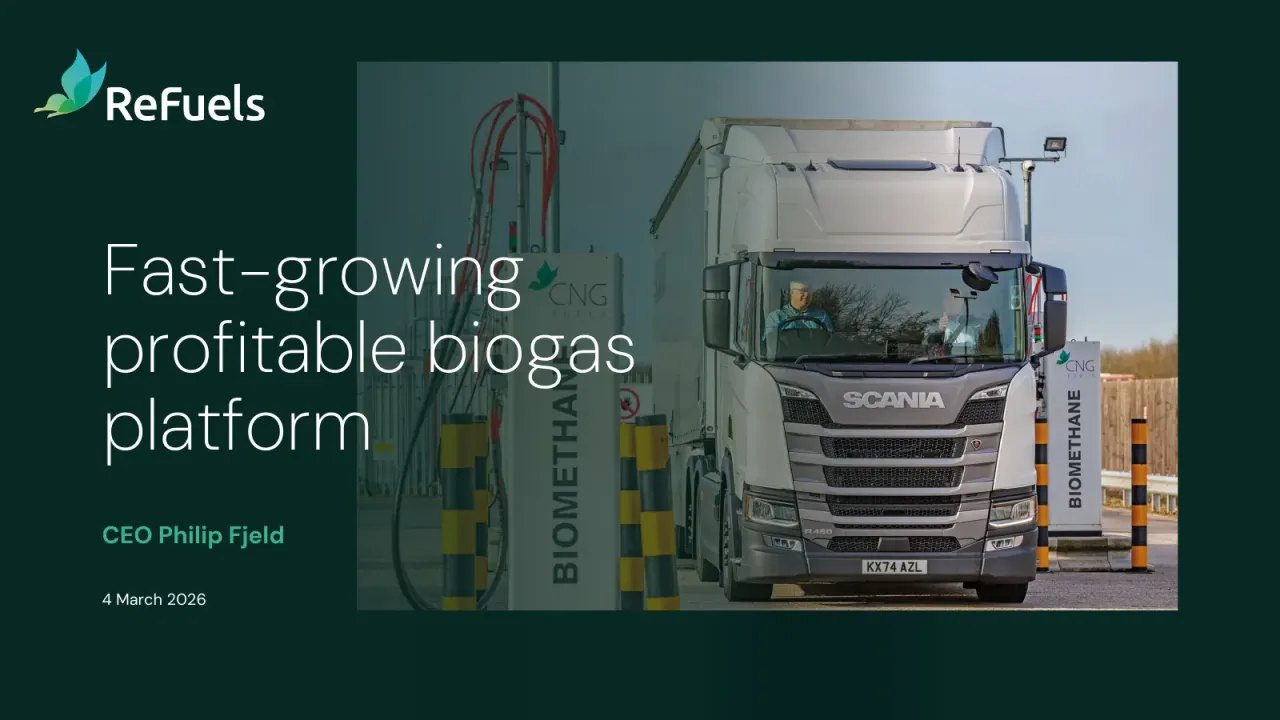
0:54 So what is it we do? We are putting 100% renewable gas into trucks called biomethane. At this point in time, we are, supplying about 50% of the biomethane that goes into trucks, across The UK. What is what are the benefits of putting BioMeath into trucks? One, it reduces your greenhouse gas emissions from those trucks in the range of 85 to 90%. And as you'll see later in the presentation, there is also a financial benefit as well. If you look at the number of trucks we've got on the road today, you know, when the when the group was founded back in 2014, there were zero dedicated CNG trucks on the road. Today, we've got north of 2,200 trucks refueling through our network every day.
1:45 I mentioned fuel cost savings previously, but if you look at the overall impact we've had on the fuel cost builds of our customers over the last five to six years, we've helped them save north of £50,000,000 by running on CNG instead of diesel. And more importantly to a lot of our customers, they also wanna make sure that they're doing the right thing by the environment. And if you look at the last twelve month period, we have saved north of 200,000 tons of greenhouse gas or helped our customers save north of 200,000 tons of greenhouse gas emissions. If we then look at REFUELS and how do we fit into the picture here, we have a a group entity called CNG fuels, which sits below us and Foresight. REFUELS owns 40% of that group. Foresight holds 60% of that group. There are essentially two verticals within CNG fuels.
2:40 There is RTFS, which sources biomethane, generates something we call RTFCs, which Baden will touch a bit on a bit later, and where we then can generate a margin and a profit from that. And then on the right hand side, you see CNGFUELS' brand when it comes to the the station infrastructure. CNGFUELS as such is a is an integrated group, whereas I said, we own 40%, Foresight owns 60%. And as you will see in a bit, we are now have taken the group, what I would say, out of the the build only phase, and we're now actually also starting to get into a cash flow positive phase where we'll we'll continue to roll out the platform absolutely, but where we're now also starting to see some of the benefits from having invested in what we've been doing over the last twelve years.
3:31 This is just an example of one of our stations. This is Warrington. That's the M 62 up in the top corner there. To the West is Liverpool. To the East is Manchester. What you don't see around here, had we been zooming out, you will see a lot of very large distribution centers of lots of of large warehouses. These are very efficient pieces of infrastructure where as of today, we have more than 300 truck refuelings here every day. The drivers do all the work as such. They're unmanned. We can remotely monitor them, and then we have engineers go to site if there is something that needs to be fixed. If you look at the total volume going through Warrington today, it's just north of about 50% of what we would call steady state utilization, currently dispensing about 8,000,000 kilos of biomethane a year and generating north of 30,000,000 RTFCs per year. So once again, this is just a good illustration of the type of infrastructure that we put in place.
4:31 And as of today, we are not aware of, a more efficient way of putting green energy or a green energy vector into, into trucks. If we then look at the highlights, of our October to dispense sorry, to December quarter. Our EBITA for the period is, is close to £10,000,000, £9,700,000. That's up 10 x from the same period in 2025. We are proud to be raising our guidance again from previously communicated 10 to £12,000,000 for this financial year to 13 to £15,000,000 for this year. So what is it that's driving our increase in guidance, operational efficiencies, scale benefits, and also higher certificate prices, which are improving margins?
5:22 Clearly, when you have to build an industry like we have, there will come a a point in time when you have to invest and you have to, you know, build core infrastructure. Now we're moving into the phase where we will continue to build out the network, but where we're also focused on operations and making sure that there are scale benefits that come out of of the network. If you look at the, at the dispense volume, up 13%, year on year, and we're also proud to see that in a soft overall truck market, CNG adoption continues to grow, across our customer base. Just mentioned the truck market. The truck market is going through, a tough time at the moment.
6:07 There are a lot of hauliers that are either scaling back or actually unfortunately going out of business, likely because there was a bit of over, you know, overexpansion during the COVID years. And, of course, with a much softer economy currently, you know, we're technically in a recession, you will see that there is a less need for moving goods around the country. So what we've seen for the last three, full full calendar years is that the overall truck market, new registrations into the market, and this is, of course, majority of these by far, the majority of these are diesel, new registrations has dropped quite a bit. In that same market, we're growing. So that's, of course, a a nice position to be in. But I think it's also important for you guys listening to this that had we been in a more stable overall grow a truck market or maybe a truck market that was growing, we would likely grow faster as well. Eventually, the market will turn around on an overall basis, and we expect that to be a benefit for us as well. If you look on the right hand side of this graph, you see we're mentioning four by two trucks, six by two trucks, and you see that the six by two market is essentially a six times larger market than what the four by two trucks are today. About 21,504 by twos on the road, about a 144,006 by twos on the road. We've got currently about 10% of the four by two market are running on CNG exclusively exclusively
7:38 through our network. However, we've only got point 1% of the six by two market. You might say, well, why is that? That is because the truck manufacturers have only in the last twelve to eighteen months brought out factory built and factory warranted six by twos. As we see, you know, we see record strong interest in demoing and trialing trucks in the six by two market, so we would expect our market share there to grow quite rapidly once these trucks go from trial phase into being ordered and being delivered into customer hands. An aging truck fleet also means that you can't just put off replacing trucks forever. Eventually, trucks cut literally to fall apart, and, clearly, you can't base your your fleet strategy on on on glue and duct tape, keep you know, keep keeping trucks together.
8:31 So as we we're in a period now where there is a lot less replacement of vehicles going on, eventually, that would have to catch up. And we estimate that over the next ten years, there's about a 100,000 trucks that need to be replaced. And more importantly, the vast majority of that truck replacement cycle, the fuel technology has not yet been decided. So once again, it's a really exciting years ahead for us there to be able to influence our customer base to move away from diesel and particularly important now that the six by two CNG trucks have arrived. I previously mentioned there are basically two benefits for our customers here. One is they can by running on biomethane, they get to save approximately 85 to 90% greenhouse gas emissions compared to diesel. That's incredibly important for the majority of our customers who've got GHGM ambitions, which are essentially, you know, as an example, 50% GHG reduction by 2030, maybe a 100% by 2035.
9:31 As of today, there's really only one technology in town, and that's buying ethane or fuel vector in town that can provide them that. But more importantly, majority of our customers also can't afford to go green and lose money. So if you look at a base base case comparison here, which is a typical diesel vehicle, yes, a CNG truck on the right hand side here. CNG truck is typically £25,000 more expensive to buy. However, the fuel is cheaper. So when you then look at the payback period, and this is a simple, you know, cash on cash payback period, a typical truck, diesel truck, by its first owner is kept for five years. Yes. Some will keep them shorter, some keep them longer. On average, it's about five years. If you're running on HVO, 100% biodiesel, your payback period on your additional investment in your CNG truck is less than a year.
10:23 If you're running a a regular diesel truck or on regular diesel, your payback period is about a year and a half. Of course, depending on mileage. So if you if you drive your truck a a bit, you know, shorter mileage or be longer pay payback period. If you if you drive it further or or lot longer mileage every year, there'll be a shorter payback period. But what we're seeing here is cash on cash, very strong financial reasons to also adopt by methane. And then when you put in the the GHG savings, you get into win win scenario for our customers, and that's why we're seeing some of the really large PLCs in The UK now mass adopting CNG trucks. We sometimes get a question, Philip, there is a bit of uncertainty in the biodiesel market as to what type of feeds and and the availability of feedstocks actually produce, biodiesel, that's not the case in the biomethane market.
11:17 As of today, we do not see a shortage or the market isn't seeing a shortage with regards to feedstocks. On the contrary, you know, we are aware of close to 30,000,000,000 going in to expand by methane production across Europe, over the next five years. This figure is almost a year old now based on discussions that we're having with large infrastructure investors, private equity invest investors. We'd expect that figure to be larger today, but let's go with, you know, the official stats we've got. So close to 30,000,000,000 is looking to expand upstream capacity. So that well, you know, why is that important to us? Well, of course, you know, we wanna source by methane and make margin out of it, but, of course, we wanna source by methane so so that our our customers can be you know, have have certainty that they are actually running on biomethane and not fossil gas.
12:08 And this gives us the the confidence and the visibility forward forward looking visibility to do that. So where are we then on our rollout of our infrastructure network today? Today, we've got 16 grid connected stations operational, and we've got 11 so called MRSs, mobile refueling stations. We we do have a business plan now that takes out until the end of twenty twenty eight where we're looking to have 25 grid connected stations either operational or in build and considerably larger number of of mobile refueling stations closer to 30 of those in operation. So that would effectively double our theoretical refueling capacity, and then you might say, well, you know, if you're only refueling 2,200 trucks a day, you've got theoretical capacity of 11,500, why would you wanna take that up to 20,000?
12:59 Because a lot of our customers don't just operate trucks where we've already got stations. They want to adopt CNG as well in areas of the country where we to do where where we today do not have a station, and therefore continuing to expand the network, particularly in parallel with the c n six by two adoption increasing is very important. Speaking of stations, this is just an overview as to what we've opened recently and what is coming. Got Livingston in Scotland, which opened in May last year. We've got Maygor in in in South Wales where construction is is well underway. We've got Swindon where we are expecting to make a final investment decision very shortly, just waiting on a couple of things there to to to fall in line. And then we have a third site that will be going into build later this year, and that will be announced in due course with the exact location.
13:55 If you then look at the biomethane that we put into trucks, clearly, are a couple of elements there. It's the cost of the biomethane, but also the RFCs, which is the the certificates that we generate from those. Baden will talk a bit about margins on those in a bit. But what we're currently seeing is that, yes, RFCs can be volatile. That's just the nature of of of operating in a market based mechanism. But what we are seeing is the certificate prices have essentially returned to their historical averages, and we are starting to see the benefits of that. And, of course, there's a lot of supportive biofuel policy developments here, particularly across the EU with the red three renewable energy directive number three legislation that is about to be, implemented, which is also supportive of this longer term.
14:47 If you look at biofuel mandates, as I just mentioned, we in The UK are a bit of a laggard. We are here, we have a a quite flat curve with regards to the type the the amount of biofuel that is used in in in transport. We are expecting a consultation from UK government imminently from the Department of Transport to look at potentially increasing those targets. I mentioned the red three implementation. The one at the top there is just showing Germany's ambitions out until 2040. That is currently going through German legislative approval process. And, of course, you could see there there is a huge gap between the ambitions in The UK, which we expect to to be increased going forward.
15:32 But more importantly, the German ambitions with which are being ramped up is and and it being the largest biofuel market in Europe is gonna have a significant impact on the overall biofuel market whether The UK makes changes or not. And with that, I will hand it over to Baden. Thank you very much, Philip. So just to those of you who haven't watched us before, a reminder to those who have, what we're seeing here and what we show is actually the financial results of CNG fuels being the operating entity that you saw previously on on the in the earlier structure slides. Why do we show that? Well, CNG well, obviously, REFUELS owns 40% of that, and that is its primary holding. It's it's then that is, therefore, is this is the best proxy for performance that we can show to investors or market participants to show them the the the performance of the REFUELS entity itself.
16:29 So what we've we've obviously had had a very good a very strong quarter. Year to date revenue is up 22. That is to compare against about 13% increase in volumes. So and that's, of course, you've seen where where our margins obviously continue to improve very well. The 70 we've had a 72% increase in gross profit for up to £10,000,000 in the quarter. And and the split there, which I'll go into maybe on the next slide, is about 33% to the CNG station business and 66% to the RTFS to the to the to the biomethane side of the business. EBITDA has gone from breakeven in the comparable quarter last year to to £5,600,000 in this quarter, and that's doubled from the £2,800,000 we made last quarter. So, again, very a substantial increase in EBITDA. Once again, these additional volumes at good margins have broken up through our through the cost base. Now we're really seeing that driving straight out to the bottom line.
17:34 Philip's already described the difference between CNG fuels and RTFS. But just a reminder for the business on our revenue streams, we have two business two two revenue streams that are essentially correlated by volumes alone. One is the RTFS revenue streams, which from the biomethane selling side of the business. So that's the buying purchase of biomethane, cellular, and and and the generation of RTFCs, the margin we make from there. And then we have the CNG station business downstream where we sell where we sell the bio CNG to customers and and generate a compression charge on that. And so those two biz those those two revenue streams are linked by volumes, but fundamentally, otherwise, are are non correlated. So that's why it's so important that we're now starting to see, first of all, excellent EBITDA contribution from RTFS continuing and continuing to grow, but also the CNG station business itself after many years is is very, very soon to break even.
18:31 And, of course, that also involves the research and development and new station activities that go on within that entity. And so that is a that will be an exciting milestone that is that is happening in the near term where both parts of the business they're both and and both revenue streams will be will be contributing to the earnings of the business and no part subsidizing any other any other part of any other part of the of the group. In addition, we also we also generated and sold a record 82,200,000 RTFCs in the quarter. That, of course, that, of course, is great news by itself. But being the end of the obligation year under the RTFO, that means that our customers were also a 100% were sort of received a 100% RTFO approved by methane through the 2025 year, which is very important to them for their for reporting their emission savings. So that's obviously a that's a great milestone for us as well as business as them being able to report those.
19:29 So as Philip also mentioned, you we have increased our guidance 20% for the financial year. So, obviously, the the our financial year finishing as shortly on March 31 this month to 13 to £15,000,000. On that, again, is on the back of continued strong margins coming against the sort of end of year volume growth, which, of course, continues to grow throughout the year. It is we've also been we've also achieved the highest gross profit margin on our RTFC sales we've seen for three years now. So over thirty years, about 31%. And that, of course, has helped drive that earning drive drive those earnings forward for yeah. Which is which is results in the upgrade to our guidance. Really important to note, and, of course, you've seen recent turmoil in the energy markets, or you you certainly have heard of the recent turmoil in energy markets.
20:21 But the the business has sold forward essentially all of its RTFCs for the for the for this calendar year and into 2027 and source the biomethane that we require for the same period. So that's that's obviously got two two excellent benefits for the business. One is very strong visibility on our earnings for the for the coming financial year, as well as also having very little RTFC and general commodity exposure for the year ahead. Clearly, this whilst the this turmoil plays out, that's a that's a that's a very good position for the business to be in and exactly the kind of position we want to be in where we wanna make sure we minimize the risks and just continue to focus on growing underlying volumes for the business. With that in mind, it's worth noting that we still that we the other day, we gave a light amount of guidance for the year ahead, guiding on volume, not on not on EBITDA, of 15 to 20%, which is consistent with the the prior year's prior year's growth. We are reiterating that. We and we believe that it's because we do see a continued soft haulage market for the year ahead. There are some signs that it is starting to turn the corner, but but but but we believe it's pretty prudent to say we'll grow about the same amount in volumes as we did in the prior year. And that's because we're still seeing growth coming through even in the soft haulage market as customers do continue to want to decarbonize and and, you know, have committed to doing so. So that is that is as close as we
21:51 will go from now. Fun. Just a reminder, and, again, to those who may be new, last year in April, we we completed a restructuring transaction with Foresight Group. And a reminder of the rationale behind that, that was to bring the CNG station assets back onto the balance sheet of CNG fuels, which had two effects. One is that we were starting to see the earnings come through the biomethane side, and I could see that the station business was coming up close behind it. Now we, of course, get to bring but have have both of those both of those earning streams, but also on bring bring on to the balance sheet very large number of of, yeah, a a very large asset base to to essentially underpin underpin those earnings. And we're really starting to see that that strong balance sheet, yeah, provide a provide, yeah, the benefits that we were hoping for, both both in the cost of funding that we are seeing when we go when we're looking at the market for future funding and the ability to optimize our funding going forward, as well as the as well as seeing customers still being still placing orders for new trucks in a relatively difficult market because we have said we have, you know, we've improved our strength as a counterparty, and we've seen this as well in the improvements in our credit ratings recently.
23:11 So that's so, yeah, so the justification there, I think, has has worked out well. We've still got £25,000,000 credit facility with Forsyth Group, currently drawn to about £5,000,000. We will have fully committed that over the next two stations, which you've which Philip showed earlier, one which is obviously not not disposed yet where where the site will be. So we will be able to look to go to the market again at some point later in the year, continue to optimize our funding mix, but to access additional funding for the next round of CNG stations. And with that, also just to remind everyone, you know, we have we do have a process we are looking at the moment, which is the the potential for a dual listing or an uplisting in order to, yeah, you know, to to improve liquidity in the stock amongst amongst other reasons. We are continuing that process at the moment, and and, obviously, we'll update the market in due course as we have more information on it. Thank you.
24:06 Thanks, Baden. I will then wrap up before we provide a bit of a summary, before we get into some q and a's. And I can see there's some questions coming already, so please feel free to, yeah, to send those through. As Dave mentioned, when we announced in April '25, so almost a year ago now, that we had kind of collapsed the the previous structure we had with Foresight where we had brought at that point in time, we had three verticals and brought everything in under the CNG fuels umbrella. We provided, a bit of a stake in the ground if you want of what things could look like at the end of twenty thirty, and clearly, there's a lot of there's a lot of ground to cover between now and 2030.
24:55 But what we basically said was, listen. If you or if we believe that we can get to approximately 8,000 trucks on the road by the end of twenty thirty. And given certain margin assumptions, we believe we can get to a quarterly EBITDA figure in the range of 25 to 30,000,000. You know, is that is that something that we stand by today? Yes. That's something that we absolutely feel is achievable. And, you know, what would that then result in? That would result in us clearly, you know, having having grown a lot from where we are today. You know, we've we've just released north of 5,000,000 of EBITDA, we need to, you know, five x that between now and 2030, which we believe is achievable.
25:40 If you then look at overall, you know, to summarize the quarter in and what we look ahead, as they've mentioned, we've provided, if we can call it soft guidance that we reckon we will grow there or thereabouts, maybe a bit faster volume wise for the next financial year compared to what we're doing this year. It's also important for us to continue to grow out our refueling infrastructure so that we can cover, you know, other parts of the country that we're not covering today. And this is particularly important now that the six by two adoption is starting to to to move into a phase where once again, you know, we will have customers who who will need refueling infrastructure in geographical locations we haven't got today. And finally, the guidance is up again from 10 to 12 to 13 to 15,000,000.
26:32 You know, it's it's it's the plan that we've been putting in place for a number of years now is now actually starting to be executed on and is starting to deliver results. And with that, we will I will reduce that down so I can see the questions, and then we will jump into the q and a's. And as I said, please feel free to, send through questions, and we'll do our best to get them answered. With that, I will start with the first one. Can you explain the impact in the business of the recent developments in Iran? Well, clearly, we're in almost unprecedented times with regards to turmoil in the global energy markets. You know, diesel prices are up.
27:18 Gas prices are up. There's a lot of there's a lot of turmoil out there. I don't think our crystal ball is better than anyone else's crystal ball with regards to where, you know, what the end game, is going to be here. All I can say, though, is that the business, we are in a and have always been in a risk management position. We are not exposed to gas prices that come up, diesel prices that come up, etcetera. So as such, you know, this will play out over time, but just a bit of a data point maybe. You have to recall here or remember here, hopefully, that in 2021, 2022, the there was unprecedented turmoil in the European gas markets as part of the Russian invasion of Ukraine in, in February 22.
28:14 Yes. Gas prices have come up, in Europe over the last couple of weeks. But if you look at that spike compared to what we we came through as a business back in twenty twenty one, twenty two, we are still way off, the peak prices that we saw back then. So, I mean, this will work its way through the system at some point in time. How long it will take? I don't know. But these are, you know, territories, and these are not uncharted waters for us as a business. This will pass this as well. Then we've got the next one, which is there were articles over the weekend about The UK running out of gas. Is that true? And what does that mean for customers? I think I've seen some of the similar articles. I think it was mentioned that there's only two two days of of gas storage in, in The UK.
29:04 So let's just sort of pull that one apart slightly. Yes. The UK has very little of its own gas storage, which is about two or three days of consumption, but that is that doesn't mean that The UK is gonna run out of gas. So just to give you some some some figures, about 43% of all gas we use is imported via pipeline from Norway. About 43% is domestically produced in The UK, and the rest comes in via LNG into three different LNG import terminals. In addition, we've got the storage, as I mentioned, but we're also connected to the EU gas market through two independent so called interconnectors, meaning that we can export gas to Europe or we can or we can import gas from Europe. So as such, it's an integrated energy system we we have in The UK with regards to gas supply, and we do not see a likelihood whatsoever that The UK is going to run out of gas. And as such, probably those articles are looking for sensationalist clickbait rather than actually giving the facts as to how well supplied The UK gas market is.
30:17 Then we move on to the next one, which is about the truck market. When do we think the truck market will turn a corner? I suspect this is in relation to the chart we had showing that we were three three years of redo of of reduction in overall registrations of of trucks in The UK. Things here, it's important to understand, we do not sell trucks. That said, we do have a a finger on the pulse with regards to orders of CNG trucks, clearly. But when it comes to the overall diesel market or or sorry. The order order and purchase and delivery of diesel trucks, we don't have visibility of that. That said, when we have you know, when we do speak to the truck manufacturers, which, of course, we do on a weekly basis, they seem to think that the market is bottoming out or might grow marginally this year.
31:13 But, of course, this is a this this could change, you know, if we have a recession that's that's you know, prolonged recession, that will change. But there are indications that the truck market might be bottoming out this year and starting to grow again, which, of course, would be a benefit for us because we believe our growth rate will be even higher in an overall positive market rather than a declining overall registration market. We have another one on truck orders. I think we've largely covered that one, but I'll do it again. What does it mean for the future orders when less trucks have been replaced for two years? Well, clearly, you know, trucks need to be eventually replaced. And when you are putting off replacing a truck for six months or three months or a year or however long it is, eventually, you need to catch up because, you know, trucks do literally wear out. Things start to break. Things you know, the the the overall maintenance cost becomes so high that it's much better to go and buy a new one. So, eventually, the downward trend will turn, whether it's this year or next year, Who knows? But I I you know, we believe there is a there is a limited amount of of additional runway that a downward market can have, but sooner or later, trucks will need to be replaced.
32:35 Has there been, have there been any changes in the competitive landscape, or in alternative fuels? Not really. No. I mean, there is a lot of focus as always about electrification of of trucks. The reality there is, however, that there is this this huge gulf between ambitions and reality. And reality, you know, the reality just doesn't support mass adoption of large electric trucks for now. As such, you know, the majority of our customer base, or the majority of the trucks are run by large companies. They have to, decarbonize over a certain time frame, some by 2040, some by 2035, some by 2032, etcetera.
33:28 And as such, the alternative that they're all looking at today, is by methane, some in a more aggressive timeline than others, but, no, we haven't really seen the landscape change. That doesn't mean that, you know, electric trucks aren't going to start to fill a role, but we see that role being filled initially in in a city and, you know, urban distribution, not by running up and down the motorway, which is our core market. What is the risk of the market running out of biomethane over the next few years? We see that as extremely low. We don't see that as a as a considerable risk at all. Now we see a lot of new production, coming online, and that production is you know, will be supportive of, of supplying our growing demand, our growing need for biomethane over the next two, three, four years.
34:28 We do expect to see competing, uses of competing demand for biomethane, such as from the maritime sector. But as of today, as far out as we can see, which is the next two, three, maybe four years, we expect there to continue to be healthy supply situation, with regards to to, to buy methane, across Europe. What are the biggest challenges in expanding the BioCNG infrastructure model beyond The UK into other markets? So first of all, let's sort of take a step back on that one slightly. The way we do our stations is quite unique, if not very unique, in a European context.
35:16 The scale of which we operate at, the fact they're unmanned, there's a lot of IP that's gone into it. It it might just look like we've poured some concrete to put down some compressors. That's not the case. There's a lot of IP that's into that, which is quite unique in a European context. Now if you then look at for bio CNG to be as successful across Europe, we believe you will need to replicate the type of stations we've got in The UK. I attended a conference last week and got a question, you know, why is The UK an outlier? Why is CNG growing faster in The UK than LNG as as a truck fuel? We would say because of infrastructure and because the backbone that we've developed. So the big challenge here is really rolling out what we've done in The UK, which has taken many, many years to replicate, and we would see that if if we were to enter into European markets in the future, it would likely have to be either through a joint venture model or through some kind of m and a activity.
36:16 Building it organically would likely take too long. Here's one for you, Vaden. What is the typical payback and ROI, so return on investment, of a new station once it reaches full utilization? Yeah. So, I mean, we've we've sort of published figures around this previously. You know, we generally look at the return return on CNG stations just purely from the compression margin we charge, obviously, we dispense volumes to customers. We don't use the RTFCs, in these calculations. But, generally, we see a pay typical payback period on new station around five years. That's a substation that costs somewhere between 8 and £10,000,000. Free cash flow yields, are are extremely healthy, again, just off the compression charges, you know, anywhere north of 25 to 25%, on the initial investments.
37:07 But and IRRs, as we've published, you know, fifteen years unlevered IRR north of high high twenties into 30% depending again on the pressure tiers we're connected to. So as piece of infrastructure, they they have very healthy payback periods and obviously makes sense to continue to build those out when they're well in excess of our cost of funding. Thanks, Baden. And with that, I think that was the last question. So, yeah, that's the final question. Unless someone is very quick and types one in, then I think we will start to wrap up here. Yeah. That is correct, Philip Baden. Thank you for addressing those questions for investors. And Philip, if I could just ask you for a few closing comments to wrap up with, that would be great. Thank you. And thank you once again to those of you who've tuned in and showing an interest in what we do.
37:59 As we continue to say, you know, when you're building out a new industry, which you essentially have, you know, starting something from scratch, things take time. It's taken us basically twelve years to get to where we are today. With the visibility we have ahead, we're now starting to really get into a a mode where we can focus on on two things. One is to continue to roll out infrastructure so we can cater for particularly the growth that we are expecting from the six by two market, but also starting to deliver returns, positive returns of what we've already invested. And that we're starting to see given, the EBITDA generation we made in the last quarter. We've upped our guidance. We're feeling quite good about the the the quarters ahead as such. Why?
38:51 Because this is at the end of the day, we have developed infrastructure. Yes. There are market forces out there that can move us around and will move us around in the future. But once we get up to a certain level of utilization, there is stability here, in what we do. So as such, thank you very much for following us, and I hope you guys will tune back in towards the end of May or early June. Thank you. That's great. Philip Baden, thank you once again for updating investors today. Could I please ask investors not to close this session On behalf of the management team, we would like to thank you for attending today's presentation, and good morning to you all.
Follow Refuels N.V. into a list and get an email when it puts out news.
MD and CFO at REFUELS N.V
CEO at REFUELS N.V