Baden Gowrie-Smith
MD and CFO at REFUELS N.V
Replay available
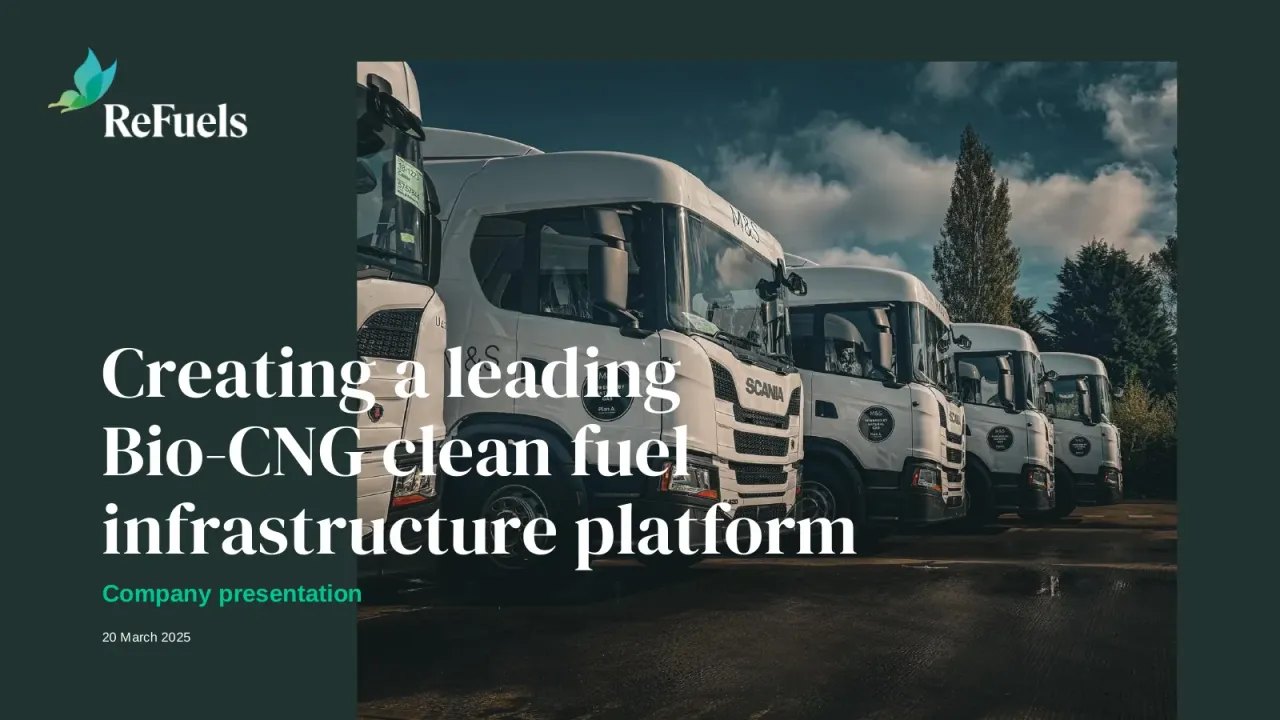
Creating a leading UK Bio-CNG clean fuel infrastructure platform hosted by Refuels (Oslo:REFL) on Investor Meet Company, held 2025-03-25.
On 6ix: 6ix.com/event/refuels-nv-refl-creating-a-leading-uk-bio-cng-clean-fuel-infrastructure-platform
Automated transcript · Written by software from the replay's audio. It can mishear names and figures; the replay is the record.
0:00 Morning, ladies and gentlemen, and welcome to the REFUELS PLC Investor Presentation. Throughout today's recorded presentation, investors will be in listen only mode. Questions are encouraged and can be submitted at any time using the Q and A tab situated on the right hand corner of your screen. Please simply type in your questions at any time and press sound. The company may not be in a position to answer every question received during today's meeting. However, the company can review your questions submitted today and we'll publish those responses where it's appropriate to do so. Before we begin, we'd like to submit the following poll, and I'm sure the company may be most grateful for your participation. I'd now like to hand over to the management team from the company. Good morning to you both, Baden and Philip. Over to you. Good morning. Thank you, and welcome to everyone who's either watching this live or on on catch up. And we are pleased to take you guys through, the transaction that we announced, last week, with with Foresight.
0:55 And as was mentioned, please submit questions, as you go through, and we'll get to those at the end. So we're very pleased and happy we've finally got this transaction done. It's taken quite a bit of time. It's a fairly complex transaction bringing three verticals together under one umbrella, which is now CNGFUELS. Hence, it's taken a bit longer than we ideally would have wanted.
1:21 There's been no drama in the fact that it's taken longer. It's just a a function of complexity. So what have we what have we achieved? We've now created a a a fully integrated biomethane sourcing, refueling, and, you know, certificates trading company. We are bringing in 15 stations that were sitting outside of the the structure today that was sitting in in CNG foresight. Very important point that we're very pleased to announce. We are fully equity funded. Yes. We will need some additional capital, but that will be external capital, which we'll get onto in a bit, external debt, which is, you know, precisely why the the structure has been put in place that the way it has so that we don't need to to do any dilution going forward, but can extract and can can use the strength of the combined group to attract debt at attractive terms.
2:17 As I mentioned, we've got 15 stations coming in to CG fuels, thereby bringing it to to to 16, including one that's in build, which is our second one, up in Livingston, where also or the REFUELS group is also transferring in, its ownership, in RTFS, the biomethane sourcing, and trading entity. We are also have agreed a a business plan with Foresight, which will see us build a minimum of nine stations or grid connected stations over the coming coming three years. And in addition for us to basically go from 10 to a target number of 30 MRSs, which we'll get onto in a bit, in order to to to pull forward some of the growth that we are seeing from our customer base.
3:08 REFUELS, at this point in time, has has 40% of the combined entity. But under certain performance scenarios, that can go up to a 55% stake depending on on on certain value realization scenarios, in the future. We do need EGM, so we do need shareholder approval for this, which is something we're looking to, obtain early April, and we will be closing, pretty much immediately after that. So if you then look at the, the structure today, sorry, the structure post transaction, as you can see here, we we we end up with bringing the entire value chain that we've today got together under one c CGFUELS umbrella, which is RTFS upstream, which is the biomethane sourcing and trading entity that we've got, and then we have c g fuels downstream.
4:03 This will, of course, then internalize all the cash flows and will put us in a much stronger position with regards to servicing debt, etcetera, to ensure that we can deliver on the growth plan, that we mentioned previously on the nine stations, additional MRSs, and so on. So what is the strategic, you know, rationale here? Well, first of all, the three verticals we've had, which has been basically buy methane sourcing and trading, senior fuels, which has been the the the engine room if you want where, you know, employees sit where we develop stations, operate stations, maintain them, build them, etcetera. And then the third vertical, which has been c g foresight with with the stations, bringing those together means that we're now, you know, bringing cash flows and bringing the focus that we need in order to take to take the business business forward.
5:03 If you look at the the growth opportunities, we're not short of growth opportunities. Our biggest, I would say, holdback or or impediment to growth currently has been our ability to fund more stations. We've been running a comprehensive set of of or looking at a comprehensive set of funding options over the last couple of years. And and what we believe that we've now ended up with is by far the best option for REFUELS shareholders, gives us the greatest flexibility and the lowest cost of capital, and gives us also the fastest route to execution so that we can continue to grow the company going forward. As of today, we have capacity to service about 10,000 trucks a day. We are currently servicing about 2,000.
5:54 So there's there's ample capacity to continue to grow under the current structure even without building more stations. However, the world isn't that easy. Why? Because whilst The UK isn't the largest the largest country out there, you have to remember that, you know, fifteen, sixteen stations spread across The UK only covers a certain portion of our customers' feet. There's only so many miles or kilometers a customer will go off route with regards to to to going to an alternative fuel. So we need more stations in key locations for existing and new customers. Now that will that will continue to to to grow adoption if you want at our existing station network today, but we'll also start to fill the new capacity that we're looking at, which basically means that three and a bit years from now, we are looking to double our capacity up to up to a theoretical 20,000 trucks per day through the nine stations that I mentioned, but also MRSs.
6:55 Just a bit of a reminder around our core market and why we're so focused on this specific market. 1% of The UK road fleet makes up close to 20% of greenhouse gas emissions. So if you then look at the type of vehicles that we could be working with to decarbonize, a lot of focus on electric cars, and so on and so forth. What you have to remember here is that for every rough numbers here, but for every 70 passenger vehicles, they emit as much greenhouse gas emissions as basically one large HGB. So by tackling large HGB fleets, we, of course, get more bang for a buck with regards to emissions reduction, and we also put more energy into vehicles per vehicle on the road. So therefore, it makes it makes sense from us both from a financial perspective, but also from a greenhouse gas reduction perspective.
7:52 As of today, we are only supplying biomethane to our customers. That doesn't mean that we will be a a mono fuel or mono mono energy vector company forever. But as of today, that is what our customers are asking us to provide. That's what they want. So they can grow their ambitions within greenhouse gas reduction from their fleet. Yes. There's talk lots of talk about, you know, large battery electric trucks and so on and so forth. The reality is they are not here for a number of reasons to be mass adopted today. Yes. We do have also a 100% biodiesel out there, which is a a popular option amongst some fleets. But when you look at our core customer base, their plans over the next five years pretty much all are centered around by methane, and that's why that's our near term growth will come from that. But over time, we would expect multi fuel facilities to become operational as well.
8:55 If you then look at where the where the the companies come from, it's founded back in 2014. You know, just over the last five years, we've gone from being below 400 trucks using our network every day to now basically being being 2,000. So we basically five x the number of trucks that are using our network over the last five years, and, you know, we don't see that slowing down going forward. On the contrary, yes, there are gonna be, you know, some years where where growth is stronger. Why? Because transport and logistics is heavily linked to the health of the economy as well. When the economy slows down, of course, the need for adding additional fleet, replacing fleet might be moved out six months, twelve months. But over time, we expect the growth to continue.
9:46 And as such, you know, 2,000 trucks, yes, that sounds like we've got a lot of spare capacity as I mentioned previously, but given the growth we're expecting ahead, we need more stations. We have, today, we cover about 10% of the so called four by two market in The UK, just approximately 21,004 by two trucks in The UK. But up until basically the last six months, we have been confined to that market. We haven't really been able to to make inroads into the much larger six by two market. That's now happening. Both Scania and Aveco have launched six by two products with even larger engines and so on and so forth being being being released at the moment.
10:32 They're both in trial. We are aware of large orders that are likely to be placed for these very soon. So this is a market that for those of you who followed us for for a while now, we're we're very excited about. And this will essentially also define our growth going forward. If the six by two market starts to see the same adoption that we have seen in the four by two market, we will need a lot more than nine stations. But we have to start somewhere, and that's why the business plan we do have agreed with Foresight is built around nine stations over the next three years. But as I say, if six by twos take off the way we we hope and think, then nine stations might turn out to be not anywhere near ambitious enough.
11:22 If you look at our coverage of the country today, yes, from the green dots there, it looks like, you know, we're we're we're starting to get good coverage. Well, the reality is no. Not really. And why do I say that? Because if you look at logistics around The UK and the amount of distribution centers around The UK, you know, we could just an example, you know, we've got a station in Warrington in in in the Northwest between Manchester and and and Liverpool. We could have another five or 10 stations within a radius of probably thirty, forty miles of that, and over time, that might not even be enough. Why? Because there is just an incredible density of distribution centers around there. And if you have one station linked to one specific motorway junction, trucks that are five five miles to west or five miles to right might not necessarily to to east, sorry, might not necessarily be using that specific station. So we need a lot more stations, and that's why we're so excited to finally get this this deal done so we can get on with with with rolling out additional stations.
12:26 Speaking of stations, a typical station I say typical because there is really no no specific formula that covers all of the stations. Why? Because some, we buy the land, some, we lease the land, some are connected to to high pressure pipe work, some are systems, some are connected to the lower pipeline tiers, some need more civils work to them, some need less. But if you look at a typical station, a CapEx would be in the range of about 8,000,000. We're looking at IRRs 25 to 30%, which we see as prudent and conservative estimates based on what we've achieved in in the past. That gives you a payback period of about five years. If you then start to add buy methane revenue to this, and, you know, the margins that we make on RFCs, then, of course, that payback period can be shortened or or will be likely shortened considerably.
13:27 In 2019, 2019, 2020, we developed the mobile refueling station, option solution. We back then didn't really fully appreciate and understand the potential it had and how robust and elegant solution it actually is and how, how embraced it has become amongst our customer base. We've now got 10 deployed. We've got another one that's gone into build ordering. We just placed the order quite recently. We are expecting to order quite a few late this year. These are fast to put into to to operation, probably about eight months from from placing an order till it can be in operation, can refuel as many as as 100 trucks per day, can be set up in a matter of hours, and can be removed in a in a matter of hours, doesn't rely on planning approvals, and so on and so forth. So a very elegant, flexible, fast solution, but, of course, it doesn't work in isolation on its own because you need the the the grid connected stations in order to fill the trailers to to bring the gas in. So the two work really well in tandem.
14:39 And as I say, now that the MRS has become a a proven, tried, tested solution, it's well known across many companies as being very reliable. That's why we see this as a as a as a faster option of pulling adoption of trucks forward than necessarily waiting for some of the grid connected stations that we plan to develop in 2627 going live because this means that we can you know, if we place an order today, we can basically have another MRS in operation this side of Christmas.
15:10 We are part of the RFO, the renewable transport fuel obligation, which is where we supply biomethane under. This is a robust market based system. It's been in place since 2008. It doesn't have an end date and has a constantly increasing blending obligation, which then gradually over time increases demand, sorry, for renewable fuels and therefore tightens the market and thereby should all all other factors, all external factors, you know, ignore to some extent should tighten the market and thereby increase, the attractiveness of putting, renewable fuels, into transport. We are heavily dependent on RTFCs renewable transport fuel certificate prices.
15:58 They are volatile. That is a world that we we are aware of. It's a world we're accustomed to. Why is it volatile? Because it's a market based mechanism. It's like all other, you know, market based prices. Prices go high, prices come back low, and they're affected by a number of a number of factors. So it is important to understand here that, yes, RTFCs, you know, are outside of our control with regards to the pricing. So what we need to do is to ensure that we have a robust robust strategy in place in order to source the biomethane that we put through our stations and into trucks. If you then look at where the RFC prices are today, they're roughly 26p, slightly above, probably 26.5 at the moment, thereabouts.
16:47 At those prices, we are now seeing attractive margins again, not just attractive for us, but also attractive for the biomethane producers. So as such, we're in a we're in a structurally sound market at the moment with regards to access to biomethane and also the certificate prices. Now, of course, certificate prices are determined by essentially the price of of road biodiesel. Why? Because that is the marginal fuel. So when an obligated party under the RFO is looking to to to blend, is looking to provide a renewable fuel, they go to solutions biodiesel.
17:24 However, the feedstock used to produce biodiesel is typically used cooking oil and tallow. It's a very versatile, good feedstock. However, the willingness to pay is currently and is expected to be higher in the aviation fuel sector than it is in road transport. There is not a unlimited amount of used cooking oil out there. There's not an unlimited amount of tallow. So as such, over time, not just us, but the industry as a whole expects that market to tighten, the feedstock
17:57 market to tighten, and as such, biodiesel prices have to trend up in order to compete for feedstock. Biodiesel prices trend up, then that is gonna also cause RTC prices to move higher than where they are today at 26p. And this is just highlighting, our exposure to lower and higher RTC prices. Doesn't really need that much more commentary, I don't think. It's it's it's something to look at. But here, you just see how, I think, slightly asymmetrically exposed we are to RTC prices, which, of course, is a function of volume that we put through our station network, number of trucks, but also the the price of of. And with that, I will hand over to Bain.
18:44 Thank you very much, Philip. So here, we've tried to show some of of just purely an illustration on what what growth may look like, what we're and what we're considering for the business over the next couple of years. Historically, our growth rate's been excess of 40%
18:59 per annum. And just here, we're using a a sort of a a low a lower growth rate just to be illustrative, conserved around 25%. And, you know, as Philip has mentioned, depending on what happens with the six by two and the speed at which that takes off over the next year of orders, we may where you may see that accelerate or or stay around these levels depending on that market uptake. What we do know, however, is that given our given the sort of the growth the growth we've seen previously and the pattern of growth, it is really a question of when and not if we we we reach these levels. Trip what's the EBITDA, of course, strip for these businesses driven driven by truck growth, principally, truck volumes, and and and, of course, RTFC values and the and and profitable sourcing of biomethane.
19:49 Historically, we've only had access to the RTFC value, and now and now we have both now you can see here both we have access to both revenue streams, the dark blue of the stations and the light light the green color for the RTFCs. We've only assumed in this diagram as constant price of 26p, which as you'll have seen from Philip's previous comments, yeah, that we'll have to we can take a view on. Historically, that's been about the average price for RTFCs. And depending what happens in market dynamics, we may see that move move in either direction over time. It is volatile, but we are confident in the RTFC price generally as time goes on.
20:27 CNG stations have a different revenue profile to the RTFCs, which is more of an annuity style annuity style income stream. We are a market leader with a very strong market position, and so we are confident in that in in in those streams continuing to improve over time.
20:44 The and the other factor here is, of course, that the the is yeah. That well, the way the way we'll drive growth is via is is really determined by by timelines. And and as those stations grow and start to mature, we'll see that station proportion of value continue to increase. But here, you can see that the certificates in the stations really do bring in bring in both very positive volume value, but are relatively equal.
21:11 So some illustrative value distribution scenarios here. I think it's probably important to think about where, you know, where we've come from, where we are now. Philip and I, the executive team, you know, market tested the the went to market tested for more than a year with different institutional investors, what would be the best option for future growth for the business, what, yeah, what the best direction, and try to find what we've what what would look to be the best deal for shareholders and stakeholders. And where we've ended up now with Foresight is what we feel is not not just the best best possible deal for investors, but we also have very both for for our investors, but also we have a very informed investor in Foresight who understands the business very well and has been with us since year since 2020. Previously, we had a higher cost of debt coming through the station network that was a joint joint venture.
22:01 That was 13% minimum return hurdles, and that's now been replaced with a 10% prefs across the board where the where those where those prior loans have been replaced and moved up to CNG fuels level. We had large working capital loans at CNG fuels, which was where where the at CNG fuels level where REFUELS and CNG fuels principal principal revenue streams would have been through RTFCs and, of course, the costs of running those stations. Those large working capital loans have now been dealt with. We had the overhanging fear from investors of of a very large equity capital raise, which we have now solved by by creating this new structure, and now we feel that we are fully fully equity funded to the extent that we don't wish to grow dramatically faster than we can do just with debt in the future, But with our with our with our business plan and with the cash flows coming through over the next couple of years, we feel that the equity we feel that the the large equity raising concern is has been resolved as well.
22:58 We do still need some new debt, but it's conservative with the cash flows we now have. Again, we can source low cost funding. And and the other feedback we had was the complexity of the of the previous structure, which, yes, we now have pro preferred shares sitting in the structure, it's dramatically simplified now with everything in one place. And this and REFL shareholders have large a large leverage to the upside of the RTFC values and station values to the ratchet mechanism we've created.
23:28 So how are we gonna drive value over time? Value to the REFL shareholders. Again, this is illustrative. Take and and time value here is important. The as as we go out in time, clearly, this, the stations continue to build up and and RTFCs continue to build up more volume and more EBITDA. But at the same time, as we grow more rapidly, if you want to use an EBITDA multiple as the as the form of valuation, then your EBITDA multiple will also improve over time as you grow more rapidly. So, hence, that can also drive value. What the what this type of valuation does also ignore is the terminal value associated with the business from strategic value as from strategic values to to potential acquirers or investors over time.
24:14 And that obviously that that is, we feel, a very important point that would be missed out in in in this in in the way of having a look at this. But we do have to consider how you might wanna think about future value of the business. What do we think will drive the EBITDA and the EBITDA multiples? And we have a doubling of the truck capacity over the next couple of years. Market conditions, of course, will help. But truck growth, we have an r we we have an RTFC market we are large participants in that's continuing to mature and get more visibility into the future. And then, of course, if the strategic value of the business with market penetration that continues to improve over time, we have if we if the six by two picks up very well, continue to to develop our market a strong mark continue to build our strong market position, a strong competitive position as we continue with our first mover advantage, and, of course, have a portfolio that is unique and in the best spots in The UK.
25:05 Thank you. Philip, you might be on mute.
25:27 There we are. Sorry. He's good. Thank you. Yeah. Was clicking too many times on it. Yeah. So just as a reminder, before I wrap up here, please feel free to submit questions. You can see quite a few have come through already, so we'll go through those in a bit. But just as as Bade mentioned and just tagging on to to some of his comments, we feel this is a is a really good structure with regards to not only creating future value for for for REFUELS, recognizing value that's already there, but also putting us in a in in a place where we can grow with sensible cost of capital. The markets have not been that easy for infrastructure type assets, infrastructure type companies to raise sensible financing. I say sensibly priced financing in the last last couple of years.
26:17 So therefore, we feel this is a this is a really good structure, from where to to to grow, without it being, too expensive. We do have a lot of growth coming through from from large, sorry, large new customers where we already have visibility. But the really sort of unknown here, which is probably a very positive unknown, is the six by two demand. It's still too early to say what that demand's gonna look like. We believe it's gonna be very strong. We haven't got the evidence to back up those comments yet. Give us three or six months. We will really we should really start to see what that demand, is starting to look like, probably the other, the other side of Christmas. By bringing the three verticals together, we have a self funded, I would say, fast growing for being infrastructure, fast growth company.
27:14 Not that many of us out there. It's a quite unique combo. Usually, fast growth means a lot of new equity, a lot of additional capital coming in. Once again, fairly expensive capital. So that's, a box that we feel feel feel we're ticking. And finally, we've had a couple of years now, where the biofuel markets have been tough. Other external factors haven't necessarily been, been in our favor. We're starting to see that turnaround. It has started to turn around. We're seeing margins we make of biomethane have come back up to historical averages. There's still a lot of potential upside from that. That's not us saying that upside will necessarily materialize, but there is potential strong upside from that. And as such, if we look out, let's say, until, you know, the next five years, there is a potential here for for very substantial EBITDA generation over the coming years.
28:15 And with that, I will drop the slot and we'll go into the questions. That's great. Philip, Baden, thank you very much indeed for updating investors. Ladies and gentlemen, please do continue to submit your questions as she's in the Q and A tab situated on the right hand corner of your screen. Philip and Baden take a few moments just to review your questions submitted already. I'd just like to remind you that a recording of this presentation will be available to you on the Investor Meet company platform. Philip, Baden, you've had a number of questions from investors. Thank you to everybody for your engagement this morning. Perhaps if I may hand back to you, you can take us through the q and a, and then I'll pick up from you at the end. Thank you so much. So I'll start at the top here and just make my way down. Can you explain exactly what Foresight gave up, in forgave loans and what they got in return in the new structure and explained the fairness. I think the fairness there is probably relating to the fairness opinion that we obtained from an external investment bank, but I'll let I'll let Baden address that one quickly.
29:13 Yeah. Thank you. Yes. So I tried to touch on this on the price slide, but I'll be more specific. So where there was £32,000,000 worth of working capital loans that CNG fuels had directly with Foresight and around a £150,000,000 worth of prefs related within the CNG Foresight entity and the joint venture that form the minimum return hurdle for the ownership of the stations. The £150,000,000 has converted directly up into a pref at CNG fuels levels, so that has just simply moved up the structure along with the stations, and that is the rate on that has dropped from 13% down to 10%. The £32,000,000 working capital loans are now are now raised, and they have a holding in CNG fuels where where REFUELS also maintains its existing 40% holding with a ratchet to the upside there.
30:05 Refills also transfers in. It's RDFS holding both for an existing both for a new pari passu pref share of about £16,000,000. And with the with the ability with distributions over time to grow that along with foresight, but ahead of the ratchet mechanism, which is preferable to us. And then we have and and, of course, the ratchet, which favors which favors refuels when RTFC if RTFC value really really performs over time. The fairness opinion was was done by an independent adviser, Arctic, who looked at the structure prior to the transaction and post transaction and considered the value to the value attributable to shareholders under the same scenarios of growth in either structure. Both found to be very similar. They deemed the the transaction to be on the for for the purpose of of the boards to make a decision, the entire board, which, of course, is majority, independent, directors, to make a decision on the base on, as to whether or not this deal was fair for shareholders, which they deemed it to be fair.
31:10 And the board approved the transaction, with that that as part of their considerations. Thanks, Baden. So I'll take the next one. I think Baden's answered that one slightly already, but I'll just give it a brief, brief cover over. You have previously worked with different financing routes, including to raise debt and equity to take up foresight. Why is this the best option? Well, if I can just summarize couple of points there. First of all, we're working with a trusted partner. We've we've worked really well with foresight now since, since December 2020. So, it's a known entity. They know us. We know them. And as such, in order to to to to select a partner, going forward, we know one another really well. That also helps in speed of execution.
31:56 Had we gone down a different route, which I'll get back into in a bit as to why who wouldn't have but if we had gone down a different route, it would have taken probably considerably longer with the speed of execution, which again would have been holding us back with regards to rolling out additional stations. And then finally, it's the cost. Bain's mentioned previously, we've been out speaking to more than a 100 large professional investors who are active in this space or similar spaces. And what we've ended up with here is a structure that is is is good also from a cost and flexibility, perspective. Okay. Go on to the next one. It's still not the most transparent structure. What's the reason for this setup with shareholder loans and ratchet mechanism? Well, I'll be very quick on that one as well. Shareholder loans, you can essentially look like I mean, if you were to look at this differently, you could almost just say that's external debt. It's just that it's external debt that is basically held by by by internal internal parties. The ratchet mechanism here is really about, additional value equity value in certain when the business delivers or should the business deliver over the years ahead. So, you know, it might still look complicated on the outside.
33:17 We absolutely don't feel it is complicated compared to the previous structure. There is much greater visibility, much greater transparency on value creation that will become apparent in our quarterly reports going forward. So and and as such, yes, it probably takes some getting used to, but, you know, give us some months to educate the market on this. We we feel that this this is a much a much easier structure as such. I might I might quickly just add to that if I can. The shareholder loan structure, yes, whilst it is a sort of internal debt essentially from from from the shareholders, of course, it's much more favorable than external debt. It's a very low covenants. It's able to be rolled up. It's pay if you can, not pay if not not not you must pay. And therefore, the, you know, the shareholders are able to see that accrue over time. It's easy to measure. It's easy for the market and easy for analysts to go and measure those amounts as they grow. 10% is obviously a nice easy number to calculate on.
34:14 And and and as I say, that it also gives us the flexibility, which I can see to the next question here, for to to be able to bring in senior debt over the top of it easily because the shareholders can allow that to allow allow that to come in, allow that to to to rapidly to to essentially turbocharge the growth of the business. Okay. Next question. Please, can you elaborate on CNGFUELS' debt servicing capacity? I'll I'll just go very quickly on that one. Basically, what we're doing now is we are bringing the two, verticals of cash flow together, both from the station side, which has been sitting outside of CNGFUELS and RCFS', debt, sorry, cash cash generation is coming in under CNGFUELS.
35:06 So that will put CNG fuels into a much stronger position with regards to external sourcing, external senior debt at, of course, market terms. So it dramatically improves his improves CNG fuels' ability to to to source debt and to service debt over the coming quarters, basically. What happens if REFUELS and or FORESIGHT wants to exit the structure? So there are there are pre agreed mechanisms for that. That said, it is, of course, a function of it's a function of time, and it's a function of of what, you know, market conditions are, at at at that point in time. So it it will depend clearly on on, on exactly the timing here, but there are pre agreed mechanisms in place.
36:00 But what exactly a you know, instead of calling it an exit, think think value realization is is probably better. Because if you look at, Foresight as an example, you know, they are a professional fund manager. They will need to crystallize returns for for their funds at some point. What does that look like? Does that mean, you know, them being replaced by someone else? All of that will become clear in in in the future, but that's not a focus for us now. Our focus now is is basically growth and to ensure that we we we get a good platform in place here to to to nail down some some equity equity growth both both for us and for Foresight. How will the rollout towards end twenty twenty eight be affected, by RFC prices?
36:53 Well, clearly, if RTC prices, you know, are lower, then then, of course, that that affects our cash generation. It's a higher that affects our cash generation. So there is a link there. There isn't a one to one correlation, of course, because the stations themselves have increasing cash flow generation going forward that can be used to service debt. But, you know, in a in a all else equal, higher RTC prices will or should generate greater cash flow into the group, which again could be used to accelerate growth going forward. And, of course, the flip side is also true. Is a UK listing still planned? So we've commented on that before and said that is an option that we are looking at.
37:46 We are looking at a number of options to increase liquidity of of the stock. And, you know, that's something that has been, of course, difficult to to to work on over the last six to nine months whilst we're negotiating the structure because, you know, from an outside investor's perspective, things are up in the air and slightly limbo. Now that we've landed the structure, now there is full transparency on it, that is a an easier task for us to work on. So there'll be a lot of focus on that over the coming quarters, and we can update you accordingly, during some of our quarterly calls going forward. How many new BioCNG stations are planned, and where will the initial expansion be focused? Alright.
38:32 Couple of points there maybe. So we are not, we are not starting from from zero, meaning we are not only now getting ready to go out and and secure sites and so on and so forth. Our team has been busy securing attractive sites in the background whilst we're doing the transaction. Now the transaction has landed, we will go into execution mode on the initial batch of those sites, which are in really attractive locations. I don't wanna mention specific geographical locations here, but these sites are in key areas where we know we have existing and future strong customer demand. So as we develop these stations, these will be or we expect them to be loaded quite quickly and therefore will be high IRR sites.
39:24 And then our land team will continue to work on bringing forward other attractive sites over the coming quarters. So we already have the three sites that we need to go into build on on on shortly. They are sitting there ready ready to go with others then coming through into the pipeline. Of course, on top of this, there are MRSs, which we will be, honestly, deploying more, I think, more opportunistically. Why? Because it will be customer demand driven. If customers need an MRS in a certain location, of course, we will react to that. But it's not a solution that we will necessarily push as such because we can't go to a customer's depot and say, we would like to place one here. It's driven by customer interest, which currently is a lot stronger for MRSs than it was just six or twelve twelve months ago.
40:14 And then there's one here. Are you seeing increased interest from logistics companies transitioning away from diesel? The answer is yes. I'll give maybe a bit of context there. So we already have a quite, if I may say so myself, quite impressive list of blue chip customers who are who are well on their way of transitioning away from diesel by using biomethane and bio CNG. But it's also the fact that a number of large UK fleets have been hedging their bets. They have been on the fence if you want, waiting to see if bigger big battery electric trucks would solve their problems as as an as an example or solve their their need to decarbonize, as an example, 50% by 2030,100% by 2035.
41:03 What we've now seen is that that is not a solution that is deemed mass adoptable for a number of reasons they weren't going to hear, but this isn't us saying this. This is the market. This is well informed, well educated fleet saying, do you know what? That is not an option that will get us to where we need to be with regards to reducing greenhouse gas emissions by 2035, twenty twenty thirty, 2035. So we have to start acting now. So we have a number of of very large customers now coming on board, which weren't on board a couple of years ago, but which now have to go down the Bymethean route because they haven't got any other options. So, yes, we are seeing that not only do we have strong growth from existing customers, but we've also got a number of customers who were previously undecided which route they would go are now embracing by methane, and we'll see a lot of orders from them going forward.
41:58 Are there any upcoming innovations in your refueling or compression technology that support scale? Yes. There are a couple. I won't stand here and say what that is because people might, yeah, might not be or some of our competitors or potential competitors might might be listening to that. But, yes, we continue to push for better efficiency, better redundancy, which is already good, but also, you know, higher pressures to be able to to to to deal with 250 bar, etcetera, etcetera. So there are a number of things that we will be we will be doing actively over the coming years. That said, when it comes to putting Bio CNG into trucks, it is a tried and tested proven solution.
42:46 So what we're now doing is more optimizing, fine tuning it. I wouldn't say there are any sort of step changes here. This is more about just ensuring that we can we we can provide an even better customer customer experience. What is the revenue and cost structure for the stations business? That's a very long question. I think we should probably I don't think we have time to go into that one other than to say that there is a specific revenue component in the stations business, which is called a compression charge, which is has has no correlation or is not related at all to the performance of RFCs as an example, which is why I mentioned that the stations themselves have recurring revenues here, which are which are not affected by high or low RTC prices.
43:39 The cost structure, it's a very complex question, so I think we'll park that now. If whoever sent that in wants more more clarity on that one, then feel free to drop myself or or bait an email, and we can always take that offline. Can you comment on the availability of biomethane given the potential high growth in its use as a transport fuel? Is there sufficient availability? Excellent question. The short answer is yes as of today. As of today, there is considerably more buying ethane chasing transport demand than there is transport demand essentially. Now and then you might say, well, what about next year or the year after? Well, to put into context, there's been announced about 30,000,000,000 of funding in The EU alone, between now and 2030 to expand by methane production. Now we didn't expect it.
44:30 We'll stop at 30,000,000,000. That's just what's been sort of tallied up so far. We expect that to continue to grow. Conservatively, biomethane production across The EU is expected to be five x between now and 2030, potentially more. UK is looking at strong growth, etcetera. So we don't see a shortage in biomethane production or biomethane supply available that could go into to to transport. Of course, there are market conditions here that could affect competitiveness of who can, you know, source that fuel in the future. But, no, we don't see any shortage of biomethane supply or feedstocks used to produce biomethane supply. And I think that's a that's a very important takeaway if if you're if you're taking any way today is that if you look at biodiesel, that is an or expected to become an increasingly tight and short market with regards to availability of feedstocks, sustainable feedstocks.
45:29 By methane, however, we don't see that shortage appearing for potentially decades to come. So the answer is no. As of today, there's a lot more chasing transport demand, and as such, we are seeing a very healthy biomethane sourcing market that our team is currently is currently working in. And we are already just just to put it out there, we are already pretty much fully sourced to buy methane for 2025. We are already now sourcing for 2026. Baden, Philip, thank you very much indeed. I think that's all the questions from investors. So thank you once again to all of you for your engagement this morning. Philip, Baden, I know that investor feedback is important to you. I'll shortly redirect those on the call to give you their thoughts and their expectations. But before doing so, perhaps, Philip, I could just come back to you for a couple of closing comments, and then I'll send investors to give you their feedback.
46:20 Thank you. Thank you once again for showing an interest in, in REFUELS, and what we do. Hopefully, we've provided a bit more clarity as to why we're excited about the deal that we've just done, done with Foresight. However, if there are any questions that you don't feel were fully answered, or questions you didn't feel comfortable putting out there, then, feel free to get in touch either directly with Baden and myself. We're always happy to to jump on a call. We'll also answer you via email. So thank you once again, and, yeah, look forward to seeing you on next one. That's great. Philip, Baden, thank you once again for your presentation this morning. Company is asking investors not to close this session as we now automatically redirect you for the opportunity to provide your feedback in order the management team could better understand your views and expectations.
47:06 This will only take a few moments to complete, but I'm sure it will be greatly valued by the company. On behalf of the management team of REFUELS PLC, we'd like to thank you for attending today's presentation, and good morning to you all.
Follow Refuels N.V. into a list and get an email when it puts out news.
MD and CFO at REFUELS N.V
CEO at REFUELS N.V