Transcript
Automated transcript · Written by software from the replay's audio. It can mishear names and figures; the replay is the record.
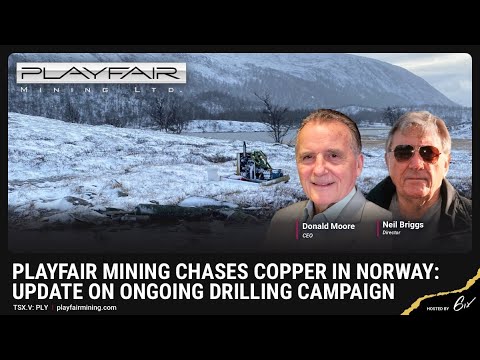
0:08 Hello everyone and welcome to Playfair Mining's live summit today, hosted by 6. I'm joined today by Don Moore, CEO and Director at Playfair Mining, as well as Neil Briggs, their director. Don and Neil are going to walk us through their presentation and after we'll be accepting questions. You can submit your questions using the Q&A panel found on the right hand side of your screen at any time during today's presentation and as always this summit is being recorded and will be available to watch afterwards on Six.com. Without further ado though, I'm gonna hand things over to you Don to kick us off. Thank you Cam. Welcome back everybody. This is Playfair's second ever virtual event. I'm hoping it'll go a little smoother than the last one. So I guess just to bring you all up to speed, some of you will have heard this before, some haven't. So I'm just going to speak generally as to why we're in Norway. So what convinced Neil and Greg Davison and Don Moore to pick up a project in Norway for Playfair.
1:02 There's lots of projects out there in the world and we're always looking. This particular one came by EMX. EMX is a Canadian company mainly operating out of the States. They're a project generator type of a company. We looked at their projects and lo and behold, we came up with this really interesting looking project in Norway and we dubbed it RKV. RKV covers a really great track of land that hasn't been looked at for over 50 years. And it's got interesting history dating back to the 1600s. What most people wouldn't realize is that Norway actually provided the majority of the capital for the, the copper for the industrial revolution out of this area. Within 75 kilometers of this, of our project, there's roughly 80 million tons of copper bearing ore that was mined over the ages.
1:58 The reason is very, very seldom you get a shot at a district scale play in a little junior company. And one that has got definitive indication of VMS presence. And we all know that VMS deposits come in clusters. So where there's 1, there's going to be more. And in fact, we know that there's at least 3 spots along this project that have been mined in the past. So the overall length of the area is roughly 30km. That's of our main interest. And within that 30km, we have 3 known deposits that were mined. As a little bonus to the whole project, in another piece of geology which is tied on, it's a slightly different type of geology. There is a drilled off Nickel deposit. It's a roughly 1% Nickel and 0.4 Copper. It's not big enough to stand on its own, but it's roughly 400,000t of 1% Nickel and 0.4 Copper. It is an asset that could become interesting and possibly important in the event of a bunch of discoveries we needed to support a local centralized mill.
3:18 These were all the things that urged us to get going on it. Then we found out that Norway itself was trying to switch from being a country totally reliant on their oil revenues, which have been fantastic over the last 50 years, and to switch over to minerals. They want to promote the mineral industry. So we had comforting conversations with officials from Norway, and we felt quite confident that the Norwegian government was moving towards regenerating a mining industry. With that background and that backdrop, we felt quite comfortable with the whole idea of dealing with a solid company like EMX, going into a good jurisdiction like Norway, and with a great project. And that's how it all started. That's what convinced Neil and I to get involved.
4:12 Greg Davison is our third director, and he's been very helpful in a lot of the technical things as we went into the project. So having picked this great project, we know that nothing has been looked at here for over 50 years. So We decided that in order to bring all the information to the modern era, we would take a slightly different approach on gathering all the information that was available and figuring out where to go. You have to consider that the whole project was roughly 300 square kilometers when we started, which is very cumbersome. So in order to narrow it down, we took all the information that was available.
5:00 The previous airborne surveys, there was 1 done in 2004 by Falkenbrich Nickel. The NGU, which is the government of Norway, had numerous showings that had been mapped out over the area. The past producing mines were a clear indicator of interesting things. We took all of that information and we put it into a system called CARDS. CARDS stands for Computer Assisted Resource Detection System. We've known about it for a long time. We know that cards can do a great job in narrowing down your target areas. So, we went ahead and we put all this information into cards. We let the computer do its job and it squirted out 27 different areas of interest.
5:45 But we also know that Cards doesn't give you drill targets. So knowing that it's a VMS district, and knowing that Cards doesn't get us all the way to the drilling stage, we thought we'd take a different approach and just look for upward extensions of whatever might be buried there under the ground. The geophysical responses are very complex and hard to define because there's a lot of puritite in the area. The targets that we're looking for are masked by these pyrrhotite targets. There's tens of miles of Mag-EM targets to be sifted through. We thought that Cards would do that trick and in fact, it did.
6:32 To follow up and bring the cards targets to a drill target, we use a geochemical system called MMI. So the MMI gives us access to what lays right below your feet by measuring ions that are sifting through the soils. The thesis is that the decane sulfides will generate ions. So if it's a copper sulfide, you'll see the ions going through the soil. You're not looking for the actual metal. You're looking for the ions that are being emitted. It's this technology that we've been aware of for a long time. It was developed in Australia. We knew the people that developed it. SGS, a well-known group in analytical works has recently bought that technology and they are the people that do all the assaying for these ions. It's a proprietary system.
7:32 There's other systems similar, but MMI was the first and SGS is a real solid. We thought that we'll let MMI tell us where to drill. We set about covering all of the cards targets with a grid for MMI. We then followed up on anything that looked interesting. We did closer in grids. And then finally, we ended up at a spot where we've got 5 different areas with 7 targets, all of which look extremely interesting. And now we're setting about to start to work on them. Last year, we got started drilling and last year was a very complex year. First of all, everybody knows COVID was out there. And there's local rules and regulations in Norway that cause us all kinds of trips.
8:25 And in order to resolve and get rid of them all, in 1 fall swoop, we decided to go with a man-portable drill. Now, man-portable drills have got their own issues. However, in our case, they made life real simple. In February of last year, we made the decision to buy a man-portable drill, which we did. Then we had it restructured and redone and put together again. COVID really interfered with that process. What we were hoping to do last year was start drilling by June, but between the COVID delays and the delays in transportation of the drill and getting our drillers into Norway, In fact, last year we didn't get started drilling until September 21st, which really set us back. It was a really tough year for us in that regard. But you're looking at an image there now of the very first drill to be drilled in Norway on this belt of rocks in over 50-years.
9:19 The guys involved, you see the guys in the bright green jackets, they're from a company called Arctic Drilling. We drill under the auspices of Arctic drilling. The driller on the left is Devin Small. He's a well-versed Canadian driller. His father and he led the team last year. They are coming back to help us out again this year. We've gathered up other people in Norway that will become part of their team. And we're looking forward to a real good drill season this coming year, starting as soon as we can get in after the snow debates. Now, last year, we didn't have helicopter access or a helicopter assistance. And since last year, we've made good contacts with the people in the Tinset municipality and their economic development officer has come to our aid and he has helped us get a helicopter permit. There's still a restriction and we're still working to undo them and get them better, but the ice is broken. We now have a good solid local support through the economic development officer in Tinsett and he is bringing other people to understand that the great potentially have in their municipality for discovery of mineral wealth.
10:38 Having said that, there are still additional challenges to be done, but we think we've got it kind of sorted out. Now you say, how do you move a manportable drill in a place like Norway? We got lucky. We met a group of men all working in construction who also like to work out at the gym. And between Devin's good personality and these guys, they built up a bit of a relationship. And this muscle man, as we nickname him, come out and help us move that drill. The heaviest part is about 450lbs and it's those heavy pieces that judge how soon we can move the holes. We're only drilling short holes. We're only drilling 50m holes to test what's really under our feet in those MMI anomalies. We're ready to go. A couple of those guys are going to join our team this year. A couple of the Musclemen will become full-time people with us this year. And Devin and Dale will go back, possibly one other Canadian. So we'll have a really experienced drill team. So we should be able to move a lot quicker this year than we did last year. So You're looking at the very first piece of core that came out of our Rodelan project there on the right.
12:02 At Rodelan, Rodelan was the very first one that we drilled. It appears that the MMI anomaly was caused by an amphibolite horizon that we drilled into. There wasn't anything of economic consequence. Some minor Chalcopyrite was noted. There's no big assays, but the Amphibolite is the type of rock that the other deposits in the area, Kivikni and Rostevangen, are associated with. We figure that that target is worthy of following up. But in order to follow it up, you've got to drill into the mountainside and it's going to be blind drilling. And it's not where we want to be right now. We want to chase all our targets on surface. Now, you may recall that that Storborn was an extraordinary MMI target.
12:50 So We set about chasing that target down. We went in and because it was man-portable, we started to drill at the bottom of the hill and worked our way up. Had we had helicopter support, we would have started at the top and worked our way down. As we went about our business of drilling, we were over the strong MMI, but we were getting sediments, which is not what we wanted to see. We wanted to see amphibolites or some other geology that wasn't there in the sediments. We had trouble figuring out why the MMI was so strong, and yet we were in sediments. We continued to drill upwards up the hill and the first 6 holes were really disappointing.
13:35 We didn't have the stuff we wanted to see. However, Kjell Nielsen, who's one of Norway's leading geologists, was our geologist on site And he did some field work in the immediate area, sort of concurrent with our drilling our last hole. We knew the snow was coming. We had to get out before the snow flew. Kel picked up some really interesting looking rocks higher up the hill than where we were and sent them out for assay. And these were like scree. They hadn't travelled far, whatever they are, they didn't move far. So while that was going on, we were drilling our hole number 7 and After 20m into the hole, we hit a different rock type. Chell called it an Ultramafic. When we got the chemistry back, we're not sure if it's Ultramafic or Mafic, but it's a different rock type than all of the sediments that we had seen.
14:32 After we'd finished drilling, we got the assays back. There was nothing of consequence in that hole. However, the rock that Kjell had picked up ran 1.25% Copper, 3% Zinc, give or take, 0.2g of Gold and 16g of Silver. That's farther up the hill than where we were. The other thing that Chell found at that time was what we call a dead zone. We refer to it in our presentations as unvegetated. What it is, is water coming down the hill that has been made acidic by the presence of probably puritite, possibly other types of sulfites. But this acidic water we think has come down the hill and exacerbated the results that we're getting out of the MMI. We think now that that MMI that we were reading was actually in the Copper was in the soils, not in the rock. And now we're chasing up the hill to see if we can find the source of the soil. And we figured the high numbers had something to do with that acidic water also concentrating.
15:43 The anomaly is very compact and unique, so We know it didn't travel far. If you're looking at that picture, you see that red circle, there's a little image there in the middle of that red circle. That's our last hole and we're drilling off parallel to that cliff there. The next move is going to be to chase that structure to the top of that hill. If you see on our MMI targets there, off to the Northwest, we had another big hit. So We're quite optimistic that we have yet to figure out what caused that MMI target, but we're totally confident that the MMI put us on top of that and Cards put us in that area. So as far as the technique of narrowing down this big project, we're very confident that we have something that's quite unique and is yet to be economically proven, but we're very positive about going forward, chasing the anomalies that we've created.
16:47 This is what we're going to do this year. Besides getting all our guys together and all the logistics and getting all the permits and everything in place, we're going to go back in and we're going to drill. The whole project is to be drilling this year. There are a few other things we may do to expand the area, to look at other avenues, to look at the card system again to see if there are other areas that would pop out of what we have that would be interesting to follow up with MMI, but the main thrust is drilling. The first thing we're going to do of course is get back into store-born and try to chase down the source of that anomaly. And we got our fingers crossed. Incidentally, all of those assays in that boulder were what you call a good VMS recipe.
17:33 The Copper, Zinc, Gold, Silver, that's typical stuff you'd find in VMS deposits. So we're really quite enthused about getting back there and drilling. Now the other targets, Cletton and Sainte-Etienne, incidentally we never would have been to Storborne without this methodology. There was no reason to go there other than the cards sent us there. The same thing at Cletton and Sainte-Etienne. Now at Cletton, no one has ever been close to the place as far as exploration goes. We have developed 2 targets there, which we hope to get in and drill. That's the one that will be greatly assisted by helicopter assistance. The helicopter is about a 3.5km run and a lot of it's got terrain involved and it would be really difficult to get the man-portable drill in there. But with the helicopter assist, we can get it in and we can do the job on both of those targets.
18:28 Following that, there's another area, Satre-Fiat, that is really interesting. It's all by itself. It's never been looked at before, but it is about 5km away from the original Kavikni mine. There has been mining in that general area, just not, There's been no work done where our targets have been developed. That's a completely new target we're going to be taking shots at there. And then Røstavangen, the target that we developed there is close to the past producer Rostevangen. It was Norway's largest producer of Copper, pardon me, that area's largest producer of Copper back in the early 1900s. It went spectacularly bankrupt when the price of Copper dropped out of the ceiling in the 1920s.
19:18 The MMI target also lines up with the geology that we know that hosted the Rostevangin. It lines up with the geophysics. We got new geophysics in the area. We did follow up on all our targets And the geophysics and the geology also line up as to where the MMI target are at Rostevangen. So those 5 targets are all high priority and we've got our fingers crossed that they're going to give us some joy. So I think we've kind of covered most everything. We are of course, at some point in time, going to have to raise some money. I'm looking forward to raising that at least 15 cents if not higher. And we'll be pushing in that direction. We've got about $400,000 left in the kitty and we've made all our serious payments. We have $110,000 in payments we had to make this year. So we're good to go.
20:16 So for those of you who's out there that would like to participate in our financing at all, if you'd contact me and I'll put you on a list of interested people. There's no obligation to take what you say, but If you're interested in getting a call when it does happen, I'd be happy to put you on the list. Incidentally, in that list, Playfair is really unique and fortunate. We have some excellent big shareholders. We have 1 Albremichael who's riding at roughly 20%. We've got a group out of Norway, which has been most helpful to us. They're running at roughly 14%, the last we saw. EMX got 10%. Our little group here has got about 7%. So A lot of the stock out there is in serious hands and we're looking to make a project out of this. The whole philosophy here is that this is a very low-cap company with a big project. The idea is you get a low cap company and you get some joy and some discovery, there's a chance for the big win. And that's what we're playing for here.
21:23 We're playing for the home run.
21:27 Is there anything else you'd like to add, Neil? No, I think you've covered all the basics and maybe people have questions. Okay, well, with that, I'll put Cam back on there and you can run with it for a minute. Cam, we'll see if anybody is popping up with a question or 2. Yeah, absolutely. Thank you so much, Don. Thank you, Neil. I'd like to remind everyone in the audience that you can of course ask any question you like using the Q&A chat found on the right hand side of your screen. Just type it in and we'll be love to get to it. But Don, you know, we've had some questions actually come in in advance of today's summit. So I'll start with this one. How did COVID regulations affect the program last year? And will it be easier going forward? I know you already spoke about this in your presentation, but maybe if you could reiterate. Last year, COVID hurt every part of our operation, starting with the drill.
22:17 We bought that drill February 22nd and the 1st thing that happened, we had to ship it from Mexico to Kelowna, BC. It got stuck at the Mexican-US border to a great degree because of COVID. And then it took forever. It finally got to the US Canada border, went through the same process, and then finally got to the people that were going to repair it and restore it for us, because this is an old drill. And when they looked at it, there was a few pieces that had to be replaced new. And those pieces took forever to get in. And that was basically all COVID related. And that was one of the main reasons for us being so slow in getting the container shipped off to Norway.
23:06 Well, once we got shipped the container, it arrived in Norway. We have people there that are really helping us out. Radar Gopis has been an extraordinary help to Playfair. He's opened up all kinds of doors for us and he's been extremely good at helping us on the logistical end and on the political end. Once the container landed there, then we had to get our drillers in. It turned out last year Norway's policy was no Canadians. So, Radar helped us get some dispensation so that we could get our drillers in, which eventually happened. They had to quarantine for 8 days and that slowed us down. And when when we got there, we were supposed to have some people that were available to help us right away. Well, COVID related things, they weren't there.
23:59 So Devin and Dale had to get going on their own. And it took a while to get the guys, you know, with the help that we were expecting eventually came, but it was about 3 weeks later. And so all these COVID related delays causes a lot of headaches in terms of getting going. Keeping in mind, because we have man-portable drill, we have to be off the road or off the hill before the snow flies.
24:26 And some of the rules in Norway, we need off-road permits if the roads get covered by snow. So it's a complex issue. So we had to shut it down for safety reasons because of the snow and plus local municipal bylaw reasons. So this year, Norway, as of about a week and a half, or I guess a week ago, has opened the doors. Canadians are welcome. So you want to go take a Horta, was it Horta Gruten cruise? You can do that now. Last year you couldn't. So They have, they had opened up to Europe, but just not Canada. So now everybody's welcome again, and we're thinking it's going to be a lot easier for us to get our crews in. However, it just sort of keep that in the back of your head that COVID has sort of trumped us a few different times in the past. So we don't feel it's clear sailing, but we're much more confident about getting back there on time this year than we were last year. And we're looking to get in there as soon as the snow is gone and the ground is dry enough for us to get working where we want to be going.
25:35 No, absolutely. Thank you for that. Another question, we have some questions coming in from the audience live. The first question is what's the size of the target deposit in the area? Well, there's been roughly 80 million. Do you want to take that, Neil? Yeah. Hi, Harar. Thank you for your question. The deposits that are known in the area are like the sort of 500,000 to 1 million ton size as far as we know, but they were shut down when there was still ore ahead of them. They were shut down in the case of Kovechny by flooding and that the Rostvangen because of the big dive in the price of copper in the 20s.
26:30 We would hope to find something much bigger than that. What I would say is that this small nickel deposit that Falkenbridge found in the around 75,400,000 tons, they calculated at that time, they would need probably 1 million and a half tons to 2 million, something in that range to justify a standalone mill. So, if we're not... And you could of course use the same mill for copper-nickel or for copper-zinc, you know.
27:14 The fault circuit would be different, but the big cost is the big capital is the mill, and the mill would be the same. So if we were to find 1 million tons, in addition to what's known, we'd be pretty close to justifying a standalone operation. But I, you know, these type of VMS deposits can be all kinds of sizes, you know, up to hundreds of millions of tons. So we would hope for, you know, 5 million tons or something like that is what our real target is. Absolutely, thank you for that, Neil. Robert in the audience is wondering what your drilling timeline is based on normal weather though?
28:04 Well, on if, okay, there's still a lot of ifs, okay. But let's assume we have our crew in place and we have our helicopter support. We should be knocking off a hole probably once or 1 every 3 days. So we got what, 26 holes or something like that to go. So you say something like 60 days in a couple of months, 2, 2.5 months, we should have it wrapped up. And keep in mind that as we go along, if we punch into something that catches our attention, schedules can change pretty quick. But the idea is to get all of these targets tested to see which pieces of the ground we want to maintain and keep going forward because it gets more and more expensive for us as you go ahead to hold the ground. There's payments you have to make to the state and they add up pretty quick. So we want to figure out which ones we want to keep and which ones we want to go with. I'm not quite sure that answers your question, Robert, but if not, answer again. Anyone out there is always welcome to either call Neil or I directly at any given time.
29:17 Absolutely. Well, thank you for that though, Don. Hara has another question. Are the rocks in the area isoclanally folded? Indeed they are. In fact, They're usually recumbent folds all through the whole area. And the deposits that are known all follow the main foliations that you see in the area. They tend to be at about 20 to 30 degree plunge on the foliations. But yes, in this area of Norway, you're in the Caledonides and all the famous knaps of Norway, as they call them, thrust belt.
30:15 Yes, everything is isoclinically folded. Great. Thank you for that. Lenin the audience wants to know if there are any competing prospects or potential developments in the immediate area. Where's Capella drilling, Neil? Where's Capella drilling, Neil? Well, they're not drilling anywhere at the moment, but I'd say if we back up to the second slide, Capella are working in the Ruros area, which is immediately to the east of RKV, where there's a bunch of old deposits. And they're also working to the north where that 30 million ton deposit was mined for over, I don't know, 150 years or something, a long period.
31:08 So there's activity in those 2 areas. Okay, Fair enough. Adam in the audience wants to know, or has been wondering, if there have been any magnetic scans of the area made, knowing that it's new technology. If you haven't, do you have any plans to? Okay, I'll take that deal. Going back to the cards, The big thing that got us, one of the big assets that got us in there was the 2004 Falcon Bridge airborne survey. They did a MAG-EM, quite a sophisticated project at the time. They generated lots of MAG targets and lots of EM targets. That was a challenge.
31:57 There were too many targets to really look at. When Falconbridge got their results back, they had 2 geologists in the field for 3 weeks to try to check out 62 targets that had evolved. So yes, there has been MAG and EM done in the past. Further to that, Once we got our targets delineated with MMI, we went and we had them flown with a mag, not with no EM, but we had them flown with a mag, a drone MAG did the job for us. Unfortunately, on the very last target, it did run into a problem with data and parked itself on the side of a hill. It wasn't completely a mortal event, but they had to take it back to Germany to get it going again. So We didn't quite finish the mag at Borshawhole.
32:54 We haven't talked about Borshawhole at all because it's in a landscape protection area, but Borshawhole was estimated to be about 2Mt of roughly 2% Copper by some Norwegian geologists back in the 1940s. We don't have any data to really support his reports, but it is a spot that we would really like to get back into if we can navigate the, let's say all the challenges of working in a restricted area. We haven't tackled it now because we have obvious targets in non-restricted areas and we're sticking to that. But Borsho Ho could be an ace in the hole. It could be something that could give us some joy, but until we are able to get in there with any measure of confidence, then we'll just let it sit there. So yes, the answer is yes, there's been mag done.
33:51 Alright, well fair enough. Thank you. Another question we received in advance was, you know, do you have any plans for your Tungsten deposit at the Greater River in Newfoundland? Oh my goodness, yes. I don't know where that came from, but going back a ways, Playfair was quite exposed in the Tungsten market and we did so on the back of thinking that the Western world wouldn't want to be beholding to China for all their important Tungsten assets. Tungsten is a commodity that's used as an additive. There's a lot of things that use it in small amounts. The Chinese control the market with an iron fist. Anytime anybody outside of China tried to get something going, it's been knocked back. But we've always felt that there will be reason someday to want to have a source of Tungsten outside of China.
34:45 Recently, the price has come up off the bottom from about $240M in MTU to, I think it got as high as around $330M. Back when we had the project active, it hit $465M in MTU. At that point, this little project looked really interesting. It looked like it could make a small mine to start with. We've held on to it all these years with the idea that given a catalyst of a price of Tungsten looking like it's going North, then it's a really great little project to get going. The whole thing could be put into mine status for probably $50M. The plant for these gravity operations is very cheap. The underground mining that we can see, roughly 850,000t have been blocked out, but all in 1 vein. These types of environments will have numerous veins that contain Tungsten.
35:37 It is an asset that's really worthwhile. The timing about pushing a start button on it or having somebody come out of the mist and want to do a deal with us. Every year for the last 15 years, we would say maybe next year is the year. That still stands true. Maybe next year is the year. But right now, no specific plans other than keeping the project. No, fair enough. Absolutely. Andreas in the audience wants to know if there's any easily accessible energy that you can use to run a mine in the area. So I think just talking about an energy grid or the available infrastructure. Are we talking Norway? I believe in Norway. Yes. Yeah. Norway has lots of energy and I don't know exactly how they produce it all, but they, it's kind of...
36:26 Mostly hydro. Mainly hydro? Yeah, And there's lots of transmission lines in the general area here. There's no shortage. Great. Thank you. Adam in the audience wants to know if you have any plans for getting listed on the Oslo exchange. He provides the example that with the growth market of Euronext and the fact that Norway has only a few mine companies, apparently, could it be a good way to reach more investors? Yeah, we're on the watch list there. We have now 2 serious Norwegian investors and we have chatted about going on to Oslo, but at this stage of the game, we figure we want to get a discovery. Once we get a discovery, all of those things can come into play. As we sit right now, we're happy to stay where we are.
37:20 We know what the rules are. We're not tripping over ourselves. We're able to progress, raise money, do the things we have to do. Oslo could well, in fact, be a really good spot for us. We know there's good eyes on us. There's some really serious people over there watching what we're doing and I'm certain that we're going to get more support out of Norway. I've got Our largest Norwegian shareholder has told us to our face that yes, they're going to continue to support us in any way they can. And that has included not only money, but contacts. They've been extremely good in helping us with contacts. And through them, we have a second, smaller type institutional investor that has sort of dipped his toe into the pie.
38:07 But not a big commitment yet, but we're looking forward to bringing more Norwegian capital into Playfair as we go forward. Wonderful. Well, thank you, Don. Thank you, Neil. I think that's all the questions and time really we have for today. So I'd like to thank you first and foremost for coming on and joining us, as well as everyone in the audience. If you didn't get a chance to get your question answered, or if you think of 1 after the summit, you can find Playfair Mining's team's contact details on this PDF or of course at their website, playfairmining.com. You can always find more information there beyond just their contact information, of course. But Don, I'd like to hand things back to you now for some closing remarks before we wrap up for the day. Well, first of all, thanks for anyone who's managed to stay on the line this long. It's, I guess, has been a bit of a stretch. We're really looking forward to a great year this year. We're looking forward to things going a lot smoother. We're looking forward to discovery and we're looking forward to raising money.
39:06 All of those things combined, if you do want to participate, let me know and we will be doing that over the next month or 2, the raising money part. In the meantime, I look forward to providing you some exciting news and keep your fingers crossed and let's say away we go. Wonderful. Well, gentlemen, thank you again. And with that, we'll be wrapping up for the day. I hope you have a good rest of your week. Cheers!